
Women in Indian National Movement
From the drawing rooms of Calcutta to the salt flats of Dandi, Indian women carved out a political presence across six turbulent decades of colonial rule. This document traces the arc of women's participation in the nationalist movement — from their cautious entry into Congress sessions in the 1880s to their armed service in the Indian National Army. It examines the suffrage struggle, the role of key women's organisations, the transformative influence of Mahatma Gandhi, and the persistent contradictions between nationalist mobilisation and genuine feminist emancipation. The story is one of remarkable courage hedged by structural constraint — a story that historians continue to debate and reassess.
Chapter 1
The Women's Movement: Origins and Character
One of the most significant features of the twentieth century was the rise of the women's movement in India. Yet this movement was never a monolithic whole. It encompassed several ideological streams, vastly differing perspectives, and contrasting working styles. The concerns that animated one group of activists were not necessarily shared by another. In its earliest phase, the movement was preoccupied with questions of women's education, religious customs, social beliefs, and entrenched superstitions. It was by confronting the concrete evils of child marriage, sati, the devadasi system, purdah, dowry, polyandry, polygamy, and female infanticide that women first entered the arena of social reform.
The pioneers of this movement — Savithri Bai Phule, Renuka Rai, Sucheta Kripalani, Rama Bai, and Sarojini Naidu among them — enjoyed certain privileges of class, caste, and religion that distinguished them from the mass of Indian women. The quest for improved women's education is illustrative: the beneficiaries and leaders of the movement in the nineteenth century were overwhelmingly women from upper-caste, middle-class, and high-class families. In the first decades of the twentieth century, these same women led social reform campaigns, reasoning that the education women had acquired in the earlier period would necessarily serve as the foundation for whatever social changes were to follow.
Education proved transformative. It made women articulate and gave them a confidence they had previously been denied. Savithri Bai Phule, Pandita Rama Bai, Begum Rukiya Sakhavat, and Subbalekshmi were among those who founded schools for girls. Many other women launched publications to highlight women's concerns and bring them into public discourse. As Saraladevi Chaudhurani posed the defining question of her era: "How can we attain rights?" Her answer was unequivocal — by the strength of agitation, by forcing men to concede demands, and by carrying on propaganda among women themselves.
Social Reform Agenda
Abolition of child marriage and sati
Ending the devadasi system and purdah
Opposition to dowry and female infanticide
Access to education for women across communities
Key Pioneers
Savithri Bai Phule — schools for girls
Pandita Rama Bai — women's education institutions
Begum Rukiya Sakhavat — Muslim women's education
Saraladevi Chaudhurani — agitation and publication
Chapter 2
The Suffrage Struggle: Franchise and Council Entry
The question of women's suffrage became one of the central political battles of the early twentieth century. In 1917, Annie Besant, Sarojini Naidu, and Margaret Cousins, together with eight other women, formed a delegation and approached Secretary of State Montagu in Delhi with a formal demand that women be granted voting rights. That same year, women's representatives in Calcutta asked for a role in the nationalist movement. These associations, led largely by upper-caste women, followed a strategy of "petition politics" — drawing attention to voting rights and legal rights while leaving the problems of lower-class and lower-caste women largely unaddressed.
Sarojini Naidu raised the issue of women's suffrage at the special session of the Indian National Congress in Bombay in August 1918. Sarladevi Choudhurani presented the formal resolution on women's suffrage at the INC regular session in December 1918 in Delhi. The Southborough Franchise Committee, which visited India in 1918 to gather information before the Act of 1919, heard arguments from both sides; two of its members favoured extending franchise to Indian women, one of them being C. Sankaran Nair, a member of the Viceroy's Executive Council.
The Government of India Act of 1919 did not accept women's suffrage outright, but added a crucial provision allowing provincial legislative councils to extend the franchise to women. Bombay and Madras were first to do so in 1921, followed by United Provinces in 1923, Punjab and Bengal in 1926, and Assam, Central Provinces, Bihar, and Orissa in 1930. All provinces eventually granted women the right to be elected to the legislatures. Muthulakshmi Reddy became the first woman legislator, appointed to the Madras Legislative Council in 1927.
1917
Delegation to Montagu in Delhi; Calcutta women's conference demands
1918
Naidu raises suffrage at INC Bombay session; Southborough Committee visits India
1919
Act of 1919 — no suffrage granted, but provinces given discretion
1921–1930
All provinces progressively grant franchise to women
1927
Muthulakshmi Reddy — first woman legislator in Madras
1935
Government of India Act: 1:5 ratio; reserved seats for women
At the Round Table Conferences, Begum Jahan Ara Shah Nawaz and Radhabai Subbarayan were appointed as women's representatives by the British Government for RTC I (1930) and RTC II (1931). Sarojini Naidu represented Indian women's organisations at RTC II. The Lothian Committee, the second franchise committee formed during the Round Table Conference, recommended increasing the female voter ratio from 1:20 to 1:5. The Government of India Act of 1935 ultimately fixed it at 1:5 and introduced special electorates for women — a provision that the Congress and women's organisations had reluctantly accepted, having preferred universal adult franchise.
Chapter 3
Women and the Indian National Congress
Women's formal association with the Congress began at the 1889 Bombay session, owing to the efforts of social reformer Dwarkanath Ganguly. Six women delegates were present — including Pandita Ramabai, Rabindranath Tagore's sister Swarnakumari Devi, and Kadambini Ganguly, Calcutta University's first lady graduate. Orthodox opinion strongly objected to even this limited participation, and Dwarkanath was ridiculed for insisting on women's right to be represented in Congress and to be elected to legislative councils. From 1890 onwards, women began attending every INC meeting, sometimes as delegates but more often as observers.
Women's issues did not figure prominently in the nationalist discourse of the early twentieth century because all forms of emancipation were perceived as conditional on national liberation first. The Congress until 1917 did not directly address the women's question — just as it avoided the untouchability issue — because it remained oversensitive about the fragility of an incipient national movement. However, as extremism gained strength in Bengal, nationalists appropriated the already-privileged cultural concept of "motherhood" as an empowering symbol of indigenous cultural distinctiveness.
This appropriation had deep roots. In 1875, the Bengali intellectual Bankim Chandra Chatterjee wrote the song Bande Mataram (Hail Mother), later incorporated into his novel Anandamath (1882). In that novel he portrays three images of the mother-goddess: "mother as she was," "mother as she is," and "mother as she will be." Rabindranath Tagore first sang the song at the Calcutta Congress session in 1896. During the Swadeshi movement, Aurobindo Ghosh further developed this imagery, and from that point almost every nationalist leader — from Bipin Chandra Pal to Jawaharlal Nehru — employed the metaphor of motherhood to signify the country and the nation.
1889 — Bombay Session
First six women delegates attend INC; Pandita Ramabai, Kadambini Ganguly, Swarnakumari Devi present. Orthodox backlash against Dwarkanath Ganguly for insisting on women's representation.
1917 — The Turning Point
Congress begins formally addressing women's question. Annie Besant elected INC President. Delegation to Montagu. Women's suffrage resolution placed before the Congress.
1939 — National Planning Committee
INC founded a sub-committee of the National Planning Committee composed of women, chaired by Rani Rajwade, to submit proposals on women's position in a planned economy.
1940 — Women's Department
INC set up a Women's Department. Sucheta Mazumdar Kripalani, wife of Acharya Kripalani, was chosen to organise this department and broaden women's participation in Congress activities.
From the 1920s onwards, male leaders in the nationalist movement consciously cemented a relationship with peasants, workers, and women's associations with the intention of gaining mass support. The participation of women legitimised the INC, and women's activities validated Indian unity and the satyagraha method. Even British officials acknowledged this: one wrote, "There is no doubt that but for them (women) the movement would never have gained the force it has had." Yet as Sarala Debi Chaudhurani bitterly observed, Congress wanted women to be "law-breakers only and not law-makers."
Chapter 4
Women's Role in Early Nationalism and the Swadeshi Movement
In the early nationalist reconstruction of the mother-goddess, the familiar image of a nurturing Bengali mother was merged with the concept of shakti — the primal power represented in Hindu cosmology by goddesses Durga and Kali, who destroyed demons and protected the innocent. Gradually, however, this aggressive aspect was toned down. The mother came to be imagined as the epitome of Indian spiritualism. In nationalist iconography, Abanindranath Tagore's painting of Bharat Mata (c. 1904–5) came to symbolise this new, serene image — offering protection and prosperity, simultaneously "human and divine," familiar and transcendental.
Historian Jasodhara Bagchi has argued that this ideology of motherhood, by creating a myth about women's strength and power, paradoxically took away from women their "real power." It confined them exclusively to their reproductive role and deprived them of access to education, occupation, and all other avenues to genuine empowerment. The discursive implications of this metaphor for the actual status of Indian women were thus deeply ambiguous.
In the Swadeshi movement, whatever participation women had was channelled within the accepted gender ideology that prescribed the home as women's rightful arena of activities. Women boycotted British goods, crushed their glass bangles, and observed non-cooking days as a ritual of protest. The most powerful imagery used to mobilise women's support in Bengal was that of the goddess Lakshmi, who had allegedly departed because of the Partition of Bengal (1905) and who had to be welcomed back, protected, and looked after. Women's action was thus framed in the language of domestic piety rather than political agency.
Domestic Protest
Boycott of British goods, burning of foreign cloth, non-cooking days as rituals of protest — all framed within the sanctioned domestic sphere of women's activity.
Revolutionary Exceptions
Sarala Debi Chaudhurani led a physical culture movement for Bengali youth. A small number of women joined the revolutionary underground — wearing disguises, carrying weapons, and making bombs.
Cultural Nationalism
The mother-goddess metaphor — from Bankim's Bande Mataram to Abanindranath's Bharat Mata — framed women as symbols of the nation rather than as political agents in their own right.
There were, however, some remarkable exceptions. Women who joined the revolutionary movement worked closely with men — wearing disguises, travelling alone, learning to shoot, drive cars, and construct bombs. They described themselves as sacrificing everything a woman might want — marriage, children, a home — for their country. Yet even their involvement was mostly "indirect" in nature: giving shelter to fugitive revolutionaries or acting as couriers. This participation did not abruptly breach accepted norms of feminine behaviour, and no one — not even the revolutionary women themselves — considered them representative of Indian womanhood broadly.
Chapter 5
Women in the Revolutionary Movement
While mainstream nationalist politics offered women a carefully circumscribed role defined by respectability and non-violence, a smaller and more radical cohort of women entered the revolutionary underground. Their stories represent some of the most dramatic instances of women's political agency in the colonial period, and also some of the most poignant — for even their extraordinary bravery was rarely translated into lasting social emancipation.
Bina Das
Fired at Governor Jackson in Bengal — a direct act of armed political resistance that shocked colonial authorities and nationalist society alike.
Pritilata Waddekar & Kalpana Datta
Associated with Surya Sen's armed raids. Pritilata died in the Chittagong Armoury Raid of 1932; Kalpana Datta was arrested and imprisoned.
Latika Ghosh
Led girls engaged in higher studies and well-employed women in daring revolutionary programmes. Founded Mahila Rashtriya Sangh in 1928 with the support of Subhas Chandra Bose.
Nari Satyagraha Samithi
Led by Urmila Devi, Jyotimayi Ganguly, Santhi Das, and Prothibha Devi — a militant group of women ready to court arrest. Kalyani, Surma Mithra, and Kamala Das Gupta led the associated girl students' association.
Under the leadership of Latika Ghosh, girls who were engaged in higher studies as well as many employed women carried out daring programmes of resistance. By 1933, almost all the revolutionary women were in jail, having suffered brutal torture at the hands of the police. Their involvement, however, was routinely categorised by contemporaries — and by later historians — as exceptional rather than representative. Most women leaders were unable to get beyond their own sense of respectability when seeking recruits, and the revolutionary women themselves occupied an ambiguous position: celebrated for their courage, yet excluded from the category of "Indian womanhood" that the nationalist movement sought to mobilise and protect.
The Indian National Army (INA) offered yet another arena. Dr. Lakshmi Swaminathan served as Head of the Department of Women's Affairs under the provisional INA government and took charge of the celebrated Rani of Jhansi Regiment. Janaki Davar was another important woman associated with this movement. Countless women were tortured, imprisoned, and in some cases killed — their sacrifices often unrecorded in the official histories of the freedom struggle.
Chapter 6
Annie Besant and Sarojini Naidu: Eminent Figures of the Post-War Era
The period after the First World War witnessed the rise of two of the most prominent women in Indian political life. Both Annie Besant and Sarojini Naidu became household names across the subcontinent, and both achieved historic firsts within the INC. Yet historians have noted that despite being "inspirational figures," neither could evolve a coherent ideology for women's emancipation, nor carve out for women a genuine niche in nationalist decision-making.
Annie Besant (1847–1933)
President of the Theosophical Society
Launched the Home Rule Movement in 1916
Published journals Common Weal and New India
Elected President of the INC in 1917 — first woman to hold the position
Co-founded the Women's Indian Association in Madras (1917)
Sarojini Naidu (1879–1949)
England-educated poet; delivering patriotic speeches since 1906
Led 1917 delegation to London to demand female franchise
Raised suffrage resolution at 1918 INC session in Bombay
Founded Rashtriya Stri Sangh — political organisation for Swaraj and women's emancipation
Elected President of the Congress in 1925
Led Dharsana Satyagraha in Gujarat during Civil Disobedience
Both women operated within and reinforced the constraints of their era. Their politics were fundamentally aligned with the Congress mainstream, which prioritised national liberation over the specifically feminist agenda that a smaller but vocal group of women activists was beginning to articulate. Sarojini Naidu's eloquence and national stature gave women's concerns a visibility they had previously lacked, but the structural question — whether women would be law-makers rather than merely law-breakers — remained unanswered. Their careers illuminate both the extraordinary possibilities that opened up for elite women in this period and the glass ceiling that remained firmly in place.
Chapter 7
Gandhi and Women: Ideology and Mobilisation
It was with the advent of Gandhi that historians identify a major rupture in the story of women's involvement in the nationalist movement. Gandhi played a crucial role in integrating women into the national movement during the 1920s and 1930s, fundamentally altering the scale and character of their political participation. Yet the ideology through which he accomplished this mobilisation was deeply rooted in traditional concepts of femininity, and its long-term implications for women's emancipation remain a subject of vigorous scholarly debate.
Gandhi, in conceptualising ideal Indian womanhood, shifted the focus from motherhood to sisterhood by negating women's sexuality. It was in South Africa that he had first realised the power of selfless sacrifice that women could offer and decided to harness it in the service of the nation. But his clarion call to women was couched in a language full of religious metaphors that did not appear to subvert traditional values about femininity. His role models for Indian women were Sita, Damayanti, and Draupadi — figures taken from Indian mythology but reconstituted and loaded with new nationalist meanings. These women were represented not as slaves of their husbands, but as supremely virtuous individuals capable of making the ultimate sacrifice for family, society, and state.
"From within their ordained spheres, women could serve the nation by spinning, by picketing at foreign cloth and liquor shops, and by shaming men into action."
— Gandhi's prescription for women's participation in the freedom struggle
He evoked sacred legends from the Ramayana, branding the British as Ravan who had abducted Sita, and appealing that the Rule of Rama would be founded when women like Sita joined the nationalist struggle. When addressing Muslim women, Gandhi scrupulously avoided such allegorical references to the Ramayana, instead calling British rule the "Rule of Satan" and exhorting Muslim women to renounce foreign cloth to save Islam. He thus deployed community-specific religious symbolism to mobilise women across religious lines — a politically astute strategy that nonetheless reinforced rather than challenged the subordination of women's interests to community identity.
Gandhi accepted what he called the "natural division of labour" between the sexes and believed that women had a duty to look after the hearth and home. He accepted women's biological weakness but turned that weakness into power by glorifying their strength of soul. As Sujata Patel has forcefully argued, Gandhi remained firmly within the Indian middle-class tradition of conceptualising womanhood. What he achieved was, in his own phrase, "an extraction and reformulation of received social ideas in moral terms" — a redefinition of political participation that created space for politics in the home without disturbing the fundamental architecture of the patriarchal household.
South Africa (1913)
Gandhi first involves women in public demonstrations — realises the vast political potential of Indian womanhood
Religious Framing
Sita-Damayanti-Draupadi deployed as role models; Ramayan imagery for Hindus; community sacrifice invoked for Muslims
Domestic to Political
Spinning, picketing, boycotting — women's domestic virtues reframed as political acts within their "ordained spheres"
Mass Mobilisation
Hundreds of thousands of women enter the public sphere; the freedom struggle acquires an unprecedented moral authority
Chapter 8
Non-Cooperation Movement (1920–22): Women Enter Public Space
When the Non-Cooperation Movement began in 1921, Gandhi initially prescribed a limited role for women — that of boycott and promotion of swadeshi. Women, however, claimed for themselves a far greater and more active role than their leader had envisaged. In November 1921, a demonstration of a thousand women greeted the Prince of Wales in Bombay, signalling the scale of mobilisation that was now possible. In December, Basanti Devi, wife of Bengal Congress leader C.R. Das, his sister Urmila Devi, and niece Suniti Devi, stunned the nation by participating in open demonstrations on the streets of Calcutta and by courting arrest.
Gandhi was concerned about their physical safety and chastity, but endorsed their move because it had a tremendous demonstration effect. Similar movements took place across the country, and crucially, these were not confined to women from respectable middle-class families alone. The Gandhian appeal was now seemingly reaching down to marginalised women — including prostitutes and devdasis — although Gandhi himself was not particularly keen to involve them. Sarojini Naidu, Bi Amma (mother of Mohammad Ali and Shaukat Ali), Saraladevi Choudhurani, Rajkumari Amrit Kaur, Muthulakshmi Reddi, and Swarup Rani all played significant roles during the Non-Cooperation Movement.
A defining moment: It was from the Non-Cooperation Movement onwards that women became associated with a specific programme — dharna on liquor shops. This form of picketing became one of the most visible and symbolically powerful forms of women's political action in the decades that followed, connecting domestic concerns about alcohol with national political resistance.
The Gandhian strategy worked in part because it did not visibly breach accepted norms of feminine behaviour. His insistence on non-violence and on maintaining the respectable image of women satyagrahis meant that men felt confident their women would be safe. There was thus less resistance to women's participation from male guardians — but this very safety came at the cost of a fundamental conservatism. Most women who joined the nationalist struggle came from families where men were already involved in Gandhian movements; their public role was, in most cases, an extension of their domestic roles as wives, mothers, sisters, or daughters. Their politicisation, therefore, did not lead to any significant change in their domestic or family relations.
Chapter 9
Civil Disobedience Movement (1930–34): The Floodgates Open
It was during the Civil Disobedience Movement that the floodgates of women's participation were truly opened. Gandhi once again did not want to include women in his original core group of volunteers on the Dandi March. But on his way, he addressed meetings attended by thousands of women, and when the movement actually took off, thousands participated in the illegal manufacture of salt, picketing of foreign cloth and liquor shops, and mass processions. Sarojini Naidu organised the famous Dharsana Satyagraha in Gujarat — one of the most iconic acts of civil disobedience in the entire history of the freedom struggle.
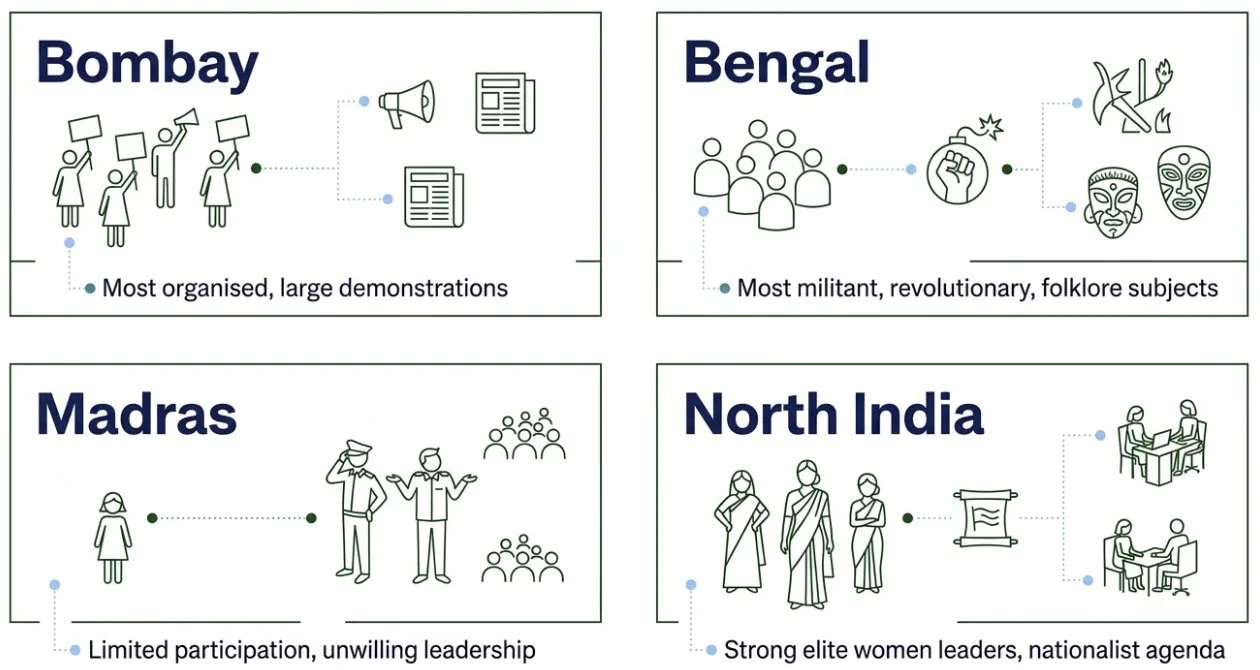
The movement showed distinct regional patterns. It was most organised in Bombay, most militant in Bengal, and limited in Madras. In North India, in cities like Allahabad, Lucknow, Delhi, and Lahore, hundreds of women from respectable families shocked their conservative menfolk by openly participating in nationalist demonstrations. Kamladevi Chattopadhyay and Krishnabai Rau played important roles, while Usha Mehta joined the Vanar Sena (Monkey Army). In Bengal, some women moved beyond protest into violent revolutionary action — unlike the Swadeshi period, they were now actually firing pistols at magistrates and governors.
Bombay
Best organised, most independent, largest demonstrations. Feminist nationalism articulated clearly. Women picketed, sold salt, and conducted door-to-door khadar sales. High media visibility.
Bengal
Most militant. Women marched alongside men and joined revolutionary parties. Peaceful demonstrations fewer but powerful; girl students recruited actively. Society still widely practised purdah.
Madras
Limited participation — leaders were reluctant to use women's talent. Fewer women joined the movement. A lost opportunity for the nationalist cause in the south.
North India
Nehru and Zutshi families provided strong women leaders. Hundreds from respectable families openly defied conservative menfolk to join demonstrations in Allahabad, Lucknow, Delhi, and Lahore.
Two exceptional figures stand out from the Civil Disobedience period. Rani Gaidinliu, a follower of Gandhi, launched a movement against the British at the age of sixteen in the Manipur and Naga belts. She was arrested in 1932 and sentenced to life imprisonment; Jawaharlal Nehru met her at Shillong Jail in 1937 and gave her the title "Rani," pledging to pursue her release. She was finally freed in 1947. Aruna Asaf Ali courted arrest by offering individual satyagraha in 1941, while Sucheta Kripalani played a role in individual satyagraha in 1940, was imprisoned for two years, later became a member of the Constituent Assembly, and in 1947 joined Gandhi in pacifying communal violence in Bengal.
Chapter 10
Quit India Movement (1942): Women Lead from the Front
The Quit India Movement of August 1942 represented the most dramatic moment of women's leadership in the entire colonial period. At the very outset, nearly all the front-ranking male Congress leaders were arrested and imprisoned. In a contingency that their male counterparts had not planned for, prominent women leaders took upon themselves the responsibility of coordinating the movement in the face of unprecedented police repression. Sucheta Kripalanicoordinated non-violent resistance, while Aruna Asaf Ali gave leadership to underground revolutionary activities — and this she did by politely turning down Gandhi's advice to surrender, an act of remarkable individual courage.
Usha Mehta — Voice of India
Organised the Congress Radio under the name Voice of India, broadcasting until November 1942. She played a vital role in keeping the underground movement connected and inspired during the worst phase of repression.
Matangini Hazra — Tamluk's Martyr
A 73-year-old widow who showed extraordinary valour at Tamluk in Bengal during the Quit India agitation, becoming one of the movement's most celebrated martyrs.
Bhogeswari Phuakanii — Assam's Sacrifice
A woman martyr of the 1942 movement, hailing from Nagaon District of Assam. Her sacrifice symbolised the reach of the Quit India Movement into rural northeastern India.
Kanak Lata Barua — Assam's Flag Bearer
Shot while attempting to hoist the national flag in Assam during the Quit India Movement. Her death became a rallying point for the movement across the northeast.
The most important aspect of the Quit India Movement, from the perspective of women's history, was the participation of a large number of rural women acting on their own initiative to liberate their country. This engagement of rural women was further expanded after the lifting of the ban on the Communist Party in 1942. Women from Kerala — A.V. Kutimalu Amma, Akkamma Cheriyan, Mettilda Kallan, Kamalam, Annie Mascreen, Karthyayani Amma, and Kochukutty Amma — were among the more important women leaders in the Travancore, Kochi, and Malabar regions. Back in the 1920s and 1930s, many middle-class educated women had joined the communist movement; by 1941, the girls' wing of the All-India Students Federation had approximately fifty thousand members.
Chapter 11
The Indian National Army and the Rani of Jhansi Regiment
One of the most remarkable experiments in women's military participation in Indian history was initiated by Subhas Chandra Bose within the Indian National Army (INA). Back in 1928, Bose had been instrumental in raising, under the leadership of "Colonel" Latika Ghosh, a Congress women's volunteer corps that marched on the streets of Calcutta in full uniform. When in 1943 he raised an expatriate army in Southeast Asia, he decided to add a women's regiment — which he named, with characteristic symbolism, the Rani of Jhansi Regiment.
In October 1943, the training camp was opened for the new regiment. Approximately fifteen hundred women from elite as well as working-class Indian families of all religions and castes living in Southeast Asia joined the regiment. They were given full military training and prepared for combat duties. When at the initial stages they were assigned non-combat roles, the ranis protested to their leader and were later engaged in actual war operations in the Imphal campaign of 1945. The campaign went seriously wrong and put an end to the whole experiment, as the INA had to retreat before the advancing British army.
"It was a significant enlargement of women's role in nationalist politics — from the passive role model of mythic Sita to the heroic activism of historic Rani of Jhansi fighting as comrade-in-arms with male soldiers."
Ideologically, even this experiment was not entirely a radical departure. Bose too believed in and sought to invoke the "spiritual power" of the "mothers and sisters" of India. But the symbolic shift was nonetheless significant: the regiment's very name — invoking the Rani of Jhansi's historical resistance — proposed a model of active heroism rather than passive suffering. Dr. Lakshmi Swaminathan headed the Department of Women's Affairs under the provisional INA government and took charge of the regiment, while Janaki Davar was another important woman associated with the movement. The INA experiment remains a complex and contested episode, combining genuine innovation in women's military roles with the persistence of older ideological frameworks about femininity and sacrifice.
Chapter 12
Tebhaga, Telengana, and Communist Women's Movements
The final years of the colonial period saw women's activism expand into new class-based arenas through the communist movement. The Tebhaga movement of 1946 in Bengal, led by communist-led kisan sabhas with the sharecroppers' demand for two-thirds of the produce, witnessed widespread autonomous action of "proletariat and semi-proletariat women" belonging to Dalit and tribal communities. Through their own initiative, they formed Nari Bahinis — women's brigades — and resisted the colonial police with whatever weapons they could lay their hands on. In the unequal contest that followed, a number of them became martyrs.
In 1942, some leftist women leaders in Bengal organised a Mahila Atmaraksha Samiti (Women's Self-Defence League), mobilised rural women through it, and conducted relief work during the devastating Bengal Famine of 1943. The Communist Party made special efforts to mobilise women, recognising that without their support the movement could not sustain itself. Yet even within the communist movement, the persistence of patriarchal assumptions was striking. The party leadership preferred only supportive and secondary roles for women and could not envision women outside the conventional structures of gender relations — family and marriage. Women were considered to be sources of problems when it came to maintaining sexual morality and discipline within the ranks.
The Telengana movement, which continued from 1946 to 1951 against the Nizam of Hyderabad and feudal oppression, saw women fight side by side with men for better wages, fair rent, and greater dignity. The movement created a new space for peasant women's militant action. Most women joined on their own, acted as couriers of secret messages, arranged shelter, and a few took up guns and became participating members of the dalams (revolutionary units). But if the boundaries between men's and women's roles were blurred during militant action, they were quickly re-established afterwards. Women who came out of their homes because the movement promised them equality soon found that the metaphor of family was being continually emphasised by a communist leadership that preferred to keep women within their traditional domestic boundaries.
Tebhaga (1946) — Bengal
Dalit and tribal women formed Nari Bahinis (women's brigades). Autonomous action unprecedented for peasant women. Several became martyrs; Mahila Atmaraksha Samiti mobilised rural women during 1943 Famine.
Telengana (1946–51) — Andhra
Women fought alongside men against Nizam and feudal oppression. Acted as couriers, arranged shelter, some took up arms in dalams. Party leadership still confined women to supportive roles after the movement.
The Structural Limit
In both movements: "If the boundaries were blurred in course of militant action, they were re-established quickly afterwards without failure." Communist patriarchy proved as persistent as its nationalist equivalent.
Chapter 13
Muslim Women and the Pakistan Movement
The emergence of the Pakistan movement in the 1940s opened up for Muslim women of the subcontinent a new, if fraught, space for political action. Through the 1930s, Muslim women had been participating in a united front with their Hindu sisters to claim women's rights — including female suffrage and legal reform. The division appeared in 1935 on the charged issue of reservation of women's seats on a communal basis. Some Muslim leaders of the All India Women's Conference, such as Begam Shah Nawaz, refused to "accept joint electorates when their men were not prepared to do so." Broader political alignments — in other words, men's politics — had thus decisively influenced women's movements.
The Muslim League started a women's sub-committee in 1938 to involve Muslim women more systematically. As the Pakistan movement grew in momentum, more and more of them were drawn into it — as election candidates, as voters, and as active demonstrators in street politics, particularly in Punjab and the North-West Frontier Province. Many of them were ordinary women for whom this political participation was itself a "liberating experience." Yet the moment of emancipation proved tragically short-lived — too brief to bring any actual change in their daily existence.
The central contradiction: Muslim women "did not use the occasions to raise issues that affected them as women." Their own goals were subordinated to those of national liberation and community honour — a pattern identical to that of their Hindu counterparts in the Congress. In both cases, the nationalist or communal project swallowed the feminist one.
The Partition of 1947 brought the worst moment for subcontinental womanhood, both Hindu and Muslim. Partition violence transformed women into the objects of male construction of community honour. Women's sexuality became the territory to be conquered or destroyed. They were caught in what historians have described as a "continuum of violence," facing the choice either of being raped, mutilated, and humiliated by men of the "other" community, or of committing suicide — instigated by their own family members and kinsmen — to prevent the honour of the community from being violated. The nationalist and communal movements that had mobilised women for public political action thus culminated, in their final moment, in the most extreme possible reassertion of patriarchal control over women's bodies.
Chapter 14
Women's Organisations: Building an Institutional Foundation
Women's participation in Indian public life was organised and sustained through a network of women's organisations that grew in number and ambition across the early twentieth century. These bodies constituted what historians have called an "extended female space" — somewhere between the segregated family household and the wider public arena. They ranged from local social organisations and girls' educational institutions to explicitly political bodies that lobbied governments and addressed mass meetings.
1904 — Bharat Mahila Parishad
Women's wing of the Indian National Social Conference (founded by M.G. Ranade). Organised women's conferences in 1909 and 1910 (Allahabad).
1909 — Bharat Stri Mahamandal
Founded by Saraladevi Choudhurani in Allahabad. Opened branches across India to promote women's education. First meeting 1910.
1914 — All India Muslim Ladies Conference
First major organisation to address Muslim women's issues at an all-India level.
1916 — Lady Hardinge Medical College
Founded to open professional medical education to women. A landmark in the expansion of women's access to higher education.
1917 — Women's Indian Association (WIA)
Founded in Madras by Margaret Cousins, Annie Besant, and others. Published journal Stri Dharma. Focused on religion, politics, education, and philanthropy.
1925 — National Council of Women in India
Formed as a branch of the International Council of Women. Lady Mehribai Tata was its main spirit in the early years.
1926–27 — All India Women's Conference (AIWC)
Founded at Poona with Margaret Cousins as inspirational figure. Initially focused on women's education; grew into the most important women's organisation of the pre-1947 era. Published journal Roshni.
1928 — Mahila Rashtriya Sangh
Founded by Latika Ghosh with the support of Subhas Chandra Bose. A more radical political organisation focused on women's active role in the nationalist struggle.
At the provincial level, significant organisations emerged in Bengal during the 1920s. The Bangiya Nari Samajcampaigned for women's voting rights; the Bengal Women's Education League demanded compulsory elementary and secondary education for women; and the All-Bengal Women's Union campaigned for legislation against illicit trafficking of women. These organisations, however, typically petitioned governments and appealed to nationalists rather than mobilising mass agitations — a strategic choice that reflected both the social constraints on their members and their own faith in reformist constitutionalism. The government intervened reluctantly, if at all, believing that the majority of Indian women were not yet ready to use their rights properly — a deeply condescending assessment that nonetheless shaped policy for decades.
Chapter 15
Legislative Reforms and Their Limits
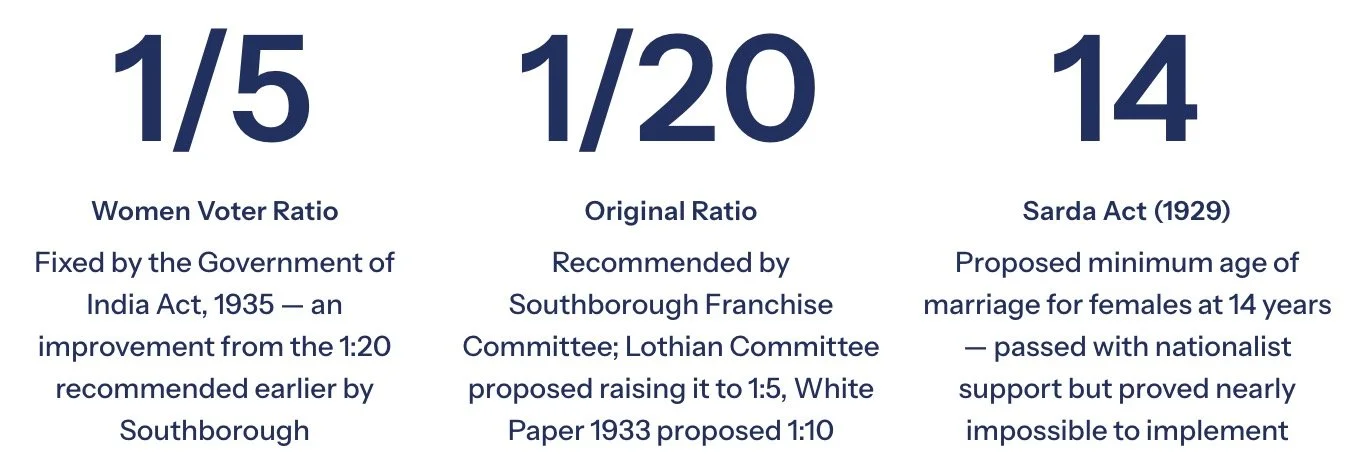
The period between 1919 and 1935 saw a series of legislative measures that formally extended rights to women, but whose actual implementation proved deeply problematic. The Government of India Act of 1919 had left the women's franchise question to provincial legislatures; between 1921 and 1930, all the provinces granted voting rights to women, subject to the usual property and educational qualifications. The Government of India Act of 1935 increased the ratio of female voters to 1:5 and gave women reserved seats in legislatures — a provision that the Congress and women's organisations accepted grudgingly, having preferred universal adult franchise.
Women in Indian National Movement
Unlike the Age of Consent Bill of 1891, the Child Marriage Restraint Act (Sarda Act) of 1929, which proposed fixing the minimum age of marriage for females at fourteen and males at eighteen, was passed with overwhelming nationalist support. In the central and provincial legislatures, a whole range of bills was passed in the 1930s to define women's right to property, inheritance, and divorce, and to restrain dowry and control prostitution. But did all these legislative changes actually improve gender relations and the quality of life for Indian women? If the Sarda Act is taken as a test case, the answer is sobering: both the government and the nationalists soon found it impossible to implement, and before long the Act was effectively dead for all practical purposes.
The elections of 1937 did produce a cohort of women in significant positions: Vijayalakshmi Pandit became a Minister in United Provinces; Anasuyabai Kale served as Deputy Speaker in Central Provinces; Sippi Milani as Deputy Speaker in Sind; Qudsia Aizaz Rasul as Deputy Speaker of UP; Begum Shah Nawaz as Parliamentary Secretary in Punjab; and Hansa Mehta as Parliamentary Secretary of Bombay. These appointments were historic — but they remained exceptions in an overwhelmingly male political world. The Congress and its leaders, as the evidence consistently shows, were not genuinely interested in women's issues and, except for allowing some symbolic presence, never included women in any real decision-making process.
Chapter 16
Regional Differences and the Question of Representation
Women's participation in the nationalist movement was not uniform across India's vast and diverse landscape. Distinct regional differences existed in the number of women who joined, in their relationship with Congress leaders, and in the extent to which they synthesised women's interests with nationalist issues. These regional patterns reveal much about the social and political conditions that either facilitated or constrained women's political action.
Bombay women were the best organised, the most independent, and fielded the largest demonstrations. Most of their leaders also belonged to women's organisations and articulated a clearly feminist nationalism. Women participated extensively in picketings and demonstrations in the 1930s, attracting high media attention. The fervour spread, and women in large numbers sold salt in the streets, made propaganda for swadeshi, and took up door-to-door selling of khadar. In Bengal, women attracted enormous attention because of their militancy — marching alongside men in Congress parades and later joining revolutionary parties, they became the subjects of folksongs and legends. Their peaceful demonstrations were fewer but powerful in a society where purdah was widely practised.
In Madras, leaders were unwilling to use women's talent, and fewer women joined the movement. This stands in contrast to the remarkable record of Madras in formal political firsts — including Muthulakshmi Reddy's pioneering legislative appointment — suggesting a gap between elite appointments and mass mobilisation. In North India, the Nehru and Zutshi families provided strong women leaders who nonetheless tended to put the nationalist agenda first. Rural women's participation remained limited throughout most of India, except during the Quit India Movement, when rural women began acting on their own initiative in unprecedented numbers.
Women in Indian National Movement: Regional Differences and the Question of Representation
Women who demonstrated claimed to represent all Indian women — but the groups involved, other than upper- and middle-class Hindu women, were never large. A few Muslim women were steadfast followers of Gandhi; many more either found it difficult to accept the overtly Hindu ideological basis of his ideas or were neglected by Congress organisers. Women marched and picketed in sex-segregated groups, usually wearing distinctive orange or white saris to emphasise their purity and sacrifice. Their directives came from Congress committees. Rural women, unless they were widows, protested with their families. Male guardianship prevailed even though the Indian freedom movement was not, in formal terms, characterised by patriarchal nationalism.
Chapter 17
Did Political Activism Generate Feminist Consciousness?
This is the central analytical question that historians of women's history in colonial India have grappled with most intensely. The demonstrations organised by women in cities did little to generate a feminist consciousness in the wider society. So far as the mass of Indian women was concerned, the answer must be: no. But for those women who actually participated in the nationalist struggle, and for their more enlightened middle-class women leaders, the experience could perhaps never leave them entirely unchanged.
A burgeoning women's literature of this period indicates that the private/public dichotomy was increasingly being blurred in the consciousness of educated women, and that they were growing resentful of the existing gender asymmetry in their society. Yet despite such contestations and "transgressions of 'desirable' codes," these middle-class/high-caste women also broadly consented to the "hegemonic aspirations of the nationalist patriarchy." Among Muslim women too, there was the rise of a new "feminist" Urdu literature in the early twentieth century that contested traditional boundaries and ideologies of gender relations — but it too refrained from advocating dramatic change and privileged the image of the Muslim community over all else.
"Such 'strong traditionalist moorings' explain why this politicisation was possible and why it failed to promote to any significant extent the social emancipation of women in India."
— Tanika Sarkar
The more nuanced argument, advanced by scholars like Sujata Patel, is that it is difficult to separate analytically which came first — women's participation or Gandhi's advocacy. Some women were slowly pushing the boundaries of their autonomy by manipulating available cultural metaphors. Bi Amman, the elderly mother of Shaukat and Muhammad Ali, participated in the Khilafat Non-Cooperation movement after a whole life behind purdah. At a mass meeting in Punjab, she lifted her veil and addressed the crowd as her children — incorporating the whole nation into her "extended fictive family." Her rhetoric did not subvert the ideology of purdah; her practice effectively extended its boundary. And it is highly unlikely that all the thousands of women who participated in the Civil Disobedience Movement had secured their guardians' prior permission. Once mobilised, as historical evidence repeatedly shows, women moved on their own — and time and again they disobeyed Gandhian injunctions that sought to set limits to their activism.
What Changed
Hundreds of women from respectable families marching in public, going to jail, and returning with no stigma attached. A remarkable shift in Indian social attitudes — the public sphere was no longer exclusively male territory.
What Did Not Change
Domestic and family relations remained largely undisturbed. Politicisation was not accompanied by feminist consciousness for the mass of participants. The Congress never genuinely included women in decision-making.
The Structural Explanation
Women participated largely because their male guardians wanted them to. Their public roles were extensions of domestic roles. The framework of "social feminist ideology" recognised some public role while accepting fundamental biological and social difference between sexes.
Chapter 18
Appointments After 1937 Elections and Women's Legislative Careers
The elections of 1937, held under the Government of India Act of 1935, marked a watershed in women's formal representation in Indian legislatures. Reserved seats and the expanded franchise enabled a cohort of women to launch their legislative careers — though the numbers remained small and their influence within the Congress limited. These appointments were historic firsts and signalled to Indian society that women could occupy positions of governmental authority, not merely of symbolic presence.
Vijayalakshmi Pandit
Minister in United Provinces (UP) — the first woman to hold a ministerial portfolio in India. Her appointment was a landmark in Indian political history.
Anasuyabai Kale
Deputy Speaker in Central Provinces (CP) — one of the earliest women to hold a position of legislative authority.
Sippi Milani
Deputy Speaker in Sind — represented the spread of women's legislative presence to the northwestern provinces.
Qudsia Aizaz Rasul
Deputy Speaker of UP — a Muslim woman in a position of legislative authority, significant for communal representation.
Begum Shah Nawaz
Parliamentary Secretary in Punjab — had earlier served as a women's representative at the Round Table Conferences.
Hansa Mehta
Parliamentary Secretary of Bombay — also a leading figure in the All India Women's Conference and later a member of the Constituent Assembly.
The Congress and the women's organisations had not liked the idea of reserved seats, having preferred universal adult franchise. However, once provided, they accepted the reservation, and it did help a number of women launch legislative careers after 1937. The broader pattern that these appointments reveal is one of selective, tokenistic inclusion — women were brought into the formal political structure at moments when their presence served Congress's legitimacy, but they were rarely given meaningful decision-making authority. The gap between symbolic representation and substantive power remained wide, and would continue to define women's political experience well into the post-Independence era.
Legacies, Contradictions, and Unfinished Business
The period from 1885 to 1947 witnessed a remarkable transformation in Indian women's public presence — and a persistent failure to translate that presence into genuine emancipation. Women entered the streets, the legislatures, the revolutionary underground, and even the battlefield. They built organisations, published journals, petitioned governments, and marched to jail. By any measure, the scale of women's political participation had been transformed beyond recognition from the tentative appearance of six delegates at the 1889 Congress session to the tens of thousands who joined the Quit India Movement half a century later.
Yet the contradictions are equally striking. The concept of feminism itself created confusion throughout this period — it was either considered a Western import subversive of Indian cultural essence or an undesirable digression from the more important cause of freedom. Leading nationalists like Jawaharlal Nehru believed that once political freedom was achieved, the women's question would resolve itself automatically — a confidence that subsequent history would prove entirely misplaced. The Congress and its leaders were not genuinely interested in women's issues and, except for allowing some symbolic presence, never included women in any real decision-making process.
Mobilisation
Women called into public action by nationalist, communist, or communal movements — always in the service of a larger cause
Domestication
Once the crisis passed, boundaries were re-established. Public roles framed as extensions of domestic virtue — wife, mother, sister
Subordination
Women's specific interests subordinated to national liberation, community honour, or class struggle — by leaders across all ideological persuasions
Contestation
A growing feminist literature, women's organisations, and individual acts of defiance — pushing boundaries even within inherited ideological frameworks
Partition violence brought the worst moment for subcontinental womanhood, as women's bodies became the territory on which community honour was inscribed and contested. The horrific violence of 1947 revealed, with brutal clarity, that decades of political mobilisation had not fundamentally altered the patriarchal conception of women as bearers of community honour rather than as autonomous individuals with rights of their own. But that does not mean that no woman ever dreamed of freedom in a way contrary to the dominant patriarchal convention upheld by their nationalist leaders, community elders, or party bosses. Hundreds of women marching in files on the streets of India, going to jails, suffering indignity there, and returning to their families with no stigma attached — this, as Sujata Patel has noted, signified a remarkable change in Indian social attitudes. The story of women in Indian politics between 1885 and 1947 is, ultimately, one of possibilities glimpsed, boundaries pushed, and struggles that — far from being resolved by Independence — would have to be renewed, on new terrain, in the decades that followed.
Key Scholars : Jasodhara Bagchi (ideology of motherhood), Tanika Sarkar (traditionalist moorings and politicisation), Sujata Patel (Gandhi and womanhood).
Key Legislative Milestones: Government of India Act 1919, Sarda Act 1929, Government of India Act 1935.
Key Organisations: All India Women's Conference (1926–27), Women's Indian Association (1917), Mahila Rashtriya Sangh (1928), Nari Bahini, Mahila Atmaraksha Samiti.
