
The Election of 1937 and the Congress Ministries
The provincial elections of 1936–37 marked a decisive turning point in India's freedom struggle. The Indian National Congress, wrestling with internal divisions over whether to contest elections under the Government of India Act of 1935, ultimately chose to participate — and won a spectacular victory. What followed was a complex, two-year experiment in governing under colonial constraints, testing the Congress's capacity to balance mass politics with administrative responsibility, and revealing the tensions between its left and right wings, its labour and peasant bases, and its relationship with the Muslim League.
The Congress in Crisis: Post-CDM Dissensions
The collapse of the Civil Disobedience Movement around 1934 left the Indian National Congress deeply divided — just as the withdrawal of the Non-Cooperation Movement had done a decade earlier. With Gandhi temporarily stepping back from active politics, the ideological vacuum within the Congress began to be filled by competing factions, each with a distinct vision of India's future and the path to achieving it.
The Left Wing
In May 1934, socialists and other leftist elements formed the Congress Socialist Party (CSP) within the Congress. Their ideology ranged from vague radical nationalism to a fairly firm advocacy of Marxian Scientific Socialism. Nehru never formally joined the group, yet remained broadly sympathetic to its goals.
Demanded a more confrontational approach to imperialism
Opposed any form of constitutional collaboration with the British
Pushed for greater integration of workers and peasants into the Congress
The Right Wing
Led by stalwarts like Rajendra Prasad and Vallabhbhai Patel, with Gandhi's quiet endorsement, the right wing favoured pragmatic engagement with constitutional reforms as a short-term tactic — not as an end in itself.
Believed contesting elections would boost Congress's flagging morale
Argued that direct action was not a viable option at the time
Supported a strategy of mass politics combined with legislative work
The rift came to a head around two central questions: Council Entry and Office Acceptance. Though the Lucknow Congress of 1936 brought the two wings to the brink of a split, mutual respect for the anti-imperialist cause — and the awareness that a formal division would damage the movement — kept the party together.
The Road to Contesting: Lucknow, Faizpur, and Bombay
The Congress arrived at its decision to contest the 1937 elections through a sequence of deliberations spread over two landmark sessions. These were not merely organisational exercises — they were pitched ideological battles that shaped the character of the nationalist movement for years to come.
Lucknow Congress, Early 1936
Majority of delegates, led by Rajendra Prasad and Patel with Gandhi's blessing, concluded that contesting elections under the Act of 1935 would help boost the flagging morale of the Congress at a time when direct action was not an option. Decision on office acceptance was postponed.
Faizpur Congress, Late 1936
The second session reaffirmed the decision to fight elections. The party committed to engaging the electorate across all eleven provinces while continuing to defer the contentious question of whether to accept ministerial office once results were in.
AICC Bombay Meeting, August 1936
The All India Congress Committee formally decided in favour of contesting the elections but deliberately postponed the office acceptance question until after the electoral outcome was known, allowing the Congress to campaign without a binding commitment.
Crucially, while the federal provisions of the Government of India Act, 1935 were never implemented, provincial autonomy came into operation from 1937. Though the reforms fell far short of India's aspirations, the Congress calculated that participation would extend its influence, deepen its roots among newly enfranchised voters, and demonstrate its capacity to govern. Business interests — even sceptics like Mody — drifted closer to the nationalists in this period, though the party remained far from under capitalist domination.
The 1937 Provincial Elections: Scale, Scope, and Mandate
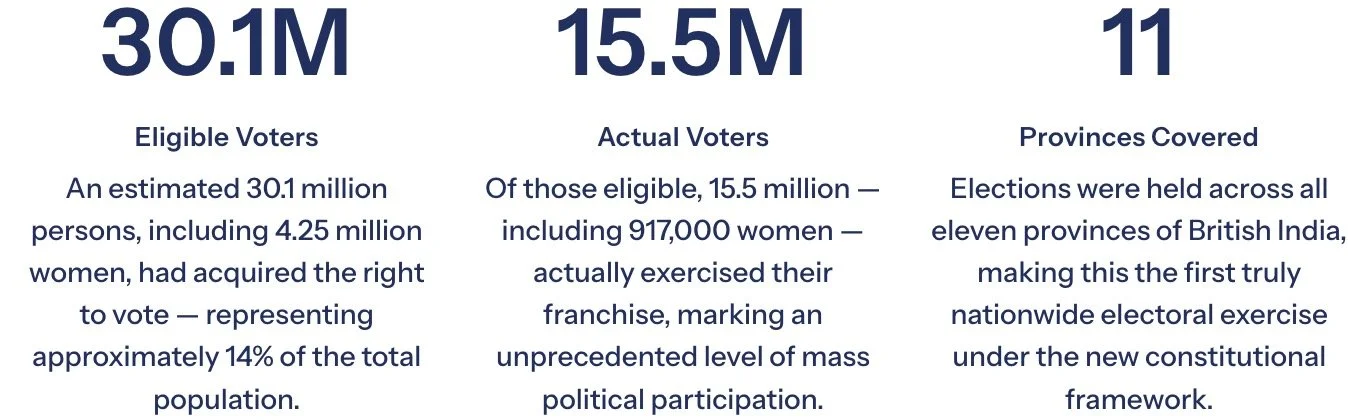
The provincial elections held in the winter of 1936–37 were the most expansive democratic exercise India had witnessed until that point. Mandated by the Government of India Act, 1935, they spanned eleven provinces across British India — Madras, Central Provinces, Bihar, Orissa, United Provinces, Bombay Presidency, Assam, NWFP, Bengal, Punjab, and Sindh.
The Election of 1937 and the Congress Ministries
The Congress election manifesto was bold and wide-ranging. It reaffirmed the party's total rejection of the 1935 Act as a substitute for genuine self-government, while simultaneously promising a package of concrete reforms: the restoration of civil liberties, release of political prisoners, removal of disabilities based on sex and untouchability, radical transformation of the agrarian system, substantial reduction in rent and revenue, scaling down of rural debt, provision of cheap credit, and the right to form trade unions and strike. The campaign generated massive public enthusiasm and reawakened the political consciousness that had lain dormant since the end of the Civil Disobedience Movement.
Election Results: A Congress Triumph
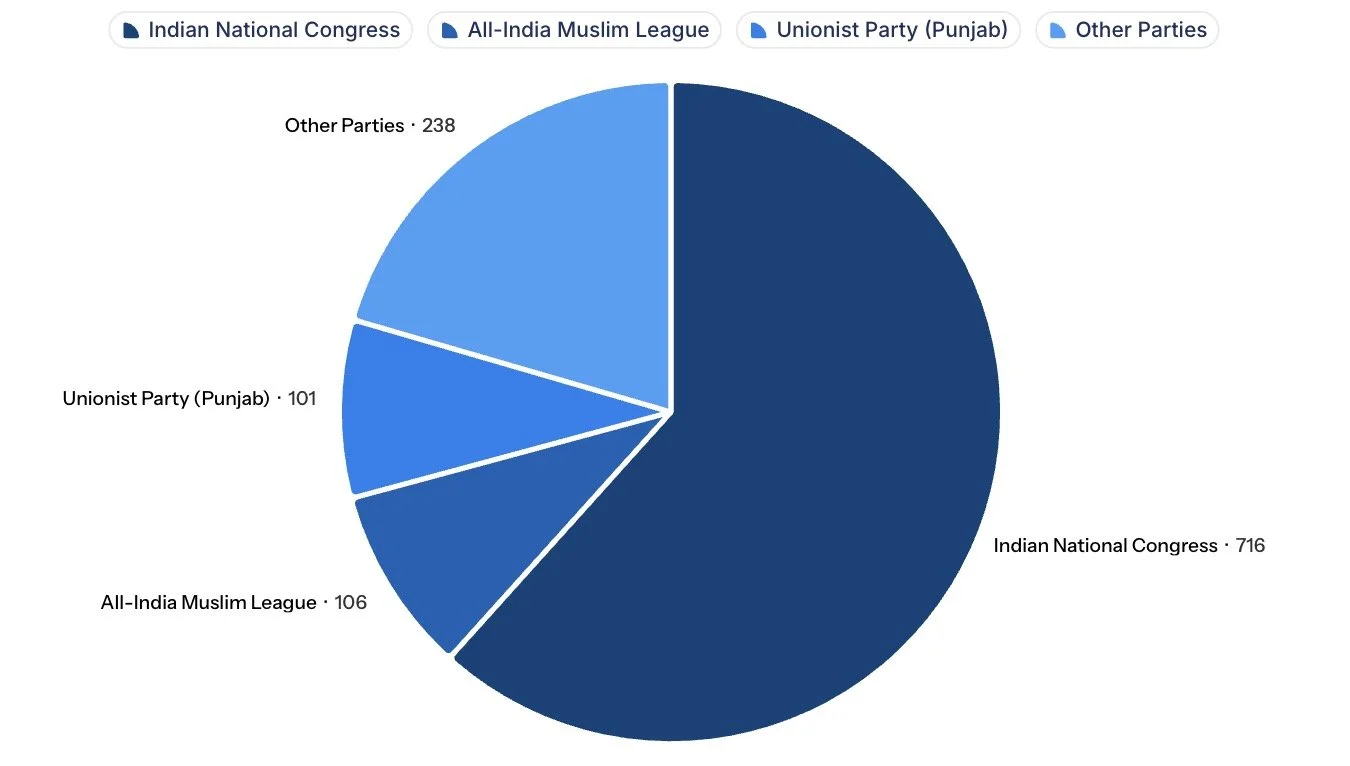
The results were a resounding vindication of the Congress's decision to contest. The party won an overwhelming mandate in the majority of provinces, dramatically altering the political landscape and exposing the weakness of its rivals — most notably the Muslim League.
The Election of 1937 and the Congress Ministries
Key Outcomes
Congress won 716 out of 1,161 seats it contested
Clear majority in most provinces; largest single party in Bengal, Assam, and NWFP
Won 617 of 739 seats in "general" constituencies
Won 25 of 59 Muslim-reserved seats it contested, including 15 in NWFP
Won only 73 of 151 reserved seats for the Depressed Classes
Muslim League fared badly even in Muslim-majority provinces
After the election, Jinnah offered coalition governments — but insisted Congress nominate no Muslims, claiming exclusive representation of Indian Muslims. Congress declined.
Ideological Battle
The Office Acceptance Debate: Arguments For and Against
The question of whether Congress should accept ministerial office under the 1935 Act was one of the most consequential debates in the history of the nationalist movement. It divided the Congress along ideological, strategic, and temperamental lines.
Against Office Acceptance
Led by: Nehru, Subhas Bose, Congress Socialists, Communists
Accepting office would "negate our rejection of the 1935 Act" — assuming responsibility without power
Congress would become a partner in the repressive apparatus of imperialism
Office acceptance would strip the movement of its revolutionary character acquired since 1919
The Congress would get sucked into parliamentary activity and forget freedom, economic justice, and removal of poverty
It would fall into "a pit from which it would be difficult for us to come out"
Counter-strategy: enter assemblies to create deadlocks; long-term reliance on workers and peasants
For Office Acceptance
Led by: Rajendra Prasad, Patel, Rajagopalachari — endorsed by Gandhi
The option of mass movement was not available at the time; a constitutional phase was necessary
Congress should combine mass politics with legislative work to alter an unfavourable political situation
The administrative field should not be left to pro-Government forces who would weaken nationalism and encourage communal politics
Provincial ministries could promote constructive work — Harijan uplift, khadi, education, debt reduction
As Vishwanathan argued: "Do not look upon ministries as offices, but as centres and fortresses from which British imperialism is radiated."
Gandhi, in one of his characteristic compromise positions, ultimately endorsed office acceptance while reposing his faith in non-violence and constructive work outside the legislatures. The AICC sanctioned office acceptance by overriding the objections of Nehru and other CSP leaders. Nehru's opposition rested on the argument that running provincial governments would make the Congress responsible for "keeping the imperialist structure functioning" — within a few years, he was to be proved prophetic.
Formation of Congress Ministries: A Province-by-Province Account
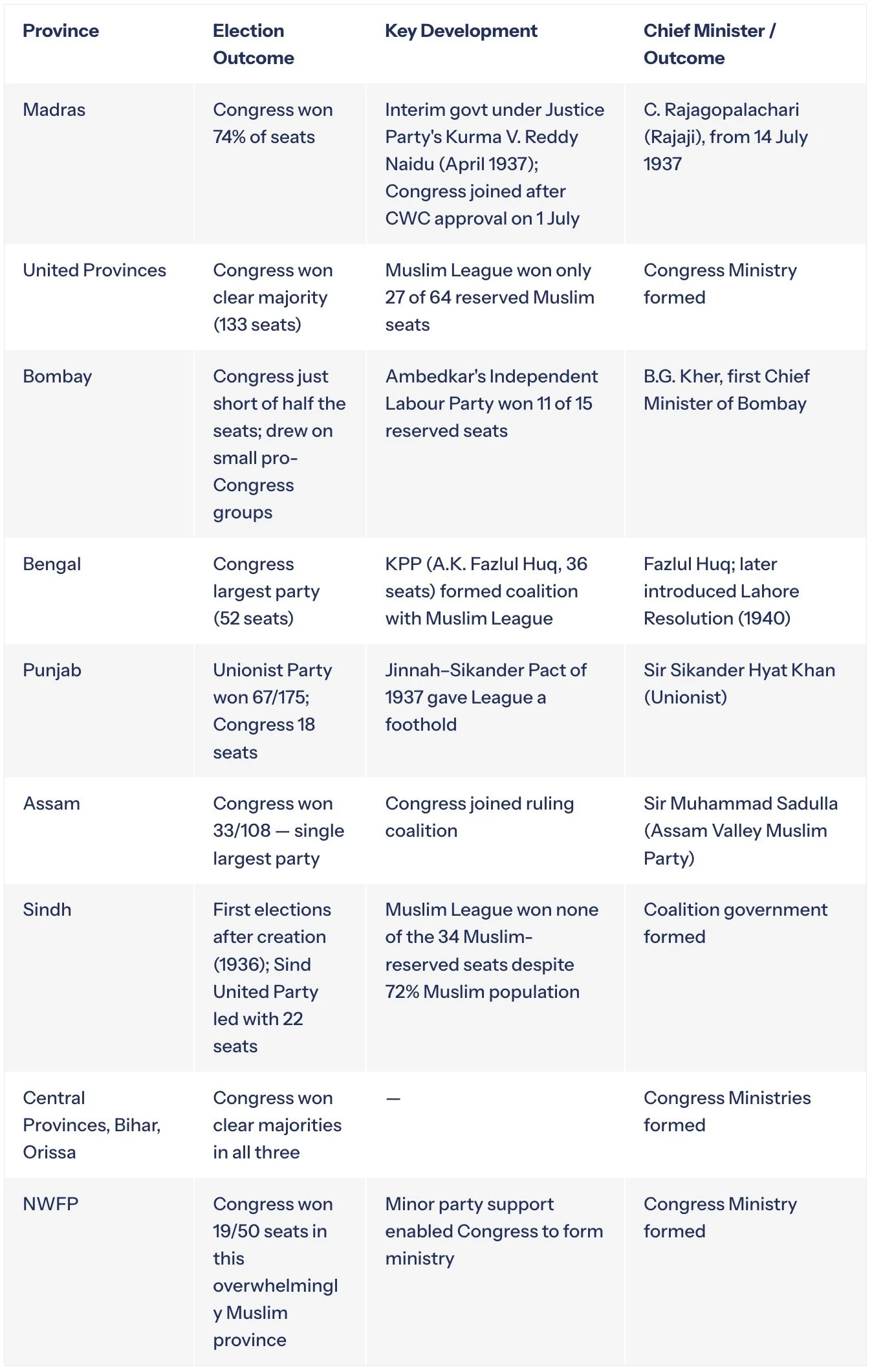
Congress Ministries were formed in 8 out of 11 provinces of India in 1937. To coordinate their activities and ensure that British hopes of "provincialising" the Congress did not materialise, a central control body — the Parliamentary Sub-Committee — was formed, with Sardar Patel, Maulana Abul Kalam Azad, and Rajendra Prasad as members. As Gandhi wrote in Harijan on 7 August 1937: "These offices have to be held lightly, not tightly. They are or should be crowns of thorns, never of renown."
Formation of Congress Ministries: A Province-by-Province Account
Governance Record
Work of the Congress Ministries: Political Reforms
The Congress Ministries — in power for two years and four months — moved with remarkable speed to dismantle the repressive apparatus of colonial governance in the provinces they controlled. Their work in the political domain was perhaps the most immediately visible and dramatically felt by ordinary Indians.
Civil Liberties Restored
All emergency powers acquired during 1932 through Public Safety Acts were repealed. Bans on political organisations such as the Hindustan Seva Dal and Youth Leagues were lifted. All restrictions on the press were removed, securities taken from newspapers were refunded, and pending prosecutions were withdrawn. Confiscated arms were returned and forfeited licences restored.
Police Powers Curbed
In Congress provinces, police powers were significantly curtailed. The reporting of public speeches and the shadowing of political workers by CID agents was stopped. Gandhi had written that "the triumph of the Congress will be measured by the success it achieves in rendering the police and military practically idle."
Political Prisoners Released
One of the first acts of Congress Governments was to release thousands of political prisoners and detenus and cancel internment and deportation orders. Many revolutionaries from the Kakori and other conspiracy cases were freed. In U.P. and Bihar, ministries even threatened resignation to secure the release of prisoners whose release required Governor's consent — and won.
Blemishes on the record: In Madras, two socialist Congress leaders — Yusuf Meherally and S.S. Batliwala — were prosecuted for inflammatory and seditious speeches. In Bombay, Home Minister K.M. Munshi used the CID to watch Communists and left-wing Congressmen, earning a sharp rebuke from Nehru. These exceptions, however, must be seen against the vast overall expansion of civil liberties.
Agrarian Reforms: Promise, Constraint, and Partial Achievement
The agrarian question was at the heart of Congress's electoral mandate. The party had promised radical transformation of the land system — yet the reality of governing under the 1935 Act imposed severe structural constraints that forced it to settle for incremental reform rather than systemic overhaul.
Why a Complete Overhaul Was Not Possible
Provincial Ministries lacked constitutional powers for complete zamindari abolition
Extreme shortage of financial resources — lion's share of revenues went to the Government of India
Reactionary second chambers (Legislative Councils) dominated by landlords, capitalists, and moneylenders
Multi-class coalition strategy required balancing competing class interests
Severe time constraint — Congress knew ministries would not last long
Agrarian structure was centuries-old, complex, and poorly documented
What Was Achieved
Tenancy Bills passed in U.P., Bihar, and Orissa — giving multiple rights to tenants and placing restrictions on zamindars
Security of tenure extended to tenants in Bombay, Central Provinces, and NWFP
Debtors' Relief Acts passed in most provinces (except U.P. and Assam) — cancelling or drastically reducing accumulated interest
In Bombay, 40,000 tied serfs were liberated and grazing fees in forests were abolished
Grazing fees reduced in Madras
Rural reconstruction programmes initiated across provinces
Limitation: The basic system of landlordism was not affected. Sub-tenants and agricultural labourers — not yet mobilised by kisan sabhas or enfranchised — largely did not benefit.
Labour Policy and Industrial Relations
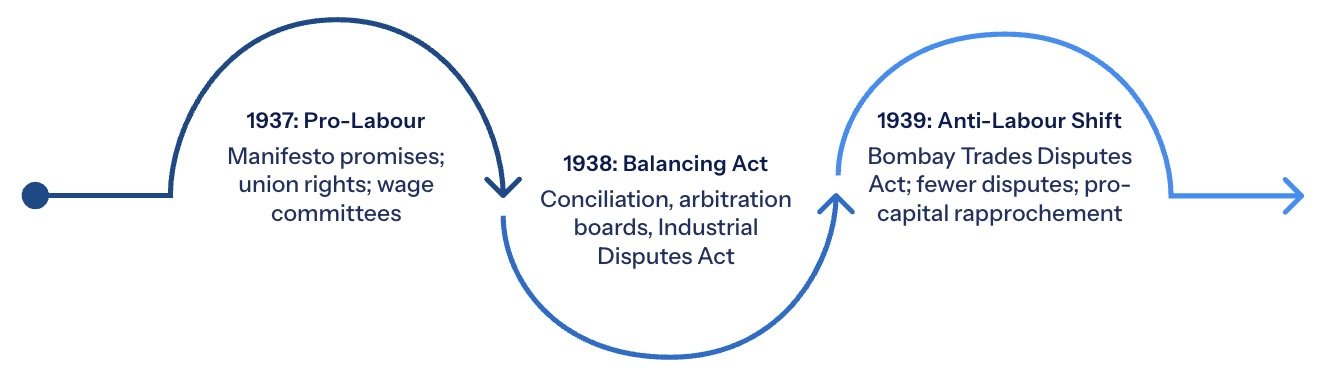
The Congress Ministries inherited contradictory obligations on the labour question: their election manifesto had promised workers the right to organise and strike, yet their dependence on capitalist funding and their multi-class coalition strategy required them to mediate between capital and labour rather than champion one against the other.
The Election of 1937 and the Congress Ministries: Labour Policy and Industrial Relations
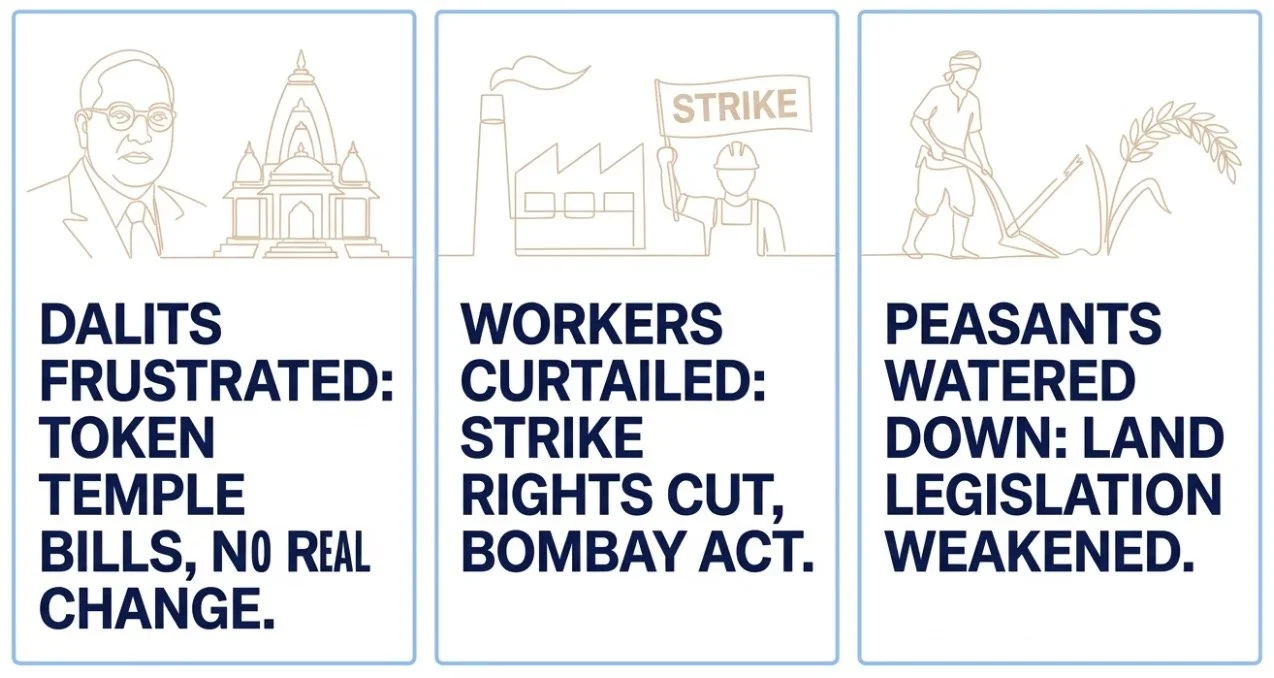
The most consequential legislative act was the Bombay Industrial Disputes Act (November 1938), justified by Premier B.G. Kher as based on "class collaboration and not class conflict." It emphasised conciliation, arbitration, and negotiation over direct action, and was designed to prevent lightning strikes and lockouts — though in practice it tilted heavily in favour of capitalists. All parties except Congress condemned it; its passage was greeted with a general strike in Bombay. Similar pro-arbitration policies were promoted in Madras and U.P., where a Labour Enquiry Committee headed by Rajendra Prasad recommended minimum wages, an arbitration board, maternity benefits, and recognition of the Mazdur Sabha. The Bihar Labour Enquiry Committee, also headed by Prasad, made comparable recommendations in 1938.
Social Reform
Social Legislation: Harijans, Education, and Public Health
The Congress Ministries took their social reform agenda seriously, attempting to fulfil pledges made to some of India's most marginalised communities. While the reforms were significant in scope, their implementation was uneven and critics — especially Dalit leaders — viewed many measures as tokenistic.
Harijan Welfare
Laws enabling Harijans to enter temples
Free access to public offices, wells, ponds, roads, transport, hospitals, educational institutions, restaurants
No court or public authority to recognise customs imposing civil disabilities on Harijans
Increased scholarships and freeships for Harijan students
Efforts to increase Harijan representation in police and government services
Education
Expansion of primary, technical, and higher education
Special focus on education for girls and Harijans
Introduction of basic education emphasising manual and productive work
Mass literacy campaigns organised for adults
Health, Prohibition & Other Reforms
Improved public health and sanitation infrastructure
Prohibition introduced in selected areas across different states
Support and subsidies given to khadi, spinning, and village industries
Prison reform schemes initiated
National Planning Committee appointed in 1938 by Congress President Subhas Bose
Despite these efforts, Dalit leaders were not impressed. The caste disabilities removal and temple-entry bills were seen as token legislative programmes — window dressing that offered nothing substantive to communities that had waited decades for genuine social emancipation. This disillusionment would have long-term consequences for the Congress's relationship with Dalit constituencies.
Tensions
Dilemmas of Governance: Popular Movements vs. Law and Order
The formation of Congress Ministries unleashed popular energies across India. Kisan sabhas sprang up everywhere; trade union membership rose by 50 per cent; student and youth movements revived; left parties expanded manifold. The Communist Party brought out its weekly organ The National Front from Bombay; the CSP published The Congress Socialist. Yet this very explosion of popular assertion created a profound dilemma for the Congress as a governing party.
Could a party which ran a government be simultaneously the organiser of popular movements and the enforcer of law and order?
The contradiction manifested in dramatic episodes. In Bihar, the Kisan Sabha movement came into frontal confrontation with the Congress Ministry when it asked peasants to withhold rent and occupy landlord lands. In Bombay, the AITUC, Communists, and followers of Ambedkar organised a general strike on 7 November 1938 against the Industrial Disputes Act — the police opened fire, killing two and injuring over seventy. In Kanpur, workers struck repeatedly, sometimes violently. The Madras Government used the police to shadow radical Congressmen.
Gandhi's Position
Gandhi opposed militant agitations because their violent character threatened his fundamental strategy of non-violence. Yet he also objected to the frequent use of colonial laws and machinery against popular agitations. He wanted reliance on political education of the masses. He perceived the immense harm to Congress's popular support base — especially workers and peasants — caused by repeated use of force. This was a major reason he began questioning the efficacy of continuing office acceptance.
The Left's Critique
Left parties were highly critical of Congress Governments' handling of popular protest, accusing them of trying to suppress peasants' and workers' organisations. They were particularly outraged by the Bombay Industrial Disputes Act, which they saw as a fundamental betrayal of the working class. Their criticism deepened the internal tensions within the Congress, even as they remained formally within its organisational fold.
Right-Wing Tendency
Right-wing leaders like C. Rajagopalachari and K.M. Munshi did not hesitate to use state apparatus in politically repressive ways. The growing scramble for positions, factional strife, and creeping corruption alarmed Gandhi. He wrote in Harijan: "I would go to the length of giving the whole Congress organisation a decent burial, rather than put up with the corruption that is rampant."
Frustrated Constituencies: Dalits, Workers, and Peasants
The Congress's two-year record of governance disappointed virtually every constituency that had voted for it in the hope of radical change. The gap between electoral promise and administrative delivery was wide — and would have lasting consequences for the party's relationship with India's most vulnerable social groups.
The Election of 1937 and the Congress Ministries: Frustrated Constituencies: Dalits, Workers, and Peasants
On the peasant front, the Bihar Kisan Sabha launched a militant movement in 1938–39 around the issue of bakasht lands— where permanent tenancies had been converted into short-term ones. In U.P., Kisan activists were disillusioned when the 1938 tenancy legislation, originally expected to reduce rents by half, was significantly blunted. In Orissa, even a diluted tenancy bill was blocked by the Governor until a mammoth Kisan Day rally on 1 September 1938. The right-wing Congress leadership in these provinces consistently renegotiated its alignments with landlords, retrieving the party from what socialists had built up at the grassroots level.
Province Focus
The Madras Presidency: Rajaji's Ascendancy
The Madras Presidency offered one of the most dramatic examples of electoral transformation in 1937. The Justice Party, which had held power for seventeen years since 1920 (with only a brief interruption in 1926–28), faced an electorate that had grown deeply disenchanted with its rule under the Raja of Bobbili.
Decline of the Justice Party
The Justice Government had been losing ground since the early 1930s — beset by factional politics, autocratic rule, unpopular economic policies during the Great Depression, and its refusal to reduce land revenue taxation in non-zamindari areas by 12.5%. Its collaboration with British repression of Congress protests further alienated the electorate.
Congress Builds Its Base
The Swaraj Party merged with the Congress in 1935. The Civil Disobedience movement, land tax agitations, and union organisations helped Congress mobilise broad opposition. Revenue agitations brought peasants into the fold; the hand-spinning programme secured weavers' support; preferential treatment of European traders drove indigenous commercial interests toward nationalism.
Congress Wins — But Hesitates
Congress won 74% of all seats, eclipsing the Justice Party (which won only 21 seats). Despite a majority in both chambers, Congress was initially reluctant to form government due to the Governor's special powers under the 1935 Act. An interim government was formed with Justice Party's Kurma Venkata Reddy Naidu as Chief Minister on 1 April 1937.
Rajaji Takes Charge
Congress leaders like S. Satyamurti campaigned to convince the High Command to accept power. On 22 June 1939, Viceroy Linlithgow issued a statement expressing the desire to work with Congress. The CWC agreed to form governments on 1 July 1937. On 14 July 1937, C. Rajagopalachari was sworn in as Chief Minister, marking the beginning of his ascendancy in the Congress Legislature Party.
Bengal & Punjab
Bengal, Punjab, and the Muslim League's Strategic Manoeuvres
In Bengal and Punjab — two of India's most politically complex provinces — the 1937 elections produced outcomes that would redefine the trajectories of the Muslim League and the future of communal politics in India.
Bengal
The Congress was the largest party with 52 seats, but the Krishak Praja Party (KPP) of A.K. Fazlul Huq (36 seats) formed a coalition government with the Muslim League. Huq had challenged the League's dominance in 1937, but soon came to terms with it. He gradually lost popularity as he gravitated toward zamindar and rich peasant interests and reneged on election promises to tenant and poor peasant constituencies. Huq joined the League in 1937 and was given the distinction of introducing the Lahore Resolution in 1940.
Punjab
The Unionist Party under Sikander Hyat Khan won 67 of 175 seats; Congress won 18 and the Akali Dal 10. The Unionists formed a coalition ministry. But Sikander soon reached an accommodation with Jinnah — the Jinnah–Sikander Pact of 1937 — which, despite being full of internal tensions, gave the Unionists legitimacy among Punjabi Muslims while providing Jinnah a springboard to project the Muslim League as the centre of South Asian Muslim politics.
Both Bengal and Punjab demonstrated how Jinnah used electoral alliances and political manoeuvring to expand the League's influence even in provinces where it had performed poorly at the polls.
The Muslim League's Response: From Defeat to the Pirpur Report
The 1937 elections were, by most objective measures, a catastrophic defeat for the All-India Muslim League. It had won only 106 seats (6.7% of the total), performed badly even in Muslim-majority provinces, and seen its claim to be the exclusive representative of Indian Muslims thoroughly undermined by the Congress's success in Muslim-reserved constituencies — particularly in the NWFP. After the election, Jinnah offered coalition arrangements but insisted Congress nominate no Muslims, which Congress rejected outright.
The Pirpur Committee (1938)
Established by the All India Muslim League in 1938 under the chairmanship of Raja Syed Muhammad Mehdi of Pirpur, this committee was tasked with documenting alleged atrocities against Muslims under Congress Ministries. Its report charged the Congress with: interference with religious rites and practices, suppression of Urdu and propaganda for Hindi, denial of legitimate political representation to Muslims, and economic suppression of Muslim communities. The report became a major propaganda tool for the League and shaped communal narratives in the pre-Partition decade.
Strategic Significance
Jinnah skillfully used the Pirpur Report and similar documents to construct a narrative of Congress "Hindu Raj" — a narrative that, while contested by Congress and many secular Muslims, resonated with sections of the Muslim middle class alarmed at their political marginalisation. The 28-month record of Congress Ministries thus became the ideological raw material from which the League would build its case for a separate Muslim homeland — culminating in the Lahore Resolution of 1940.
Assessment
Overall Record of the Congress Ministries
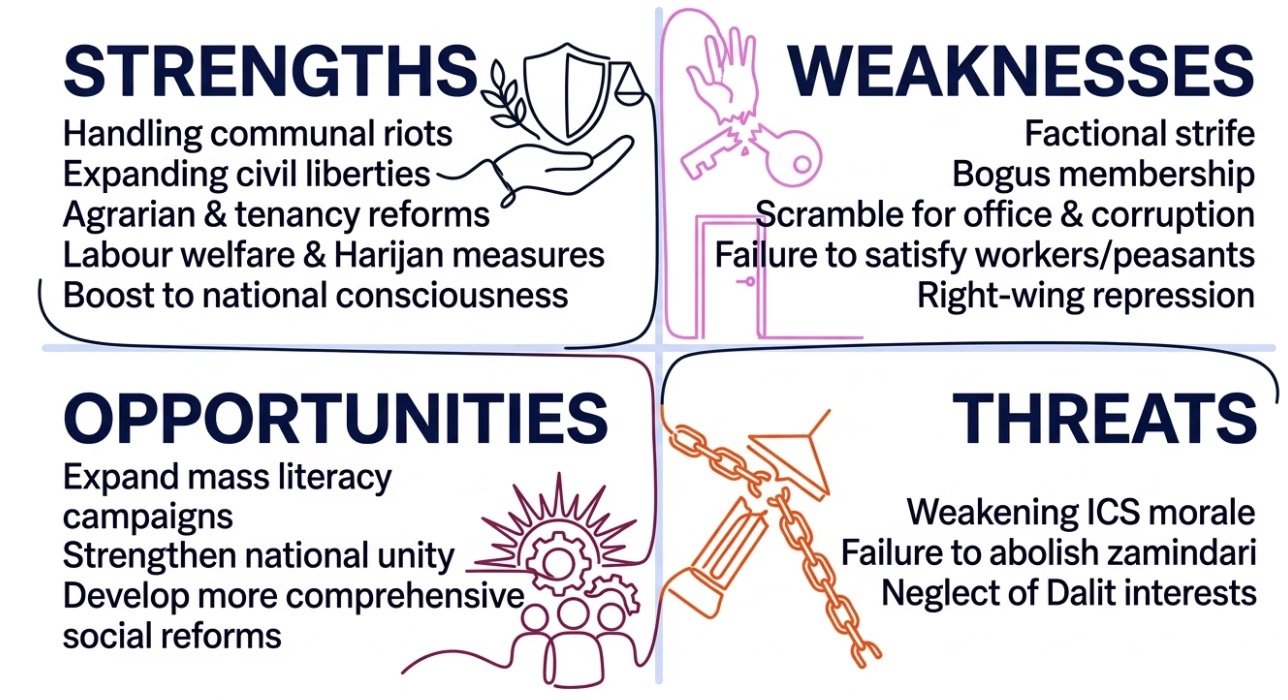
Any honest assessment of the Congress Ministries must weigh their genuine achievements against their structural limitations and political failures. Nehru — one of their sternest critics during 1938–39 — wrote in 1944: "Looking back, I am surprised at their achievements during a brief period of two years and a quarter, despite the innumerable difficulties that surrounded them."
The Election of 1937 and the Congress Ministries: Overall Record of the Congress Ministries
Perhaps the most significant achievement of the Congress Ministries was political rather than administrative. They foiled the imperialist design of using constitutional reforms to weaken the national movement and demonstrated how a constitutional structure could be used by a movement aiming at the capture of state power to further its own aims without getting co-opted. The movement's influence extended deep into the bureaucracy — the morale of the ICS suffered a shattering blow, and many officers came to believe that British departure was only a matter of time. There was no growth of provincialism, no lessening of the sense of Indian unity — contrary to British hopes. When the moment came to resign, the Congress did so without hesitation, proving that office had indeed been "just one phase in the freedom struggle."
Internal Decay
Weaknesses Within: Corruption, Factionalism, and Organisational Decay
The period of the Congress Ministries was not only a test of governance — it was a test of the organisation's internal integrity. The exercise of power exposed and accelerated tendencies that would haunt the Congress for decades.
Factional Strife
There was a great deal of factional squabbling on both ideological and personal grounds. The most dramatic example was the factional battles within the Congress Ministry and Assembly party in the Central Provinces, which led to the resignation of Dr. N.B. Khare as Premier. Factionalism corroded the Congress's internal discipline and diverted energy from governance and popular mobilisation.
Bogus Membership and Careerism
The practice of bogus membership made its appearance and began to grow. Opportunists, self-seekers, and careerists — drawn by the lure of associating with a party in power — entered the Congress at various levels. This was facilitated by the Congress's status as an open party that anyone could join. Indiscipline increased everywhere; many Congressmen began exploiting casteism in their search for power and position.
Gandhi's Alarm
Gandhi grew deeply concerned. He wrote in Harijan against the growing misuse of office and creeping corruption: "I would go to the length of giving the whole Congress organisation a decent burial, rather than put up with the corruption that is rampant." Nehru too expressed anxiety, writing to Gandhi on 28 April 1938: "Congress ministries are adapting themselves far too much to the old order... We are sinking to the level of ordinary politicians." Both leaders began to argue for disengagement from office.
Resignation
The Resignation of Congress Ministries: October 1939
The immediate trigger for the resignation of the Congress Ministries was the outbreak of the Second World War in Europe. On 3 September 1939, Viceroy Linlithgow declared India at war with Germany — without any prior consultation with Indian political leaders. The Congress was outraged.
3 September 1939
Viceroy Linlithgow unilaterally declares India at war with Germany without consulting Indians.
Congress Conditions
The CWC offers cooperation if a central Indian national government is formed and a commitment to post-war independence is made. Linlithgow refuses.
League's Response
Jinnah promises Muslim League support to the British, calling on Muslims to help the Raj by "honourable co-operation" at this "critical and difficult juncture."
22 October 1939
Congress Ministries tender their resignations across all provinces. Viceroy Linlithgow and Jinnah are both pleased.
22 December 1939
Jinnah calls on Indian Muslims to celebrate the day as a "Day of Deliverance" from Congress — a momentous communal provocation.
The resignations had multiple meanings. Gandhi welcomed them as a chance to cleanse the Congress of corruption: "It will drive away all the parasites from the body," he wrote to Rajagopalachari on 23 October. The resignations also had a unifying effect: they brought the Left and Right wings of the Congress closer together around a common policy on war participation. The opportunists who had flooded the Congress in search of office began to leave. And by demonstrating that Congress could and would walk away from power on principle, the resignations strengthened — not weakened — its moral authority in the eyes of the nation.
Legacy
The Enduring Legacy of the Congress Ministries
The 28-month experiment of Congress governance from 1937 to 1939 left an indelible mark on the trajectory of India's freedom struggle, the character of its largest political organisation, and the shape of its post-Independence political culture. It was simultaneously a success and a cautionary tale.
For the Freedom Struggle
The Congress demonstrated it could hold state power without being co-opted by it. National consciousness was deepened, the ICS's confidence was shattered, and the myth that Indians were unfit to rule was decisively broken. The experience made future mass mobilisation — including the Quit India Movement — more credible and more potent.
For Congress as an Organisation
The period revealed enduring tensions — between left and right, between mass politics and parliamentary work, between principle and pragmatism. Factional strife, bogus membership, and creeping corruption exposed organisational vulnerabilities that the party would grapple with for generations. The experience of governance also clarified, painfully, the limits of reformism under colonial constitutional constraints.
For Communal Politics
The ministries' record — whatever its actual merits — became the raw material from which Jinnah and the Muslim League constructed the narrative of Congress "Hindu Raj." The League's recovery from the humiliation of 1937, aided by the Pirpur Report and the Jinnah–Sikander Pact, led directly to the Lahore Resolution of 1940 and the eventual demand for Pakistan.
Above all, the Congress gained by influencing all sections of the people. The process of the growth of Congress and nationalist hegemony in Indian society was advanced. If mass struggles had destroyed the myth of British invincibility, the sight of Indians exercising power shattered the myth that Indians were unfit to rule.
The resignation of October 1939 was not a defeat. It was, as Gandhi intended, a moral and political statement — proof that for the Congress, independence was not a distant aspiration but an immediate, non-negotiable demand. The Congress Ministries had been, as promised, crowns of thorns. But they had also, in their brief tenure, fundamentally altered India's political landscape.
