
August Offer & Individual Satyagraha
A critical chapter in India's freedom struggle, this document examines the turbulent years of 1939–1941, when the outbreak of the Second World War forced Indian political leadership to confront complex questions of allegiance, sovereignty, and strategy. From the divisive debates within the Congress Working Committee to Gandhi's carefully calibrated Individual Satyagraha, this period reveals the extraordinary tensions between imperial ambition and nationalist aspiration.
India Enters the War — Without Consent
In 1939, Lord Linlithgow, the Viceroy of India, unilaterally declared India a belligerent state on the side of Britain in the Second World War. This momentous decision was taken without consulting Indian political leaders or the elected provincial representatives, an act that was received with profound indignation across the nationalist spectrum. The declaration exposed the fundamental contradiction at the heart of British imperial policy: claiming to fight for democracy abroad whilst denying it at home.
The Congress Working Committee convened an emergency meeting at Wardha from 10 to 14 September 1939 to formulate an official response. The debates that unfolded were among the most consequential in the history of the Indian National Congress, revealing deep ideological fissures within the leadership on the nature of the war and India's appropriate response to it.
Gandhi's Position
Advocated unconditional support to the Allied powers, distinguishing sharply between the democratic states of Western Europe and the totalitarian Nazi regime.
Bose & Socialists
Characterised the war as imperialist — both sides fighting for colonial territories. Demanded immediate civil disobedience to wrest freedom from British weakness.
Nehru's Position
Distinguished democracy from Fascism but argued that India, as an unfree nation, could not participate — yet must not exploit Britain's difficulty for immediate advantage.
The CWC Resolution & Congress Demands
The Congress Working Committee's resolution at Wardha was a document of considerable moral clarity and political sophistication. It condemned Fascist aggression unequivocally, while simultaneously holding Britain to the standard it claimed to uphold. The resolution sought to force British India's hand by asking it to reconcile its professed democratic war aims with its continued denial of self-governance to India.
The Congress leadership deliberately exercised restraint, seeking every opportunity for a negotiated settlement before embarking on any form of direct action. This approach reflected Gandhi's characteristic preference for exhausting all constitutional avenues before resorting to civil disobedience. The CWC presented three cardinal demands to the British Government:
Democratic Consistency
India could not be party to a war ostensibly fought for democratic freedom, while that same freedom was being denied to the Indian people by the imperial power.
Proof of Principles
If Britain was genuinely fighting for democracy and freedom, it must demonstrate this by ending imperialism in its colonies and establishing full democratic governance in India without delay.
Clarification of War Aims
The Government must declare its war aims clearly and specify how the principles of democracy would be practically applied to India's political future.
"Congress will safeguard minority rights provided they do not advance claims inconsistent with India's independence." — Mahatma Gandhi
The Government's Response & Hidden Agenda
The British Government's response, delivered by Linlithgow on 17 October 1939, was entirely negative and widely regarded as evasive. Rather than engaging with the Congress demands in good faith, the Viceroy sought to exploit communal divisions by using the Muslim League and the Indian princes as counterweights against the Congress. He vaguely stated that Britain was waging a war to strengthen peace, and that after the war, modifications to the Government of India Act of 1935 would be considered in accordance with Indian wishes — a promise deliberately couched in ambiguity.
Official Response
Refused to define British war aims beyond stating Britain was "resisting aggression"
Proposed consulting "representatives of several communities, parties and interests" on future modifications to the 1935 Act
Offered to set up a "consultative committee" with purely advisory functions
The Hidden Agenda
Linlithgow's statement was not merely evasive — it was part of a deliberate policy to regain ground lost to Congress by provoking a confrontation and then deploying extraordinary wartime powers. Emergency powers for the centre had been acquired even before the war's declaration, and the Defence of India Ordinance was enforced on the very day war was declared, severely curtailing civil liberties.
A top-secret Draft Revolutionary Movement Ordinance (May 1940) was prepared to launch pre-emptive strikes against the Congress. The strategy also sought to win liberal and leftist sympathy globally by painting the Congress as pro-Japan and pro-Germany. Churchill and the Secretary of State, Zetland, branded Congress as a "purely Hindu organisation."
Congress Ministries Resign & Political Fallout
On 23 October 1939, the Congress Working Committee met and delivered its definitive verdict. The Viceroy's statement was rejected as a reiteration of old imperialist policy. The CWC resolved that Congress would not support the war effort and, in a decisive act of political protest, called upon all Congress ministries in the provinces to resign forthwith.
Congress Provincial Governments in eight provinces duly resigned, creating a significant political vacuum. This mass resignation was a moment of considerable political drama. Mohammed Ali Jinnah and the Muslim League greeted the Congress resignations with undisguised satisfaction. Jinnah declared 22 December 1939 as 'The Day of Deliverance', presenting the end of Congress provincial governance as a relief for minorities — a move that deepened communal polarisation at a critical juncture.
Gandhi's Reaction
"The old policy of divide and rule is to continue. The Congress has asked for bread and it has got stone." — A sharp indictment of Linlithgow's October 1939 statement.
Linlithgow's January 1940 Statement
The Viceroy stated that "Dominion status of Westminster variety, after the war, is the goal of British policy in India" — a position Nehru was to describe as wholly inadequate and outdated.
Muslim League's Response
Jinnah called 22 December 1939 'The Day of Deliverance', celebrating Congress resignations and deepening the communal divide within the nationalist movement.
The Debate on Immediate Mass Satyagraha
The rejection of Linlithgow's October 1939 statement reignited the intense internal debate within the Congress on whether to launch an immediate mass civil disobedience movement. Two broad camps crystallised around fundamentally different readings of political readiness and moral imperatives.
Against Immediate Struggle — Gandhi's Camp
Gandhi and his supporters held that the conditions for a mass struggle were not yet ripe. Their reasoning was multi-layered:
The Allied cause against Fascism was fundamentally just
Communal sensitivity and the absence of Hindu-Muslim unity risked triggering communal riots
The Congress organisation was in disarray and not fit for a sustained struggle
The masses were not adequately prepared for a movement of this magnitude
Their prescription was to strengthen the Congress organisation, intensify political work among the masses, and negotiate until all possibilities of a peaceful settlement were exhausted.
For Immediate Struggle — The Leftist Coalition
A coalition comprising Subhash Bose and the Forward Bloc, the Congress Socialist Party, the Communist Party, and the Royists argued that the war presented a historic opportunity to attain freedom through an all-out struggle.
The masses were ready and only awaiting a call from leadership
Obstacles like communalism would be swept away in the course of struggle itself
Bose even proposed a parallel Congress to organise immediate mass struggle
Nehru intellectually sympathised with an early struggle but ultimately sided with Gandhi, recognising that mass action at this juncture would undermine the global fight against Fascism.
The Congress resolution at the Ramgarh Session (March 1940) reflected the dominant leadership's view: "Congress would resort to civil disobedience as soon as the Congress organisation is considered fit enough or if circumstances precipitate a crisis."
The Pakistan Resolution & Change in England
March 1940 was a month of momentous political declarations that would shape the subcontinent's destiny for generations. Even as the Congress debated strategy at Ramgarh, the Muslim League passed its most consequential resolution to date at Lahore — a document that fundamentally altered the terms of India's political future.
The Lahore Resolution (March 1940)
The Muslim League called for the grouping of geographically contiguous Muslim-majority areas in the North-West and East into independent states in which constituent units shall be autonomous and sovereign, with adequate safeguards for Muslims in minority provinces. This effectively formalised the demand for Pakistan.
Change of Government in England
Neville Chamberlain was succeeded by Winston Churchill as Prime Minister. The Conservatives who assumed power held no sympathetic stance towards Congress's demands. Churchill was openly hostile to Indian nationalism and, together with the Secretary of State Zetland, branded Congress as a purely Hindu body.
These two developments — the formal articulation of a two-nation theory by the League and the hardening of the Conservative government's attitude towards India — dramatically narrowed the space for a negotiated settlement and set the stage for the events of August 1940.
The August Offer — 8 August 1940
The fall of France in 1940 temporarily altered the strategic calculations on both sides. With Britain facing an immediate threat of Nazi occupation during the Battle of Britain, the Congress offered to cooperate in the war effort on the condition that authority in India be transferred to an interim government. The British Government's response came in the form of Viceroy Linlithgow's statement of 8 August 1940, known to history as the August Offer.
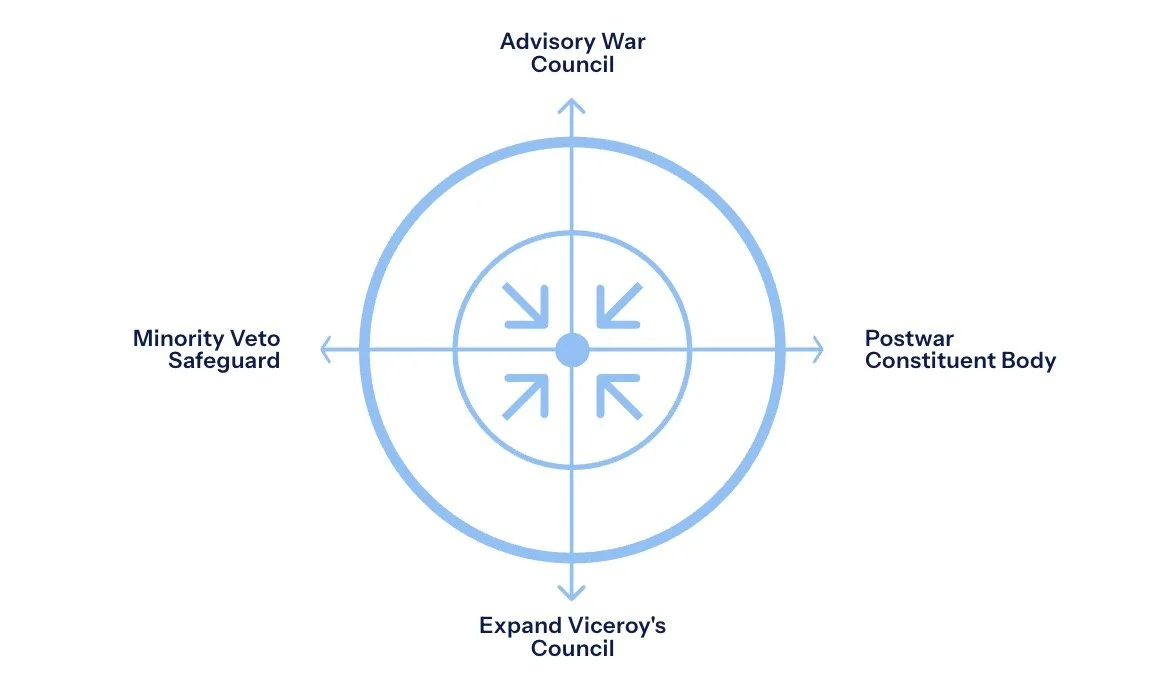
For the first time in the history of British India, the August Offer explicitly recognised the inherent right of Indians to frame their own constitution, and the Congress demand for a Constituent Assembly was effectively conceded. Dominion status was explicitly offered. In July 1941, the Viceroy's Executive Council was enlarged to give Indians a majority of 8 out of 12 members — a historic first — though white officials retained control of the crucial portfolios of Defence, Finance, and Home Affairs. A National Defence Council was also set up, but with purely advisory functions.
Congress Rejected the Offer
Nehru declared: "Dominion status concept is dead as a door nail." Gandhi stated that the declaration had widened the gulf between nationalists and British rulers. The offer was seen as too little, too vague, and too conditional.
Muslim League Welcomed the Offer
The League warmly welcomed the veto assurance given to minorities, which effectively gave it a right of veto over any constitutional arrangement. It reiterated that partition remained the only solution to the political deadlock, using the offer to reinforce its bargaining position.
Individual Satyagraha 1940–41
In the context of widespread dissatisfaction following the rejection of Congress demands and the August Offer, Gandhi revealed to the Congress Working Committee at Wardha his plan for a uniquely calibrated form of protest: Individual Civil Disobedience, or Individual Satyagraha. This was a deliberate departure from the mass movement model, reflecting Gandhi's deep strategic thinking and his insistence on non-violence as an absolute principle.
Gandhi conveyed this approach personally to Lord Linlithgow at a meeting on 27 September 1940. The Individual Satyagraha was not aimed at winning independence directly, but at asserting the fundamental right of free speech — specifically, the right to speak out against the war. Gandhi was also anxious not to embarrass Britain at a moment of acute military danger, and feared that a mass movement might turn violent.
Aim: Affirm Free Speech
To assert the right of Indians to publicly oppose the war — not to launch independence but to demonstrate that nationalist restraint was a matter of principle, not weakness.
Aim: Moral Signal
To express that Indians made no distinction between Nazism and the "double autocracy" ruling India, and that they had no interest in a war fought to preserve imperial rule.
Aim: One More Chance
To give the British Government yet another opportunity to accept Congress's demands peacefully before any wider confrontation became unavoidable.
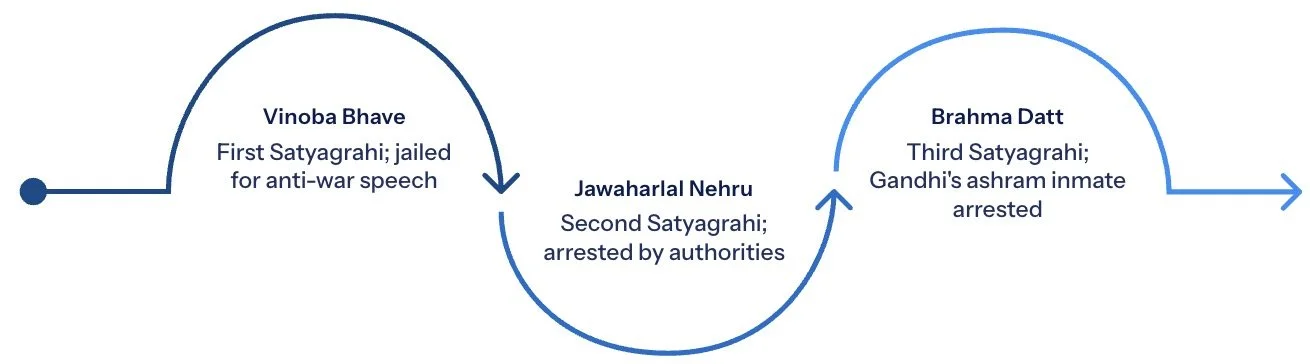
Individual Satyagraha, 1940–41
The campaign was carefully controlled: Satyagrahis were individually selected to ensure non-violence remained its centrepiece. Acharya Vinoba Bhave was chosen as the first Satyagrahi and was promptly jailed for speaking against the war. Nehru followed as the second, and Brahma Datt, an inmate of Gandhi's Ashram, was the third. All were imprisoned under the Defence of India Act. The movement attracted limited enthusiasm in its first phase, and Gandhi suspended it in December 1940. When it resumed in January 1941, thousands joined, and approximately 20,000 people were arrested. On 3 December 1941, the Viceroy ordered the release of all Satyagrahis.
Strategic Significance
The period from 1939 to 1941 represents one of the most complex and intellectually rich phases of India's freedom struggle. The events of these years — the Wardha debates, the Congress resignations, the August Offer, and the Individual Satyagraha — collectively illustrate the sophisticated political calculus that the nationalist leadership was required to navigate under conditions of global war.
The War as Political Accelerant
The Second World War forced every stakeholder — Congress, Muslim League, British Government, and regional leaders — to publicly articulate their constitutional visions, accelerating the pace of political bargaining and crystallising positions that would shape the 1946–47 endgame.
Gandhi's Strategic Restraint
Individual Satyagraha demonstrated Gandhi's genius for calibrated protest — maintaining moral pressure on the British while avoiding the risks of mass violence, communal discord, or appearing to side with fascism. It was resistance through discipline rather than disruption.
The League's Consolidation
Jinnah and the Muslim League skillfully used each Congress misstep — including the provincial resignations — to strengthen their own political legitimacy. The Lahore Resolution of 1940 marked the formal beginning of the partition trajectory.
British Imperial Calculation
The British Government's responses across this period reveal a consistent pattern: using the war as a pretext to consolidate imperial control, dividing nationalist opinion, and making concessions only when strategically compelled — never out of genuine democratic principle.
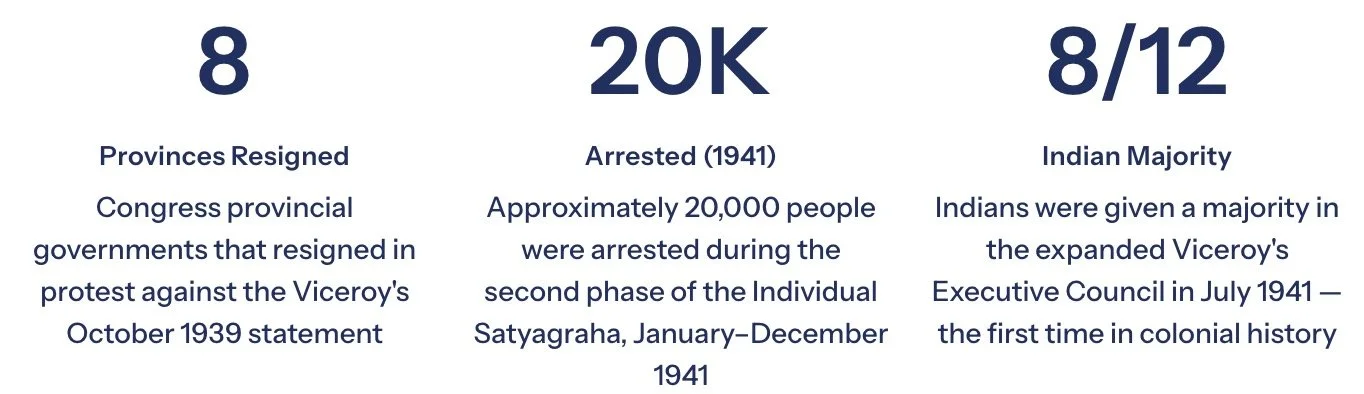
Individual Satyagraha 1940–41
"There is to be no democracy for India if Britain can prevent it." — Mahatma Gandhi, reacting to the British Government's position, 1939
