
The Cripps Mission (1942)
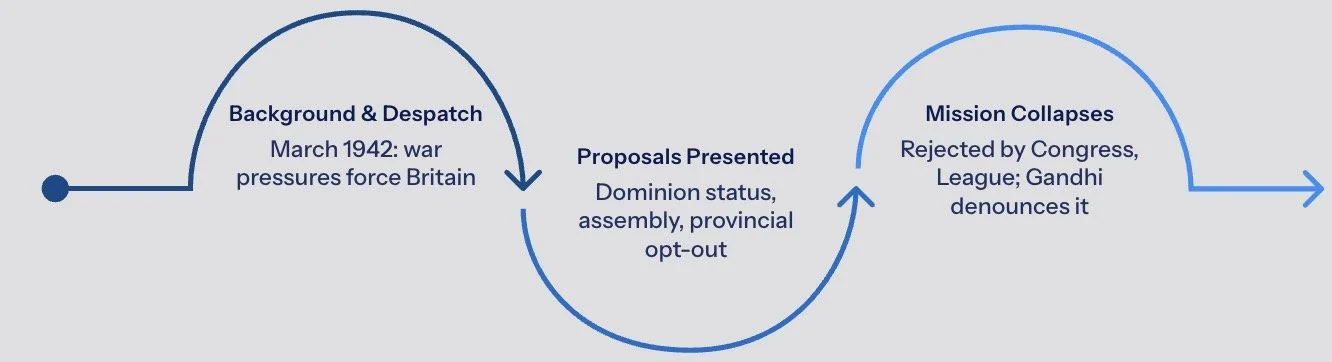
In March 1942, the British War Cabinet despatched a high-level delegation to India under Sir Stafford Cripps, carrying constitutional proposals aimed at securing Indian cooperation in the Second World War. What followed was one of the most consequential — and ultimately futile — diplomatic episodes of the independence struggle. This document examines the background, key proposals, departures from previous policy, and the manifold reasons for the Mission's failure.
The Cripps Mission (1942)
The Mission is a pivotal episode for students of modern Indian history: it reveals the limits of British wartime concessions, the deep divisions within Indian nationalist politics, and the accelerating momentum that would culminate in the Quit India Movement of August 1942.
Context
Why Was the Cripps Mission Sent?
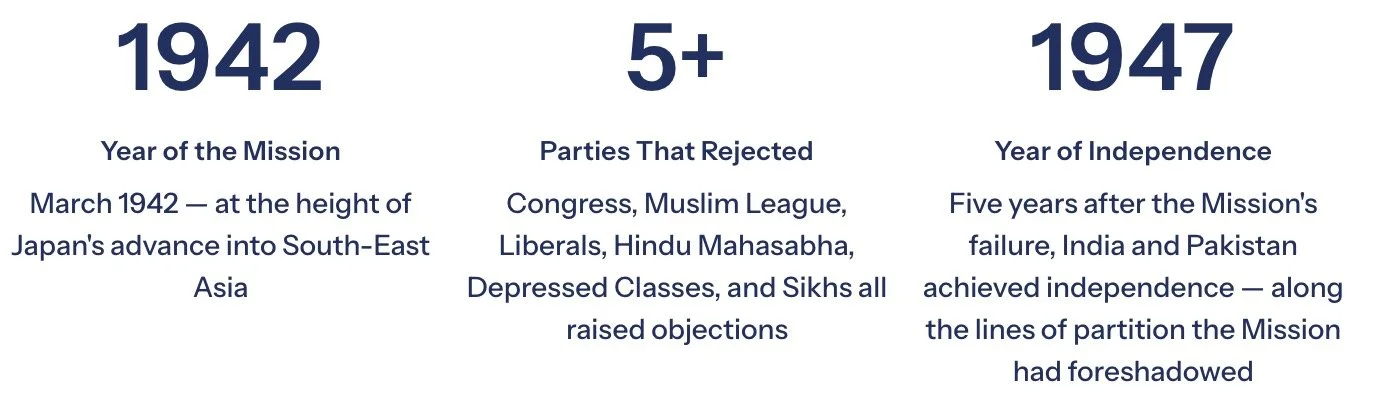
By early 1942, Britain's strategic position in South and South-East Asia had deteriorated dramatically. Japanese forces had swept through Malaya, captured Singapore, and were advancing towards Burma. The threat of a Japanese invasion of India was no longer hypothetical — it was imminent. Under these circumstances, Britain could no longer afford to govern India through coercion alone; it desperately needed the active cooperation of Indian political leaders and the Indian people for the war effort.
Stafford Cripps was a left-wing Labourite who had long been sympathetic to the Indian national movement, and his personal rapport with Indian leaders made him a credible emissary. As Leader of the House of Commons and a member of Churchill's War Cabinet, he carried sufficient political weight to signal British seriousness — or so it appeared.
Military Necessity
Reverses in South-East Asia made Indian support for the Allied war effort strategically indispensable. A Japanese land invasion of India was considered a real and immediate threat.
Allied Pressure
The United States, the Soviet Union, and China — all Allied partners — pressed Britain to seek a genuine political settlement with Indian nationalists as a precondition for effective cooperation.
Nationalist Conditions
Indian nationalist leaders had signalled willingness to support the Allied cause, but only if substantial power was transferred immediately and full independence was guaranteed after the war's conclusion.
The mission was therefore driven by a convergence of military vulnerability, diplomatic obligation, and conditional Indian goodwill — a fragile foundation upon which a lasting agreement would prove impossible to construct.
Political Landscape
The Divided Indian Response
Indian political opinion in 1942 was far from monolithic, and the Cripps Mission arrived into an environment of sharp internal disagreement. The Congress, the Muslim League, and numerous smaller parties all carried competing visions of India's future — making consensus extraordinarily difficult to achieve.
The Congress: Three Positions
The Hawks: Angered by the Viceroy's unilateral declaration of India's entry into the war, some Congress leaders favoured launching an outright revolt against British rule, regardless of the war's gravity in Europe.
The Conciliators: Chakravarti Rajagopalachari, backed by Sardar Vallabhbhai Patel, Maulana Azad, and Jawaharlal Nehru, advocated supporting Britain in exchange for immediate self-government and eventual independence.
Gandhi's Principled Opposition: The Mahatma refused to morally endorse a war under any circumstances and doubted British sincerity about Indian independence, though he did not prevent talks from proceeding.
The Muslim League
Muhammad Ali Jinnah and the Muslim League supported the British war effort but on their own terms. Jinnah condemned the Congress position and insisted that any constitutional settlement must recognise the demand for Pakistan — a separate, sovereign Muslim state. He firmly resisted Congress calls for pan-Indian cooperation and opposed any arrangement that subordinated Muslim political identity to a unified Indian framework.
The Context of Negotiations
Rajagopalachari, Patel, Azad, and Nehru ultimately held formal talks with Cripps, offering full wartime support in exchange for immediate self-government. These negotiations would ultimately break down — not for want of goodwill on the Indian side, but due to the narrowness of what Cripps had actually been authorised to offer.
The Proposals
Main Proposals of the Cripps Mission
The constitutional proposals brought by Cripps were embodied in a Draft Declaration. They represented, in theory, significant advances over previous British offers such as the August Offer of 1940 — but, as events would demonstrate, the gap between what was promised for the future and what was conceded in the present proved unbridgeable.
Indian Union with Dominion Status
A self-governing Indian Union with dominion status would be established after the war. It would be free to determine its own relationship with the Commonwealth and to participate in the United Nations and other international bodies as a sovereign entity.
Constituent Assembly
After the conclusion of hostilities, a constituent assembly would be convened to frame a new constitution. Members would be partly elected by the provincial assemblies through proportional representation and partly nominated by the princely states.
Provincial Opt-Out Clause
The British Government would accept the new constitution subject to a critical condition: any province unwilling to join the Indian Union could opt out and form a separate constitution under a separate Union — a provision with profound implications for partition.
Treaty for Transfer of Power
The new constitution-making body and the British Government would negotiate a treaty to govern the transfer of power and to safeguard the rights of racial and religious minorities throughout the transition.
Wartime Governance Unchanged
In the interim period, defence of India would remain entirely in British hands. The powers of the Governor-General would remain intact — a provision that would become the central sticking point in the negotiations.
Significance
Departures from the Past and Their Implications
Despite its ultimate failure, the Cripps Mission did mark several notable departures from the terms of earlier British constitutional offers, particularly the August Offer of 1940. These advances deserve careful attention, as they shaped the subsequent trajectory of constitutional negotiations and the eventual terms of Indian independence.
Constitution Solely in Indian Hands
Unlike the August Offer, which had stipulated that the constitution-making process would be "mainly" in Indian hands, the Cripps proposals conceded that this responsibility would rest solely with Indians — a significant symbolic advance.
A Concrete Plan for the Constituent Assembly
For the first time, a specific and detailed mechanism for convening a constituent assembly was placed before Indian leaders, moving the process from vague assurances to an actionable constitutional framework.
Blueprint for Partition
The option for any province to frame a separate constitution was an explicit acknowledgement that a united India could not be assumed — effectively providing a constitutional blueprint for eventual partition, which would materialise in 1947.
Right to Leave the Commonwealth
Free India would not be bound to remain within the British Commonwealth — a departure from dominion status as previously understood, granting genuine freedom of association in international relations.
Greater Indian Share in Administration
Indians were to be allowed a larger share in the administration of the country during the interim period — though the Governor-General's ultimate supremacy and the British control of defence were explicitly preserved.
The tension at the heart of the Cripps proposals is clear: substantial future concessions were offered, but present power — especially over defence and executive authority — remained firmly in British hands. It was this gap that doomed the Mission.
Failure Analysis
Why Did the Cripps Mission Fail?
The collapse of the Cripps Mission was the product of multiple overlapping failures — political, structural, and personal. It was not the result of any single misstep, but rather a concatenation of incompatible demands, bad faith, and the fundamental unwillingness of the British establishment to relinquish real power during the war. The result was a mission that pleased nobody and resolved nothing.
Objections of the Indian National Congress
Dominion, Not Independence
The offer of dominion status rather than complete and immediate independence fell far short of Congress's declared goal of Purna Swaraj.
Nominated, Not Elected
Princely states would be represented in the constituent assembly by nominees of the princes rather than by elected representatives — undermining democratic legitimacy.
Right of Secession
Permitting provinces to opt out violated the fundamental Congress principle of a united and indivisible India.
No Real Power Now
There was no plan for immediate transfer of power; the Governor-General's supremacy was retained, and the demand that he serve only as a constitutional head was rejected outright.
Objections of the Muslim League
The Muslim League found the proposals equally unsatisfactory, though for diametrically opposite reasons. Jinnah criticised the idea of a single Indian Union as the default constitutional arrangement. The League objected to the machinery for the constituent assembly and the procedure for provincial accession to the Union. Most fundamentally, it held that the proposals denied Muslims the right to self-determination and failed to provide any clear pathway to the creation of Pakistan.
Objections of Other Groups
The Liberals
Considered the secession proposals to be dangerous to the unity and security of India.
Hindu Mahasabha
Criticised the constitutional basis for the right to secede as fundamentally anti-national.
The Depressed Classes
Feared that partition would leave Scheduled Caste communities at the mercy of caste Hindu majorities in separated provinces.
The Sikhs
Objected that partition would divide Punjab, placing a large Sikh population outside an Indian Union — a prospect they found wholly unacceptable.
Structural Failure
The Structural and Personal Causes of Collapse
Beyond the objections of the various parties, the Mission was undermined by a series of structural contradictions and personal failures that made agreement all but impossible even if goodwill had been present on all sides.
Churchill's Deliberate Obstruction
Prime Minister Churchill, Secretary of State Leo Amery, Viceroy Lord Linlithgow, and Commander-in-Chief Wavell consistently worked to torpedo Cripps's efforts. The Mission was, in Churchill's conception, primarily a propaganda exercise for American and Chinese consumption — not a genuine offer of power. Cripps found himself undermined at every turn by the very government that had sent him.
Confusion Over Cripps's Authority
It was never clear precisely what Cripps had been authorised to offer. He had earlier spoken of a "cabinet" and a "national government," but later retreated to stating that he had merely meant an expansion of the Viceroy's Executive Council — a far more modest concession. This inconsistency gravely damaged his credibility with Indian leaders and created an atmosphere of suspicion and distrust.
The Viceroy's Veto
Talks ultimately broke down on the question of the Viceroy's veto over the decisions of the proposed Indian executive. Congress demanded that the Governor-General function as a constitutional head; Britain refused to concede this point. With neither side willing to move, the negotiations reached an irresolvable deadlock.
Procedural Ambiguity on Secession
The procedure for provincial secession was poorly defined and weighted in ways that disadvantaged Hindu minorities in Punjab and Bengal. A province could opt out by a 60% majority in its legislature, or — if this threshold was not met — by a simple majority plebiscite of adult males. The arithmetic of this arrangement raised serious concerns about how it would operate in practice.
"Take It or Leave It" Rigidity
Cripps adopted an inflexible stance, refusing to go beyond the Draft Declaration or to negotiate on its terms. This rigidity transformed what might have been a genuine dialogue into a confrontation, and left Indian leaders with no sense that their core concerns had been heard or taken seriously.
"A post-dated cheque drawn on a crashing bank." — Mahatma Gandhi's verdict on the Cripps proposals
"The existing structure and autocratic powers would remain and a few of us will become the Viceroy's liveried camp followers and look after canteens and the like." — Jawaharlal Nehru
Stafford Cripps returned to Britain leaving behind, as contemporaries noted, a frustrated and embittered Indian people. Though they continued to sympathise with the victims of Fascist aggression across the world, Indian nationalists had concluded that the existing political situation at home had become intolerable — and that the time had come for a final, decisive assault on imperial rule. The Quit India Movement of August 1942 was the direct consequence of this conclusion.
The Legacy of the Cripps Mission
The Cripps Mission of 1942 stands as one of the most instructive episodes in the final decades of British rule in India. It reveals, with unusual clarity, the fundamental tension between Britain's wartime needs and its unwillingness to relinquish real executive power — even as it offered substantial constitutional concessions for the post-war period. The Mission was, in the phrase that has endured, a post-dated cheque: generous in its promises for the future, but empty in its offer of present authority.
A Mirror of Nationalist Divisions
The Mission exposed the deep fractures within Indian nationalism — between Congress and the League, between those willing to cooperate and those who saw any engagement as complicity. These divisions would deepen over the following five years and shape the terms of partition in 1947.
The Limits of British Wartime Concessions
Churchill's government was unwilling to concede control over defence or to dilute the Governor-General's authority during the war. The Mission demonstrated that Britain's constitutional offers were calibrated to satisfy Allied opinion rather than to genuinely empower Indian leaders.
Catalyst for Quit India
The failure of the Mission removed the last significant argument for patient constitutional negotiation. It convinced the Congress leadership — and Gandhi in particular — that a direct, mass confrontation with British authority was the only remaining path. The Quit India Resolution followed within months, in August 1942.
For students of modern Indian history, the Cripps Mission is essential reading not merely as a diplomatic failure but as a political text. It encapsulates the contradictions of late colonial governance — the simultaneous need for Indian consent and the refusal to grant Indian power — and illuminates why the road to independence, when it finally came in 1947, was so fraught with the violence of partition.
The Cripps Mission (1942)
