
Quit India Movement (1942–1944)
The Quit India Movement, launched on 8th August 1942, stands as one of the most dramatic and consequential episodes in India's long struggle for independence. Initiated by Mahatma Gandhi and the Indian National Congress, it was a bold, mass-scale civil disobedience campaign demanding an immediate end to British colonial rule. Unlike previous movements, Quit India was marked by extraordinary spontaneity — when the entire Congress leadership was arrested overnight, millions of ordinary Indians carried the torch forward, defying brutal repression with unparalleled courage and resolve.
Background
The Road to Resolution: Wardha, July 1942
Following the collapse of the Cripps Mission in March–April 1942, Gandhi concluded that further patience with the British was untenable. The Mission had failed to offer any meaningful constitutional advance, and Gandhi framed a resolution calling for British withdrawal and a non-violent non-cooperation movement — even against a potential Japanese invasion.
The Congress Working Committee (CWC) met at Wardha on 14th July 1942 and accepted the idea of a mass struggle, passing a landmark resolution demanding complete independence from Britain. The draft proposed massive civil disobedience if the British did not accede to Indian demands.
"The committee, therefore, resolves to sanction for the vindication of India's inalienable right to freedom and independence, the starting of a mass struggle on non-violent lines on the widest possible scale, so that the country might utilise all the non-violent strength it has gathered during the last 22 years of peaceful struggle… they must remember that non-violence is the basis of the movement…"
The resolution proved controversial within the Congress. Chakravarti Rajagopalachari, a prominent national leader, resigned from the Congress over this decision, as did several regional organisers. Jawaharlal Nehru and Maulana Azad were apprehensive and critical, yet ultimately backed Gandhi's leadership. Sardar Vallabhbhai Patel, Dr. Rajendra Prasad, and Dr. Anugrah Narayan Sinha were enthusiastic supporters, joined by veteran Gandhians and socialists like Asoka Mehta and Jayaprakash Narayan.
Causes
Why the Movement Was Launched: Five Key Reasons
The decision to launch the Quit India Movement was driven by a convergence of political, economic, and psychological factors that had created an explosive atmosphere across the country by mid-1942.
Failure of the Cripps Mission
The Mission's collapse exposed Britain's unchanged attitude on constitutional advance, making further silence tantamount to accepting British authority over India's future without Indian consent.
Popular Economic Discontent
Rising prices, shortages of rice and salt, commandeering of boats in Bengal and Orissa, and fears of a British scorched earth policy in Assam, Bengal, and Orissa against possible Japanese advance fuelled mass anger.
British Military Reverses in Asia
News of British defeats in South-East Asia and an imminent collapse of British power enhanced popular willingness to express discontent. Public faith in British stability was so low that people were withdrawing deposits from banks and post offices.
Shattered White Prestige
The manner of British evacuation from South-East Asia — with separate "Black Roads" for Indian refugees and "White Roads" for Europeans — exposed the deep racism of the colonial rulers and destroyed the myth of British invincibility.
Preparing for Japanese Invasion
The Congress leadership wanted to condition the Indian masses psychologically and organisationally for the possibility of a Japanese invasion, ensuring that Indians, not the British, would determine the country's response.
Historic Moment
Gowalia Tank Maidan, Bombay — 8th August 1942
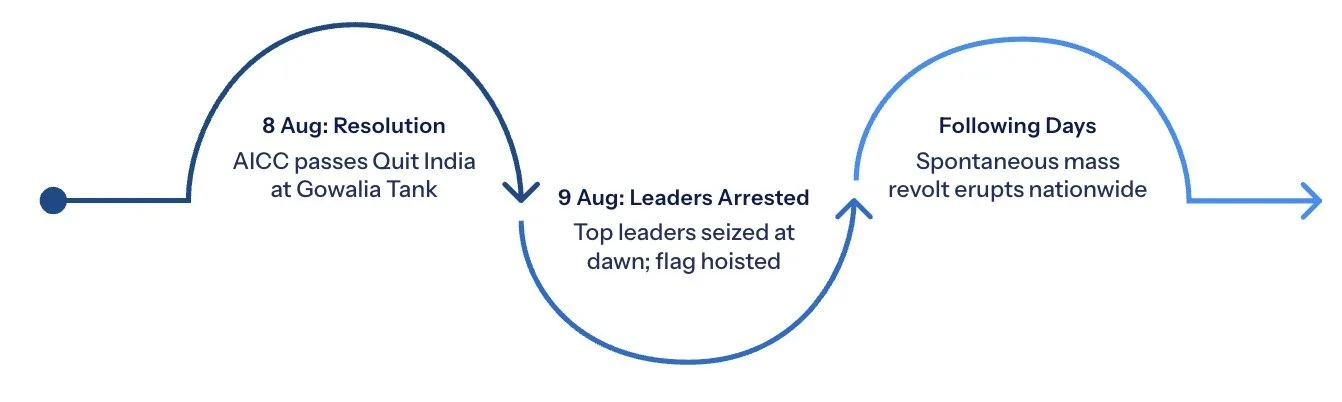
The All India Congress Committee (AICC) convened at Gowalia Tank Maidan in Bombay on 8th August 1942 and formally ratified the Quit India Resolution with certain modifications. It was here that Gandhi delivered his electrifying "Do or Die" speech, one of the most powerful addresses in the history of Indian nationalism.
"Here is a mantra, a short one that I give you. You may imprint it on your hearts and let every breath of yours give expression to it. The mantra is: 'Do or Die'. We shall either free India or die in the attempt; we shall not live to see the perpetuation of our slavery."
Resolutions Passed at the AICC
Demand an immediate end to British rule in India
Declare free India's commitment to resist Fascism and imperialism
Form a provisional Government of India after British withdrawal
Sanction a civil disobedience movement against British rule
Name Gandhi as the undisputed leader of the struggle
Gandhi's Instructions to Different Sections
Government servants: Do not resign; declare allegiance to Congress
Soldiers: Do not leave the army, but do not fire on compatriots
Students: If confident, leave studies and join the movement
Peasants: Negotiate rent with sympathetic zamindars; withhold from pro-government ones
Princes: Support the masses and accept the sovereignty of your people
Princely states' people: Support rulers only if they oppose the British
Immediate Aftermath
Mass Arrests and the Spark of Spontaneous Revolt
The British government was fully prepared to act. In the early hours of 9th August 1942 — within hours of the resolution being passed — all top Congress leaders including Gandhi, Nehru, Patel, and Maulana Azad were arrested in a single sweep and taken to undisclosed locations. Most would remain imprisoned for the rest of the war, cut off entirely from the masses.
With established leaders gone, a young and then relatively unknown Aruna Asaf Ali courageously presided over the AICC session on 9th August and hoisted the Congress flag. The Congress party was subsequently banned. Far from crushing the movement, these arrests generated enormous public sympathy and outrage.
Quit India Movement (1942–1944)
The removal of established leadership left younger and more militant elements to act on their own initiative, transforming what was planned as a controlled non-violent movement into a spontaneous, nationwide uprising. People burnt government offices, called strikes, cut telegraph lines, and challenged authority in ways that the original resolution had neither anticipated nor fully authorised.
Spread of Revolt
The Public on Rampage: Violence, Strikes, and Sabotage
Despite — or perhaps because of — the absence of central leadership, the Quit India Movement spread rapidly and dramatically across the subcontinent. Citizens who had never before participated in open resistance took to the streets, fields, and factories in an extraordinary display of national defiance.
Symbols of Authority Attacked
The general public hoisted national flags forcibly on public buildings. Satyagrahis offered themselves for arrest, bridges were blown up, railway tracks were removed, and telegraph lines were cut. Activity was most intense in eastern UP and Bihar.
Students and Workers Strike
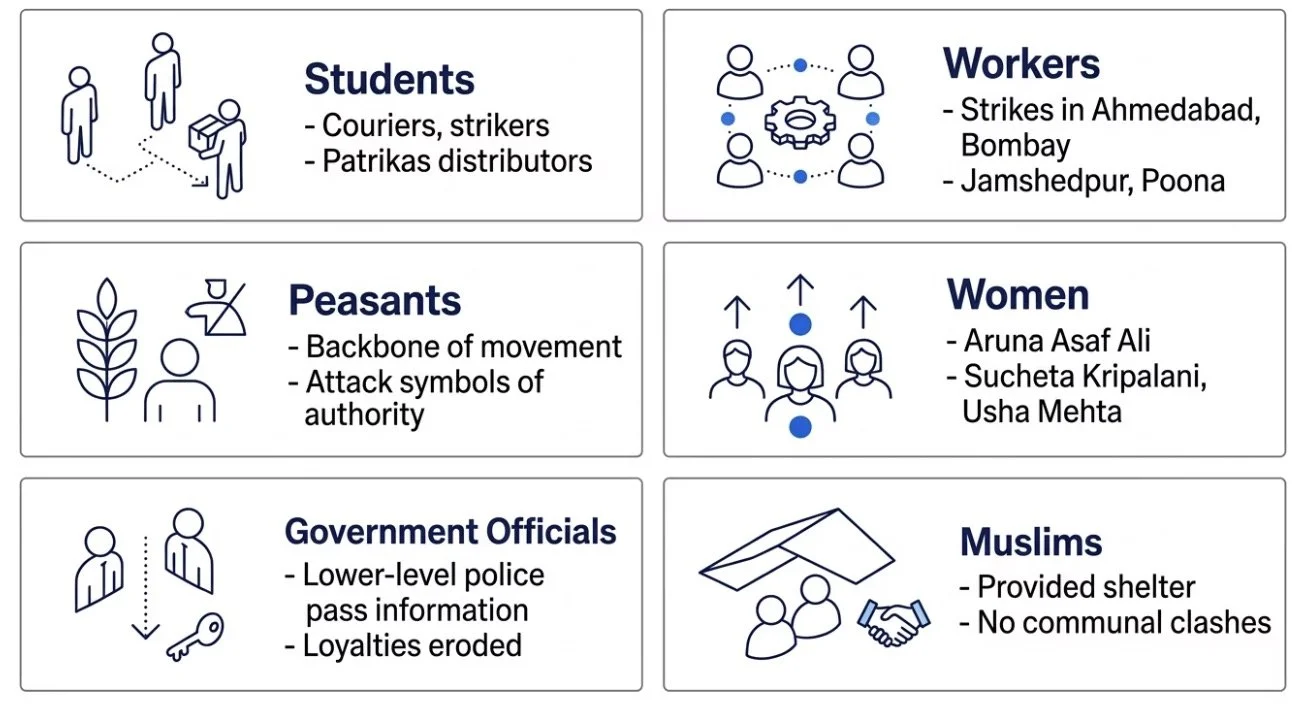
Students went on strikes in schools and colleges across the country, participated in processions, distributed illegal news patrikas, and served as couriers for underground networks. Workers struck in Ahmedabad, Bombay, Jamshedpur, Ahmednagar, and Poona.
Rural Uprisings
In rural West Bengal, peasants' resentment against new war taxes and forced rice exports fuelled open resistance bordering on rebellion in 1942, until the great famine of 1943 suspended the movement. In Saurashtra, the region's 'baharvatiya' tradition — going outside the law — actively abetted sabotage activities.
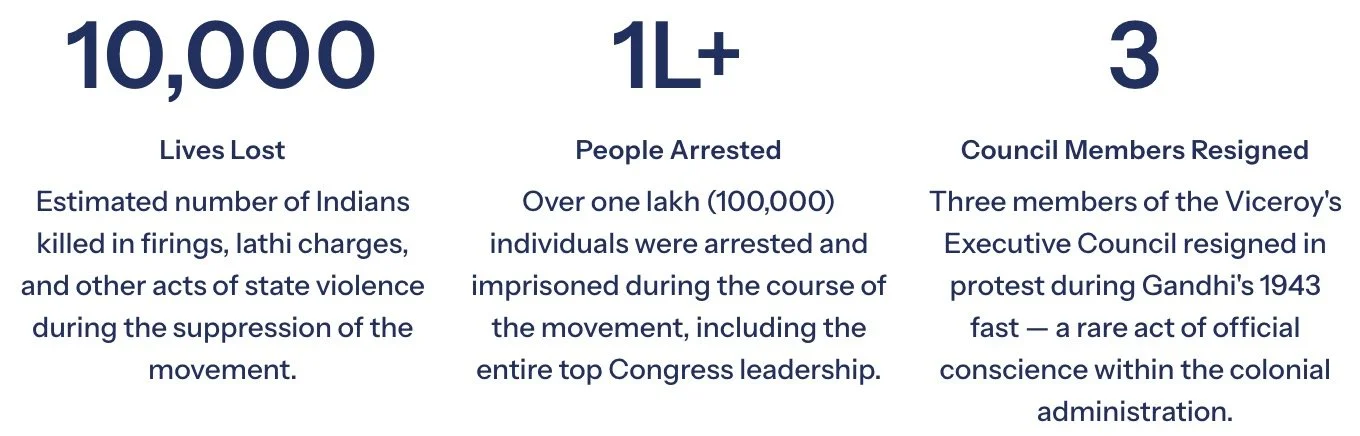
The government responded with massive force. The military occupied many cities; police and secret services exercised sweeping powers. Agitating crowds were lathi-charged, tear-gassed, and fired upon. Rebellious villages were heavily fined, and mass floggings were carried out. The number of those killed is estimated at 10,000, and over one lakh people were arrested. The press was muzzled throughout this period.
Underground Resistance
The Underground: Radio, Networks, and Parallel Governments
As visible mass protests were suppressed, a sophisticated underground resistance emerged to keep national morale alive. Socialists, Forward Bloc members, Gandhi ashramites, revolutionary terrorists, and local organisations across Bombay, Poona, Satara, Baroda, Gujarat, Karnataka, Kerala, Andhra, UP, Bihar, and Delhi sustained the movement covertly.
Key Underground Figures
Rammanohar Lohia
Jayaprakash Narayan
Aruna Asaf Ali
Usha Sharma
Biju Patnaik
Chhotubhai Puranik
Achyut Patwardhan
Sucheta Kripalani
R.P. Goenka
Congress Radio — The Voice of the Underground
Organised by Usha Mehta (1920–2000), the Congress Radio was a clandestine station that broadcast for approximately three months, operating from shifting locations in Bombay. Her associates included Vithalbhai Jhaveri, Chandrakant Jhaveri, and Babubhai Thakkar. Technical equipment was supplied by Nanak Motawani of Chicago Radio, Mumbai. Eminent personalities like Ram Manohar Lohia, Achyutrao Patwardhan, and Purushottam Trikamdas were also associated with it. The radio served as a critical lifeline — distributing guidance, maintaining command, and boosting the morale of a leaderless people.
Parallel Governments
Governments Within the Empire: Three Centres of Defiance
One of the most remarkable achievements of the Quit India Movement was the establishment of parallel governments — independent administrations that openly defied British authority and demonstrated that Indians were capable of governing themselves. Three stand out as historic examples.
🏛 Ballia, UP
August 1942 — One Week
Led by Chittu Pandey, the parallel government at Ballia lasted approximately one week but made a powerful statement. Pandey succeeded in securing the release of several imprisoned Congress leaders, directly challenging British judicial and administrative authority.
🌾 Tamluk, Midnapore
December 1942 – September 1944
The longest-lasting parallel government undertook remarkable civic work: cyclone relief operations, sanctioning grants to schools, redistributing paddy from the rich to the poor, and organising Bidyut Bahinis (voluntary brigades). It demonstrated genuine grassroots governance.
⚖ Satara, Maharashtra
Mid-1943 – 1945
Known as "Prati Sarkar" (parallel government), organised under Y.B. Chavan, Nana Patil and others. It set up village libraries, Nyayadan Mandals (dispute resolution bodies), ran prohibition campaigns, and organised 'Gandhi marriages' — offering an alternative social and legal order entirely outside British jurisdiction.
Participation
Who Joined the Movement? Extent of Mass Participation
The Quit India Movement was remarkable for the sheer breadth of its participation. Unlike previous movements, which had drawn from specific social strata, this uprising cut across class, profession, gender, and region — though not without notable exceptions and contradictions.
Quit India Movement (1942–1944): Who Joined the Movement? Extent of Mass Participation
The main storm centres of the movement were eastern UP, Bihar, Midnapore, Maharashtra, and Karnataka. Students and youth were at the very forefront, though many also looked to Subhas Chandra Bose, then in exile and supporting the Axis powers. Women — particularly school and college girls — played an active and visible role. Government officials, especially at lower levels, participated, resulting in a significant erosion of loyalty to the Crown. Communists, despite their formal anti-Quit India position, felt the irresistible pull of the movement. Princely states showed a largely low-key response, reflecting their structural dependence on British patronage.
Opposition
Forces Against Quit India: Opposition from Within and Without
The Quit India Movement, for all its mass appeal, faced organised and significant opposition from several political forces — opposition that had serious long-term consequences for Indian political unity.
The Communist Party of India
The CPI strongly opposed the Quit India Movement, supporting the British war effort in order to protect the Soviet Union after Germany's invasion. In response, the British lifted the ban on the party — a fact that deeply damaged its credibility with nationalist Indians. Many industrial workers who were CPI members, however, defied the party line and supported the movement.
The Muslim League
Muhammad Ali Jinnah opposed the call, leading large numbers of Muslims to cooperate with the British and enlist in the army. The League gained massive numbers of new members during this period. As Congress members resigned from provincial legislatures in protest, the League took control in Sindh, Bengal, and the Northwest Frontier. On 23rd March 1943, Pakistan Day was observed — a direct political consequence of the Congress's weakened position.
Hindu Mahasabha and Princely States
Smaller parties like the Hindu Mahasabha opposed the call. Princes in the princely states were strongly opposed and actively funded opposition to the movement, given their structural dependence on British patronage and their resistance to popular sovereignty.
Limited International Support
Whilst US President Franklin D. Roosevelt privately pressured Churchill to concede to Indian demands, when Churchill threatened to resign, the US quietly retreated. Washington instead bombarded Indians with propaganda strengthening public support for the Allied war effort — a poorly executed operation that annoyed both the British and the Indians, and left the Congress without meaningful international backing.
State Response
Government Repression: The Full Force of Empire
The British response to the Quit India Movement was swift, extensive, and severe. Although formal martial law was not declared, the repression applied amounted to a war against the Indian civilian population.
Quit India Movement (1942–1944): Government Repression
The military occupied many major cities. Police and secret services operated without restraint. Rebellious villages were collectively fined, and mass floggings were carried out as collective punishment. The press was comprehensively muzzled — censored dispatches and suppressed newspapers ensured that news of the repression, and of the movement's scale, did not reach the wider world. Despite all of this, the movement demonstrated that the British could no longer govern India by force alone.
Gandhi in Prison
Gandhi's Fast, February 1943: Resistance from Within
Gandhi was imprisoned at the Aga Khan Palace in Pune. The period of his incarceration was marked by profound personal tragedy — his wife Kasturbai Gandhi and his personal secretary Mahadev Desai both died while in captivity, and Gandhi's own health deteriorated sharply. Yet Gandhi did not yield.
When the Government demanded that Gandhi publicly condemn the violence of the Quit India Movement, Gandhi responded with a 21-day fast — directed not against Indian violence, but against the violence of the colonial state itself. The popular response was immediate and overwhelming: hartals, demonstrations, and strikes erupted at home and abroad.
Public Morale Raised
The news of Gandhi's fast re-energised a movement that had been suppressed and disheartened, reminding Indians that the spirit of resistance was unbroken.
Anti-British Sentiment Heightened
The spectacle of a frail, grieving 74-year-old man fasting unto death against an empire intensified anti-colonial feeling across the country and internationally.
Political Activity Enabled
The fast provided a legitimate rallying point for public demonstrations, hartals, and protests at a time when all direct political activity had been suppressed.
State High-Handedness Exposed
The Government's inability to break Gandhi's will — and its eventual decision to release him on health grounds in 1944 — exposed the moral bankruptcy of the colonial administration.
Gandhi's Philosophy
Why Did Gandhi Accommodate Violence in Quit India?
The Quit India Movement presented a striking philosophical evolution — or at minimum a pragmatic adaptation — in Gandhi's approach to violence. For decades, Gandhi had been the world's foremost proponent of non-violent resistance. Yet in 1942, he made a significant shift that puzzled, troubled, and inspired different sections of Indian society in equal measure.
In the months before the Quit India Resolution, Gandhi argued that "under certain conditions the use of violence would not injure the national cause, however much he might prefer a different form of service." Gandhi had always held that violence in immediate self-defence — against murderers or rapists — was morally permissible. By 1942, he had extended this reasoning: violent resistance to British rule could be categorised as instinctual, immediate self-defence against criminal acts of colonial exploitation and oppression.
Gandhi: "In the villages… the peasants will stop paying taxes… their next step will be to seize the land."
Fischer: "With violence?"
Gandhi: "There may be violence, but then again the landlords may cooperate."
Fischer: "You are an optimist."
Gandhi: "They might cooperate by fleeing."
So while Gandhi still urged all participants to use tactics of non-violence, he would not condemn those who took up arms. He arguably expected violence to break out — and his rhetoric, including "Do or Die," reflected an acceptance that the stakes had changed. This represented not an abandonment of his philosophy, but a contextual recalibration in the face of an empire that had refused every peaceful overture.
Estimating the Movement: Spontaneity, Significance, and Legacy
By early 1944, India was mostly peaceful again. The Congress leadership remained imprisoned, the movement had been militarily suppressed, and its immediate political objectives had not been achieved. A sense of failure depressed many nationalists. Jinnah and the Muslim League, as well as the Communists, sought to capitalise on the Congress's weakened position, criticising Gandhi and the party. Yet to judge the Quit India Movement solely by its immediate outcomes would be to fundamentally misread its historical significance.
Unprecedented Spontaneity
Unlike the Non-Cooperation Movement or the Civil Disobedience Movement — both carefully staged under Gandhi's direct supervision — Quit India was fundamentally a spontaneous rising by the people. When leadership was removed overnight, millions acted on their own conscience. The element of spontaneity was higher than in any previous mass movement, even though the Congress had been ideologically, politically, and organisationally preparing for such a struggle for years.
Independence on the Immediate Agenda
The movement's greatest significance was that it irrevocably placed independence — not dominion status, not constitutional reform — on the immediate agenda of the national movement. After Quit India, there could be no retreat to half-measures. The demand for full, immediate, and unconditional independence had been placed before both India and the world.
Proof That India Could Not Be Governed by Force
The movement established, beyond any reasonable doubt, that it was no longer possible to rule India against the wishes of Indians. The depth and breadth of resistance — from students to zamindars, from government officials to Muslim shelter-givers — demonstrated how profoundly nationalism had taken root in Indian society at every level. The British knew, even if they did not yet publicly acknowledge, that the end of empire in India was a matter of when, not if.
The Unbreakable Spirit of August 1942
The Quit India Movement of 1942–1944 occupies a unique and irreplaceable place in the narrative of Indian independence. It was the most radical and the most spontaneous of the three great Gandhian movements — and perhaps the most honest in its portrayal of a nation that had reached the limits of its endurance. When the leadership was removed, the people did not collapse; they rose.
The movement bequeathed to independent India a gallery of remarkable figures: Aruna Asaf Ali, who hoisted the flag when elders were imprisoned; Usha Mehta, who kept the voice of freedom alive on a hidden radio; Jayaprakash Narayan, who organised resistance from underground; the farmers of Tamluk who governed themselves through flood and famine; the students who chose the street over the classroom. These were not professional politicians — they were ordinary Indians who chose, at great personal cost, to be extraordinary.
July 14, 1942
CWC passes Quit India Resolution at Wardha
August 8, 1942
AICC ratifies resolution at Gowalia Tank; Gandhi delivers "Do or Die" speech
August 9, 1942
All top leaders arrested; Aruna Asaf Ali hoists the flag; mass revolt erupts
February 1943
Gandhi begins 21-day fast at Aga Khan Palace, Pune; three council members resign
1943–1944
Parallel governments function at Ballia, Tamluk, and Satara; underground resistance continues
1944
Gandhi released on health grounds; movement winds down; independence agenda irrevocably set
The Quit India Movement did not win independence immediately. But it shattered the moral foundations of British colonial rule, demonstrated the depth of India's national consciousness, and made clear to the world — and to Britain itself — that the age of empire in India was drawing inexorably to a close. Five years later, on 15th August 1947, the truth of August 1942 was finally confirmed.
