
The CR Formula & Wavell Plan: India's Constitutional Deadlock (1944–1945)
The CR Formula & Wavell Plan: India's Constitutional Deadlock (1944–1945)
The years 1944–1945 marked a critical juncture in India's independence struggle, characterised by intense negotiations, failed conferences, and deepening political divisions between the Indian National Congress and the All India Muslim League.
Background & Context
By 1942–1944, Indian politics had reached a deadlock. After the Quit India Movement, much of the Congress leadership was imprisoned, while the Muslim League, under Muhammad Ali Jinnah, continued to consolidate its position as the principal voice of Muslim political interests. At the same time, the Second World War was turning increasingly in favour of the Allies, yet the British remained unwilling to make any major political concessions on India’s future.
C. Rajagopalachari (CR or Rajaji), a senior Congress leader, former Premier of Madras, and one of Gandhi’s closest associates, proposed the formula as a practical way out of this impasse. His aim was to bridge the Congress-League deadlock and create a pathway toward independence through negotiation rather than confrontation.
The core issue was how to reconcile Congress’s demand for a united India with the League’s insistence on Muslim political safeguards and the idea of Pakistan. The CR Formula became significant because it was the first serious Congress-side attempt to accept, at least in principle, the possibility of partition if it could unlock agreement with the League and advance the freedom struggle.
Main Points of the CR Plan
The Rajaji Formula was a carefully balanced set of proposals intended to break the political stalemate by offering the League a path to Pakistan in exchange for immediate cooperation on independence. Its provisions were structured around a sequence of steps — from wartime cooperation to post-war self-determination.
League Endorses Independence
The Muslim League would endorse Congress's demand for full independence from Britain and cooperate in forming a provisional government at the Centre.
Post-War Commission
After the war, a commission would be appointed to demarcate contiguous districts with an absolute Muslim majority in the north-west and north-east of India.
Plebiscite on Partition
A plebiscite based on adult suffrage of all inhabitants — including non-Muslims — in those demarcated areas would decide whether to form a separate sovereign state.
Shared Sovereignty Safeguards
If partition was accepted, both new nations would jointly manage defence, commerce, and communications. Border districts could opt to join either state.
Conditional on Full Transfer
All the above provisions would be operative only if Britain transferred full powers to India — ensuring independence was not sacrificed for the sake of the arrangement.
The formula was notable for its attempt to satisfy League aspirations without completely abandoning the idea of a shared framework. The insistence on adult franchise for the plebiscite — covering all inhabitants, not just Muslims — was a key point of contention that would later become central to Jinnah's objections.
Gandhi–Jinnah Talks of 1944: The Negotiations
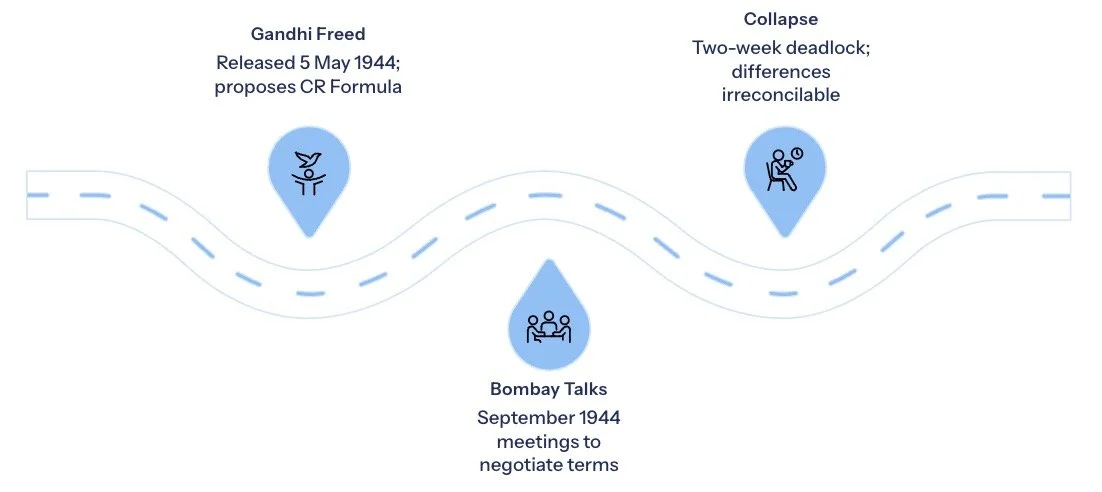
Gandhi was released from prison on 5 May 1944, while most other Congress leaders remained incarcerated. His release came partly because of his deteriorating health and partly due to the changing political atmosphere as Allied victories shifted the tide of the Second World War. Almost immediately, Gandhi sought direct dialogue with Mohammed Ali Jinnah, placing the CR formula at the heart of his proposals.
The two leaders — arguably the most powerful political figures in India — met in September 1944 for a series of discussions in Bombay. Gandhi hoped to use the CR formula as a bridge between Congress and League positions, proposing what he envisioned as a separation "within the family" — a division that retained elements of shared governance and partnership. Jinnah, however, held a fundamentally different vision of what Pakistan should mean.
The CR Formula & Wavell Plan
After two weeks of intensive negotiations, the talks broke down without agreement. Gandhi later reflected that the failure stemmed from a fundamental divergence in outlook: he sought a familial separation with shared institutions, whereas Jinnah demanded complete and sovereign dissolution. Viceroy Wavell observed with characteristic bluntness that Gandhi did not "really believe" in the formula himself, and that Jinnah was unwilling to "answer awkward questions" that would expose the unexamined implications of Pakistan.
Why the CR Formula Failed: Objections and Reactions
The CR formula drew criticism from multiple quarters — not only from Jinnah and the Muslim League, but also from other political formations who felt it went too far or not far enough. Understanding these objections reveals the extraordinary complexity of India's political landscape in 1944.
Jinnah's Objections
Demanded Congress formally accept the two-nation theory before negotiations
Wanted only Muslims of North-West and North-East to vote in the plebiscite — not the entire population
Argued that the League alone represented all Indian Muslims; adult franchise was therefore "redundant"
Feared a plebiscite would risk partitioning Punjab and Bengal, as Muslim majorities were not absolute in every district
Opposed the idea of a common centre for shared governance of defence, commerce, and communications
Other Objections
Akali Dal (Master Tara Singh): Saw the formula as Congress's betrayal of the Sikhs — Punjab's partition would divide the Sikh community between two nations
V. D. Savarkar & Syama Prasad Mookerjee (Hindu Mahasabha): Opposed any concession toward Pakistan
Srinivas Sastri (National Liberal Federation): Rejected the proposal entirely
Lord Wavell: Suggested both Gandhi and Jinnah approached the talks in bad faith, each unwilling to confront the full implications of their positions
Key Takeaway : Jinnah's core objection was twofold — he rejected the principle of universal adult franchise for the plebiscite (wanting only Muslims to vote) and insisted on full sovereignty without any shared institutional framework. The Sikh objection to Punjab's partition is often tested separately in examinations.
The Wavell Plan (1945): Background and Proposals
Lord Wavell succeeded Lord Linlithgow as Viceroy of India in October 1943. He inherited a situation of complete political stalemate: Congress leaders were imprisoned, the Muslim League was consolidating its position, and the war had created economic and social pressures across the subcontinent. With the war moving decisively in the Allies' favour by early 1945, Wavell recognised that the moment had come to make a fresh political move.
Wavell travelled to England in March 1945 for consultations with the British Government. On 14 June 1945, he broadcast his proposals to the people of India — simultaneously, the Secretary of State for India, Mr. Amery, made a corresponding statement in the House of Commons. These proposals came to be known as the Wavell Plan.
Renovation of the Executive Council
The Governor-General's Executive Council would be completely reconstituted, pending preparation of a new constitution. All members except the Governor-General and Commander-in-Chief would be drawn from Indian political leadership.
Balanced Community Representation
The new Council would have a balanced representation of main communities, with equal proportions of Muslims and caste Hindus. Scheduled Castes would be separately represented. The Council would operate under the existing constitution.
Limited Veto Power
The Governor-General's veto would not be abolished but would not be exercised unnecessarily. The portfolio of External Affairs would be transferred to an Indian member of the Council.
Shimla Conference
A conference of representatives chosen by the Viceroy would be convened to obtain joint or separate lists of suitable persons to constitute the new Executive Council. Provincial ministers would also resume office, with coalition governments expected.
The Wavell Plan was also informally known as the Breakdown Plan — in the event of fundamental disagreement, it proposed that Britain withdraw to the six Pakistan provinces and leave Congress to manage the rest of India. This provision was not accepted by the British Government, which considered withdrawal without a universally agreed settlement to be dishonourable.
The Shimla Conference (June–July 1945)
To discuss the Wavell Plan's provisions, the Viceroy invited 21 Indian political leaders to Shimla — the summer capital of the British administration. The gathering included luminaries such as Maulana Abul Kalam Azad, then President of the Congress, and Mohammed Ali Jinnah, President of the All India Muslim League. The Congress leaders, recently released from prison, participated with cautious optimism.
The conference was convened with the explicit aim of agreeing upon the Wavell Plan for Indian self-government. Initial discussions yielded a potential agreement that provided separate representation to Muslims and sought to balance power between communities in their respective majority regions. For a brief moment, a united and self-governing India seemed within reach.
The Shimla Conference (June–July 1945)
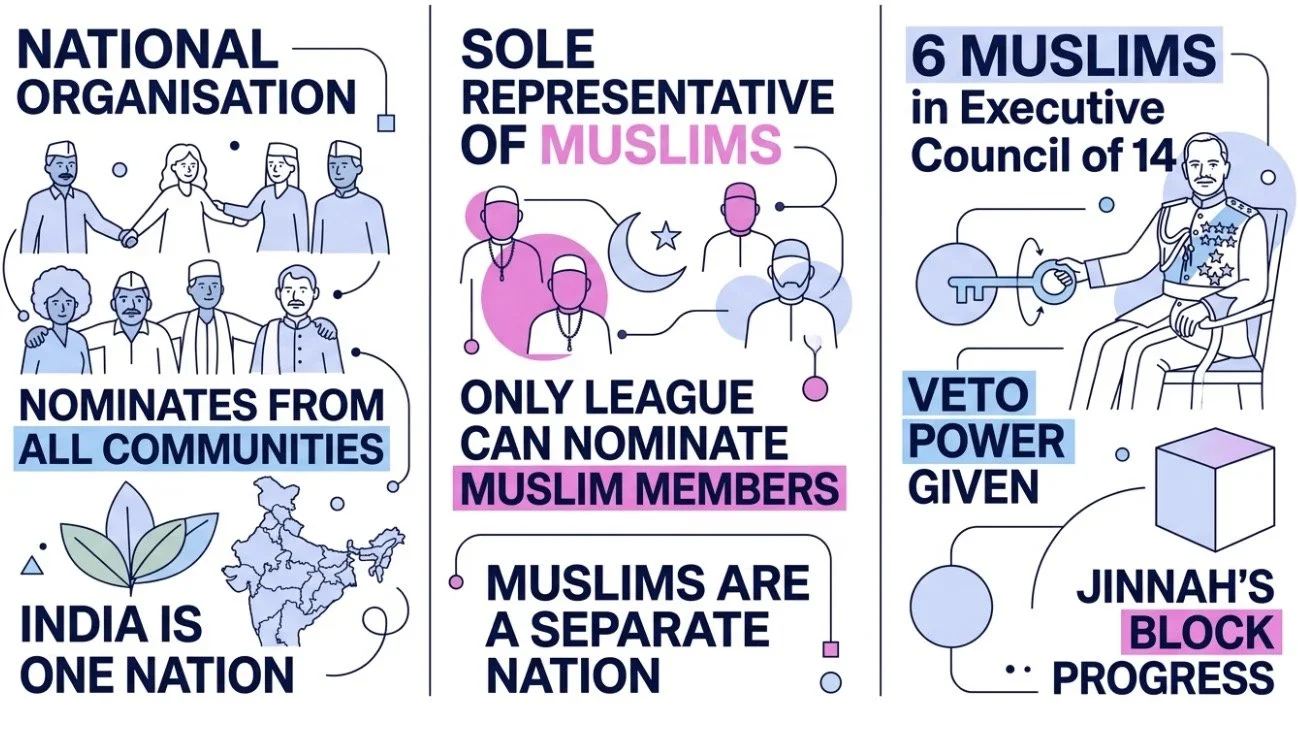
The central issue that shattered the conference was the selection of Muslim representatives to the Executive Council. Jinnah categorically stated that no non-League Muslim could be represented, since the Muslim League alone held the right to represent Indian Muslims. This meant Congress — a national organisation that included Muslim members — could not nominate any Muslim to the Council. This was a position Congress could not accept without fundamentally compromising its identity as a national, multi-religious organisation.
Jinnah further demanded that any vote divided along communal lines should require a two-thirds majority to pass — effectively granting the Muslim bloc a structural veto over all Council decisions. Wavell had allocated 6 Muslim seats in a 14-member Council, even though Muslims constituted only 25% of India's population. These unreasonable demands were rejected by Congress, but the League refused to relent. Lord Wavell ultimately dropped the plan and declared the conference a failure.
Responsibility for the Failure of the Shimla Conference
The failure of the Shimla Conference was not a simple matter of one party's intransigence — it involved a complex interplay of rigid positions, strategic miscalculations, and deliberate political manoeuvring. Historians and contemporaries alike have distributed the blame across multiple actors.
Lord Wavell's Role
Wavell reversed the precedent set by the Cripps Mission, which had recognised the INC as the primary platform for negotiations. By creating two equal platforms at Shimla, Wavell elevated the League to the same status as Congress.
He also failed to share his final list of Executive Council members with party leaders beforehand — a step that might have enabled a compromise through quiet persuasion.
Most critically, Wavell handed Jinnah effective veto power over all constitutional progress, making him the sole arbiter of Muslim representation.
Jinnah's Intransigence
Jinnah refused to allow Congress to nominate any Muslim to the Council, insisting the League alone spoke for all of India's Muslims. He declined to negotiate on this core demand.
He demanded structural vetoes through the two-thirds majority provision, making governance effectively impossible without League approval.
Congress President Maulana Azad placed the blame for the conference's breakdown directly on Jinnah's shoulders.
Congress's Position
Congress insisted on its right to nominate representatives from all communities, including Muslims — a non-negotiable principle for a self-described national organisation.
Gandhi objected to the use of the term "caste Hindus" in the Wavell Plan's framing, reflecting sensitivities within Congress over communal categorisation.
The party refused to accept that it had no right to represent Indian Muslims, which conflicted directly with the League's exclusive claim.
"The viceroy had assured the Congress President that no party to the conference could be allowed to obstruct settlement out of wilfulness — but as in the parallel case of Cripps, Wavell's hands were stayed at the last moment."
Consequences and Aftermath
The failure of the Shimla Conference had profound and lasting consequences for the future of India. What some historians have called the last viable opportunity for a united independent India was squandered, and the political landscape shifted dramatically in favour of the Muslim League.
Jinnah Elevated to Gandhi's Equal
By giving Jinnah effective veto power over constitutional arrangements, Lord Wavell formally raised the Muslim League to the status of Congress's sole counterpart. Jinnah became, in the public eye, the "Muslim Gandhi" — the undisputed leader of a separate Muslim political nation.
League Strengthened Before 1945–46 Elections
The conference's failure dramatically strengthened the Muslim League's position. This was clearly manifested in the elections of 1945–46, where the League swept Muslim-reserved seats, vindicating its claim to represent all Indian Muslims and making Partition increasingly difficult to avoid.
Congress Less Sympathetic in Cabinet Mission
When Congress and the League reconvened under the Cabinet Mission in 1946, Congress was far less accommodating of League demands, despite Jinnah's initial approval of the British plan. The accumulated frustrations of failed negotiations had hardened Congress's positions.
The tangible result of these two failures — the CR formula negotiations and the Shimla Conference — was to entrench communal divisions and make the two-nation framework appear ever more inevitable. The Muslim League had emerged from both episodes as a significantly more powerful political actor than it had entered them, with the institutional backing of British recognition and the political capital of demonstrated Congress concessions.
Key Takeaways
These two episodes — the CR Formula of 1944 and the Wavell Plan with Shimla Conference of 1945 — are frequently examined in UPSC, State PCS, and school-level history papers. The following summary consolidates the most important facts, arguments, and analytical points.
1944 — CR Formula Proposed
Rajagopalachari proposes Congress-League cooperation with post-war plebiscite on Pakistan. Gandhi supports it. Rejected by Jinnah, Hindu Mahasabha, Akali Dal, and National Liberal Federation.
May 1944 — Gandhi Released
Gandhi released from prison as Allied tide turns. Most Congress leaders still imprisoned. Gandhi proposes direct talks with Jinnah using CR formula as basis.
September 1944 — Gandhi–Jinnah Talks
Two weeks of negotiations in Bombay. Talks fail over Jinnah's demand for two-nation theory acceptance, Muslim-only plebiscite, and no common centre.
June 1945 — Wavell Plan Announced
Wavell broadcasts plan for full Indianisation of Executive Council with balanced communal representation. Congress leaders released to participate in Shimla Conference.
June–July 1945 — Shimla Conference Fails
21 leaders meet at Shimla. Talks break down on Jinnah's demand for exclusive Muslim League nomination rights. Wavell drops plan; League emerges stronger.
1945–46 — League Sweeps Muslim Seats
Provincial elections confirm League's dominance among Muslim voters. Path to Partition becomes increasingly clear, setting the stage for the Cabinet Mission of 1946.
Comparison the CR Formula with the Lahore Resolution (1940) and the Cabinet Mission Plan (1946). Key contrasts include the plebiscite methodology (all inhabitants vs. Muslims only), the question of a common centre, and the role of Congress as a national vs. communal organisation. The Shimla Conference is also frequently paired with the Cabinet Mission in questions about India's path to Partition.
