
The INA Trial & RIN Mutiny
The INA Trial & RIN Mutiny
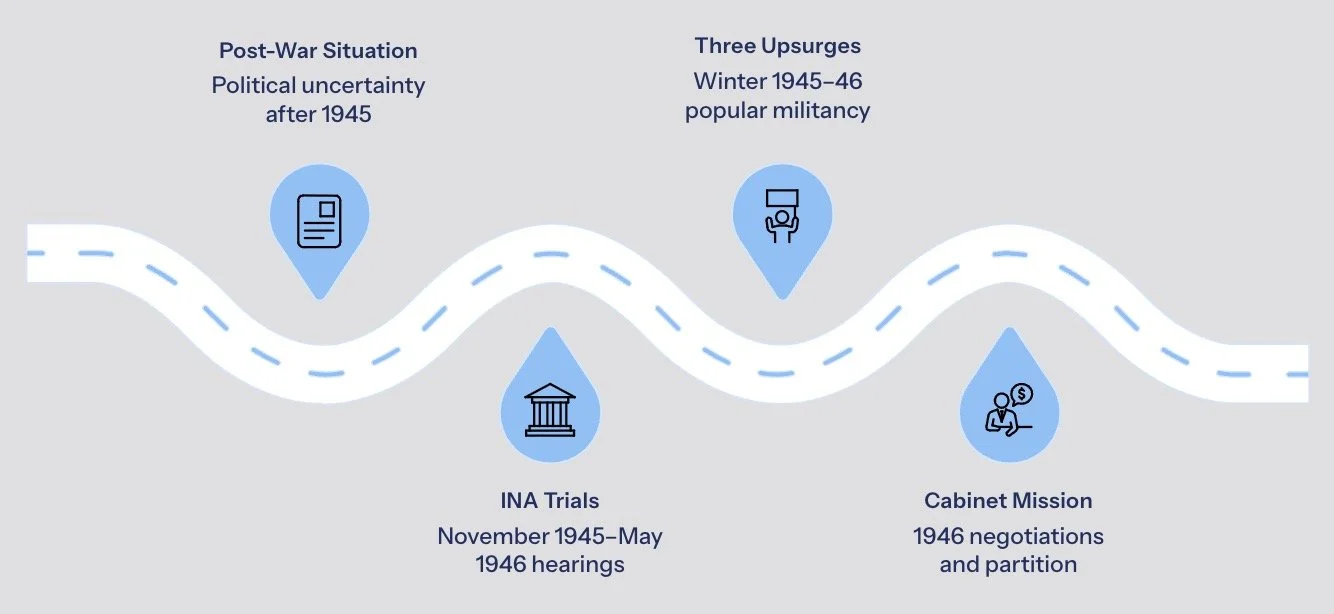
The closing years of British rule in India were shaped not only by political negotiations between Congress, the Muslim League, and the Crown, but also by a dramatic surge of popular militancy. From the celebrated trials at the Red Fort to the sailors' revolt in Bombay harbour, the years 1945–46 witnessed events that fundamentally shook British confidence and accelerated the transfer of power.
The INA Trial & RIN Mutiny
The Post-War Situation in India
The end of the Second World War in 1945 left the British Empire in a dramatically weakened position, and nowhere was this more apparent than in India. When the Government lifted the ban on the Congress and released its leaders in June 1945, the colonial authorities expected to find a demoralised, exhausted people after three years of fierce repression following the Quit India Movement. Instead, they encountered tumultuous crowds seething with impatience and a renewed hunger for freedom. Popular energy had resurfaced with remarkable speed, and the expectations of the people were heightened enormously by the return of their revered leaders.
The political deadlock persisted well into 1945. The Wavell Plan, backed by the outgoing Conservative Government in Britain, had failed to break the constitutional impasse. A decisive shift came in July 1945 when the Labour Party swept to power in Britain, with Clement Attlee as Prime Minister and Pethick Lawrence as Secretary of State for India. In August 1945, elections to central and provincial assemblies were announced, and in September, the Government declared that a Constituent Assembly would be convened after the elections, broadly in the spirit of the Cripps Offer.
Forces Pushing for Change
Labour Government sympathetic to Indian demands
USA and USSR — both superpowers — favoured Indian freedom
British economy shattered; soldiers war-weary
Anti-imperialist wave in Vietnam and Indonesia
Wave of socialist-radical governments across Europe
Fears Within the Colonial Administration
British officials were acutely aware of what another Congress revolt could mean — a revival of the 1942 situation, but far more dangerous. A likely combination of attacks on communications, agrarian revolts, labour trouble, and army disaffection, joined by government officials and police, in the presence of battle-hardened INA men with military experience, presented a genuinely alarming prospect.
Elections were also inevitable: the last elections had been held in 1934 for the Centre and 1937 for the provinces. The British would have had to retreat regardless; the Labour Government only quickened the process somewhat.
Sporadic Mass Action and Militant Movements
Alongside the tortuous high-politics of constitutional negotiations, 1945–46 was characterised by a wave of sporadic, localised, and often extremely militant mass action by workers, peasants, and the peoples of princely states. These struggles were not isolated incidents but part of a broader countrywide ferment that revealed the depth of anti-colonial feeling among ordinary Indians.
INA Release Movement
A nationwide campaign demanding the release of Indian National Army prisoners, which transcended class, community, and geography, becoming the most unifying popular agitation of the period.
Royal Indian Navy Revolt
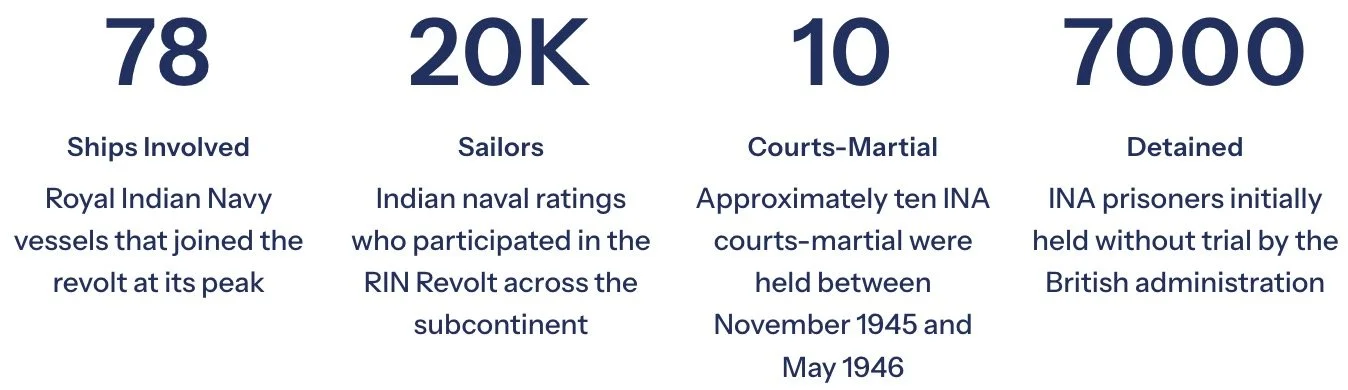
A dramatic mutiny beginning in Bombay harbour on 18 February 1946, eventually involving 78 ships, 20 shore establishments, and 20,000 sailors across the subcontinent.
Peasant Struggles
The Tebhaga movement in Bengal, the Worli revolt, Punjab Kisan Morchas, the Travancore peoples' struggle (including the Punnapra-Vayalar episode), and the Telangana peasant revolt all erupted in this period.
The simultaneity of these struggles was significant. They were not coordinated by any single organisation, yet they all expressed the same underlying mood: a people who had endured years of repression and were now determined, in their various ways, to assert their rights. The Congress election campaign channelled much of this energy, but it also flowed beyond any party's control — a fact that would prove both inspiring and unsettling to the nationalist leadership.
The Congress Election Campaign
Elections were held during the winter of 1945–46 against the backdrop of this charged atmosphere. The most distinctive feature of the Congress election campaign was that it was not merely an appeal for votes — it was a mobilisation of Indians against British rule. The campaign expressed the nationalist sentiment accumulated during the Quit India repression of 1942, and it did so through emotionally powerful means that resonated deeply with ordinary people.
The brave resistance of the leaderless people during 1942 was lauded and celebrated. Martyrs' memorials were established across the country; relief funds were collected for those who had suffered under repression; the officials responsible for brutality were publicly condemned; and Congress leaders promised enquiries and threatened punishment to those guilty. The Government found itself unable to check these speeches, and the effect on the morale of the services was devastating. The prospect of the return of Congress ministries — particularly in provinces where the repression had been most brutal — filled the colonial bureaucracy with dread. A 'gentleman's agreement' with the Congress seemed increasingly necessary.
Glorification of Martyrs
Memorials were set up, relief funds raised, and the courage of ordinary people during the leaderless resistance of 1942 was publicly celebrated and honoured.
Condemnation of Officials
Specific officials responsible for acts of repression were named and condemned in public speeches. Promises of post-independence accountability were made, shaking bureaucratic morale profoundly.
INA as a Symbol
The INA soldiers were portrayed as patriots who had fought for India's freedom, turning the forthcoming trials into a powerful rallying point around which cross-community sentiment could unite.
The INA Trials: The Red Fort Courts-Martial
The Indian National Army trials — popularly known as the Red Fort Trials — were courts-martial of officers of the INA held between November 1945 and May 1946. They were charged variously with treason, torture, murder, and abetment of murder. The decision to hold a public trial at the symbolically resonant Red Fort in Delhi proved to be a serious political miscalculation by the colonial government. Rather than serving as a warning, the trials became a stage upon which the INA officers were transformed into national heroes in the eyes of millions.
The first and most celebrated trial was the joint court-martial of Colonel Prem Sahgal, Colonel Gurubaksh Singh Dhillon, and Major General Shah Nawaz Khan. All three had been officers in the British Indian Army, taken as prisoners of war in Malaya, Singapore, and Burma, before joining the INA and fighting alongside Japanese forces in Imphal and Burma in allegiance to Azad Hind. These three were uniquely charged with "waging war against the King-Emperor" (the Indian Army Act of 1911 having no separate charge for treason) as well as murder and abetment of murder. Those tried subsequently faced only charges of torture and murder.
Defence Committee
The INA Defence Committee was a formidable assembly of legal and political talent. Defence was organised by:
Bhulabhai Desai
Tej Bahadur Sapru
Kailash Nath Katju
Jawaharlal Nehru
Asaf Ali
An INA Relief and Enquiry Committee distributed funds, food, and helped arrange employment for the affected families.
Second Trial and Modifications
In light of unrest and the glorification generated by the first trial, the charge of treason was dropped in the second trial, which involved Abdul Rashid, Shinghara Singh, Fateh Khan, and Captain Malik Munawar Khan Awan. The site was also moved from the Red Fort to an adjoining building, reflecting the government's anxiety about the political spectacle it had created.
The Advocate General of India, Sir Naushirwan P. Engineer, was appointed counsel for the prosecution, but the political winds were already turning decisively against the government's position.
The INA Agitation: A Landmark on Many Counts
The campaign for the release of INA prisoners was unprecedented in its pitch, intensity, and geographical reach. The agitation secured massive publicity through extensive press coverage featuring daily editorials, distribution of pamphlets (often containing threats of revenge), graffiti conveying similar messages, public meetings, and the celebration of INA Day on 12 November 1945 and INA Week from 5–11 November. The combination of formal political support, popular mass mobilisation, and the emotional resonance of the INA's story made this one of the most powerful agitations in the history of the independence movement.
The INA Agitation: A Landmark on Many Counts
The movement marked the last major campaign in which the Congress and the Muslim League aligned together. Both parties made the release of the three defendants a central political issue. The geographical reach was extraordinary — while the nerve centres were Delhi, Bombay, Calcutta, Madras, UP towns, and Punjab, the campaign spread to Coorg, Baluchistan, and Assam. Support came from film stars, municipal committees, Indians living abroad, gurudwaras, tongawallas (carriage drivers), and political organisations ranging from the Communist Party to the Hindu Mahasabha and the Sikh League. Even government employees collected funds, and loyalists with British titles appealed to the Government to abandon the trials for the sake of Indo-British relations.
The central theme became the right of Britain to decide a matter concerning Indians. Britain realised the political significance of the INA issue, which with each day assumed more and more of an 'Indian versus British' colour.
Three Upsurges: The Winter of 1945–46
The nationalist sentiment that reached a crescendo around the INA trials developed into violent confrontations with authority in the winter of 1945–46. Three major upsurges erupted in quick succession, each following a recognisable three-stage pattern: a group defies authority and is repressed; city people join in; and finally, people in other parts of the country express sympathy and solidarity. These events collectively represented the most dramatic popular challenge to British authority since 1942.
21 November 1945 — Calcutta
Student procession over INA trials. Forward Bloc, SFI activists, and Islamic College students tied League, Congress, and red flags together. Lathi charge, stone-throwing, police firing — two deaths.
11 February 1946 — Calcutta
Protest against the seven-year sentence given to INA officer Rashid Ali. Led by Muslim League students joined by Congress and communist student organisations. Defiance of Section 144; further lathi charges and arrests.
18 February 1946 — Bombay
Strike by Royal Indian Navy Ratings of HMIS Talwar. Spread from Karachi to Calcutta; 78 ships, 20 shore establishments, 20,000 sailors. The defining act of popular militancy in this period.
The Royal Indian Navy Revolt
The Royal Indian Navy mutiny — also called the Bombay Mutiny — was one of the most dramatic events in the final years of British rule. Beginning on 18 February 1946 with a strike by ratings of HMIS Talwar at Bombay harbour, it rapidly spread to engulf ships and shore establishments across the entire subcontinent, from Karachi to Calcutta. At its height, it involved 78 ships, 20 shore establishments, and 20,000 sailors. By dusk on 19 February, a Naval Central Strike Committee had been elected, with Leading Signalman M.S. Khan and Petty Officer Telegraphist Madan Singh unanimously elected President and Vice-President respectively.
Racial Discrimination
Demand for equal pay for Indian and white soldiers — a fundamental grievance about the unequal treatment embedded in the structure of the colonial military.
Conditions & Food
Unpalatable food and abuse by superior British officers provided the immediate, day-to-day provocations that made the sailors' anger impossible to contain.
INA Inspiration
Stories of Netaji and the INA's fight in Imphal and Burma, received through wireless and media, fed discontent and inspired the sailors to strike in solidarity.
Use of Indian Troops Abroad
The deployment of Indian Army units to restore French and Dutch colonial rule in Vietnam and Indonesia deeply offended the anti-imperialist sentiments of the sailors.
A particularly powerful symbol was the flags hoisted by the revolting ships: the Congress tricolour, the Muslim League's crescent flag, and the red flag of the Communist Party of India tied together — signifying a unity that transcended communal division. The revolt found extraordinary popular support: crowds brought food to the ratings, shopkeepers invited them to take whatever they needed, and a one-day general strike was called in Bombay. The strike spread to the Royal Indian Air Force and local police forces in several cities. In Madras and Poona, British garrisons faced revolts within the ranks of the Indian Army.
Suppression of the RIN Revolt
The British response to the mutiny was swift and firm. Prime Minister Clement Attlee ordered the Royal Navy to suppress the revolt. Admiral J.H. Godfrey, commanding the RIN, issued a chilling ultimatum: "Submit or perish." The Royal Air Force flew a squadron of bombers low over Bombay harbour in a show of force. In Karachi, realising that Indian troops could no longer be trusted to act against their compatriots, the 2nd Battalion of the Black Watch was called from their barracks. The ratings holding HMIS Hindustan on Manora Island opened fire when attempts were made to board, but by morning the British soldiers had secured the island. Total fatalities from the mutiny amounted to seven RIN sailors and one officer killed.
The Surrender
The revolt was called off following a crucial meeting between M.S. Khan, President of the Naval Central Strike Committee, and Vallabhbhai Patel, sent to Bombay by the Congress to settle the crisis.
Patel issued a statement calling on the strikers to end their action. This was echoed by a statement from Mohammed Ali Jinnah on behalf of the Muslim League. Under these twin pressures, the strikers gave way on 23 February 1946, with assurances that national parties would prevent victimisation.
Despite these assurances, widespread arrests followed, succeeded by courts-martial and large-scale dismissals from the service.
Jabalpur Army Mutiny
Another Army mutiny took place at Jabalpur during the last week of February 1946, shortly after the Navy mutiny at Bombay. This was suppressed by force, including the use of the bayonet by British troops. It lasted approximately two weeks.
Sympathetic Strikes
Strikes spread to military establishments in Karachi, Madras, Visakhapatnam, Calcutta, Delhi, Cochin, Jamnagar, Andaman, Bahrain, and Aden. The Royal Indian Air Force struck in Bombay, Poona, Calcutta, Jessore, and Ambala.
Lack of Support from National Leadership
One of the most significant and historically debated aspects of the RIN Revolt is the response — or rather, the lack of support — from the mainstream national political leadership. The mutineers in the armed forces were largely leaderless and received no official backing from Congress or the Muslim League. This absence of support ultimately proved decisive in ending the revolt.
Mahatma Gandhi
Condemned the revolt on 3 March 1946, criticising the strikers for revolting without the call of a "prepared revolutionary party" and without the "guidance and intervention" of political leaders. He also criticised Aruna Asaf Ali for supporting the mutineers, arguing: "If the union at the barricade is honest then there must be union also at the constitutional front."
Muslim League
Issued attacks on the mutiny arguing that the unrest of the sailors was not best expressed on the streets. Jinnah echoed Patel in calling for surrender, prioritising the constitutional path to Pakistani statehood over solidarity with the ratings.
Communist Party of India
The third-largest political force extended full support to the naval ratings and mobilised workers in their support. The CPI's literature later portrayed the RIN Revolt as a spontaneous nationalist uprising that had the potential to prevent partition — and that was essentially betrayed by the nationalist leadership.
Aruna Asaf Ali
One of the very few prominent nationalist leaders to openly support the mutineers. She argued she would rather unite Hindus and Muslims on the barricades than on the constitutional front — a stance that drew sharp criticism from Gandhi.
Later historians have concluded that the discomfiture of the mainstream political parties stemmed from the fact that the public outpourings indicated their weakening hold over the masses at a time when they could show no success in reaching agreement with the British Indian government. Both the Congress and the Muslim League feared that if the militant mass uprising succeeded, it would erode the central political authority they were so close to inheriting. The class content of the uprising frightened them. As one historian noted: Patel and Jinnah, two representative faces of the communal divide, were united on this single issue — the ratings must surrender.
Evaluation: Potential and Limits of the Three Upsurges
The three upsurges of the winter of 1945–46 were significant events in the final phase of the independence movement, but historians have debated both their impact and their inherent limitations. They were distinguishable from earlier nationalist activity precisely because of their form of articulation: these were violent challenges to authority, whereas earlier activity had been a peaceful demonstration of national solidarity. This shift both expanded and contracted the possible base of participation.
Significance
Fearless mass action expressed deep militancy in the popular mind
Revolt in the armed forces had a great liberating psychological effect
RIN revolt was widely seen as marking the end of British rule
Prompted concrete British concessions on INA trials and troop deployments
Demonstrated the cross-community potential of anti-imperialist unity
Limitations
Direct, violent conflict could only engage the more militant sections
Short-lived and confined to a few urban centres
General INA agitation reached remote villages; these upsurges did not
Communal unity was more organisational than genuine popular unity
British repressive infrastructure remained intact; situation was quickly controlled
A Maratha battalion ultimately rounded up the ratings in Bombay
The question of whether the communal unity witnessed during these events, if built upon, could have offered a way out of the communal deadlock is one that historians have pondered deeply. The Communist Party argues yes — that the RIN Revolt was the great missed opportunity. The mainstream nationalist view, as expressed by Gandhi and Patel, was that spontaneous and unregulated mass uprisings could only disrupt the careful negotiations on which independence depended. The Congress did not officially support the upsurges because negotiations had been an integral part of its strategy — especially when the British appeared to be preparing to leave in any case. Congress indifference also stemmed from two deeper fears: that the situation would go out of its control, and that disciplined armed forces would be vital in a free India.
British Concessions Following the Upsurges
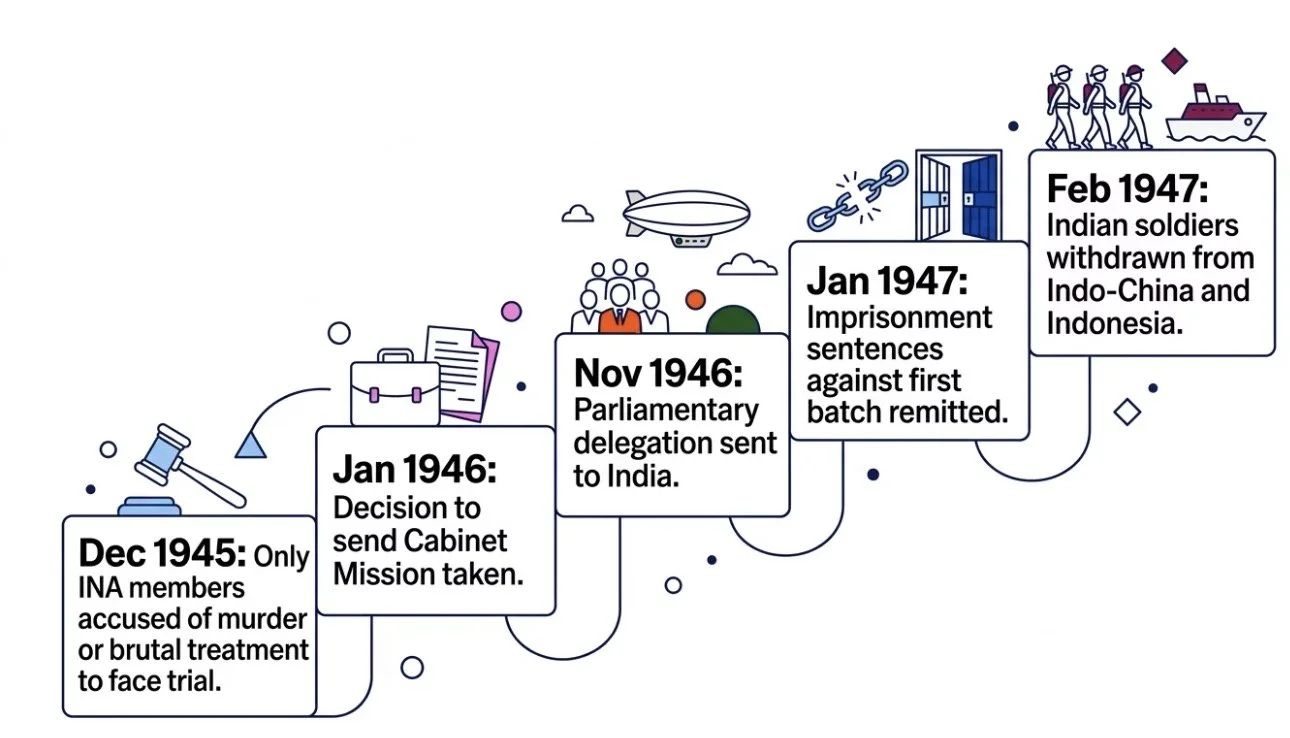
Despite suppressing the immediate revolts, the British were compelled to make substantial concessions in the wake of the three upsurges and the broader INA agitation. These concessions reflected a fundamental shift in the balance of power between the colonial government and the Indian political leadership, and they signalled clearly that the days of British rule were numbered.
The INA Trial & RIN Mutiny
These concessions collectively illustrated the limits of British power in the post-war context. The decision to send the Cabinet Mission in January 1946 was perhaps the most consequential: it represented Britain's formal acceptance that the transfer of power was imminent and that the only remaining question was its terms. The withdrawal of Indian troops from Indo-China and Indonesia also responded directly to one of the RIN mutineers' core demands, demonstrating that even an "unsuccessful" revolt could achieve tangible political results.
Election Results: 1945–46
The elections held during the winter of 1945–46 produced results that reshaped the political landscape of India and defined the terms of the constitutional negotiations that followed. The results confirmed the dominance of the two major parties — the Congress and the Muslim League — while also revealing the extent to which communal voting had taken hold, in sharp contrast to the cross-community unity displayed in the popular upsurges.
Congress Performance
Won 91% of non-Muslim votes
Captured 57 out of 102 seats in the Central Assembly
Majority in most provinces, including NWFP and Assam
Coalition with Unionists and Akalis in Punjab under Khizr Hyatt Khan
Did not win majorities in Bengal, Sindh, and Punjab
Muslim League Performance
Won 86.6% of Muslim votes
Captured all 30 reserved seats in the Central Assembly
Majority in Bengal and Sindh
Unlike 1937, the League now clearly established itself as the dominant party among Muslims
Result lent enormous credibility to Jinnah's claim to speak for Indian Muslims
The elections were notable for what they revealed about the distortions built into the electoral system itself. The franchise was extremely limited: for the provinces, less than 10% of the population could vote, and for the Central Assembly, less than 1% of the population was eligible. This meant that the election results reflected the political preferences of a tiny, educated, and propertied elite rather than the broad popular mood that had been so visibly expressed in the INA agitation and the three upsurges. Furthermore, the system of separate electorates — by which Muslims voted only for Muslim candidates — institutionalised communal divisions at the very moment when popular action had been demonstrating the possibility of Hindu-Muslim unity.
The 1946 Cabinet Mission to India
The United Kingdom Cabinet Mission of 1946 to India was formulated at the initiative of Prime Minister Clement Attlee and represented Britain's most serious and sustained effort to oversee an orderly transfer of power. The Mission consisted of Lord Pethick-Lawrence (Secretary of State for India), Sir Stafford Cripps (President of the Board of Trade), and A.V. Alexander (First Lord of the Admiralty). Notably, Viceroy Lord Wavell did not participate directly. The Mission's purpose was threefold: to hold preparatory discussions with elected representatives, to set up a constituent body, and to establish an Executive Council with the support of the main Indian parties.
Preparatory Discussions
Hold talks with representatives of British India and the Indian states to secure agreement on the method of framing a new constitution for independent India.
Constituent Body
Set up a Constituent Assembly to draft the new constitution, representative of both British India and the princely states.
Interim Executive Council
Establish an Executive Council with the support of the main Indian parties to govern India during the transitional period before full independence.
The Mission held talks with the Congress and the Muslim League — the two largest parties in the Constituent Assembly — to determine a power-sharing arrangement and to decide whether British India would be better off unified or divided. The Congress wanted a strong central government with more powers than state governments. The League under Jinnah wanted India to remain united but with political safeguards — particularly a guarantee of 'parity' in the legislatures — to protect Muslims from what was widely feared would become a 'Hindu Raj' once the British departed.
The Cabinet Mission Plan of 16 May 1946
After extensive dialogue, the Mission announced its plan on 16 May 1946 — preceded by the Simla Conference of 1945. The plan sought to keep India united while addressing Muslim fears through a system of provincial groupings. It was one of the most complex constitutional proposals ever advanced for India, and its ultimate failure to secure agreement from both parties was to have momentous consequences.
United Dominion
A united Dominion of India as a loose confederation of provinces would be given independence, preserving the territorial integrity of the subcontinent.
Group A (Muslim-Majority North-West)
Sindh, Punjab, and the North-West Frontier Province would form one group, providing political consolidation for Muslim-majority provinces in the north-west.
Group B (Muslim-Majority North-East)
Bengal and Assam would form a second group — a provision that was particularly contentious, as Assam had a Congress majority government.
Group C (Hindu-Majority Provinces)
Hindu-majority provinces in central and southern India would form a third group. The Centre would handle defence, currency, and diplomacy; all remaining powers went to the provinces.
The consensus between Congress and the League collapsed over these groupings. Congress abhorred the idea of groupings designed to 'balance' Muslim and Hindu majority provinces at the Central Legislature. The League could not accept any modifications to this plan, since the very 'parity' that Congress rejected formed the basis of the Muslim political safeguards Jinnah had long demanded. Reaching an impasse, the British proposed a second, alternative plan on 16 June 1946 that provided for the partition of India into two dominions — the option Congress had, through its rejection of parity, effectively made inevitable.
Reactions to the Cabinet Mission Plans
The responses of the two main parties to the Cabinet Mission plans were critical in determining the path to independence and partition. The Congress Working Committee officially declined to accept either plan outright. Its resolution of 24 May 1946, in response to the May plan, stated that the connected problems of the Provisional Government and Constituent Assembly must be viewed together, and that in the absence of a full picture, no final opinion could be given. A subsequent resolution of 25 June 1946, responding to the June plan, was more forthright in rejection.
In the formation of a Provisional or other governance, Congressmen can never give up the national character of Congress, or accept an artificial and unjust parity, or agree to a veto of a communal group. The Committee are unable to accept the proposals for formation of an Interim Government as contained in the statement of June 16. The Committee have, however, decided that the Congress should join the proposed Constituent Assembly with a view to framing the Constitution of a free, united and democratic India.
On 10 July 1946, Jawaharlal Nehru declared in Bombay that Congress had agreed only to participate in the Constituent Assembly and "regards itself free to change or modify the Cabinet Mission Plan as it thought best." This statement, by signalling that Congress would not be bound by the groupings provision, effectively destroyed the last basis for the League's acceptance of a united India. Jinnah responded by announcing on 29 July 1946 that the League would not participate in the Constituent Assembly, as he held that only the Muslim League could nominate Muslim candidates.
Interim Government Composition (August 1946)
The Viceroy invited 14 men to join the interim government in June 1946. When the League refused to participate, Nehru was invited on 12 August 1946 to form the provisional government. The announced council of 12 included 5 Hindus, 3 Muslims and one each of scheduled caste, Christian, Sikh, and Parsi. Congress replaced Muslim League candidates with its own members, further inflaming League grievances.
Nehru as Vice-President
Jawaharlal Nehru became head of the interim government (Vice-President in title but possessing executive authority). Vallabhbhai Patel became Home member. Congress-led governments were formed in most provinces, including NWFP and Punjab (in coalition).
Direct Action Day and the Breakdown of Coalition
With the Muslim League excluded from the Constituent Assembly and the Congress having formed the interim government without League participation, Jinnah and the League vowed to agitate for Pakistan "by any means possible." The consequences were catastrophic. The League declared 16 August 1946 as Direct Action Day — designed to demonstrate the strength of Muslim feeling to both the British and Congress. What followed was among the worst communal violence in Indian history.
The Great Calcutta Killings
16 August 1946 witnessed widespread riots and mass killing between Hindus and Muslims in Calcutta. The day marked the start of what became known as "The Week of the Long Knives." Communal riots then spread throughout India. Viceroy Wavell stalled the Central government's efforts to suppress the disorder, instructing that the matter be left to provincial governors, who took little effective action.
The Dysfunctional Coalition
To end the disorder, Wavell encouraged Nehru to invite the League into government. Despite opposition from Patel and most Congress leaders, Nehru conceded in hope of preserving communal peace. League leaders entered the council under Liaquat Ali Khan (the future first Prime Minister of Pakistan) who became Finance Minister. The council, however, did not function in harmony: League ministers held separate meetings, and both parties vetoed each other's major initiatives, rendering governance impossible.
Upon the arrival of the new and proclaimed last Viceroy, Lord Mountbatten, in early 1947, Congress leaders expressed the view that the coalition was unworkable — leading directly to the eventual proposal and acceptance of the partition of India.
Congress Strategy: A Critical Assessment
The Congress strategy during this period has been the subject of considerable historical debate. The party did not officially support the three upsurges because of their tactics and timing. Negotiations had been an integral part of the Congress strategy, to be explored before a mass movement could be launched — especially when the British appeared to be preparing to leave in any case. But the decision not to back the popular militancy of the winter of 1945–46 came at a significant historical cost.
Congress indifference to the revolutionary situation arose from two considerations: that the situation would go out of its control, and that disciplined armed forces were vital in a free India. Gandhi remarked that the mutiny was "badly advised": if the ratings had mutinied for India's freedom, they were doubly wrong; if they had grievances, they should have waited for the guidance of their leaders. This patrician attitude towards spontaneous popular action reflected the Congress leadership's fundamental approach — it sought to channel popular energy into constitutional paths rather than allow it to express itself freely.
The Revolutionary Path Not Taken
If Congress leaders had not surrendered to power play, a different path to independence might have emerged — one built on the cross-community unity demonstrated in the three upsurges rather than the communal electoral arithmetic of the 1945–46 elections.
The INA Agitation as Congress Creation
These upsurges were, in reality, an extension of earlier nationalist activity fostered by the Congress itself — through its election campaign, its advocacy of the INA cause, and its highlighting of the excesses of 1942. The Congress had lit the fire, but feared the heat.
The RIN Revolt's Enduring Legacy
More recently, the RIN Revolt has been renamed the "Naval Uprising" and the mutineers honoured for the part they played in India's independence. The Communist Party's interpretation — that it was a spontaneous nationalist uprising betrayed by bourgeois leadership — has gained renewed scholarly attention.
Key Themes and Historical Significance
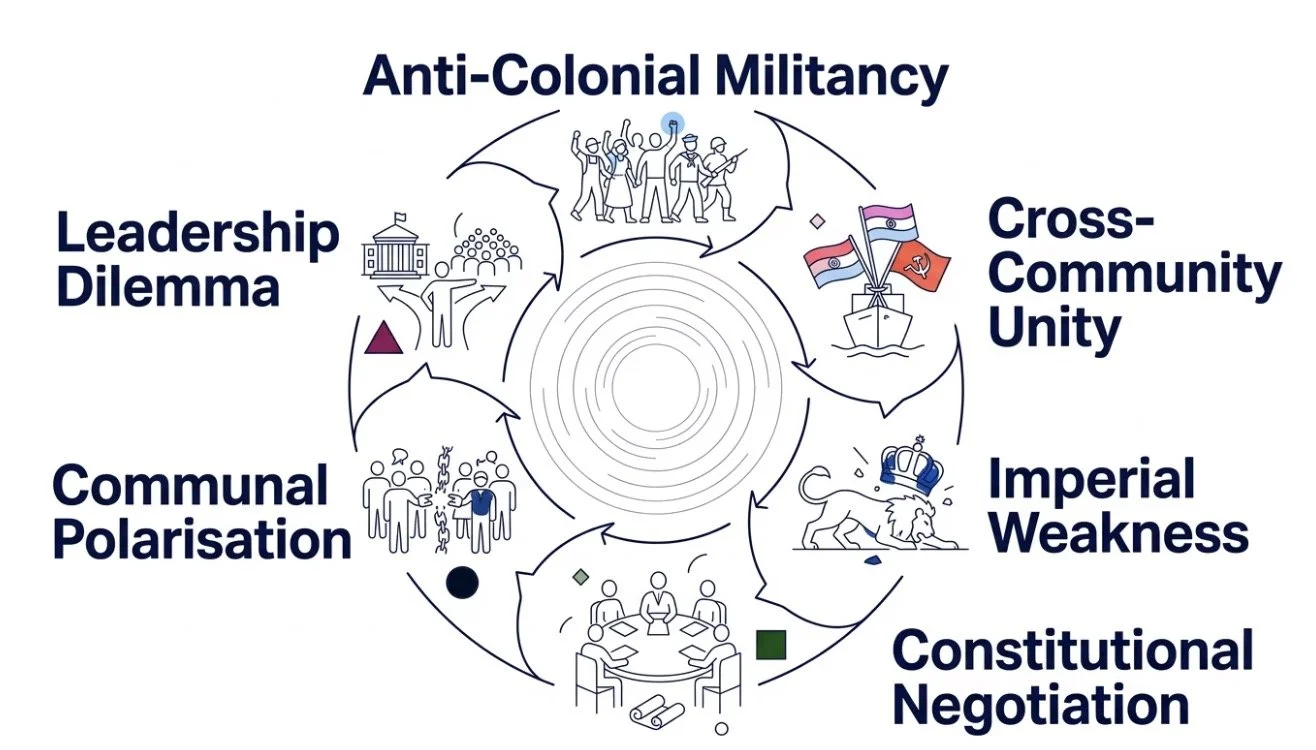
The period of 1945–46 represents one of the most compressed and consequential phases of India's freedom struggle. Within barely eighteen months, India moved from a state of post-war repression to the brink of independence, propelled by a remarkable convergence of mass popular action, constitutional negotiation, and imperial exhaustion. The INA trials, the RIN Revolt, and the three urban upsurges were not isolated episodes but deeply interconnected expressions of the same fundamental reality: the era of British rule in India was ending.
The INA Trial & RIN Mutiny:Key Themes and Historical Significance
The tragic irony of this period is that the communal unity so vividly demonstrated on the streets of Calcutta and Bombay, and on the decks of Indian naval vessels, found no reflection in the constitutional negotiations that determined India's future. The limited franchise, the separate electorates, the intransigence of both the Congress and the League on the question of power-sharing, and ultimately the violence unleashed on Direct Action Day — all combined to foreclose the possibility of a united, independent India. The partition that followed was, in this sense, a failure not just of political negotiation but of the imagination of the leadership to build upon the genuine popular unity that these extraordinary months had briefly made possible.
Key Terms and Revision Points
Use the following reference points for examination preparation and revision. Understanding the connections between these events, personalities, and concepts is essential for answering analytical questions on this period of modern Indian history.
Key Events
Red Fort Trials (Nov 1945–May 1946): Courts-martial of INA officers; first trial of Sahgal, Dhillon, Shah Nawaz Khan; all sentenced to deportation for life, then released under mass pressure.
Three Upsurges (Winter 1945–46): Calcutta (21 Nov 1945), Calcutta again (11 Feb 1946), RIN Revolt Bombay (18 Feb 1946). Each followed a three-stage pattern of defiance, city-wide support, and national sympathy.
Cabinet Mission Plan (16 May 1946): Proposed united India with three provincial groupings; collapsed over Congress rejection of parity and League's insistence on it.
Direct Action Day (16 August 1946): League-organised protest leading to the Great Calcutta Killings and the collapse of the constitutional road to a united India.
Key Personalities
M.S. Khan & Madan Singh: President and Vice-President of the Naval Central Strike Committee; led the RIN Revolt from HMIS Talwar.
Bhulabhai Desai: Led the INA Defence Committee at the Red Fort Trials alongside Nehru, Asaf Ali and others.
Aruna Asaf Ali: The only prominent nationalist leader to openly support the RIN mutineers; criticised by Gandhi for doing so.
Liaquat Ali Khan: Led the League in the dysfunctional interim government as Finance Minister; later became Pakistan's first Prime Minister.
Claude Auchinleck: Commander-in-Chief of the Indian Army who, under immense public pressure, released the three INA defendants despite their sentences.
Examination Tip: Questions on this period frequently ask students to evaluate whether the events of 1945–46 made partition inevitable, or whether the communal unity demonstrated in the upsurges offered an alternative path. Ensure you can argue both sides, using specific evidence from the INA agitation, the RIN Revolt, the election results, and the Cabinet Mission's failure.
