
The Cabinet Mission Plan, 1946
The Cabinet Mission Plan of 1946 stands as one of the most consequential — and ultimately ill-fated — attempts to negotiate a constitutional framework for a united, independent India. Dispatched by Britain's post-war Labour government under Clement Attlee, the Mission sought to reconcile the competing visions of the Indian National Congress and the All-India Muslim League, while preserving British strategic interests in the subcontinent.
British Strategic Interests and the Push for a United India
British policy in 1946 was shaped by a fundamental strategic calculation: a divided India would be a weaker, less reliable partner in the post-war Commonwealth order. The preferred British outcome was a united, independent India that would remain friendly to Britain and serve as an active partner in Commonwealth defence arrangements. A fragmented subcontinent, British planners believed, would lack strategic depth, frustrate joint defence planning, and stand as an embarrassing monument to failed diplomacy.
Crucially, Pakistan was not envisaged by Britain as her natural future ally. This sharply distinguished British policy in 1946 from the earlier posture of encouraging communal forces and legitimising the All-India Muslim League's maximalist demands. Continuance of imperial rule had once demanded a stance of divide and control; withdrawal and the imperatives of post-imperial relationships now dictated a contrary posture — one of encouraging unity.
Congress Demand
Transfer of power to one strong centre. Minorities' demands to be resolved within the Indian Union framework — but after the British left.
British Preference
A united India, friendly to Britain, active in Commonwealth defence. A divided India was seen as strategically weak and diplomatically damaging.
This strategic preference manifested in Prime Minister Attlee's landmark statement of 15 March 1946, in which he declared that "a minority will not be allowed to place a veto on the progress of the majority." This was a dramatic departure from the precedent set at the Simla Conference of June–July 1945, where Viceroy Wavell had permitted Jinnah to wreck negotiations by insisting on nominating all Muslim representatives himself. The shift in tone was unmistakable and deliberate.
Composition and Mandate of the Cabinet Mission
On 19 February 1946, Prime Minister Clement Attlee announced the dispatch of a high-powered Mission of three Cabinet Ministers to India. The Mission was to work "in conjunction with the leaders of Indian opinion" toward the "early realisation of full self-government in India." This was a formal and public commitment to the transfer of power — a departure from the ambiguities of earlier wartime declarations.
Lord Pethick-Lawrence
Secretary of State for India. Led the Mission and served as its principal negotiator with Indian political leaders.
Sir Stafford Cripps
President of the Board of Trade. Had previously led the failed Cripps Mission of 1942; brought detailed knowledge of Congress positions.
A. V. Alexander
First Lord of the Admiralty. Represented British strategic and defence interests in the deliberations.
Notably, Viceroy Lord Wavell did not participate in the Mission's deliberations, reflecting a deliberate effort by London to conduct negotiations at the highest political level, bypassing the Viceroy's more cautious instincts. The Mission arrived in India in March 1946 and proceeded to hold extensive talks with representatives of the Indian National Congress and the All-India Muslim League — the two largest parties in the recently constituted provincial assemblies.
The Mission's stated purpose had three interlocking objectives: to hold preparatory discussions with elected representatives of British India and the Indian states; to set up a constitution-making body; and to establish an Executive Council with the support of the principal Indian parties. These objectives reflected both the short-term imperative of managing the transition and the longer-term aspiration of leaving behind a stable constitutional order.
The Political Fault Lines: Congress and the League
Before examining the Cabinet Mission Plan itself, it is essential to understand the irreconcilable positions that the two major parties brought to the negotiating table. These positions were not merely political preferences; they reflected fundamentally different visions of what post-colonial India should look like.
Indian National Congress
Congress sought a strong, centralised government with powers significantly greater than those of provincial or state governments. It viewed a powerful Union as essential for economic development, national integration, and the management of defence. Congress was deeply suspicious of arrangements that might allow provinces to function as quasi-sovereign units.
All-India Muslim League
Under Jinnah, the League was nominally willing to accept a united India — but only with robust political safeguards for Muslims, including guaranteed parity in central legislatures. The League's position was rooted in the widespread Muslim fear that British departure would simply replace the British Raj with a "Hindu Raj," leaving Muslims politically defenceless against an overwhelming Hindu majority.
The League regarded itself as the sole legitimate spokesman for all Indian Muslims and considered it a matter of political survival to extract constitutional guarantees from the Crown before any transfer of power. This stance made negotiation extraordinarily difficult: Congress could not concede parity without undermining its vision of democratic majority rule, while the League could not abandon parity without conceding its central claim to political protection for Muslims.
These irreconcilable positions were the structural constraint within which the Cabinet Mission had to operate. Any plan that could satisfy both parties simultaneously would require a degree of creative constitutional ambiguity — and it was precisely this ambiguity that would eventually unravel the Plan.
The Cabinet Mission Plan of 16 May 1946
After weeks of consultations that failed to produce direct agreement between Congress and the League, the Cabinet Mission announced its own plan on 16 May 1946. The central feature of the Plan was a decisive rejection of the demand for a sovereign Pakistan and the proposal, in its place, of a three-tier loose federal structure for a united India.
The Cabinet Mission rejected the proposal of a sovereign Pakistan with six provinces as a non-viable concept and offered instead a three-tier structure of a loose federal government for the Union of India, including both the provinces and the princely states.
At the apex of this structure would be a Union of India — embracing both British India and the princely states — which would be responsible for three subjects only: Foreign Affairs, Defence, and Communications, together with the financial powers necessary to sustain these functions. The Union would have an Executive and Legislature constituted from representatives of both British Indian provinces and the Indian states.
A critical communal safeguard was built into the legislative process: any question raising a major communal issue in the Legislature would require a double majority — a majority of the representatives of the two major communities present and voting, as well as a majority of all members present and voting. This was a significant concession to the League's demand for communal protection at the centre.
Group A
Six Hindu-majority provinces: Madras, Bombay, C.P., U.P., Bihar and Orissa
Group B
North-western Muslim-majority provinces: Punjab, N.W.F.P. and Sind
Group C
North-eastern provinces: Bengal and Assam
Provinces were to enjoy full autonomy over all subjects not assigned to the Union, and all residuary powers would vest in the provinces. Provinces would be free to form groups with their own executives and legislatures, and each group could determine which provincial subjects would be managed in common. After the first general elections, a province could leave a group; after ten years, any province could call for a reconsideration of the group or Union constitution.
The Fatal Ambiguity: Compulsory or Optional Grouping?
The single most consequential — and deliberately unresolved — question in the Cabinet Mission Plan was whether the grouping of provinces was compulsory or optional. This ambiguity was not an oversight; it was a calculated attempt to keep both parties within the framework by allowing each to read the Plan as a confirmation of its own position. The gamble failed catastrophically.
The League's Interpretation
The Muslim League took compulsory grouping to be the "corner-stone of the whole edifice" of the proposals. For the League, Groups B and C — which would be overwhelmingly Muslim-dominated — represented the "substance of Pakistan" within a formal Union structure. The League's acceptance of the Plan was explicitly premised on this interpretation.
Congress's Interpretation
Congress maintained that grouping was optional for provinces, and that any province was free to join or not join any group. This interpretation was driven by concern for Congress-governed provinces — specifically Assam and NWFP — which would find themselves placed in Muslim-majority groups despite having voted Congress majorities.
The British Decision
When forced to adjudicate, the British Government ultimately decided in favour of the League's interpretation — that grouping was compulsory. This decision alienated Congress and further hardened positions on both sides.
The Mission Plan declared that grouping was optional but sections were compulsory — a logical contradiction that, rather than being clarified, was deliberately left unresolved. As one analysis puts it, the Mission "quibbled about" this tension "in the hope of somehow reconciling the irreconcilable." The result was that each party proceeded on its own interpretation, making genuine agreement illusory.
The ambiguity over compulsory versus optional grouping became the pivot on which the entire Cabinet Mission Plan eventually broke down. It illustrates the structural limits of constitutional ambiguity as a negotiating tool in conditions of deep communal distrust.
Constitution-Making Machinery
Beyond the three-tier federal structure, the Cabinet Mission Plan made detailed provisions for a Constituent Assembly that would draft the constitution for the whole of India. These provisions were carefully designed to reflect the communal arithmetic of British India while giving all significant communities a voice in the constitution-making process.
Provincial Representation
Provinces would send representatives to the Constituent Assembly on the basis of population — roughly one representative per million people. Seats allocated to each province were divided into three categories: General (210 seats), Muslim (78 seats), and Sikh (4 seats).
Election by Provincial Assemblies
The Constituent Assembly would be elected by the recently constituted provincial legislative assemblies. It would first meet at the Union level and then divide into three Sections corresponding to the three Groups.
Sectional Meetings
Section A (Hindu-majority regions), Section B (north-western Muslim-majority), and Section C (north-eastern Muslim-majority: Bengal and Assam) would each settle the provincial constitutions of the provinces within their section and decide whether any group constitution should be established.
Opt-Out Rights
After constitutions were settled at all three levels (Province, Group, and Union), provinces would have the right to opt out of any particular group — but not from the Union itself. Reconsideration of the constitution would be possible after an initial period of ten years and at ten-yearly intervals thereafter.
The princely states would be given adequate representation at the Central Constituent Assembly through negotiations. In the meanwhile, an Interim Government would manage day-to-day administrative matters. Pethick-Lawrence announced that the final goal would be to "accord independence whether within or without the British Commonwealth" as Indians would choose of their own free will — a formulation that formally left the door open to complete independence outside the Commonwealth.
Why the Cabinet Mission Rejected Pakistan
The Cabinet Mission's rejection of the demand for a sovereign Pakistan was not perfunctory — it was argued on multiple grounds, ranging from demographic to logistical to military. Understanding these arguments is essential to grasping why the Mission believed a united India remained viable even in 1946.
Demographic Argument
A separate Pakistan would not solve the communal problem. Non-Muslims in the proposed north-western zone of Pakistan would constitute 37.93% of the population; in the north-eastern zone, 48.31%. Large non-Muslim minorities would thus remain within Pakistan, negating the very premise of communal separation.
Territorial Argument
There was no justification for including the predominantly non-Muslim districts of Bengal, Assam, and the Punjab within Pakistan. Every argument used in favour of Pakistan could equally justify the exclusion of non-Muslim areas from it — an endless regress of partition demands.
Division of Communities
A smaller Pakistan, requiring a division of the Punjab and Bengal, would be against the wishes of a large proportion of inhabitants and would divide the Sikh community into two separate states — a prospect with profound consequences for communal stability.
Administrative and Military Grounds
The communication and railway network had been organised on an all-India basis; division would seriously hurt both successor states. The division of the armed forces was deemed even more problematic. The two proposed halves of Pakistan were separated by some 700 miles, making communication dependent on the goodwill of Hindustan in both war and peace.
These arguments cumulatively presented Pakistan as not just politically inconvenient but structurally unviable. The Mission's rejection of Pakistan was therefore presented as a reasoned conclusion rather than a political preference — though it was, of course, both.
The Muslim League's Acceptance: A Study in Ambiguity
On 6 June 1946, the Muslim League Working Committee formally accepted the Cabinet Mission Plan — even though its preamble categorically rejected the demand for Pakistan. The League's resolution of acceptance was carefully worded to justify this apparent paradox: it asserted that "the basis and the foundation of Pakistan" had been "inherent" in the plan and that acceptance would ultimately lead to "the establishment of complete sovereign Pakistan."
This decision has generated contradictory interpretations among historians, and it is worth examining these competing analyses, as they illuminate broader questions about Jinnah's ultimate political objectives.
Ayesha Jalal
"The Mission plan was a perfect way forward for the Pakistan Jinnah was after" — for Jinnah never really wanted partition as such. The Pakistan demand was reiterated as a face-saver, not a genuine goal. The three-group structure would have given Muslims effective autonomy without the strategic and demographic costs of outright partition.
Asim Roy
The League's resolution suggested that Jinnah was still willing to "accept something less than what almost everyone else knew as Pakistan" — indicating continued flexibility on the final constitutional outcome as late as June 1946.
R. J. Moore
The very rhetoric of acceptance signalled "an attempt to turn the scheme to advantage, without compromising in principle." The League accepted the plan instrumentally, not in good faith, reserving the right to withdraw if its interpretation of compulsory grouping was not upheld.
What is clear, regardless of interpretive framework, is that the League's acceptance was conditional and instrumental. The moment Congress offered its own interpretation of the Plan that undermined compulsory grouping, the League would have a principled ground for withdrawal — and Jinnah used precisely this opportunity when it presented itself.
Congress's Conditional Approval and Nehru's Fateful Statement
Congress's response to the Cabinet Mission Plan was characterised by deep internal ambivalence. The Congress Working Committee's resolution of 24 May 1946 offered a notably non-committal response: the Committee regarded the "connected problems" of the Provisional Government and the Constituent Assembly as requiring a "full picture" before a "final opinion" could be given. This cautious hedging reflected genuine reservations within Congress leadership about several key provisions of the Plan.
Concern Over Grouping of Provinces
Congress was deeply concerned about the placement of Assam and the North-West Frontier Province — both Congress-governed — into Muslim-majority groups. Congress argued that provinces should have the option not to join a group in the first place, rather than waiting until after the first elections to leave.
Demand for Stronger Centre
Congress wanted additional powers for the central government to intervene in crisis situations or extreme breakdowns of law and order — powers that the Mission's Plan, with its emphasis on provincial autonomy, had deliberately withheld.
Sikh Anxieties in Punjab
The proposed grouping arrangements raised serious concerns about the political status of Sikh-majority areas in the Punjab, which would find themselves within a Muslim-majority Group B — a matter of profound concern to the Sikh political leadership.
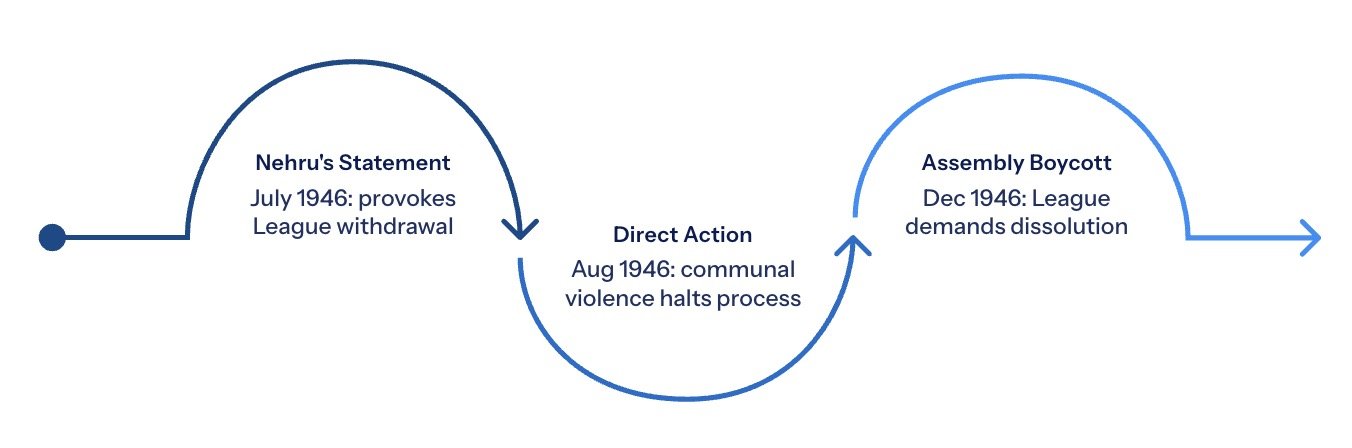
The situation reached a decisive turning point on 10 July 1946, when Nehru — newly elected as Congress President — declared at a press conference in Bombay that Congress had "agreed to nothing else" other than participation in the Constituent Assembly, and that Congress "regards itself free to change or modify the Cabinet Mission Plan as it thought best." He predicted that "the group system would collapse" as NWFP and Assam would not agree to their assigned groupings.
We are not bound by a single thing except that we have decided to go into the Constituent Assembly. — Jawaharlal Nehru to the AICC, 7 July 1946
The implication of Nehru's statement was that the Constituent Assembly was sovereign and could determine its own rules of procedure — effectively nullifying the carefully negotiated provisions of the Mission Plan. Jinnah seized upon this statement to withdraw the League's acceptance of the Mission Plan on 29 July 1946. The window for a negotiated, united India had effectively closed.
The Structural Contradiction at the Heart of the Plan
With the benefit of hindsight, it is possible to identify the precise constitutional contradiction that made the Cabinet Mission Plan unworkable as a long-term settlement. The Plan simultaneously declared that grouping was optional and that sections were compulsory — positions that were logically incompatible.
This contradiction was not accidental — it was a deliberate attempt to offer each party a textual foothold within the same document. The Mission calculated that if both parties entered the constitutional process in good faith, the contradiction could be managed over time through negotiation and convention. This calculation proved to be wrong. In conditions of deep mutual distrust, constitutional ambiguity does not enable compromise; it enables each side to accuse the other of bad faith.
Sardar Patel maintained that the Mission's Plan was against Pakistan, that the League's veto was gone, and that one Constituent Assembly was envisaged. The League simultaneously announced acceptance insofar as the "basis of Pakistan" was implied in the plan by virtue of compulsory grouping. These contradictory readings were not misunderstandings — they were the inevitable consequence of a plan designed to be read in two incompatible ways.
Formation of the Interim Government
Alongside the long-term constitutional plan, the Cabinet Mission sought to establish an Interim Government to manage day-to-day administration during the constitution-making process. This short-term arrangement proved equally fraught, as the question of Muslim representation — specifically, whether Congress could include its own Muslim member — became the immediate flashpoint.
Following consultations, the Viceroy invited fourteen individuals to join the Interim Government on 15 June 1946, representing Congress, the League, the Sikhs, the Parsis, the scheduled castes, and the Christians. However, the arrangement collapsed immediately when Congress proposed including Zakir Hussain among its nominees — a Muslim candidate not acceptable to the League, which insisted that only the Muslim League could nominate Muslim members to the government.
On 29 July 1946 — the same day Jinnah withdrew the League's acceptance of the Mission Plan — the Muslim League Working Committee also withdrew from the short-term plan and issued its call for "Direct Action." The dilemma before the Government became acute: proceed with a Congress-only government, or await League agreement at the cost of further delay and disorder.
15 June 1946
Viceroy invites 14 leaders to join the Interim Government; Congress and League both represented in the proposed list.
29 July 1946
Jinnah withdraws League's acceptance of both the long-term Mission Plan and the Interim Government; calls for "Direct Action."
12 August 1946
Viceroy invites Nehru to form the provisional government; list of 12 members announced, replacing League nominees with Congress members.
2 September 1946
Interim Government formed with Congress members alone; Nehru becomes head (Vice President in title); Patel becomes Home Member.
On 12 August 1946, the Viceroy announced that Nehru was invited to form the provisional government. The twelve-member list contained five Hindus, three Muslims, and one each of scheduled caste, Christian, Sikh, and Parsi representation. The Interim Government was formally constituted on 2 September 1946 with Congress members alone. Jawaharlal Nehru assumed the role of head — Vice President in title but possessing full executive authority — while Vallabhbhai Patel became Home Member.
Direct Action Day and the Descent into Communal Violence
The Muslim League's withdrawal from constitutional negotiations was accompanied by an escalation to extra-constitutional agitation. The consequences were immediate and devastating. Jinnah and the League condemned the Congress-led Interim Government and vowed to pursue Pakistan "by any means possible." Disorder spread rapidly across Punjab, Bengal, Delhi, Bombay, and Calcutta.
Direct Action Day: 16 August 1946
The Muslim League Council organised a day of action to demonstrate the strength of Muslim feeling to both the British and the Congress. In Calcutta, the day degenerated into widespread riot and manslaughter between Hindus and Muslims — an event that came to be known as the "Great Calcutta Killings." It marked the beginning of what historians have called "The Week of the Long Knives."
The Logic of Direct Action
The League's call for Direct Action reflected a calculated political strategy: Muslims feared that if the British departed without adequate constitutional safeguards, they would be left defenceless before an overwhelming Hindu majority. Direct Action was designed to demonstrate that Muslim acquiescence could not be taken for granted, and that the cost of ignoring Muslim demands would be civil disorder on a massive scale.
Wavell's Role
Viceroy Wavell stalled the Central Government's efforts to suppress the disorder, instructing that this be left to provincial governors, who took no major action. Faced with rising bloodshed, Wavell encouraged Nehru to invite the League into the government — a concession that Patel and most Congress leaders strongly opposed.
Communal riots spread throughout India in the weeks following Direct Action Day. The violence demonstrated the fragility of constitutional arrangements in the face of organised communal mobilisation, and it fundamentally altered the political calculus of all parties — including the British, who now faced the prospect of a full-scale civil war if the transfer of power was mishandled.
The League Joins the Interim Government: Coalition and Dysfunction
On 26 October 1946, Wavell brought the Muslim League into the Interim Government — a decision taken with extraordinary speed and under extraordinary pressure. The League had neither accepted the short-term nor the long-term provisions of the Cabinet Mission Plan, nor had it abandoned its policy of Direct Action. The Secretary of State justified the decision on the grounds that without the League's presence in the government, civil war would have been inevitable. As one assessment put it: "Jinnah had succeeded in keeping the British in his grip."
League leaders entered the council under the leadership of Liaquat Ali Khan, who became Finance Minister. Liaquat was the sole heavyweight in the League contingent — all other League nominees were, by common assessment, second-raters, indicating that what was at stake for the League was power, not the responsibility of governance. Jinnah had recognised that it was fatal to leave the administration entirely in Congress hands; the Interim Government, for the League, was, in his own formulation, "the continuation of civil war by other means."
Separate Conduct
League ministers refused to attend the informal meetings Nehru had devised for arriving at collective decisions. They did not hold joint cabinet discussions, maintaining a posture of permanent opposition within the government.
Mutual Veto
Both parties vetoed each other's major initiatives, highlighting their ideological differences and political antagonism. No significant policy could be advanced when either party could block the other.
Disruptionist Tactics
League ministers questioned appointments made by Congress members and systematically challenged decisions taken before their entry. These tactics confirmed Congress leaders' view that the coalition was an exercise in organised futility.
Congress leaders held on until 5 February 1947, when nine members of the Interim Government wrote to the Viceroy demanding that the League members resign. The immediate trigger was the League's demand for the dissolution of the Constituent Assembly, which had met for the first time on 9 December 1946. The League had refused to join the Constituent Assembly despite an explicit assurance from His Majesty's Government in a statement of 6 December 1946 that the League's interpretation of compulsory grouping was the correct one.
The Collapse of the Cabinet Mission Framework
By early 1947, it was evident to all parties — British, Congress, and League — that the Cabinet Mission Plan had failed as a framework for a negotiated constitutional settlement. The Constituent Assembly had met, but the League was absent; the Interim Government was paralysed by factional conflict; and communal violence continued to ravage large parts of the subcontinent. The structural contradictions of the Plan had been exposed and exploited to the point of no return.
Cabinet Mission
The League's withdrawal from the Constituent Assembly — despite being given everything it had asked for in terms of the interpretation of compulsory grouping — signalled a fundamental shift in Jinnah's strategy. A direct bid for Pakistan, rather than through the constitutional mechanisms of the Mission Plan, now appeared to be the objective Jinnah was pursuing. The Mission Plan had been a vehicle; having failed to deliver the destination, it was abandoned.
Congress's demand that the British compel the League to modify its conduct in the Interim Government, or to remove it entirely, had been voiced almost from the moment the League members were sworn in. The arrival of the new Viceroy, Lord Mountbatten of Burma, in early 1947 brought a fresh assessment of the situation. Congress leaders expressed to Mountbatten their conviction that the coalition was unworkable. This view, communicated with increasing urgency by leaders of both Congress and the League, led directly to the eventual proposal — and acceptance — of the partition of India.
The Alternative Plan of 16 June 1946
Even before the full collapse of the May Plan, the British had felt compelled to prepare a contingency. On 16 June 1946, reaching an impasse in negotiations, the Cabinet Mission proposed a second, alternative plan that acknowledged the possibility of India's division. This plan — prepared even as the May Plan was still officially alive — sought to arrange for India to be divided into a Hindu-majority India and a Muslim-majority India, which would later be renamed Pakistan.
May Plan (16 May 1946)
A three-tier loose federal Union of India. Pakistan categorically rejected. Provinces grouped but Union remains intact. Communal safeguards built into the central legislature.
June Alternative (16 June 1946)
Acknowledges possibility of partition into Hindu-majority and Muslim-majority successor states. A list of princely states permitted to accede to either dominion or attain independence drawn up. Triggered by Congress's vehement rejection of parity at the Centre.
The June alternative plan reflected the British government's growing recognition that the May Plan's internal contradictions could not be managed indefinitely. The decision to prepare a partition option, even while publicly maintaining commitment to unity, also reveals the extent to which British strategic thinking had shifted in the face of mounting communal violence and political deadlock. The June plan was not yet the Mountbatten Plan — that would come in 1947 — but it was the moment at which partition moved from the unthinkable to the contingency-planned.
The simultaneous existence of the May Plan and the June alternative illustrates the fundamental dilemma of the British position in 1946: committed in principle to unity, but increasingly aware that unity could not be imposed on parties that had fundamentally incompatible visions of constitutional order. The Cabinet Mission's brief had been to reconcile the irreconcilable; by June 1946, it was becoming apparent that this was a task beyond the reach of constitutional engineering.
Perspectives on the Cabinet Mission
The Cabinet Mission Plan has attracted considerable historiographical attention, both as a constitutional document and as a moment of missed opportunity in the history of South Asian decolonisation. Scholars have approached the Plan from multiple perspectives, generating debate about the responsibility for its failure and the alternatives that might have been available.
The "Missed Opportunity" School
Associated with scholars such as Ayesha Jalal, this perspective argues that the Cabinet Mission Plan offered a genuine, workable framework for a united India — one that Jinnah was prepared to accept. The failure, on this reading, lay primarily with Congress, whose insistence on a strong centre and whose refusal to accept compulsory grouping made the Plan unworkable. Nehru's July statement is identified as the decisive turning point.
The "Structural Impossibility" School
An alternative reading argues that the communal distrust between Congress and the League had reached such depths by 1946 that no constitutional formula, however ingeniously designed, could have bridged the gap. The Plan's ambiguity was not a defect that could have been corrected but a symptom of the underlying impossibility of the task.
The "British Responsibility" School
A third perspective emphasises British responsibility for the failure — both the long-term responsibility arising from decades of "divide and rule" policy, and the immediate responsibility for the deliberate ambiguity of the May Plan. On this reading, the British government prioritised the appearance of a settlement over the substance of one, creating a document that was designed to be read in contradictory ways.
These historiographical perspectives are not mutually exclusive. The failure of the Cabinet Mission Plan was overdetermined — the product of structural forces, immediate political miscalculations, and institutional decisions that together made partition, in the end, the path of least resistance.
Key Themes
The Cabinet Mission Plan of 1946 occupies a unique place in the historiography of Indian independence. It was simultaneously the most sophisticated attempt to preserve Indian unity in the face of communal division, and the clearest demonstration of why such preservation had become structurally impossible. Several analytical themes emerge from a careful study of the Plan and its fate.
Constitutional Ambiguity as Strategy
The deliberate ambiguity over compulsory versus optional grouping was designed to keep both parties within the framework. Instead, it became the mechanism through which both parties could simultaneously claim vindication and withdraw in principled outrage.
British Strategic Interests
British preference for a united India was genuine but motivated by strategic self-interest — not altruism. The shift from "divide and rule" to advocating unity reflected the imperatives of post-imperial partnership, not a belated conversion to Indian nationalism.
The Limits of Negotiation
By 1946, the gulf between Congress and League had become too deep to bridge through constitutional formulae. Each party's irreducible minimum — strong centre for Congress, compulsory grouping for the League — was incompatible with the other's. No amount of creative drafting could resolve a political impasse of this depth.
Violence as Political Instrument
The Direct Action campaign and the Great Calcutta Killings demonstrated that organised communal violence could alter the constitutional calculus more effectively than negotiation. The League's use of Direct Action gave it leverage that its parliamentary position alone could not have provided.
The Cabinet Mission Plan remains essential reading for students of decolonisation not because it succeeded, but because its failure so precisely illuminates the conditions under which constitutional engineering breaks down — when trust has evaporated, when each party calculates its advantage rather than seeking common ground, and when the departing colonial power lacks both the will and the capacity to enforce the settlement it has designed.
Chronology
19 Feb 1946
Attlee announces dispatch of Cabinet Mission
March 1946
Mission arrives in India; talks begin with Congress and League
16 May 1946
Cabinet Mission Plan announced; three-tier federal structure proposed; Pakistan rejected
6 June 1946
Muslim League accepts the Plan (conditionally)
16 June 1946
Alternative (partition) plan proposed
10 July 1946
Nehru's press conference statement undermines the Plan
29 July 1946
League withdraws acceptance; calls for Direct Action
16 Aug 1946
Great Calcutta Killings; Direct Action Day
2 Sep 1946
Interim Government formed with Congress alone
26 Oct 1946
League enters Interim Government despite rejecting the Plan
9 Dec 1946
Constituent Assembly meets for the first time (without League)
Early 1947
Mountbatten arrives; partition accepted as the path forward
