
Constitutional Developments in Colonial India, 1858–1935
The Viceroy's Executive Council: Origins and Structure
The Viceroy's Executive Council served as the de facto cabinet of the Government of British India. It was headed by the Viceroy and Governor-General of India, and its character transformed significantly over the course of the colonial period — from a modest advisory body into a functioning executive cabinet operating on the portfolio system.
Under the Government of India Act, 1858, the advisory council of the Governor-General was based in the capital, Calcutta, and consisted of four members. Of these, three were appointed by the Secretary of State for India and one by the Sovereign. The Governor-General, now styled the Viceroy, became the direct representative of the Crown and was answerable not to a dual authority, as before, but solely to the Secretary of State.
Before 1858
The Governor-General's Council had both executive and legislative responsibilities under Company rule. Members were elected by the Court of Directors of the East India Company.
After 1858 & 1861
The Indian Councils Act, 1861, transformed the council into a portfolio-based cabinet. Five ordinary members took charge of separate departments: Home, Revenue, Military, Law, and Finance. The military Commander-in-Chief participated as an extraordinary member.
Secretary of State appointed three members
The Sovereign appointed two members
In 1869, the Crown assumed power to appoint all five
In 1874, a new member was added for Public Works
A critical provision of the 1861 Act was the Viceroy's power to overrule the council on any affair he deemed necessary. This ensured that, while the portfolio system gave the appearance of collective governance, ultimate executive authority remained firmly concentrated in the hands of the Viceroy. This arrangement reflected the colonial state's fundamental unwillingness to dilute its executive control, even as it adopted the outward forms of cabinet government.
Indian Membership in the Executive Council
The question of Indian representation in the Viceroy's Executive Council was, for decades, treated as politically inconceivable by colonial authorities. The Indian Councils Act of 1909 marked a critical departure: it empowered the Governor-General to nominate one Indian member to the Executive Council. This led directly to the appointment of Satyendra Prasanno Sinha as the first Indian member — a milestone of significant symbolic and practical importance. The Government of India Act, 1919, subsequently raised the number of Indians in the council to three.
Law Members
Satyendra Prasanno Sinha (1909–1914)
P. S. Sivaswami Iyer (1912–1917)
Tej Bahadur Sapru (1920–1923)
Muhammad Shafi (1924–1928)
Bepin Behary Ghose (1933)
Education
C. Sankaran Nair (1915–1919)
Muhammad Shafi (1919–1924)
Revenue, Agriculture & Health
B. N. Sarma (1920–1925)
Muhammad Habibullah (1925–1930)
Girija Shankar Bajpai (1940)
Commerce, Law & War Supply
C. P. Ramaswami Iyer: Law (1931–32), Commerce (1932), Information (1942)
Muhammad Zafarullah Khan: Commerce, Law, Railways, Industries & Labour (1935–1941)
Expansion Towards Self-Government: 1940 Onward
By 1940, the political pressures of World War II and the intensifying Indian nationalist movement compelled the colonial government to make significant concessions regarding Indian representation in the executive. On 8 August 1940, Viceroy Lord Linlithgow announced the August Offer, a proposal to expand the Executive Council to include a greater number of Indians. Though widely rejected by Indian political parties as inadequate, it signalled the beginning of a fundamental shift in the nature of the council.
The most transformative step came with the Cabinet Mission Plan of 1946. The Executive Council was expanded to consist entirely of Indian members, with the sole exceptions of the Viceroy and the Commander-in-Chief. This formation constituted the Interim Government of India — a watershed moment in which Indians effectively exercised executive authority over the administration of their own country for the first time within the colonial framework.

This trajectory — from a purely advisory body of British officials to a proto-cabinet dominated by Indians — captures in miniature the broader arc of constitutional development in colonial India: slow, contested, and always shaped by the interplay between nationalist pressure and imperial calculation.
The Imperial Legislative Council: Origins and Predecessors
The Imperial Legislative Council was the central legislature of British India from 1861 until 1947. Its institutional lineage stretches back to the earliest instruments of British governance in India, making it essential to trace its predecessors before examining its own evolution.
The Regulating Act, 1773
Established the Council of Four for the Governor-General of India, elected by the East India Company's Court of Directors. This act was the first serious attempt to regulate the Company's political activities in India and reduce the arbitrary power of the Governor-General.
Pitt's India Act, 1784
Reduced the council's membership to three and established the India Board (Board of Control) in London, creating the system of Double Government — a shared authority between the Company's Court of Directors and the Crown's Board of Control.
Pre-1858 Council of the Governor-General
Under Company rule, the council of the Governor-General held both executive and legislative responsibilities. Four members were elected by the Court of Directors. The fourth member had a restricted role: he could only sit and vote when legislation was being debated, not on executive matters.
Transfer of Power, 1858
The British Crown's takeover transformed the council into the Imperial Legislative Council. The Court of Directors lost the power to elect members. The legislative-only fourth member was henceforth appointed by the Sovereign, and the other three by the Secretary of State for India.
The Imperial Legislative Council, 1861–1892
The Indian Councils Act of 1861 brought about the most significant reconstitution of the legislative council since its inception. The council was now formally designated the Governor-General's Legislative Council, or more commonly the Imperial Legislative Council. Three members were to be appointed by the Secretary of State and two by the Sovereign; from 1869, the power to appoint all five passed to the Crown. Crucially, the Governor-General was empowered to appoint an additional six to twelve members.
The five individuals appointed by the Secretary of State or Sovereign headed the executive departments, while those appointed by the Governor-General debated and voted on legislation. This functional distinction was critical: it meant that the core executive members were insulated from legislative deliberation, whilst the additional nominated members had legislative but no executive role.
Indian Membership, 1862–1892
A total of 45 Indians were nominated as additional non-official members between 1862 and 1892.
25 were zamindars (landlords)
7 were rulers of princely states
The remainder were lawyers, magistrates, journalists, and merchants
First Three Indian Members (January 1862)
Raja Sir Deo Narayan Singh of Benaras (1862–1866)
Narendra Singh, Maharaja of Patiala (1862–1864)
Dinkar Rao (1862–1864)
Despite their formal inclusion, the participation of Indian members in council meetings was negligible. Their presence was largely ceremonial, serving to provide the semblance of Indian consultation without the substance of it.
The Indian Councils Act, 1892: Modest Expansion
The Indian Councils Act of 1892 represented a cautious, incremental step towards broadening Indian participation in the legislative process. The number of legislative members was increased: the council now had a minimum of ten and a maximum of sixteen additional members. In compositional terms, the council comprised six officials, five nominated non-officials, four members nominated by the provincial legislative councils of Bengal, Bombay, Madras, and North-Western Provinces respectively, and one member nominated by the Calcutta Chamber of Commerce.
The reforms of 1892 introduced two significant, if carefully circumscribed, procedural rights for members. First, members were now permitted to ask questions in the council — a right that had not previously existed. However, they were not allowed to ask supplementary questions or discuss the answers given, severely limiting the utility of this right. Second, members were empowered to discuss the annual financial statement (budget) under certain restrictions, though they could not vote on it. These concessions were the thin end of a wedge that nationalist leaders would use to demand fuller legislative powers in subsequent years.
Pherozeshah Mehta
Representing Bombay (1893–1901). One of the foremost liberal Indian politicians of his era and a prominent figure in early Congress politics.
Aga Khan III
Nominated (1903). Spiritual leader of the Ismaili Muslims and an important interlocutor between the colonial government and the Muslim community.
Syed Hussain Bilgrami
Member 1902–1908. A prominent Muslim intellectual and educationist who played a role in the formation of the Muslim League in 1906.
Gopal Krishna Gokhale
Representing Bombay (1903–1909). One of the most distinguished Indian constitutionalists and social reformers, celebrated for his articulate advocacy within the colonial legislative framework.
The Indian Councils Act, 1909: Morley-Minto Reforms
The Indian Councils Act of 1909, associated with Secretary of State John Morley and Viceroy Lord Minto, marked the most significant constitutional advance since 1861. It expanded the Imperial Legislative Council to 60 members, of whom 27 were to be elected — effectively allowing the election of Indians to the central legislative council for the first time. Previously, all Indians had been appointed rather than elected.
A particularly consequential and controversial provision was the introduction of separate Muslim representation — six Muslim representatives were included, the first time such representation had been given to a specific religious group. This provision planted the institutional seed for communal electorates, which would have profound and lasting consequences for Indian politics, ultimately contributing to the logic of Partition in 1947.
Ex-Officio Members
9 members from the Viceroy's Executive Council, sitting by virtue of their office.
Nominated Officials
28 official members nominated by the Governor-General from the civil and military services.
Nominated Non-Officials
5 members: Indian commercial community (1), Punjab Muslims (1), Punjab Landholders (1), Others (2).
Elected Members
27 elected from provincial legislatures — the landmark innovation of the 1909 Act, introducing the elective principle for the first time at the centre.
The 1909 Act also empowered the Governor-General to nominate one Indian to the Executive Council — leading to the appointment of Satyendra Prasanno Sinha, the first Indian member of that body.
The Government of India Act, 1919: A Bicameral Legislature
The Government of India Act of 1919, which embodied the Montagu-Chelmsford Reforms, effected the most far-reaching transformation of the central legislature since 1861. The Imperial Legislative Council was converted into a bicameral legislature consisting of two houses:
Central Legislative Assembly (Lower House)
Also known as the Imperial Legislative Assembly. As the lower house, it was to be the primary forum of legislative deliberation, with a larger elected membership and wider representation of Indian opinion.
Council of State (Upper House)
Served as the reviewing chamber, scrutinising legislation passed by the Assembly. The President of the Council of State was appointed by the Governor-General. Its composition was more conservative and included a higher proportion of nominated members.
Despite this structural advance, the Governor-General retained sweeping powers over the legislature. He could authorise expenditure without the legislature's consent for ecclesiastical, political, and defence purposes, and for any purpose during emergencies. He could veto or even stop debate on any bill. If he recommended a bill's passage but only one chamber cooperated, he could declare the bill passed over the other chamber's objections. Foreign affairs and defence lay entirely outside the legislature's authority. Furthermore, whilst the Central Legislative Assembly elected its own President (except the first), this election required the Governor-General's approval — ensuring the executive retained its ultimate dominance over the legislative branch.
The Governor-General's extensive reserve powers fundamentally limited the significance of the bicameral reform. The 1919 Act expanded representation without conceding genuine parliamentary sovereignty.
The Government of India Act, 1858: Background and Context
The Government of India Act, 1858, was not an event without antecedents. The Charter Act of 1853 had already signalled the beginning of the end for Company rule: it stipulated that the Company was to retain the territories and revenues of India in trust for the Crown — not for any specified period as previous Charter Acts had provided, but until Parliament should otherwise direct. The door was thus left open for the Crown to step in and assume direct administration at any time of its choosing.
The immediate trigger for the Act was the great uprising of 1857. The revolt made the English public far more acutely aware of Indian conditions and generated powerful popular support for both the perpetuation and the reorganisation of British rule. The crisis of 1857–58 gave decisive impetus to the demand that a trading company should not be permitted to exercise political sovereignty over so vast a territory. When the reorganisation of Indian governance was undertaken in the aftermath of the revolt, it furnished the ideal opportunity for transferring control from the Company to the Crown.
Economic Interests
Since 1833, English traders and settlers had developed a vested interest in India. Their persistent complaint was that the Company had been neglecting their commercial interests in favour of its own monopoly arrangements.
Irresponsibility of Company Rule
Lord Palmerston identified the Company's "utter irresponsibility" as its first and most fundamental defect. The system of Double Government — shared between the Court of Directors and the Board of Control — was cumbrous, complex, and irrational.
The Parliamentary Move
Disraeli (as Chancellor of the Exchequer, with Lord Derby as Prime Minister) introduced an India Bill, which was ridiculed by Palmerston. The eventual Act for the Better Government of India received Royal Assent on 2 August 1858and was coterminous with Queen Victoria's Proclamation of the same year.
Provisions of the Government of India Act, 1858
The Act was comprehensive in its scope, fundamentally restructuring the relationship between Britain and India at every level of governance. Its principal provisions may be examined under several heads.
Transfer of Sovereignty
All of the Company's territories in India were vested in the Queen. The Company's property, treaties, and contractual obligations were transferred to the Crown. India was henceforth to be governed in the Queen's name.
Secretary of State for India
The President of the Board of Control was replaced by a Secretary of State for India — a member of the British Cabinet responsible to Parliament. He was "in subordination to the Cabinet, the fountain of authority and the director of policy in India", assisted by a Council of 15 members.
The Council of 15
Of the 15 council members, 8 were appointed by the Crown and 7 selected from the former Court of Directors. At least half had to have served in India for ten or more years. Members held office during good behaviour and could be removed only by petition to the Crown from both Houses of Parliament.
The Viceroy
The Governor-General received the title of Viceroy — the direct representative of the Crown. Instead of dual control, he was answerable solely to the Secretary of State. His prestige, if not his statutory authority, was considerably enhanced.
Indian Civil Service
Provision was made for the creation of an Indian Civil Service under the control of the Secretary of State. Appointments to the Covenanted Civil Service were to be made by open competition under rules laid down by the Secretary of State, with Civil Service Commissioners. The recruitment examination introduced in 1853 was continued.
A notable provision was that the Secretary of State for India was declared a corporate body, capable of suing and being sued in courts both in England and in India. This gave India's governance a degree of legal accountability that had been absent under the Company's more opaque arrangements.
Significance of the Government of India Act, 1858
The Government of India Act of 1858 is frequently characterised as marking the formal end of Company rule and the beginning of the British Raj. This is correct, but the assessment requires nuance: the Act meant, in the words of historians, more continuation than change in terms of the actual administrative structure.
The Company had been dead as a political power long before 1858, but its skin was still preserved as though it was still alive. All that the Act of 1858 did was to give a decent burial to that corpse.
The Crown had been steadily increasing its control over the Company's affairs since the beginning of its territorial sovereignty. Beginning from the Regulating Act of 1773, a series of statutes — of 1784, 1793, 1813, 1833, and 1853 — had progressively reduced the powers of the Court of Directors until they had become entirely nominal. The Charter Acts of 1813 and 1833 had explicitly declared the sovereignty of the Crown over territories acquired by the Company. The Charter Act of 1853 had reduced the number of Directors from 24 to 18, of whom 6 were Crown nominees, and had stripped the Directors of their power of patronage.
The political significance of the Act was, however, more profound than its administrative continuity might suggest. India passed from Company rule to Crown rule, which meant — paradoxically — the rejection of the liberal reformist promise of preparing India for self-government. It represented what scholars have called a "symbolic endorsement of British permanence in India". Thomas Metcalf has observed in the aftermath of the revolt a pervasive "new attitude of caution and conservatism" in every aspect of British policy in India.
Racial Assertion
There was now an explicit assertion of the racial superiority of the ruling race, which carefully distanced itself from Indian society in order to formalise a more authoritarian regime. Indians were held to be "tradition-bound" and therefore incapable of meeting the "moral standards of the West".
Alliance with Local Elites
Trust was reposed in India's "natural leaders" — the landed gentry and the aristocrats — who were restored to prominence in the hope of securing their loyalty. This was the foundation of what Anand Yang has described as the "Limited Raj": a colonial regime that depended on local power elites such as zamindars for the administration of the interior.
The Paradox of Parliamentary Control After 1858
One of the most intellectually arresting observations about the period after 1858 concerns the paradox of Parliamentary control over Indian administration. Though Parliament formally assumed direct oversight of India through the mechanism of the Secretary of State — replacing the Court of Directors and the Board of Control — the practical exercise of this oversight actually slackened from 1858 onwards.
When power had been in the hands of the Board of Control and the Court of Directors, Parliament had asserted its authority vigorously, precisely because those bodies represented competing interests that required parliamentary supervision. But once the Secretary of State for India became Parliament's direct instrument of Indian governance and was made responsible to it, Parliament was satisfied. Having secured the formal architecture of accountability, it largely ceased to exercise the actual work of continuously controlling and criticising Indian administration.
Capable Secretaries of State
The Secretaries of State for India were, on the whole, far abler administrators than the members of the Board of Control had been. Their efficiency removed occasions for Parliamentary intervention or criticism.
Improved Communications
Rapid improvements in communication between India and England meant that Indian news was available in Britain far more swiftly than before, reducing anxiety about the opacity of Indian governance.
Domestic Preoccupations
From 1857 to 1915, British politicians and parties were absorbed in their own domestic affairs and had neither the inclination nor the time to study Indian problems with the attention they required.
The Theory of the Man on the Spot
The efficiency of the Indian Civil Service encouraged a governing philosophy of trusting and supporting the man on the spot — the Secretary of State backed the Viceroy, the Viceroy backed the Governors, and so on — creating a self-reinforcing chain of delegated authority that rendered Parliamentary oversight largely superfluous in practice.
The Dissolution of the Imperial Legislative Council, 1947
The final chapter in the story of the Imperial Legislative Council was written by the Indian Independence Act of 1947. Under this Act, the Imperial Legislative Council and its two houses — the Central Legislative Assembly and the Council of State — were formally dissolved on 14 August 1947. They were replaced by two new constitutional bodies:
Constituent Assembly of India
Tasked with framing a new constitution for independent India, the Constituent Assembly had been elected by the provincial legislatures in 1946. It completed its work on 26 November 1949, and the Constitution of India came into force on 26 January 1950.
Constituent Assembly of Pakistan
Similarly, the new state of Pakistan received its own Constituent Assembly, which inherited the legislative authority of the colonial legislature for the territories comprising Pakistan. It faced a more protracted constitutional process, eventually adopting a constitution in 1956.
The dissolution of the Imperial Legislative Council thus symbolised the definitive end of the colonial constitutional order. The council had evolved, over the course of 86 years from 1861 to 1947, from a purely advisory body with a handful of nominated Indian members to a bicameral legislature with elected Indian representatives at its centre. Yet throughout this evolution, executive supremacy — exercised through the Viceroy and the Secretary of State — had remained the inviolable constant of the colonial system. The transfer of power in 1947 was therefore not merely a political event but also a constitutional revolution: the replacement of an executive-dominated colonial order with the promise of genuinely representative, democratic governance.
Comparative Analysis: Key Constitutional Acts
A comparative understanding of the key constitutional acts is essential for examination purposes. The following table maps the principal dimensions of each act for rapid reference and analytical comparison.
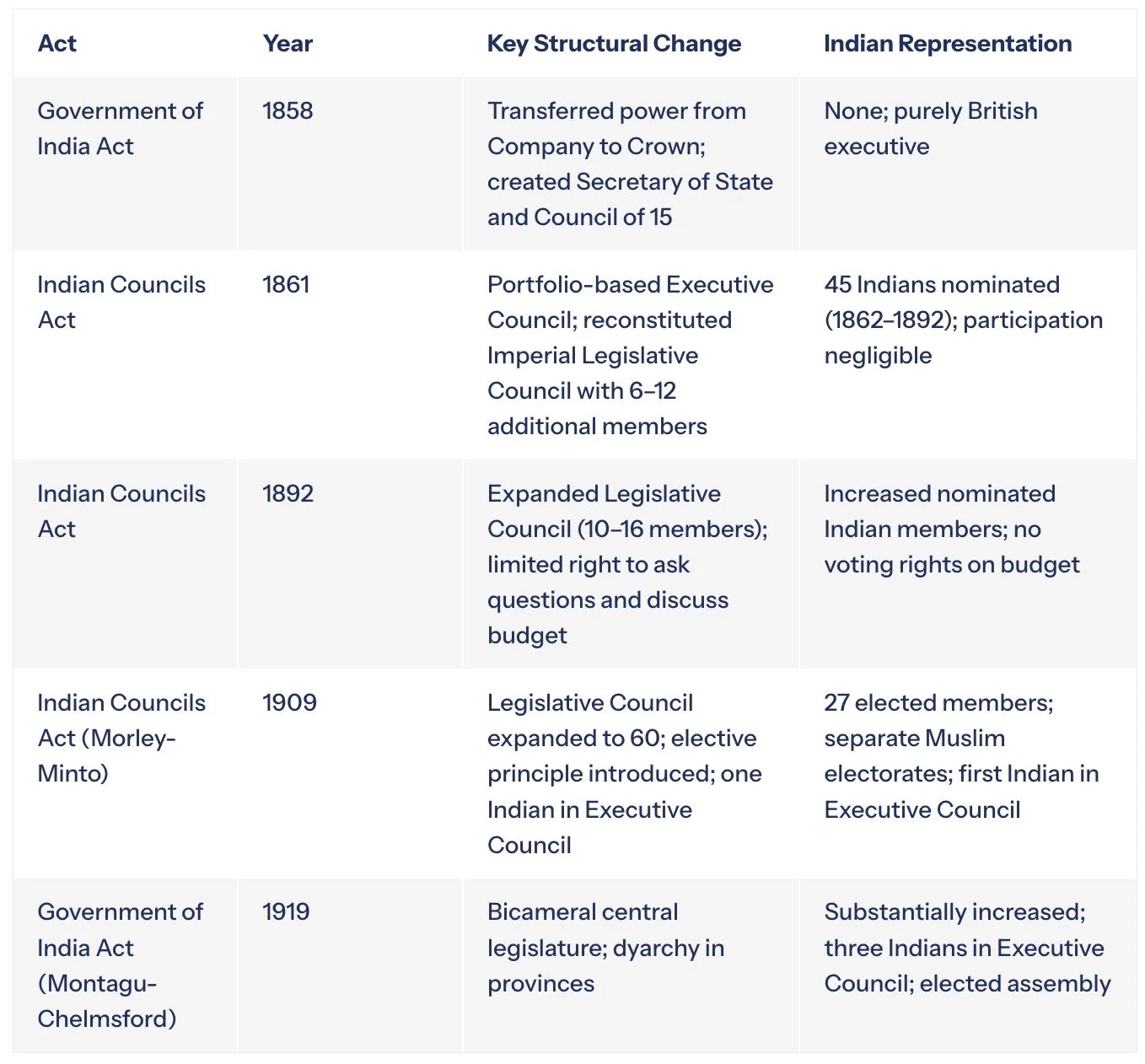
Comparative Analysis: Key Constitutional Acts
The Indian Councils Acts of 1861 & 1892
A comprehensive study of the two landmark Acts of the British Parliament that began the gradual transformation of India's legislative and executive governance — from an autocratic colonial administration towards a nascent parliamentary framework.
The Indian Councils Act 1861 — Background & Context
The Indian Councils Act 1861 emerged from a confluence of political turbulence, administrative inadequacy, and mounting pressure for reform following the great Revolt of 1857. The Act of 1858, which had transferred power from the East India Company to the British Crown, exclusively introduced changes in the Home Government and did not touch the administrative set-up within India itself. It became increasingly apparent, however, that sweeping constitutional changes were urgently required.
The Revolt of 1857 had exposed a dangerous gulf between the rulers and the ruled. Eminent voices of the era articulated this peril with striking clarity. Sir Bartle Frere, Governor of Bombay, warned that "unless you have some barometer or safety valve in the shape of a deliberative council, you will always be liable to very unlooked for and dangerous explosions." Syed Ahmed Khan, one of the most perceptive observers of the era, similarly opined that a principal cause of the crisis of 1857–58 was the want of contact between the rulers and the ruled. The question of associating Indians with legislation was, however, deferred until the immediate situation had settled.
Centralisation of Legislation — Charter Act of 1833
The Charter Act of 1833 had centralised all legislative power in a single Legislative Council at the Centre. It alone could legislate for the entire country, yet it remained deeply ignorant of local conditions across India's vast and varied regions. It neither possessed the will nor the time to develop legislative standards applicable to all parts of the country.
Shortcomings of the 1853 Legislative Council
The Legislative Council set up by the Charter Act of 1853 had degenerated into something resembling a debating society or a parliament in miniature. It arrogated to itself the functions of a representative body, adopted full parliamentary procedures causing significant delay, embarrassed the Indian Government by calling for sensitive information, and on occasion even stopped supplies — all of which authorities in England were determined to correct.
Demand for Indian Association
There was a growing recognition that Indians needed some form of association with the work of legislation — both as a matter of political prudence and as a means of better governance. The lack of any such mechanism had contributed to the alienation that culminated in 1857. After an exchange of views between the Home Government and the Government of India, the first Indian Councils Act was passed in 1861.
Provisions of the Act of 1861 — Executive Changes
The Indian Councils Act 1861 made notable changes in the composition of the Governor General's Council for both executive and legislative purposes. The Council of the Governor General of India performed the dual functions of an executive and a legislature, and the Act introduced significant reforms to each of these dimensions.
For its executive functions, the Executive Council of the Governor General was expanded by the addition of a fifth member for law. The Council now comprised members for home, revenue, military, law, and finance, and after 1874 a sixth member for public works was added. More importantly, the Act empowered the Governor General to make rules for the more convenient transaction of business in the Council.
"Up to that time the theory was that the Government of India was a government by the entire body of the Executive Council; so all business and all official papers had to be brought to the notice of all members of the Council. This system was very cumbrous and inconvenient."
The Old System
All business and official papers — however routine — had to be placed before the entire Executive Council. Every member had to be informed of every matter, regardless of its significance or relevance to their domain. This produced enormous inefficiency and delay in the day-to-day administration of India.
The Portfolio System — Lord Canning's Reform
Lord Canning used the new power to introduce the portfolio system — a cabinet-style arrangement — in the Government of India. Each member of the Council was allocated a specific portfolio. Routine matters were handled by the relevant member; important matters were placed before the Governor General; only matters of general policy came before the full Executive Council. This decentralisation made for vastly greater efficiency.
Provisions of the Act of 1861 — Legislative Changes
For purposes of legislation, the Viceroy's Executive Council was expanded by the addition of not less than six and not more than twelve 'additional' members, nominated by the Governor General for a term of two years. Of these, not less than half were required to be non-official — either English or Indian. This marked a tentative beginning towards the establishment of a legislative system with non-official members.
Additional Members
Between 6 and 12 additional members were added for legislative purposes, nominated by the Governor General for 2-year terms. At least half were required to be non-officials — a modest but meaningful new element.
Governor General's Veto
No bill relating to public revenue or debt, religion, military, naval, or foreign relations could be passed without the assent of the Governor General. The Imperial Legislative Council remained purely an advisory body.
Ordinance-Making Power
In cases of emergency, the Governor General was empowered to issue ordinances without the concurrence of the Legislative Council. Such ordinances were to remain in force for not more than six months.
Restoration of Provincial Powers
The legislative powers of Madras and Bombay — stripped by the Charter Act of 1833 — were restored. Provincial laws required the assent of the Governor General, and prior approval was mandatory for matters such as currency, posts, and military affairs.
The Act also laid down a provision for the formation of legislative councils in other provinces. The Governor General was empowered to create new provinces for legislative purposes and to appoint Lieutenant Governors accordingly. Under this provision, Legislative Councils were established in Bengal (1862), the North-Western Provinces (1886), and the Punjab (1897).
Significance of the Act of 1861
The Indian Councils Act 1861 holds a foundational place in the constitutional history of India. Its significance operates at several levels — administrative, legislative, and political — and its long-term consequences reverberated through every subsequent reform measure up to 1935.
Consolidation of the Framework of Government
The three separate presidencies were brought into a common administrative system. The legislative and administrative authority of the Governor General in Council was asserted over all provinces and extended to all their inhabitants. For the first time, a coherent governmental architecture was established across British India.
Foundation of Legislative Devolution
By vesting legislative powers in the Governments of Bombay and Madras and by providing for similar legislative councils in other provinces, the Act laid the foundations of legislative devolution — a process that would culminate in the grant of provincial autonomy under the Government of India Act, 1935.
Recognition of Local Needs
The principle of recognising local needs and welcoming local knowledge was formally admitted. Local councils were created or re-created, and a small number of non-official and even Indian members were introduced for the purposes of advice — a modest but historic concession.
Sir Charles Wood, Secretary of State for India: "The Act is a great experiment. That everything is changing in India is obvious enough, and that the old autocratic government cannot stand unmodified is indisputable."
Criticism of the Act of 1861
Despite its significance as a foundational reform, the Indian Councils Act 1861 attracted considerable criticism from constitutional scholars, Indian political leaders, and even some British administrators. These criticisms illuminated the severe limitations of what was ultimately a cautious and conservative measure.
No Demarcation of Jurisdictions
The Act made no attempt to demarcate the jurisdiction of the Central and Local Legislatures, as is customary in federal constitutions. The Governor General's Council could legislate for the whole of India, and a provincial council for the whole of its province — subject only to obtaining the Governor General's sanction for certain matters. This ambiguity created potential for confusion and conflict.
Negligible Indian Influence
The Act did little to improve the influence of Indians in the legislative council. The role of non-official members was limited strictly to advice. No financial discussion could take place. Official and ex-officio members remained in a clear majority, ensuring that every official piece of legislation was guaranteed a majority. Nominated non-official members — always a minority — were reportedly reluctant to attend sessions and were always in a hurry to depart.
Not a True Legislature
The legislative councils could not possibly be called a true legislature, either in composition or in function. They were merely committees for the purpose of making laws — instruments through which the executive government obtained advice and assistance in legislation. The councils could not inquire into grievances, call for information, or examine the conduct of the executive. Finance remained the exclusive purview of the wholly official Executive Councils.
No Representative Government
The Act in no way established representative government in India. Sir Charles Wood, while introducing the Bill, made it explicit that Her Majesty's Government had no intention of introducing a representative law-making body. He strikingly likened the proposed Legislative Councils to the durbar of an Indian ruler — where the nobles might express their opinion, but the ruler was not bound by their advice.
The Indian Councils Act 1892 — Background
The Indian Councils Act 1892 was passed by the Parliament of the United Kingdom to authorise an increase in the size of the various legislative councils in British India. Its passage was the product of years of political agitation, the growing influence of the Indian National Congress, and a reluctant recognition by British authorities that some further reform was unavoidable.
The growth of the Indian Constitution after the Act of 1861 is, as one scholar described it, largely the story of political disaffection and agitation alternating with Council reform. The reforms grudgingly conceded were always found inadequate, which occasioned fresh disaffection and evoked demands for further reform. This pattern repeated itself with each subsequent Act — 1892, 1909, 1919, and 1935.
The Legislative Council created by the Act of 1861 had naturally failed to satisfy the aspirations of the people. The element of non-officials, negligible as it was, did not even represent the people in any meaningful sense. It consisted of big zamindars, retired officials, or Indian princes — none of whom could claim to understand the problems of ordinary Indians. The Indian National Congress, founded in 1885, emerged in this context as the principal vehicle for articulating popular dissatisfaction and pressing for constitutional reform.
1861
Indian Councils Act passed — restores provincial powers, adds non-official members
1885
Indian National Congress founded — begins pressing for elected representation and budget discussion rights
1888
Lord Dufferin attacks Congress as representing a "microscopic minority" but secretly proposes Council reforms
1890
Conservative Ministry introduces bill in House of Lords based on Dufferin's proposals
1892
Indian Councils Act 1892 finally passed after two years of slow Parliamentary progress
The Congress Demands & Lord Dufferin's Response
Before the Act of 1892 was passed, the Indian National Congress had adopted resolutions at its sessions in 1885 and 1889, articulating a clear set of constitutional demands. These demands reflected the deep dissatisfaction of the Indian political class with the existing governance arrangements and expressed a confident vision for reform.
Key Demands of the Congress
Reform of the Legislative Councils and adoption of the principle of election in place of nomination
All budgets to be referred to the Councils for consideration and discussion
Admission of a considerable number of elected members to the legislatures
The right to discuss budget matters fully and freely
Creation of similar legislative councils for the North-Western Province, Oudh, and the Punjab
Lord Dufferin's Dual Strategy
Though publicly dismissing the Congress as representing only a "microscopic minority" whose demands constituted "a big jump into the unknown," Lord Dufferin was astute enough to recognise the significance of the movement. He secretly sent proposals to England for liberalising the Councils, appointed a committee to plan the enlargement of provincial councils and the partial introduction of the elective principle — whilst firmly repudiating any intention of introducing a parliamentary system on the British model.
Dufferin's proposals aimed at giving a wider share in the administration of public affairs to Indian gentlemen whose influence fitted them to assist the responsible rulers of the country with their counsel. This paternalistic framing — admitting Indians as advisers rather than representatives — would define the severe limits of the 1892 Act. The Conservative Ministry in England, at the instance of Lord Cross, Secretary of State for India, introduced a Bill in the House of Lords in 1890. It proceeded slowly and was enacted only two years later.
Provisions of the Act of 1892 — The Central Legislature
The Indian Councils Act 1892 dealt exclusively with the powers, functions, and composition of the Legislative Councils in India. Its provisions operated at both the central and provincial levels, with distinct arrangements for each.
At the level of the Central Legislature, the Act increased the number of additional (non-official) members to between ten and sixteen. The new composition of the Council comprised six officials, five nominated non-officials, four members nominated by the provincial legislative councils of Bengal, Bombay, Madras, and the North-Western Provinces, and one nominated by the Chamber of Commerce in Calcutta. The law member was made a permanent fixture of the Council.
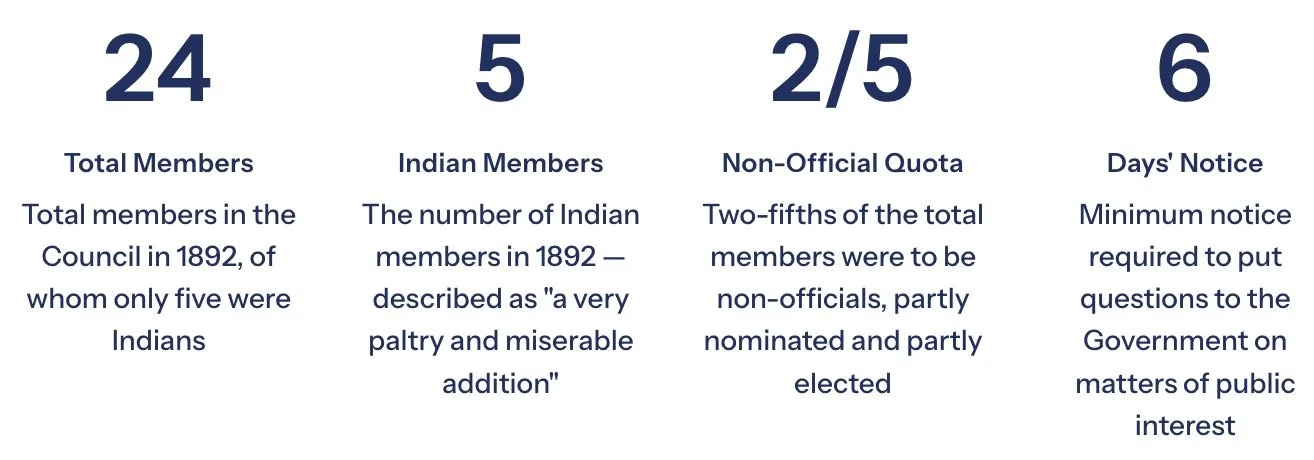
Provisions of the Act of 1892 — The Central Legislature
Members of the Central Legislature gained the right to express their views upon the Budget, which was henceforth to be presented on the floor of the Legislature. However, they were not empowered to move resolutions or divide the House in respect of any financial question. They were permitted to ask questions within defined limits on matters of public interest, but enjoyed no right to ask supplementary questions.
Provisions of the Act of 1892 — The Provincial Legislatures
The Act of 1892 significantly enlarged the provincial legislative councils and extended their functions compared to the arrangements under the Act of 1861. The changes varied across provinces, reflecting the different political and administrative circumstances of each.
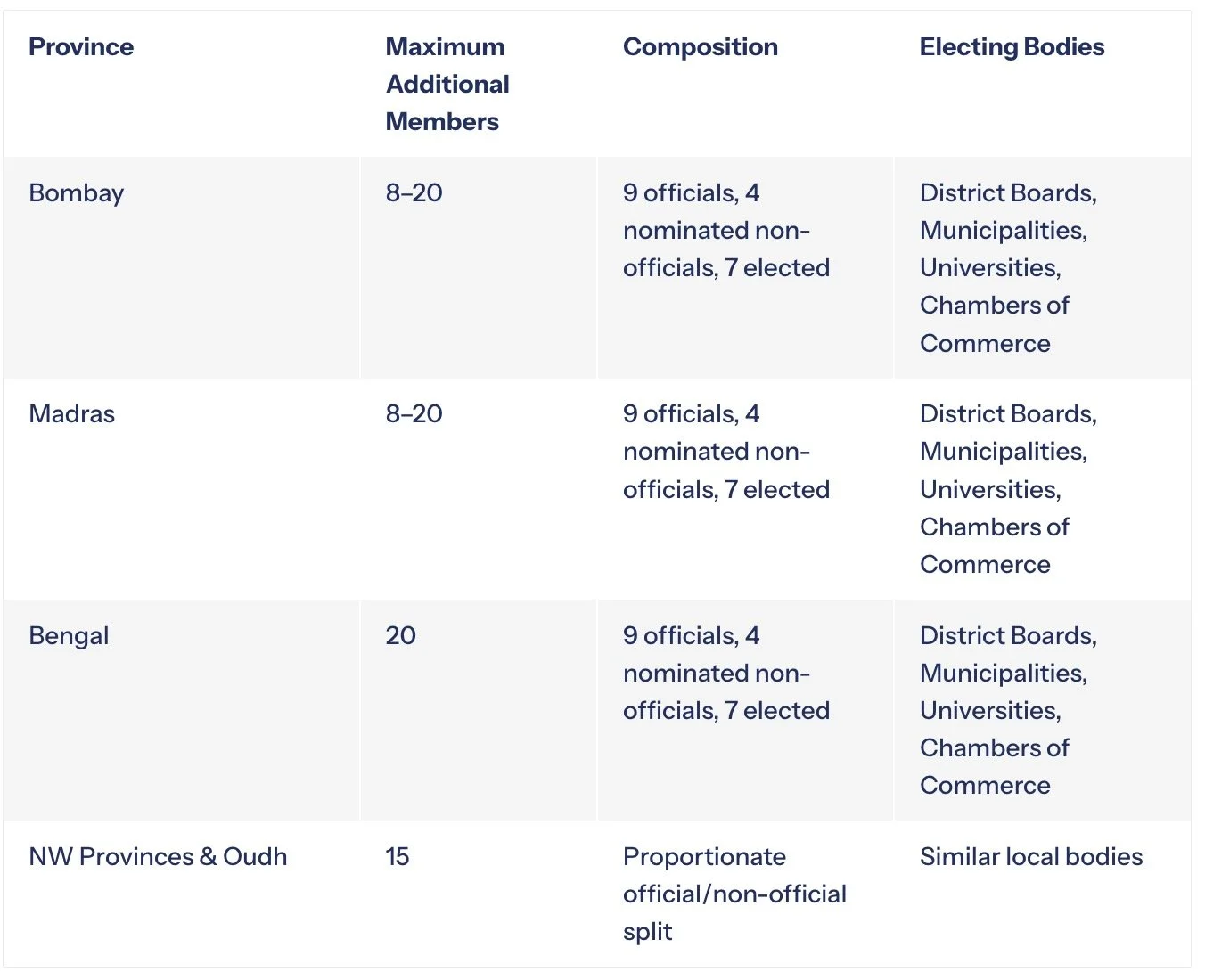
Provisions of the Act of 1892 — The Provincial Legislatures
In terms of functions, members of the Provincial Legislatures secured the important right of interpellation of the executive on matters of general public interest — a right the Act of 1861 had wholly denied them. They could also discuss the policy of the Government and ask questions, subject to six days' prior notice. Like those at the Centre, however, such questions could be disallowed without the Government assigning any reason — a significant limitation on the practical utility of this new right.
The Principle of Election — A Landmark Innovation
The most constitutionally significant feature of the Act of 1892 was the introduction of the principle of election, even though the word 'election' was very carefully avoided throughout the Act itself. This deliberate evasion was a measure of the British Government's ambivalence towards representative government, yet the principle conceded was of lasting importance.
The 'elected' members were officially declared as 'nominated' — though only after taking into consideration the recommendations of the specified bodies. The circumlocution was transparent, but the constitutional precedent was real.
Election to the Central Legislature
In addition to official members, the Central Legislature was to have five elected non-official members. One each was to be elected by the non-official members of the four Provincial Legislatures of Madras, Bombay, Bengal, and the North-Western Provinces, and one by the Calcutta Chamber of Commerce. The remaining five non-officials were nominated by the Governor General.
Election to Provincial Legislatures
The bodies permitted to elect members to the Provincial Legislatures were: Municipalities, District Boards, Universities, and Chambers of Commerce. Though the Government retained the formal power of nomination, in practice it was expected to accept the recommendations of these bodies — a rudimentary, indirect electoral process.
The principle of election, veiled though it was, represented a measure of considerable constitutional significance. It acknowledged, however obliquely, that those who were to be governed had some legitimate claim to participate in the selection of those who would advise on the laws that governed them. It was a small but irreversible step towards representative government.
Significance of the Act of 1892
The Indian Councils Act of 1892 was an undeniable advance on the Act of 1861. Its significance lay not merely in the specific provisions it contained, but in the constitutional trajectory it set in motion — one that would lead, haltingly and over many decades, to the establishment of representative and responsible government in India.
First Step Towards Parliamentary Government
The Act of 1892 can be said to be the first step towards the beginning of the parliamentary system in India. By conceding the principle of election and giving the legislature some control over the executive, it paved the way for further and more substantive reforms.
Widened Functions of Legislatures
The budget was now presented to the legislatures, and members were permitted to make general observations, suggest changes in revenue or expenditure, and criticise financial policy. Questions to the executive introduced an element of accountability, however limited, into the relationship between legislature and administration.
Attracted Eminent Indian Leaders
As legislative functions widened, the councils attracted the country's finest political talent. Leaders such as Gopal Krishna Gokhale, Ashutosh Mookerjee, Rash Behari Ghosh, and Surendra Nath Banerjee entered the legislatures, demonstrating the parliamentary capacity and patriotism of educated Indians through their eloquence and wisdom.
Enlarged Size of Legislatures
Both at the Centre and in the Provinces, the maximum and minimum number of additional members and the element of non-officials were raised, in comparison with the Act of 1861 — a quantitative as well as qualitative expansion of legislative representation.
Criticism of the Act of 1892
Despite its advances, the Indian Councils Act 1892 failed to satisfy Indian nationalists and was criticised at successive sessions of the Indian National Congress. The goal of representative government remained, in the celebrated phrase of the era, "a far cry." The criticisms were numerous, pointed, and largely justified.
A Roundabout System of Election
The so-called right of election enjoyed by local bodies amounted merely to nomination — it was entirely at the discretion of the Government to accept or reject the recommended candidates. The right of election was thus more fiction than reality.
Unsatisfactory Rules of Representation
Certain classes were grossly over-represented while others received no representation at all. In Bombay, for instance, two seats were given to European merchants but none to the Indian mercantile community; two seats were assigned to Sind, but none to Poona and Satara — anomalies that deeply aggrieved Indian opinion.
Strictly Limited Functions
Members could not ask supplementary questions; any question could be disallowed without explanation or remedy; the councils obtained no substantial control over the budget. Members could not submit resolutions on financial matters or divide the council on any financial discussion. In Dadabhai Naoroji's assessment at the 1893 Lahore Congress, this amounted to operating "under an arbitrary rule."
A Policy of Controlled Concession
Many critics saw the Act as a deliberate British policy of gradually involving Indians in the administrative structure with the objective of preventing any major upsurge from the nationalist front by creating a permanent group of loyalists — not a genuine move towards self-governance.
The Congress, Moderates, and Tilak — A Diverging Response
The passage of the Act of 1892 sharpened the internal debate within the Indian nationalist movement about the appropriate strategy for achieving constitutional reform. The Act's inadequacy became a catalyst for a significant ideological divergence that would define Indian politics for the following two decades.
The Congress, under its Moderate leadership, had placed its faith in the policy of petition, prayer, and protest — a constitutionalist approach premised on the belief that reasoned argument and loyal representation would eventually move the British Government towards meaningful reform. The Act of 1892 seemed, in the eyes of many, to vindicate the limits of this approach. The British Government had interpreted the Congress's moderation as weakness, not as a demonstration of civic virtue.
Bal Gangadhar Tilak articulated the emerging radical critique with characteristic force:
"Political rights will have to be fought for. The Moderates think that these can be won by persuasion. We think that they can only be obtained by strong pressure."
Dadabhai Naoroji, delivering his Presidential address at the 1893 Lahore session of the Congress, offered a meticulous legal critique of the Act's financial provisions: "By the Act of 1892 no member shall have the power to submit or propose any resolution or divide the Council in respect of any such financial discussion... Thus, we are to all intent and purposes under an arbitrary rule."
These voices of dissatisfaction — both the forensic constitutionalism of Naoroji and the militant nationalism of Tilak — reflected the growing recognition that the British Government was not going to concede representative government voluntarily or speedily. Yet the Act of 1892, for all its shortcomings, had undeniably enlarged the space of political participation and set irreversible precedents for further reform.
Comparative Analysis — The Acts of 1861 & 1892
Placing the two Acts in comparative perspective illuminates the halting but real progress of constitutional reform in British India, as well as the persistent structural limitations that defined the colonial legislative framework throughout the nineteenth century.
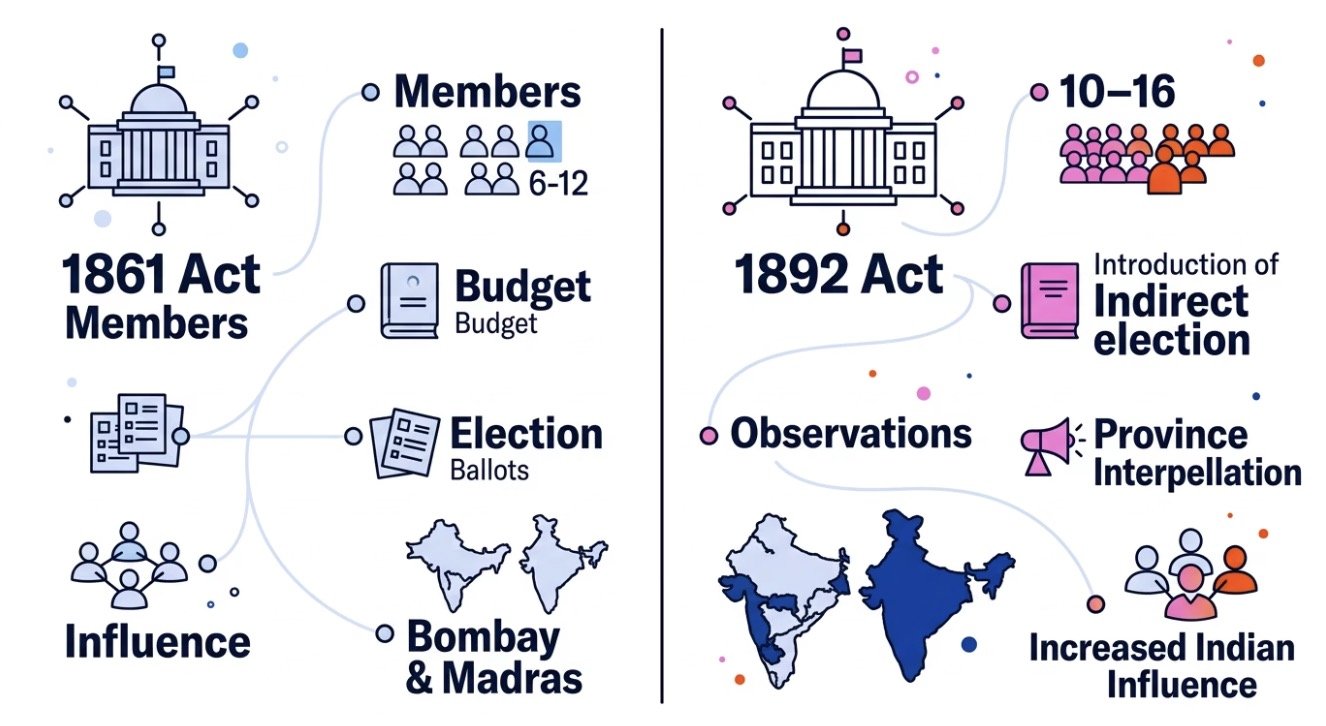
Comparative Analysis — The Acts of 1861 & 1892
Both Acts shared a fundamental limitation: neither established representative government in any meaningful sense, and both maintained the supremacy of official majorities and executive control over the legislative process. Yet each Act advanced the constitutional conversation, expanded the legislative membership, widened the functions of the councils, and set precedents that the next generation of reformers would build upon. The journey from the Act of 1861 to the Morley-Minto Reforms of 1909, and onward to the Government of India Acts of 1919 and 1935, was a continuous, if painfully slow, process of constitutional evolution.
Key Personalities & Their Contributions
The constitutional reforms of 1861 and 1892 were shaped not only by impersonal forces of political necessity but also by the specific interventions of remarkable individuals — both British and Indian — whose ideas, arguments, and actions left a lasting imprint on the legislative history of the period.
Sir Bartle Frere
Governor of Bombay who famously used the metaphor of a "barometer or safety valve" to argue for deliberative councils after 1857, warning of "dangerous explosions" without such institutions.
Syed Ahmed Khan
Muslim reformer and educationist who identified the "want of contact between the rulers and the ruled" as a principal cause of the 1857 Revolt, providing intellectual justification for associating Indians with legislation.
Lord Canning
Governor General who utilised the new powers granted by the Act of 1861 to introduce the portfolio (cabinet) system in the Government of India — a transformative administrative innovation.
Sir Charles Wood
Secretary of State for India who introduced the Bill of 1861, describing it as "a great experiment" whilst making clear that representative government was not the intention — likening the councils to an Indian ruler's durbar.
Lord Dufferin
Viceroy who publicly attacked the Congress whilst privately proposing Council reforms — a characteristic instance of British policy simultaneously resisting and accommodating Indian political demands.
Dadabhai Naoroji & Gopal Krishna Gokhale
Eminent Moderate leaders whose entry into the Legislative Councils demonstrated Indian parliamentary capacity, and whose critiques of the Acts set the intellectual agenda for subsequent reforms.
The Long Arc of Reform — From 1861 to 1935
The Indian Councils Acts of 1861 and 1892 are best understood not in isolation but as the opening chapters in a long constitutional narrative that would take over seven decades to reach its provisional conclusion in the Government of India Act, 1935. Each reform measure was the product of the same fundamental dynamic: Indian political agitation, British reluctance, partial concession, renewed dissatisfaction, and further agitation.
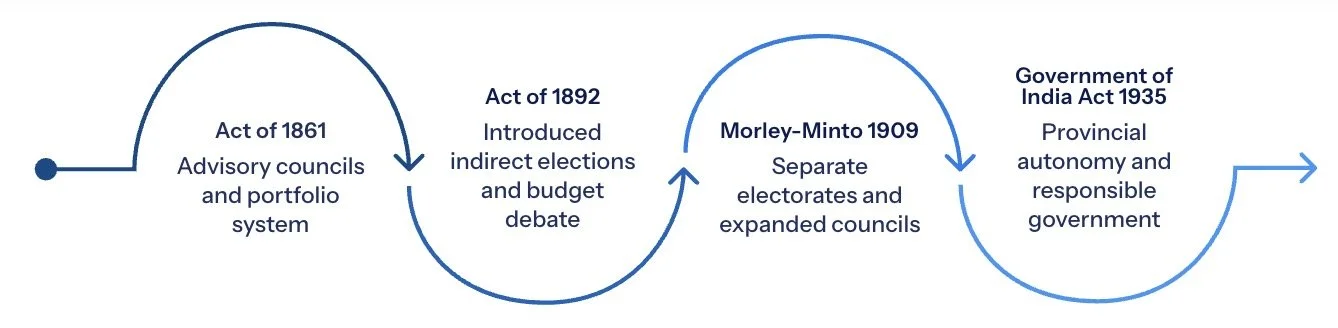
The Act of 1861 laid the architectural foundations — a common governmental framework, devolved legislative powers, and the portfolio system. The Act of 1892 introduced the principle of election, however indirectly, and widened the functions of the legislatures. The Morley-Minto Reforms of 1909 brought direct elections but also the fateful introduction of separate electorates. The Government of India Act, 1919 introduced dyarchy in the provinces. The Government of India Act, 1935 — the culmination of the devolutionary process begun in 1861 — granted genuine autonomy to the provinces and provided the constitutional template that would, in modified form, underpin the governance of independent India.
Key Takeaways
For students and general readers approaching the constitutional history of nineteenth-century India, the Indian Councils Acts of 1861 and 1892 offer an essential foundation. The following points represent the core conclusions of this study.
The Act of 1858 Was Incomplete
It reformed only the Home Government. The administrative set-up within India required separate legislation, which the Act of 1861 provided.
1857 Was the Catalyst
The Revolt of 1857 made it politically necessary to associate Indians with governance and to introduce some element of consultative and legislative representation, however limited.
The Portfolio System Was Transformative
Lord Canning's introduction of the portfolio (cabinet) system under the powers granted by the 1861 Act was perhaps the single most consequential administrative change of the entire period — the true beginning of cabinet government in India.
The Word 'Election' Was Avoided in 1892
Despite introducing the principle of election for the first time, the Act of 1892 deliberately avoided the word. 'Elected' members were officially termed 'nominated' — a transparent but politically significant evasion.
Both Acts Were Inadequate but Significant
Both Acts fell far short of the demands of Indian nationalists. Yet both advanced the constitutional framework in ways that could not be undone — each one setting precedents and creating expectations that drove the demand for further reform.
Legislative Devolution Led to Provincial Autonomy
The restoration of provincial legislative powers in 1861 and their enlargement in 1892 laid the groundwork for the provincial autonomy ultimately granted by the Government of India Act, 1935 — making the Acts of 1861 and 1892 the true starting points of Indian federalism.
Key Terms
The following terms appear frequently in the study of nineteenth-century Indian constitutional history and require precise understanding for a proper appreciation of the subject.
Portfolio System
A system of cabinet-style government in which each member of the Executive Council is assigned responsibility for a specific department or portfolio. Introduced by Lord Canning under powers granted by the Act of 1861, replacing the cumbersome system by which all business had to be placed before the entire Council.
Legislative Devolution
The transfer of legislative powers from a central authority to provincial or local bodies. The Act of 1861 began this process by restoring legislative powers to Bombay and Madras, a process that culminated in provincial autonomy under the Government of India Act, 1935.
Non-Official Member
A member of a legislative council who does not hold a government office. Non-official members could be British or Indian and were introduced as advisers — a modest departure from wholly official councils.
Interpellation
The right of a legislative member to put formal questions to the executive on matters of public interest. First granted to provincial legislatures under the Act of 1892, subject to six days' notice and the Government's right to disallow questions without explanation.
Imperial Legislative Council
The central legislative body under the Governor General, expanded by additional non-official members under the Acts of 1861 and 1892. It remained an advisory body throughout the nineteenth century, with official members always in a majority.
Ordinance
An emergency legislative measure issued by the Governor General without the concurrence of the Legislative Council. Under the Act of 1861, ordinances could remain in force for not more than six months.
Dyarchy
A system of dual government introduced at the provincial level by the Government of India Act, 1919, in which certain subjects were transferred to elected Indian ministers whilst others remained reserved for British officials — a later development of the devolutionary process begun in 1861.
Elective Principle
The constitutional principle that members of a legislative body should be chosen by election rather than nomination. Introduced indirectly and under the euphemism of 'nomination after consultation' by the Act of 1892 — the first constitutional recognition of this principle in British India.
