
The Morley-Minto Reforms, 1909
The Morley-Minto Reforms, 1909
The Indian Councils Act of 1909 — popularly known as the Morley-Minto Reforms — was a landmark yet deeply controversial piece of British legislation that brought about a limited and carefully calibrated expansion of Indian participation in colonial governance. Named after John Morley, the Liberal Secretary of State for India, and Lord Minto, the Conservative Viceroy, the Act amended earlier Indian Councils Acts of 1861 and 1892. While it introduced the principle of election for the first time, its broader legacy — particularly the introduction of separate electorates for Muslims — would cast a long and troubling shadow over Indian politics for decades to come.
Background: A Nation Seething with Discontent
By the early twentieth century, Indian society was gripped by a profound and multi-layered sense of frustration. The inadequacy of the Indian Councils Act of 1892, which had failed to meet even the moderate aspirations of the Indian National Congress, left educated Indians deeply disillusioned. Lord Curzon's tenure as Viceroy only deepened the wound. His policies were openly dismissive of Indian aspirations: he "officialised" the Calcutta Corporation by reducing its membership by a third and installing a European majority; he stripped Indian universities of their autonomy through the Universities Act of 1904; and he used the Official Secrets Act of the same year to dramatically extend the definition of "sedition," suppressing political dissent.
Economic grievances added fuel to the fire. Intellectuals and patriots such as R.C. Dutt and Dadabhai Naoroji argued persuasively that the systematic impoverishment of India was not accidental but rather the direct result of deliberate British economic exploitation — what Naoroji famously termed the "drain of wealth." Meanwhile, educated Indians found themselves shut out of government services, and Indians overseas — especially in South Africa — faced humiliation and racial discrimination. The closing years of the nineteenth century also brought devastating famines and bubonic plague, and the public squarely blamed the colonial administration for the misery that followed.
The Partition of Bengal in 1905 was the final provocation. Widely seen as a "subtle attack on the growing solidarity of Bengali nationalism," it was perceived as punishing an assertive political community. The Bengalis felt "humiliated, insulted and tricked," and a vigorous agitation followed. A free press — unshackled since 1882 — amplified every grievance, building a climate of intense nationalist resentment across the country.
Political Failure
The Indian Councils Act of 1892 failed to meet Congress demands. Curzon's imperialist policies alienated educated Indians and stripped institutions of autonomy.
Economic Exploitation
Naoroji, Dutt, and others documented the systematic drain of Indian wealth. Educated Indians were denied fair access to government service and administration.
Social & Humanitarian Crisis
Devastating famines and plague in the late 1890s caused widespread suffering. Indians overseas, especially in South Africa, faced racial indignity and discrimination.
The Bengal Partition, 1905
The Partition of Bengal was the climactic provocation. It triggered the Swadeshi movement and accelerated the rise of militant nationalism across India.
The Muslim Question and the Shimla Deputation
While the Indian National Congress was growing as the foremost voice of national freedom, the Muslim community largely kept its distance. Initially, this "indifference" reflected the influence of Sir Syed Ahmed Khan, who had counselled Muslims against joining the Congress. Over time, however, this indifference hardened into something closer to antagonism — actively encouraged by a British bureaucracy alarmed at the Congress's growing ability to unite Indians across community lines. The colonial strategy of "divide and rule" found fertile ground in this environment.
In October 1906, a delegation of Muslim elites — the Shimla Deputation, led by the Aga Khan — met Lord Minto and made two demands: separate electorates exclusively for Muslims, and representation in excess of their numerical population share, justified by the supposed "value of the contribution" Muslims were making to the defence of the Empire. Minto promised to deliver both. This moment proved to be a pivotal turning point. As historians have noted, with Minto's assurance, the foundations of Muslim communalism in Indian politics were formally laid. The Muslim League was established just months later in December 1906.
"The die was thus cast and the foundations of Muslim communalism were laid." — On Lord Minto's acceptance of the Shimla Deputation's demands, 1906
It is essential to understand the British calculus at work here. Morley and Minto were not naïve reformers; they were seasoned imperialists. They recognised that Curzon's Bengal Partition had destabilised the Raj, and that something had to be done to restore order. Their three-pronged strategy was revealing in its cynicism: outright repression of revolutionary activity, concessions to rally the moderate wing of the Congress, and divide and rule through separate electorates for the Muslims. The reforms were thus not a genuine step toward self-governance but a carefully designed instrument of political management.
Drafting the Reforms: The Political Process
The road to the Indian Councils Act of 1909 was a deliberate and politically charged legislative process. Secretary of State Morley's budget speech of 1906 first signalled that some form of representative government would be introduced in India. He urged Viceroy Minto to balance the deeply unpopular Bengal Partition with meaningful constitutional concessions. The resulting reforming impulse, however, was firmly hedged: Indians would be given "some share of power," but within the frame of what Morley himself called a system that would never lead to a "parliamentary or responsible government."
Morley and Minto offered the prospect of reforms to the Moderate leadership of the Congress in early 1906, beginning discussions even as a vigorous popular movement — one the Government was simultaneously trying to suppress — was unfolding across the country. The Moderates agreed to cooperate. This decision proved catastrophic for the unity of the nationalist movement. It deepened the rift between the Moderate and Extremist factions of the Congress, ultimately producing a total split in the nationalist ranks at the famous Surat Congress of 1907.

A Committee of the Executive Council of the Viceroy studied the matter and sent a despatch to England embodying its proposals. Morley returned these proposals to the local governments in India for public criticism — a gesture toward consultation, though firmly controlled. The Bill was then drafted, approved by the Cabinet, and passed by Parliament in February 1909, coming into force as the Indian Councils Act, 1909.
Provisions of the Act: Structure of the Legislatures
The Act enlarged the size and functions of Legislative Councils at both the central and provincial levels. Members of these Councils were divided into four categories: ex-officio members (the Governor General and members of their Executive Councils), nominated official members (government officials nominated by the Governor General), nominated non-official members (non-officials nominated by the Governor General), and elected members (elected by various categories of Indians). The Governor-General, with the approval of the Secretary of State, made regulations governing nominations, elections, and qualifications — regulations which had to be laid before both Houses of Parliament before coming into force.
The Central Legislature
The Imperial Legislative Council was expanded to a maximum of 60 "additional" members, giving a total membership of 69. Of these, 37 were officials and 32 were non-officials. Among the 27 elected members, 13 came from general electorates drawn from non-official members of various provincial legislatures (Bombay, Madras, Bengal, United Provinces each sent 2; Central Provinces, Assam, Bihar and Orissa, Punjab, and Burma each sent 1). The remaining 14 comprised 12 from class electorates (6 from Landholders' constituencies and 6 from separate Muslim constituencies) and 2 from Special electorates representing British commercial interests (Bengal and Bombay Chambers of Commerce).
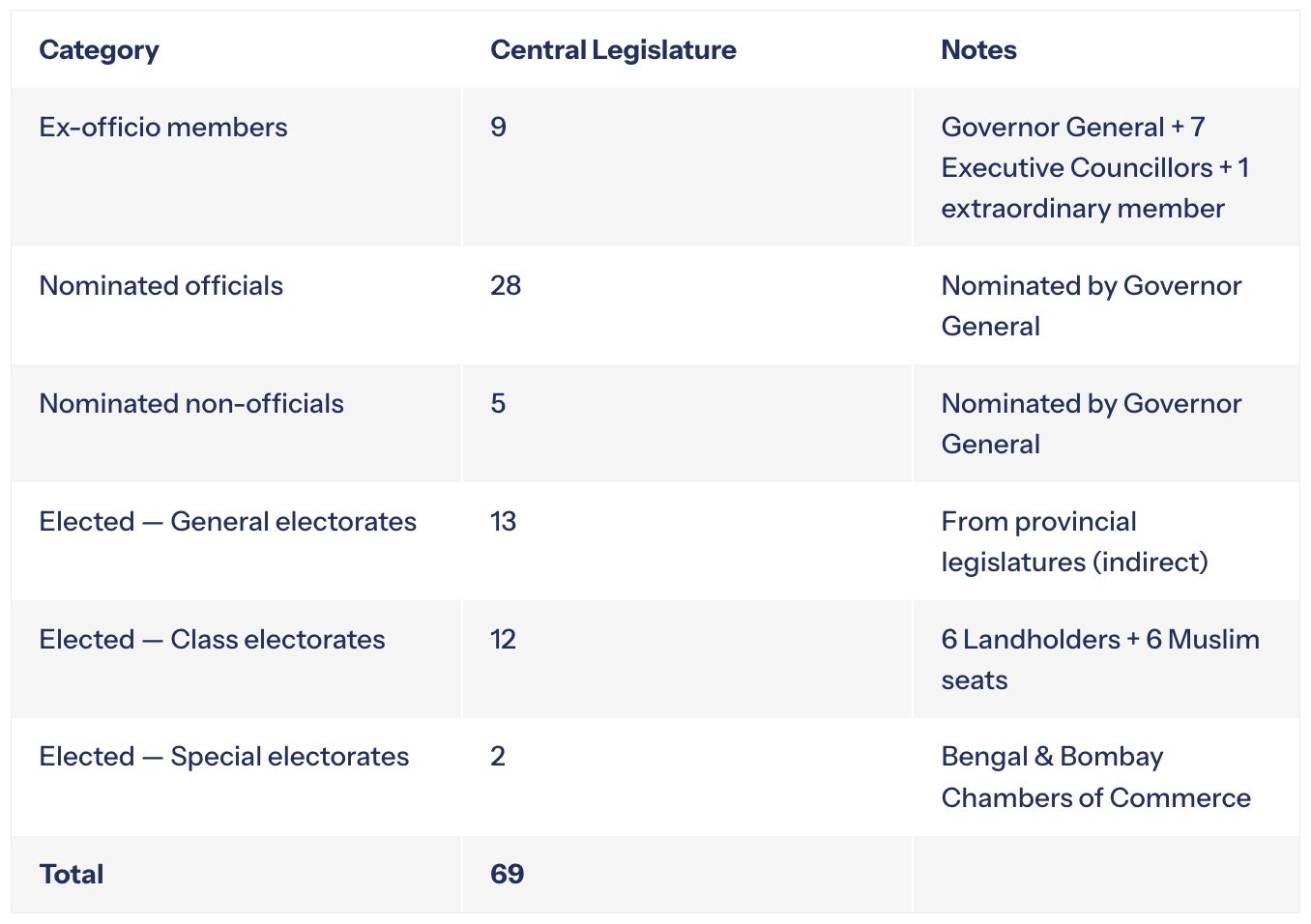
Crucially, elections were indirect. Local bodies elected an electoral college, which elected members of provincial legislatures, who in turn elected members of the Central Legislature — an elaborate system of filtering that effectively insulated the colonial government from direct democratic pressure.
Provisions: Provincial Legislatures and Separate Electorates
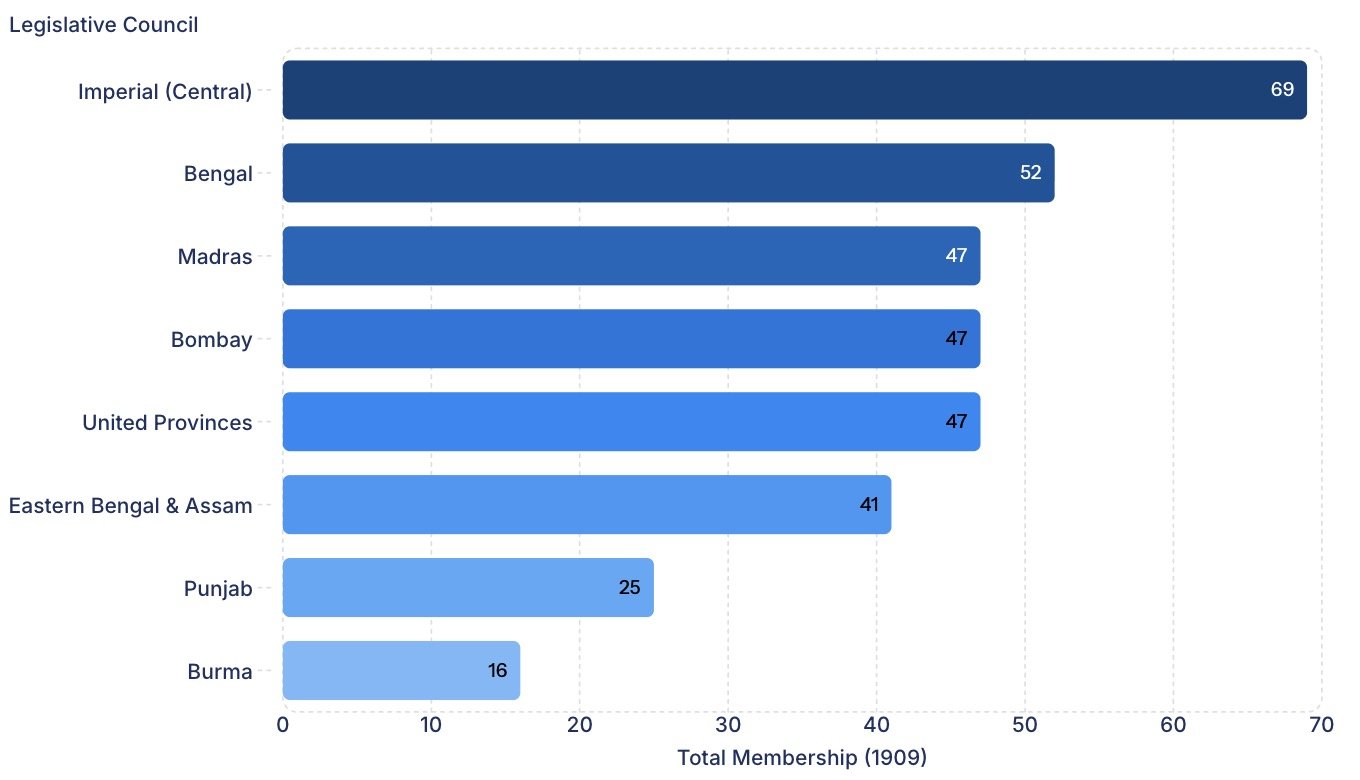
The Act expanded the Provincial Legislative Councils substantially. Burma received 16 members; Punjab, 25; Eastern Bengal and Assam, 41; Bengal, 52; and Madras, Bombay, and United Provinces, 47 each. The Act formally provided for non-official majorities in the provinces — but this was deceptive. Since many of these "non-officials" were nominated by the Governors and reliably sided with the Government, effective official control over the councils was retained. As historians have noted, the overall non-elected majority thus remained intact.
In the Bombay Provincial Legislature, to take one example, 21 elected members were drawn from three types of constituencies: 6 from Special electorates (Bombay Corporation, Bombay University, etc.), 8 from General electorates (District Boards, Municipalities, etc.), and 7 from Class electorates (4 Muslim seats + 3 Landlord seats). The membership of Executive Councils of Bengal, Madras, and Bombay was also raised to four members each, and the Government was empowered to constitute similar Councils for Lieutenant Governors.
The Separate Electorate Provision
Only Muslims could vote for candidates contesting Muslim seats. Muslims were given representation in excess of their population share. The income qualification for Muslim voters was set lower than that for Hindu voters — making it easier for Muslims to participate in "their" constituencies while limiting overall franchise.
The Justification Given
Muslim leaders expressed fear that a "first past the post" electoral system would leave them permanently subject to Hindu majority rule. The Shimla Deputation had already secured Minto's personal promise. The colonial government used this argument to justify a provision that served, above all, its own strategic interest in dividing the nationalist movement.
In 1909, Satyendra Prasad Sinha became the first Indian appointed to the Viceroy's Executive Council as Law Member. Earlier, in August 1907, two Indians — K.G. Gupta and Syed Hussain Bilgrami — had been made members of the Secretary of State's India Council.
Provisions: Functions of the Legislative Councils
While the Act enlarged the size of the Legislative Councils, the powers granted to elected members remained severely limited. The reforms created an impression of representative governance without its substance. Below is a clear breakdown of what members could — and could not — do.
What Members COULD Do
Discuss budgets and ask supplementary questions
Move resolutions on additional grants, changes in taxation, and new loans
Discuss matters of general public interest and vote on resolutions
Participate in a Budget Committee (Finance Member as Chair, 50:50 officials and non-officials)
What Members COULD NOT Do
Vote on the budget itself (they could discuss, not decide)
Discuss foreign relations or relations with Indian Princes
Discuss matters under court adjudication, state railway expenditure, or debt interest
Compel the Government to accept any resolution, even if passed
The President of the Council retained the power to disallow any resolution — in whole or in part — without assigning any reason. The Government was under no obligation to accept resolutions on matters of public interest or on financial statements, even if passed by the Council. In practice, this meant that legislative deliberation existed as a theatre of debate rather than as a genuine mechanism of democratic accountability. The real power remained firmly entrenched in the executive branch of the colonial administration.
A small number of members, most notably Gopal Krishna Gokhale, made constructive use of the limited platform available: demanding universal primary education, condemning repressive policies, and drawing attention to the condition of indentured labourers and Indian workers in South Africa. But these were individual acts of conscience, not the exercise of genuine representative power.
Evaluation: A Shadow, Not Substance
The Morley-Minto Reforms have been assessed by historians and contemporary observers alike as a deeply flawed exercise — one that offered the appearance of reform while carefully preserving the architecture of colonial domination. Lord Morley himself was unambiguous: "If it could be said that this led directly or indirectly to the establishment of a parliamentary system in India, I, for one, would have nothing at all to do with it." The reforms were not steps toward self-government; they were instruments of political management dressed in constitutional language.
Narrow Franchise, No Real Power
The electorate was based on high property qualifications, severely restricting participation. Elected members could debate but not govern. The President could disallow any resolution without reason. The Government was not obliged to accept even passed resolutions. As critics put it, "the Councils were left with no functions but criticism."
Elections Were Indirect and Disconnected
The multi-tiered electoral process — from local bodies to electoral college to provincial legislature to central legislature — created an almost complete disconnect between the voter and his supposed representative. There was "no responsibility upon and no political education for the people who nominally exercise a vote."
Bureaucratic Manipulation Built In
Details of seat allocation and electoral qualifications were left to local governments, allowing ample room for bureaucratic manipulation. The Government of India retained the general power to disallow any candidate from contesting on suspicion of being "politically dangerous."
Strategic Division of the Nationalist Movement
By engaging the Moderates in discussions while simultaneously suppressing the popular agitation, the British engineered a fatal split within the Congress. The reforms were, as one analysis puts it, "aimed at dividing the nationalist ranks by confusing the Moderates."
The Legacy of Separate Electorates: Sowing Dragon's Teeth
Of all the provisions of the 1909 Act, none had a more catastrophic long-term impact on Indian political life than the introduction of separate electorates for Muslims. Jawaharlal Nehru captured its effect with precision: "a political barrier was created round them, isolating them from the rest of India." The barrier was small at first — the electorates were limited and the franchise narrow — but with every subsequent extension of the franchise, the wall grew higher and more formidable.
The system was designed to encourage the notion that the political, economic, and cultural interests of Hindus and Muslims were separate and not common — that they were rival communities rather than fellow citizens of a shared nation. In practice, when officials and Muslim leaders spoke of "the community," they were appealing to a broad religious identity but serving the interests of a small Muslim elite. The Congress consistently condemned separate electorates as undemocratic and as an obstacle to the development of a shared Hindu-Muslim national consciousness.
"We are sowing dragon's teeth, and the harvest will be bitter." — Lord Morley, in a letter to Lord Minto, on the introduction of separate electorates
The consequences cascaded outward. Once separate electorates were conceded to Muslims, other communities claimed equivalent privileges on the grounds of "services rendered to the Empire." The Sikhs successfully fought for their own special representation, which was conceded in 1919. By the Act of 1935, Harijans, Indian Christians, Europeans, and Anglo-Indians had also obtained separate representation or reservations. The principle of communal representation, once introduced, proved impossible to contain. It perpetuated the division of creeds and classes, teaching communities to think as partisans rather than citizens, and creating "camps organised against each other." The subsequent evolution of Muslim political identity — from separate electorate to separate minority to separate nationhood — followed a long and devastating trajectory that culminated in the Partition of 1947.
1906
Shimla Deputation; Minto promises separate electorates. Muslim League founded.
1909
Morley-Minto Reforms: separate Muslim electorates formally enshrined in law.
1919
Separate representation extended to Sikhs under the Montagu-Chelmsford Reforms.
1935
Government of India Act extends communal representation to Harijans, Indian Christians, Europeans, Anglo-Indians.
1947
Partition of India: the ultimate, tragic consequence of institutionalised communal identity.
Significance and Later Modifications
Despite its profound limitations, the Indian Councils Act of 1909 was not without historical significance. It was, for the first time in the history of British India, the principle of election that was formally introduced into the governance of the country. While previously some Indians had been appointed to legislative councils, the Act allowed Indians to be elected to these bodies for the first time. As Morley himself ruefully acknowledged, the introduction of the elective principle laid the groundwork for a parliamentary system even though that outcome was entirely contrary to his intent.
The Act served as the governance structure of British India for roughly a decade — a remarkably short lifespan that itself testifies to its inadequacy. It was modified by the Government of India Act 1912, which clarified the authority of the Governor of Bengal, created a legislative council for the new province of Bihar and Orissa, removed the requirement for Parliamentary review when new legislative councils were created for provinces under a lieutenant-governor, and permitted the creation of legislative councils in provinces under chief commissioners.
Electoral Principle Introduced
For the first time, Indians were formally elected (rather than merely appointed) to legislative councils — a precedent that could not be undone, even if the franchise remained narrow and the elections indirect.
Foundation for Future Reform
Despite Morley's stated intentions, the Act inadvertently laid the conceptual groundwork for the later Montagu-Chelmsford Reforms (1919) and the Government of India Act (1935), which progressively expanded representative governance.
The Communal Legacy
The Act's most enduring and destructive legacy was the institutionalisation of communal representation — a principle that fractured Indian politics and contributed, over decades, to the Partition of 1947.
The Act of 1909 was, as one scholar summarised, "the most short-lived of all constitutional reforms in British India." It had to be revised within ten years. It was a document that gave to the people of India "a shadow rather than substance" — they had demanded self-government, and what they received was, in the words of contemporary critics, "benevolent despotism."
Key Takeaways: The Morley-Minto Reforms at a Glance
The following overview consolidates the essential facts, structural provisions, and critical judgements of the Indian Councils Act, 1909 — a useful reference for revision and examination preparation.
Named After
John Morley (Secretary of State for India) and Lord Minto (Viceroy of India). Amended Indian Councils Acts of 1861 and 1892.
Key Trigger
Partition of Bengal (1905), rise of the Swadeshi movement, militant nationalism, and the need to manage moderate Congress opinion.
Structural Change
Central Legislature expanded to 69 members (27 elected, indirectly). Provincial councils enlarged. Four categories of members introduced.
Historic First
S.P. Sinha became the first Indian appointed to the Viceroy's Executive Council (1909). Principle of election formally introduced for the first time.
Fatal Flaw
Separate electorates for Muslims introduced — institutionalising communal identity and laying seeds for the eventual Partition of India in 1947.
Overall Verdict
"A shadow rather than substance." Colonial power remained intact. No responsible government. The reforms were revised within a decade by the Montagu-Chelmsford Reforms of 1919.
The chart above illustrates the expanded membership of legislative councils across British India under the Act of 1909. The Central (Imperial) Legislature was the largest, reflecting the hierarchical structure of the colonial governance framework.
