
Montagu-Chelmsford Reforms & the Government of India Act, 1919
The Government of India Act, 1919, commonly known as the Montagu-Chelmsford Reforms or the "Montford" Act, represents one of the most consequential — and most contested — pieces of constitutional legislation in British Indian history. Emerging from the dissatisfaction with the Minto-Morley Reforms of 1909, the backdrop of the First World War, and the growing clamour for self-determination, the Act attempted to chart a path towards "responsible government" in India whilst firmly retaining ultimate authority in British hands.
Failure of the Minto-Morley Reforms & Rising Discontent
The Minto-Morley Reforms of 1909 were never designed to establish a parliamentary system in India. Their primary objective was to buttress British bureaucratic authority by rallying the Moderate faction of the Congress and the Muslim community to the imperial side. Far from satisfying Indian political aspirations, the Reforms of 1909 deepened grievances across virtually every section of Indian society.
The Indian National Congress catalogued its dissatisfactions systematically. It objected to the excessive and disproportionate share of representation accorded to the followers of one religion, to unjust distinctions between Muslims and non-Muslims in electoral arrangements, to arbitrary disqualifications placed upon candidates seeking election, to the general distrust of the educated classes, and to the ineffective composition of non-official majorities in the Provincial Councils.
Congress Grievances
Disproportionate religious representation
Unjust Muslim/non-Muslim electoral distinctions
Arbitrary candidate disqualifications
Distrust of educated classes
Ineffective Provincial Council majorities
Muslim Estrangement
Muslim discontent also grew considerably in this period. The failure to establish a Muslim University at Aligarh, the annulment of the partition of Bengal in 1911, and England's hostile attitude towards Turkey during the Turco-Italian War (1911–12) all deepened alienation. The Balkan Wars of 1912–13 were widely viewed as a Christian conspiracy against Turkey. By March 1913, the Muslim League revised its constitution to include the "attainment of a system of self-government suitable to India" as a formal objective.
Paradoxically, the estrangement of Muslims from the British Government produced one salutary consequence: it brought Hindus and Muslims closer together. The Congress-League rapprochement culminated in the historic Lucknow Pact of 1916, through which a joint scheme of constitutional reforms was placed before the Government in December of that year.
The War, Self-Determination & the Push for Reform
As the First World War dragged on, the doctrine of self-determination — championed most prominently by President Woodrow Wilson — exercised a profound influence on Indian public opinion. If the war was being fought to make the world safe for democracy, as the Allies proclaimed, then surely the world's most populous colonial possession might at least be set upon the road to self-government. The moral inconsistency of fighting for freedom abroad whilst denying it at home became increasingly untenable.
"If the war was being fought to make the world safe for democracy, it was hoped that it would at least put India on the road to self-government."
The British Government, meanwhile, had resorted to a series of repressive legislative measures to suppress the rising tide of discontent following the 1909 Reforms. These included the Indian Press Act of 1910, the Seditious Meetings Act of 1911, the Criminal Law (Amendment) Act of 1913, and the sweeping Defence of India Act of 1915, which provided for trial of revolutionary offenders by a special bench with no right of appeal. These measures underscored the urgency of a substantive political response.
1909
Minto-Morley Reforms — widely seen as inadequate and divisive
1916
Lucknow Pact — Congress and Muslim League unite on joint reform scheme
1917
Montagu Declaration — responsible government announced as British policy
1918
Montford Report published — blueprint for the 1919 Act
Montagu's Declaration of 20 August 1917
The new Secretary of State for India, Edwin Montagu, made a landmark statement in the House of Commons that fundamentally reframed British policy towards India. His declaration announced the "increasing association of Indians in every branch of the administration and gradual development of self-governing institutions with a view to the progressive realisation of responsible Government in India as an integral part of the British Empire."
"Progress in this policy can only be achieved by successive stages. The British Government and the Government of India, on whom the responsibility lies for the welfare and advancement of Indian peoples, must be judges of the time and measure of each advance."
While the Declaration temporarily eased the tense political atmosphere in India, it was far from universally welcomed. Critics pointed out that no definite timeline was prescribed for India to reach its goal, no standard was laid down by which to assess readiness for further reforms, and it was considered insulting that the British alone would judge India's capacity for self-governance.
What the Declaration Promised
Increasing Indian association in administration
Gradual development of self-governing institutions
Progressive realisation of responsible government
Substantial steps to be taken "as soon as possible"
What It Left Unresolved
No definite timeline for achieving responsible government
No objective standard for assessing progress
Britain retained sole authority to judge India's readiness
Sovereignty of the British Parliament fully intact
Montagu arrived in India in November 1917 and worked alongside Viceroy Lord Chelmsford, senior British civil servants, and prominent Indian politicians. A committee was constituted to help prepare a draft reform scheme, which was published in July 1918 as the Montagu-Chelmsford (Montford) Report. This report formed the basis of the Government of India Act, 1919.
Preamble of the Government of India Act, 1919
The Preamble of the Government of India Act, 1919 laid down the governing principles upon which all future constitutional reforms in India were to be progressively carried out. Unlike earlier instruments, the Preamble gave explicit legal shape to British policy, transforming political declarations into statutory obligations — albeit carefully hedged ones.
Integral Part of the Empire
British India was to remain an integral part of the British Empire — reasserting imperial sovereignty.
Responsible Government
Responsible government in British India was declared the objective of Parliament's policy.
Progressive Realisation
Responsible government was expressly described as "capable of progressive realisation only" — not immediate.
Provincial Independence
Concurrently with self-governing institutions in provinces, the highest practical independence from central government was to be accorded at the provincial level.
The significance of the Preamble was considerable. It gave definite legal form to what Montagu had declared in 1917, unambiguously reasserted the sovereignty of the British Parliament over India, and informed the country in clear terms of the basis for future British constitutional action. For scholars and students, the Preamble is indispensable for understanding both the intentions and the limitations of the entire reform exercise.
Changes in the Home Government
The Act introduced several structural changes to the administrative machinery governing India from Britain, most significantly altering the financial and functional arrangements of the Secretary of State for India and creating an entirely new office — that of the High Commissioner for India.
Secretary of State — New Salary Arrangement
The Secretary of State for India, who had historically been paid out of Indian revenues since 1793, was henceforth to be paid by the British Exchequer. This corrected an injustice of over a century's standing and removed a visible symbol of India subsidising its own governance.
High Commissioner for India
Several functions of the Secretary of State were transferred to a newly created High Commissioner for India, appointed and paid by the Government of India. This officer acted as the agent of the Governor General in Council and took charge of the Stores Department and the Indian Students Department, amongst other responsibilities.
Reduced Provincial Control
The Secretary of State's supervisory control was reduced in the provincial sphere insofar as Transferred Subjects were concerned. However, his control over the Central Government remained as complete and intact as before — a fact that drew significant criticism from Indian nationalists.
Changes at the Centre — Executive & Division of Subjects
At the central level, the Act retained the Governor-General as the chief executive authority and declined to introduce responsible government at the Centre. However, Indians were accorded greater formal representation than ever before, with the number of Indian members in the Governor-General's Executive Council raised to three in a Council of eight. These Indian members were entrusted with departments such as Law, Education, Labour, Health, and Industries — significant in symbolic terms, though comparatively limited in actual power.
A critical innovation was the formal division of subjects into a Central List and a Provincial List, establishing the embryonic form of a federal division of powers.
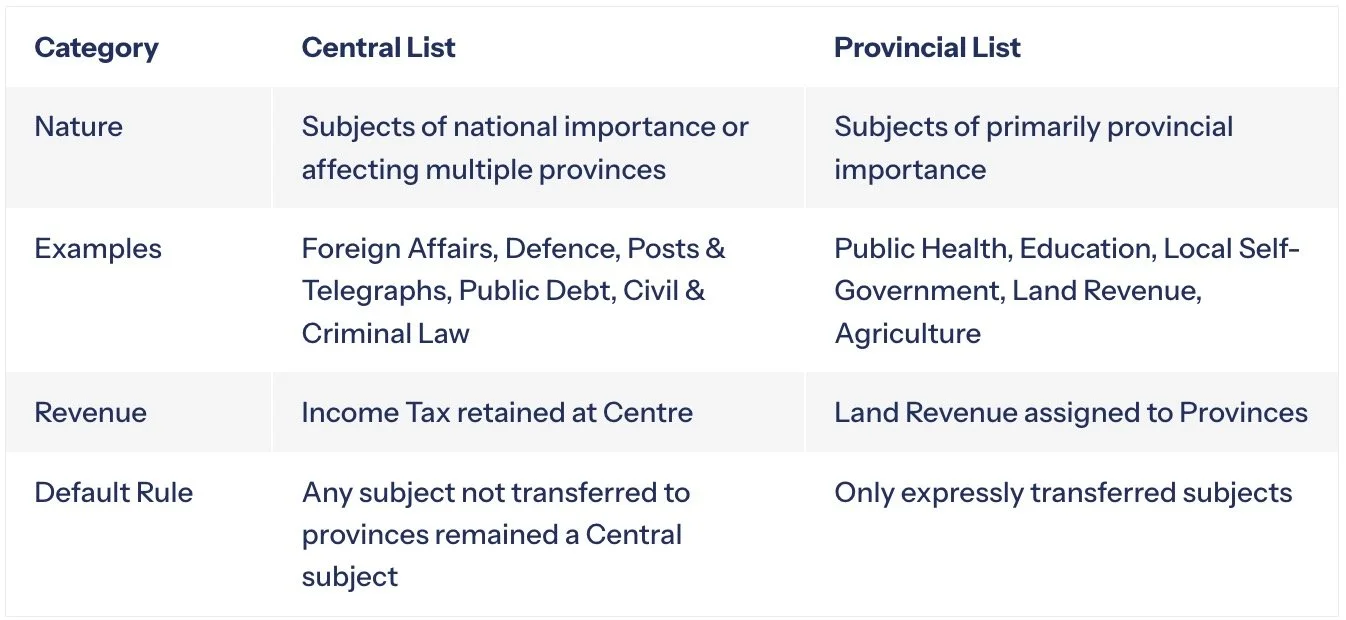
Critics noted that whilst Indian representation increased, the departments assigned to Indian members were comparatively unimportant, and Indian members were not made responsible to the Legislature. Furthermore, the division of subjects was not always clear-cut, and the Governor-General retained vast executive powers and full control over his councillors — the wishes of the Indian people in respect of this office were effectively ignored.
The Bicameral Central Legislature
One of the most structurally significant changes introduced by the Act was the replacement of the single-chambered Imperial Legislative Council with a bicameral legislature at the Centre, comprising two Houses: the Council of State(Upper House) and the Central Legislative Assembly (Lower House).
Council of State (Upper House)
60 total members
26 nominated by the Governor-General (20 officials, 6 non-officials)
34 elected (20 General, 10 Muslim, 3 European, 1 Sikh)
5-year tenure; partially renewed annually
President nominated by the Viceroy
Women excluded from membership
Franchise: income tax on Rs. 10,000/yr minimum, or land revenue of Rs. 750/yr minimum
Only 17,364 persons qualified to vote (out of 24 crore population in 1920)
Central Legislative Assembly (Lower House)
145 total members
41 nominated (26 officials, 15 non-officials)
104 elected: 52 General, 30 Muslim, 2 Sikh, 7 Landholders, 9 European, 4 Indian Commercial
3-year tenure (extendable by Governor-General)
Broader franchise than Council of State
909,874 voters qualified in 1920
Seat distribution based on provincial importance, not population
The distribution of seats among provinces was based on their political and commercial importance rather than population. Bombay and Madras were each granted 16 seats, despite Bombay's population being only half that of Madras — justified on grounds of Bombay's commercial significance. Communal representation was not only retained but considerably extended: in addition to Muslims, Sikhs were granted separate electorates, seats were reserved for non-Brahmans in Madras, and the 'depressed classes' were offered nominated seats at all legislative levels.
Powers & Restrictions of the Central Legislature
The Act ostensibly conferred wide powers upon the central legislature. It could legislate for the whole of British India, for Indian subjects and servants of the Government whether inside or outside the country, and could repeal or amend any existing law. Members enjoyed freedom of speech, the right to move resolutions and adjournment motions, the right to ask questions and supplementaries, and the right to consider urgent matters of public importance.
Prior Sanction of Governor-General Required For
Amendment or repeal of existing law or Governor-General's ordinances
Foreign relations and relations with Indian States
Military, naval and air force discipline or maintenance
Public debt and public revenue
Religion, religious rites and usages
Additional Executive Powers
The Governor-General could prevent consideration of any bill affecting the safety or tranquillity of British India
If the Legislature refused to pass a law on Governor-General's advice, he could pass it himself (subject to Crown's sanction)
He could promulgate ordinances in emergencies lasting up to six months
His assent was essential for the enactment of any law passed by the Legislature
Budget Constraints
Certain budget items were subject to the vote of the Assembly
Others were open only for discussion
Some could be neither discussed nor voted upon
The Act therefore introduced what historians describe as "responsive" rather than "responsible" government at the Centre. A vote of no-confidence by the Legislature could not remove members of the Executive Council; however, executive members did in practice respond to legislative wishes — through standing committees on Public Accounts and Finance, through questions, supplementary questions, adjournment motions, and budget rejections. It was, at best, an indirect and incomplete form of accountability.
Introduction of Dyarchy in the Provinces
The most structurally innovative — and ultimately most controversial — feature of the Act was the introduction of Dyarchy (rule of two) in the provinces. The Montford Report had asserted that provinces were the appropriate domain for the earliest steps towards responsible government. To give effect to this principle, the Act divided provincial subjects into two categories: Reserved and Transferred.
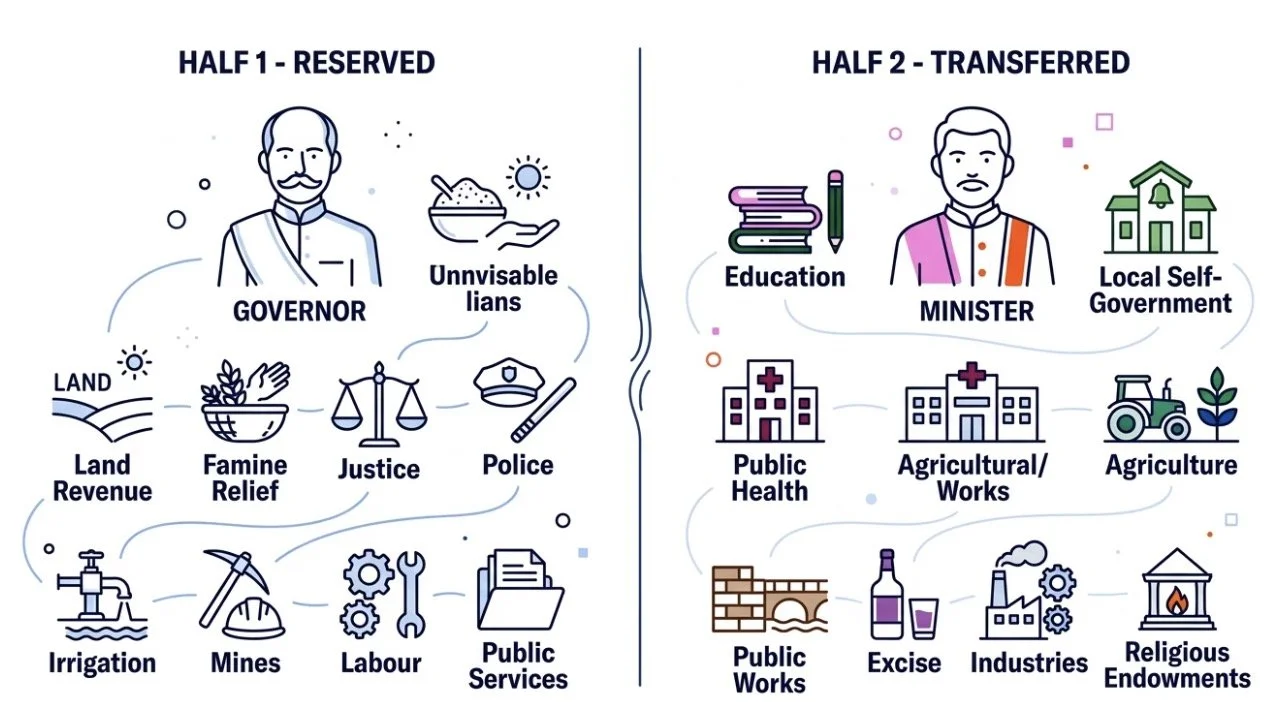
Dyarchy in the Provinces
The Governor remained the executive head of the province. For Reserved Subjects, he worked with nominated Executive Councillors who were not answerable to the Legislature. For Transferred Subjects, he worked with ministers drawn from elected members of the Legislature, who were responsible to it and could be removed by a vote of no-confidence. The Secretary of State and the Governor-General could interfere in Reserved matters but had restricted scope to do so in Transferred matters. In cases of constitutional breakdown, the Governor could assume control of Transferred Subjects as well.
Provincial Legislative Councils were substantially expanded: at least 70% of their members were to be elected by direct vote, with women granted the right to vote. Not more than 20% could be officials, and the remainder were nominated non-officials. Members enjoyed freedom of speech, the right to initiate legislation on provincial subjects, and the ability to reject the budget — though the Governor retained the power to restore it and to veto bills or issue ordinances.
Critique of Dyarchy — Structural Failures
Dyarchy was introduced in the provinces on 1 April 1921 and remained in operation until 1 April 1937. Throughout this period, its theoretical limitations rapidly translated into practical dysfunction. Historians and contemporary observers have catalogued its failures extensively, and the system was ultimately abolished on the recommendation of the Simon Commission in the Government of India Act, 1935.
Illogical Division of Subjects
The actual separation of subjects between Reserved and Transferred categories was widely regarded as irrational. Agriculture was Transferred whilst Irrigation remained Reserved, despite their inseparability. Industry was Transferred whilst Water, Power, Factories, and Mines remained Reserved. Unity of administrative purpose was structurally impossible.
Ministerial Weakness & Divided Loyalties
Ministers were compelled to serve two masters simultaneously — the Governor and the Legislative Council. Appointed by the Governor and dismissible at his will, yet answerable to the Legislature, ministers in practice prioritised gubernatorial favour over legislative accountability. In the absence of strong parties, no minister commanded a reliable legislative majority and thus depended upon the official bloc. Ministers effectively became, in the words of C.R. Das, "only dumb spectators."
Bureaucratic Supremacy Over Ministers
A minister's own permanent secretary maintained a weekly interview with the Governor, ensuring official opinion invariably carried more weight. Differences between ministers and their secretaries or divisional commissioners were referred to the Governor, who consistently sided with the officials. The All-India Services remained under the Secretary of State's control even in Transferred departments, rendering ministerial authority over them nominal.
Financial Strangulation
All so-called "nation-building departments" were placed under Transferred ministers, yet adequate financial resources were withheld. Ministers depended entirely upon the goodwill of the Finance Member — a bureaucrat with little sympathy for popular aspirations — who consistently prioritised Reserved departments over Transferred ones.
A celebrated example of jurisdictional confusion involved an enquiry commenced by the Agriculture Department on land fragmentation. After a year, it was transferred to the Revenue Department; two years later, it was discovered to belong to the Co-operative Department. Such episodes illustrated the fundamental incoherence of the Dyarchy framework. The absurdity was not merely administrative — it exposed the degree to which the entire structure was premised upon limiting rather than enabling Indian self-governance.
Additional Hindrances to the Act's Successful Working
Beyond the structural deficiencies of Dyarchy itself, several contextual factors severely hindered the Act's effective operation from its very inception. The political atmosphere in India was deeply contaminated by suspicion and distrust following the terrible events in the Punjab and the British Government's attitude towards Turkey. Economic conditions also conspired against success.
Political & Moral Crisis
Rowlatt Act (March 1919): passed despite unanimous Indian opposition in the Legislative Council — authorised imprisonment without trial, suspending habeas corpus
Jallianwala Bagh massacre (April 1919): galvanised Nehru, Gandhi and mass Indian opinion
Repressive press restrictions re-enacted simultaneously with constitutional reforms
Muslim alienation over British policy towards Turkey deepened
Economic & Financial Difficulties
Monsoon failure of 1920 compounded popular misery
Post-war market slump disrupted Central and Provincial finances
India's favourable balance of trade disrupted
Under the Meston Award, provinces were required to make annual contributions to the Government of India — a burden they could ill afford amid financial crisis
The passage of the Rowlatt Act in March 1919 — which authorised the Government to imprison any person without trial or conviction, effectively suspending the right of habeas corpus — was widely seen throughout India as a betrayal of the strong support the Indian population had extended to the British war effort. Every single Indian member of the Central Legislative Council had opposed it; several, including Mohammed Ali Jinnah, resigned in protest. Gandhi launched a nationwide protest movement against the Rowlatt Acts, the strongest agitation occurring in the Punjab. An apparent violation of assembly restrictions at Jallianwala Bagh, Amritsar in April 1919 resulted in a massacre that proved a decisive turning point in Indian political history, radicalising an entire generation of leaders.
Reception of the Act in India
From the nationalist perspective, the Act of 1919 suffered from three principal and irredeemable defects. First, it offered no responsible government whatsoever at the Centre. Second, it consolidated and extended the system of separate electorates — a structural feature that, though condemned by the Montford Report itself as "a very serious hindrance to the development of the self-governing principle," became a permanent fixture of Indian political life. Third, the Dyarchy introduced in the provinces was too administratively complicated to operate smoothly and too politically constrained to satisfy even moderate nationalist expectations.
Indian National Congress, August 1918
Meeting in special session at Bombay under Hasan Imam's presidency, Congress declared the reforms "disappointing" and "unsatisfactory" and demanded effective self-government instead.
Mahatma Gandhi
"The Montford Reforms…were only a method of further draining India of her wealth and of prolonging her servitude."
C.R. Das on Ministers under Dyarchy
Ministers operating under the Dyarchy were "only dumb spectators, who could neither speak nor say anything" — capturing the fundamental powerlessness of the elected element within the system.
Montagu did order an inquiry into the events at Amritsar under Lord Hunter. The Hunter Inquiry recommended the dismissal of General Dyer, who commanded the troops responsible for the massacre. However, many British citizens supported Dyer, considering him to have been treated unfairly — a divide that further deepened Indian disillusionment with the British sense of justice and the limits of British liberalism when confronted with colonial realities.
Interpretations — Positive Aspects & Historiographical Debate
Notwithstanding the numerous and weighty criticisms levelled at the Act, historians have also identified its positive dimensions. For the first time in the history of British rule, the Act provided for a genuine, if limited, transfer of power. Previous measures had enabled Indians increasingly to control their legislatures; now, for the first time, Indians were to govern — as leaders of elected majorities in provincial legislatures, and responsible to them. The electorates were considerably enlarged: approximately 5.5 million persons became eligible to vote for provincial bodies and 1.5 million for the imperial legislature — a transformation in political scale from the minuscule franchise of 1909.
Philip Woods
The ideas behind the reforms "were crucial in establishing parliamentary democracy in India and, thereby, in beginning the process of decolonisation." This interpretation emphasises the long-term constitutional legacy of 1919 as a foundation for later self-government.
The Cambridge School
Sought to establish a connection between the constitutional reforms of 1909 and 1919 and the emergence of mass politics after World War One. As the electorate widened, Indian leaders were forced to operate democratically and seek popular support — inadvertently nurturing mass political participation.
Peter Robb
The major problem of the reform was its being "limited by ideas of continuing British presence" — a fundamentally constrained exercise that could never meet the aspirations of those Indians who had already moved beyond the framework of self-government within the empire.
Carl Bridge
The extended communal reservations were measures to "safeguard the essentials of the British position" in India — a reading that emphasises imperial calculation over genuine constitutional generosity.
Tomlinson
The reforms were an attempt to mobilise "an influential section of Indian opinion … to support the Raj" — a strategy of co-optation aimed at preserving British authority through selective political inclusion rather than meaningful power-sharing.
The Cambridge School interpretation must, however, be treated with caution. It does not adequately explain the mass upsurge under Mahatma Gandhi, whose philosophy was explicitly based on a critique of Western civil society and the constitutional arena itself. Gandhi's non-cooperation programme launched in December 1920 called for the boycott of the new councils, and the mass movement he engineered operated according to an altogether different political logic — one that sought to liberate Indian politics from precisely the constricted arena of constitutionalism that the 1919 Act represented.
Legacy & Later Developments
The Montagu-Chelmsford Report had itself stipulated that there should be a review of the Act after ten years. Accordingly, the Simon Commission was appointed under Sir John Simon to assess the working of the Act and recommend further constitutional changes. Its report, though controversial — the Commission contained no Indian members, prompting widespread protests — recommended the abolition of Dyarchy and further constitutional evolution.
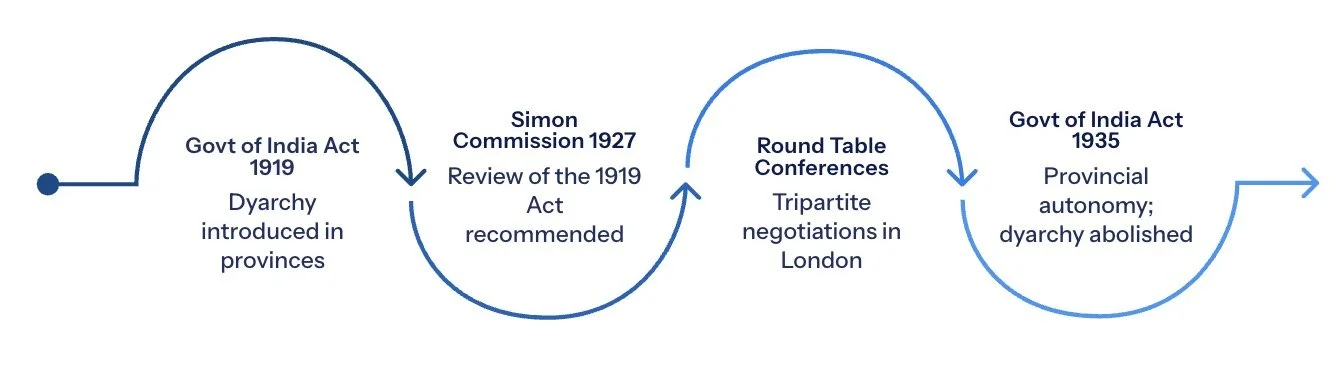
Three Round Table Conferences were held in London in 1930, 1931, and 1932, bringing together the major interests in Indian politics. Gandhi attended the 1931 conference following negotiations with the British Government. The central disagreement between the Congress and the British remained the question of separate electorates — which the Congress opposed but which were retained in Ramsay MacDonald's Communal Award of 1932. These conferences ultimately led to the Government of India Act, 1935, which abolished Dyarchy in the provinces, introduced provincial autonomy, and continued — however haltingly — the movement towards self-government first set in motion by the Montagu-Chelmsford Report.
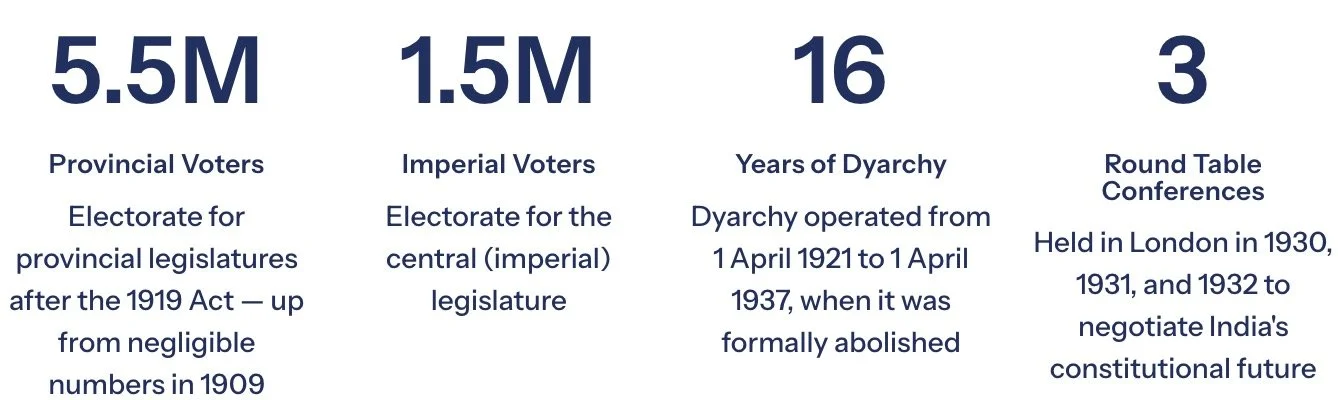
The Government of India Act, 1919 must ultimately be understood as a product of its contradictions. It was simultaneously the most expansive constitutional concession the British had yet made to Indian political aspirations and a document designed to perpetuate British supremacy. It introduced Indians to governance whilst ensuring they could not govern; it spoke of responsible government whilst denying its substance. Its failure to satisfy Indian political opinion did not prevent the emergence of mass politics — it accelerated it, making the eventual demand for complete independence, swaraj, not merely inevitable but irresistible.
