
The Government of India Act 1935
The Government of India Act 1935 stands as one of the most consequential pieces of legislation in the constitutional history of the Indian subcontinent. Enacted in August 1935, it was the longest British Act of Parliament ever passed at that time, encompassing 14 parts, 321 sections, and 10 schedules. It laid the groundwork for provincial autonomy, proposed an All-India Federation, introduced a form of dyarchy at the centre, and reshaped the relationship between the British Crown, the Indian provinces, and the Princely States. Though never fully implemented, the Act remained the operative constitutional framework of British India until Independence in 1947, and its provisions directly influenced the interim constitutions of both India and Pakistan.
Background: The Road to Reform
Indians had been demanding a greater role in the governance of their country since the late nineteenth century. The Indian contribution to the British war effort during the First World War compelled even the more conservative elements of the British political establishment to concede the necessity of constitutional change. This resulted in the Government of India Act 1919, which introduced a novel system of provincial government known as "dyarchy," dividing provincial subjects into "reserved" and "transferred" categories. The Indian National Congress, however, considered the Montagu-Chelmsford Reforms of 1919 to be "inadequate, unsatisfactory and disappointing," and while it resolved to work them as far as possible, it continued to press for full responsible government based on the principle of self-determination.
By the early 1930s, the British Government had successfully suppressed the mass Civil Disobedience movement of 1932–33, but it recognised that repression could only be a short-term tactic. The permanent weakening of nationalist politics required a more strategic approach: dividing the Congress internally, co-opting large segments of it into the colonial constitutional structure, and channelling political energy away from mass agitation and towards constitutional participation. A fresh phase of constitutional reform was therefore deemed necessary by colonial policy-makers.
The 1919 Act's Limitations
The Act of 1919 had satisfied neither any significant section of Indian opinion nor the Conservative establishment in London. Political agitation made it clear that Congress had to be allowed some share of power—but without endangering British control over the central government.
The Simon Commission (1927)
Fresh discussions for reform started in the late 1920s, with a parliamentary commission appointed in 1927 under Sir John Simon. When the Commission visited India, it was boycotted by all political parties because it was wholly European and included no Indian members.
From Round Table Conferences to the White Paper
In October 1929, Lord Irwin made a concession by announcing that full dominion status would be the natural goal of India's constitutional progress. However, in view of fierce Conservative opposition at home, this declaration meant little in practical terms. The Simon Commission's report, released in June 1930, suggested replacing dyarchy with full responsible government in the provinces while leaving the central government largely unchanged. The proposal satisfied none of India's political groups and could not be implemented, partly because the Civil Disobedience movement had begun in earnest.
The new Labour Government declared that the Simon Commission's Report was not final, and to break the constitutional deadlock, it proposed consulting representatives of all Indian communities through a Round Table Conference in London. Three sessions were held in 1930, 1931, and 1932 respectively. Their recommendations were embodied in a White Paper published in 1933, which was then considered by a Joint Select Committee of the British Parliament, chaired by Lord Linlithgow. Division between Congress and Muslim representatives proved a major obstacle to agreement on the details of federal governance.
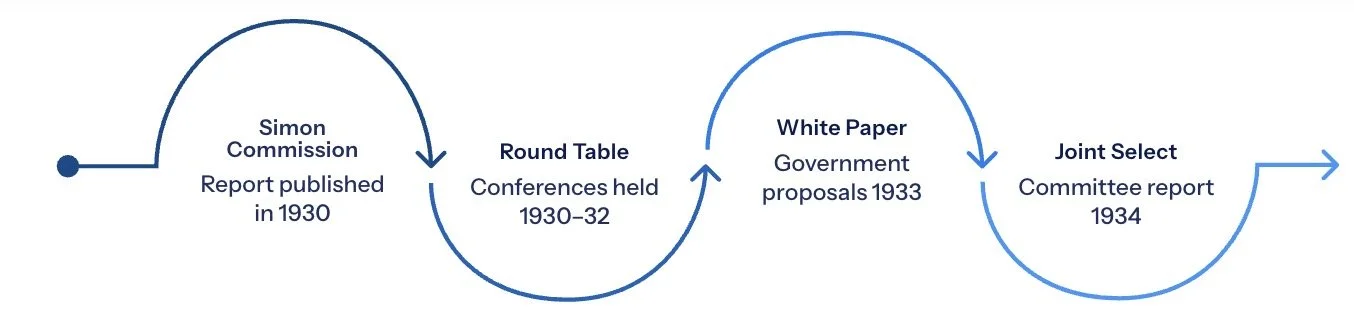
The Conservative-dominated National Government in London ultimately decided to proceed with its own proposals. A drafting committee of 20 representatives from British India and 7 from the Indian States, including 5 Muslims, deliberated from April 1933 to December 1934 and submitted its report to Parliament. Parliament debated the report, passed the Bill in February 1935, and it received Royal Assent on 24 July 1935. The Act was brought into force on 1 April 1937.
Principal Sources of the Act
The Government of India Act 1935 was not drafted in a vacuum. It drew upon a wide range of prior reports, conference proceedings, and constitutional deliberations that had accumulated over nearly a decade of intense political negotiation. Each of these sources contributed distinct elements to the final legislation, reflecting the various political pressures — from Indian nationalists, Muslim leaders, Princely States, and Conservative opinion in Britain — that had to be balanced in its drafting.
Simon Commission Report
Recommended full responsible government in provinces; provided the structural blueprint for provincial autonomy.
Nehru Report
The All Parties Conference report, which notably included a draft bill of rights — a provision ultimately omitted from the Act.
Round Table Conferences
Three successive conferences (1930–1932) exploring federation, responsible government, and minority representation.
White Paper & Joint Select Committee
The White Paper (1933) translated conference recommendations into legislative proposals; the Joint Select Committee refined them.
Lothian Report
Specifically determined the electoral provisions of the Act, including the expanded but heavily qualified franchise.
Structure and Key Features of the Act
The Government of India Act 1935 was a vast and extraordinarily detailed document. It contained 321 sections, 14 parts, and 10 schedules — a reflection of the complex constitutional arrangements it sought to establish across a vast and diverse subcontinent. The Act was essentially divided into two major operative parts: one governing the provinces of British India and one concerning the proposed All-India Federation.
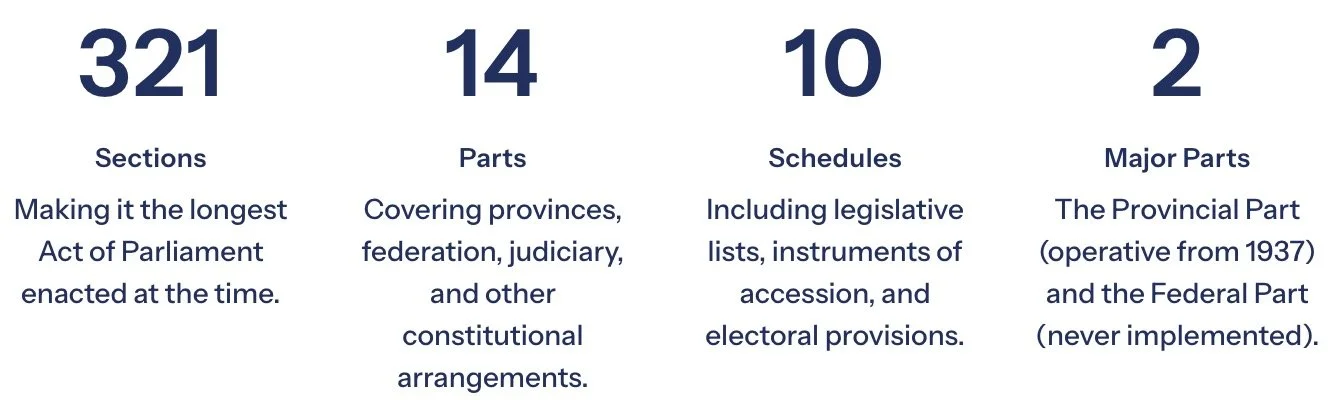
Structure and Key Features of the Act, 1935
The three main features of the Act were: provisions for an All-India Federation bringing together British Indian provinces and Princely States; the introduction of responsible government at the provincial level, qualified by extensive safeguards for the Governor; and the retention of separate representation for communal and other groups — a system that would have deep and lasting consequences for Indian politics.
Provincial Autonomy: Replacing Dyarchy
The provincial portion of the Act represented its most significant practical achievement. In place of the cumbersome dyarchical system introduced in 1919, the Act of 1935 provided for fully responsible government in all provincial departments. All subjects were now placed under elected ministers, accountable to elected provincial legislatures. This was a substantial advance: there were no longer "Reserved" departments shielded from ministerial control at the provincial level.
The Council of Ministers in each province was drawn from elected members of the provincial legislature and was collectively responsible to it. Ministers were to be appointed on the advice of the Chief Minister, who commanded the confidence of the legislature, though the Governor was required to ensure adequate representation of minorities in the ministry. The other ministers held office at the Governor's pleasure, a provision that, as events would show, was not merely ceremonial.
Gains Under Provincial Autonomy
All provincial subjects under elected ministers
No "Reserved" departments at provincial level
Chief Minister to command legislative majority
Collective ministerial responsibility encouraged
Significantly more power than under 1919 Act
Limits and Safeguards
Governors retained wide discretionary powers
Special powers over summoning legislatures and withholding assent
Governors could dismiss ministers
Governor could assume total control of a province
Special responsibilities shielded minority rights and civil servants
The provincial ministers under the 1935 Act were certainly superior in power to their predecessors under the 1919 Act. It was generally recognised that the provincial part of the Act conferred a great deal of power and patronage on provincial politicians, as long as both British officials and Indian politicians played by the rules. However, the paternalistic threat of intervention by the British Governor remained a source of deep political resentment.
The Provincial Governor: Powers and Discretion
The Governor was the pivot of provincial administration under the Act. His position was largely modelled on that of the Governor-General at the centre. While he was normally expected to act on the advice of his Council of Ministers, the Act invested him with three distinct modes of functioning — constitutional, individual judgement, and pure discretion — that collectively gave him enormous real power over provincial governance.
In the discharge of his "special responsibilities," the Governor could act without consulting his ministers, or consult them and disregard their advice. These special responsibilities included: the prevention of any grave menace to the peace or tranquility of a province; the safeguarding of the legitimate interests of minorities; the protection of the rights of civil servants and their dependants; and the prevention of commercial discrimination. If a question arose as to the capacity in which the Governor was acting in a particular case, his own decision on that question was final — meaning the field of ministerial responsibility was as wide or as narrow as the Governor chose to make it.
The Governor's discretionary powers over approximately 40% of the provincial budget, combined with his authority to dismiss ministers and assume direct rule, meant that "responsible government" at the provincial level was, in practice, always conditional on British approval.
The Governor could, by proclamation, take the entire or partial government of a province into his own hands — initially for six months — if satisfied that the province could not be governed in accordance with the Act's normal provisions. This power was exercised directly after the resignation of Congress provincial ministries in 1939, when governors directly ruled the former Congress provinces throughout the Second World War.
Provincial Legislatures and Electoral Provisions
The composition of provincial legislatures naturally varied from province to province. In all Provincial Legislative Assemblies, members were directly elected by the people. Six provinces — Madras, Bombay, Bengal, the United Provinces, Bihar, and Assam — were given bicameral legislatures, consisting of both a Legislative Council and a Legislative Assembly. In each of these Legislative Councils, a few seats were filled by the Governor through nomination.
The electoral provisions of the Act were governed by the Communal Award of the British Government, as modified by the Poona Pact in respect of the Scheduled Castes. Seats in the legislatures were divided among various communities and groups. There were separate constituencies for General, Muslim, European, Anglo-Indian, Indian Christian, and Sikh communities. All qualified electors who were not voters in one of these special constituencies were entitled to vote in a General constituency, and some of the General seats were reserved for the Scheduled Castes. Additionally, separate constituencies were provided for Labour, Landholders, Commerce and Industry, and similar functional groups.
General Constituencies
Open to all qualified voters not belonging to a special communal or functional electorate. Some seats reserved for Scheduled Castes.
Communal Electorates
Separate constituencies for Muslims, Europeans, Anglo-Indians, Indian Christians, and Sikhs. Each community voted only for its own representatives.
Functional Constituencies
Separate seats allocated to Labour, Landholders, Commerce and Industry, and other occupational groups.
Women's Reservation
Women were granted 41 reserved seats in provincial legislatures and limited reservations in the central legislature, though women's seats were further subdivided along religious lines.
The electorate was substantially enlarged to approximately 30 million voters, but the high property qualifications meant that only around 10 percent of the Indian population was enfranchised. In rural India, the franchise was effectively extended to rich and middle peasants — groups seen as the main constituency for Congress politics — leading some historians, notably D. A. Low, to interpret the electoral provisions as a calculated attempt to corrode the Congress support base and attach these important rural classes more firmly to the Raj.
The Proposed All-India Federation
The Act proposed the establishment of an All-India Federation comprising the British Indian provinces and the Princely States. The constituent units of the proposed Federation were to be eleven Governor's Provinces, six Chief Commissioner's Provinces, and all those Indian States that agreed to join. Crucially, accession to the Federation was entirely voluntary for the Princely States, while it was compulsory for the provinces of British India. This asymmetry would prove fatal to the federal scheme.
At the time of joining the Federation, the ruler of each princely state was to execute an Instrument of Accession in favour of the Crown. The terms on which a state joined were to be laid down in this Instrument, and on its acceptance, the state would become a unit of the Federation. The terms offered to the Princes were generous: each prince would select his state's representatives in the Federal Legislature; there would be no pressure to democratise their administrations or allow elections for state representatives; and the Princes would enjoy heavy weightage in both Houses of the federal legislature, despite representing only about a quarter of India's population.
The Federation could not be established unless states whose rulers were entitled to choose at least 50% of the 104 seats of the Council of State, and whose aggregate population amounted to at least 50% of the total population of all Indian States, had acceded. This threshold was never met. The federal provisions were indefinitely postponed after the outbreak of the Second World War.
The Federal Executive: Dyarchy at the Centre
In a significant reversal, dyarchy — which the Simon Commission had firmly rejected and which had been abolished at the provincial level — was reintroduced at the centre. The Act divided Federal Subjects into two categories: Reserved and Transferred. Reserved subjects, including Defence, External Affairs, Ecclesiastical Affairs, and the Administration of Tribal Areas, were to be administered by the Governor-General on the advice of executive councillors appointed by him, not exceeding three in number. These were matters of paramount British imperial interest, insulated entirely from Indian democratic control.
Transferred subjects were to be administered by the Governor-General with the aid of a Council of Ministers of not more than ten, who were to hold office at his pleasure. Even over Transferred subjects, the Governor-General retained "special responsibilities" — in regard to which he had full freedom to accept or reject ministerial advice. No finance bill could be placed in the Central Legislature without his consent. At least 80 percent of the federal budget comprised non-votable items — covering British responsibilities and foreign obligations such as loan repayments and pensions — which were taken off the top before any funds could be considered for social or economic development.
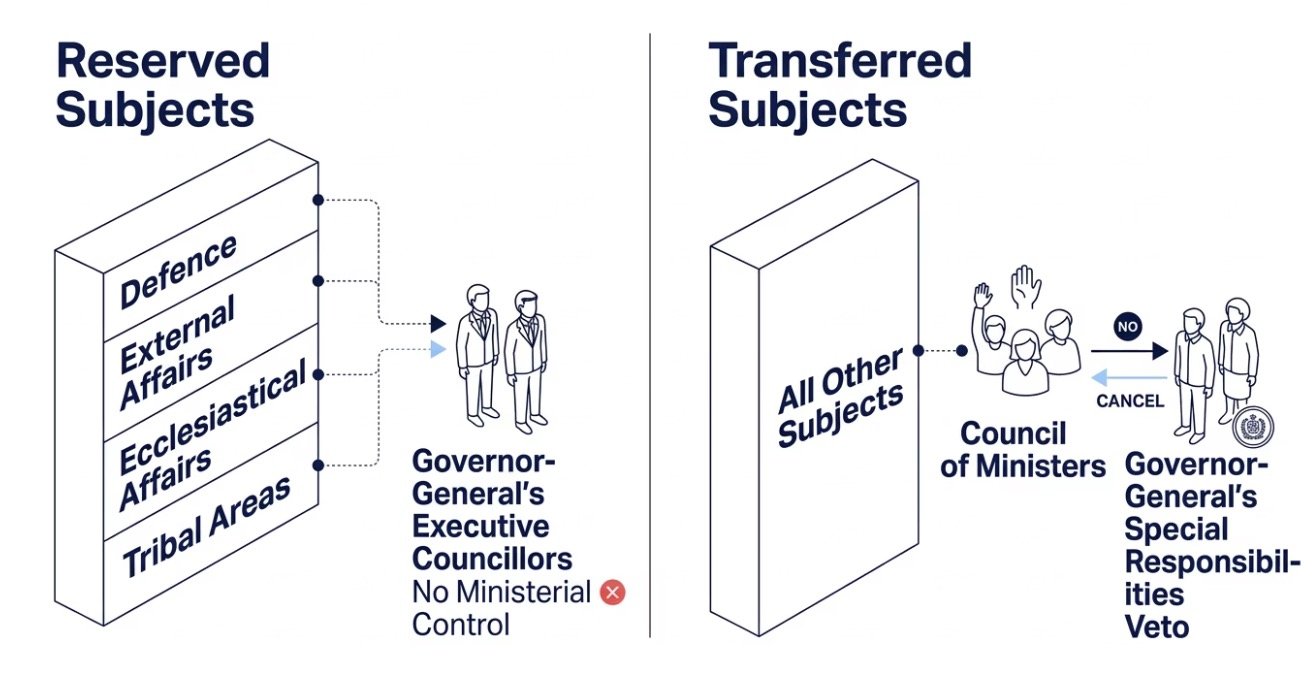
Dyarchy at the Centre
The Viceroy, under the supervision of the Secretary of State for India, was provided with overriding and certifying powers that could theoretically have allowed him to rule autocratically. The British Government, through the Secretary of State, continued to control India's financial obligations, defence, foreign affairs, the British Indian Army, and the key appointments to the Reserve Bank of India and the Railway Board. Responsibility was thus introduced at the Federal Centre in a very limited and heavily qualified manner.
The Federal Legislature: Composition and Powers
The proposed federal legislature was to be a bicameral body consisting of the Council of States (Upper House) and the Federal Assembly (Lower House). The Upper House was to be a permanent body with one-third of its membership being vacated and renewed every three years. Of its 260 seats, 104 were to represent the native Indian states, nominated directly by the rulers, and 156 were to represent the British Indian provinces. Of the 156 provincial seats, 150 were to be filled on a communal basis, with Hindu, Muslim, and Sikh seats filled by direct elections and seats for Indian Christians, Anglo-Indians, and Europeans filled by indirect election through an electoral college.
The Federal Assembly was to consist of 375 members — 250 from British India and 125 from the Indian States. In a striking anomaly, while the Upper House elected its British Indian members by direct election, the Lower House elected them indirectly through the provincial legislative assemblies. Members representing the Indian States in the Lower House were nominated by the rulers rather than elected by the people of the states. The Princes were thus to nominate one-third of the representatives in the Lower House and two-fifths in the Upper House — a provision that made a Congress majority in the Federal Legislature mathematically impossible.
Three Legislative Lists
Replacing the single division of the 1919 Act: the Federal Legislative List, the Provincial Legislative List, and the Concurrent Legislative List. Residuary powers rested with the Governor-General, who alone decided in his sole discretion under which list any subject fell.
Restricted Legislative Powers
Certain subjects were explicitly excluded from both Federal and Provincial Legislatures, including laws affecting the British Sovereign or Royal Family, the Army Act, the Air Force Act, the Law of Prize Courts, and any amendment to the 1935 Act itself. Discriminatory legislation against British commercial interests was banned outright.
Governor-General's Overriding Powers
The Governor-General could summon a joint sitting of both Houses in case of disagreement, veto Bills passed by both Houses, send Bills back for reconsideration, or reserve them for His Majesty's consideration. Even Acts assented to by the Governor-General could be disallowed by the King-in-Council.
The Governor-General: Pivot of the Constitution
The Act made the Governor-General the undisputed pivot of the entire constitutional order. He gave unity and direction to its diverse and often conflicting elements, acting in three distinct capacities. Normally, he was to act on the advice of his Council of Ministers. In connection with his "special responsibilities," he could act in his individual judgement, consulting but potentially disregarding ministerial advice. And in a third category of matters — including the Reserved Departments, ordinance-making, control over non-votable budget items, and the issuing of instructions to provincial Governors — he acted in his pure discretion, without consulting his ministers at all.
Acts on Ministerial Advice
For routine governance of Transferred subjects — but subject always to his overriding powers in areas of special responsibility.
Individual Judgement
Regarding: safeguarding India's financial stability; preventing grave menace to peace; protecting minorities and civil servants; and preventing commercial discrimination against British interests.
Pure Discretion (No Consultation)
Reserved Departments; appointment and dismissal of the Council of Ministers; ordinance-making; control over 80% of the budget; summoning joint sittings; and withholding assent to legislation.
The ministers in the Transferred sphere were to be chosen and summoned by the Governor-General in his discretion, and would hold office during his pleasure. Given these extensive powers, the Act's commitment to "responsible government" at the Federal Centre amounted, in the view of most Indian political leaders, to very little indeed.
Other Key Provisions of the Act
Beyond the provincial and federal structures, the Act contained a number of other significant provisions that reshaped the constitutional and administrative landscape of British India. These ranged from the establishment of new judicial and administrative bodies to territorial reorganisation and changes to the powers of the Secretary of State for India.
Federal Court Established
The Act provided for a Federal Court with original and appellate powers to adjudicate inter-state disputes and constitutional interpretation. It began functioning from 1 October 1937, with Sir Maurice Gwyer as its first Chief Justice, consisting of one Chief Justice and up to six judges. Appeals in certain cases could still be made to the Privy Council in England.
Federal Railway Authority
Control of the railways was vested in a new seven-member Federal Railway Authority, kept deliberately free from the control of ministers and councillors — an assurance to British railway shareholders that their investment was secure.
Reserve Bank of India
The Reserve Bank of India was formally established under the Act. However, key appointments to the Reserve Bank were subject to the approval of the British Government through the Viceroy, limiting India's true fiscal autonomy.
Provincial Reorganisation
Sindh was separated from Bombay, and Bihar and Orissa were divided into separate provinces, creating two new provinces. Together with the North-West Frontier Province, this brought the total number of Governor's Provinces to eleven. Burma was also separated from India, and Aden was transferred to the Colonial Office as a Crown Colony, both with effect from April 1937.
The Act also abolished the Council of the Secretary of State for India, which had been established in 1858, replacing it with a body of advisers whose advice the Secretary of State could accept or reject at will (except in respect of the Services). The abolition responded to sustained agitation in India against the Council's persistently anti-Indian policies. At the same time, the Secretary of State's control over the powers of the Governor-General and provincial Governors — wherever they acted in their individual judgement or discretion — remained entirely intact.
Critical Analysis: The Act's Structural Flaws
The Government of India Act 1935 has been subject to searching criticism from virtually every angle — Indian nationalists condemned it as falling far short of genuine self-government, while a significant element in Britain considered it dangerously radical. A close reading reveals that the British Government equipped itself with legal instruments to take back total control at any time it deemed desirable. The following critical assessments highlight the Act's most fundamental constitutional deficiencies.
No Preamble — The Dominion Status Ambiguity
Unlike the 1919 Act, which contained a preamble pledging "the gradual development of self-governing institutions" towards "responsible government," the 1935 Act had no preamble of its own. It merely kept the 1919 Act's preamble in place — widely read in India as a lukewarm signal from the British that full dominion status remained a distant and conditional prospect. Indian demands were by then centring on constitutional parity with Canada and Australia.
No Bill of Rights
In contrast with most modern constitutions, and unlike the draft Nehru Report which had included a bill of rights, the Act contained no fundamental rights. The inclusion of autocratic Princely States in the proposed Federation made incorporating such rights particularly complex — the princes had no intention of subjecting their administrations to constitutional rights protections.
Pervasive Safeguards
The Act was riddled with "safeguards" enabling British intervention whenever British interests or responsibilities were perceived to be at risk. These elaborate safeguards were a vital subtraction from the principle of self-government. The Governor-General and Governors could override ministers and legislatures in circumstances defined by themselves, and in extremis could assume absolute dictatorial powers.
The Federation Problem
The attempt to bring together democratic British Indian provinces with autocratic Princely States was inherently contradictory. The voluntary nature of accession for princes — while provinces had no choice — handed the Princes a collective veto over the entire federal scheme. The process for bringing the Federation into existence was, in the view of many, ill-conceived and illogical.
Dyarchy Reintroduced at the Centre
Despite being thoroughly condemned and abolished at the provincial level, dyarchy was reintroduced at the federal centre. The most important departments — Defence, which consumed the lion's share of the budget, and External Affairs — were kept as Reserved subjects, entirely beyond democratic accountability.
False Equivalences and British Commercial Interests
The Act required that British citizens resident in the UK and British companies registered in the UK be treated on the same basis as Indian citizens and companies — despite the completely dominant position of British capital in the Indian modern sector and the non-existence of any comparable Indian involvement in the British economy. The Viceroy was required to intervene if any Indian law was found to discriminate against British commercial interests.
Indian Reactions and the Congress Response
The Act was condemned by nearly all sections of Indian opinion and was unanimously rejected by the Indian National Congress. Congress demanded instead the convening of a Constituent Assembly elected on the basis of adult franchise to frame a constitution for an independent India. Jawaharlal Nehru, then Congress President, described 1 April 1937 — the day the Act came into force — as the imposition of an "unwanted, undemocratic and anti-national" constitution against the "wholehearted and unanimous will of the country." On another occasion, he declared the new constitution to be "a machine with strong brakes but no engine."
"After all we framed the constitution … of 1935 because we thought it the best way … to hold India to the Empire."
— Lord Linlithgow, Viceroy of India
Muslim leaders, while not openly opposing federation, were deeply afraid of Hindu domination and felt the proposed federal structure was still too unitary. All the representatives of British India to the central legislature were to be elected through the provincial assemblies — a process that disadvantaged Muslims, who were a minority in all but four provinces. Muslim political leadership therefore preferred decentralisation and a weak central government that would allow more autonomy for Muslim-majority provinces.
The Congress objected particularly to the federal assembly arrangement, in which one-third of seats were to be filled by princes, tying the fate of democratic India to the whims of autocratic dynastic rulers. However, even within Congress and among the Liberals, some — including Sapru and Birla — cautiously felt that working the Act might be the only practical option at the time. Gandhi himself, Birla reported, was less troubled by the reservation of Defence and External Affairs than by the method of choosing States' representatives.
Why the Princes Did Not Join the Federation
The federal scheme's architects had hoped that the Princes would recognise that their best hope for a secure future lay in rapidly joining the Federation and forming a united bloc that no other group could outvote. Instead, the Princes stayed out, and their collective veto prevented the Federation from ever coming into existence. Their reasons for abstention were numerous and, in combination, insuperable.
The Paramountcy Problem
Their main formal objection was that the Act did not resolve the issue of paramountcy. The Government of India, as the paramount power, still retained the right to intervene in the affairs of their states or even overthrow their governments if necessary. The Princes wanted this threat removed before they would contemplate joining.
Lack of Cohesion
The Princes were not a cohesive group. Each was primarily consumed by the desire to secure the best individual deal for his own state — maximum money, maximum autonomy, maximum representation. The larger states resisted surrendering fiscal autonomy; the smaller states complained of inadequate representation in the legislature.
Fear of Democratic Pressure
The Princes' deepest fear was joining a democratised federal central government where elected political leaders from British India would have little sympathy for their autocratic rule and would actively encourage democratic movements within their territories. Congress was already agitating for democratic reforms within the Princely States, and it was widely understood that this pressure would intensify within a federal framework.
The Congress Coup Scenario
Had the Federation been established and democratic elections held in the states, the representatives would in all likelihood have been largely Congressmen. This would have amounted to a Congress coup from within the federal structure — precisely the opposite of what the British had intended by inviting the Princes in as a conservative counterweight to nationalism.
This last point exposed a deep contradiction at the heart of British policy. While officially claiming to look favourably on the eventual democratisation of the Princely States, the British plan for the Federation actually required the States to remain autocratic — for the scheme to work as a conservative check on nationalism. The failure of the Princes to join was thus not merely a practical setback: it revealed the internal incoherence of the federal design itself.
The Political Objectives of the British Government
The Act of 1935 was not simply a constitutional document: it was a calculated political instrument designed to serve a precise set of British imperial objectives. As historian B.R. Tomlinson observed: "The progress of constitutional advance in India is determined by the need to attract Indian collaborators to the Raj." Every major provision of the Act can be understood in terms of these strategic goals.
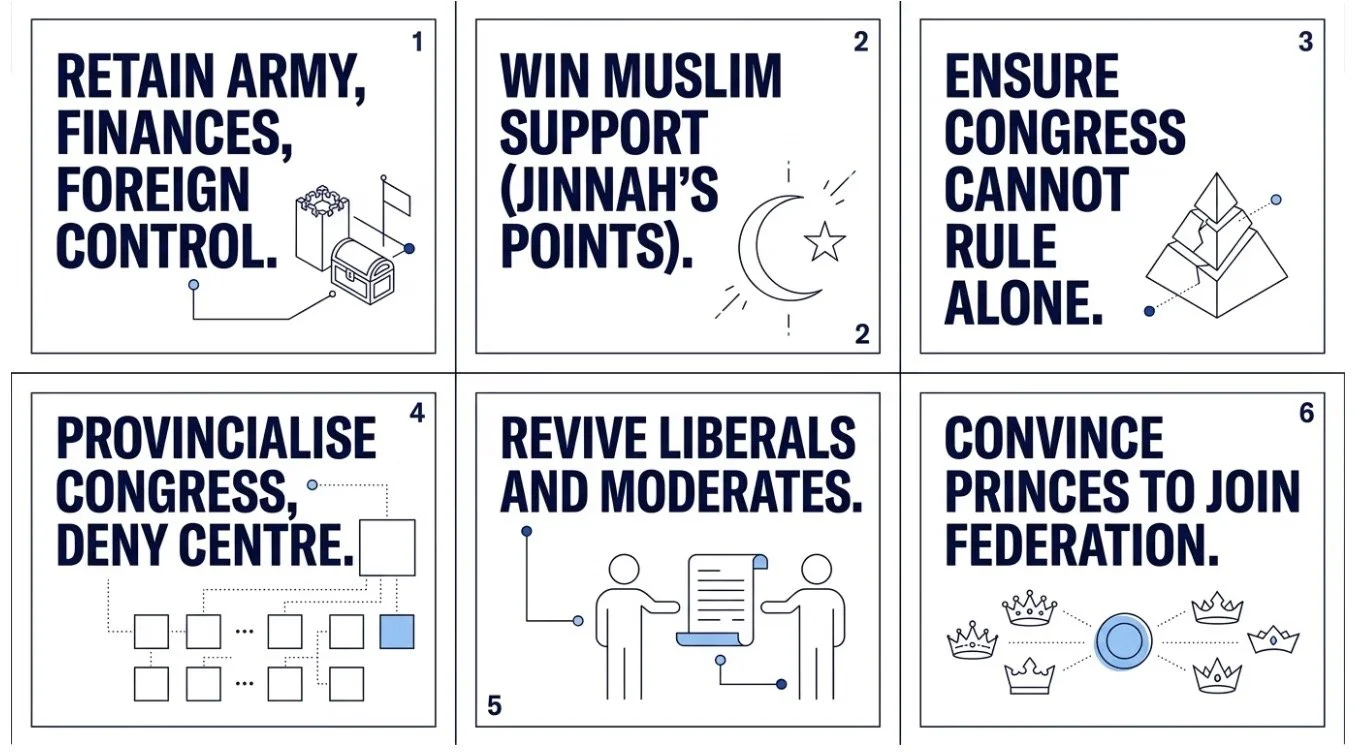
The Labour opposition in London argued that the Act only proposed to protect British interests in India by sharing power with loyalist elements. The Conservative leadership envisaged that over the very long term, the Act would lead to a nominally dominion-status India that was conservative in outlook, dominated by an alliance of Hindu princes and right-wing Hindus, and well disposed to remain under British guidance and protection. Lord Linlithgow put the matter bluntly in a letter of 1936: "Our best hope of avoiding a direct clash is in the potency of Provincial Autonomy to destroy the effectiveness of Congress as an All-India instrument of revolution."
The strategy of "provincialization" was perhaps the most sophisticated of these objectives. By giving Indian politicians substantial power at the provincial level while denying them responsibility at the centre, it was hoped that the Congress — the only truly national party — would disintegrate into a series of provincial fiefdoms, with the authority of the central all-India leadership fatally weakened. As events proved, this strategy was ultimately unsuccessful: the Congress High Command was able to maintain control over its provincial ministries and forced their collective resignation in 1939, demonstrating the organisation's remarkable cohesion.
The Working of the Act: 1937–1939
The British Government sent out Lord Linlithgow as the new Viceroy with the specific remit of bringing the Act into effect. Linlithgow was intelligent, extremely hardworking, honest, serious, and genuinely determined to make a success of the Act. However, he was also unimaginative, stolid, and legalistic — and found it very difficult to develop rapport with people outside his immediate circle. These personal qualities would have significant consequences for Indo-British relations.
In 1937, following the holding of provincial elections, provincial autonomy commenced. Congress won decisive majorities in seven of eleven provinces, forming governments that — whatever their reservations about the Act — wielded real administrative power. From this point until the declaration of war in September 1939, Linlithgow tirelessly attempted to secure the accession of enough Princely States to launch the Federation. In this endeavour he received only the weakest backing from the Home Government in London, and in the end the Princes rejected the Federation en masse.
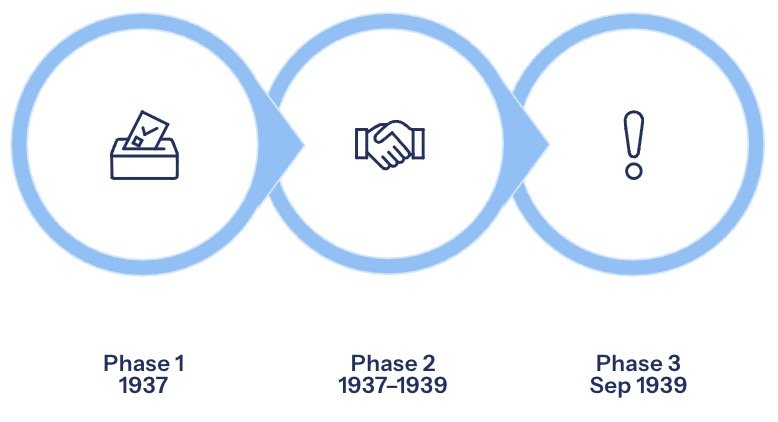
In September 1939, without consulting the elected representatives of the Indian people, Linlithgow simply declared that India was at war with Germany. Though his action was constitutionally correct under the Act, it was deeply offensive to much of Indian opinion that so momentous a decision had been taken unilaterally. This directly precipitated the resignation of all Congress provincial ministries. From 1939 onwards, Linlithgow concentrated entirely on supporting the war effort, and the governors directly ruled the former Congress provinces for the duration of the war — vindicating critics who had warned that the Act's safeguards gave the British the power to negate any constitutional advance whenever they chose.
Legacy and Constitutional Significance
The operative part of the Government of India Act 1935 remained in force until 15 August 1947, when it was amended by the Indian Independence Act 1947. In a remarkable testament to the Act's structural importance, a relatively small number of amendments to the 1935 Act sufficed to transform it into the functioning interim constitutions of both the new Dominion of India and the new Dominion of Pakistan. Many of the Act's institutional arrangements — from the distribution of legislative powers to the structure of the judiciary — directly influenced the framers of the Indian Constitution of 1950.
The basic conception of the Act was that the Government of India was the government of the Crown, conducted by authorities deriving their functions directly from the Crown insofar as the Crown did not itself retain executive functions. This conception, familiar in Dominion constitutions, had been entirely absent in earlier Acts passed for India — and its presence in 1935 marked, however qualified, a shift in the constitutional philosophy underlying British Indian governance.
A Point of No Return
The experiment of provincial autonomy under the Act definitively served to accustom Indian politicians and the Indian electorate to democratic self-governance at the provincial level. The Government of India Act 1935 marks a point of no return in the history of India's constitutional development — even if its federal provisions were stillborn.
Foundation for Independence Constitutions
In 1947, the Act was adapted with relatively few amendments to serve as the interim constitution of both India and Pakistan. Many provisions, institutions, and federal principles carried directly into the Constitution of India (1950) and the Constitution of Pakistan (1956).
The Persistent Imperial Dynamic
As Tomlinson observed, "the apex of the system of imperial control moved from London to Delhi." The Viceroy now enjoyed many of the powers previously exercised by the Secretary of State — a new orientation designed to best protect essential imperial interests. The failure of the Act to win Indian support demonstrated, conclusively, that grudging conditional concessions of power caused more resentment than they resolved.
Conclusion: The Cup Half-Full or Half-Empty?
Lord Lothian, one of the Act's architects, offered a contrasting view of its real significance: "If you look at the constitution it looks as if all the powers are vested in the Governor-General and the Governor. But is not every power here vested in the King? Everything is done in the name of the King but does the King ever interfere? Once the power passes into the hands of the legislature, the Governor or the Governor-General is never going to interfere." This optimistic assessment captured the view that once constitutional conventions were established, formal legal safeguards would fade into irrelevance — as had happened in Canada and Australia.
But the record of 1937–1939 provided limited support for Lothian's thesis. In September 1939, the Viceroy demonstrated precisely that the Governor-General could and would exercise his constitutional powers to override the elected representatives of the Indian people when British interests demanded it. The Congress ministries' resignation confirmed that India's leading political force viewed the Act's safeguards not as theoretical but as operational instruments of continued imperial control.
The Half-Full View
Provincial autonomy gave Indian politicians real power and experience of governance. The Act established democratic institutions and practices that outlasted British rule. It was, for Lord Linlithgow, "the best way to hold India to the Empire" — but it ultimately accelerated, rather than arrested, India's path to independence.
The Half-Empty View
Responsible government was introduced in so limited and conditional a manner at the Federal Centre as to be largely illusory. The absence of a preamble, the absence of fundamental rights, the pervasive safeguards, and the structural impossibility of a Congress federal majority together ensured that the Act fell far short of genuine self-determination — and was rejected by the very constituencies it was designed to win.
The Government of India Act 1935 ultimately failed to achieve its central political objective — securing the long-term allegiance of influential Indian political groups to the British imperial structure. By 1947, it had become the foundation for the constitutions of two independent successor states rather than the framework for a continuing British India. Its deepest significance lies perhaps not in what it achieved, but in what it demonstrated: that constitutional progress driven by imperial necessity, rather than by genuine commitment to self-determination, is constitutionally precarious and politically self-defeating.
Key Dates
1927
Simon Commission appointed
1930–32
Three Round Table Conferences
July 1935
Royal Assent to the Act
April 1937
Provincial Autonomy begins
Sept 1939
Congress ministries resign
Aug 1947
Act superseded by Independence
