
The Revolutionaries: Other Strands in the National Movement
Beyond the politics of petition and mass agitation, a distinct and dramatic strand of Indian nationalism emerged in the late nineteenth and early twentieth centuries — the Revolutionary Terrorists. Driven by disillusionment with constitutional methods and the failures of both Moderate and Extremist leadership, young nationalists turned to secret societies, armed action, and eventually socialist ideology to challenge British colonial rule. This document traces the emergence, ideology, geographical spread, and ultimate decline of this remarkable movement — from Bengal's bomb factories to the Ghadar Party in California, and from Bhagat Singh's Lahore Conspiracy to Surya Sen's Chittagong Armoury Raid.
The revolutionary movement unfolded across three distinct phases (1897–1938), each with its own character, leadership, and political content. Understanding this movement is essential for any comprehensive study of India's freedom struggle, as it illuminates the tensions, contradictions, and passionate idealism that characterised Indian nationalism at its most radical edge.
Why the Revolutionaries Emerged: Context and Causes
The emergence of Revolutionary Terrorism was not an isolated phenomenon — it grew organically from a specific set of political failures, colonial provocations, and ideological frustrations. To understand why educated, idealist youth turned to bombs and pistols, one must first understand what alternatives had already failed them.
Failures of Moderates and Extremists
The Moderates' politics of petitions and constitutional agitation had long lost credibility, coming under sustained criticism from Extremists. But by 1907, the Extremists themselves had reached a political dead end — their programme lacked practical expression, their aims remained unfulfilled, and their inspiring ideology never translated into concrete action. The British showed no sign of relenting: official arrogance and repression continued unabated, and the Partition of Bengal — despite a prolonged protest movement — was not revoked.
Shock of Non-Cooperation's Suspension
The Non-Cooperation Movement (1920–22) had generated unprecedented popular enthusiasm. Almost all future revolutionaries participated in it and shared the exhilaration of Gandhi's promise of independence within a year. The abrupt suspension of the movement after Chauri Chaura came as a profound shock. Idealist youth could see nothing wrong with Chauri Chaura; Gandhi's insistence on integrating morality and politics was incomprehensible to them. This produced deep dissatisfaction, disillusionment, and eventually a turn towards revolutionary terrorism.
The disintegration of Hindu-Muslim unity further deepened the gloom. The alternative political paths — Swarajist parliamentarianism or Gandhian constructive work — held no appeal for restless, radical youth. Their deepening pessimism and despair pushed them toward two interconnected destinations: socialism on one hand, and revolutionary terrorism on the other. Crucially, these were not mutually exclusive — Revolutionary Terrorism with a distinct socialist tinge emerged as a synthesis of both impulses.
Inspirations and Influences Shaping the Revolutionary Mind
The revolutionary movement did not emerge from a vacuum. It was nourished by specific ideological currents, historical events, and social forces that gave it energy, direction, and a sense of possibility. Three influences were particularly decisive.
The Russian Revolution
The Russian Revolution of 1917 was a seismic event for Indian revolutionaries. It demonstrated the triumph of socialistic ideas, the birth of a new political system, and — most inspiringly — the success of a mass-based revolution against a powerful internal enemy. For Indian youth who had grown despondent about their own movement, the Russian Revolution proved that colonial and class rule could indeed be overthrown. It stirred the youth into action and served as a constant source of inspiration and ideological reference.
The Upsurge of the Working Class
Though the influence was more indirect and vague, the growing militancy of the Indian working class was not lost on the revolutionaries. They perceived the revolutionary potential of this new social force and wished to harness it to the cause of national revolution. This recognition would later become more explicit in the ideological programme of the third phase, particularly in the thinking of Bhagat Singh and the HSRA, who made the mobilisation of workers and peasants a central political objective.
Early Revolutionary Traditions
The background for the new generation of revolutionaries in the 1920s was prepared by the early Revolutionary Terrorists of 1897–1910. Their secret societies, anti-establishment journals, and heroic individual actions built a platform and a tradition of sacrifice upon which the later movement could grow. The Anushilan Samiti, Yugantar, and the martyrdom of figures like Khudiram Bose and Madanlal Dhingra created a powerful legacy that inspired succeeding generations of nationalist youth.
Ideology and Programme of the Revolutionary Terrorists
Revolutionary extremism was, at its core, a response of nationalist youth to the failures of existing political strategies and the ongoing humiliations of colonial rule. Its ideology evolved significantly across the movement's three phases, moving from a somewhat inchoate mix of religious inspiration and violent action to a more developed socialist-nationalist framework.
Cult of Violence and Terror
The fundamental constituent of terrorist ideology was the cult of bomb and pistol. The central aim was to strike terror among the British. Equally important was removing fear from the people's minds and arousing revolutionary and patriotic sentiments. Terrorist activities took the form of assassination of unpopular British officials and organising "swadeshi dacoities" to raise funds. This cult was practised and popularised by ardent nationalist youth who placed heroism and self-sacrifice at the highest pedestal.
Secret Societies and Journals
The organisational backbone of the movement was the secret society. These societies were the foci of revolutionary activities, imparting training and organising terrorist actions. A second crucial organ was the revolutionary press — newspapers and journals that were anti-establishment in nature. They disseminated revolutionary ideas, served as vehicles for propaganda, and played a significant role in arousing anti-imperialist sentiments among educated Indians.
Religion as Strength, Not Politics
The early twentieth-century revolutionaries drew upon religion and mysticism for inspiration, but they were not imbued with a communalist approach. To them, religion was a source of inner strength, not the basis of their politics. It inspired them to become fighters for national liberation of all Indian people — not organisers of communal politics. In essence, their religious and mystical beliefs led them to fight against imperialism rather than against other sections of the Indian people.
Socialist Consciousness in the 1920s
In the 1920s, a distinct change occurred. The revolutionary terrorists of this period exhibited a pronounced socialist tinge, particularly in North India. They were not content with mere national independence — creation of a new social order emerged as a necessary complement. This new order was to rest on socialist principles: an end to exploitation, egalitarianism, and a state structure in which power vested in workers and peasants. They also grasped the close links between capitalism and modern imperialism, conceiving British rule as the rule of foreign capitalists.
Revolution, Youth, and the Masses: The Advanced Programme
By the 1920s, the ideology of the Revolutionary Terrorists had acquired a wider content and broader dimension. A new generation of terrorist revolutionaries showed deeper consciousness and extended the base of the movement at least at a programmatic level to workers, peasants, and common people. This represented a revolutionary programme with an advanced social outlook, even while it still incorporated individual or group armed actions of a terrorist nature.
The Concept of Revolution
To the revolutionaries of the 1920s, the word "Revolution" carried a wide and ennobling connotation. It stood for change, progress, order, and regeneration. It was a living and dynamic spirit that could save society from the dark forces of decay and degeneration. Revolution implied struggle — total struggle aimed at victory. It had a wider social content: it could create a new social order, eliminate injustice, and end exploitation. In broader parlance, it expressed the people's aspirations to transform their social and economic conditions. This broad scope was peculiar to this period, though the concept was inherited from the revolutionary upsurges of 1901–1910.
Secular Nationalism
One significant and distinctly discernible change in the 1920s was the adoption of secular nationalism. The religious tinge of the first phase was conspicuously absent. The revolutionaries of this generation stood opposed to communal forces as well, reflecting a matured, inclusive vision of Indian nationhood.
The Primacy of Youth
To the revolutionaries, the youth was to be the vanguard of the revolution — the conveyers of the revolutionary socialist message and the direct fighters for freedom. They believed only youth possessed the capacity for sacrifice and heroism needed to make revolutionary ideas popular.
Propaganda Through Action
The most important form of their propaganda was "propaganda through action" — even through accepting death. Terrorist and heroic action was to generate revolutionary consciousness among the masses, arouse their revolutionary spirit, disseminate revolutionary ideas, and build a platform over which revolution could ultimately be waged.
Mass Revolutionary Potential
A new element of their programme was recognition of the revolutionary potentialities of the masses. They believed a successful struggle could only be waged on the strength of workers, peasants, and common people. Organisation of workers and peasants became a central part of their political agenda.
The Three Phases of the Revolutionary Movement
The revolutionary movement can be divided into three distinct phases, each with a different character, geographical centre of gravity, and ideological content. Together they span four decades of intense, often tragic, nationalist activity.
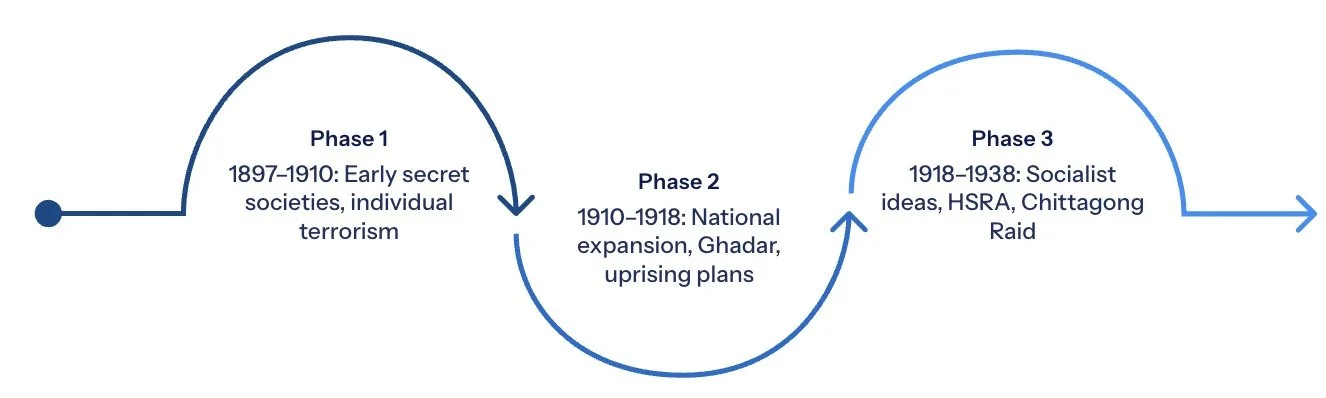
Each phase built upon the legacies of the previous one, even as it diverged in methods and ideology. The first phase was characterised by individual heroism and religious inspiration; the second by organisational expansion and international connections; the third by a conscious attempt to fuse socialist ideology with mass revolutionary action. Understanding these distinctions is crucial for accurately situating individual revolutionary figures and events within the broader movement.
Phase I · 1897–1910
The First Phase: Akharas, Secret Societies, and Early Terrorism
The first phase of the revolutionary movement (1897–1910) was rooted in Bengal and the Deccan, nourished by physical culture movements, secret societies, and the charged atmosphere of the Swadeshi Movement. It was characterised by individual acts of spectacular violence and a deeply religious-mystical inspiration.
Bengal: The Nerve Centre
The precursors to Bengali revolutionary terrorism were the akharas — gymnasia that propagated physical culture and an interest in militant politics, set up across Bengal in the 1860s and 1870s. The earliest secret societies emerged around 1902, including the Midnapore Secret Society (founded by Jnanendranath and Satyendranath Basu, and Hemchandra Kanungo), Sarala Ghoshal's gymnasium for sword and lathi-play, Atmaannoti Samiti (Nibaran Bhattacharya), and most significantly the Anushilan Samiti founded by Satishchandra Basu.
The Swadeshi Movement of 1905 produced a sudden and dramatic increase in the activities of these societies and the birth of many new ones. The Dacca chapter of the Anushilan Samiti was founded by Pulinbehari Das in 1906. In that same year, Hemchandra Kanungo travelled to Europe to train with revolutionaries. Aurobindo Ghose and Charuchandra Dutta started the weekly Yugantar; they also set up a religious school and bomb-making factory at Manicktala, using Hemchandra's expertise freshly acquired from Europe.
Alipore Bomb Case, 1908
The first successful assassination attempt was undertaken by Khudiram Bose and Prafulla Chaki, who threw a bomb at a carriage they believed was carrying magistrate Kingsford. Instead, it killed the wife and daughter of barrister Pringle Kennedy. Within 36 hours, the whole group was arrested. Prafulla shot himself; Khudiram was sent to the gallows. The Dacca Anushilan Samiti also made its presence felt with the dramatic Barrah dacoity in 1908.
Deccan: Chapekar Brothers and Savarkar
Discontent was rife in the Deccan too, particularly in the aftermath of the plague epidemic, during which the destruction of property and forcible hospitalisation created deep resentment. The Chapekar brothers assassinated Rand, the Plague Commissioner of Pune, in 1897, and were hanged in 1898. Their martyrdom profoundly influenced V.D. Savarkar, who ran a group called the Mitra Mela, which later became the Abhinav Bharat.
By 1910, those involved in the Muzaffarpur blast and the Manicktala bomb factory had been tried; some were hanged and others deported for life. Savarkar was transported to the Andamans. Dhingra's revolutionary friends in London, now under police surveillance, dispersed to Paris, Berlin, and Geneva. These events brought the intense first phase to a close.
Revolutionaries Abroad
Revolutionary Activities Outside India: Europe and Beyond
Revolutionary activities and propaganda were not confined to the Indian subcontinent. Indians abroad — in London, California, Canada, and across Southeast Asia — organised, published, and planned with remarkable energy and dedication. These overseas networks were vital channels for revolutionary ideas, international contacts, and the supply of arms and funds.
Shyamji Krishna Verma — London
One of the earliest pioneers among Indian revolutionaries abroad, Shyamji Krishna Verma founded the India Home Rule Society in London in 1905 and started the journal Indian Sociologist. He established the India House, which became a meeting place for revolutionary leaders including P.M. Bapat, Virendranath Chattopadhyay, Lala Hardayal, Bhai Parmanand, Madanlal Dhingra, V.V.S. Aiyar, Madame Cama, and Savarkar, who arrived in London in 1906.
Madame Cama
A close associate of Shyamji, Madame Cama continued propaganda in favour of revolutionary activities and organised protest against the deportation of Lajpat Rai and Ajit Singh. She stated pointedly: "Three years ago it was repugnant to me even to talk of violence... but owing to the heartlessness, the hypocrisy, the rascality of the Liberals, that feeling is gone. Why should we deplore the use of violence when our enemies drive us to it?"
Madanlal Dhingra
A member of the London revolutionary group, Dhingra assassinated Curzon Wyllie, an officer from the India Office, on 1 July 1909. At his execution, he declared: "Poor in wealth and intellect, a son like myself has nothing else to offer to the Mother but his own blood. The only lesson required in India at present is to learn how to die." He was hanged in May 1909.
Other Key Figures Abroad
Raja Mahendra Pratap set up a Provisional Independent Government of India in Kabul in 1915. Taraknath Dasformed the Indian Independence League in California in 1907. Chandrakanta Chakravarty planned an uprising against British imperialism in Asia in 1916 with German help, though the plan ultimately fizzled out. Group rivalries and personal animosities frequently undermined these overseas revolutionary efforts.
Phase II · 1910–1918
The Second Phase: National Expansion and the Ghadar Movement
The second phase (1910–1918) was crucial because centres of revolutionary activity spread far beyond Bengal, emerging in many parts of the country and among Indian diaspora communities on the Pacific coast of North America. This phase saw the most ambitious attempt yet at an organised armed uprising against British rule.
Expansion Across India
Secret societies emerged in Benaras and Dehradun under Rashbehari Bose and Sachindranath Sanyal. Similar organisations were set up in Punjab under Ajit Singh, Bhai Parmanand, and Hardayal, with the encouragement of Lala Lajpat Rai and Hansraj. The Anushilan Samiti in Dhaka and the Yugantar group in Calcutta under Jatindranath Mukherji expanded their operations. The Bharat Mata Association came up in Tirunelveli in the Madras Presidency — a sign of how far the movement had spread geographically.
These societies continued to attack British officials and undertake political dacoities to raise funds. Their leaders established contacts with each other and sought sympathy and arms from sources beyond Indian borders.
The Ghadar Party — Founded 1913
The most significant development of this phase was the Ghadar Party, established in 1913 in San Francisco under Lala Hardayal and Sohan Singh Bhakhna. Its membership was predominantly Punjabi traders, peasants, and workers who had emigrated to America and Canada. The party's journal, Ghadar (meaning "Revolution"), was circulated widely — in America, Canada, Shanghai, Hong Kong, Manila, Penang, and Singapore.
Their aim: to exploit British preoccupation with World War I, link up with Germany and Turkey, and organise a coordinated armed uprising in India, targeted for 21 February 1915. About 8,000 Ghadarites entered Punjab. They made contact with garrisons in Lahore, Rawalpindi, Ferozepur, Banaras, and Fort William.
The plan ended in failure — German arms did not arrive, and the British uncovered the conspiracy. 46 Ghadarites were executed, 64 transported for life, and hundreds imprisoned. Sachindranath Sanyal was deported; Jatindranath died in a gun battle; Rashbehari Bose escaped to Japan.
The Ghadar Party
The Ghadar Movement: Organisation, Reach, and Legacy
The Ghadar Party deserves special attention as one of the most internationally ambitious revolutionary organisations in Indian history. Founded in 1913 by Indians residing in America and Canada — predominantly Sikh jawans and peasants led by educated Muslim and Hindu leaders — it established branches across Mexico, Japan, the Philippines, Malaya, Singapore, Thailand, and Indo-China.
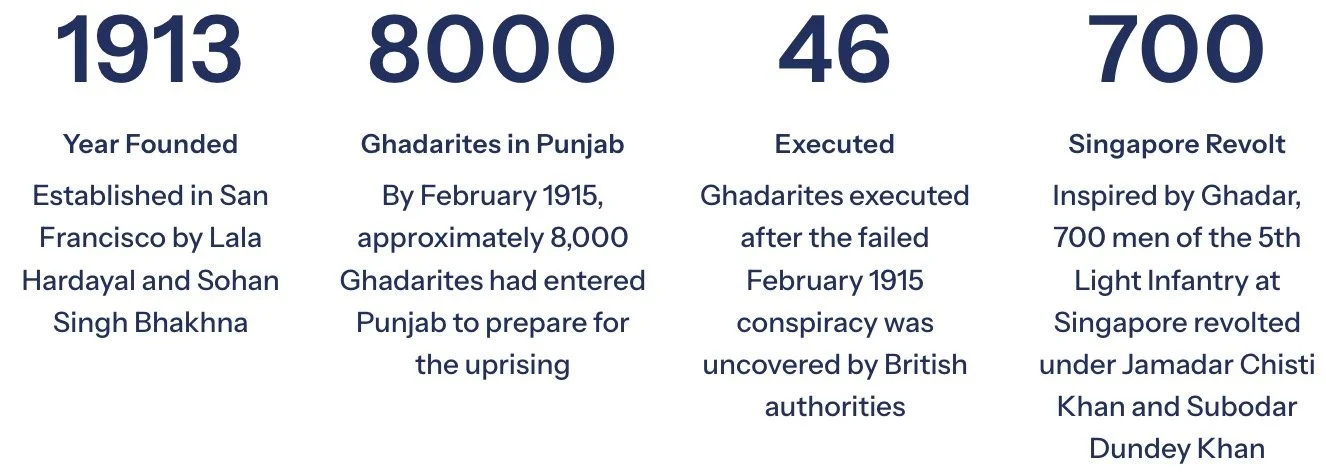
Lala Hardayal published the journal Ghadar in multiple languages to maximise its reach among diverse Indian communities worldwide. Millions of dollars were collected; supporters gave lifelong savings, sold ornaments, property, and land. The Ghadarites sent messages to Indian soldiers urging revolt at an appropriate time. In Singapore, the inspired revolt of 700 men of the 5th Light Infantry ended in failure — 37 members were publicly executed and 41 sentenced to life imprisonment.
Prominent Ghadar workers included Barkatullah (active in Japan and Afghanistan), Raja Mahendra Pratap (active in Germany and Afghanistan), Jatin Mukherjee (known as Bagha Jatin), Ras Behari Bose, and Lala Hardayal. They dreamt of a free India — a dream that did not materialise in their lifetimes, but one that left an enduring imprint on every Indian heart and inspired future generations to continue the struggle.
Phase III · 1918–1938
The Third Phase: Socialist Revolution and the HSRA
The third phase (1918–1938) was the most ideologically sophisticated period of the revolutionary movement. It began with a period of relative quiet as Gandhi's entry reinvigorated mass support during the Non-Cooperation Movement. But the abrupt suspension of that movement in February 1922 — at its very peak, following Chauri Chaura — caused profound dismay and precipitated a new wave of revolutionary activity.
The technique of the third phase was diametrically opposed to Gandhi's ahimsa. But it was also qualitatively different from the first phase: alongside preparation for armed struggle through secret societies, bomb factories, assassination, and political dacoities, there was now a conscious attempt to develop a larger ideology of socio-economic emancipation of the poor masses through revolution.
1923
A 'New Violence Party' comes up in Bengal, establishing links with the Hindustan Republican Association (HRA) centred in UP
1925 — Kakori
HRA activists hold up a train at Kakori, 14 miles from Lucknow, in a daring political dacoity. Many are later arrested.
1927
Ashfaqullah, Ram Prasad Bismil, Rajendranath Lahiri and Thakur Roshan Singh are hanged for the Kakori Conspiracy Case
1928 — HSRA
Leaders meet in Delhi to establish the Hindustan Socialist Republican Army. Bhagat Singh becomes principal ideologue, giving the movement a Marxist-Socialist orientation
1929 — Assembly
Bhagat Singh and Batukeshwar Dutt hurl harmless bombs in the Central Legislative Assembly "to make the deaf hear" and court arrest
1931
Bhagat Singh, Sukhdev, and Rajguru are executed. Chandrashekhar Azad is killed in Allahabad.
HSRA
Bhagat Singh and the Hindustan Socialist Republican Army
The most iconic figures of the third phase were Bhagat Singh, Sukhdev, Rajguru, and Chandrashekhar Azad — young men who combined extraordinary personal courage with a sophisticated Marxist-Socialist political vision. Their story represents the high-water mark of the revolutionary movement.
From HRA to HSRA
The Hindustan Republican Association (HRA) in UP already possessed a revolutionary ideology aimed not merely at overthrowing the British colonial state but replacing it with a "federal republic" established through mass participation and universal suffrage, dedicated to ending the exploitation of the poor. After the hanging of the Kakori conspirators in 1927, surviving leaders met in Delhi in 1928 and reconstituted the organisation as the Hindustan Socialist Republican Army (HSRA).
The young Bhagat Singh was the principal ideologue of the HSRA. He gave the movement a clear Marxist-Socialist orientation and focused its energies primarily on peasants, students, and workers — the social forces he believed would carry the revolution forward.
Key Acts and Their Significance
In December 1928, Bhagat Singh, Sukhdev, and Rajguru killed Saunders, a police official, to avenge the death of Lala Lajpat Rai in the lathi-charge during the anti-Simon Commission agitation. This act of retribution turned them into national heroes almost overnight.
In April 1929, Bhagat Singh and Batukeshwar Dutt hurled harmless bombs in the Central Legislative Assembly and scattered HSRA leaflets. They courted arrest deliberately. Their subsequent trial for the Lahore and U.P. Conspiracy Cases became a political platform — long hunger strikes in prison agitated for the rights of political prisoners. Jatin Das died after an epic 64-day hunger strike, becoming a martyr. They used the spotlight of their trial to propagate their ideas and inspire the country to action before being executed in 1931.
Bengal
Surya Sen and the Chittagong Armoury Raid
In Bengal, the revolutionary movement of the third phase retained a different emphasis. Here, national independence — rather than socialist revolution — remained the more urgent and hallowed goal. The most dramatic expression of this Bengal-centred revolutionary spirit was the Chittagong Armoury Raid of 1930, organised by Surya Sen.
"The Indian Revolutionary Association was established in Chittagong in 1928 on the lines of the Irish Sinn Féin — a model of disciplined, militarised national liberation."
Surya Sen was a revolutionary from Chittagong who had escaped the police to reorganise revolutionary work across Bengal, Bihar, Assam, and UP. In 1928, he and his friends established the Indian Revolutionary Association (IRA). They planned a military insurrection to take over Chittagong and declare it a republic.
22 April 1930
The IRA engaged in a fierce gun battle with police at Chittagong. They lost 13 of their number in the encounter.
Guerrilla Warfare
After the initial raid, the IRA launched "khanda juddha" (guerrilla warfare) against the state — a prolonged and remarkable campaign that continued for years.
Arrest and Sentencing
Surya Sen was arrested in February 1933; his aides Tarakeswar Dastidar and Kalpana Datta in May 1933. Surya Sen and Tarakeswar were sentenced to death in 1934; Kalpana received a life sentence.
End of an Era
After 1934, revolutionary activity continued sporadically, often to avenge these heroes, but with diminishing impact. In 1938, the most long-lived revolutionary organisation, the Yugantar, formally dissolved itself.
Weaknesses and Decline of the Revolutionary Movement
Despite the heroism, sacrifice, and ideological sophistication of the revolutionary movement, it ultimately failed to achieve its objectives or sustain itself as an effective political force. Its weaknesses were structural, ideological, and organisational — and they proved fatal.
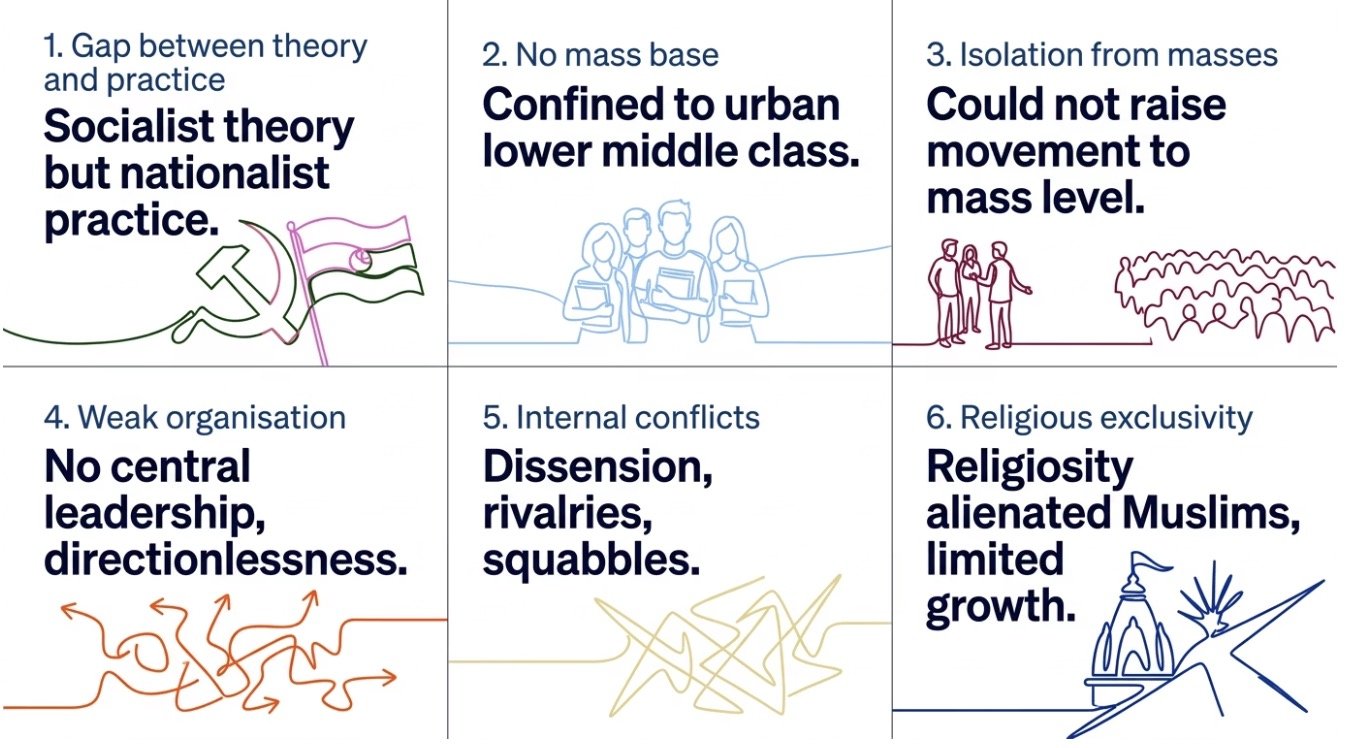
Perhaps the deepest contradiction was between theory and practice. In theory, the revolutionaries were committed to socialism; in practice, they could not go beyond nationalism. In theory, they planned mass action; in practice, their activities remained restricted to terrorist and individual action. In theory, peasants and workers were to constitute their social base; in practice, the movement remained confined to urban lower middle class and petty bourgeois youth. They made little effort to undertake political work among the masses and remained virtually cut off from them.
Government repression proved a deathblow. A series of conspiracy cases, harsh legislation, and severe penalties decimated their ranks. The revolutionaries also stood in opposition to the Gandhian leadership of the national movement and sought to wean youth away from his ideological hegemony — but they failed to provide a credible substitute. They remained a weak force in the wider political struggle and gradually petered out.
Contradictions
The Central Contradiction: Idealism Versus Pragmatism
The most poignant failure of the revolutionary movement lay in the gap between its inspiring ideals and its actual practice. This contradiction ran through every dimension of the movement and ultimately prevented it from achieving the revolutionary transformation it sought.
Ideology vs. Practice
The revolutionaries articulated high ideals at the theoretical level but failed to give them practical expression. They were committed to socialism in theory but could not go beyond nationalism in practice. Their inspiring visions of a transformed social order remained confined to manifestos and declarations.
Mass Movement vs. Individual Action
They planned mass action in theory but their activities remained restricted to terrorist and individual action. The fundamental principle of "revolution by masses" — which they proclaimed — was contradicted by their actual mode of operation, which was conspiratorial and elitist.
Social Base vs. Actual Constituency
Workers and peasants were to constitute their social base in theory, but in practice the movement remained confined to urban lower middle class and petty bourgeois youth. Their "propaganda through action" generated nationalistic sentiments that went in favour of strengthening the very Gandhian nationalist leadership they opposed.
Unity vs. Fragmentation
The movement lacked effective organisational structure and powerful central leadership. Carefully and meticulously prepared plans were few, and even these plans brought little success. Dissension, internal conflicts, and squabbles created divisions and emasculated their strength.
The intense religiosity of the early movement proved a negative factor. While inspiring devotion and self-sacrifice, it restricted the growth of organisation and leadership, and became a factor in isolating Muslims from the movement — a serious limitation for a movement that claimed to fight for all of India's people.
Assessment
The Revolutionary Movement in Historical Perspective
How should historians assess the Revolutionary Terrorist movement? Its practical failures are clear. But its historical significance — in terms of inspiring generations, demonstrating colonial vulnerability, and enriching Indian political thought — is equally undeniable.
What They Achieved
Demonstrated that colonial power could be directly challenged, inspiring widespread nationalist sentiment across India
Provided a tradition of heroic sacrifice that energised successive generations of freedom fighters
Enriched Indian nationalist ideology by introducing and popularising socialist ideas
Their secret societies, journals, and networks built organisational infrastructure that the broader movement could utilise
The martyrdom of figures like Bhagat Singh, Khudiram Bose, and Jatin Das created enduring symbols of resistance that resonated with millions
Forced the British to deploy massive repressive resources, indirectly weakening colonial authority
Where They Fell Short
Could not translate socialist ideology into a mass movement or organisational reality
Remained isolated from the peasants and workers they claimed as their social base
Failed to compete effectively with Gandhian nationalism for the allegiance of the Indian masses
Internal rivalries and absence of central leadership produced a directionless and fragmented movement
The early religious tinge alienated Muslim participation and limited the movement's reach
Government repression, systematically applied through conspiracy cases and harsh penalties, effectively decimated their ranks
The revolutionaries worked at cross-purposes not only with the Moderates and Extremists but also among themselves. They acted as an independent force devoid of support from the principal political groups of the time on the one hand and the masses on the other. The irony noted by historians is particularly sharp: their efforts and sacrifices, aimed at building a revolutionary movement, instead generated nationalistic sentiments that strengthened the Gandhian nationalist leadership they were trying to displace.
Key Figures
Prominent Revolutionaries: A Biographical Overview
The revolutionary movement produced an extraordinary gallery of individuals — each combining courage, idealism, and a willingness to accept death with remarkable intellectual and political conviction. The following profiles cover the most significant figures across all phases and regions of the movement.
Bal Gangadhar Tilak (Contextual Inspiration)
Though not a revolutionary terrorist himself, Tilak's extremist ideology and his cult of Shivaji and Ganapati celebrations provided an early ideological environment from which many revolutionaries drew inspiration.
Khudiram Bose
One of the earliest revolutionary martyrs. Threw a bomb at a carriage believed to carry Magistrate Kingsford in 1908. Executed at the age of 18. Became an iconic symbol of youthful sacrifice for the nation.
V.D. Savarkar
Founded Abhinav Bharat. Fled to London in 1906, was part of the India House circle, and was transported to the Andamans for life in 1910. Later became a major ideologue of Hindu nationalism.
Lala Hardayal
Principal organiser of the Ghadar Party in the United States. Published the Ghadar journal in multiple languages. Had to flee the USA after incurring the displeasure of the American government.
Bhagat Singh
The most iconic revolutionary of the third phase. Chief ideologue of the HSRA. Gave the movement a clear Marxist-Socialist orientation. Executed in 1931 at the age of 23. Remains one of the most celebrated figures of India's freedom struggle.
Surya Sen
Led the Chittagong Armoury Raid of 1930 and established the Indian Revolutionary Association. Conducted guerrilla warfare against the state for years. Arrested in 1933 and executed in 1934.
Key Events
Major Events and Conspiracy Cases: A Reference Chart
The following table provides a systematic reference to the major events, conspiracy cases, and organisational milestones of the revolutionary movement — essential for examination preparation.
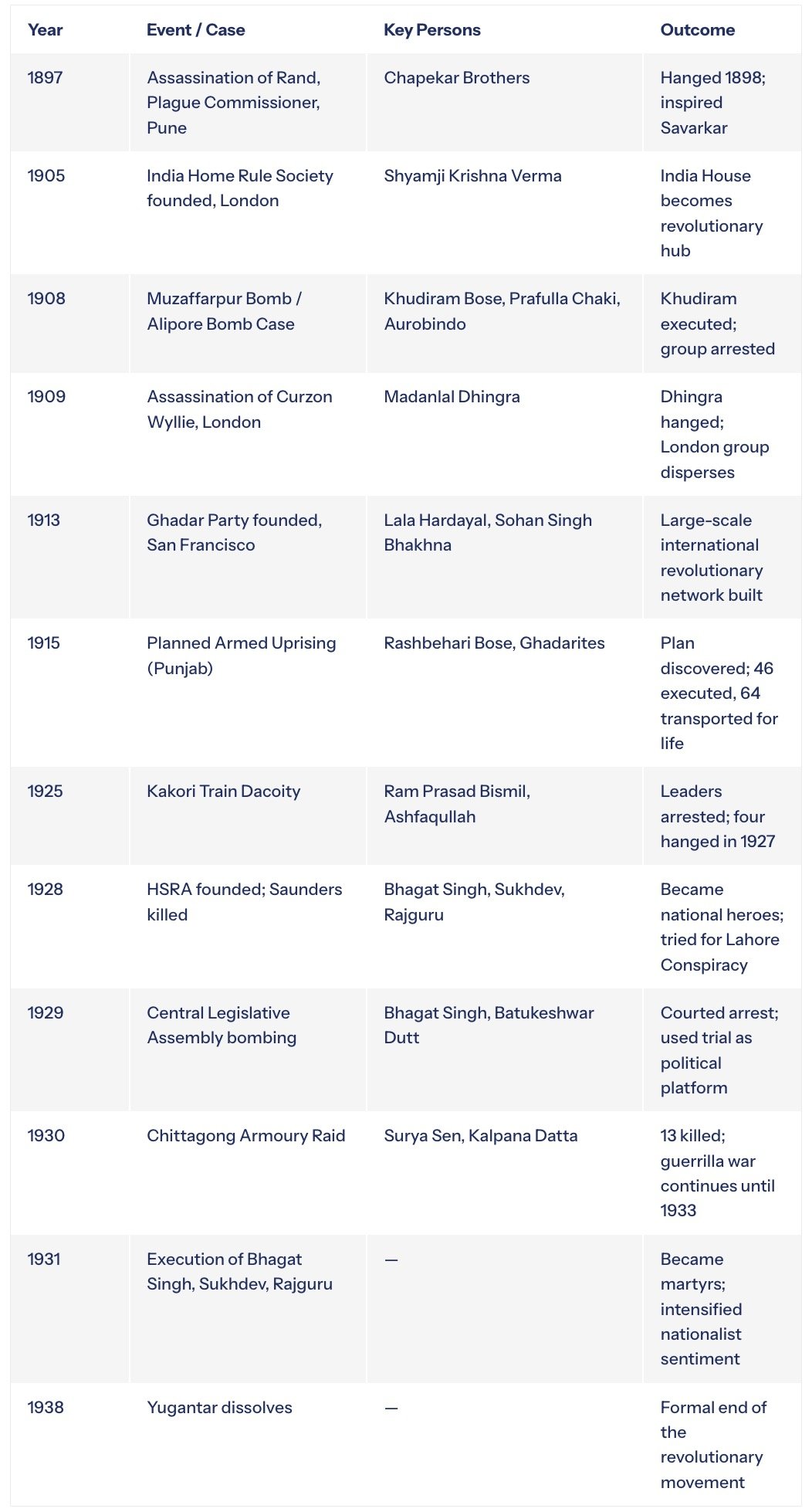
Major Events and Conspiracy Cases: A Reference Chart
Key Themes
For undergraduate students and examination readers, the revolutionary movement raises several important analytical questions that frequently appear in university examinations and competitive tests. Mastering these themes — rather than merely memorising facts — is essential for high-level answers.
Why did the Revolutionary Terrorist movement emerge when it did?
Analyse the conjuncture of failures: Moderate political irrelevance, Extremist dead end by 1907, the shock of Non-Cooperation's suspension in 1922, British intransigence on Bengal Partition, and the inspiring example of the Russian Revolution. The movement was not simply "born" — it was produced by specific political failures and opportunities.
How did the ideology of the revolutionaries evolve across the three phases?
Trace the shift from religious-mystical inspiration and individual terrorism (Phase 1) through organisational expansion and international networks (Phase 2) to a sophisticated Marxist-Socialist ideology emphasising mass revolution, workers and peasants, and secular nationalism (Phase 3). Note the distinction between Bengal (national independence priority) and North India (socialist revolution priority).
What was the central contradiction of the movement?
The gap between theory and practice: socialist in theory but nationalist in practice; mass revolution in theory but individual/group terrorism in practice; workers and peasants as social base in theory but urban petty bourgeois youth in practice. This contradiction accounts for both the movement's ideological vitality and its practical failure.
How does the revolutionary movement relate to the mainstream Congress-led national movement?
The revolutionaries sought an alternative to both Moderate constitutionalism and Extremist direct action. They also sought to displace Gandhian ideological hegemony over the nationalist movement. But they failed to provide a substitute. Their "propaganda through action" paradoxically strengthened nationalist rather than revolutionary socialist sentiments. Their relationship with the mainstream was one of creative tension and ultimate failure to compete for mass allegiance.
The Enduring Legacy of the Revolutionary Strand
The Revolutionary Terrorist movement was one of the most morally intense, intellectually ambitious, and tragically flawed strands of India's freedom struggle. It drew into its ranks some of the most courageous, idealistic, and self-sacrificing individuals that the nationalist movement produced. Yet it ultimately could not translate idealism into effective mass politics or compete successfully with the Gandhian movement for the loyalty of the Indian people.
A Movement Ahead of Its Time
The revolutionary socialists of the 1920s — particularly Bhagat Singh and the HSRA — articulated a vision of independent India as a socialist republic that was, in many respects, ahead of the mainstream nationalist discourse of their time. Their critique of capitalism as the engine of imperialism, and their insistence that political independence without social and economic transformation was incomplete, anticipated debates that would shape Indian politics for decades after independence.
The Paradox of Propaganda Through Action
Perhaps the deepest irony of the movement was identified by historians who noted that the revolutionaries' supreme sacrifice — intended to build a revolutionary platform — instead generated nationalist sentiments that strengthened the Gandhian movement. Their martyrdom was real; its political beneficiary was not the revolutionary movement but the broader nationalist cause. History is rarely tidy in distributing credit.
An Indelible Imprint
The revolutionaries left what contemporaries called an "everlasting print on every Indian heart." Figures like Bhagat Singh, Khudiram Bose, Surya Sen, Ram Prasad Bismil, and Ashfaqullah became symbols of a particular kind of nationalist courage — one that defied death, embraced sacrifice, and refused to compromise with colonial power. In this sense, even in failure, the Revolutionary Terrorist movement made an indispensable contribution to the moral and emotional life of India's freedom struggle — and to the nation that ultimately emerged from it.
For students of history, the revolutionary movement is a reminder that political movements are never simply successful or unsuccessful — they are complex, contradictory human endeavours whose significance cannot be reduced to their immediate outcomes. The revolutionaries failed to seize power. But they helped forge the soul of a nation.
