
The Rise of Left Movements in India
From the twilight of the First World War to the eve of Independence, Leftist ideology took root in India through a confluence of colonial exploitation, intellectual awakening, and international revolutionary currents. We can trace the emergence of three distinct streams of the Indian Left — the Congress Left, the Communist Party of India, and other radical organisations — examining the forces that gave them life and the complex, often contradictory path they carved through the nationalist movement from 1920 to 1947.
Three Streams of the Indian Left
The emergence of Leftism in India was not a monolithic phenomenon. It took shape through three broadly distinct but often overlapping streams, each drawing on different organisational platforms, ideological emphases, and political strategies.
Stream I — Left within the Congress
The rise of a socialist tendency inside the Indian National Congress, culminating in the formation of the Congress Socialist Party in 1934. Key figures included Jawaharlal Nehru, Subhas Chandra Bose, Jayaprakash Narayan, and Acharya Narendra Deva.
Stream II — Communist Party of India
Organised Communism on the platform of the Communist Party of India, founded in 1925. The CPI functioned as a branch of the international communist movement and was largely guided — and often controlled — by the Comintern in Moscow.
Stream III — Other Radical Organisations
A diverse constellation of party organisations such as the HSRA, the Forward Bloc, and Royist groups influenced by M.N. Roy, along with radical individuals like Indulal Yagnik, Swami Sahajanand Saraswati, and N.G. Ranga who championed peasant and worker causes.
These three streams often competed, occasionally cooperated, and collectively shaped a robust radical tradition within the broader Indian nationalist movement. Their combined pressure pushed the Congress leftward on economic questions and kept the debate over Swaraj's social content alive throughout the freedom struggle.
Factors Responsible for the Rise of the Left
The growth of Leftist ideology in India was not the product of any single cause. It emerged from a dense web of structural, ideological, and conjunctural factors that made colonial India particularly fertile ground for socialist and communist ideas.
Structural & Economic Roots
British colonial exploitation of the Indian economy laid bare the mechanics of imperial extraction, pushing patriotic intellectuals — especially those with exposure to Western thought — towards Leftist alternatives.
A land-based exploitative system and systematic exploitation of agricultural labour fuelled agrarian discontent and gave rise to the Kisan Sabha movement.
The rise of modern capitalist industry created a large, concentrated working-class population. The growth of trade unionism prepared the organisational ground for Leftist mobilisation.
The Great Depression of 1929 catastrophically exposed the weaknesses of the capitalist system, worsening the plight of peasants and workers, while the Soviet Union — unaffected by the slump and completing its Five-Year Plans — drew admiring attention.
Political & Ideological Catalysts
The aftermath of the Non-Cooperation Movement produced widespread disillusionment. Those dissatisfied with the Gandhian Constructive Programme and the Swarajists' parliamentary politics sought an alternative ideological compass.
A section of radicals felt that the exclusive emphasis on Swaraj, without a socio-economic dimension, was inadequate. They viewed the cult of non-violence as an obstruction to genuine revolutionary mass struggle.
The financial burden of the First World War — rising prices, famine conditions, and profiteering by the business class — exposed the evils of imperialist-capitalist domination to a wider public.
The Russian Revolution of 1917 demonstrated for the first time that Marxist ideas could triumph in practice. It fired the imagination of Indian intellectuals and offered a concrete model of anti-imperialist struggle.
Role of Leftist Leaders
Leaders like M.N. Roy, Jawaharlal Nehru, and Subhas Chandra Bose emerged as great popularisers of socialist ideas. Their vigorous appeal to masses, youth, and students gave Left ideology its momentum and visibility.
Press & Organisations
The rise of Leftist organisations, newspapers, and journals — including Dange's Socialist (Bombay) and the Bengali weekly Janavani — created channels for the dissemination of radical ideas across India.
World Events
The rise of Fascism and Nazism, products of capitalist crisis, alarmed democratic intellectuals. The success of Soviet planning contrasted sharply with the capitalist world's disorder, making Marxism increasingly attractive.
Origins of the Communist Movement in India
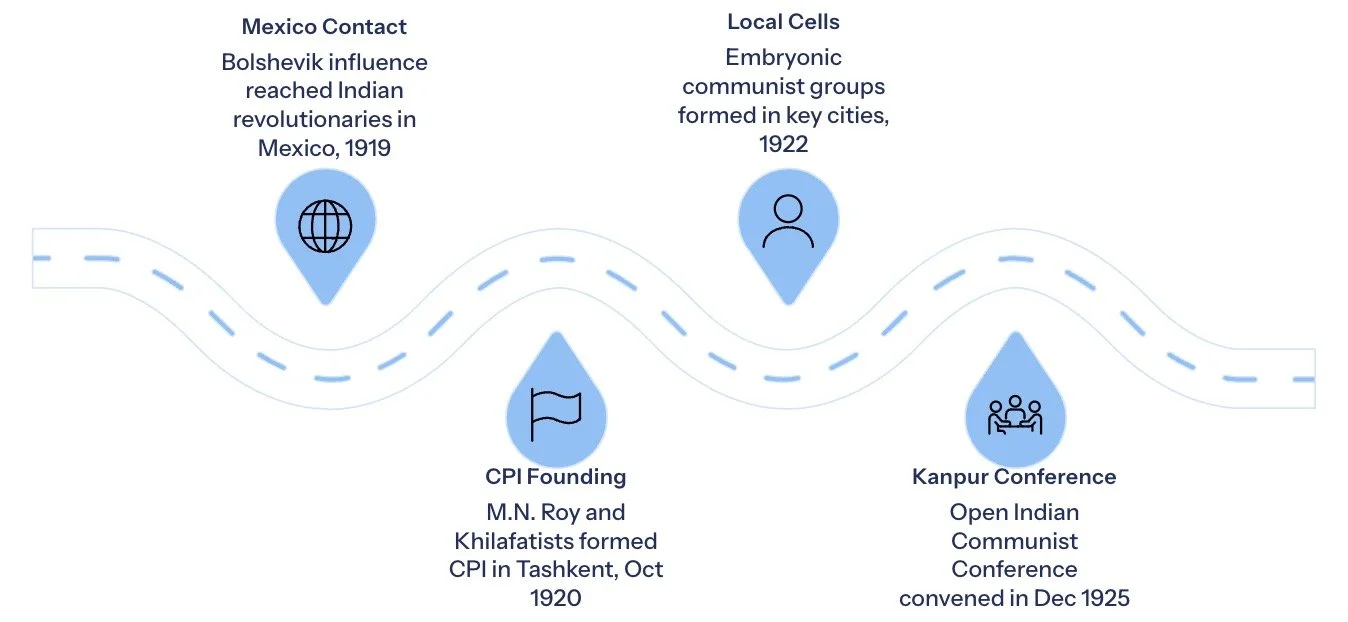
Indian Communism did not arrive as a foreign transplant. It sprang organically from roots within the national movement itself — as disillusioned revolutionaries, Non-cooperators, Khilafatists, and labour-peasant activists sought new roads to political and social emancipation. Its most important early architect was Manabendra Nath Roy (originally Naren Bhattacharji), a famous Yugantar revolutionary who came into contact with the Bolshevik Mikhail Borodin in Mexico in 1919.
The Rise of Left Movements in India
In October 1920, M.N. Roy, Abani Mukherjee, and Khilafatists including Mohammad Ali and Mohammad Shafiq founded a Communist Party of India in Tashkent, along with a political-cum-military school, when hopes of infiltrating India through Afghanistan faded. By late 1922, Roy had established tenuous secret links — through emissaries Nalini Gupta and Shaukat Usmani — with embryonic communist groups in Bombay (S.A. Dange), Calcutta (Muzaffar Ahmad), Madras (Singaravelu), and Lahore (Ghulam Hussain).
Roy's intellectual output was formidable. From his Berlin headquarters, he published the fortnightly Vanguard of Indian Independence and co-authored (with Abani Mukherjee) India in Transition — a pioneering Marxist analysis of Indian economy and society. Copies of Vanguard were widely circulated among Indian nationalists, trade unionists, and intellectuals. By 1923, S.A. Dange had started publishing the English weekly Socialist from Bombay, and the Bengali weekly Janavani had commenced from Calcutta — giving organised Communism a visible public voice. The formal organised party emerged from the Kanpur Conference of December 1925, chaired by Hasrat Mohani, with Singaravelu as president.
Five Phases of the Communist Movement
The history of the Communist movement in India from 1920 to 1947 can be divided into five distinct phases, each shaped by a shifting relationship between the CPI, the Indian National Congress, and the directives of the Communist International (Comintern). Understanding these phases is essential to grasping both the promise and the failures of Indian Communism.
Phase I: The Three Conspiracy Trials (c.1922–1934)
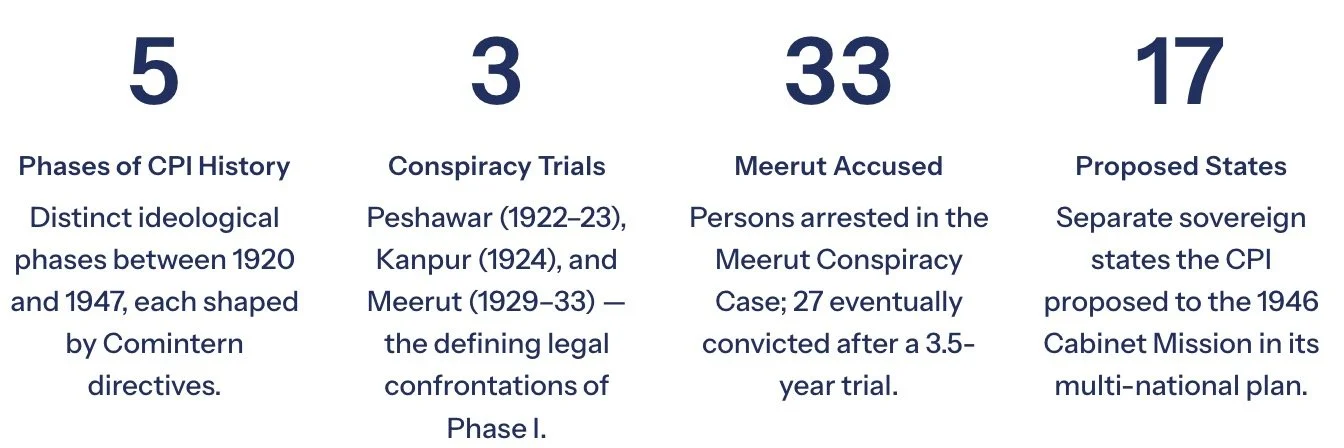
Communists worked through the Workers and Peasants Parties; gained significant influence in trade unions; came under severe state repression in the Peshawar (1922–23), Kanpur (1924), and Meerut Conspiracy Trials (1929–33). The Meerut Trial, lasting over three and a half years, convicted 27 persons but also made martyrs of the Communists and won them nationalist sympathy.
Phase II: Political Wilderness (1929–1934)
Following the 6th Comintern Congress (1928), the CPI broke with the Congress, dissolved the Workers and Peasants Party, attacked both Congress wings, and denounced Gandhi as a tool of imperialism. This "ultra-left" turn proved utterly unrealistic; the CPI was declared an illegal organisation in July 1934 and fragmented.
Phase III: Anti-Imperialist United Front (1935–1939)
Reorganised under P.C. Joshi in 1935, the CPI responded to the 7th Comintern Congress by re-joining the Congress fold. The Dutt-Bradley Thesis (1936) advised Communists to strengthen the Congress Left (the CSP) and oust the right wing. The popular front never fully materialised, but Communists re-entered mainstream radical politics.
Phase IV: The Communist Somersault (1939–1945)
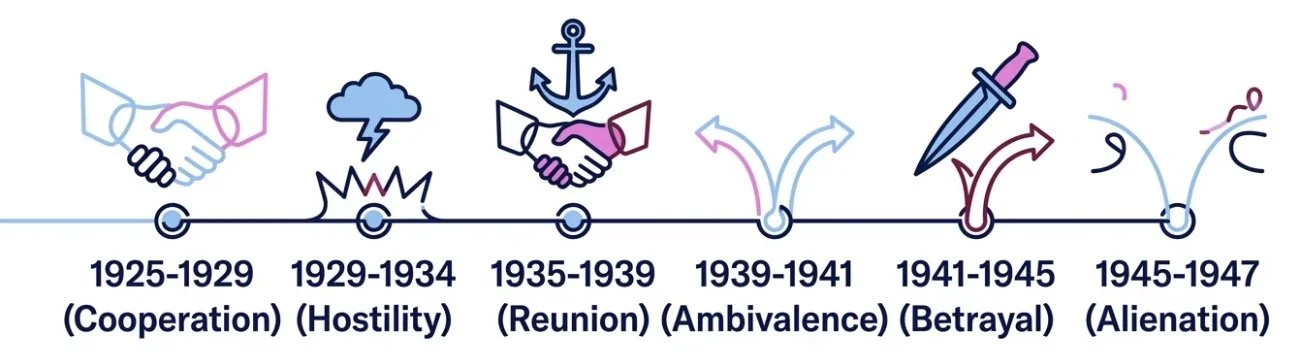
When the Second World War began, CPI initially labelled it an "imperialist war." When Hitler attacked the USSR in June 1941, the party staged a dramatic reversal, calling it a "people's war" and supporting the Allied effort. The CPI was legalised in 1942 but severely discredited for opposing the Quit India Movement and allegedly collaborating with British intelligence.
Phase V: Transfer of Power & the Multi-National Plan (1945–1947)
The CPI adopted a pro-Muslim League posture, widened Congress–League alienation, and in 1942 passed a resolution declaring India a "multi-national state" comprising 16 nations. In 1946, it placed before the Cabinet Mission a plan for 17 sovereign states on a Balkan/Soviet model. By 1947, the CPI was in complete disarray and political irrelevance.
Phase I in Detail: The Conspiracy Trials (1922–1934)
The first phase of the Communist movement was characterised simultaneously by organisational growth, significant penetration of the trade union movement, and relentless state repression through three major conspiracy prosecutions. Together, these trials both damaged and paradoxically publicised the Communist cause.
Organisational Growth
After the Communist Party of Great Britain assumed supervisory responsibilities, its emissary Philip Spratt arrived in India in December 1926, organising unions, editing newspapers, and launching youth and front organisations. Workers and Peasants Parties sprang up in Bengal (February 1926), followed by similar bodies in Bombay, the United Provinces, and the Punjab. These were united in 1927 into the All India Workers and Peasants Party. Between 1928 and 1929, the CPI organised a series of major industrial strikes in Bombay's textile mills. By 1920–28, Communist influence in trade unions had grown immensely.
The Three Conspiracy Trials
Peshawar Conspiracy Trial (1922–23): Targeting Khilafatist Muhajirs attempting to re-enter India.
Kanpur Bolshevik Conspiracy Case (1924): Muzaffar Ahmad, S.A. Dange, Shaukat Usmani, and Nalini Gupta were jailed.
Meerut Conspiracy Trial (1929–33): The most significant — 33 arrested including foreign advisers H.L. Hutchinson, B.F. Bradley, and Philip Spratt; 27 convicted after a trial lasting over three and a half years.
The Meerut Trial & Nationalist Sympathy
The Meerut Trial had a deeply paradoxical outcome. While it sought to cripple the Communist movement, it produced precisely the opposite effect in nationalist public opinion. The Congress Working Committee set up a Central Defence Committee and sanctioned funds for the accused. Eminent nationalists like Jawaharlal Nehru, K.N. Katju, and F.H. Ansari pleaded the defence case. Gandhiji visited the prisoners in jail in 1929 and expressed sympathy.
Congress members of the Central Legislative Assembly successfully opposed the Public Safety Bill (1928), a bill directed specifically against Communists. The long-drawn-out trial gave Communist leaders a platform for politically charged speeches that received wide coverage in the nationalist press, transforming accused conspirators into recognisable public figures.
Between 1925 and 1929, the CPI cooperated with the Congress and worked to influence its programme from within — a strategy that would be abruptly reversed in the next phase.
Phase II & III: Wilderness and the United Front
The years between 1929 and 1939 illustrate with particular clarity how the CPI's fortunes were tied to instructions from Moscow rather than to an independent assessment of Indian conditions. The swing from ultra-left sectarianism to popular-front collaboration reveals both the flexibility and the ideological dependency that defined this period.
The Ultra-Left Turn (1929–1934)
At the direction of the 6th Comintern Congress (1928), the CPI severed ties with the Congress and dissolved the Workers and Peasants Party — dismissing it as an irrational "two-class party." The CPI attacked both the right and left wings of the Congress, denounced the Gandhi–Irwin Pact as a betrayal, and labelled the Congress Left itself a "counter-revolutionary force." This came precisely when the Congress was boycotting the Simon Commission, adopting the Purna Swaraj resolution (December 1929), and launching the Civil Disobedience Movement. The CPI's attempt to project a "triangular contest" — people versus British imperialism and Indian exploiters — fell on deaf ears. Declared illegal in July 1934, the party fractured into several groups, entering a period of profound political irrelevance.
Reorganisation Under P.C. Joshi (1935)
The 7th Comintern Congress (Moscow, 1935) shifted the global Communist line in response to the rising threat of Fascism, advocating a broad anti-fascist united front. The CPI was reorganised under P.C. Joshi and instructed to cooperate once again with the Congress. This reversal was theorised in the Dutt-Bradley Thesis (March 1936), which identified the Indian National Congress as the primary vehicle of the anti-imperialist people's front and advised Communists to join it, strengthen the Congress Socialist Party, and oust the right-wing reactionaries from within.
Limits of the United Front
Despite the favourable political climate of the late 1930s — marked by a rising mass upsurge and quickening political activity — the Communists failed to translate the united front strategy into lasting organisational gains. The proposed Front Populaire based on a common minimum programme never materialised. Nevertheless, the Communists emerged from their political quarantine, regained a foothold among radical elements in Indian politics, and benefited from the tide of popular anti-imperialist sentiment during the Congress ministries period (1937–39).
Phase IV: The Communist Somersault in World War II
No episode more dramatically illustrates the contradictions of the CPI's position within the Indian nationalist movement than its conduct during the Second World War. Within the space of two years, the party executed a complete reversal of its political line — a "somersault" that would permanently damage its nationalist credibility.
September 1939
World War II begins. CPI, following the Comintern line shaped by the Stalin–Hitler Pact of 1939, declares the war an "imperialist war." Formulates the "Proletariat Path" — committing to open rebellion, general strikes, and anti-British agitation. Organises a major textile strike in Bombay (March 1941).
June–July 1941
Hitler attacks the Soviet Union (June 22). The USSR and Great Britain sign a joint operations agreement (July 12). The CPI immediately relabels the war a "people's war" and announces full support for the Allied war effort. The Government of India rewards the CPI with legalisation in 1942.
August 1942
The Congress launches the Quit India Movement. The CPI, honouring its pro-Allied stance, actively opposes it. CPI cadres allegedly collaborated with British police and the CID in arresting Congress leaders and workers — an act of political betrayal that evoked fierce condemnation in nationalist circles.
August 1947
India achieves Independence. The CPI dismisses it as a "farce" (yeh azadi jhooti hai), alienating itself from the popular euphoria of freedom. By this point the party had lost whatever credibility it once possessed in Indian politics.
The somersault demonstrated with painful clarity that the CPI's policy decisions were dictated by "outside and international wire-pullers" rather than by an independent reading of Indian realities. This episode would haunt the party for decades.
Phase V: Transfer of Power & the Multi-National Plan
In its final phase before Independence, the CPI's conduct reached perhaps its most contentious point. Driven by a desire to secure at least one territorial base from which to operate, the party adopted positions that placed it squarely at odds with the mainstream demand for a united, independent India.
The Multi-National Thesis
In 1942, the CPI passed a resolution declaring India to be a multi-national state, identifying as many as 16 distinct Indian "nations" on the basis of language and ethnicity. In 1946, it submitted a memorandum to the Cabinet Missionproposing the division of India into 17 separate sovereign states, modelled on either the Balkans or the USSR. The strategy was to tighten Communist control over at least one such state and use it as a base for the "liberation" of the rest of India.
Pro-Muslim League Posture
During this period the CPI adopted a markedly pro-Muslim League stance, actively working to deepen the Congress–League alienation and encouraging all separatist elements. It sought an alliance with the Muslim League, but the League spurned the overture. This left the CPI politically isolated and thoroughly discredited.
Assessment: Why the CPI Failed
When national emancipation was the dominant aspiration of the Indian people, the CPI's extra-national loyalties made it suspect. Three fundamental tensions explain its failure:
Proletarian Internationalism vs. Indian Nationalism — the CPI's concept of international class solidarity could not be reconciled with the dominant national sentiment.
Class Antagonism & Violence vs. Indian Tradition — Marxism's articles of faith in class war and violent revolution remained alien to the Gandhian ethos that permeated Indian political culture.
External Dependence — exclusive reliance on European models and Comintern directions meant the party was perpetually reactive rather than rooted in Indian soil.
By 1947, the CPI was in complete disarray. Whatever place it had earned in Indian politics through the trade union movement and the Meerut martyrdom had been comprehensively squandered.
The CPI's Love-Hate Relationship with the Congress
Critically examining the Communist role in India's freedom struggle requires an honest assessment of the fundamental tension at the heart of the CPI's existence: it was inspired simultaneously by Marxism and nationalism. It wanted to free India from imperial domination, but it also believed in Marxist principles of class struggle. Added to this internal dilemma was the Comintern's constantly shifting strategic directives. The result was a "love-hate relationship" with the Congress that produced wildly inconsistent behaviour.
The Rise of Left Movements in India
"The communists were guided by various extraneous variables and looked outside India for political guidance — and this contributed to the development of a love-hate relationship with the Congress."
The CPI's record was not entirely negative. Its work in building the trade union movement, its role in the Kisan Sabha mobilisation, the intellectual contribution of figures like M.N. Roy to Marxist analysis of colonial society, and the personal courage displayed by its leaders in the face of repression all represent genuine contributions. Moreover, Marxist-Leninist philosophy — stripped of its extra-national loyalties — retains relevance to independent India. The yawning gap between rich and poor, and the underdeveloped condition of the Indian economy, remain conditions in which socialist ideas can serve as a "beacon-light for the downtrodden masses." The tragedy of the CPI was not its ideology, but its inability to Indianise that ideology in the hour that mattered most.
Key Metrics of the Communist Movement
A statistical and structural overview of the CPI's organisational reach and the scale of state repression helps contextualise its historical significance.
The chart above illustrates the relative influence of the CPI within the nationalist political mainstream across the five phases. The peaks correspond to periods of Congress cooperation (1925–29 and 1934–39), while the troughs reflect the consequences of ultra-left isolation and, most damagingly, the reversal of 1941–45 when the party's decision to oppose the Quit India Movement and collaborate with the British administration permanently eroded its nationalist credibility.
Assessment
The rise of the Left in India was a genuinely significant chapter in the history of Indian political thought and action. It introduced a sustained critique of colonial capitalism, gave organisational voice to peasants and industrial workers who had hitherto been peripheral to elite nationalist politics, and enriched the intellectual landscape of the freedom movement with Marxist categories of analysis that continue to influence Indian social science.
Colonial Conditions Created the Left
The structural conditions of colonial exploitation — agrarian crisis, industrial labour, post-war inflation, and repeated disillusionment with moderate nationalism — made Leftist ideology not merely attractive but historically necessary as a form of political expression for India's dispossessed classes.
Three Streams, One Landscape
The Congress Left (CSP), the CPI, and the radical third stream together constituted a plural Left that kept alive the question of socio-economic transformation within the nationalist agenda, even as the Congress mainstream prioritised political Swaraj over social revolution.
Comintern Dependency as Fatal Flaw
The CPI's most crippling structural weakness was its subservience to the Comintern. Every major reversal — 1929, 1935, 1941, 1945 — was a response to Moscow's changing global priorities, not to independent analysis of Indian conditions. This external dependency prevented the party from developing an authentically Indian Marxism.
Enduring Relevance
Despite its failures, the Indian Left's contribution to trade unionism, peasant organisation, secular nationalism, and the critique of economic inequality remains historically significant. Marxist-Leninist analysis, re-rooted in Indian soil and freed from extra-national loyalties, retains its relevance to the structural challenges of post-Independence India.
For Examination: The question of the CPI's "love-hate relationship" with the Congress (1925–1947) is a recurring theme in UPSC History papers. Students should be able to trace the five phases coherently, analyse the role of the Comintern in shaping CPI strategy, and critically evaluate why the CPI failed to become the vanguard of India's independence struggle despite its initial promise.
