
Strategy and Ideologies of the Indian National Movement
The Indian national movement was not merely a spontaneous uprising against colonial rule — it was a carefully calibrated, long-drawn political struggle built upon evolving strategies, ideological frameworks, and mass mobilisation. This document offers a comprehensive analytical overview of how Indian nationalists understood colonial power, devised their response, and constructed a counter-hegemonic ideology that ultimately led to independence.
From the semi-hegemonic character of the British colonial state to the Gandhian philosophy of Satyagraha, from the Struggle-Truce-Struggle model to the growing socialist orientation of the Congress — every dimension of the movement reflects a sophisticated political intelligence rarely recognised in mainstream historical writing.
The Strategic Imperative: Why Strategy Mattered
A fundamental yet often overlooked aspect of the Indian national movement is the strategic logic that guided its every phase. The capacity of any people to sustain a prolonged struggle depends not merely on the fact of exploitation or subjugation, but crucially on the strategy and tactics underpinning that struggle. Yet existing scholarship has largely failed to examine the nationalist strategy in any systematic, theoretical manner.
One reason for this gap is that the leaders of the Indian national movement were not theoreticians in the classic sense. Unlike Lenin or Mao, who produced explicit programmatic texts, Indian nationalist leaders expressed their strategy primarily through political practice — through the choices they made about when to launch mass movements, when to work within constitutional frameworks, and when to negotiate with the colonial state. The strategy was implicit, embedded in action rather than written text.
This does not mean the strategy was absent or incoherent. On the contrary, the various phases of the struggle — constitutional activity, constructive work, non-violence, Satyagraha, civil disobedience — cannot be properly understood unless they are seen as integral parts of a coherent, overarching strategic vision. The strategy evolved during the Moderate and Extremist phases and came to full fruition during the Gandhian era.
The Strategic Challenge
Colonial rule was not pure tyranny. It was semi-hegemonic and semi-authoritarian — a "legal authoritarianism" that combined coercion with civil institutions, making simple armed resistance insufficient.
The Strategic Response
The nationalist movement responded with a hegemonic counter-struggle — a war of position fought on the terrain of ideas, mass mobilisation, and sustained political organisation across decades.
The Nature of the Colonial State: Legal Authoritarianism
The nationalist strategy was shaped fundamentally by an accurate diagnosis of the colonial state's character. Indian leaders recognised that British rule was neither a simple military dictatorship nor a full democracy. It was, most precisely, a form of legal authoritarianism — a system that combined ultimate reliance on force with the maintenance of certain civil institutions: elected assemblies, local government bodies, courts, and schools, alongside a formal commitment to the rule of law.
This dual character had profound implications. On one hand, the colonial state provided limited civil liberties during non-agitation periods and even maintained certain legal norms while suppressing popular opposition. On the other hand, force remained its ultimate sanction, and it was willing to deploy it ruthlessly when its authority was challenged. Understanding this duality was essential to crafting a response that could exploit the state's contradictions.
Pillar One
Force & Coercion
The colonial state was established by military conquest. Naked force was used to suppress movements, yet it could not govern by force alone indefinitely without catastrophic cost.
Pillar Two
Civil Institutions
Courts, elected assemblies, schools, and a formal rule of law created a veneer of legitimacy, giving the colonial state a semi-democratic face that constrained its own repression.
Pillar Three
Ideological Hegemony
Two carefully cultivated myths: that British rulers were benevolent Mai-Baap, and that they were invincible. Both were essential to the acquiescence of the Indian people.
Pillar Four
Carrot and Stick
Constitutional concessions were offered alongside repression — a deliberate strategy to co-opt moderate nationalists and split the movement between constitutionalists and radicals.
It was precisely in opposition to this complex, semi-hegemonic, semi-authoritarian colonial state that the national movement gradually evolved its distinctive strategy. The movement had to fight simultaneously on the terrain of ideas, mass organisation, and political action — never reducing the struggle to any single dimension.
The Hegemonic Struggle: A War of Position
The basic strategic perspective of the Indian national movement was to wage what Antonio Gramsci would later theorise as a war of position — a prolonged hegemonic struggle for the minds and hearts of the Indian people. Rather than seeking a single decisive military or political confrontation, the nationalist strategy aimed at the continuous, cumulative expansion of nationalist influence across all sections of society and through all available channels.
This was emphatically not a strategy of gradual reform. It was a strategy of active struggle with the ultimate objective of wresting state power from the colonial rulers. The movement alternated between phases of extra-legal mass struggle — where laws were broken and civil disobedience was practised — and phases of functioning within the existing legal framework. Crucially, both phases were understood as integral parts of the same anti-imperialist strategy, not as contradictions or retreats.
Objective 1
Mass Politicisation
Break the political passivity of the masses, especially in villages, which was the bedrock of colonial stability.
Objective 2
Erode Colonial Hegemony
Undermine the twin myths of British benevolence and invincibility through ideological-political work at every level.
Objective 3
Weaken State Apparatuses
Gradually reduce the loyalty of civil servants, police, and armed forces to the colonial regime through nationalist appeal.
Objective 4
Expand Democratic Space
Constantly widen the semi-democratic political space available for legal activities and peaceful mass struggles.
The most important element of nationalist strategy was its ideological-political work. The process of undermining the notion of British benevolence was initiated brilliantly by Dadabhai Naoroji, Justice Ranade, and R.C. Dutt. The Extremists then carried this critique to the lower middle classes. During the Gandhian era, it reached the masses. The notion of invincibility was challenged by the bold press, the work in legislative councils, and ultimately shattered by the law-breaking mass movements of the post-1918 period.
The Struggle-Truce-Struggle Model
The second major dimension of nationalist strategy was its long-drawn, cyclical character — what may be described as the Struggle-Truce-Struggle (S-T-S) model. Under this framework, a phase of vigorous extra-legal mass movement and open confrontation with colonial authority was followed by a phase during which direct confrontation was withdrawn. During this "truce" phase, political and ideological work continued intensely within the existing legal framework, while forces were gathered for the next, higher-level mass movement.
Mass Struggle
Truce & Consolidation
Ideological Work
Higher-Level Struggle
The S-T-S strategy was predicated on a clear-eyed understanding of the limits of mass mobilisation. Mass movements, by their very nature, cannot be sustained indefinitely. The masses invariably get exhausted; their capacity to confront the state and make sacrifices is not unlimited. The colonial state, for its part, remained strong until at least 1945, with loyal state apparatuses capable of crushing movements as it did in 1932–33 and 1942.
The entire political process of S-T-S was an upward spiralling one. Each stage represented an advance over the previous one. Freedom was understood as indivisible — it was not partially won through constitutional reforms; until fully won, it was not won at all. This understanding prevented the national movement from being co-opted by the colonial state during the "passive" phases. As Gandhiji memorably put it: "Suspension of civil disobedience does not mean suspension of war. The latter can only end when India has a Constitution of her own making."
The Logic of Phases: Why Not One Continuous Struggle?
A critical question confronts any student of the national movement: why did the strategy require alternating phases? Why could the movement not take the form of one continuous mass struggle until freedom was won? Would this not have shortened the path to independence?
The Gandhian strategic perspective rested on a precise understanding of both human capacity and political reality. Mass movements are exhausting. Their participants — ordinary men and women from villages and towns — could not maintain indefinite activism, sacrifice, and confrontation with state power. The movement had to respect this reality and provide periods of rest, consolidation, and organisational deepening.
Gandhiji on the Timing of Struggle
"A wise general does not wait till he is actually routed: he withdraws in time in an orderly manner from a position which he knows he would not be able to hold."
"An able general always gives battle in his own time on the ground of his choice. He always retains the initiative in these respects and never allows it to pass into the hands of the enemy."
The Steel Frame
Mass movements needed a "standing army" of whole-time political workers — thousands of dedicated nationalists who devoted their lives to the freedom struggle. But the real striking power could only come from the masses. Both were essential; neither was sufficient alone.
The non-mass movement phases were used to train this cadre, expand organisational reach, and prepare the ground for the next wave of struggle.
The decision to shift from one phase to another was, crucially, a tactical and not a principled question. The timing depended on the movement's strength, the staying power of the masses, and the political and administrative reserves of the colonial government. Similarly, negotiations were not avoided on principle — the question was always: when to negotiate, how to negotiate, and what to negotiate for, so as to maximise nationalist advantage.
Constructive Work: Sustaining the War of Position
Constructive work occupied a unique and indispensable place in Gandhian — and even pre-Gandhian — nationalist strategy. It was not merely social reform work; it was a strategic instrument for filling the political space during the "passive" or non-mass movement phases, sustaining a sense of activism among nationalist workers and the people when direct confrontation with the colonial state was not possible.
Constructive work was primarily organised around the promotion of khadi, spinning, and village industries; national education; Hindu-Muslim unity; the struggle against untouchability and the social upliftment of Harijans; and the boycott of foreign cloth and liquor. It was symbolised by hundreds of Ashrams established across the country, almost entirely in villages, which served as centres of political-ideological work.
Khadi & Village Industries
Promoted economic self-reliance, challenged colonial economic structures, and provided a tangible symbol of resistance accessible to every Indian regardless of class or education.
National Education
Countered colonial education's ideological influence. Nationalist schools and literacy programmes spread anti-colonial consciousness and trained future workers for the movement.
Social Reform & Unity
Hindu-Muslim unity work and campaigns against untouchability addressed the social fragmentation that colonial rulers exploited. These were not peripheral but central to the movement's hegemonic project.
Constructive work had a decisive strategic advantage: it was scalable to millions. Parliamentary work could be done by relatively few; intellectual work by even fewer. But constructive work could involve everyone — from village women spinning khadi to schoolteachers running night schools. Moreover, not all could go to jail or participate in civil disobedience, but all could contribute to constructive work. The hard core of constructive workers also provided the cadre base — Gandhiji's "steel frame" — for the Civil Disobedience Movements.
Legislative Councils and Constitutional Strategy
Constitutional reforms and legislative councils were a central element of the complex colonial strategy to manage Indian nationalism. They were designed to co-opt moderate nationalists, promote dissensions within the movement along constitutionalist versus non-constitutionalist lines, and weaken the impulse towards mass politics. Indian nationalists, therefore, had to evolve an equally sophisticated and internally consistent approach towards these institutions.
The complexity arose from a fundamental tension. On one hand, the constitutional structure represented an instrument of colonial domination — a means of derailing the national movement by offering limited power while retaining essential control. On the other hand, these very structures were the fruits of anti-colonial struggle — a measure of the changing balance of forces and a widening of the democratic space in which the movement could operate. The gains could not be surrendered; they had to be occupied and used.
The Colonial Calculation
Constitutional work would weaken the nationalist urge for mass politics
Reforms would promote splits between Right and Left within Congress
Council members would gradually be absorbed into the colonial administrative structure
Partial concessions would satisfy moderates and isolate radicals
The Nationalist Counter-Strategy
Work the reforms but in a manner that advanced nationalist goals, not colonial ones
Use councils to expose the hollowness of reforms and demonstrate India's continued subjugation
Build public confidence in Indians' capacity to govern themselves
Abandon legislatures whenever mass movements erupted — councils were arenas of struggle, not ends in themselves
This strategy registered considerable success. The work in councils, municipal bodies, and popular ministries after 1937 gave relief to hard-pressed people, built Congress prestige, and, crucially, demonstrated the inadequacy of colonial reforms. The Congress successfully avoided the Surat split trap after 1919 because Congressmen remained committed to mass politics at heart. When the mass upsurge came, they abandoned the legislatures and plunged in — treating councils as tools for struggle, never as substitutes for it.
Non-Violence: Principle, Policy, and Strategic Genius
For Gandhiji, non-violence was a matter of profound moral principle. But for the overwhelming majority of his contemporaries in the Congress — C.R. Das, Motilal Nehru, Jawaharlal Nehru, Maulana Azad, Sardar Patel — it was a carefully considered matter of political policy. As policy, non-violence was an essential, irreplaceable component of the overall strategy of the national movement. Understanding this distinction is critical to understanding why non-violence was not merely idealism but strategic genius.
The Dilemma It Created for the Colonial State
Non-violent mass movement placed colonial rulers on the horns of an inescapable dilemma. If they refrained from suppressing it, they admitted their inability to enforce the law — an abdication of authority. If they suppressed it by force, they destroyed their own moral legitimacy by using violence against peaceful people. Either way, they lost. The national movement had a winning strategy: a semi-democratic state has no answer to a mass movement that is simultaneously non-violent and enjoys massive popular support.
The Material Reality of Disarmament
Since 1858, the colonial state had through an elaborate system completely disarmed the Indian people, making it nearly impossible to obtain arms or training. The leaders of the national movement understood clearly that Indians lacked the material resources to wage an armed struggle against a strong, well-equipped colonial state. In non-violent mass struggle, it was moral strength and the force of mobilised public opinion that counted — and here the disarmed Indian people were at no disadvantage.
Mass Participation and Women's Agency
Non-violent forms of struggle enabled the participation of the mass of the people who could not have participated in an armed movement in similar numbers. This was especially true of women's participation — a critical and often underappreciated dimension. Women might have found it difficult to join armed struggle in large numbers; but in undergoing suffering, facing lathi-charges, and picketing for hours in extreme weather, women proved themselves as strong as, or stronger than, men.
Violence Would Have Justified Massive Repression
A fundamental strategic understanding was that any resort to violence by the movement would have provided the colonial government with moral and legal justification to launch a massive, unrestricted attack on the popular movement. Such heavy repression would have demoralised the people, led to political passivity, and set back the movement by decades. Non-violence denied the state this justification.
In a war of position, non-violence was thus a means of achieving political equality with an armed colonial state — a way of compensating for the massive material disparity in force through moral force. In India's specific historical context, non-violent struggle was as revolutionary in its consequences as armed revolution in other contexts, for it aimed at, and achieved, fundamental changes in the structure of state and society.
Evaluating the Strategy: Success Despite Apparent Defeats
The criterion for evaluating the success or failure of the nationalist strategy should not be whether individual mass movements achieved their stated political objectives in the immediate term. The correct criterion is the extent to which colonial hegemony over the Indian people was undermined and the extent to which people were politicised and prepared for sustained struggle.
Judged by this standard, the nationalist strategy was an unqualified success. Even when mass movements were suppressed (1932, 1942), withdrawn (1922), or ended in compromise (1930–31) — and appeared defeated in terms of their immediate, declared objectives — in terms of hegemony, these movements were great successes, marking qualitative leaps in mass political consciousness.
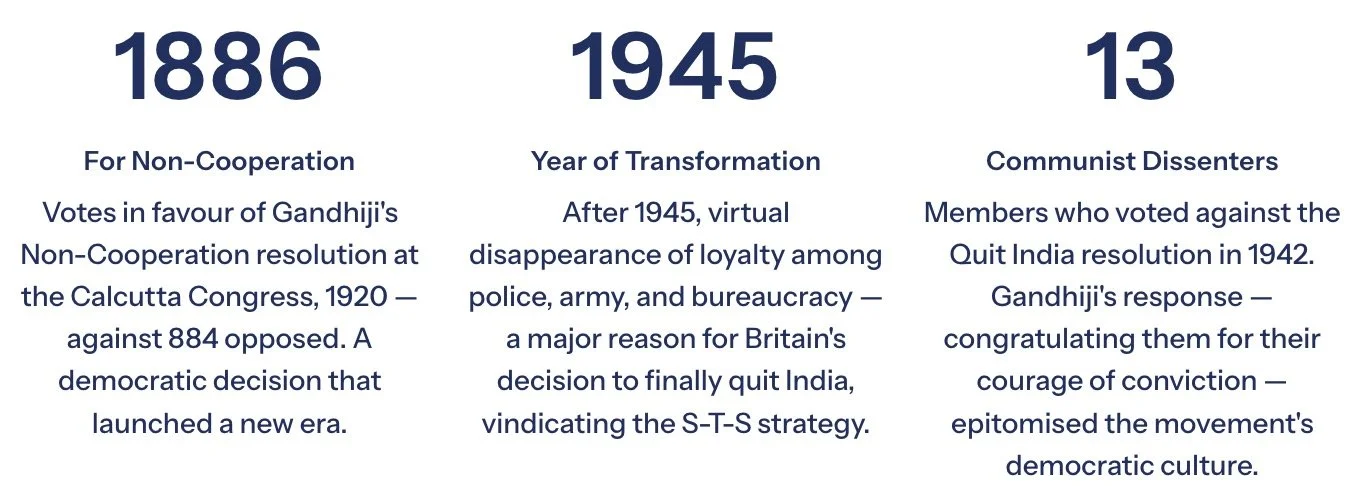
India represents the only actual historical example of a broadly Gramscian "war of position" being successfully practised — a semi-democratic or democratic state structure being replaced or transformed through sustained hegemonic struggle rather than armed revolution. This gives the strategic practice of the Indian national movement a significance in world history comparable to that of the great revolutions of the modern era.
Formation of the Anti-Colonial Ideology
The ideological foundation of the Indian national movement was constructed upon a clear, scientific, and evolving understanding of colonialism. The leadership gradually arrived at the recognition that British rule was not merely political subjugation but a systematic mechanism for subordinating the Indian economy and society to the needs of the British economy and society. India was not merely governed by Britain — it was being actively underdeveloped.
By the end of the 19th century, the founding fathers of the national movement had worked out a comprehensive critique of all three modes of colonial exploitation: through plunder, taxation, and the employment of Englishmen in India; through free and unequal trade; and through the investment of British capital. Crucially, they grasped that India's colonial relationship was not an accident of history or a policy choice — it sprang from the very character of British society and India's structural subordination to it.
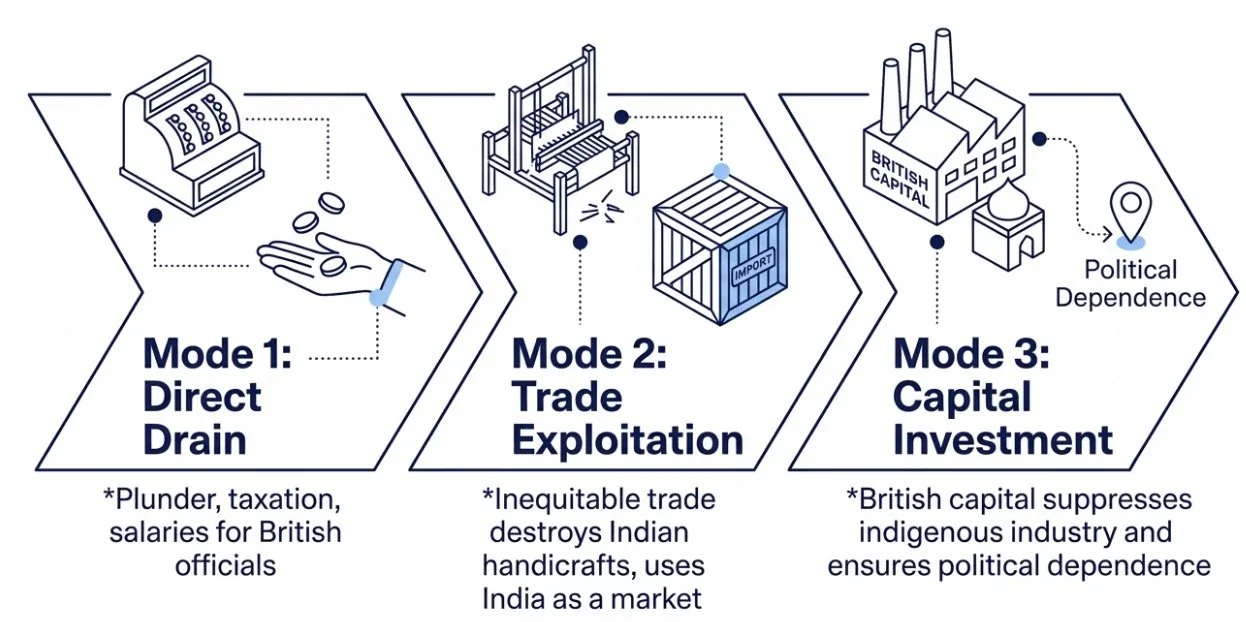
The theory of the drain of wealth — that a large part of India's capital and wealth was being transferred to Britain — became the focal point of the entire nationalist critique. This understanding was further advanced after 1918 under the impact of anti-imperialist mass movements and the spread of Marxist ideas. During the Gandhian era, the lower-most cadres of the national movement disseminated this critique to the common people in urban and rural areas. The twin themes of the drain of wealth and the destruction of Indian handicraft industries formed, as Bipin Chandra puts it, "the very pith and marrow of their agitation."
Democracy and Civil Liberties: Core Nationalist Commitments
The Indian national movement was fully and unequivocally committed to parliamentary democracy and civil liberties — at a time when the colonial rulers were actively propagating the argument that democracy was unsuited to India's climate, historical traditions, and social institutions. It was left to the national movement to fight for democracy, internationalise it, and, most importantly, root it in Indian soil. The movement thus performed the historic function of indigenising democracy as a living political culture.
From its inception, the Indian National Congress was organised along deeply democratic lines. All resolutions were publicly debated and voted upon. Minority opinions were not suppressed but encouraged. Some of the most consequential decisions in Congress history were taken after heated debate and close votes — demonstrating that democratic culture was practised, not merely preached.
Lokamanya Tilak on press freedom: "Liberty of the Press and liberty of speech give birth to a nation and nourish it."
Gandhiji on civil liberty: "Civil liberty consistent with the observance of non-violence is the first step towards Swaraj. It is the breath of political and social life. It is the foundation of freedom. There is no room there for dilution or compromise. It is the water of life."
Jawaharlal Nehru on press freedom: "The freedom of the Press does not consist in our permitting such things as we like to appear. Civil liberty consists in our permitting what we do not like, in our putting up with criticisms of ourselves."
Nehru was perhaps the strongest champion of civil liberties within the movement. The Karachi Congress resolution of 1931 on fundamental rights, drafted by him, guaranteed freedom of expression, freedom of the press, and freedom of association. In August 1936, largely through his efforts, the Indian Civil Liberties Union was formed on non-partisan, non-sectarian lines to mobilise public opinion against all encroachments on civil liberties. The movement thus, over decades, created an ideology and culture of democracy based on respect for dissent, the majority principle, and the right of minority opinions to exist and grow.
Secularism, Caste, Gender: Strengths and Limitations
The Indian national movement's ideological record on questions of communalism, caste, and gender reveals both genuine commitments and significant limitations — both of which must be acknowledged honestly for a balanced historical assessment.
Secularism and Communal Unity
Secularism was made a basic constituent of nationalist ideology from the very beginning, with a strong emphasis on Hindu-Muslim unity. The movement's failure to eradicate communalism and prevent Partition was not due to deviation from secular ideology but to weaknesses in its strategy for fighting communalism and an incomplete grasp of its socio-economic and ideological roots. The ideological commitment was genuine; the tactical execution was flawed.
Nation-in-the-Making
The movement fully recognised India's multifaceted diversity. It accepted that India was a nation-in-the-making, not a completed nation, and organised itself accordingly — including the restructuring of Congress provincial committees along linguistic lines from 1921, recognising the cultural aspirations of different linguistic groups.
Caste Oppression
After 1920, abolition of untouchability became a basic constituent of the movement's programme. Gandhiji's work for the Harijans represented a genuine commitment. However, a serious limitation remained: a strong, systematic anti-caste ideology was never fully developed or propagated. The movement addressed untouchability without fundamentally challenging the caste system's ideological foundations.
Women's Liberation
The cause of women's liberation was not taken up with the seriousness it deserved, despite the remarkable participation of women in mass movements. The movement recognised women's political participation without adequately addressing the deeper structures of gender inequality. This represented a significant ideological gap in what was otherwise a remarkably comprehensive anti-colonial vision.
The Economic Vision: Independent, Self-Reliant Development
The Indian national movement accepted, with near unanimity, the objective of a complete economic transformation of the country based on modern industrial and agricultural development. From Justice Ranade onwards, nationalists agreed that industrialisation was the only path out of mass poverty. This consensus formed the economic core of the movement's vision for free India.
The nationalists were fully committed to independent, self-reliant economic development — deliberately independent from foreign capital, based on the creation of an indigenous capital goods sector, and underpinned by independent science and technology. They vehemently opposed the colonial argument, advanced by British economists since the 1840s, that foreign capital investment was the primary instrument of Indian development. Foreign capital, nationalists from Dadabhai Naoroji to Nehru argued, did not develop a country but underdeveloped it — suppressing indigenous capital, distorting economic structures, and ultimately wielding dominating political influence over the administration.
Public Sector Role
Starting with Naoroji and Ranade, nationalists visualised a crucial role for the public sector. By the 1930s, Nehru, Gandhiji, and the Left argued for public sector dominance in large-scale and key industries to prevent wealth concentration.
Economic Planning
By the late 1930s, economic planning was widely accepted. In 1938, under Subhas Bose's presidentship, the Congress set up the National Planning Committee under Nehru's chairmanship to draw up a development plan for independent India.
Bombay Plan
Even India's leading capitalists — J.R.D. Tata, G.D. Birla, and Sri Ram — envisioned far-reaching land reforms, a large public sector, and massive public and private investment, reflecting the hegemony of the nationalist developmental consensus.
Gandhiji's Nuance
Gandhiji opposed machines only when they displaced the labour of the many or enriched a few. He said he would "prize every invention of science made for the benefit of all." He supported large-scale industry if owned and controlled by the state, not private capitalists.
The Growing Socialist Orientation
From its early days, the national movement adopted a pro-poor orientation. The Moderates' entire economic agitation and critique of colonialism was linked to the growing poverty of the masses. This orientation was then immensely strengthened by three converging forces: the impact of the Russian Revolution of 1917, the arrival of Gandhiji on the political stage, and the growth of powerful Left-wing parties and groups during the 1920s and 1930s.
While the nationalist developmental perspective remained, broadly speaking, within a bourgeois-capitalist framework, it was subject to sustained and increasingly successful challenge from the Left. The ideological struggle within the movement produced a continuous, measurable drift in a radical socio-economic direction — each Congress session after 1929 reflecting further concessions to socialist demands, even if with a time lag of a few years.
The chart above illustrates the progressive leftward drift of the national movement's ideological orientation. Key milestones include: the Karachi resolution of 1931 guaranteeing fundamental rights and economic reforms; the Lucknow and Faizpur resolutions of 1936 adopting substantial reductions in rent and revenue, abolition of feudal dues, and workers' rights; and the Congress Working Committee's 1945 declaration calling for the abolition of landlordism — "the reform of the land system involves the removal of intermediaries between the peasant and the state." Socialism had not become dominant, but it had become an irreversible constituent of the nationalist vision.
Key Socialist Demands Adopted by the National Movement
The progressive radicalisation of the national movement's programme found concrete expression in a set of demands that were, by the standards of the 1920s and 1930s, highly radical. These demands reflected both the Left's sustained pressure and the Congress leadership's recognition that political freedom without economic transformation was incomplete.
Education and Tax Relief
Compulsory primary education for all; the lowering of taxation on the poor and middle classes; reduction of the salt tax, land revenue, and rents.
Agrarian Reforms
Relief from indebtedness and provision of cheap credit to peasants; protection of tenants' rights and fixity of tenure; abolition of feudal dues and forced labour; a living wage for agricultural labourers.
Labour Rights
Workers' right to a living wage and a shorter working day; higher wages for low-paid government servants including policemen; defence of the right of workers and peasants to organise.
Social Reforms
Eradication of the drink evil; improvement of the social position of women including equal political rights, right to work and education; legal and social measures for the abolition of untouchability.
Economic Modernisation
Protection and promotion of village industries; promotion of modern science and technical education; reform of the machinery of law and order.
Nehru, Gandhiji, and the Push for Socialist India
Two towering figures shaped the socialist orientation of the national movement in profoundly different but complementary ways: Jawaharlal Nehru and Mahatma Gandhi. Their approaches were different in method, language, and theoretical grounding, yet both tended to push the movement in a radical direction that challenged the hegemony of bourgeois ideology.
Jawaharlal Nehru
Nehru was perhaps the most systematic advocate of socialist ideas within the national movement. He argued that political freedom must mean the economic emancipation of the masses. Throughout the 1930s, he pointed to the inadequacy of the existing nationalist ideology and stressed the need to inculcate a new, basically Marxist ideologythat would enable the people to study their social condition scientifically.
He played a crucial role in popularising the vision of a socialist India both within the movement and in the country at large. The Fundamental Rights resolution at Karachi (1931), the Indian Civil Liberties Union (1936), the National Planning Committee (1938) — all bore his imprint.
Mahatma Gandhi
Gandhiji did not accept class analysis or the role of class struggle. Yet his basic outlook was one of social transformation. By the 1930s and 1940s, he was moving in an increasingly radical direction. In 1933, he agreed with Nehru that "without a material revision of vested interests the condition of the masses can never be improved."
His most remarkable shift was towards agrarian radicalism. In 1937, he declared that "land and all property is his who will work it." In 1942, he told Louis Fischer that peasants would "take the land" and that compensation to landlords would be "fiscally impossible." This was not the language of gentle trusteeship.
In June 1942, Gandhiji told Louis Fischer: "In the villages, the peasants will stop paying taxes. They will make salt despite official prohibition... Their next step will be to seize the land." When asked about compensation for landlords, he replied: "No, that would be fiscally impossible. Of course it would be — it would be financially impossible for anybody to compensate the landlords."
The National Movement as a Multiclass, Popular Movement
The Indian national movement was, at its core, a multiclass, popular movement — representing the interests of different classes and strata of Indian society united against the primary contradiction: colonialism. This character was both its greatest strength and the source of its internal tensions.
While the Indian people were unified in the anti-imperialist struggle, they were simultaneously divided into social classes with their own contradictions — with colonialism and with each other. Different classes had different levels of contradiction with colonial rule and different extents of participation in the anti-imperialist struggle. The result was that the anti-colonial struggle could have several different class consequences. The final outcome — what kind of India would emerge after freedom — depended on the balance of class and political forces at the moment of independence.
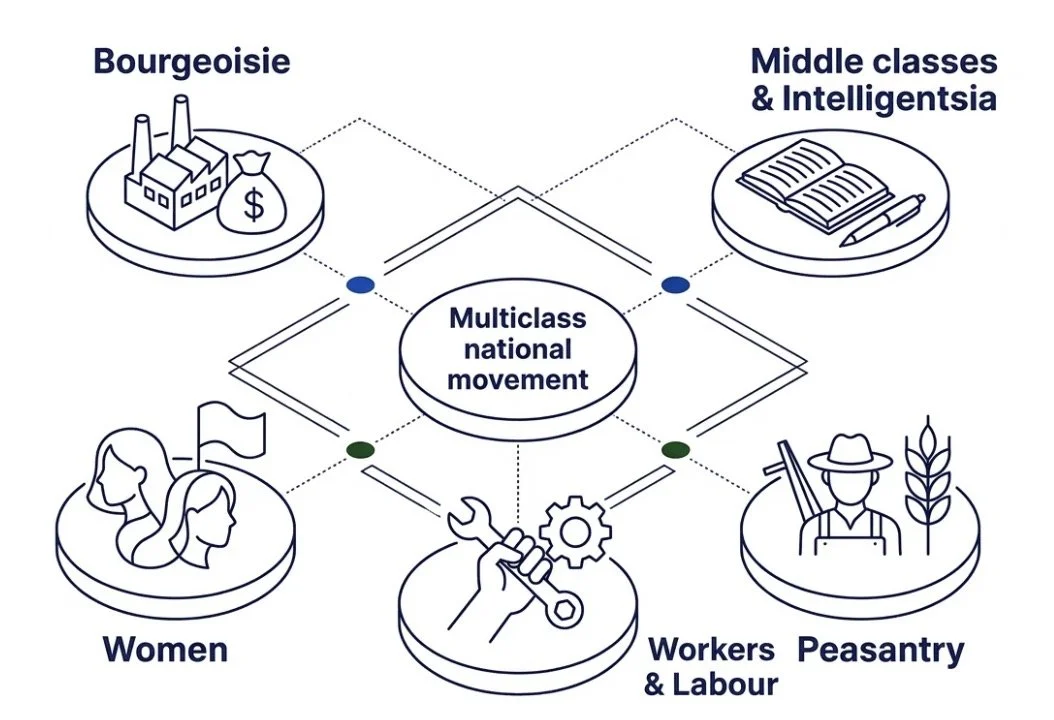
The national movement continuously defined itself in an increasingly radical direction. The Left-wing and socialist ideas grew in geometric proportions through the 1930s. While they did not become the dominant trend, they succeeded in becoming a basic constituent of the movement and in constantly shifting it leftward. By the late 1930s, the Indian national movement was one of the most radical national liberation movements in the world — a remarkable achievement given the social complexity and diversity of the country it sought to liberate.
The Integrated Vision: Anti-Colonial, Democratic, and Socially Radical
The Indian national movement, at its best, achieved a remarkable synthesis: a clear-cut anti-colonial ideology combined with a vision of a civil libertarian, democratic, secular, and socially radical society. The Indian economy was to be developed along independent, self-reliant lines. It was this integrated vision that enabled the movement to base itself on the politically awakened and politically active people, acquiring the character of a genuinely popular movement in the deepest sense.
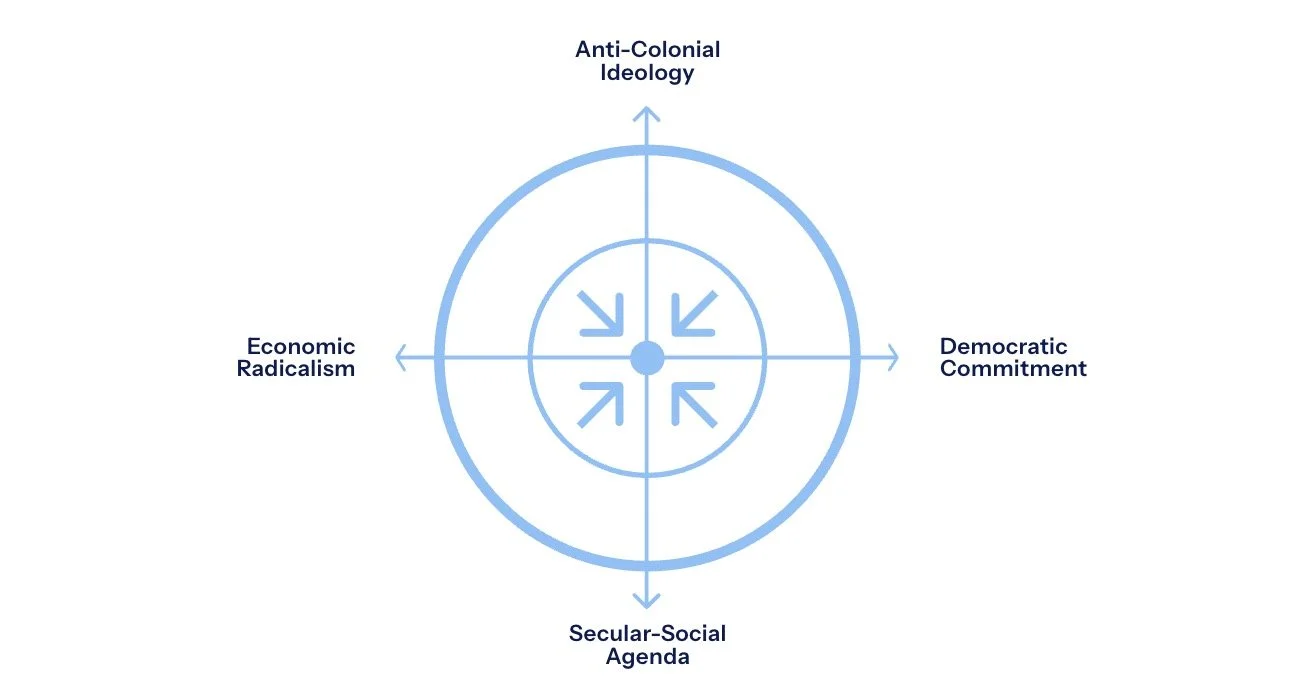
The world outlook of the national movement — based on anti-colonialism, anti-fascism, peace, and national independence — was a powerful element of its overall ideology. India's national movement engaged actively with international currents: the Russian Revolution, the anti-fascist movement, Chinese and Vietnamese liberation struggles. It understood that Indian independence was part of a global movement against imperialism.
The legacy of this integrated vision was profound. The values forged in the crucible of the national movement — democracy, civil liberties, secularism, social equality, economic self-reliance — became the foundational principles of independent India's Constitution and its early developmental model. That these principles were sometimes imperfectly realised in practice does not diminish the significance of their articulation and the political culture they created. The national movement gave India not just independence but a set of ideals worth struggling for — ideals that remain relevant and contested to this day.
Key Takeaways: Strategy and Ideology at a Glance
The following summary distils the central analytical insights of this document for quick review and examination preparation.
Nature of Colonial State
The British colonial state was semi-hegemonic, semi-authoritarian — "legal authoritarianism." It relied on both force and ideological myths (benevolence + invincibility) to sustain rule.
Basic Strategic Perspective
A hegemonic struggle or "war of position" (Gramscian) — winning minds and hearts, not a single military confrontation. Strategy of active struggle, not gradual reform.
S-T-S Model
Struggle-Truce-Struggle — an upward spiral. Both phases were anti-imperialist. Freedom was indivisible. Timing of shift was tactical, not principled.
Non-Violence
For most leaders: a strategic policy, not just principle. Enabled mass participation (especially women), put colonial state in a no-win dilemma, compensated for material disarmament.
Anti-Colonial Ideology
Drain theory + exposure of colonial economic mechanisms. The ideological basis complemented the material/structural basis of the movement. Strong ideology enabled mass sacrifice.
Socialist Orientation
Continuous leftward drift through the 1930s–40s. Never became dominant but became irreversible constituent. Congress adopted most Left demands with a time lag. Both Nehru and Gandhiji (in different ways) contributed to this radicalisation.
For Examination: The most frequently tested themes are the S-T-S strategy, the semi-hegemonic character of the colonial state, the strategic rationale for non-violence, the four objectives of nationalist strategy, and the socialist orientation of the Congress in the 1930s. Ensure you can explain each with specific examples and the names of key leaders associated with each phase.
