
Politics of Separatism: Communalism and the Partition of India
Politics of Separatism: Communalism and the Partition of India
Examination of communalism as a modern political phenomenon in colonial India — its ideological architecture, socio-economic roots, and the role it played in the catastrophic partition of the subcontinent. Drawing on historiographical debates and primary political developments from the 1880s through 1947, this study interrogates the three-stage progression of communal ideology, the colonial state's calculated exploitation of religious divisions, and the ultimate failure of the nationalist movement to neutralise communalism through principled ideological struggle. Intended for students of political science, history, and South Asian studies, this document moves systematically from theory to historical evidence, offering a rigorous framework for understanding one of modern history's most consequential political tragedies.
The Three Stages of Communal Ideology
Communalism, as a political ideology, does not emerge fully formed. It develops through a structured progression of three analytically distinct yet historically interconnected stages, each building upon the last and making retreat to earlier, more moderate positions increasingly difficult. Understanding this architecture is essential to grasping how communalism metastasised from a fringe intellectual tendency into a mass political force capable of partitioning a subcontinent.
Stage One: Shared Secular Interests
The foundational belief that co-religionists share common political, economic, social, and cultural interests — making religion the primary unit of social identity rather than class, nationality, or region.
Stage Two: Liberal Communalism
The divergence thesis — the belief that the secular interests of different religious communities are dissimilar and often in conflict. Liberal communalists still upheld democratic and nationalist values but insisted on distinct communal rights and safeguards.
Stage Three: Extreme Communalism
The incompatibility thesis — the declaration that Hindu and Muslim interests are permanently and irresolvably antagonistic. This fascistic stage used fear, hatred, and the language of war. The Muslim League and Hindu Mahasabha moved decisively here after 1937.
These stages were not hermetically sealed from one another. The first stage fed into the second and the third, creating an ideological continuum that made it exceptionally difficult for nationalists — even those who rejected mutual antagonism — to wage a clean break. Many who saw themselves as "Nationalist Hindus" or "Nationalist Muslims" remained, often unwittingly, trapped within the logic of the first stage, lending communalism a measure of respectability it could not otherwise have claimed.
The Unreality of Communal Interests
One of the most penetrating critiques advanced by secular nationalist intellectuals was the claim that the communal "interests" invoked by communal leaders were, in fact, fictitious constructs with no material basis in Indian social reality. This was not merely a rhetorical counter-argument; it was a sociological claim with far-reaching political consequences.
The Fiction of Communal Unity
The economic and political interests of Hindus, Muslims, and other communities were fundamentally the same. As Hindus or Muslims, individuals did not possess a distinct political-economic life on an all-India or even regional basis. They were divided from fellow Hindus or Muslims by region, language, culture, class, caste, social status, and food and dress habits — and united on precisely these axes with followers of other religions.
An upper-class Muslim had far more in common — even culturally — with an upper-class Hindu than with a lower-class Muslim.
A Punjabi Hindu stood culturally closer to a Punjabi Muslim than to a Bengali Hindu.
The communal division thus obscured real divisions: linguistic-cultural regions and social classes.
The Deeper Deception
If communal interests did not exist, the communalist could not be serving his community's interests. He could not be its genuine representative. In the name of his community, he served — knowingly or unknowingly — entirely other interests. Communalism was not a partial or one-sided view of social reality; it was its wrong and unscientific view.
The communal question was, in this sense, a middle-class question par excellence — not a representation of popular religious aspiration but a mobilisation of sectional economic anxiety dressed in the idiom of faith.
Communalism as a Modern Phenomenon
A persistent misconception — often deliberately cultivated by communal propagandists — holds that communalism is an ancient inheritance, a primordial conflict hardwired into the encounter between Hinduism and Islam on the subcontinent. This interpretation is historically untenable. Communalism, like nationalism and socialism, is an emphatically modern phenomenon, intelligible only within the structural conditions produced by colonialism and popular politics.

Communalism could only emerge after the advent of modern politics — politics based on popular participation, mass mobilisation, and the creation of public opinion. In pre-modern India, people were either ignored in upper-class political arrangements or compelled to rebel outside the political system altogether. As Jawaharlal Nehru noted in 1936, "communalism in India is a latter-day phenomenon which has grown up before our eyes." Nor was it uniquely Indian — analogous phenomena elsewhere produced Fascism, anti-Semitism, racism, and Catholic-Protestant conflict in Northern Ireland.
The communal consciousness arose specifically as a consequence of colonialism's transformation of Indian society. The growing economic and administrative unification of the country, the formation of modern social classes, and the birth of new politics in the latter half of the 19th century created an urgent need for new identities, wider loyalties, and fresh ways of understanding collective interests. Where modern ideas of nationalism, class struggle, and cultural-linguistic development spread fully, this transition was secular. Where their growth was slow or partial, people inevitably fell back on pre-modern categories — caste, region, religion, sect — to make sense of new realities.
Colonial Underdevelopment and the Middle-Class Crisis
Communalism was, above all, one of the by-products of the colonial character of the Indian economy — of colonial underdevelopment and the structural incapacity of colonialism to develop Indian productive forces. The economic stagnation produced by colonial exploitation, and its impact particularly on the educated middle classes, created precisely the conditions that made communalism thrive.
Unemployment and Economic Anxiety
Throughout the 20th century, in the absence of modern industrial development and adequate social services, unemployment was an acute problem — especially for the educated middle and lower middle classes who could not fall back on land. The Great Depression after 1928 dramatically worsened these conditions, producing large-scale unemployment across professional and clerical sectors.
Competition and Communal Reservation
Intense competition for government jobs, professional openings, and business opportunities led middle-class individuals to use every available means to gain advantage — including communal, caste, and provincial group identities. Communal reservations in jobs and legislative seats offered a short-term, sectional solution to a structurally produced problem.
Extension to Rural Areas
As education spread to prosperous peasants and small landlords, the boundaries of the job-seeking middle class expanded to rural areas. Newly educated rural youth, unable to sustain themselves on stagnant agriculture, flocked to towns seeking government employment and used communal reservation systems to compete — gradually widening communalism's social base to include upper peasant and landlord strata.
The Oscillation Between Nationalism and Communalism
The crisis of the colonial economy generated two opposing political tendencies within the middle classes. When anti-imperialist revolution appeared on the agenda, they enthusiastically joined national movements. When prospects receded and passive phases set in, many shifted to short-term communal solutions, functioning as a narrow interest group and objectively serving colonialism.
Government service was the dominant avenue of middle-class employment in colonial India — as late as 1951, 3.3 million persons were employed in government service, compared to 1.2 million covered by the Factory Acts. Communal politics could be used to pressure the government to allocate jobs and seats in professional colleges along communal and caste lines. Crucially, communal leaders' demands were almost entirely confined to these arenas; they took up no issues of genuine interest to the working masses.
How Communalism Distorted Class Conflict
At another analytical plane, communalism frequently distorted or misinterpreted genuine social tensions and class conflicts — between exploiters and exploited belonging to different religions — as communal conflicts. The discontent and clash of interests was real and rooted in non-religious factors, but due to backward political consciousness it found a distorted expression in communal violence.
The Structural Coincidence
What made communal distortion plausible was a specific feature of Indian social development: in several parts of the country, religious distinctions coincided with social and class distinctions. In Bengal and parts of north India, the exploiting sections — landlords, merchants, and moneylenders — were predominantly upper-caste Hindus, while the poor and exploited were often Muslims or lower-caste Hindus.
As C.G. Shah observed: "Under the pressure of communal propaganda, the masses are unable to locate the real causes of their exploitation, oppression, and suffering and imagine a fictitious communal source of their origin."
Concrete Distortions
The struggle between tenant and landlord in East Bengal, and between peasant-debtor and merchant-moneylender in Punjab, was routinely portrayed by communalists as a struggle between Muslims and Hindus. In Punjab, big Muslim landlords used communalism to deflect tenant anger toward Hindu traders and moneylenders — while the latter used communal rhetoric to protect their own threatened class interests.
Critically, it was not always participants who gave conflicts a communal colour — it was often the observer, the official, the journalist, the politician, and finally the historian, all providing post-facto communal explanations rooted in their own conscious or unconscious bias.
Historical Counterevidence: In the Pabna agrarian riots of 1873, both Hindu and Muslim tenants fought zamindars together. The predominance of Hindus among bankers and moneylenders in northern India was not the result of being Hindu but of the economic role they acquired within the colonial exploitation system. Colonial history guaranteed the dominance of merchant-moneylenders; medieval history had guaranteed that they would be mostly Hindu. These were structural facts, not communal ones.
Divide and Rule: The Colonial State and Communalism
British rule and its systematic policy of Divide and Rule bore special — indeed, primary — institutional responsibility for the growth of communalism in modern India. The colonial state possessed immense power to promote either national integration or divisive forces; it consistently chose the latter. Communalism was actively cultivated as a weapon to counter the growing national movement and to obstruct the welding of the Indian people into a nation.
Treating Communities as Antagonistic
India was consistently presented by official ideology not as a nation-in-the-making but as a collection of structured, mutually exclusive, and antagonistic religion-based communities. This framing made Hindu-Muslim disunity the primary justification for the continuation of British rule.
Official Patronage to Communalists
Communal leaders, newspapers, and organisations received extraordinary tolerance and official favour. The Muslim communal demands presented to the Viceroy in 1906 were accepted almost immediately — while the Congress had failed to get any of its demands accepted between 1885 and 1905.
Separate Electorates as Instrument
Separate electorates introduced in the Morley-Minto Reforms of 1907 turned legislative elections into arenas of communal competition. Candidates appealed exclusively to co-religionists, systematically training voters to think and act communally across every domain of political life.
Inaction Against Communal Violence
The Government refused to act against virulent communal propaganda through the press, pamphlets, and public platforms — a stark contrast with the frequent suppression of the nationalist press and civil servants. Communal riots were not crushed energetically, and preventive measures taken routinely against nationalist protest were absent.
In the final analysis, communalism may be described as the channel through which the politics of the middle classes were placed at the service of colonialism and the jagirdari classes. It was also the route through which colonialism extended its narrow social base to sections of workers, peasants, and the bourgeoisie whose interests were otherwise in direct contradiction with colonial rule.
Hindu Tinge in Nationalist Thought and the Communal Consequence
A significant contributory factor in the growth of communalism — and more particularly in the failure to contain it — was the pronounced Hindu tinge that permeated much nationalist thought and propaganda at the turn of the 20th century. This was not a trivial cultural flavouring; it had concrete political consequences that proved deeply damaging to the secular credentials of the national movement.
The Extremist Contribution
Many Extremist leaders introduced a strong Hindu religious element into nationalist thought. They emphasised ancient Indian culture to the exclusion of the medieval period and provided a Hindu ideological underpinning to Indian nationalism. Tilak used the Ganesh Puja and the Shivaji Festival to propagate nationalism; the anti-partition agitation was inaugurated with dips in the Ganges. Bankim Chandra Chatterjee and many literary figures referred to Muslims as foreigners in fiction, identifying nationalism itself with Hindus.
Political Consequences
The Hindu tinge was not the cause of communalism, but it was a cause of the nationalists' failure to check its growth. It made winning Muslim participation in the national movement marginally but consequentially more difficult. It enabled the Government and Muslim communalists to sustain among Muslim populations the fear that national success would mean Hindu supremacy. It also created ideological openings for Hindu communalism and made purging communal elements from within the Congress's own ranks far more politically treacherous.
The nationalist movement remained, on the whole, basically secular in its approach and ideology — and young nationalist Muslims like M.A. Jinnah and Maulana Abul Kalam Azad had little difficulty accepting it as such. This secularism grew sturdier when leaders like Gandhi, C.R. Das, Motilal Nehru, Jawaharlal Nehru, Maulana Azad, Subhas Bose, and Sardar Patel came to the helm. But the damage done by the Hindu tinge in earlier decades had already constrained the movement's capacity to challenge communalism from a position of unimpeachable moral clarity.
The Communal Distortion of Indian History
A communal and distorted view of Indian history — particularly of its ancient and medieval periods — was not merely a symptom of communal politics; it was one of its primary instruments and a constitutive element of communal ideology itself. For generations, communal interpretations of history of varying degrees of virulence were propagated, first by imperialist writers and then by Indian communalists of all varieties.
The Imperialist Foundation
James Mill inaugurated the tradition in the early 19th century by dividing Indian history into "Hindu" and "Muslim" periods. Though he notably failed to label the modern period as "Christian," his framework was adopted wholesale by subsequent British and Indian historians, embedding a religious categorisation into the very periodisation of historical knowledge.
Hindu Communal History
Hindu communalists portrayed medieval Muslim rulers as anti-Hindu tyrants, medieval India as a period of foreign oppression, and ancient India as a lost golden age destroyed by Muslim rule. The rhetoric of "a thousand years of slavery" became common. All medieval rulers were declared "foreign" on grounds of religion alone, erasing the composite cultural reality of medieval Indian civilisation.
Muslim Communal History
Muslim communalists harked back to an Islamic golden age in West Asia, propagated the myth that all Muslims were rulers or beneficiaries in medieval India, glorified religious bigots like Aurangzeb, and evolved a "fall" theory — that Muslims declined as a community throughout the 19th century after "losing" political power. Both versions of communal history denied the composite, syncretic reality of Indian cultural development.
Gandhiji wrote: "Communal harmony could not be permanently established in our country so long as highly distorted versions of history were being taught in her schools and colleges, through the history textbooks." The communal view of history was also spread through poetry, drama, historical novels, newspapers, pamphlets, and above all orally through the public platform, classroom teaching, and the socialisation processes of family and community.
Religiosity, Religion, and the Communal Problem
A common but analytically imprecise conflation treats communalism as the natural or inevitable expression of religious pluralism — as though the mere co-existence of multiple religions in India made communal conflict unavoidable. This is historically and sociologically incorrect, and its acceptance would make communalism both inexplicable in its timing and insoluble in principle.
Religion vs. Communalism
Religion as a belief system — the personal, spiritual, and moral dimensions of faith — is categorically distinct from communalism, which is an ideology of religion-based socio-political identity. Religion comes into communalism only to the extent that it serves politics arising in spheres entirely external to religion itself. K.M. Ashraf described communalism as "Mazhab ki siyasi dukadari" — the political trade in religion.
Communalism was not inspired by religion; religion was merely its vehicle, its mobilising instrument, not its object.
The Crucial Role of Religiosity
While religion per se was not a cause of communalism, religiosity — defined as intense emotional commitment to religious matters and the tendency to allow religious emotions to intrude into non-religious domains of life — was a major contributory factor. Religiosity was not communalism, but it opened individuals to communalism's appeal by making them susceptible to the cry of "religion in danger."
Communalism became a genuinely popular movement after 1939, and especially during 1945-47, precisely when it adopted this inflammable cry. Secularisation, therefore, did not mean removing religion from Indian life — it meant progressively narrowing the sphere of religion to the private and moral life of the individual, reducing the political purchase of religiosity.
Syed Ahmed Khan and the Origins of Organised Communalism
There was hardly any organised communalism in India before the last quarter of the 19th century. Hindus and Muslims had fought shoulder to shoulder in the Revolt of 1857. The identity emphasised by North Indian newspapers in the 1860s was that of the Hindustanees vis-à-vis British rulers. Even Syed Ahmed Khan — undoubtedly one of the most outstanding Indians of the 19th century — began his educational activities without communal bias, co-founding scientific societies involving both Hindus and Muslims and building the Aligarh College with Hindu financial support and a substantial Hindu faculty and student body.
"Do you not inhabit this land? Are you not buried in it or cremated on it? Surely you live and die on the same land. Remember that Hindus and Muslims are religious terms. Otherwise Hindus, Muslims and Christians who live in this country are by virtue of this fact one qaum." — Syed Ahmed Khan, 1884
Yet the same Syed Ahmed Khan, from 1887 onward, laid the foundational architecture of communal ideology. Under pressure from Viceroy Dufferin's frontal attack on the Congress and motivated by his conviction that Muslim interests in government posts could only be secured through demonstrated loyalty to colonial rulers, Syed Ahmed pivoted decisively. He declared that Hindus, as a majority, would dominate Muslims under any democratic arrangement; that India could not be considered a nation; that the Congress was a Hindu body opposed to Muslim interests; and that the British were the necessary guarantors of Muslim welfare.
His co-workers gradually laid down all the basic themes of communal ideology as it would be propagated throughout the first half of the 20th century: the permanent clash of Hindu and Muslim interests; separate electorates; communal reservation in government jobs and legislative councils; and the rejection of democratic elections as inherently dangerous to Muslim welfare. Crucially, Syed Ahmed asked Muslims to remain politically passive — because, as he correctly understood, any agitational politics would tend to become anti-colonial and seditious. The colonial rulers were quick to recognise the inherent logic of this position and began actively promoting and supporting communalism from its very inception.
The Formation of the Muslim League and Hindu Mahasabha
The founding of organised communal political institutions marked a decisive transition from communal ideology to communal politics as a structured, ongoing enterprise. Both the All India Muslim League and the All-India Hindu Mahasabha emerged in the first two decades of the 20th century, yet their social bases, political trajectories, and relative strengths differed markedly.
All India Muslim League (Founded 1906)
Founded at the end of 1906 by big zamindars, ex-bureaucrats, and upper-class Muslims — the Aga Khan, the Nawab of Dacca, and Nawab Mohsin-ul-Mulk — the League was constituted as an explicitly loyalist, communal, and conservative organisation. It supported the partition of Bengal, demanded separate electorates, raised the slogan of separate Muslim interests, and reiterated all the major themes of Syed Ahmed's communal ideology.
Its primary objective was to prevent the emerging Muslim intelligentsia from joining the Congress. Its activities were directed against the National Congress and Hindus — not against the colonial regime. When the Swadeshi Movement brought mass politics to India, the League's upper-class loyalist approach faced its first serious challenge from younger, nationalist Muslim intellectuals.
All-India Hindu Mahasabha (Founded 1915)
The first session was held in April 1915, but the Mahasabha remained, for several years, a comparatively weak organisation. The colonial government gave Hindu communalism fewer concessions and less support — it relied more heavily on Muslim communalism and could not simultaneously placate both. Moreover, among Hindus, the modern intelligentsia, bourgeois elements, and democratic nationalists had already acquired intellectual and political hegemony, crowding out the feudal and clerical elements that dominated Muslim communal organisations.
The Punjab Hindu Sabha, founded in 1909, laid much of the ideological groundwork — explicitly directing its anger against the Congress for "sacrificing Hindu interests" and calling upon Hindus to be "Hindu first and Indian after."
The Lucknow Pact, Separate Electorates, and the Legitimation of Communalism
The period between 1912 and 1924 witnessed a genuine — if ultimately flawed — rapprochement between the Congress and the Muslim League, driven by a new generation of nationalist Muslim intellectuals and Congress leaders willing to accommodate communal concerns within a broad national framework. The Lucknow Pact of 1916 represented both the apex of this rapprochement and, paradoxically, one of its deepest structural failures.
The Pact was negotiated through the efforts of Lokmanya Tilak and M.A. Jinnah, who brought the two organisations to a common political platform at their concurrent sessions in Lucknow. Common political demands — including the demand for self-government after the War — were placed before the Government. On this level, the Pact was a genuine step forward and generated considerable nationalist enthusiasm.
The Forward Step
Hindu-Muslim political unity; common demands for self-government; Congress-League cooperation representing a powerful challenge to colonial rule.
The Backward Step
The Congress formally accepted separate electorates and the system of weightage and reservation of seats for minorities — legitimising communal politics and tacitly accepting that India consisted of distinct communities with separate interests.
The Long-Term Consequence
By negotiating with and making concessions to communal leaders, the Congress validated their claim to represent communal interests, weakened secular Muslim nationalists, and left the door open to the future resurgence of communalism in Indian politics.
The introduction of separate electorates through the Morley-Minto Reforms of 1907 had already established the institutional infrastructure for communal politics. Under this system, Muslim voters were placed in constituencies from which only Muslims could stand as candidates and for which only Muslims could vote. This arrangement systematically trained generations of voters to think communally, to evaluate political progress in communal terms, and to express every socio-economic grievance through the idiom of communal power and communal injury.
The Khilafat Movement, Post-Non-Cooperation, and the Communal Resurgence
The years after World War I saw the national movement reach its greatest breadth and intensity — and communalism reach its lowest ebb. The agitation against the Rowlatt Acts, the Khilafat Movement, and the Non-Cooperation Movement produced an unprecedented mobilisation of both Hindu and Muslim masses under a common anti-colonial banner. Swami Shradhanand, a staunch Arya Samajist, was invited to preach from the pulpit of the Jama Masjid at Delhi; Dr. Saifuddin Kitchlu, a Muslim, was given the keys to the Golden Temple at Amritsar. The entire country resounded to the cry of "Hindu-Muslim ki Jai."
Yet the Khilafat Movement carried a structural weakness that would bear bitter fruit. While it succeeded in raising the anti-imperialist consciousness of Muslim masses, its leadership made extensive appeals to religious sentiment, utilised fatwas and religious sanctions, and emphasised Muslim solidarity — thereby strengthening the hold of orthodoxy and priesthood over political minds and keeping an opening for communal ideology to re-enter at a later stage. The nationalist leadership failed to consistently raise religious-political consciousness to the higher plane of secular political consciousness.
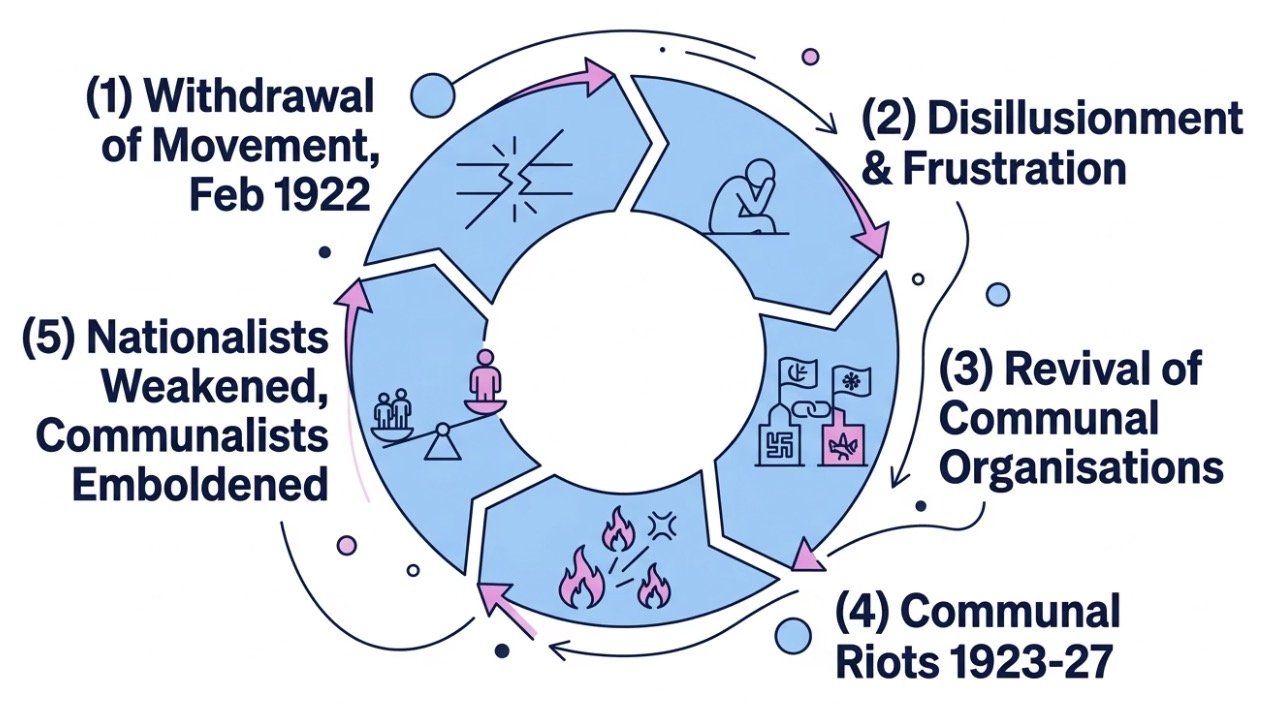
The Hindu Mahasabha was revived in 1923 with the proclaimed objective of "the maintenance, protection and promotion of Hindu race, Hindu culture and Hindu civilization for the advancement of Hindu Rashtra." Sangathan and Shuddhi movements among Hindus and Tanzeem and Tabligh movements among Muslims worked simultaneously for communal consolidation. Significant nationalists — Lajpat Rai, Madan Mohan Malaviya, and even former Khilafatists like Maulana Mohammed Ali — moved toward communal positions, accusing the Congress of sacrificing Hindu or Muslim interests respectively.
The Nehru Report, Jinnah's Fourteen Points, and the Failure of Compromise
The late 1920s represented perhaps the last realistic opportunity to resolve the communal problem through negotiated constitutional settlement before the ideological hardening of the 1930s made compromise essentially impossible. The Congress's strategy of seeking communal unity through top-level negotiation with communal leaders was tested to its limits during 1927-29 — and found comprehensively inadequate.
The Delhi Proposals (1927) and Nehru Report (1928)
A group of Muslim communal leaders evolved four basic demands — separation of Sind, constitutional reform in North-West Frontier Province, 33⅓% Muslim representation in the central legislature, and population-proportionate representation in Punjab and Bengal. The Congress responded with the Nehru Report, which accepted the separation of Sind and NWFP reform, proposed joint electorates with reserved seats in proportion to population, and recommended a federal structure based on linguistic provinces.
M.A. Jinnah proposed three amendments: Muslim weightage in central legislature (⅓), population-proportionate representation in Punjab and Bengal, and residuary powers in the provinces. A section of the League and Khilafatists were willing to accept these. However, a larger section led by Mohammed Shafi and the Aga Khan refused to surrender separate electorates.
Jinnah's Fourteen Points and Their Legacy
When the Calcutta Convention failed to reach unanimous agreement, and the Congress refused to accept the weak centre envisioned by the Jinnah amendments, Jinnah consolidated all outstanding communal demands into a single document — the Fourteen Points. These incorporated the four Delhi Proposals, the three Calcutta amendments, the continuation of separate electorates, and reservation of Muslim seats in government services and self-governing bodies.
The Fourteen Points became the basis of all future communal propaganda. They represented the outer boundary of liberal communalism — and their rejection by the Congress, however principled, marked a decisive turning point toward the era of extreme communalism that would follow 1937.
The Inherent Weakness of the Negotiation Strategy: By negotiating with communal leaders, the Congress tacitly legitimised their claim to represent real communal interests, weakened secular nationalists like Azad and Ansari, found it politically impossible to force concessions to Muslim communalism on Hindu communalists, and discovered that concessions only whetted the appetite of communalists while a more recalcitrant leader always emerged to push demands further. Jinnah himself was a textbook example of this dynamic.
Extreme Communalism After 1937: The Fascist Turn
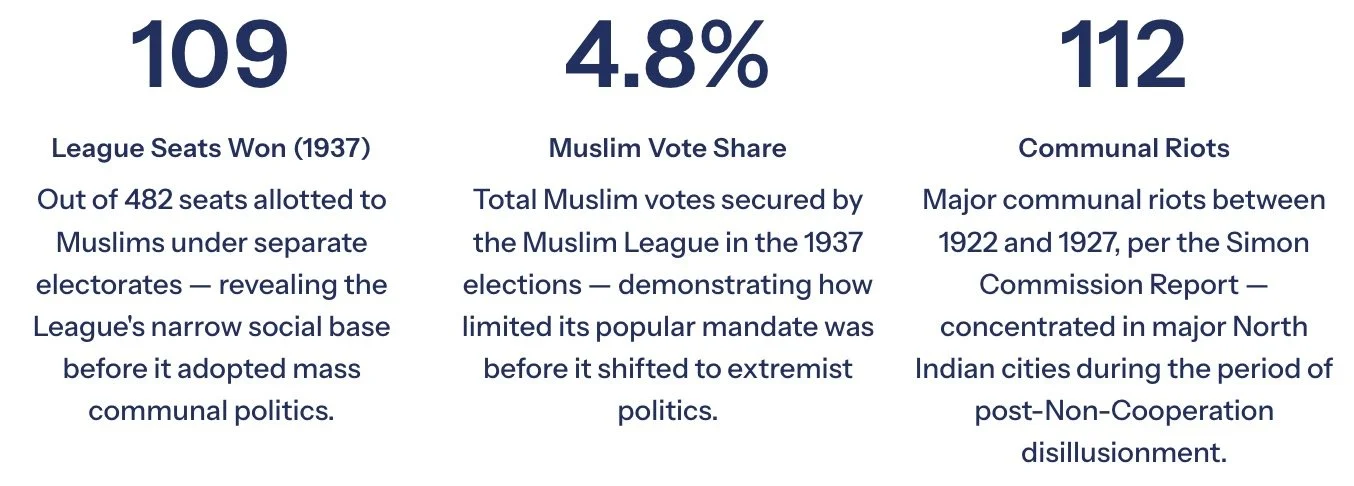
The elections of 1937 constituted a watershed moment in the history of Indian communalism. The Congress emerged as the dominant political force; the Muslim League won only 109 of 482 Muslim seats, securing a mere 4.8% of the Muslim vote; and the Hindu Mahasabha fared even worse. Both organisations faced the prospect of political irrelevance. Their response was to abandon liberal communalism and adopt the politics of mass mobilisation through extremism — a model drawn explicitly from the contemporary European fascist experience.
Zamindars Shift to Communalism
Landlords and jagirdari elements finding open defence of their class interests no longer feasible switched wholesale to communalism. In Punjab, big Muslim landlords of West Punjab shifted from the Unionist Party to the Muslim League; in Bengal, Muslim jotedars and zamindars followed suit. Hindu zamindars in north and west India gravitated toward Hindu communal organisations. Communalism became the vehicle of class defence for the landed aristocracy.
Colonial All-In on Muslim Communalism
By 1937, nearly every other divisive strategy employed by the colonial authorities — non-Brahmin agitation, Scheduled Caste mobilisation, provincial rivalries, Congress Left-Right splits — had been overcome by the national movement. The communal card alone remained. The colonial state threw its full weight behind Muslim communalism, giving the League a veto on any political settlement and recognising it as the sole spokesperson for Muslims.
Mass Fascist Politics Adopted
Having failed electorally on liberal communal lines, both the League and the Mahasabha adopted extremist mass politics modelled on fascist movements. Appeals to reason and programme were abandoned; appeals to irrational fear, hatred, and the cry of "religion in danger" were adopted. Congress's Muslim Mass Contact Programme under Nehru added urgency to this shift — the communalists needed to reach the Muslim masses before the Congress could.
Extreme communalism after 1937 operated on the politics of domination and suppression, permanent antagonism, and physical threat. Phrases like "oppression," "extermination," and "extinction" entered communal discourse. The Muslim League and Hindu Mahasabha alike poured venom on the Congress and Gandhiji, and most viciously attacked their co-religionists among the nationalists. The principle, as one analyst put it, was "the bigger the lie the better." The logic of communalism had inexorably produced its own extremist endpoint.
The Two-Nation Theory and the Feedback Loop of Communalisms
One of the most analytically important — and politically disingenuous — moves made by communal ideologues of all varieties was to ascribe the origins of their own communalism to the prior existence of and reaction to the communalism of the other. The Hindu communalist blamed Muslim communalism; the Muslim communalist blamed Hindu communalism. Each provided, through this attribution of "original blame," a backdoor justification for their own politics. The question of which communalism came first, as one historian noted, is as answerable as the question of which came first: the chicken or the egg.
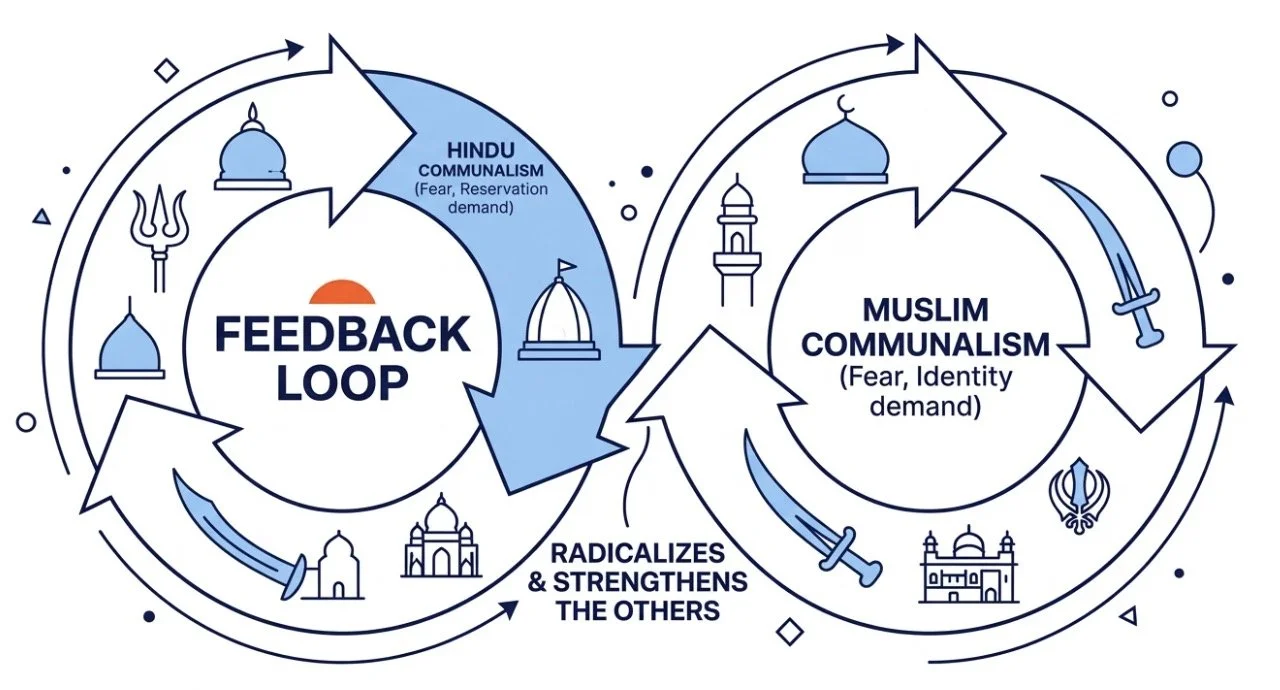
Once communalism arose and developed, its different variants fed and fattened on each other. Each extremist act by one community's communalists provided the other with evidence of existential threat; each demand accepted for one community intensified the demands of all others; each instance of communal violence produced a communal counter-reaction. The system was, by design or by consequence, self-perpetuating and self-radicalising. Liberal communalism's inherent instability — its inability to permanently contain the transition to extremism — meant that the logic of the ideology always pushed in one direction: toward greater exclusiveness, greater fear, and greater antagonism.
The Two-Nation Theory — the declaration that Hindus and Muslims constituted two separate nations whose mutual antagonism was permanent and irresolvable — was the ideological apex of this process. Both the Muslim League under Jinnah and the Hindu Mahasabha under Savarkar arrived at structurally identical conclusions through mirror-image reasoning. The Lahore Resolution of 1940, demanding a separate Muslim homeland, was the political expression of this ultimate ideological stage.
The Congress's Failed Anti-Communal Strategy
The nationalist movement's failure to neutralise communalism constitutes one of the most important and sobering lessons of modern Indian political history. This failure was not primarily a failure of intent — the Congress leadership from Dadabhai Naoroji through Gandhiji and Nehru was deeply committed to secularism and Hindu-Muslim unity. It was a failure of strategy, analysis, and political will at the level of sustained ideological struggle.
Over-Reliance on Top-Level Negotiations
The Congress consistently sought to solve the communal problem through compromise agreements with communal leaders — the Lucknow Pact, the Nehru Report negotiations, the Delhi Proposals process. Each such negotiation legitimised communal leaders as genuine representatives of their communities, weakened secular Muslim nationalists, and validated the very communal framework the Congress ostensibly opposed.
Absence of Mass Ideological Struggle
The real answer lay in an all-out opposition to communalism in every arena — ideological, cultural, social, and political — grounded in scientific exposure of its ideological content, socio-economic roots, and political consequences. This was not done. The Congress provided no deep public analysis of the communal phenomenon. Gandhiji made Hindu-Muslim unity a platform priority but staked it on personal moral appeals rather than structural political analysis.
Failure to Address Agrarian Class Conflicts
Where peasant and debtor struggles were being distorted into communal channels, the necessary counter-strategy was to take up the peasants' class cause directly and reveal the communal misrepresentation of their exploitation. This was sporadically done by Left forces but never made central to the national movement's anti-communal programme.
Tolerance of Internal Communalism
The Congress had permitted Hindu and Muslim liberal communalists to work within its organisation for too long, creating ideological inconsistency that communal opponents exploited. The eventual move under Nehru and Left pressure to expel communalists came too late and was too limited to reverse the damage. A more rigorous and consistent internal standard of secular politics was never enforced.
Understanding the historical trajectory of communalism requires situating key political events within the broader structural dynamics of colonial underdevelopment, nationalist mobilisation, and imperial manipulation. The following chart maps the rise and intensification of organised communal activity in relation to critical moments of nationalist strength and colonial political intervention.
The chart illustrates the inverse relationship between the strength of the nationalist mass movement and the intensity of communal political activity — a pattern that strongly supports the structural analysis that communalism thrived precisely in the political vacuums created by nationalist retreats, colonial manipulation, and the failure to wage sustained ideological counter-struggle. The convergence of both indices at high levels in 1945-47 represents the tragic final act: the national movement strong enough to demand independence but communalism too entrenched to be rolled back without partition.
Communalism, Partition, and Historical Lessons
The partition of India in 1947 was not an inevitable consequence of the co-existence of Hinduism and Islam on the subcontinent, nor was it the product of primordial hatreds hardwired into Indian civilisation. It was the outcome of a specific, historically contingent, and analytically explicable process: the emergence of communalism as a modern political ideology rooted in colonial underdevelopment, exploited by the colonial state, instrumentalised by reactionary class forces, and insufficiently opposed by the national movement that might have contained it.
Communalism Was Not Inevitable
It was not an inherent or inevitable product of India's historical development. It emerged under specific structural conditions — colonial stagnation, middle-class economic anxiety, the need for new political identities — that in other societies produced analogous phenomena: Fascism, anti-Semitism, sectarian violence. Its growth required active promotion by the colonial state and could not have reached the scale it did without that support.
The Congress's Structural Failure
The failure of the Congress was not the acceptance of partition in 1947 — by that stage, communalism had advanced too far and the alternative was likely civil war with the armed forces still under colonial command. The true failure was the preceding decades' inability to wage a patient, scientific, mass-level ideological and political struggle against communalism before it acquired the popular base and extremist character that made 1947 inevitable.
The Ongoing Relevance
The structural analysis offered here — of communalism as ideology, as a product of material conditions, as a distortion of class conflict, and as a tool of reactionary class interest — retains analytical power for understanding communal politics in contemporary South Asia. Communalism is not solved by the existence of democratic institutions alone; it requires active ideological contestation, material amelioration of the conditions that fuel it, and a political culture that refuses to legitimise communal categories as valid units of political representation.
There is never an instant solution to a socio-political problem like communalism. Conditions and forces for a solution have to be prepared over a number of years and even decades. This the Congress and the national movement failed to do — not for want of commitment to secularism, but for want of a viable and effective long-term strategy to combat communalism at the political, ideological, and cultural levels simultaneously.
The historiography of partition continues to evolve, and debates about responsibility, agency, and contingency remain active and contested. But the analytical framework established by secular nationalist historians — centred on the modern, structural, and ideologically constructed character of communalism — remains essential reading for any serious student of South Asian politics, history, or the politics of religious identity in democratic societies.
