
Transfer of Power & Independence
Transfer of Power & Independence: India's Partition and the End of the Raj
The independence of India in August 1947 remains one of the most consequential and debated events in modern world history. Yet independence arrived not as a singular triumph, but as a duality — freedom paired with the trauma of Partition. We can examine the structural causes behind British withdrawal, the erosion of imperial authority, the breakdown of constitutional negotiations, the Congress's acceptance of Partition, and the rich historiographical debates that continue to animate scholarly discourse on these events.
Why Did the British Finally Quit? Competing Interpretations
The question of why the British ultimately withdrew from India has generated sharply divergent responses across ideological and scholarly traditions. Understanding these competing frameworks is essential before arriving at a more historically grounded explanation.
The Imperialist Answer
Independence was the natural fulfilment of Britain's self-appointed civilising mission — a benevolent preparation of Indian people for self-governance. Partition, in this view, was the regrettable consequence of an age-old Hindu-Muslim rift, a failure of the two communities to agree on how power should be transferred. The British, by this account, are absolved of structural responsibility.
The Radical View
Independence was wrested through the mass actions of 1946–47, in which many Communists participated as leaders. However, the bourgeois Congress leadership, frightened by the revolutionary upsurge, struck a deal with the imperial power. Power was transferred to an elite, and the nation paid the price of Partition — a betrayal of the masses by their own representatives.
The Historical Answer
The Independence-Partition duality reflects the success-failure dichotomy of the anti-imperialist movement led by the Congress. The Congress succeeded in building nationalist consciousness sufficient to force British withdrawal, but failed to weld a unified nation — particularly in integrating Muslims into the nationalist project. Independence and Partition are thus two sides of the same coin.
This third interpretation, associated with historians like Bipan Chandra, frames the Congress as bearing a two-fold historical task: structuring diverse classes, communities, and regions into a coherent nation, and securing independence from British rule for that emerging nation. Its partial success and partial failure explain the contradictory outcome of 1947.
The Pillars of British Rule and Their Erosion
British rule in India rested on a complex architecture of consent, prestige, coercion, and institutional control. By the end of the Second World War, each of these pillars had been significantly weakened — not through any single dramatic event, but through a sustained, decades-long process of attrition from within and nationalist pressure from without.
The Three Foundations of Imperial Authority
Social Consent
The Raj depended on the acquiescence of zamindars, upper classes, and Indian loyalists who manned the administration and received British favour. These collaborators worked the reform machinery the British reluctantly introduced.
Ideological Legitimacy
The British secured popular consent by propagating belief in British justice, fair play, and the paternalistic image of the district officer as mai-baap — the benevolent father-figure of the Indian villager.
Administrative Prestige
The Indian Civil Service (ICS) — the so-called "steel frame of the Raj" and "heaven-born service" — was the embodiment of imperial prestige. The district officer was the visible face of an authority that ran, above all, on reputation.
Quantifying the Collapse of the ICS
Between 1940 and 1946, total ICS strength fell by over 21%, reflecting wartime attrition, Indianisation policy, and the breakdown of recruitment after 1943.
The ICS in Crisis: Morale, Contradictions, and the Collapse of Authority
The numerical decline of the ICS tells only part of the story. Far more debilitating was the internal collapse of morale and the impossible strategic contradictions the service was asked to navigate. By the end of the War, the "steel frame" had become a corroded, war-weary bureaucracy, battered by the 1942 movement and deeply uncertain about its own future.
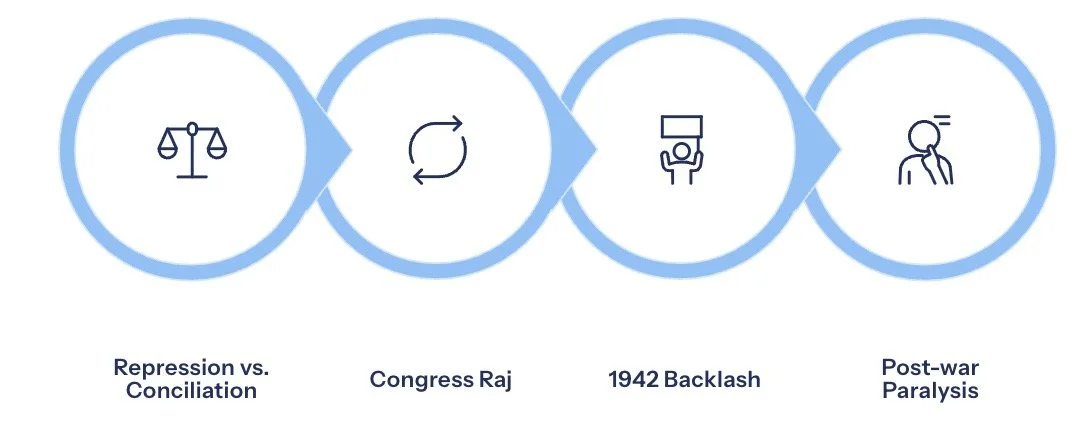
The structural dilemma was stark: decisive action was only possible when policy was clear — either repression or conciliation — not both simultaneously. The British twin policy of combining these approaches created a crisis for the very officials expected to implement them. When non-violent movements were met with repression, the naked force behind the government stood exposed. When government did not clamp down on "sedition" or effected a truce — as in the Gandhi-Irwin Pact of 1931 — its authority and prestige were fatally undermined.
Constitutionalism proved as corrosive to services morale as mass movements had been. Congress's assumption of provincial office in 1937 produced extraordinary reversals of deference: a British Chief Secretary in Madras took to wearing khadi; a Revenue Secretary in Bombay scurried across a railway platform to attend on Revenue Minister Morarji Desai in his third-class compartment. If fear of authority had been exorcised by mass non-violent action, confidence was gained through the lived reality of "Congress Raj." The prospect of Congress returning to power became a calculation in how officials handled subsequent agitations — leading, in some cases, to conspicuously half-hearted action against the 1940 individual disobedience movement in U.P. and even against 1942 rebels in East U.P. and Bihar.
The Viceroy summed up the prospect: "We could still probably suppress such a revolt, but we have nothing to put in its place and should be driven to an almost entirely official rule, for which the necessary numbers of efficient officials do not exist." — Viceroy Wavell
The Nationalist Tide: Measuring the Success of the Independence Movement
The British had won the war against Hitler but, as events made unmistakably clear, lost the one being waged against them in India. By the end of the Second World War, the space occupied by the national movement was far larger than that over which the Raj cast its shadow. The success of nationalist forces in the struggle for hegemony over Indian society was visible across multiple registers.
Mass Mobilisation
Hitherto unpoliticised areas and apolitical groups had fallen in line with the rest of the country during the agitation over the INA trials. The swelling of crowds, the wide geographic reach, and the deep intensity of nationalist sentiment all pointed to an irreversible shift in political consciousness across classes and communities.
Loyalist Defection
When the loyalists began to jump overboard — when zamindars and upper-class collaborators began hedging their political bets — the social base of the colonial regime was visibly dissolving. The changing loyalties of Indian officials and the demoralization of British civil servants told the same story of nationalist success, only from the inside.
The Armed Forces Signal
The demand for leniency toward INA men from within the Indian Army and the revolt of a section of the Royal Indian Navy (RIN) in 1946 sent a decisive signal to far-sighted officials. The structure of the Raj remained formally intact, but the services and armed forces could no longer be relied upon if Congress launched a mass movement of the 1942 type — especially with provincial ministries that would aid, not control, such a movement.
The Cabinet Mission, 1946: The Last Attempt at Unity
By early 1946, the imperialism-nationalism conflict had been resolved in principle. The central political stage was now occupied by three competing and largely irreconcilable visions of the post-imperial order: the British preference for a united, Commonwealth-aligned India; the Congress demand for transfer of power to a single sovereign centre; and the Muslim League's insistence on a separate Muslim state.
Three Competing Visions
British: United India, friendly to Britain, active partner in Commonwealth defence
Congress: Transfer to one centre; minority demands resolved after British departure
Muslim League: Separate sovereign state; compulsory provincial groupings as the path to Pakistan
The Mission Plan: Three Sections
The Cabinet Mission Plan of May 1946 proposed a three-tier constitutional structure designed to reconcile these positions without conceding full partition. Three sections of provinces were to meet separately to decide group constitutions:
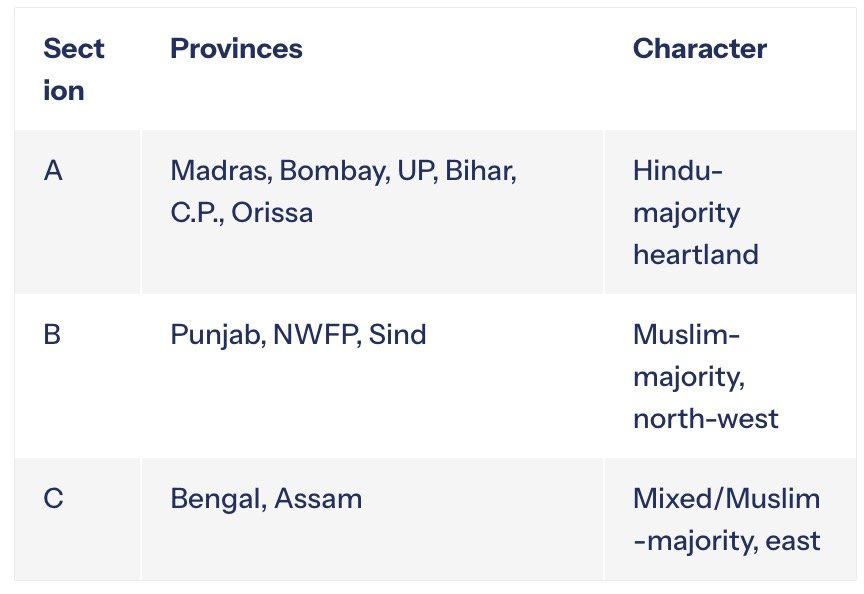
A common centre would control defence, foreign affairs, and communications. After the first general elections, a province could exit a group; after ten years, either province or group could seek a constitutional revision.
The Mission was convinced that Pakistan was not viable and that minorities' autonomy must be safeguarded within a united India. Attlee's statement of 15 March 1946 — that "a minority will not be allowed to place a veto on the progress of the majority" — represented a dramatic departure from the posture of Wavell, who had allowed Jinnah to wreck the Simla Conference in June–July 1945 by insisting on nominating all Muslim members of the Executive Council. The Mission Plan was deliberately ambivalent on the compulsory-vs-optional nature of groupings — a fatal contradiction that both the Congress and the League exploited to their own advantage, ultimately wrecking the plan's implementation.
The Breakdown: Nehru's AICC Speech and the Collapse of the Mission Plan
The Cabinet Mission Plan's inherent ambiguities set the stage for its unravelling. Both the Congress and the Muslim League interpreted its provisions in fundamentally incompatible ways, each claiming the plan as a validation of its own position — and both were, in a sense, correct, given the deliberate imprecision of the document.
6 June 1946
The Muslim League announces acceptance of the Mission Plan, arguing that compulsory groupings implied the basis of Pakistan. Jinnah treats sections B and C as the foundation of a future sovereign state.
7 July 1946
Nehru's speech to the AICC asserts that the Constituent Assembly is sovereign and not bound by the Mission Plan. "We are not bound by a single thing except that we have decided to go into the Constituent Assembly." The Assembly would decide its own rules of procedure.
29 July 1946
Jinnah seizes on Nehru's speech as a pretext and withdraws the League's acceptance of the Mission Plan. The framework for a negotiated united India collapses. Direct Action becomes the League's instrument of pressure.
16 August 1946
Jinnah declares Direct Action Day. Muslim communal groups provoke communal frenzy in Calcutta with the battle cry Lekar rahenge Pakistan, Larke lenge Pakistan. Hindu communal groups retaliate. 5,000 lives are lost in one of the worst episodes of pre-Partition violence.
The British authorities were alarmed that they had lost control over what one official described as the "Frankenstein monster" they had helped to create. Frightened by Jinnah's demonstrated ability to unleash civil war, Wavell brought the League into the Interim Government on 26 October 1946 — despite its having accepted neither the short-term nor long-term provisions of the Cabinet Mission Plan and having not abandoned Direct Action. As the Secretary of State argued, without the League's presence in the government, civil war would have been inevitable. Jinnah had succeeded in keeping the British firmly in his grip.
The Interim Government: Paralysis and the Path to Partition
The Interim Government, formed on 2 September 1946 with Congress members alone under Nehru as de facto head, quickly became what Jinnah had always intended it to be — not an exercise in power-sharing, but a theatre of civil war conducted by other means. The League's entry into the Government in October 1946 did not stabilise the situation; it transformed the Cabinet into an arena of organised disruption.
League's Disruptionist Tactics
League ministers questioned every appointment made by Congress members, refused to attend informal decision-making meetings Nehru had devised, and challenged administrative actions retrospectively. All League nominees save Liaquat Ali Khan were described as "second-raters," signalling that Jinnah's goal was to deny Congress administrative authority, not to govern.
Finance as a Weapon
Liaquat Ali Khan, as Finance Member, systematically hamstrung the functioning of other ministries through budgetary obstruction. The Interim Government was rendered powerless to check Governors from abetting the League, while the Bengal provincial Ministry remained inert — and at times complicit — in the face of ongoing communal riots.
The Constituent Assembly Deadlock
The League's demand for the dissolution of the Constituent Assembly — which had met for the first time on 9 December 1946 — proved the final straw. Even a British Cabinet declaration on 6 December 1946 confirming that compulsory grouping was the correct interpretation of the Mission Plan did not persuade the League to join the Assembly. A direct bid for Pakistan, outside the Mission Plan framework, was now openly Jinnah's strategy.
By 5 February 1947, nine members of the Interim Government had written to the Viceroy demanding the League members' resignation. The experiment in coalition governance had conclusively failed. Congress leaders had been convinced of the futility of continuing, while Nehru himself wondered aloud whether there was any point in remaining in an Interim Government while people were being butchered in the streets.
The Attlee Statement and the Appointment of Mountbatten
The constitutional crisis was temporarily defused by Prime Minister Attlee's statement in Parliament on 20 February 1947. Britain announced a fixed date for withdrawal — 30 June 1948 — and the appointment of Lord Louis Mountbatten as the last Viceroy, charged specifically with winding up the Raj.
"The basic reason why the Attlee Government accepted the need for a final date was because they could not deny the truth of Wavell's assessment that an irreversible decline of Government authority had taken place." — Bipan Chandra
Hopes Attached to the Terminal Date
The Attlee Government hoped the announcement of a fixed date would shock both parties into agreement and avert the constitutional crisis that threatened. It also aimed to finally convince Indians that the British were sincere about conceding independence. Partition was implied in the proviso that if the Constituent Assembly was not fully representative, power would be transferred to more than one central government — but even this was acceptable to the Congress as a way out of the existing deadlock.
In Congress circles the statement was enthusiastically received as final proof of British sincerity. It offered a concrete path forward: the existing Assembly could proceed to frame a constitution for the areas represented within it, regardless of whether the League joined.
The Origins of the Terminal Date: Disputed Claims
Mountbatten has claimed to have introduced the time limit into the settlement — a claim that is historically inaccurate. The idea of a fixed date was originally Wavell's: he had proposed 31 March 1948 as the date by which a stage of responsibility without power would set in. Attlee aimed for mid-1948. Mountbatten's contribution was insisting on a specific calendar date and securing 30 June 1948 — later advanced, with disastrous consequences, to 15 August 1947.
Similarly, Mountbatten's claim to plenipotentiary powers is misleading. He referred back to London at each stage, sent his aide Ismay to London, and ultimately went himself to secure Attlee's and the Cabinet's agreement to the 3rd June Plan. He did not, as he implied, write his own ticket.
Why Britain Could Not Keep India United
A fundamental question underlies the entire narrative of 1946–47: why did the British — who, by their own account and by the historical record, preferred a united India — ultimately preside over its partition? The answer lies not in the inevitability of division but in the choices Britain made about the cost it was willing to pay for unity.
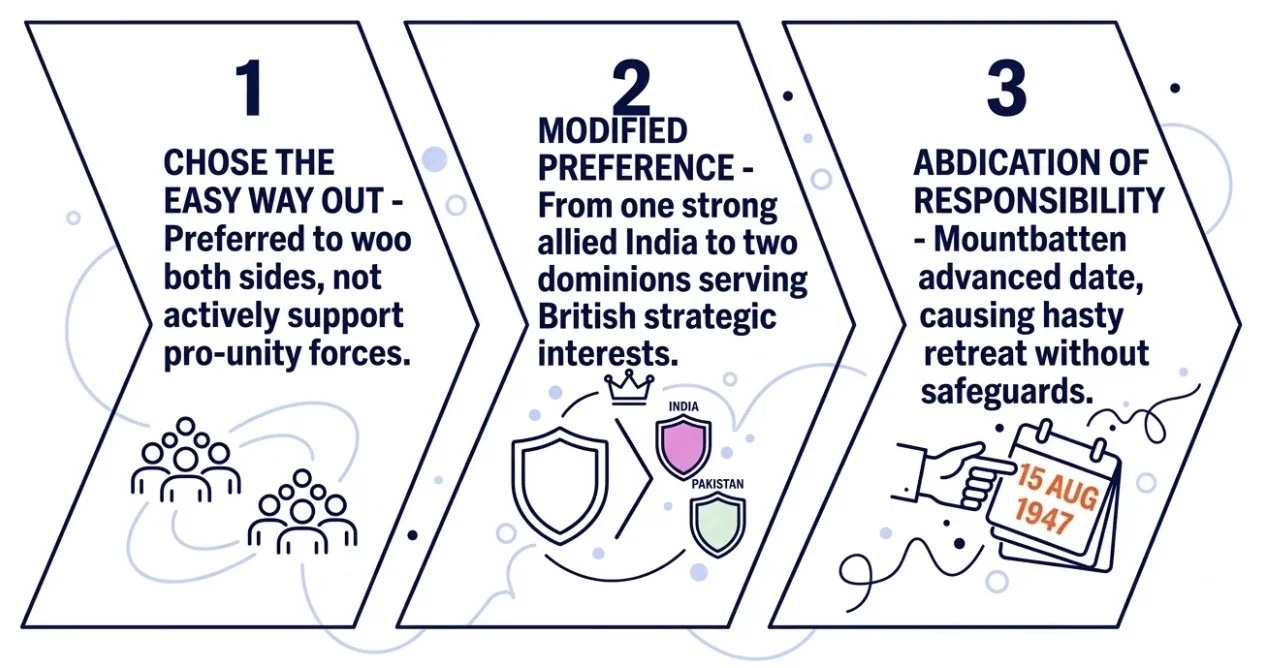
Attlee later acknowledged, "We would have preferred a United India. We couldn't get it, though we tried hard." Yet a serious attempt at retaining unity would have required identifying with the forces that wanted a unified India and actively countering those who opposed it — including using firm action against communal elements. Instead, the British preferred to woo both sides into a post-imperial relationship centred on Commonwealth defence partnerships.
The British preference for a united Indian subcontinent as a strong Commonwealth ally was progressively modified to two dominions — India and Pakistan — both of which would serve as Britain's allies and together achieve what a united India was expected to do strategically. Mountbatten's formula, ultimately, was to divide India but retain maximum unity by also partitioning Punjab and Bengal, so that the limited Pakistan that emerged would partially satisfy both the Congress and League positions. Since Congress was being asked to concede its core demand — a unified India — all its other preferences (ruling out princely independence, opposing Bengali unity, keeping Hyderabad within India) were met by Mountbatten with firm support.
The Mountbatten Plan (3rd June Plan) and the Rush to Transfer
The Mountbatten Plan of 3 June 1947 proposed an early transfer of power on the basis of Dominion Status to two successor states, India and Pakistan. The rationale for advancing the date — from 30 June 1948 to 15 August 1947, a reduction of nearly ten months — rested on the claim that the situation was too explosive to manage any longer under dual authority.
Congress Accepts Dominion Status
Congress agreed to Dominion Status because immediate assumption of full power was essential to contain the explosive communal situation, and because it offered breathing space for the new administration — British officers and civil service officials could remain temporarily to ease the transition.
Britain Secures Commonwealth Membership
For Britain, Dominion Status offered the prize of keeping India — at least temporarily — in the Commonwealth. Greater store was placed on India's membership than Pakistan's, given India's larger economic strength, defence potential, and volume of British trade and investment.
Escaping Responsibility
The early date allowed Britain to escape responsibility for the rapidly deteriorating communal situation. As Patel bluntly told the Viceroy: "You won't govern yourself, and you won't let us govern." Some officials were, as Patel implied, more than happy to pack their bags and leave.
The 72-Day Catastrophe
The seventy-two-day timetable from 3 June to 15 August 1947 for both transfer of power and division of the country proved disastrous. Senior officials including Punjab Governor Jenkins and Commander-in-Chief Auchinleck argued that peaceful division required years, not weeks. The Partition Council divided assets — down to typewriters and printing presses — in a matter of days.
The Boundary Commission Award Scandal: The Award was ready by 12 August 1947, but Mountbatten deliberately withheld its publication until after Independence Day, so that Britain would not bear responsibility for its consequences. On Independence Day, flags of both India and Pakistan flew in villages between Lahore and Amritsar — people on both sides believed they were on the "right" side of the border. The morning after freedom, they found themselves aliens in their own homes.
Why Congress Accepted Partition: The Long Road to June 1947
The Congress's acceptance of Partition under the 3rd June Plan has been widely misinterpreted as either a betrayal by leaders hungry for power or as a failure of nerve in the face of Jinnah's intransigence. In fact, by June 1947, Nehru, Patel, and Gandhi were only accepting what had become inevitable through the long-term failure of the Congress to integrate the Muslim masses into the national movement — a failure made starkly evident by the 1946 elections, in which the League won 90 percent of Muslim seats.
1942 — Cripps Mission
Congress accepts autonomy for Muslim-majority provinces as a constitutional principle.
1944 — Gandhi-Jinnah Talks
Gandhi accepts the right of self-determination for Muslim-majority provinces, going further than the Congress position.
June 1946 — Cabinet Mission
Congress concedes the possibility of Muslim-majority provinces in Groups B and C forming a separate Constituent Assembly, while opposing compulsory grouping.
December 1946
Congress accepts without demur the British Cabinet's clarification that grouping is compulsory — a major retreat from its earlier position.
March 1947
Congress Working Committee passes a resolution that Punjab (and by implication Bengal) must be partitioned if the country is divided.
June 1947
Congress formally accepts Partition under the 3rd June Plan. Patel argues in the AICC that Pakistan was already functioning in Punjab, Bengal, and the Interim Government.
The Congress's acceptance of Partition was thus not a sudden capitulation but the final act of a step-by-step process of concession to the League's intransigent championing of a sovereign Muslim state. Furthermore, acceptance of the 3rd June Plan came with a crucial safeguard that is often overlooked: the provinces and princes were not given the option of independence. This ruled out balkanisation — and preventing the princely states from standing out was, as Bipan Chandra observed, no mean achievement. Princely states opting for independence would have dealt a far graver blow to Indian unity than Partition itself.
Gandhi's Acquiescence: Understanding the Mahatma's Position
Of all the figures associated with the acceptance of Partition, Gandhi's acquiescence appears most surprising — and most misunderstood. The popular narrative portrays Gandhi as a betrayed patriarch, whose counsels were ignored by ambitious disciples and who was reduced to a "one-man boundary force" in the face of communal frenzy.
The Real Source of Gandhi's Helplessness
Gandhi's unhappiness in 1947 was genuine and profound. But the root of his helplessness was neither Jinnah's intransigence nor his disciples' alleged lust for power — it was the communalisation of his own people. The Hindus and Sikhs' desire for partition rendered him politically ineffective. The Muslims already considered him their enemy. His special political ability — which he himself described as the capacity to "instinctively feel what is stirring in the hearts of the masses" and "give shape to what was already there" — had no purchase in 1947 because there were no "forces of good" which he could "seize upon to build up a programme."
At his prayer meeting on 4 June 1947, Gandhi explained that Congress had accepted Partition because the people wanted it. This was not resignation — it was a painful diagnostic conclusion. A movement to fight communalism could not be based on a communalised people. Gandhi's tool was mass mobilisation, and the masses were no longer with him on this question.
Gandhi's Final Stand
AICC, 14 June 1947
Gandhi walked into the AICC and asked Congressmen to accept Partition as an unavoidable necessity in the given circumstances — but to fight it in the long run by refusing to accept it in their hearts.
The Undying Hope
Like Nehru, Gandhi kept alive his faith in his people. He told them that Pakistan could not exist for long if people refused to accept Partition in their hearts. He did not accept it in his own heart until the end.
Unreal Hopes and Wishful Thinking: What Congress Got Wrong
Beyond the structural and strategic failures, the Congress leadership in 1947 was also afflicted by a series of profoundly mistaken assumptions about the nature of the crisis they were navigating. These beliefs were not merely naive — they had direct, tragic consequences for the manner in which Partition unfolded.
Secession as Safety Valve
The right of secession was conceded by Congress on the assumption that Muslims would not exercise it, but would use it merely to "shed their fears." This fundamentally misjudged the nature of the movement by the mid-1940s. What was in evidence was no longer the communalism of the 1920s or 1930s — the anxious politics of a defensive minority. It was an assertive "Muslim nation," led by an obdurate leader, determined to have a separate state by any means. Each Congress concession, rather than cutting the ground from under the communalists' feet, consolidated their position further, as success drew more Muslims towards them.
Post-British Reconciliation
A second unfounded hope was that once the British left, Hindu-Muslim differences would be patched up naturally, and a free India built jointly by both communities. This belief critically underestimated the autonomy that communalism had achieved by this point. It was no longer merely propped up by British divide-and-rule policy — it had thrown away that crutch and was assertively independent, capable of defying even the British.
Partition as Temporary
Perhaps the most psychologically understandable belief was that Partition was reversible — that it had become unavoidable because of the current psyche of Hindus and Muslims, but that once communal passions subsided and sanity returned, reunification would follow. Nehru wrote to General Cariappa: "But of one thing I am convinced — that ultimately there will be a united and strong India. We have often to go through the valley of the shadow before we reach the sun-lit mountain tops." Gandhi similarly argued that Pakistan could not endure if people refused to accept Partition in their hearts.
Peaceful Transfer
The most catastrophically wrong assumption was that Partition would be peaceful. No significant riots were anticipated. No transfers of population were planned — it was assumed that once Pakistan was conceded, there was nothing left to fight over. Millions of people on both sides of the new border refused to accept the finality of Partition long after it was announced, and that refusal is a major reason why the transfer of population became such a frenzied, last-minute tragedy.
The Historiography of Partition: An Overview
For many Indians, freedom came with a profound sense of loss caused by Partition; for many Muslims in Pakistan — particularly for their state ideologues — Partition itself meant freedom. It is no wonder that "Partition" remains the most contested discursive territory of South Asian historiography. The scholarly debates generated by 1947 have evolved significantly across four broad phases: elite political history, revisionist challenges, subaltern interventions, and a more recent shift toward the aftermath and memory of Partition.
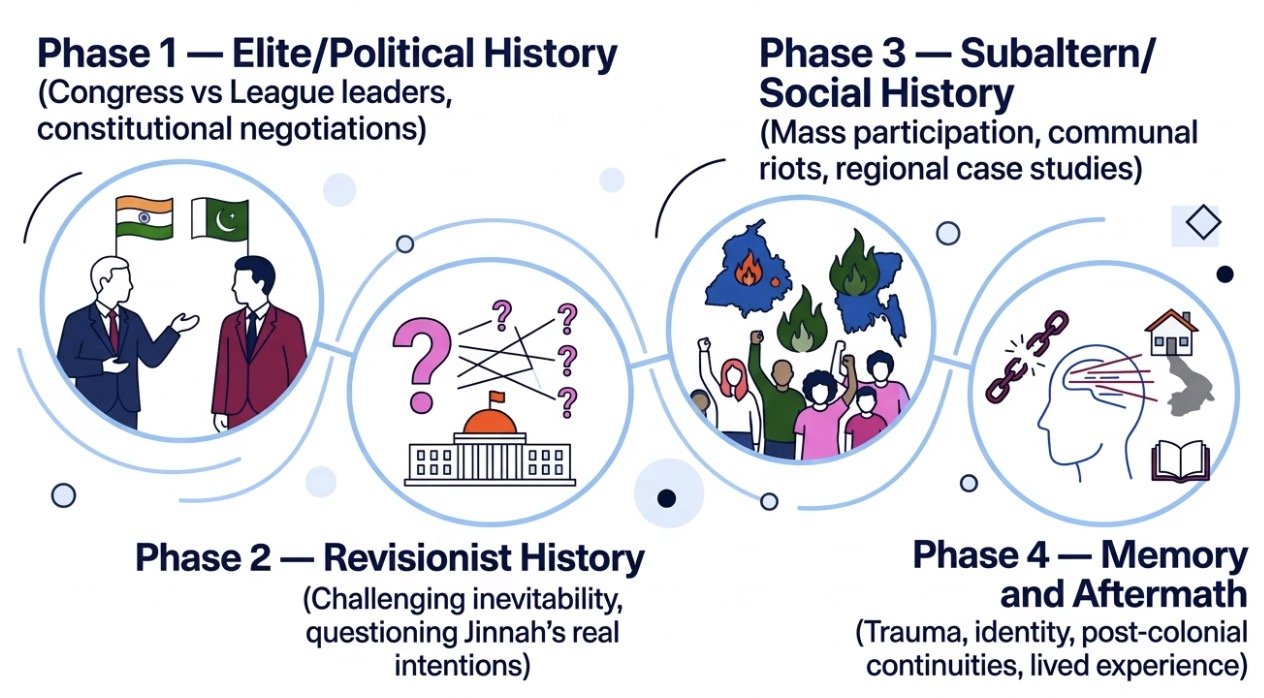
This historiographical evolution reflects broader shifts in the discipline of history itself — from high politics and constitutional history toward social history, cultural history, and eventually postcolonial studies. Each phase has generated essential insights while also exhibiting characteristic blind spots.
The Elite-Political School: Congress, the League, and the Inevitability Debate
The earliest and most dominant strand of Partition historiography focuses on the elite — the leaders of the Congress and the Muslim League as the chief architects of the subcontinent's vivisection. Within this broad category, however, there are sharp disagreements about the inevitability, legitimacy, and ultimate responsibility for Partition.
The Pakistani Nationalist School
For some Pakistani historians, Partition was a liberatory experience — a logical culmination of a long historical process beginning in the nineteenth century with Sir Sayyid Ahmed Khan's articulation of a distinct Muslim identity. Aitzaz Ahsan describes Partition as "a Primordial Divide — a Divide that is 50 years young and 5,000 years old." Akbar Ahmed argues that the concept of Pakistan was "irresistible and widespread among the Muslims," who in 1947 "forced a separation" and claimed for themselves "a separate history of their own." In this reading, Jinnah and the Muslim League are heroic protagonists of a long-delayed national awakening.
The Congress-Centric School
Sucheta Mahajan (2000) argues that Congress — despite differences in emphasis among its leaders — stood consistently for a secular, united India until the very end. In this interpretation, it was Jinnah and his Muslim League — which from 1940 began to advocate the "two-nation theory" — who were ultimately responsible for the avoidable vivisection of the subcontinent. Jinnah's alienation from the Congress began after 1937, and while he was "flexible as regards the definition and specifics of the Pakistan demand" until Britain announced its decision to quit, Partition "was always on the cards" once the League's strategy hardened. This interpretation rests on what Asim Roy has termed the "two partition myths": "The League for Partition" and "The Congress for Unity."
The Revisionist Challenge: Jalal, Roy, and Hasan
A forceful revisionist critique emerged in the 1980s and 1990s, challenging both the inevitability of Partition and the standard allocation of blame between Congress and the League. These historians brought new evidence and interpretive frameworks to bear on the question of political agency in the final years of the Raj.
Ayesha Jalal (1985)
Jalal's revisionist intervention centres on the crucial question: "How did a Pakistan come about which fitted the interests of most Muslims so poorly?" — given that 35 million Muslims remained in non-Muslim India. In her reading, the Lahore Resolution, which neither mentioned "Partition" nor "Pakistan," was Jinnah's tactical move — a "bargaining counter" to have the claim of separate Muslim nationhood accepted. Jinnah's preferred constitutional arrangement was a weak federal structure with strong provincial autonomy and Hindu-Muslim parity at the centre. His optimism was that Congress, keen on a strong unitary state, would concede his demand to avoid the more aggressive scheme of separation — which "in fact he did not really want." But this proved a miscalculation: Congress ultimately did accept Partition, and Jinnah was, paradoxically, beaten in his own game of brinkmanship.
Asim Roy
In a supportive article for Jalal, Roy makes the provocative claim that "it was not the League but the Congress who chose, at the end of the day, to run a knife across Mother India's body." However, critics have noted that this model attaches even more importance to "High Politics" than the interpretation it seeks to displace, relying too heavily on Jinnah's speculative inner intentions. Moreover, even if Jinnah initially floated Pakistan as a bargaining counter — and Sumit Sarkar accepts this — his bargaining autonomy was not unlimited once the mass mobilisation campaign began in 1944 around this emotive symbol of Muslim nationhood.
Mushirul Hasan
Hasan offers a corrective from a different angle, demonstrating that the "two-nation idea" was itself "grounded in the mistaken belief" about Muslim unanimity. At the political level, the League was as "faction-ridden and ideologically fragmented" as the Congress. At the popular level, even at the height of communal distrust, sizeable sections of the Muslim population were not reconciled to Partition and did not consider the religious divide insurmountable. Many who joined the Partition campaign were manipulated by a "highly orchestrated campaign imposed from above." In his ultimate analysis, it was the colonial government which created a Muslim community in its own image and allowed its wartime ally — the League — to transform a segmented population into a "nation."
Partition as a Mass Movement: Beyond the Elite
A significant body of regional and social history has challenged the dominant elite-centred narratives by demonstrating that the Pakistan movement — and the communal mobilisation accompanying it — involved substantial popular participation. This scholarship neither vindicates the inevitabilist Pakistani narrative nor reduces Partition to a conspiracy of leaders.
Punjab: Streets and Demonstrations
Ian Talbot has shown how in Punjab the League took the Pakistan campaign "from the drawing room on to the streets." Hundreds of thousands of Muslims celebrated various special "Days," participated in demonstrations, processions, and strikes, and finally battled in communal riots in the name of Pakistan — thus "legitimising the Muslim League's claims." The League's mass reach in Punjab, in this account, cannot be dismissed as mere manipulation from above.
Bengal: Peasant Utopia
Shila Sen and Taj Hashmi have argued that the Pakistan movement in Bengal was "mass based and democratic," successfully involving the east Bengali Muslim peasantry by offering a utopian vision of a promised land — release from the domination of the Hindu bhadralok landlord class. In the 1940s, Muslim rioters attacked Hindu adversaries with overtly political slogans such as "Pakistan ki jai," indicating considerable politicisation of the crowd along communal lines.
Hindu Mobilisation and the RSS
Christophe Jaffrelot argues that the growing popularity of the RSS in the Hindi belt was "undoubtedly linked to the circumstances of Partition." Meanwhile, Joya Chatterji (1995) has demonstrated how the Bengali bhadralok launched a campaign for the partition of Bengal and sought to involve non-bhadralok classes — including certain dalit groups in north and eastern districts who actively responded, eager to secure a foothold in the emerging power structure of post-colonial India.
Taken together, this body of regional scholarship establishes that the Pakistan movement was "hardly an elite affair anymore." The question for historians is not whether mass participation existed, but how to weigh it — whether it represents autonomous popular will, manipulated communal sentiment, or class interests finding expression in the language of religious nationalism.
Leftist Historiography and the Subaltern Turn
The left-wing and subaltern schools of Partition historiography represent two very different responses to the limitations of the elite-political paradigm. Where Bipan Chandra and the leftist school emphasise the agency and failures of Congress leadership, the subaltern historians — particularly Gyanendra Pandey — redirect attention entirely away from causation toward the lived experience of Partition's violence.
The Leftist School
Bipan Chandra and colleagues argue that Partition resulted from the surging waves of Muslim communalism since 1937 and the long-term failure of Congress to draw Muslim masses into the national movement. Congress leaders acknowledged their failure and accepted Partition as "an unavoidable necessity in the given circumstances." There is little blame here — only the tragic working-out of historical forces the movement was unable to contain.
Sumit Sarkar offers a more critical variant. For Sarkar, communalism had not yet been "normalised" in Indian public life. There was more communal harmony at the barricade lines — evidenced in popular agitations, peasant struggles, and industrial actions of the 1940s — than at the negotiating table. The Congress leadership, rather than harnessing these popular solidarities and risking another round of mass movement, accepted the "tempting alternative of an early transfer of power, with partition as a necessary price for it." For Sarkar, the communal riots from August 1946 are analytically distinct from this popular politics of the Left.
The Subaltern and Memory Schools
Gyanendra Pandey argues that conventional elite Partition historiography has been constrained by its "self-imposed aim of establishing the 'causes' of Partition." For Partha Chatterjee, the question of popular participation in Partition is itself a "non-question" — the outcome was decided by "all-India players," and it is "historically inaccurate" to suggest that the Partition campaign involved significant mass participation.
Pandey instead redirects the historical gaze to "the meaning of Partition for those who lived through it, the trauma it produced and the transformation that it wrought." In his view, the "'truth' of the partition" lay in the violence it generated. This represents a fundamental epistemological shift: not causes, but consequences; not structures, but suffering; not leaders, but ordinary lives disrupted, uprooted, and annihilated.
The Aftermath, the Memory, and the Unfinished History of 1947
The agenda of Partition historiography has significantly shifted grounds in recent decades — from its earlier preoccupation with causes and responsibility to a greater interest in the traumatic experiences, community identities, and post-colonial continuities that Partition produced. Historians are now evidently less concerned with the question of who is to blame, and more introspective about the "afterlife" or "aftermath" of Partition in South Asia.
From Causes to Consequences
Scholars now examine how Partition impacted post-colonial history and politics — how Partition memory defines community identities and affects inter-community relations across generations. 1947 is no longer treated as "the end of all history," but as a rupture whose reverberations continue to shape the subcontinent's political culture, border disputes, and communal tensions.
The Violence as Historical Truth
Pandey's insistence that the "'truth' of the partition" lay in its violence has opened a rich vein of oral history, literary analysis, and testimonial scholarship. Urvashi Butalia, Ritu Menon, and Kamla Bhasin, among others, have recovered the voices of women, refugees, and survivors — histories that conventional political narrative had rendered invisible.
The Unresolved Question
The Independence-Partition duality remains, as Bipan Chandra argued, a mirror of the national movement's own contradictions — its success in winning independence and its failure in building a fully inclusive nation. That failure was not inevitable. It was produced by specific political choices, structural constraints, and historical contingencies. Understanding it remains among the most urgent tasks of South Asian historiography.
"We have often to go through the valley of the shadow before we reach the sun-lit mountain tops." — Jawaharlal Nehru, writing to General Cariappa, 1947
The historiography of Partition is, ultimately, not merely an academic exercise. It is a sustained argument about the meaning of the modern South Asian past — about who bears responsibility for one of the twentieth century's most consequential acts of political surgery, and about what obligations that past places on the present. For students and scholars of modern South Asian history, engaging seriously with this literature is not optional: it is the very substance of the field.
