
Praja Mandal Movements in Princely States
By the middle of the 19th century, the British government had established treaty relations with most of the Princely States in India. Under British paramountcy, the internal administration of the States was left to the Princes — yet the people living under these rulers endured autocratic governance, heavy taxation, restricted civil rights, and negligible political representation. The Praja Mandal movements emerged as the organised response of these subjects, demanding democratic rights, responsible government, and integration with the broader national movement sweeping British India.
Context
The Princely States Under British Paramountcy
By the mid-19th century, the British government had established formal treaty relations with the overwhelming majority of Princely States across the subcontinent. Under the doctrine of British paramountcy, the internal administration of each state was nominally left to its ruling Prince. British Residencies were established in these states as channels of communication and, in practice, as instruments of supervision and control.
In theory, the rulers possessed absolute power within their domains. In practice, however, they were profoundly subject to the dictates of the British Resident and were entirely dependent upon the British government for both internal stability and external protection. Succession policies in the states were also effectively determined by the Resident, further curtailing the genuine autonomy of the princes.
Conditions Under the Princes
Most states were autocratically ruled with no representative institutions
Heavy taxation placed an enormous economic burden on ordinary subjects
Education and social services remained severely backward
Civil rights were systematically restricted or non-existent
State revenues were largely expended on the luxurious lifestyles of rulers
Political Inequality
Following the Government of India Acts of 1919 and 1935, subjects living under British provincial governance were granted certain political rights and participation in administration. The subjects of the Princely States, however, enjoyed no such rights — creating a stark and deeply resented inequality between two classes of Indians living under the same imperial system.
Most Princes were actively hostile and suspicious towards nationalist forces. Notable exceptions included Baroda and Mysore, which sympathised with nationalists and promoted internal reforms in administration, agriculture, and education.
Origins
The National Movement Reaches the Princely States
The onset of the nationalist movement in British India cast its influence far beyond the geographical boundaries of British-administered territory. In the first and second decades of the 20th century, many revolutionary nationalists fleeing British authority sought refuge in the Princely States, initiating political activities and awakening the consciousness of the local population.
The launching of the Non-Cooperation and Khilafat movements stirred the entire Indian population, cutting across the administrative borders that separated British India from the Princely States. Inspired by these movements, the subjects of the Princely States began to establish their own people's organisations. Such organisations were founded in Mysore, Hyderabad, Baroda, Kathiawad, Jamnagar, Indore, Nawanagar, and many other states.
The people's organisations started by the subjects of the Princely States for the purposes of the national movement were called 'Praja Mandals' or 'Praja Parishads' — and the national movement within the states became collectively known as the Praja Mandal movements.
Dual Struggle
The participants of the Praja Mandal movement fought simultaneously against their feudal princes and the British administration. Their central demand was the recognition and guarantee of democratic rights for the people of the states.
Constructive Programme
Praja Mandal activists implemented the constructive programmes of the Indian National Movement — establishing schools, promoting khadi and cottage industries, and conducting agitations against untouchability.
Popular Mobilisation
The movements succeeded in mobilising large sections of the population across hundreds of princely states, creating a mass political consciousness where none had existed under purely autocratic rule.
Organisations
Key National Movement Associations in Princely States
As the political consciousness of subjects in the Princely States deepened, several important associations and conferences were established to coordinate, represent, and advance the cause of the people's movements at regional and all-India levels.
Hitvardhak Sabha (1921)
Founded in Poona in May 1921, the Hitvardhak Sabha was established with the specific aim of addressing the problems and grievances of the people of the southern Princely States. It served as an early platform for articulating the demands of subjects in that region.
Akhil Bhor Sansthan Praja Sabha (1921)
Founded by Wamanrao Patwardhan in the Bhor region in November 1921, this Sabha was established to fight for the rights and address the specific problems of the people of the Bhor region. It represented one of the earliest locally organised people's associations in a Princely State.
All India States' People's Conference (1927)
The first session was held in Bombay in December 1927, bringing together representatives from hundreds of Princely States including Baroda, Bhopal, Travancore, and Hyderabad. It was established to encourage political dialogue on governance and the future of India. Key leaders included Balwantrai Mehta, Maniklal Kothari, and G.R. Abhayankar.
The Bombay session of 1927 was pivotal in elevating the princely states' national movement to the level of an all-India movement. It demanded responsible government and full rights of citizenship for the people of the Princely States. The Madras Session of Congress subsequently adopted these demands, lending the movement the formal backing of the national organisation.
Legislative Turning Points
The Government of India Act, 1935, and Its Impact
Two major developments in the mid-1930s brought about a radical transformation in the relations between the Princely States and British India. Together, they reshaped the political landscape and accelerated the demands for democratic representation within the states.
The Federal Scheme of 1935
The Government of India Act of 1935 projected a scheme of federation in which the Princely States were brought into a direct constitutional relationship with British India. Under this scheme, the states were to send representatives to the upper house of the Central Legislature — the Council of States. However, a critical flaw undermined the people's aspirations: all such representatives were to be nominated by the rulers of the states, rather than elected by their subjects.
This arrangement was condemned by the people's movements as it would deprive subjects of genuine representation and create a band of hand-picked loyalists to support the British Government in the Federal Legislature at any crucial moment. Furthermore, the Act gave rulers the choice to join or not join the federation, further undermining democratic representation.
The Karachi Session, 1936
The Council's Karachi Session firmly rejected the clause of the 1935 Act permitting the nomination of princes' representatives to the Imperial Legislature. It demanded that the right of electing representatives must vest in the subjects of the Princely States — not their rulers.
Congress Ministries, 1937
The acceptance of office by Congress in the majority of British Indian provinces in 1937 inspired Praja Mandal leaders to intensify their demands for responsible government in the states.
The years 1938–39 stand out as years of a new awakening across the Indian States, witnessing a large number of movements demanding responsible government and fundamental reforms.
Congress Policy
The Attitude of the Indian National Congress
The Congress first enunciated its formal policy towards the peoples' movement in the Princely States at the Nagpur Session of 1920. It called upon the Princes to grant full responsible government in their states. However, it was simultaneously clarified that while people of the states could enrol as members of the Congress, they could not initiate political activity in the states in the name of the Congress itself — they were to act through local Praja Mandals.
From the mid-1920s, Congress began taking a keener interest in the states' people's movements. In his presidential address at the Lahore Congress of 1929, Pandit Jawaharlal Nehru declared:
"The Indian States cannot live apart from the rest of India…. The only people who have a right to determine the future of the States must be the people of those States."
Nagpur, 1920
Congress first calls upon Princes to grant responsible government; states people to act through local Praja Mandals, not Congress.
Lucknow, 1936
Congress resolves that people of states deserve same rights of self-determination as rest of India; struggle to be led by state subjects themselves.
Haripura, 1938
States considered integral parts of India; Purna Swaraj demand extended to all of India including Princely States.
Tripuri, 1939
Congress passes resolution removing all restraints, formally extending support to movements in Princely States.
Gandhi explained the shift in policy in January 1939, stating that non-intervention had been wise when the people of the states were not awakened, but that the same policy would be cowardice in the face of all-round awakening and a determination to struggle for just rights. Jawaharlal Nehru was elected President of the All India States' People's Conference in 1939 at Ludhiana, a position he held until 1946, lending the movement the prestige of the foremost nationalist leader.
Post-War Developments
The Quit India Movement and the Post-War Question of Paramountcy
During the Quit India Movement of 1942, Congress formally extended its call for struggle to the people of the Princely States as well. The constitutional changes anticipated in the near future also underlined the necessity of forging an organic relationship between the Princely States and the Government of India.
In the post-World War II period, as the withdrawal of the British from India became increasingly certain, the future of the Princely States occupied the attention of national leaders. The Cabinet Mission of 1946 proposed a federal scheme for free India, observing that with the withdrawal of British power, paramountcy would cease to exist and all rights surrendered by the states to the paramount power would return to the states. Though Congress never agreed to this interpretation, several Princely States declared their intention to seek independence.
Jinnah's Position
Jinnah argued that the Indian States were sovereign entities and that no constitutional mechanism could compel them to join either Constituent Assembly. He maintained they could join a dominion only by agreement, and that British India had no authority over them. This position provided diplomatic cover to states such as Hyderabad and Travancore-Cochin that sought independence.
Nehru and Patel's Response
Nehru strongly rejected the sovereignty argument, pointing out that by no credible test could an Indian State be defined as truly sovereign. Congress pressure forced the British government to transfer the Political Department to two new State Departments of the future dominions. Sardar Patel headed India's States Department and, fortified by the support of the states' people, acted swiftly against declarations of independence by Hyderabad and Travancore-Cochin.
The Mountbatten Plan of June 1947 envisaged a division of India with the Princely States choosing their course of action. However, Mountbatten and the British government effectively ruled out independence for the states by supporting their integration into the dominions. The AICC resolution of 15 June 1947 made the position clear: no Indian State had the right to declare independence and live in isolation from the rest of India. During the weeks that followed, the ground was prepared to bring all 565 states into the Indian Union.
Regional Movement
Praja Mandal Movement in Rajkot: Background and Context
The Rajkot Satyagraha stands as one of the most dramatic episodes in the history of the Praja Mandal movements, distinguished by the direct involvement of Mahatma Gandhi and Sardar Vallabhbhai Patel, and revealing with clarity the complex interplay of popular resistance, autocratic rule, and British imperial manipulation in the Princely States.
In the 1930s, Dharmendra Singhji emerged as an autocratic ruler of Rajkot, living a life of luxury in marked contrast to his father. He was encouraged and guided by his Diwan Virawala, who concentrated power in his own hands. The state's wealth was dissipated and its finances reached a parlous condition. Monopolies for the sale of basic commodities — rice, matches, sugar, and cereals — were granted to individual merchants in exchange for payments to raise revenue. Taxes were increased, the price of rice rose steeply, and the popular assembly was allowed to lapse. All this generated profound discontent among the population.
Labour Awakening (1936)
The first blow was struck in 1936 when 800 workers in the state-owned cotton mill went on strike under a labour union organised by Jethalal Joshi, a Gandhian activist. The Durbar was forced to concede the union's demands for better working conditions.
Political Mobilisation (1937)
Encouraged by the workers' victory, Jethalal Joshi and U.N. Dhebar organised the Kathiawar Rajkiya Parishad in March 1937, demanding responsible government, reduction in taxes, and curtailment of state expenditure.
Full Satyagraha (1938)
The Parishad launched the next phase of protest in August 1938, initially against gambling, before escalating into a full-scale Satyagraha involving workers' strikes, student strikes, boycott of monopoly goods, non-payment of land revenue, and withdrawal of deposits from the state bank.
U.N. Dhebar, a Gandhian constructive worker who would later be selected by Gandhi to offer Individual Satyagraha at Viramgam in 1941, emerged as one of the main leaders in the Kathiawad region. Volunteers arrived from Mumbai and British Gujarat, and Sardar Patel maintained close contact with the Satyagrahis throughout the struggle.
Regional Movement
The Rajkot Satyagraha: Settlement, Betrayal, and Gandhi's Fast
The full-scale Satyagraha launched in Rajkot effectively blocked all sources of income for the state. The Durbar entered into a settlement with Sardar Patel on 26th December 1938, by which the Satyagraha was withdrawn and prisoners were released. Under the agreement, the Durbar committed to appointing a committee of ten state subjects or officials to formulate a scheme of reforms designed to grant powers to the people. Crucially, seven of the ten members were to be nominees of Sardar Patel.
However, the British government — which had opposed the agreement from the outset — swung into action to subvert it. After consultations at the highest levels involving the Viceroy and the Secretary of State, the Thakore Sahib was forced to repudiate the agreement, refusing to accept Sardar Patel's nominees on the spurious ground that they were exclusively Brahmins and Banias, without representation for Rajputs, Muslims, and Depressed Classes. This was a calculated attempt to create divisions amongst the people of Rajkot.
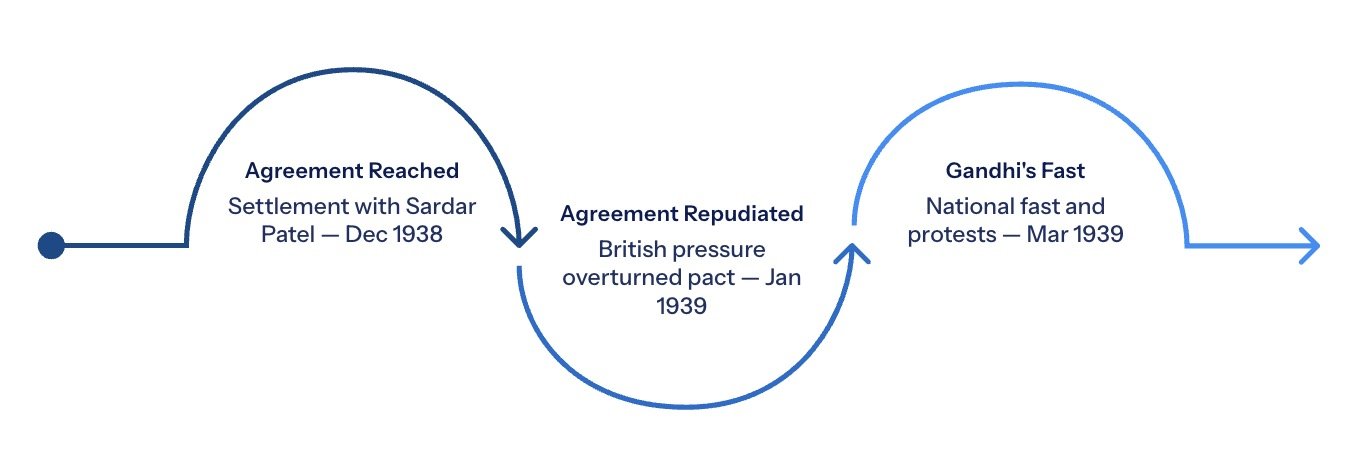
Satyagraha was resumed on 26th January 1939 and was met with heavy repression. Kasturba Gandhi, who had grown up in Rajkot, was deeply moved and proceeded to the town despite her age and frail health, accompanied by Maniben Patel. Gandhi himself then decided to proceed to Rajkot and announced an indefinite fast. The commencement of the fast triggered nationwide protests, and Congress ministries threatened resignation. The Viceroy was pressurised and, on 7th March 1939, Gandhi broke his fast after the Viceroy asked Chief Justice Sir Maurice Gwyer to arbitrate and determine whether the Thakore had violated the agreement. The Chief Justice upheld Patel's position in an award given on 3rd April.
The Durbar, egged on by Diwan Virawala, continued to promote communal and caste divisions by encouraging Muslims and Depressed Classes to put forward their separate claims, using them as a pretext to refuse to honour the agreement. Jinnah and Ambedkar then stepped in, and there were hostile demonstrations at Gandhi's prayer meetings. The British Government, having nothing to gain from a Congress victory, refused to use its influence. At this point, Gandhi chose to withdraw, releasing the Thakore from the agreement and apologising to the Viceroy and Chief Justice for what he described as a waste of their time.
Analysis
Significance of the Rajkot Satyagraha
Though the Rajkot Satyagraha ended in apparent failure, its significance extended far beyond its immediate outcome. It illuminated with unusual clarity the structural complexities of political struggle within the Princely States — complexities that distinguished such movements sharply from comparable agitations in British India.
Exposure of British Duplicity
The Rajkot struggle demonstrated that the Paramount Power was always ready to interfere in its own favour while simultaneously using the legal independence of the rulers as an excuse for non-interference whenever such non-interference served British interests. The same methods of struggle, deployed in different political conditions, often produced vastly dissimilar results.
Politicising Effect on the People
Despite its failure, the Rajkot Satyagraha exercised a tremendous politicising effect on the people of the Princely States. It awakened mass political consciousness and demonstrated to the rulers of various states the formidable power of popular resistance when properly organised.
Long-Term Impact on Integration
The demonstrations of popular will at Rajkot and elsewhere encouraged many states to opt for integration with India after Independence. The groundwork laid by the Praja Mandal movements proved essential to the relatively peaceful integration of the vast majority of Princely States into the Indian Union.
Regional Movement
Praja Mandal Movement in Hyderabad: Background and People's Councils
The State of Hyderabad was the largest Princely State in India in terms of both population and territory. Its ruler, Osman Ali Khan, bore the title of Nizam of Hyderabad. The state encompassed the Marathwada region, parts of Andhra Pradesh, and parts of Karnataka — a vast, multi-linguistic, and culturally diverse territory. The Nizam enjoyed the strong support and protection of the British administration, which shielded him from popular pressure to a considerable degree.
The Non-Cooperation Movement influenced the state's population, though the Nizam moved swiftly to crush both the Non-Cooperation and Khilafat movements in Hyderabad. Given his religious identity, he hesitated to come out openly against the Khilafat Movement and instead promoted the formation of the Ittihad ul Muslimin — an organisation premised on loyalty to the Nizam on the basis of shared Islamic faith, intended to serve as a counter to nationalist sentiment.
People's Councils Founded
Andhra Mahasabha — founded 1921 in Andhra region
Karnataka Council — founded 1921 in Karnataka region
Maharashtra Council — founded 1937 in Marathwada
These councils worked initially in the social and cultural spheres, demanding responsible political systems, expansion of private schools, and vernacular education. The press played a vital role in spreading political consciousness among the people despite state restrictions.
Role of Regional Cultural Organisations
These councils placed the problems of the people before the country despite the restrictions imposed by the state of Hyderabad. Their initial focus on social and cultural issues provided them a degree of legitimacy that the Nizam found difficult to suppress outright, and they gradually evolved into forums of political activity.
An important development was the radicalisation of the Andhra Mahasabha under Ravi Narayan Reddy, who was drawn towards the Communist Party of India and, along with B. Yella Reddy, secured the support of a large proportion of the younger cadre. This shifted the Mahasabha's focus towards peasant problems and land rights.
Regional Movement
The Hyderabad State Congress and the Freedom Struggle
The Hyderabad State Congress was founded in September 1938 by leaders of all three regional councils — the Andhra Mahasabha, the Karnataka Council, and the Maharashtra Council. Its formation marked the beginning of the first organised phase of political struggle in the state. The State Congress declared itself a secular, national organisation open to all castes and communities, with communal harmony as one of its central objectives.
The Nizam viewed the State Congress as a direct threat and promptly banned it. In October 1938, Swami Ramanand Tirtha, a Marathi-speaking Gandhian nationalist, launched a Satyagraha against the ban. Simultaneously, the Arya Samaj, Hindu Maha Sabha, and the Hindu Civil Liberty Union launched a separate Satyagraha against the religious persecution of Hindus in the state. Recognising the danger of these two movements being conflated — one political, one religious — the State Congress and Gandhi decided to suspend the political Satyagraha to keep the two issues clearly separated in the public mind.
State Congress Founded
September 1938; secular and open to all communities; immediately banned by the Nizam.
Satyagraha Launched
Swami Ramanand Tirtha leads Satyagraha against ban; political and religious movements carefully kept separate.
Vande Mataram Agitation
Students of Government College, Aurangabad, spearhead the movement to sing the national song despite the state's ban, merging the student movement with the freedom struggle.
Individual Satyagraha
In 1940, the State Congress launched Individual Satyagraha against the continuing ban. The Nizam was forced to introduce some reforms but maintained the ban until July 1946.
Key leaders in making the freedom movement strong in Hyderabad included Mukundrao Pedgaonkar, Srinivasrao Borikar, and Govindbhai Shroff, who worked tirelessly under conditions of significant state repression to sustain the movement's momentum.
Hyderabad State Congress and the Quit India Movement
When the Quit India Movement was launched by the Indian National Congress in August 1942, the Hyderabad State Congress aligned itself firmly as part of the broader national movement. It organised a massive Satyagraha throughout the state, resulting in large numbers of arrests. A notable instance saw a batch of women offer Satyagraha in Hyderabad city, during which Sarojini Naidu was arrested in connection with the agitation.
In August 1942, the State Congress placed the following formal demands before the Nizam of Hyderabad:
Responsible Government
A responsible government to be established under the Nizam, accountable to the people.
Integration with India
Integration of the State of Hyderabad with an independent India after the end of British rule.
Civil Rights
Full grant of civil rights to all the people of the State of Hyderabad without discrimination.
Removal of Ban
Removal of the ban on the Hyderabad State Congress, which had operated under prohibition since 1938.
The years 1945–46 saw the growth of powerful peasant movements in the Nalgonda district and parts of Warangal and Khammam, directed against forced labour (Vethi/Begar), illegal seizures of land, and forced grain levies imposed as part of wartime food procurement. In 1946, the All India Association of People's Council also demanded that the Nizam revoke the ban on the State Congress. By the end of the Second World War, the conditions that had emerged made the Nizam's position increasingly untenable. Finally, in July 1946, the Nizam lifted the ban on the Hyderabad State Congress.
Significance of the Rajkot and Hyderabad Movements
The cases of Hyderabad and Rajkot are instructive examples of how the methods of struggle developed and refined in British India — particularly non-violent mass civil disobedience and Satyagraha — did not possess the same viability or effectiveness when transplanted to the Princely States. The structural conditions were fundamentally different.
The absence of civil liberties and representative institutions in the Princely States meant that the political space for hegemonic, popular politics was extremely limited, even when compared to the semi-hegemonic and semi-repressive conditions prevailing under the colonial state in British India. The ultimate protection afforded by the British enabled the rulers of the states to withstand popular pressure to a considerable degree — as was demonstrated with particular clarity at Rajkot.
Tendency Towards Violent Methods
As a result of the limited effectiveness of Satyagraha in the states, there was a much greater tendency for movements in these states to resort to violent methods of agitation. This occurred not only in Hyderabad, but also in Travancore, Patiala, and the Orissa States. In Hyderabad, even the State Congress ultimately resorted to violent methods, and the Nizam could only be brought into line by the Indian Army.
Rise of the Left
The conditions in the states created a more favourable environment for the Communists and other Left groups, who had less hesitation than the Congress in resorting to violent forms of struggle. The examples of Hyderabad, Travancore, Patiala, and the Orissa States are particularly striking in this regard. The radicalisation of the Andhra Mahasabha in Hyderabad is a prime illustration.
Congress's Hesitation
The differences between the political conditions of the states and British India explain, in considerable measure, Congress's persistent hesitation to merge the movements in the states with those in British India. Political sagacity also dictated that princes should not be unnecessarily pushed into hard positions against nationalism, at least until this could be counterbalanced by the political weight of the people of the states themselves.
Praja Mandal Movement in Punjab: Origins and Context
The Punjab Riyasti Mandal was established in 1928 as an organisation of the people of the Punjab Princely States, dedicated to securing civil liberties and political rights for its subjects. Its founding must be understood against the backdrop of a dramatically contrasting political context.
In the Punjab under British administration, considerable administrative and constitutional reforms had been introduced, and a number of socio-religious reform movements had brought about significant awakening among the people. The struggle for freedom in Punjab had taken vigorous forms: agitation against the repressive Rowlatt Acts, which culminated in the Jallianwala Bagh massacre of 13 April 1919; the Gurdwara Reform movement to liberate Sikh shrines from corrupt priests supported by the British; and the violent activities of the Babar Akalis. By sharp contrast, the people in the neighbouring Indian states were entirely voiceless under the arbitrary and despotic reign of the princely rulers, with no freedom of speech or expression and no popular institutions.
Founding of the Praja Mandal
The Punjab Riyasti Praja Mandal was announced at a public conference called at Mansa, in Patiala State, on 17 July 1928. The initiative came primarily from Akali workers belonging to the Punjab states, freshly emboldened by their participation in the long struggle for Gurdwara reform.
Seva Singh Thikrivala of Patiala state, an Akali leader then still in prison, was elected president; Bhagvan Singh Laungovalia, also an Akali, was elected general secretary.
Objectives and Scope
The Praja Mandal's main objectives were:
Protection of the rights and liberties of the people of the states
The establishment of representative institutions in the states
The amelioration of the condition of the peasantry
Membership was thrown open to all adult inhabitants of the Punjab states without distinction of caste, class, or religion. The organisation's scope was extended to include all Princely States in the Punjab, Kashmir, and Shimla Hill regions, affiliated to the All India States Peoples Conference.
Punjab Riyasti Praja Mandal: Agitation, Repression, and Decline
The early activities of the Punjab Riyasti Praja Mandal focused primarily on the four Sikh states of Patiala, Nabha, Jind, and Faridkot, with the Maharaja Bhupinder Singh of Patiala as the central target. The Shiromani Akali Dal resolved to hold a series of meetings in Patiala state to secure the release of Seva Singh Thikrivala. Kharak Singh, the charismatic Akali leader, undertook a tour of the state and strongly denounced its administration. Master Tara Singh also opened a relentless campaign against the Patiala ruler.
Faced with this dual challenge, the Maharaja relented and released Seva Singh Thikrivala along with other Akali prisoners. Following his release, Seva Singh threw himself zealously into the Praja Mandal movement. The first regular session at Lahore on 27 December 1929 adopted a resolution strongly condemning the maladministration of Maharaja Bhupinder Singh.
1928
Punjab Riyasti Praja Mandal founded at Mansa, Patiala. Seva Singh Thikrivala elected president while still in jail.
1929–30
First regular session at Lahore condemns Patiala misrule. Morcha launched in Jind against enhanced land revenue and begar. Indictment of Patiala memorandum submitted to Viceroy.
1931
Third annual conference at Shimla demands deposition of Maharaja Bhupinder Singh. Patiala government issues Hidayat banning all political activity.
1933–35
Seva Singh rearrested under Hidayat provisions, sentenced to six years. He dies in solitary confinement in Patiala jail on 20 January 1935, marking the end of an important phase.
1936–45
Patiala-Akali agreement leads to weakening of Praja Mandal. Marxian influence grows among leaders. By 1945, urban Hindu leadership takes over under AISC regional council.
1946–48
Faridkot agitation marks the severest struggle. Nehru's visit on 27 May 1946 marks culmination. PEPSU formed on 15 July 1948; Praja Mandal dissolved and replaced by PEPSU Pradesh Congress.
A local leader who spearheaded the movement's final phase in Faridkot was Giani Zail Singh, who would later serve as the President of India. With the formation of PEPSU — the Patiala and East Punjab States Union, uniting Patiala, Nabha, Jind, Malerkotia, Faridkot, Kapurthala, Nalagarh, and Kalsia on 15 July 1948 — the princely regimes in Punjab ended, and the Punjab Riyasti Praja Mandal formally lapsed.
Notable Exception
The Liberal Prince of Aundh
Amidst the widespread autocracy and popular resistance that characterised the story of the Princely States, the case of Aundh stands as a remarkable exception — a vivid illustration that enlightened, progressive rule was not entirely absent from the landscape of Indian princely governance.
Balasaheb Pant Pratinidhi, the ruler of Aundh in the Deccan States Agency division of the Bombay Presidency, was a ruler of distinctly liberal and reformist convictions. His progressive actions were not merely cosmetic but represented a genuine attempt to extend self-governance to his subjects in a manner that was extraordinary for the era.
Representatives' Council
Balasaheb Pant Pratinidhi formed a Representatives' Council for his state and, crucially, allowed 50 per cent representation within the Council to the people of Aundh — a genuinely democratic gesture by the standards of any Princely State.
Legislative Powers (1926)
In 1926, he took the further step of conferring upon the Council the power to legislate and to pass resolutions — a significant transfer of authority from the ruler to a representative body, virtually unparalleled in the Princely States at that time.
Commitment to Self-Rule (1929)
In 1929, Balasaheb declared that the subjects of his state would receive the right of self-rule within the next five years. He also formed a committee to frame a constitution grounded in modern political principles — a visionary act that demonstrated his commitment to genuine democratic governance.
His work was highly appreciated by the All India Association of People's Council, which recognised Aundh as a model of what enlightened princely rule could achieve. The example of Aundh demonstrated that the demands of the Praja Mandal movements for responsible government were neither unreasonable nor impractical — and that the interests of rulers and ruled need not always be in fundamental opposition.
Key Leaders of the Praja Mandal Movements
The Praja Mandal movements were sustained and advanced by a remarkable constellation of leaders who gave their energies — and in some cases their lives — to the cause of democratic rights within the Princely States. Their diversity of background, region, and political conviction reflects the breadth and complexity of the movement.
U.N. Dhebar
A leading Gandhian constructive worker in the Saurashtra and Kathiawad region, Dhebar spearheaded the Rajkot Satyagraha and was selected by Gandhi to offer Individual Satyagraha at Viramgam in 1941.
Swami Ramanand Tirtha
A Marathi-speaking Gandhian nationalist who founded the Hyderabad State Congress in 1938 and led the Satyagraha against its banning. He remained one of the foremost leaders of the movement in Hyderabad.
Seva Singh Thikrivala
The pioneering president of the Punjab Riyasti Praja Mandal, an Akali leader who endured repeated imprisonment and died in solitary confinement in Patiala jail on 20 January 1935, becoming a martyr of the movement.
Sheikh Abdullah
In Kashmir, Sheikh Abdullah organised the people and became the central figure of popular resistance, drawing national attention to the struggle for democratic rights within the state.
Balwantrai Mehta
A key leader of the All India States' People's Conference and the Kathiawad-Saurashtra movement, Mehta was instrumental in building the organisational and political framework of the all-India states' people's movement.
Giani Zail Singh
A local leader who spearheaded the 1946 agitation in Faridkot, Punjab, Giani Zail Singh would later rise to become the President of India — a remarkable testament to the political legacy of the Praja Mandal movements.
The Praja Mandal Movements: Scale and Timeline
The Praja Mandal movements unfolded across several decades and hundreds of Princely States, gathering momentum through a series of landmark events at national, regional, and local levels. The following data illustrates key milestones and the geographic scale of the movements.
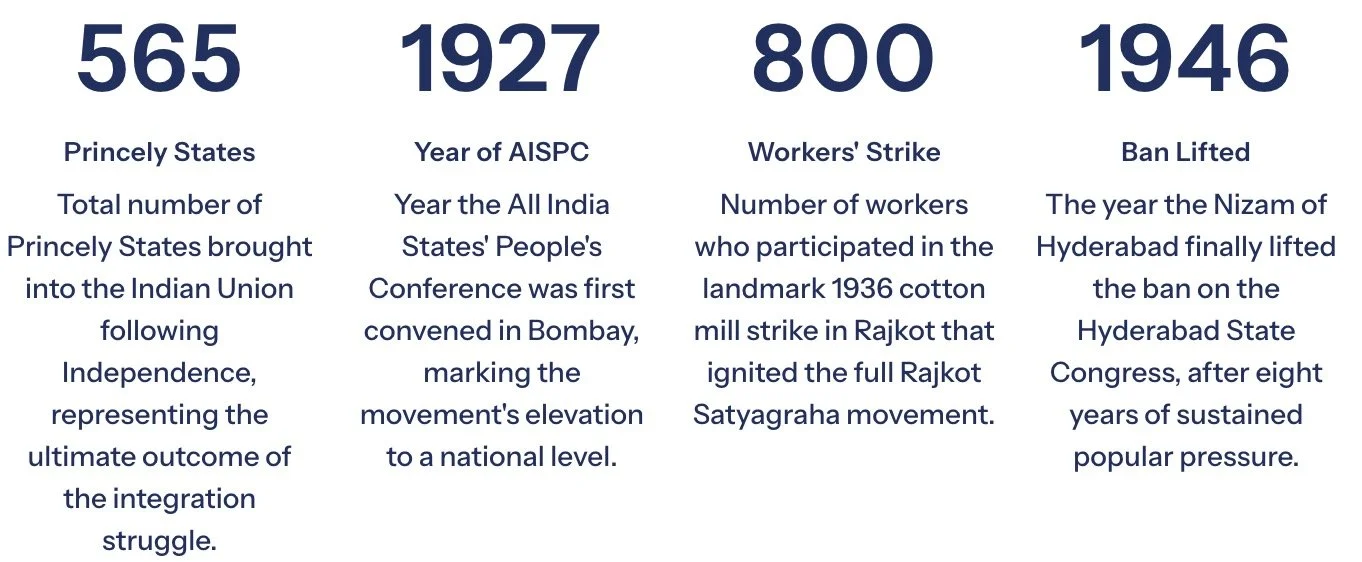
The Praja Mandal Movements: Scale and Timeline
The chart above illustrates the intensification of the Praja Mandal movements over time, with the period 1939–42 representing the peak of organised political activity — coinciding with the Quit India Movement and the formal involvement of the Indian National Congress in supporting struggles across the Princely States.
Legacy and Historical Significance of the Praja Mandal Movements
The Praja Mandal movements occupy an important yet often understated place in the broader narrative of India's freedom struggle. They extended the reach of the national movement into territories that were nominally beyond its jurisdiction, building a mass political consciousness among millions of Indians who lived under feudal autocracy rather than colonial administration. Without this groundwork, the peaceful integration of 565 Princely States into the Indian Union after Independence would have been far more difficult to achieve.
The movements demonstrated the adaptability and resilience of popular resistance, even when confronted with the double barrier of princely autocracy and British imperial protection. They also revealed the limitations of Gandhian Satyagraha in contexts where political space was far more restricted than in British India — a lesson that contributed to the diversification of political strategy and the growth of leftist and more radical formations in many states.
"The moment they became ready, the legal, constitutional and artificial boundary was destroyed." — Mahatma Gandhi, January 1939
Democratic Consciousness
The Praja Mandal movements built democratic consciousness and a sense of political rights among populations that had been entirely excluded from any form of representative governance. This proved essential to the functioning of democracy after Independence.
Integration of India
Popular pressure from Praja Mandal movements weakened the position of recalcitrant rulers and provided Sardar Patel with the moral and political authority to pursue the integration of the states firmly and decisively in 1947–48.
Ideological Diversity
The movements nurtured a wide range of political tendencies — Gandhian, socialist, communist, and liberal — that enriched the political life of independent India, particularly in regions such as Andhra, Kerala, and Punjab where leftist movements drew their initial strength from the Praja Mandal era.
Ultimately, the story of the Praja Mandal movements is the story of ordinary people in extraordinary circumstances, asserting their right to self-governance against the combined weight of feudal authority and imperial power. Their struggles, often conducted at great personal cost, helped to ensure that the India that emerged at Independence in 1947 was not merely the successor to British-administered territories, but the political home of all Indians — those from the Princely States no less than those from the provinces of British India.
