
Indian National Movement and Working Class Movements
From the first railway construction gangs of the mid-nineteenth century to the post-War strikes of 1945–47, the Indian working class charted a turbulent and transformative journey. This document traces the rise of modern industry in colonial India, the distinctive double burden of imperialist rule and capitalist exploitation faced by Indian workers, and the complex, often ambivalent relationship between the nationalist movement and organised labour. Through key episodes — the Swadeshi strikes, the founding of the AITUC, the Communist upsurge, Gandhi's trusteeship philosophy, and the Congress provincial ministries — we examine how the working class both shaped and was shaped by India's struggle for freedom.
Origins
The Birth of the Modern Indian Working Class
The beginning of the second half of the nineteenth century heralded the entry of modern industry into India. The thousands of hands employed in the construction of railways were the harbingers of the modern Indian working class — men uprooted from agrarian communities and drawn into a new, industrial mode of existence. Railways did not merely connect distant cities; they catalysed the emergence of an entirely new social formation.
Further industrialisation came swiftly in the wake of the railways. Ancillary industries multiplied along rail corridors, and the coal industry developed rapidly, employing a large working force in hazardous underground conditions. Then came the cotton mills of Bombay and Ahmedabad, and the sprawling jute industries of Bengal — each creating dense concentrations of wage labourers with shared grievances and, gradually, a shared identity.
Conditions of Labour
The Indian working class suffered from exploitation eerily similar to that witnessed during industrialisation in Europe — yet with a colonial overlay that made it distinctively severe. Workers endured:
Extremely low wages with no security of tenure
Brutally long working hours, often exceeding twelve to fourteen hours a day
Unhygienic and hazardous working conditions with no safety provisions
Widespread employment of child labour in mills and mines
Complete absence of basic amenities — clean water, sanitation, or housing
The Colonial Dimension
The presence of colonialism gave a distinctive character to the Indian labour movement. Indian workers faced two antagonistic forces simultaneously — imperialist political rule, and economic exploitation at the hands of both foreign and native capitalist classes.
This dual burden made the Indian working class movement inevitably intertwined with the broader political struggle for national emancipation — a feature that would define it for nearly a century.
Crucially, the very notion of an "Indian working class" could not exist before the notion of the "Indian people" had begun to take root. The growth of the All India working class consciousness was thus linked to the growth of the Indian National Movement and the process of the Indian Nation-in-the-making itself.
Early Nationalism
Earlier Efforts: The Moderates and the Labour Question
The early nationalists, especially the Moderates who dominated the Indian National Congress in its formative years, adopted a largely indifferent — and at times actively unhelpful — attitude towards the labour question. Their approach was shaped by a complex mixture of class interests, tactical calculations about national unity, and anxieties about the competitive position of Indian-owned industries.
Differential Treatment of Workers
The Moderates distinguished between labour employed in Indian-owned factories and those in British-owned enterprises. For the latter, nationalists had no hesitation in extending full support — as the Congress president P. Ananda Charlu put it in 1891, the foreign employer and the Indian worker were not "part and parcel of the same nation." But for Indian-owned mills, the calculation was very different.
Opposition to Factory Legislation
The early Congress leadership believed that labour legislation — such as the Factory Acts of 1881 and 1891 — would erode the competitive edge enjoyed by Indian-owned industries vis-à-vis their British counterparts. They therefore refused to support even basic protective legislation for workers, prioritising the interests of the Indian bourgeoisie over those of the working classes.
Fear of Class Division
Dadabhai Naoroji, at the very second session of the Indian National Congress (1886), made it clear that the Congress "must confine itself to questions in which the entire nation has a direct participation, and it must leave the adjustment of social reforms and other class questions to class Congresses." The overriding concern was to preserve unity in the anti-imperialist struggle.
A Dissenting Voice: The Mahratta
Not all nationalist voices were indifferent. The nationalist newspaper Mahratta, under the influence of radical thinker G.S. Agarkar, supported the workers' cause even at this early stage and asked mill owners to make concessions. This was, however, a very minor trend in an overwhelmingly moderate landscape.
The relatively lukewarm attitude of early nationalists towards labour had one overriding rationale: at this time, when the anti-imperialist movement was in its very infancy, nationalists did not wish to weaken the common struggle against British rule by creating divisions within Indian society. Thus, earlier attempts to improve workers' economic conditions were largely philanthropic — isolated, sporadic, and aimed at specific local grievances rather than systemic change.
Pioneer Figures
Pioneer Efforts in Labour Organisation: 1870–1899
Despite the indifference of mainstream nationalism, a handful of remarkable individuals made early attempts to improve the condition of workers and build organisations to represent them. These efforts, though not yet part of a coherent national movement, laid important groundwork for what was to follow.
1870 — Sasipada Banerjee
The Brahmo social reformer started a Working Men's Club and launched the newspaper Bharat Shramjeevi — one of the earliest efforts to give workers a public voice and a platform for association.
1878 — Sorabjee Shapoorji Bengalee
Tried — unsuccessfully — to get a bill providing better working conditions and limiting working hours passed in the Bombay Legislative Council. Though the bill failed, it was a pioneering legislative attempt to address labour exploitation.
1880 — Narain Meghajee Lokhanday
Started the Anglo-Marathi weekly newspaper Deenbandhu and founded the Bombay Mill and Millhands Association— an early precursor to modern trade unionism in India's most industrialised city.
1899 — GIP Railway Strike
The first strike by the Great Indian Peninsular Railways took place, receiving widespread nationalist support. Tilak's Kesari and Mahratta had campaigned for the strike for months. Public meetings and fund collections in aid of the strikers were organised in Bombay and Bengal by prominent nationalists — Pherozeshah Mehta, D.E. Wacha, and Surendranath Tagore.
The 1899 railway strike was particularly significant: since the exploiter was foreign, agitation against it acquired the character of a national issue and an integral part of the national movement. Leaders like Bipin Chandra Pal and G. Subramanya Aiyar also demanded better conditions for workers during this period, signalling a gradual shift in nationalist attitudes.
Swadeshi Era
Labour and the Swadeshi Movement in Bengal
The Swadeshi Movement of Bengal, sparked by the Partition of Bengal in 1905, marked a watershed in the relationship between nationalism and labour. Workers for the first time participated in wider political issues — a decisive shift from earlier agitation focused exclusively on economic questions. The number of strikes rose sharply, and the labour movement graduated from unorganised to organised strikes on economic issues, increasingly backed by nationalist leaders.
Key Strike Actions of 1905
Workers in jute mills, jute press factories, railway coolies and carters struck work on 16 October 1905 — the day Bengal's partition came into effect
Workers in the Burn Company shipyard in Howrah struck when refused leave to attend the Federation Hall meeting called by Swadeshi leaders
Workers struck when management objected to their singing Bande Mataram or tying rakhis as a symbol of unity
Nationalist Leadership in Labour Struggles
Swadeshi leaders organised trade unions, legal aid, fund-raising and strikes
Public meetings addressed by B.C. Pal, C.R. Das and Liaqat Hussain
Strikes organised by Ashwini Coomar Banerjee, Prabhat Kumar Roy Chaudhuri, Premtosh Bose and Apurba Kumar Ghosh
Strikes targeted government press, railways and jute industry — all controlled by foreign capital
The Swadeshi period also witnessed strikes in Tuticorin and Tirunelvelli, where Subramaniya Siva and Chidambaram Pillai led workers in a foreign-owned cotton mill, arguing that strikes for higher wages would hasten the demise of foreign mills. In Rawalpindi, arsenal and railway engineering workers struck as part of the 1907 Punjab upsurge that led to the deportation of Lajpat Rai and Ajit Singh. The biggest strike and political demonstration of this period was organised after Tilak's arrest and trial.
The Swadeshi period also saw the faint beginnings of a socialist tinge among radical nationalist leaders exposed to Marxist and social democratic ideas in Europe. The Russian workers' movement began to be cited as a model for effective political protest. The first tentative attempts to form all-India unions were also made, though these were unsuccessful. With the decline of the nationalist upsurge after 1908, the labour movement suffered an eclipse — it would revive only with the post-World War I nationalist surge, on a qualitatively higher plane.
Post-War Resurgence
Resurgence of Working Class Activity: The First World War and After
The First World War and its aftermath transformed the landscape of Indian labour politics. War brought a rise in exports, soaring prices, and massive profiteering opportunities for industrialists — but wages for workers remained abysmally low, generating intense discontent. Simultaneously, the emergence of Gandhi led to a broad-based national movement that placed workers and peasants at the centre of its mobilisation strategy.
The Strike Wave of 1918–1921
The strike movement which began in 1918 swept the country in 1919 and 1920 with extraordinary intensity. The Ahmedabad textile strike of March 1918 was led by Gandhi himself. The end of 1918 saw the first great industry-wide strike in Bombay cotton mills. By 1920, there were 119 strikes; by 1921, 152 strikes.
Railway Workers and Anti-Colonial Struggle
Between 1919 and 1921, railway workers struck repeatedly in support of the Rowlatt agitation and the Non-Cooperation and Khilafat Movement. The call for an All-India general strike by North Western Railway workers in April 1919 received enthusiastic response across the northern region. For railwaymen, Gandhi came to symbolise resistance to colonial rule itself.
International Influences
The establishment of a socialist republic in the Soviet Union, the formation of the Comintern, and the setting up of the International Labour Organisation (ILO) lent new dimensions to India's working class movement. Home Rule Leagues (1915), the Rowlatt Satyagraha (1919), and the Non-Cooperation and Khilafat Movement (1920–22) all gave further impetus to working class mobilisation.
In November 1921, at the time of the visit of the Prince of Wales, workers responded to the Congress boycott call with a countrywide general strike. In Bombay, textile factories closed and approximately 1,40,000 workers took to the streets. These industrial actions were often described as "spontaneous" movements — lacking centralised leadership, coordination, or a clear programme — something akin to a "working class jacquerie." Yet their scale and political energy were unmistakable markers of a transformed working class consciousness.
Trade Unionism
The Founding of the AITUC and the Growth of Trade Unionism
The post-War period was also the moment when Indian workers created their own national-level organisation. In 1920, there were 125 unions with a total membership of 2,50,000 — a large proportion of these formed during 1919–20. The starting point of Indian trade unionism is commonly traced to the Madras Labour Union, formed by B.P. Wadia, an associate of the Theosophist Mrs. Besant, in 1918.
Founding of AITUC
The All India Trade Union Congress was founded on 31 October 1920. Lokamanya Tilak, who had developed a close association with Bombay workers, was one of the moving spirits behind its formation.
First Leadership
Lala Lajpat Rai, the Indian National Congress president that year, was elected as the first president of the AITUC. Dewan Chaman Lal was elected as the first General Secretary.
Lajpat Rai's Vision
Lajpat Rai was the first to link capitalism with imperialism — "imperialism and militarism are the twin children of capitalism." He urged Indian labour to "organise, agitate, and educate" on a national scale and become class conscious.
Political Programme
The AITUC manifesto urged workers not only to organise themselves but also to intervene in nationalist politics. At its second session, Dewan Chaman Lal moved a resolution for Swaraj — but for workers, not capitalists.
In its early years, however, the AITUC's leaders had very limited connection with actual working class movements. The main purpose of its founding was pragmatic: to secure a nominating body for representation at the International Labour Conference at Geneva. The prominent Congress and Swarajist leader C.R. Das presided over its third and fourth sessions, and the Gaya session of the Congress (1922) welcomed its formation and created a committee to assist it. C.R. Das advocated that Congress should take up workers' and peasants' causes and incorporate them into the struggle for Swaraj — or risk isolation from the movement. Other prominent leaders who maintained close contacts with the AITUC included Nehru, Subhas Bose, C.F. Andrews, J.M. Sengupta, Satyamurthy, V.V. Giri, and Sarojini Naidu.
Gandhi and Labour
Gandhi, the ATLA, and the Philosophy of Trusteeship
Gandhi's relationship with the working class was one of the most complex and consequential dimensions of the national movement's engagement with labour. Gandhi helped organise the Ahmedabad Textile Labour Association (ATLA) in 1918, and through a protest secured a 27.5 per cent wage hike (the arbitrator's award subsequently ensured a 35 per cent raise). The ATLA was one of the largest single trade unions of the time.
"We seek not to destroy capital or capitalists but to regulate the relations between capital and labour." — Mahatma Gandhi
Gandhi's Trusteeship Philosophy
Gandhi's philosophy rested on the principle that the capitalist was the trustee of the workers' interest — not the owner of the enterprise. As Acharya J.B. Kripalani explained: "The Trustee by the very term used means that he is not the owner. The owner is one whose interest he is called upon to protect," i.e., the worker. Gandhi told Ahmedabad textile workers that they were the "real masters of the mills" and if the trustee — the mill owner — did not act in their interest, workers should offer Satyagraha.
Gandhi's Aversion to Militant Labour Politics
Gandhi's aversion to the AITUC was well known. He asked the ATLA, ever loyal to him, not to join it. He argued that "making use of labour strikes for political purposes" would be a "serious mistake." After the Chandpur tragedy in May 1921, he seriously reprimanded the Bengal Congress leadership for harnessing working class militancy to nationalism, reasoning that class war would fracture the anti-imperialist front.
Gandhi's philosophy for labour — with its emphasis on arbitration, harmony, and trusteeship — also reflected a deeper strategic need of the anti-imperialist movement, which could ill afford an all-out class war between the constituent classes of the emerging nation. At the same time, his philosophy had a genuine radical potential: by insisting that workers were the real masters of the mills, he articulated a claim that went beyond mere wage demands. Yet in practice, the Gandhian model consistently moderated working class militancy in the interests of national unity — a source of persistent tension with more radical currents in the labour movement.
State Response
Government Response to Labour: Legislation and Repression
The British Government's response to the growing labour movement was characterised by a calculated combination of limited concession and firm repression. The overarching aim was not to protect workers, but to find means of directing the labour movement into "safe channels" and the "right type of unionism."
The British Government showed some early steps through the appointment of the Bengal Committee Department in 1919–20, the Bombay Industrial Dispute Committee of 1922, and the Madras Labour Department in 1921. These were followed by the landmark Trade Union Act of 1926, which recognised trade unions as legal associations, laid down conditions for registration and regulation, and secured immunity — both civil and criminal — for trade unions from prosecution for legitimate activities. However, it simultaneously imposed special restrictions on their political activities, reflecting the Government's true objective: containment, not emancipation.
Obstacles to Trade Unionism
Employer-state collusion: workers were victimised, intimidated, coerced, and physically attacked for attempting to combine
Oversupply of labour allowed employers to easily dismiss striking workers
Goondas hired as strike-breakers were protected by local police officials
Even major unions like the Bombay Textile Labour Union and ATLA were vulnerable to employer-state pressure
Case Studies in Repression
The Madras Labour Union was temporarily crushed in 1921 by British textile magnates, the Binnys, with overt bureaucratic assistance
The TISCO management repeatedly tried to crush the Jamshedpur Labour Association (JLA) with colonial administration support
Anti-labour legislations were passed in 1934, 1938, and 1946; police were used routinely to break strikes
Communist Rise
The Rise of Communists and the Late 1920s Labour Upsurge
After 1922, there was again a lull in the working class movement, with a reversion to purely economic struggles. The next wave of working class activity came towards the end of the 1920s, spurred by the emergence of a powerful and clearly defined Left bloc in the national movement. The Communist Party of India was formally founded in 1925. Unlike socialists, Communists believed in class struggle and brought a militant, revolutionary content to the labour movement.
Workers' and Peasants' Parties (WPP)
By early 1927, various Communist groups across India had organised themselves into Workers' and Peasants' Parties (WPP), under leaders like S.A. Dange, Muzaffar Ahmed, P.C. Joshi and Sohan Singh Josh. The WPPs functioned as a left wing within the Congress and rapidly gained strength within Congress organisation.
In Bengal, the WPP organised by middle-class communists began mobilising mill workers in the Calcutta industrial belt from around 1928.
Major Communist-Led Strikes
1928: Six-month-long strike in Bombay Textile Mills led by the Girni Kamgar Union (GKU)
Communist influence spread to railways, jute mills, municipalities, paper mills in Bengal and Bombay, and the Burma Oil Company in Madras
1929: Jute mill strike gave rise to the Bengal Jute Workers' Union
1928: Serious industrial action by 26,000 TISCO workers in Jamshedpur due to rationalisation policies
1929: General strike in Calcutta jute mills involving 2,72,000 workers
The communists also utilised community ties and informal social networks to build their base. In Kanpur, the emerging communist leadership of the Kanpur Mazdoor Sabha specifically targeted Muslim workers alienated by Congress and the Arya Samaj. In Ahmedabad, the communist-dominated Mill Mazdoor Sangh drew support from Muslim workers dissatisfied with the Gandhite ATLA. The AITUC, in November 1927, took a decision to boycott the Simon Commission, and many workers participated in the massive Simon boycott demonstrations.
State Crackdown
The Meerut Conspiracy Case and the Government's Two-Pronged Attack
Alarmed at the increasing strength of the trade union movement under extremist and Communist influence, the Government resorted to a calculated two-pronged attack on the labour movement — combining repressive legislation with strategic concessions designed to split the movement and draw a section of it into a more manageable relationship with the colonial state.
Repressive Laws
The Public Safety Act (1929) and the Trade Disputes Act (TDA), 1929 were enacted. The TDA virtually banned strikes in public utility services, made individual advance notice of one month mandatory before striking, and forbade coercive or purely political trade union activity.
Meerut Conspiracy Case
In March 1929, the Government arrested 31 labour leaders. The three-and-a-half-year trial for conspiring against the King-Emperor resulted in the conviction of Muzaffar Ahmed, S.A. Dange, Joglekar, Philip Spratt, Ben Bradley, Shaukat Usmani and others. The trial gained worldwide publicity but severely weakened the working class movement.
Strategic Concessions
Simultaneously, the Government attempted to wean away a substantial section of the labour movement through concessions — most notably the appointment of the Royal Commission on Labour in 1929. This was designed to offer a legitimate outlet for labour grievances without allowing genuine working class power.
The Public Safety Bill and the Trades Disputes Act of April 1929 — which virtually banned strikes — were passed without any serious Congress opposition, a fact that reflected the INC's deep ambivalence about working class militancy. The GKU's membership collapsed from 54,000 in December 1928 to about 800 by the end of 1929 — a dramatic illustration of how government repression and Communist strategic shifts could together devastate a mass organisation. From about the end of 1928, the Communists had also reversed their policy of working within the mainstream of the national movement, leading to their isolation — both from nationalism and from large sections of the working class.
AITUC Splits
Splits in the AITUC and the Setback to Labour Unity
The late 1920s and early 1930s were marked by damaging splits within the AITUC — reflecting the ideological fault lines that ran through the Indian labour movement. These fractures significantly weakened the organised working class at a critical juncture in the national movement.
The split of 1929, in which N.M. Joshi broke away from the AITUC to form the Indian Trade Union Federation, was driven by disagreements over the independent political role of the working class. The AITUC that remained was dominated by an aggressive left wing but lacked coherence, being composed of very diverse and often competing elements. A further split in 1931 saw the Communist section form the Red Trade Union Congress.
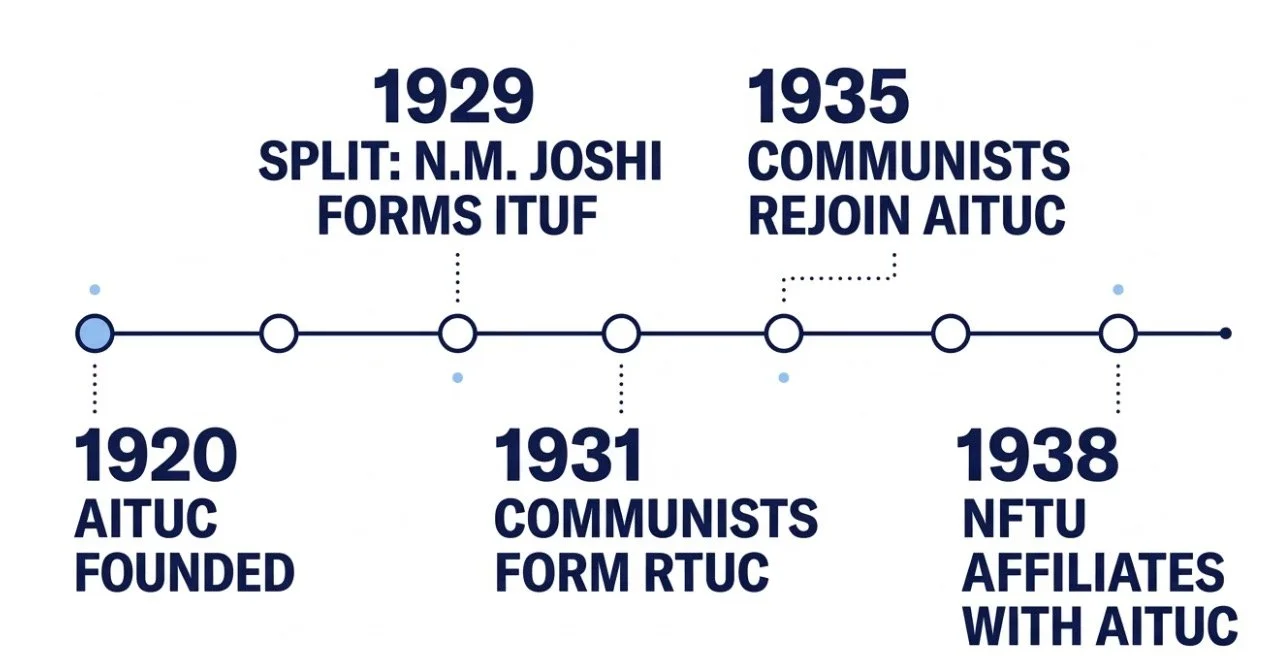
Splits in the AITUC and the Setback to Labour Unity
Recovery came gradually. There was a Communist revival around 1933–34 after the Civil Disobedience Movement was withdrawn, and the Comintern's 1935 mandate in favour of a united front strategy enabled Communists to rejoin the AITUC in 1935. By 1938 at Nagpur, the National Federation of Trade Unions affiliated itself with the AITUC, with equal representation to both sections — reuniting Indian trade unionism as a whole. The sole exception was the Textile Labour Association of Ahmedabad under Gandhist inspiration, which remained outside. The reunited AITUC now came forward with an extensive and bold economic and political programme: the establishment of a socialist state in India, and the socialisation and nationalisation of the means of production.
Congress Dilemma
The Ambivalent Attitude of the Indian National Congress Towards Labour
From its very beginning, the Indian National Congress occupied an ambivalent position vis-à-vis the working class — an ambivalence that reflected its character as a broad coalition spanning diverse class interests. The Congress was never simply a bourgeois party, nor was it ever genuinely a party of the working class. Its relationship with labour was shaped by the competing pressures of nationalist unity, capitalist funding, and the political need to mobilise workers.
The Congress and Indian vs. Foreign Capital
In the labour front, Congress could afford to be more articulate only where European capitalists were involved — such as the railways, jute mills, or tea gardens. Where Indian capitalists were affected — as in the Jamshedpur steel plants or the textile industry in Bombay and Ahmedabad — Congress consistently exerted a moderating influence. Workers were often asked to sacrifice present-day needs for the future of the nation; a strike affecting Indian business was portrayed as likely to perpetuate foreign economic domination.
Congress Leaders in the Trade Union Movement
Some leaders did participate in strikes — Gandhi in the Ahmedabad textile strike (1918), Subhas Bose in the Jamshedpur steel strike (1928–29). Others were involved in trade union organisation — V.V. Giri in Madras, Guljarilal Nanda in Ahmedabad. But their involvement was always conditioned by the overriding concern for national unity and, increasingly, by the Congress's close relationship with big business.
Workers' Conditional Allegiance
Despite sometimes organisational apathy from Congress, the working class participated overwhelmingly in the nationalist movement. Their direct participation in the Gandhian agenda was selective but significant — they often integrated nationalist agitation into their own industrial struggles and vice versa. In 1928, the Calcutta session of the Congress was taken over for two hours by 30,000 workers who passed resolutions for complete independence and a labour welfare scheme.
"Congress was not a labour organisation, but a large body comprising all manner of people." — Jawaharlal Nehru, as AITUC President, 1929
Jawaharlal Nehru's 1929 statement captures the fundamental tension. Although Congress Socialists showed greater sympathy for labour, the compulsion to remain an umbrella organisation representing all classes became the central obstacle to integrating the working classes more closely into the movement. One of the obvious results of this dilemma was the increasing influence of Communists in the labour front.
Civil Disobedience
Workers During the Civil Disobedience Movement (1930–1934)
The Civil Disobedience Movement of 1930 presented the working class with a moment of intense political choice — between the Congress call for mass agitation and the Communist policy of dissociation from nationalist politics following the Comintern's 1928 directive. The decision of the Communists to dissociate themselves from the Congress under this Comintern fiat cost Indian Communists dearly, as the Civil Disobedience movement diverted mass attention to Gandhi and the Congress.
Workers Join the Civil Disobedience Movement
The textile workers of Sholapur, dock labourers of Karachi, transport and mill workers of Calcutta, and mill workers of Madras all clashed with the Government during the movement. In Bombay, the Congress slogan was that "workers and peasants are the hands and feet of the Congress." On 6 April — the day Gandhi breached the salt law — a Satyagraha was launched by workers of the GIP Railwaymen's Union.
Integration of Economic and Political Struggle
In Chota Nagpur in 1930, workers began to wear Gandhi caps and attended nationalist meetings in thousands. By linking strikes with the nationalist movement, workers sought greater legitimacy for their own economic struggles — demonstrating how the labour movement and the independence movement reinforced each other even when their formal organisations were at odds.
Post-1931 Setback and Communist Revival
After 1931, there was a dip in the working class movement due to the further split in AITUC — the Communist section forming the Red Trade Union Congress. Communist revival came around 1933–34, after the Comintern's 1935 mandate for a united front. Communists rejoined the AITUC in 1935, and left influence in nationalist politics and the trade union movement rapidly grew again.
The workers' allegiance to Communists, as history demonstrated, was neither permanent nor unconditional. It was largely rooted in the Communists' consistent opposition to the colonial state. Once that role was reversed — as would happen again during World War II — Communist fortunes with the working class waned correspondingly. The CPI's dissociation from the Civil Disobedience Movement was an early, costly lesson in the limits of ideological loyalty when divorced from the felt needs of the working class.
Congress Ministries
Under Congress Provincial Ministries (1937–1939)
The formation of Congress provincial ministries following the 1937 elections represented both an opportunity and a test for the labour movement. Compulsions to seek labour votes forced the Congress to include in its election manifesto promises for labour welfare — including the right to form unions and go on strike. The Congress's subsequent victory aroused great enthusiasm among the working classes, as a number of trade union leaders became labour ministers in Congress cabinets.
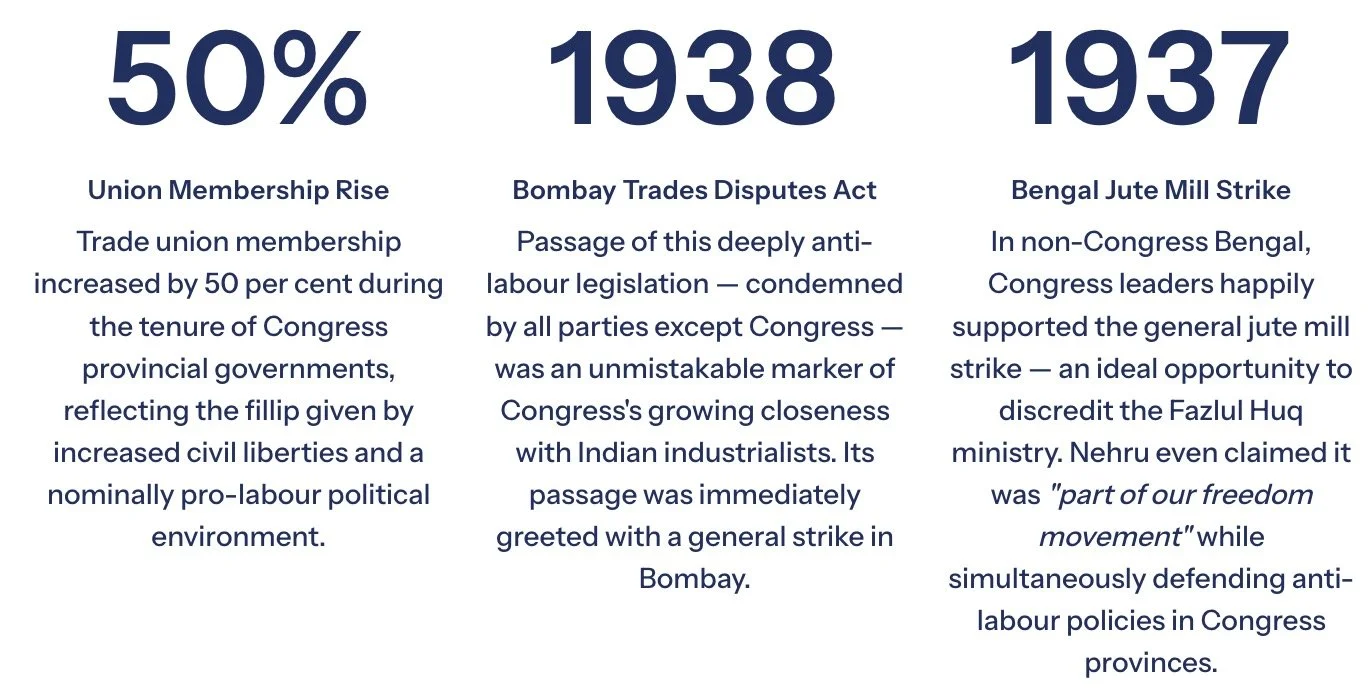
Labour Movements in India, 1937
The contradictions of the Congress's position were nowhere more visible than in the contrast between its rhetoric and its practice. In Congress provinces like Bombay, Madras and UP, Congress governments used strong-arm tactics to control industrial unrest — the same Nehru who championed the Bengal jute workers defended the mill manager's "right to dismiss a worker who does not do his work well" during the Kanpur textile strikes of 1937. The spectacular rise in industrial unrest and strikes in 1937–38 caused panic among Indian industrialists, resulting in a decisive anti-labour shift in Congress policies. The passage of the Bombay Trades Disputes Act in 1938 was an unmistakable marker of that growing friendship between Congress and capital.
Second World War
Labour During and After the Second World War
The Second World War confronted the Indian labour movement with perhaps its most severe ideological rupture. Initially, workers opposed the War: the working class of Bombay was amongst the first in the world to hold an anti-war strike on 2 October 1939. But the Nazi attack on the Soviet Union in 1941 changed the Communist position dramatically.
The Communist "People's War" Turn
The Communists argued that the War's character had changed from an imperialist war to a "people's war" and supported the Allied powers. They dissociated themselves from the Quit India Movement launched by Gandhi in August 1942 and followed a policy of industrial peace with employers to support the war effort. This reversal proved catastrophic for their mass following — their consistent opposition to the state had been the foundation of their popularity, and once that was reversed, their fortunes waned rapidly.
Workers and Quit India (1942)
Despite Communist opposition, workers across India responded to the Quit India call with strikes and hartals lasting about a week after the arrest of Gandhi and other leaders on 9 August 1942. The Tata Steel Plant was closed for thirteen days, with workers declaring they would not resume until a national government was formed. In Ahmedabad, the textile strike lasted about three-and-a-half months. In many areas, Communist rank and file actively joined the Quit India call despite the party line.
In the period 1945 to 1947, workers participated actively in the post-War national upsurges. In 1945, dock workers of Bombay and Calcutta refused to load ships taking supplies to warring troops in Indonesia. In 1946, workers went on strike in support of the Naval Ratings. The last years of colonial rule saw a remarkably sharp increase in strikes on economic issues — the All-India strike of the Post and Telegraph Department employees being the most well known. Pent-up economic grievances during the War, coupled with post-war demobilisation, high prices, food scarcity, and a drop in real wages, drove the working class to the limits of its tolerance — while the approaching dawn of independence was pregnant with expectation that all miseries would soon end.
The Scale of Labour Militancy: Key Data Points
The quantitative dimensions of the Indian labour movement reveal the remarkable scale of working class mobilisation over the colonial period — from the tentative beginnings of the 1880s to the mass strikes of the 1940s.
The data illustrates the clear correlation between periods of heightened nationalist activity and peaks in working class militancy. The years 1920–21 (Non-Cooperation), 1928–29 (Communist upsurge and rationalisation), 1937–38 (Congress ministries), and 1945–47 (post-War national upsurge) all represent waves of intensified industrial action.
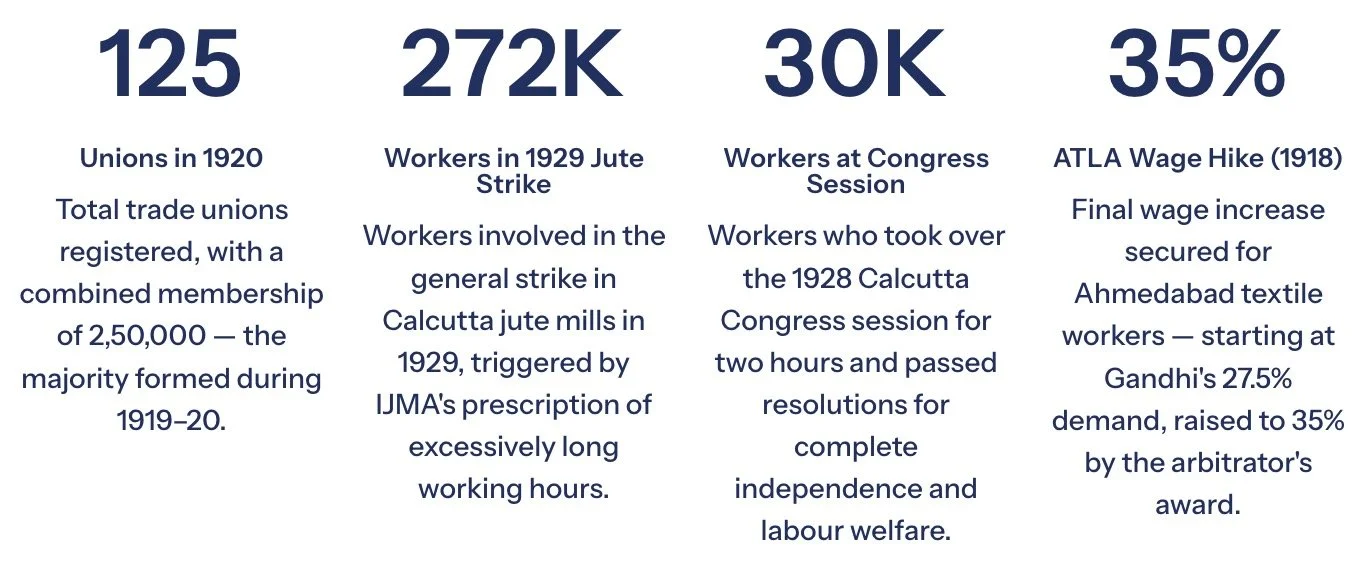
The Scale of Labour Militancy: Key Data Points
Recurring Themes and Contradictions in the Labour-Nationalist Relationship
Looking across the entire arc of the Indian working class movement from 1850 to 1947, several recurring themes and deep contradictions stand out — themes that illuminate not only the history of labour in India but also the fundamental tensions within the nationalist project itself.
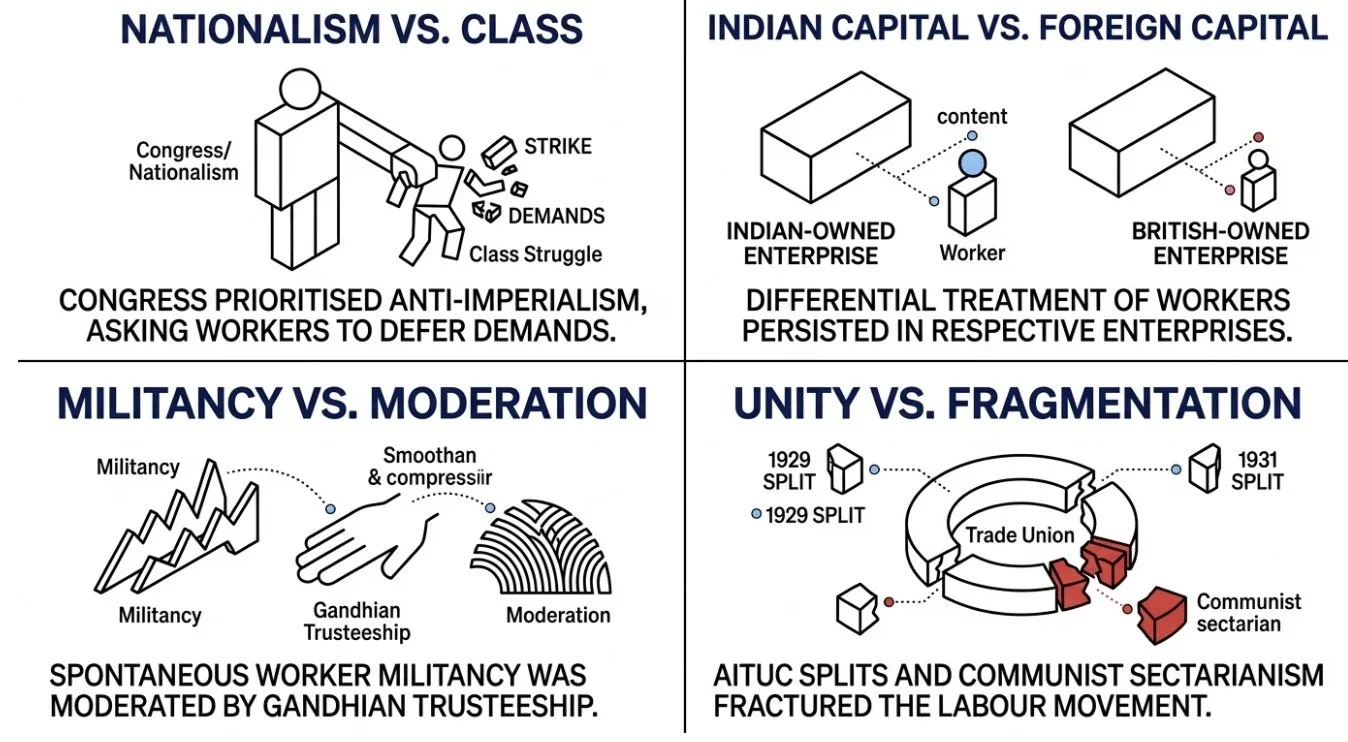
The central tension was between the demands of anti-imperialist unity and the logic of class struggle. The Congress, as an umbrella organisation, consistently asked workers to subordinate their immediate economic demands to the future promise of Swaraj. Workers often complied — but conditionally. Their support for Congress was never absolute or unconditional; it was mediated by their own experiences of exploitation, their community ties, and their assessment of which political force best served their interests at any given moment.
The Communist challenge to Congress hegemony in the labour movement reflected precisely this conditionality. When Communists consistently opposed the colonial state, they won working class support. When they reversed course — as in 1928 and again in 1942 — they lost it. The history of the Indian labour movement is, in this sense, a history of conditional allegiances — allegiances formed and dissolved in response to the shifting demands of the national struggle, the pressures of colonial repression, and the unresolved tensions at the heart of Indian nationalism itself.
Synthesis
The Historical Significance of the Working Class Movement
The Indian working class movement was far more than a series of strikes and trade union formations. It was a constitutive element of the making of modern India — shaping the national movement even as it was shaped by it. Several dimensions of its historical significance deserve emphasis.
Dual Character of Struggle
The Indian working class fought simultaneously against imperialism and against domestic capitalist exploitation. This dual struggle gave the Indian labour movement a distinctive character — simultaneously economic and political, local and national, class-specific and broadly national in its implications.
Workers as Political Subjects
Workers were never merely passive recipients of nationalist or Communist direction. They integrated political agitation into their own industrial struggles, often going beyond what their middle-class leaders were willing to sanction. Their participation fundamentally shaped the character and tempo of the nationalist movement.
The Limits of Nationalist Leadership
The history of the Congress's relationship with labour reveals the structural limits of a movement that sought to represent all classes simultaneously. The differential treatment of workers in Indian-owned versus foreign-owned industries, the recurrent appeals to sacrifice, and the anti-labour legislation of 1938 all document these limits with painful clarity.
Foundation for Post-Independence Labour
Despite repression, splits, and ideological reversals, the Indian working class movement built the institutional foundations — trade unions, labour legislation, a tradition of organised agitation — upon which independent India's labour movement would build. The AITUC, the ATLA, and the complex debates of the colonial period were the crucible in which post-independence Indian labour politics was forged.
"Workers were neither unresponsive to, nor dissociated from the nationalist or leftist politics organised by educated middle-class politicians; but their support was conditional, not absolute."
Key Takeaways
This document has traced the development of the Indian working class movement from the mid-nineteenth century to the eve of independence in 1947. The following are the essential points for examination and further study.
Origins in Industrialisation
Modern Indian working class emerged from railway construction and ancillary industrialisation. Workers faced exploitation similar to Europe but with the added burden of colonial rule — creating a dual struggle against imperialism and capitalism.
Early Nationalist Indifference
The Moderate Congress was largely indifferent to labour, feared class division, and opposed Factory Acts. Only scattered philanthropic efforts (Banerjee, Lokhanday) existed before the Swadeshi period.
Swadeshi as Watershed
The Swadeshi Movement (1905–08) saw workers enter wider political struggles for the first time. Strikes became organised and nationalist-supported, especially in foreign-controlled industries. Faint socialist ideas emerged.
Post-War Upsurge and AITUC
1918–1922 saw a massive strike wave and the founding of the AITUC (1920). International influences (Soviet Union, ILO, Comintern) reshaped the movement. Gandhi's Ahmedabad model offered an alternative to militant trade unionism.
Communist Challenge and State Repression
Late 1920s saw Communist-led militancy (GKU, WPP), massive strikes, and the Meerut Conspiracy Case (1929). The government used both repression and concession. AITUC splits (1929, 1931) severely weakened labour unity.
Congress Ambivalence and War Years
Congress remained ambivalent — pro-labour in rhetoric, pro-capital in practice. Congress ministries (1937–39) brought a brief fillip followed by anti-labour legislation. During WWII, Communist support for the "People's War" alienated workers, while Quit India saw broad working class participation.
Key Figures to Remember: Sasipada Banerjee · N.M. Lokhanday · B.P. Wadia · Lala Lajpat Rai · Dewan Chaman Lal · S.A. Dange · Muzaffar Ahmed · C.R. Das · N.M. Joshi · Subramaniya Siva · Chidambaram Pillai · V.V. Giri · Guljarilal Nanda
Key Organisations: AITUC (1920) · Madras Labour Union (1918) · ATLA (1918) · Girni Kamgar Union · Workers' and Peasants' Parties · Indian Trade Union Federation · Red Trade Union Congress
Key Legislation: Factory Acts (1881, 1891) · Trade Union Act (1926) · Public Safety Act (1929) · Trade Disputes Act (1929) · Bombay Trades Disputes Act (1938)
