
Nationalism and the Peasant Movements
The impoverishment of the Indian peasantry during the colonial era was not accidental — it was the structural outcome of deliberate economic policies that dismantled traditional agrarian societies and replaced them with systems of extraction and control. From the ruin of handicrafts to punishing land revenue demands, from moneylender bondage to landlord tyranny, the Indian peasant bore the heaviest burden of colonial rule.
Beginning with the root causes of peasant impoverishment, it traces the trajectory of major peasant movements from the 1920s through to the eve of Independence — exploring the Kisan Sabha and Eka movements, the Mappila Revolt, the Bardoli Satyagraha, the formation of the All India Kisan Sabha, regional mobilisations across Bihar, Andhra, Kerala, Punjab and beyond, and the post-war upheavals of Tebhaga and Telangana. It concludes with a comprehensive assessment of these movements' achievements and limitations, and their lasting imprint on independent India's agrarian reforms.
Chapter 1 — Roots of Agrarian Crisis
The Colonial Transformation of Agrarian India
The impoverishment of the Indian peasantry was no accident of fate — it was a direct consequence of the systematic transformation of India's agrarian structure under colonial rule. Three interlocking forces drove this transformation: colonial economic policies that destroyed indigenous industries, the imposition of an entirely new land revenue architecture, and a colonial administrative and judicial apparatus that consistently served the interests of the state and landlord over the cultivator.
The ruin of Indian handicrafts, a deliberate by-product of British industrial interests, forced millions of artisans back onto the land, causing a severe overcrowding of agriculture. With more hands competing for limited cultivable land, the bargaining power of the peasant collapsed entirely. In Zamindari areas — particularly across Bengal, Bihar and parts of Uttar Pradesh — the Permanent Settlement of 1793 had entrenched a class of rent-collecting intermediaries whose interests were structurally opposed to those of the actual tiller. Peasants faced high rents, illegal levies, arbitrary evictions, and demands for unpaid labour with no legal recourse. In Ryotwari areas such as Madras and Bombay, there was no landlord buffer — the colonial government directly levied heavy land revenues on individual cultivators, leaving little surplus for subsistence.
Crushed between the revenue demand of the state and the exactions of landlords, the overburdened farmer had only one avenue left: the local moneylender. Charging usurious rates of interest and accepting mortgages on land, cattle, and household goods, moneylenders steadily absorbed the peasant's assets. When mortgaged property was seized — which it often was — the peasant's slide from smallholder to tenant-at-will to share-cropper to landless labourer became irreversible. Over wide swathes of rural India, the actual cultivator became a stranger to the land he tilled.
Handicraft Ruin
Deindustrialisation pushed artisans onto land, causing overcrowding and depression of wages and rent bargaining power.
New Land Revenue
Permanent Settlement and Ryotwari systems extracted maximum revenue, leaving little surplus for the cultivating peasant.
Moneylender Bondage
Usurious interest rates and mortgage seizures gradually dispossessed cultivators, reducing them to tenants and labourers.
Colonial Legal System
Administrative and judicial structures consistently prioritised state and landlord interests over peasant rights and grievances.
Faced with intolerable conditions, the peasants did not remain passive. They resisted exploitation through organised protest, social boycotts, and at times through crime — robbery, dacoity, and what historians have called "social banditry." Peasant discontent against established authority was a recurring feature of nineteenth-century India. But in the twentieth century, something qualitatively new emerged: peasant movements became deeply intertwined with the organised national freedom struggle, each feeding and shaping the other in ways that would leave a permanent mark on India's political landscape.
Chapter 2 — Movements of the 1920s
The Kisan Sabha Movement and the Awakening of Awadh
The Kisan Sabha movement of the early 1920s stands as one of the most significant early examples of organised peasant resistance in colonial India, rooted in the fertile but deeply exploited plains of Awadh in the United Provinces. Following the annexation of Avadh in 1856 and the aftermath of the 1857 revolt, the Awadh Taluqdars had recovered their lands and spent the second half of the nineteenth century consolidating their grip over agrarian society. By the early twentieth century, the majority of cultivators in the region were subjected to high rents, summary evictions (bedakhali), illegal levies, and renewal fees known as nazrana. The high prices of food and necessities accompanying and following World War I rendered this oppression almost impossible to bear.
Mainly through the efforts of Home Rule activists, Kisan Sabhas were organised across UP. The UP Kisan Sabha was formally established in February 1918 by Gauri Shankar Mishra and Indra Narayan Dwivedi, with support from Madan Mohan Malaviya. By 1919, the first signs of grass-roots peasant mobilisation appeared in reports of nai-dhobi bands — a form of social boycott organised by panchayats to deprive landlords of the services of barbers and washermen. This movement was led by Baba Ramchandra, a sanyasi who had earlier served as an indentured labourer in Fiji, and whose experience of exploitation gave him a unique understanding of peasant suffering. By June 1919, the UP Kisan Sabha had 450 branches across the region.
In June 1920, Baba Ramchandra urged Jawaharlal Nehru to visit the affected villages. These visits proved formative for Nehru, enabling him to develop a close and enduring connection with rural India. The Kisan Sabha at village Roor in Pratapgarh became a nerve centre of activity, with approximately one lakh tenants registering complaints on payment of one anna each. In October 1920, differences within the nationalist ranks — between the Non-Cooperators and constitutional agitators like Malaviya — led to the formation of the Awadh Kisan Sabha in Pratapgarh. This body successfully united grassroots Kisan Sabhas across Awadh under a common banner.
The Awadh Kisan Sabha's programme was radical for its time: it asked kisans to refuse to till bedakhali land, to withhold hali and begar (unpaid labour), to boycott non-complying landlords, and to resolve disputes through panchayats. By January 1921, the movement had escalated from meetings and mobilisation to the looting of bazaars, granaries, and clashes with the police — primarily in Rai Bareilly, Faizabad, and Sultanpur. At this peak, it was virtually impossible to distinguish a Non-Cooperation meeting from a peasant rally in Awadh. The movement eventually declined under government repression and with the passage of the Awadh Rent (Amendment) Act.
The Eka Movement: Unity Against Oppression
Towards the end of 1921, peasant discontent resurfaced in the northern districts of the United Provinces — Hardoi, Bahraich, and Sitapur. This new wave of agitation came to be known as the Eka, or Unity Movement, and it addressed a specific cluster of grievances that had not been resolved by earlier mobilisation. Rents in these districts ran as much as fifty per cent higher than the officially recorded rates, the revenue collection system was in the hands of oppressive thikedars, and the pervasive practice of share-rents left cultivators with precious little after the harvest was divided.
The Eka Movement was distinguished by its deeply symbolic character. Meetings were opened with a religious ritual in which assembled peasants collectively took an oath — they vowed to pay only the recorded rent and to pay it on time; to refuse to leave when evicted; to withhold forced labour; to give no assistance to criminals; and to abide strictly by panchayat decisions. This oath-taking ceremony transformed the movement from a mere protest into a moral compact, binding participants together with a sense of collective duty and honour.
Crucially, the grassroots leadership of the Eka Movement came not from upper-caste nationalists but from Madari Pasi and other low-caste leaders, along with many small zamindars. This gave the movement a distinctive social character, drawing together communities that were usually kept apart by the caste hierarchy. By March 1922, however, severe repression by the colonial authorities brought the movement to an end, demonstrating once again the narrow limits within which peasant protest could operate under colonial rule.
Key Grievances
Rents 50% above recorded rates
Oppressive thikedars in revenue collection
Practice of share-rents leaving minimal surplus
The Eka Oath — Peasants Vowed To:
Pay only the recorded rent, on time
Refuse to vacate when evicted
Withhold forced labour entirely
Give no help to criminals
Abide by panchayat decisions
The Mappila Revolt: Agrarian Grievance and Communal Crisis
In August 1921, the simmering peasant discontent in the Malabar district of Kerala exploded into one of the most dramatic and tragic revolts of the decade. The Mappila (Muslim) tenants of Malabar rebelled against their landlords — predominantly Hindu jenmies — driven by decades of accumulated grievances: lack of any security of tenure, burdensome renewal fees, high rents, and a range of oppressive landlord exactions. Such resistance was not entirely new — there had been earlier instances of Mappila resistance to landlord oppression in the nineteenth century — but what erupted in 1921 was of an entirely different scale and intensity.
The movement's initial impetus came from the Malabar District Congress Conference held at Manjeri in April 1920, which, in a significant break from earlier Congress caution, publicly supported the tenants' cause and demanded legislation to regulate landlord-tenant relations. The conference was followed by the formation of tenants' associations at Kozhikode and subsequently across the district. Simultaneously, the Khilafat Movement was sweeping through Malabar, and the two streams — Khilafat agitation and tenant mobilisation — became virtually indistinguishable. The same leaders addressed both types of meetings, and the same audience attended both. National leaders including Gandhi, Shaukat Ali, and Maulana Azad addressed Mappila meetings during this period.
The situation deteriorated sharply in August 1921 when the arrest of a prominent priest-leader, Ali Musaliar, sparked large-scale riots. Initially, the targets were symbols of British authority — courts, police stations, treasuries — and unpopular landlords. But once the British declared martial law and repression began in earnest, the character of the rebellion underwent a disturbing change. With many Hindus perceived as collaborating with the authorities, what had begun as an anti-government and anti-landlord uprising acquired communal overtones. The communalisation of the movement completed the isolation of the Mappilas from the broader Khilafat–Non-Cooperation Movement. By December 1921, all resistance had been crushed. The militant Mappilas were so thoroughly demoralised that their participation in any form of organised politics remained almost nil until Independence.
The Mappila revolt illustrates a recurring dilemma of the 1920s peasant movements: the moment agrarian protest turned violent or communal, national leaders distanced themselves, and government repression intensified — exposing the fragility of the alliance between peasant and nationalist politics.
The Bardoli Satyagraha: A Model of Disciplined Resistance
The Bardoli Satyagraha of 1928 occupies a special place in the history of Indian peasant movements — not only for its success but for the model of organised, disciplined, and non-violent resistance it provided to the broader nationalist movement. The Bardoli taluqa in Surat district had already witnessed intense politicisation in the wake of Gandhi's emergence on the national scene. When the colonial authorities announced a 30 per cent increase in land revenue assessments in January 1926, Congress leaders immediately protested and constituted a Bardoli Inquiry Committee to examine the hike. The committee found the enhancement entirely unjustified — a finding that gave the peasants a powerful and credible platform from which to resist.
In February 1926, Vallabhbhai Patel was called to lead the movement. Under his stewardship, the Bardoli peasants resolved that they would refuse to pay the revised assessment until the government either appointed an independent tribunal or accepted the current payment as sufficient. Patel's organising genius was evident in the infrastructure he constructed: 13 chhavanis (workers' camps) were set up across the taluqa, the Bardoli Satyagraha Patrika was launched to shape public opinion, and an intelligence wing was established to ensure that tenants adhered to the movement's resolutions. Those who broke ranks faced social boycott. Special emphasis was placed on the mobilisation of women — a feature that would come to be associated with Patel's methods. Prominent legislators K.M. Munshi and Lalji Naranji resigned from the Bombay Legislative Council in solidarity.
By August 1928, the tension in Bardoli had reached a critical pitch, with the prospect of a sympathetic railway strike in Bombay adding to the government's anxiety. Gandhi himself arrived at Bardoli to stand ready in case of emergency. The government, seeking a graceful exit, eventually conceded. A subsequent inquiry recommended a revenue increase of only 6.03 per cent — a resounding vindication of the peasants' demands. It was the women of Bardoli who gave Vallabhbhai Patel the title he would carry for the rest of his life: Sardar.
January 1926
Authorities announce 30% land revenue hike; Bardoli Inquiry Committee finds enhancement unjustified.
February 1926
Vallabhbhai Patel assumes leadership; 13 worker camps established; Satyagraha Patrika launched.
August 1928
Tension peaks; Gandhi arrives; government seeks withdrawal with face-saving inquiry.
Final Outcome
Inquiry recommends only 6.03% rise; peasants vindicated; Patel earns the title "Sardar."
Chapter 3 — Movements of the 1930s
The Great Depression, the CDM, and the Radicalisation of Peasant Politics
The 1930s witnessed a qualitative transformation in India's peasant movements. Two exogenous shocks combined to deepen agrarian distress and radicalise political consciousness simultaneously. The Great Depression of 1929 devastated agricultural prices across the world, and Indian cultivators — whose revenues were fixed in money terms while the value of their produce collapsed — found themselves in an unprecedented crisis of debt and dispossession. Simultaneously, the Civil Disobedience Movement (CDM) launched by Gandhi provided the organisational and ideological framework within which agrarian protest could be channelled into the national freedom struggle.
The CDM took the form of no-rent and no-revenue campaigns in many regions. In UP, a no-revenue campaign quickly converted into a no-rent campaign. Bihar and Bengal saw movements against the Chowkidari Tax — a perverse arrangement by which villagers were compelled to pay for the upkeep of their own oppressors. Surat and Kheda witnessed no-tax campaigns, Punjab saw no-revenue agitation, Forest Satyagrahas defying colonial forest laws spread across Maharashtra, Bihar, and the Central Provinces, and anti-zamindari struggles swept through Andhra. The geographic breadth of this agitation was remarkable, demonstrating that the structural conditions of peasant oppression were pan-Indian rather than localised.
The CDM also brought into the forefront the leftist leadership of figures like Jawaharlal Nehru and Subhas Chandra Bose, who were committed to connecting the national and agrarian struggles. The formation of the Congress Socialist Party (CSP) in 1934 proved especially significant. The CSP provided a legal framework within which Communists could work openly alongside Congress activists, and the consolidation of left forces that resulted gave a decisive push to efforts to build an all-India peasant body. These efforts — driven particularly by N.G. Ranga and other Kisan leaders — culminated in the establishment of the All-India Kisan Congress in Lucknow in April 1936, which later changed its name to the All India Kisan Sabha. The first session was personally greeted by Jawaharlal Nehru, signalling the movement's deep integration with the national mainstream.
The All India Kisan Sabha: Organisation, Manifesto, and Confrontation
The All India Kisan Sabha (AIKS), founded on 11 April 1936 at the Lucknow session of the Indian National Congress, represented the most ambitious attempt to coordinate India's diverse peasant movements under a single national body. Swami Sahajanand Saraswati was elected as its first president and N.G. Ranga as its general secretary — a pairing that united the Bihar-based Kisan movement with the South Indian peasant organisations that Ranga had been building for years. The founding membership brought together a remarkable constellation of leaders: Namboodiripad, Karyanand Sharma, Yamuna Karjee, Yadunandan Sharma, Rahul Sankrityayan, P. Sundarayya, Ram Manohar Lohia, Jayaprakash Narayan, Acharya Narendra Dev, and Bankim Mukherjee.
At its second session held at Faizpur in Maharashtra alongside the Congress session, the AIKS adopted a comprehensive Kisan Manifesto that would significantly influence the Congress's own agrarian programme. The Faizpur Congress incorporated demands for a fifty per cent reduction in land revenue and rent, a moratorium on debts, abolition of feudal levies, security of tenure for tenants, a living wage for agricultural labourers, and the recognition of peasant unions. The Kisan Manifesto released in August 1936 went further, demanding the abolition of the zamindari system and the cancellation of rural debts — demands that would eventually find their way into post-Independence legislation, however circuitously.
The years 1937–39, following the formation of Congress Ministries in most provinces, represented the high-water mark of the peasant movement. Political conditions were transformed: civil liberties expanded, a new sense of popular ownership of power spread through the countryside, and expectations ran high that "our own people" in government would deliver meaningful reform. The different Congress Ministries introduced varying kinds of agrarian legislation — for debt relief, restoration of lands lost during the Depression, and security of tenure for tenants. This legislative activity, even when partial and inadequate, provided a constant impetus for peasant mobilisation either in support of proposed laws or in demand for stronger measures. Chief forms of mobilisation included Kisan conferences and meetings at the thana, taluqa, district, and provincial levels.
Kisan Manifesto Demands (1936)
50% reduction in land revenue and rent
Moratorium on rural debts
Abolition of feudal levies and begar
Security of tenure for tenants
Living wage for agricultural labourers
Recognition of peasant unions
Abolition of zamindari system
Growing Rift with Congress (1937–39)
Right-wing Congress leaders realigned with landlords on Bakasht land issue
Tenancy legislation watered down under landlord pressure in UP and Bihar
Militant 1938–39 movement for restoration of Bakasht land
AIKS adopted red flag in October 1937; denounced class collaboration in 1938
Haripura Session (1938) restricted Congressmen from joining Kisan Sabhas
The relationship between the AIKS and the Congress progressively deteriorated. When proposed tenancy legislation was diluted under landlord pressure, particularly over the question of Bakasht land — occupancy tenancies that zamindars had converted into short-term arrangements during the Depression — the AIKS launched a militant movement to demand restoration. In 1938, at its annual conference, the AIKS denounced the Gandhian principle of class collaboration and proclaimed agrarian revolution as its ultimate goal. By May 1942, with the Communist Party of India having taken over the organisation, the AIKS adopted the CPI's "People's War" line and controversially stayed away from the Quit India Movement — a decision that cost it both its popular base and several of its most prominent founders.
Regional Peasant Movements: Bihar and Punjab
The most sustained and institutionally robust regional Kisan movement of the 1930s developed in Bihar, under the founding leadership of Swami Sahajanand Saraswati. Saraswati had established the Bihar Provincial Kisan Sabha (BPKS) in 1929, initially with the aim of mobilising peasant grievances against zamindari attacks on occupancy rights. He was joined by Karyanand Sharma, Yadunandan Sharma, Rahul Sankrityayan, Panchanan Sharma, and others who would give the Bihar movement its intellectual and organisational depth. Initially, the BPKS was conceived as a vehicle for class harmony — to ensure that landlord-tenant friction would not damage the unity of the national movement. But by 1933, the movement had come under socialist influence, and by 1935 it had adopted the abolition of zamindari as a programme demand.
The BPKS used mass meetings, conferences, and demonstrations with increasing audacity. The demonstration of one lakh peasants in Patna in 1938 was a landmark event. The central demand around the Bakasht land issue brought the BPKS into sharp conflict with the Bihar Congress Ministry, which had yielded to landlord pressure. The movement was eventually suppressed by a combination of concessions, legislation, and the arrest of approximately 600 activists by August 1939 — though it resumed in pockets in 1945 and continued until zamindari was finally abolished.
In Punjab, peasant mobilisation had earlier roots in the Punjab Naujawan Bharat Sabha, the Kirti Kisan Party, and the activities of Congress and Akali activists. The Punjab Kisan Committee, formed in 1937, gave these diverse streams new cohesion. Kisan workers toured villages enrolling members, organising meetings, and mobilising for provincial conferences addressed by national leaders. The movement's main demands related to the reduction of taxes and a moratorium on debts, with the primary targets being the feudal landlords of western Punjab who dominated the Unionist Ministry. Particular flashpoints included the resettlement of land revenue in Amritsar and Lahore, and increases in water rates in canal colonies of Multan and Montgomery. In the princely state of Patiala, the muzara (tenant) movement — led by Left leaders like Bhagwan Singh Longowalia and Teja Singh Swatantar — refused to pay batai (share rent) to biswedars (landlords), a struggle that continued until 1953 when legislation enabled tenants to become owners of their land.
Regional Peasant Movements: Kerala and Andhra
In the Malabar region of Kerala, the peasant movement of the 1930s was substantially reorganised and deepened by the activities of Congress Socialist Party (CSP) activists. Numerous Karshak Sanghams (peasant organisations) came into existence across the region. The demands around which this movement cohered were specific and practical: abolition of feudal levies (akramapirivukal), renewal fees (policceluthu), advance rent, and an end to eviction of tenants on the pretext of personal cultivation by landlords. Peasants also demanded a reduction in the tax, rent, and debt burden, and the use of proper measures when landlords measured grain rents — a detail that speaks to the micro-level corruption embedded in the system.
A particularly effective form of mobilisation in Malabar was the jatha — large groups of peasants marching to the houses of prominent jenmies (landlords), placing their demands before them, and securing immediate redressal. The jatha combined the moral force of collective witness with the practical pressure of public accountability. A significant campaign in 1938 demanded amendment of the Malabar Tenancy Act of 1929; the 6th of November 1938 was observed as Malabar Tenancy Act Amendment Day, with uniform resolutions passed at meetings across the district.
The Andhra movement was shaped decisively by the figure of N.G. Ranga, who had set up the India Peasants' Institute in his home village in Guntur district in 1933 and organised major marches of peasants in 1933–34. The landmark moment was the Provincial Kisan Conference march of 1938: over 2,000 kisans marched more than 1,500 miles over 130 days, starting from Itchapur in the north, covering nine districts, holding hundreds of meetings attended by lakhs of peasants, and collecting over 1,100 petitions. These were formally presented to the provincial legislature in Madras on 27 March 1938. The demand for debt relief was incorporated into legislation passed by the Congress Ministry. The Andhra movement was also notable for its Summer Schools of Economics and Politics for peasant activists, and for the creative use of peasant songs and the celebration of "Kisan Days" as forms of cultural mobilisation.
The Andhra March of 1938: A Visual of Scale
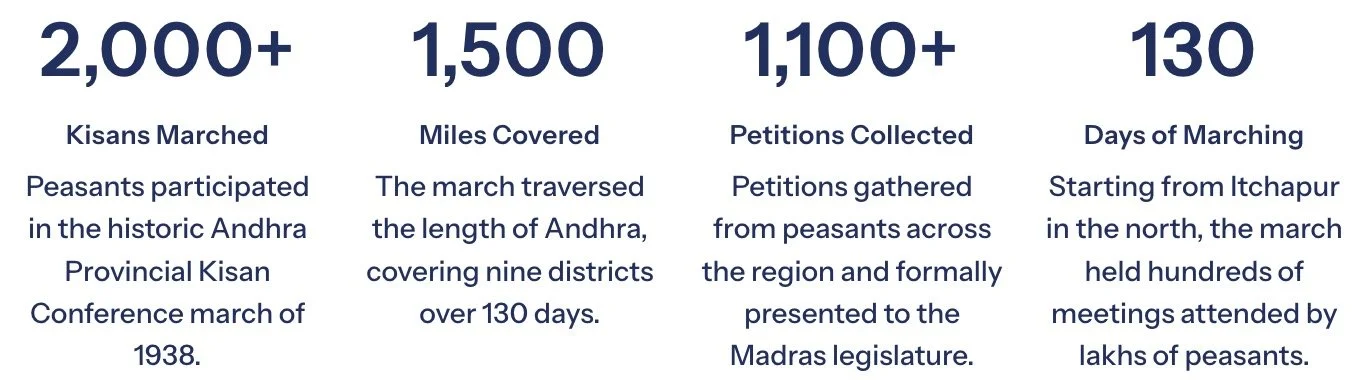
The 1938 Andhra march remains one of the most striking examples of mass peasant mobilisation in colonial India's history. Its sheer geographic scale — encompassing nine districts over four months — demonstrated that peasant consciousness in Andhra had reached a level of organisation and determination capable of sustaining a sustained, disciplined political campaign. The formal presentation of petitions to the provincial legislature transformed a social movement into a constitutional intervention, anticipating the methods of post-Independence democratic politics.
Regional Peasant Movements: Bengal, Assam, Orissa, and Beyond
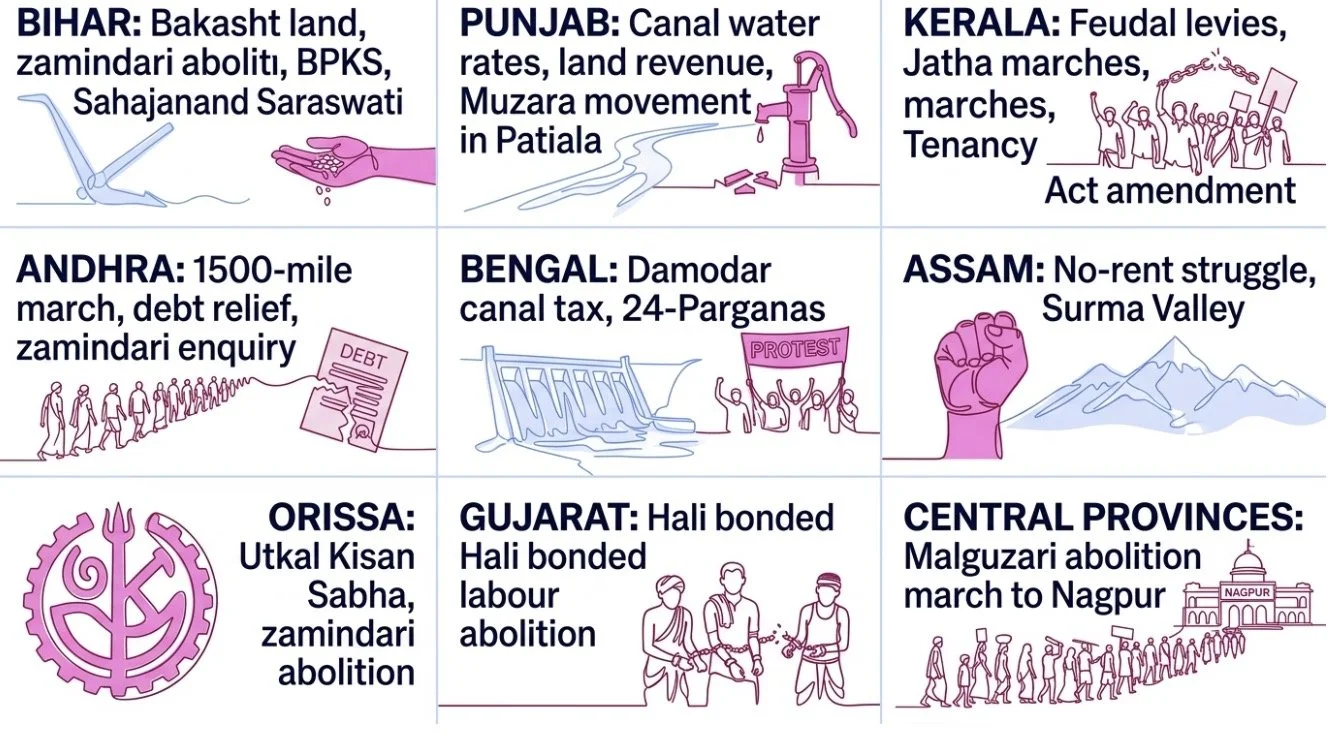
Peasant activity in the 1930s was by no means confined to the more celebrated regional movements. Across Bengal, Assam, Orissa, Central Provinces, and the North West Frontier Province, agrarian protest took varied and locally specific forms, demonstrating the breadth of the underlying crisis even as it adapted to local conditions and leadership.
In Bengal, under the leadership of Bankim Mukherjee, the peasants of Burdwan agitated against the enhancement of canal tax on the Damodar Canal and secured significant concessions. The kisans of 24-Parganas pressed their demands through a march to Calcutta in 1938. In the Surma Valley of Assam, a no-rent struggle against zamindari oppression continued for six months, while Karuna Sindhu conducted a major campaign for amendment of the tenancy law. In Orissa, the Utkal Provincial Kisan Sabha — organised by Malati Chowdhary and others in 1935 — succeeded in getting the Kisan Manifesto accepted as part of the Provincial Congress election manifesto; the ministry that followed introduced significant agrarian reform. At the very first conference of the Utkal Kisan Sabha, abolition of zamindari was adopted as a resolution.
In Gujarat, the main demand was for the abolition of Hali (bonded labour), and significant success was registered in advancing this demand. The Central Province Kisan Sabha led a march to Nagpur demanding the abolition of the malguzari system, concession in taxes, and a moratorium on debts. In the North West Frontier Province, the kisans of Ghalla Dhir state protested against evictions and feudal exactions by their Nawab. The geographic diversity of these movements points to a crucial historical argument: while agrarian oppression took locally specific forms, the structural conditions that produced it — and the demands that resistance generated — were strikingly uniform across the subcontinent.
Chapter 4 — Peasant Movements During the War
World War II and the Fracturing of the Kisan Movement
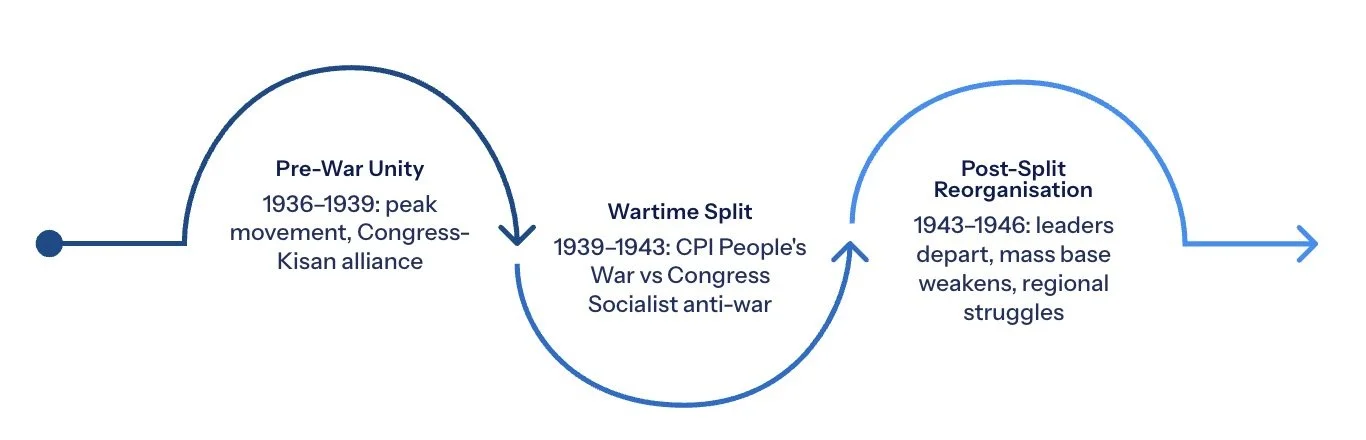
The outbreak of World War II in September 1939 abruptly interrupted the rising tide of peasant awakening that had built so powerfully through the late 1930s. The resignation of Congress Ministries from their provincial governments removed the institutional support structure that had provided peasant movements with both political cover and the legislative arena in which to press their demands. In its place came severe colonial repression, directed particularly at left-wing and Kisan Sabha leaders whose strong anti-war stance made them prime targets for the colonial state.
The situation within the Kisan movement was further complicated by the ideological earthquake that followed Hitler's attack on the Soviet Union in June 1941. The Communist Party of India reversed its anti-war position and adopted the "People's War" line — supporting the Allied war effort as a necessary condition for Soviet survival. This placed CPI-aligned Kisan Sabha cadres in direct confrontation with Congress Socialist and other nationalist members who remained committed to opposing the war and British imperialism simultaneously. The rupture came to a head with the Quit India Movement of August 1942. The Congress Socialists played a leading role in the movement; the CPI, following its party line, instructed its cadres to stay away. Though many local-level CPI workers defied party orders and joined Quit India, the official party line sealed the rift in Kisan Sabha ranks, producing a formal split in 1943.
The split had profound consequences. Three major founding leaders of the AIKS — N.G. Ranga, Swami Sahajanand Saraswati, and Indulal Yagnik — left the organisation. The AIKS, now effectively under Communist Party control, was left in an increasingly untenable position: unable to approach the peasantry without the baggage of its pro-British, pro-war stance, and progressively losing its nationalist credibility. Despite these difficulties, the Kisan Sabha continued to play an important role in relief work — most notably during the catastrophic Bengal Famine of 1943, where it worked to lessen the rigour of shortages and assist in rationing — and maintained its organisational infrastructure even under severely adverse conditions.
Peasants and Kisan Movements
The fracture of the Kisan movement during the war years illustrates a fundamental tension within anti-colonial movements: when international ideological alignments cut across national solidarity, the broader coalition that had given peasant politics its mass character inevitably weakened. The recovery of the movement's vitality in the post-war years, through the Tebhaga and Telangana movements, would demonstrate both the resilience of agrarian political consciousness and the enduring structural conditions that demanded organised resistance.
Chapter 5 — Post-War Struggles
The Tebhaga Movement: Share-Croppers' Revolt in Bengal
The post-war years saw a rapid renewal of peasant struggles across India, with many campaigns that had been suppressed since 1939 returning with intensified urgency. The demand for zamindari abolition was pressed with a new sense of historical necessity. Among the most significant of these post-war movements was the Tebhaga Movement of Bengal — a campaign initiated in late 1946 by the Bengal Provincial Kisan Sabha, working under the ideological direction of the Communist Party of India.
The immediate context was the condition of Bengal's bargardars — share-cropping peasants who tilled land rented from jotedars (rich peasants and landlords) but were required to hand over half of their harvest to the landowner. The Tebhaga Movement (meaning "sharing by thirds") demanded that the share given to landlords be reduced to one third, in accordance with the recommendations of the Floud Commission on Bengali agriculture. In September 1946, the Bengal Provincial Kisan Sabha issued a call to implement this demand through mass struggle. The central slogan — nij khamare dhan tolo, meaning "take the paddy to your own threshing floor" — captured the movement's essence: sharecroppers were to assert physical control over the harvest before division, shifting the site of distribution from the jotedar's premises to their own.
Communist cadres, including urban student militias, went into the countryside to organise the bargardars. The storm centre of the movement was north Bengal, principally among the Rajbanshis — a low caste of tribal origin — with large Muslim participation as well. In response to the agitation, the Muslim League Ministry led by Suhrawardy launched the Bargadari Bill, promising to limit landlords' share to one third. But the bill was never fully implemented. The movement dissipated under the combined pressure of the Ministry's legislative sop, intensified repression, the Hindu Mahasabha's agitation for a separate Bengal, and renewed communal riots in Calcutta that ended prospects of urban solidarity. It was only in 1950 that a Congress Ministry passed a Bargadari Bill incorporating the substance of the movement's demands.
The Demand
Reduce share given to landlords from one-half to one-third of the harvest — as recommended by the Floud Commission.
The Method
Nij khamare dhan tolo: Sharecroppers take the paddy to their own threshing floor, asserting physical control over the harvest before division.
The Response
Muslim League ministry introduces Bargadari Bill; but intensified repression and communal violence dissipate the movement before the law is implemented.
The Legacy
In 1950, a Congress Ministry passes a Bargadari Bill incorporating the movement's core demand — a delayed but substantive legislative victory.
The Telangana Movement: India's Greatest Peasant Guerrilla War
The Telangana uprising of 1946–51 stands as the most dramatic and far-reaching peasant movement in modern Indian history — a full-scale guerrilla war that shook the foundations of Hyderabad's feudal order and ultimately contributed to the princely state's integration into the Indian Union. The princely state of Hyderabad under the Asaf Jahi Nizams was marked by an especially toxic combination of conditions: religious-linguistic domination by a small Urdu-speaking Muslim elite over a predominantly Hindu, Telugu, Marathi, and Kannada-speaking population; a total absence of political and civil liberties; and the most extreme forms of feudal exploitation by deshmukhs, jagirdars, and doras — a system of forced labour (vethi) and illegal exactions that kept the peasantry in conditions of near-serfdom.
During the war years, Communist-led cadres had built a strong underground base in Telangana villages through the Andhra Mahasabha, leading local struggles over wartime exactions, abuses of the rationing system, excessive rent, and vethi. The uprising proper began in July 1946 when a deshmukh's thug murdered a village militant in Jangaon taluq of Nalgonda — an act of violence that triggered a mass insurrection. The uprising spread rapidly to Warangal and Khammam. Peasants organised themselves into village sanghams, and fought back using lathis, stone slings, and chilli powder against the brutal repression they faced.
The movement was at its greatest intensity between August 1947 and September 1948. Peasant guerrillas inflicted a rout on the Razakars — the Nizam's fanatical stormtroopers. When Indian security forces took over Hyderabad following the "Police Action" of September 1948, the movement gradually fizzled out under military pressure. Nevertheless, its achievements in the areas it controlled were transformative.
Vethi Abolished
Forced labour disappeared from villages controlled by guerrilla forces during the uprising.
Wages Raised
Agricultural wages were increased in guerrilla-controlled areas, directly benefiting landless labourers.
Lands Restored
Illegally seized lands were restored to peasants; steps were taken to fix ceilings and redistribute land.
Irrigation & Health
Measures were taken to improve irrigation infrastructure and combat cholera outbreaks in villages.
Women's Status
A marked improvement in the condition of women was witnessed in areas under peasant sanghams' control.
Andhra Pradesh Created
The autocratic-feudal regime was shaken, clearing the way for Andhra Pradesh's formation on linguistic lines.
Chapter 6 — National Movement & Peasant Politics
The Intertwined Relationship: Peasant Movements and the National Freedom Struggle
One of the most important and complex dimensions of India's peasant movements in the twentieth century is their relationship with the national freedom struggle. This relationship was neither one of simple alignment nor of straightforward opposition — it was dynamic, mutually constitutive, and at times deeply contradictory. The peasant movements and the national movement fed each other in ways that transformed both.
The peasant movements of the 1920s were closely linked with national politics from their inception. In UP, the Home Rule Leagues provided the initial organisational impetus, and the Non-Cooperation and Khilafat movements gave mass peasant agitation its energising framework. In Avadh at the peak of peasant activity in early 1921, it was genuinely difficult to distinguish a Non-Cooperation meeting from a peasant rally — the leaders, the audience, and the slogans overlapped almost completely. A similar fusion occurred in Malabar, where Khilafat and tenants' meetings merged into a single undifferentiated stream of anti-colonial feeling.
Yet in both Avadh and Malabar, the recourse to violence by peasants created an uncomfortable distance between them and the national leadership. Gandhi and other nationalist leaders asked peasants to desist from violence and, notably, from taking extreme action such as stopping the payment of rent altogether. This advice was prompted partly by genuine concern for peasant wellbeing — the consequences of violent revolt did not remain hidden for long, as both movements faced heavy government repression. But there were also strategic reasons: pushing even small landlords into the arms of the government by threatening the entire rent system would destroy the possibility of maintaining their neutrality in the conflict between the national movement and the colonial state.
Where the Movements Converged
Shared ideology of nationalism — Kisan leaders carried the message of both class organisation and national freedom
Many Kisan activists simultaneously enrolled in Congress and Kisan Sabha
Kisan Manifesto demands incorporated into Congress's Faizpur agrarian programme
Congress Ministries provided the political climate for peak peasant mobilisation (1937–39)
Where the Movements Diverged
Violence by peasants prompted national leaders to distance themselves and urge restraint
Right-wing Congress leaders protected landlord interests against Kisan Sabha demands
AIKS–Congress confrontation over Bakasht land, tenancy legislation (Bihar, UP, Orissa)
CPI's People's War line during WWII split the Kisan movement irreparably
The Limits of Alliance: Congress, Kisan Sabha, and the Landlord Question
The tensions between the Congress and the Kisan Sabha were not merely ideological — they reflected a deep structural ambiguity at the heart of the national movement's relationship with agrarian society. The Congress, as a broad nationalist coalition, needed the support of both peasants and landlords, and its leadership — particularly its conservative wing — was acutely aware of the dangers of alienating propertied interests at a moment when national unity against the colonial state was the paramount consideration. This structural constraint meant that Congress governments, even when staffed by committed nationalists, repeatedly pulled their punches on agrarian reform when faced with organised landlord resistance.
In Bihar, the most dramatic illustration of this tension was the Bakasht land issue. Occupancy tenants had lost their lands to zamindars during the Depression years, and the Kisan Sabha demanded their restoration. When the Bihar Congress Ministry, under landlord pressure, adopted a resolution unfavourable to the tenants, the BPKS launched a militant movement that brought it into open confrontation with the provincial government. In UP, the proposed tenancy legislation of 1938, which was originally designed to reduce rents by half, was so heavily diluted under landlord pressure that UP Kisan Sabha leaders like Acharya Narendra Dev and Mohanlal Gautam mobilised peasant demonstrations against a Congress Ministry. A similar pattern repeated in Orissa, where even diluted legislation was blocked by the governor until a massive Kisan Day Rally of 1 September 1938 forced the issue.
The experience of the years 1937–42 taught the Kisan movement a lesson that would shape its political calculations for decades: if it diverged too far and too clearly from the path of the national movement, it tended to lose its mass base and create damaging splits within its own leadership. The split of 1942–43 — when the CPI's People's War line separated it from the Congress Socialist members who led the Quit India Movement — was the most painful demonstration of this lesson. The growth and development of the peasant movement was, as historians have noted, indissolubly linked with the national struggle for freedom, even when the two were in tension.
"Before 1942 these differences were usually contained and the kisan movement and the national movement occupied largely common ground. With the experience of the split of 1942, the kisan movement found that if it diverged too far and too clearly from the path of the national movement, it tended to lose its mass base."
Demands, Forms of Struggle, and the Geography of Resistance
Despite the regional diversity of India's peasant movements — shaped by local agrarian structures, caste configurations, linguistic identities, and the specific character of landlord-tenant relations — the demands that these movements articulated were remarkably uniform across the subcontinent. This uniformity points to the systemic nature of agrarian oppression under colonial rule and reflects the coordinating role of the All India Kisan Sabha in building a common platform.
Revenue & Rent
Reduction in land revenue and rent; abolition of illegal cess, feudal levies, begar and vethi.
Tenure Security
Ending oppressive evictions; security of tenure for tenants; restoration of illegally seized and Bakasht lands.
Debt Relief
Reduction and cancellation of rural debts; moratorium on debt repayments during crisis periods.
Structural Reform
Abolition of the zamindari system; recognition of peasant unions; living wage for agricultural labourers.
The forms of struggle and mobilisation adopted were also strikingly consistent across regions. Kisan Sabha meetings, conferences, and rallies at every administrative level — from the village and thana up to the province — formed the organisational backbone. Jathas (marches) to landlords' houses, long-distance protest marches to provincial capitals, social boycotts, no-rent and no-revenue campaigns, and the symbolic power of mass oaths all featured across the country. Violent clashes were the exception rather than the rule; the dominant tradition remained one of disciplined collective action within a broadly nationalist framework.
One important limitation must be noted: except in a few pockets such as Andhra and Gujarat, the specific demands of agricultural labourers — as distinct from tenant cultivators — did not really become central to the movements. The Kisan Sabhas were primarily vehicles for the interests of the peasant-tenant class, and the landless labourer remained at the margins of organised agrarian politics until much later in the post-Independence period.
Chapter 7 — Assessment & Legacy
Assessment of the Peasant Movements: Achievements and Limitations
Any comprehensive assessment of India's peasant movements must begin by acknowledging what they were and what they were not. They were not revolutionary movements aimed at the overthrow of the existing agrarian structure — their demands were almost universally framed around alleviating its most oppressive aspects: reducing rents, ending illegal exactions, securing tenure, relieving debt, and restoring seized lands. The question of abolishing landlordism entirely was raised, particularly by the AIKS from the mid-1930s onwards, but it remained a programmatic aspiration rather than an immediate organisational focus. Nevertheless, these movements achieved a great deal within their own terms, and their indirect effects proved even more consequential than their immediate victories.
By consistently organising and articulating peasant grievances, the Kisan Sabhas eroded the social and political power of the landed classes in ways that no single movement or legislation could have accomplished alone. They created what historians have called "the climate" that made post-Independence agrarian reform politically inevitable. Zamindari abolition — achieved in most states by the early 1950s — did not emerge as the direct culmination of any particular struggle, but the decades-long popularisation of the demand by the Kisan Sabha movement created the political pressure that ensured its legislative realisation. Similarly, the Tebhaga demand was enacted into law in 1950, and the Telangana uprising hastened the dismantling of Hyderabad's feudal order and paved the way for the linguistic reorganisation of states that the national movement had long demanded.
The movements also demonstrated the viability of mass peasant politics in a colonial context — showing that India's rural poor could be organised into a disciplined, purposeful political force capable of sustained collective action across vast geographic areas. In their ideology, the Kisan movements accepted and built upon the framework of nationalism, their cadres and leaders simultaneously carrying the message of class organisation and national freedom. This ideological integration, despite its periodic tensions, was a source of enormous strength.
Eroded Landlord Power
Even where immediate demands were not fully met, sustained organising eroded the social prestige and political dominance of the landed classes across many regions.
Created Climate for Reform
Post-Independence zamindari abolition, tenancy legislation, and land reform were directly shaped by the decades of demand-making by Kisan Sabhas.
Built Mass Political Consciousness
Millions of Indian peasants were drawn into organised politics for the first time, creating an enduring culture of agrarian activism.
Reinforced National Movement
The Kisan movement and the national freedom struggle fed each other, each broadening the social base and moral authority of the other.
The Peasant and the Nation
The history of India's peasant movements in the twentieth century is ultimately inseparable from the history of the national freedom struggle itself. The two were not parallel currents that occasionally intersected — they were, at their deepest level, expressions of the same fundamental assertion: that the people who worked the land, fed the nation, and bore the heaviest costs of colonial exploitation deserved dignity, justice, and freedom. The peasant's enemy was, in the final analysis, the colonial state that maintained the structures of landlord power, debt bondage, and revenue extraction that kept the majority of India's population in poverty.
From the Kisan Sabhas of Awadh in 1920 to the guerrilla villages of Telangana in 1948, India's peasant movements traced a remarkable arc — from localised protest, through national organisation and legislative engagement, to armed insurrection. They were shaped by extraordinarily diverse local conditions and led by an equally diverse array of leaders: sanyasis and Communists, low-caste militants and English-educated lawyers, women who marched through the streets of Bardoli and men who took the paddy to their own threshing floors in north Bengal. What united them was a common experience of exploitation and a common vision of a more just agrarian order.
The ultimate measure of these movements' success is not found in any single legislation or any single political victory, but in the irreversible transformation they brought about in the consciousness of India's rural poor — and in the consciousness of the national leadership about what freedom would have to mean for the majority of Indians. The zamindari abolitions of the 1950s, the tenancy reforms, the ceiling legislation, and the long subsequent debates about land redistribution and agrarian justice all bear the imprint of the demands, the sacrifices, and the organising genius of the peasant movements of the colonial era.
Not Revolutionary, But Transformative
The movements did not aim to overthrow agrarian structure outright, but their sustained pressure made its transformation politically and legislatively inevitable in independent India.
Unity in Diversity
Despite regional variation in forms, leadership and local conditions, the demands and methods of India's peasant movements were strikingly uniform — a testament to shared structural oppression and shared nationalist ideology.
The Agricultural Labourer — An Unfinished Agenda
The specific demands of landless agricultural labourers remained largely outside the mainstream peasant movement, representing an unresolved question that post-Independence India would continue to grapple with.
Legacy in Democratic India
Zamindari abolition, Bargadari legislation, land ceiling laws, and the reorganisation of states on linguistic lines — the institutional outcomes of independent India's first decade bear the unmistakable imprint of the peasant movements' decades-long struggle.
The growth and development of the peasant movement was indissolubly linked with the national struggle for freedom. In its ideology, the kisan movement accepted and based itself on the ideology of nationalism — its cadres and leaders carried the message not only of organisation of the peasantry on class lines but also of national freedom.
