
Communal Award & Poona Pact
Two pivotal moments in India's constitutional history — the Communal Award of 1932 and the Poona Pact that followed — shaped the political destiny of millions of Indians, particularly the depressed classes. This document traces the background, controversies, Gandhi's dramatic fast, and the landmark agreement that emerged from one of modern India's most charged political negotiations.
The Communal Award — 16 August 1932
On 16 August 1932, British Prime Minister Ramsay MacDonald announced the Communal Award — a decision that sent shockwaves through the Indian political landscape. The Award apportioned representation among various communities and, most controversially, extended the provision of separate electorates to the untouchables (depressed classes) for the first time. Nationalists across the board immediately recognised this as yet another calculated expression of Britain's enduring policy of divide and rule.
Prior to this announcement, Muslims, Sikhs, and Christians had already been recognised as minorities entitled to separate electorates. The Communal Award went a step further by declaring the depressed classes to be a separate minority as well, thus politically fragmenting Hindu society further.
Representation Breakdown in Punjab
The Award allocated seats in a manner that many communities found deeply unequal and divisive.
Muslims: 51% reservation
Hindus: 30% reservation
Sikhs: Only 19% reservation
Who Criticised the Award?
The Award was condemned by multiple political voices from across the spectrum:
Mahatma Gandhi — viewed it as an attack on national unity
Akali Dal — protested the meagre 19% reservation for Sikhs in Punjab
Indian National Congress — strongly disagreed but did not formally reject it
Most Indian nationalists — opposed the separation of depressed classes as a political entity
Congress's Stance & the Nationalist Position
The Indian National Congress found itself in a delicate and contradictory position. While the Congress leadership was firmly opposed to the principle of separate electorates — viewing them as inherently divisive and dangerous to national cohesion — it simultaneously held that the Communal Award could not be unilaterally changed without the consent of the minorities concerned. This nuanced position reflected the Congress's attempt to balance its anti-communal ideology with its commitment to minority rights.
As a result, the Congress adopted a stance of principled ambiguity: it neither formally accepted nor rejected the Communal Award. This was a calculated political move to avoid being seen as either endorsing British divide-and-rule tactics or as dismissing the legitimate concerns of minority communities.
The Core Dilemma
Congress believed separate electorates were fundamentally harmful to national unity. Yet it also believed that any change to the Award required minority consent — creating a political deadlock.
Nationalist Opposition
Nationalists across party lines were united in their opposition to treating the depressed classes as a separate political entity. The fear was that political separation would entrench social divisions rather than resolve them.
A Diplomatic Deadlock
By choosing neither acceptance nor rejection, Congress hoped to preserve its role as a mediator and keep all channels of negotiation open — a strategy that ultimately helped pave the way for the Poona Pact.
Gandhi's Response — The Fast unto Death
For Mahatma Gandhi, the Communal Award was not merely a political misstep — it was a moral catastrophe. He saw it as a direct attack on Indian unity and, more specifically, as a sinister attempt to permanently divide Hindu society by treating the untouchables as a separate political community. Gandhi believed deeply that the untouchables were an inseparable and integral part of Hindu society, and that any political structure which reinforced their separateness would be harmful to both Hinduism and to the depressed classes themselves.
Gandhi's central argument was profound: granting separate electorates to the depressed classes would not uplift them — it would instead perpetuate their subjugation. Once treated as a distinct political category, the question of abolishing untouchability would be sidelined, and the untouchables would remain untouchables in perpetuity. The solution, Gandhi argued, was not to protect a degraded status but to eradicate untouchability root and branch. He advocated for joint electorates with universal franchise, while accepting the demand for a larger number of reserved seats for the depressed classes.
"What was required was not the protection of the so-called interests of the depressed classes, but the root and branch eradication of untouchability." — Mahatma Gandhi
16 Aug 1932
Communal Award announced by Ramsay MacDonald
20 Sep 1932
Gandhi begins indefinite fast unto death at Yerwada Central Jail, Pune
24 Sep 1932
Poona Pact signed between Gandhi and Ambedkar
Post-Pact
British Government accepts the Pact as an amendment to the Communal Award
Gandhi's fast on 20 September 1932 threw the nation into a state of panic and urgency. The prospect of Gandhi dying in prison galvanised leaders from across the political spectrum to find a negotiated solution with extraordinary speed.
Gandhi vs. Ambedkar — A Historic Negotiation
The fast brought into sharp focus a fundamental disagreement between two towering figures: Gandhi and Dr B.R. Ambedkar. While some depressed class leaders like M.C. Rajah favoured joint electorates, Ambedkar — the most influential voice of the depressed classes — saw separate electorates as the only reliable guarantee of meaningful political representation for the untouchables. He was deeply sceptical that joint electorates would truly deliver fair representation, given the social power imbalance between caste Hindus and the depressed classes.
Yet neither man was entirely inflexible. Gandhi, while opposed to separate electorates, was willing to accept a significantly larger number of reserved seats. Ambedkar, in turn, was ultimately persuaded to relinquish separate electorates in exchange for a substantially increased allocation of reserved seats and a two-tier election system that would give the depressed classes real influence over who represented them. This mutual accommodation became the foundation of the Poona Pact.
Gandhi's Position
Opposed separate electorates as divisive and harmful
Believed separate electorates would perpetuate untouchability
Favoured joint electorates with universal franchise
Accepted more reserved seats as a concession
Saw untouchables as an integral part of Hindu society
Ambedkar's Position
Viewed separate electorates as a political safeguard
Sceptical of joint electorates ensuring fair representation
Demanded structural guarantees for depressed class representation
Agreed to joint electorates in exchange for more reserved seats
Accepted a two-tier election system as a compromise
Leaders including Madan Mohan Malaviya, B.R. Ambedkar, and M.C. Rajah came together to hammer out the compromise. The urgency of Gandhi's fast compressed what might have been months of negotiation into a matter of days.
The Poona Pact — 24 September 1932
The Poona Pact was signed on 24 September 1932 at Yerwada Central Jail, Pune, between Dr Babasaheb Ambedkar and Mahatma Gandhi, with the endorsement of other political leaders. It was subsequently accepted by the British Government as a formal amendment to the Communal Award. The Pact represented a hard-won compromise: the depressed classes gave up separate electorates but gained significantly expanded reserved seats and a novel two-stage election mechanism designed to ensure their voices were genuinely heard.
Reserved Seats — Provincial
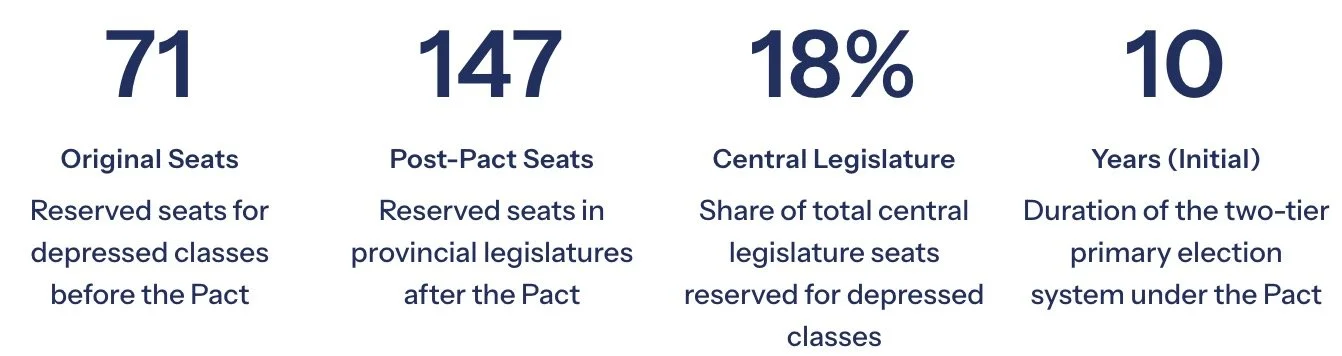
Seats reserved for depressed classes in provincial legislatures increased from 71 to 147 — more than doubled from the original Communal Award provision.
Reserved Seats — Central
18% of the total seats in the central legislature were to be reserved for depressed class representatives, ensuring a meaningful federal-level presence.
Joint Electorates
Separate electorates were abandoned. Instead, joint electorates were introduced, with all voters in a constituency participating in the final election of reserved seat candidates.
Two-Tier Primary System
Depressed class voters formed an electoral college to elect a panel of four candidates via a primary election. The top four then stood before the general electorate — a system designed for ten years initially.
Beyond electoral provisions, the Pact also included important social guarantees. It declared that there would be no disabilities attached to depressed class members in elections to local bodies or in public service appointments. Furthermore, every province was required to earmark an adequate sum from educational grants specifically for providing educational facilities to the depressed classes — a recognition that political representation alone could not achieve equality without economic and educational upliftment.
The reservation system under the Poona Pact was to continue until determined otherwise by mutual agreement between the communities concerned. The ten-year primary election system could also be terminated sooner by mutual consent — reflecting the Pact's design as a transitional arrangement rather than a permanent settlement.
Significance & Legacy
The Communal Award and the Poona Pact together represent one of the most consequential episodes in India's pre-independence constitutional history. They illuminate several enduring tensions that would continue to shape Indian democracy long after 1947: the conflict between individual community interests and national unity; the question of how best to secure representation for historically marginalised groups; and the complex relationship between social reform and political strategy.
The Poona Pact's legacy is deeply contested. For Gandhi's supporters, it was a triumph of national unity over British divide-and-rule tactics, and a reaffirmation that the depressed classes belonged within — not separate from — the broader Hindu and Indian community. For Ambedkar and his followers, it was a forced compromise achieved under duress, in which the depressed classes sacrificed a potentially powerful political tool — separate electorates — in exchange for reserved seats whose actual effectiveness remained uncertain within a joint electorate system dominated by caste Hindu voters.
Political Representation
The Pact established the principle that depressed classes deserved guaranteed political representation — a concept that became foundational to India's reservation system enshrined in the Constitution of 1950.
Social Reform Debate
The episode brought the question of untouchability to the centre of national politics, forcing both the Congress and Indian society to confront caste discrimination more directly than ever before.
Constitutional Precedent
The negotiated compromise between communities set a precedent for constitutional accommodation of diversity — influencing how the framers of India's Constitution approached minority rights and reservation policies.
For students of modern Indian history, the Communal Award and Poona Pact are essential case studies in understanding how colonial policy, nationalist ideology, caste politics, and individual leadership intersected to shape the contours of democratic India. The debate between Gandhi and Ambedkar — far from being a mere historical dispute — continues to echo in contemporary Indian politics wherever questions of reservation, representation, and social justice are raised.
Communal Award and Poona Pact
