
The Round Table Conferences, 1930–1932
The three Round Table Conferences, held between 1930 and 1932, were among the most significant — and ultimately disappointing — diplomatic encounters of the Indian independence movement. Organised by the British Government in response to mounting nationalist pressure, these conferences were meant to chart a constitutional future for India. Yet they were plagued from the outset by Congress boycotts, communal deadlocks, shifting British politics, and conflicting visions of what "self-governance" would truly mean. This document traces the origins, proceedings, turning points, and consequences of all three conferences — from the Simon Commission's recommendations to the eventual passage of the Government of India Act, 1935.
The Simon Commission and Dominion Status
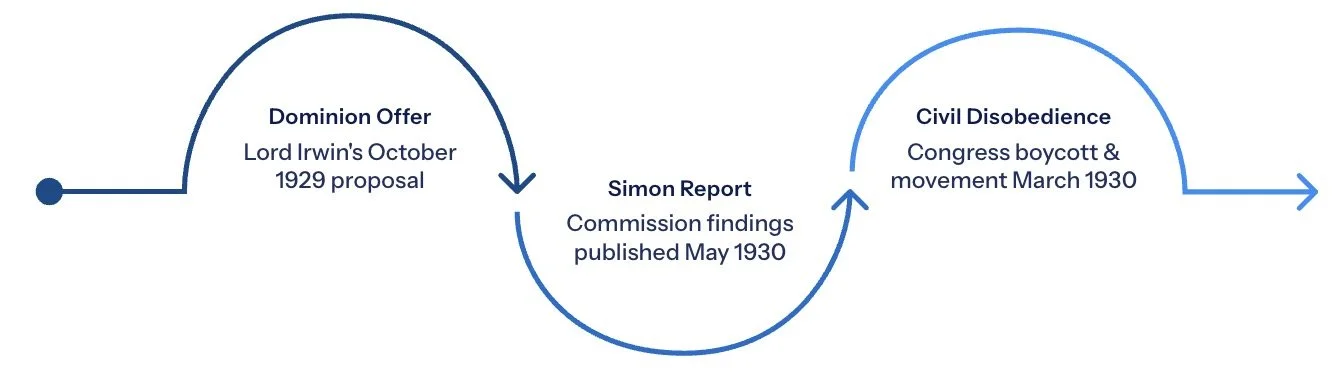
The Round Table Conferences did not emerge in a vacuum. Their immediate catalyst was the report submitted by the Simon Commission in May 1930, which had itself been a source of enormous controversy. The Commission, composed entirely of British members with no Indian representation, had toured India amid widespread protests and the chant of "Simon, Go Back." Its recommendations, though modest, set the stage for a formal negotiation process between Britain and Indian political stakeholders.
Even before the Simon Report was officially published, Viceroy Lord Irwin — on behalf of the British Government — made a significant announcement in October 1929. He offered a vague promise of dominion status for India at some unspecified future date and proposed a Round Table Conference to discuss a future constitution. While this was framed as a gesture of goodwill, Indian political leaders viewed it with deep scepticism. The promise was non-committal, lacked a clear timeline, and fell far short of the demand for full self-determination.
Congress leaders were especially dissatisfied. What they sought was not a government-appointed conference but a Constituent Assembly — a body elected by and accountable to the Indian people, empowered to draft its own constitution. An interview between Viceroy Irwin and Mahatma Gandhi failed to produce any meaningful agreement. As a result, the Congress, meeting at its historic Lahore session under the presidentship of Jawaharlal Nehru, resolved to boycott the Round Table Conference entirely. The session declared the nation's aim to be complete independence (Poorna Swaraj) and authorised the All India Congress Committee to launch a Civil Disobedience Movement, which formally began in March 1930 with Gandhi's famous Salt March.
The Round Table Conferences, 1930–1932
This sequence of events — imperial half-measures, nationalist impatience, and eventual confrontation — defined the fraught atmosphere in which the first conference convened in London in November 1930.
Conference I
First Round Table Conference (November 1930 – January 1931)
The First Round Table Conference was officially opened by Lord Irwin on 12 November 1930 in London, and was chaired by British Prime Minister Ramsay MacDonald. It was historically notable as the first conference ever convened between the British and Indians on a formally equal footing — a significant symbolic departure from the purely top-down tradition of colonial governance. However, its credibility was immediately undermined by a critical absence: the Indian National Congress.
With Congress leaders behind prison bars — arrested for their participation in the Civil Disobedience Movement — the Government nominated a set of "safe" representatives from other parties, communities, and princely states. These included figures such as Sir Mirza Ismail, Sir Akbar Hydari, and the Maharaja of Bikaner. In total, 89 delegates from India attended the conference: 57 political leaders from British India and 16 delegates from the princely states. The three British political parties were represented by 16 delegates.
Key Delegations Present
Muslims: Aga Khan III, Maulana Mohammad Ali, M.A. Jinnah, Muhammad Shafi
Hindus: B.S. Moonje, M.R. Jayakar
Justice Party: Arcot Ramasamy Mudaliar
Liberals: Tej Bahadur Sapru
Depressed Classes: B.R. Ambedkar, Rettamalai Srinivasan
Women: Begum Jahanara Shahnawaz, Radhabai Subbarayan
Notable Absentees
The Indian National Congress — the most representative political organisation in India — boycotted the conference entirely. Most senior Congress leaders were imprisoned for their role in the Civil Disobedience Movement. Without Congress participation, virtually every delegate acknowledged that the constitutional discussions lacked legitimacy.
Who Attended?
The Muslim League, Hindu Mahasabha, the Liberals, and the princes attended. Their presence, while important, could not substitute for the Congress's representative authority over the nationalist movement.
The central idea debated was that of an All-India Federation — a framework under which British India and the princely states would come together under a common federal government. All groups attending the conference supported this concept in principle. The responsibility of the executive to the legislature was also debated, and Dr. B.R. Ambedkar made a notable demand for a separate electorate for the Depressed Classes (untouchables), a demand that would resurface with greater intensity at subsequent conferences.
Three basic principles were agreed upon and accepted by the British Government: that the new Government of India would take the form of an All-India Federation; that the Federal Government would be responsible to the Federal Legislature (with certain reservations); and that the provinces would enjoy autonomy. Prime Minister MacDonald made a momentous declaration affirming that "responsibility for the Government of India should be placed upon legislatures, Central and Provincial." Despite this, the conference produced no concrete constitutional outcome, as the absence of Congress made any agreement politically hollow.
Key Outcome: The First RTC ended without fruitful results primarily due to Congress's absence. The Conservative-dominated National Government in London was also not genuinely committed to the federal idea. Efforts by Sir Tej Bahadur Sapru and M.R. Jayakar to bridge the gap eventually led to the Gandhi-Irwin Pact of March 1931.
Diplomatic Breakthrough
The Gandhi-Irwin Pact (February–March 1931)
Following the inconclusive end of the First Round Table Conference, the British Government recognised that any future negotiations would remain meaningless without Congress participation. Accordingly, efforts were made to bring the Congress back to the negotiating table. On 25 January 1931, Gandhi and all other members of the Congress Working Committee (CWC) were released unconditionally. The CWC authorised Gandhi to initiate discussions with the Viceroy.
Gandhi and Lord Irwin met on 19 February 1931, beginning a series of discussions that would culminate in a historic agreement. The resulting pact — signed in Delhi on 14 February 1931 — is known as the Delhi Pact or the Gandhi-Irwin Pact. It placed the Congress on an equal footing with the Government, a fact that outraged many British officials and politicians, including Winston Churchill, who publicly expressed his "disgust" at the spectacle of Gandhi negotiating "on equal terms with the representative of the King Emperor."
Congress Agreed To
Suspend the civil disobedience movement
Participate in the next Round Table Conference
Discontinue boycott of British goods and institutions
British Government Agreed To
Immediate release of all political prisoners not convicted of violence
Remission of all fines not yet collected
Return of lands not yet sold to third parties
Right to make salt in coastal villages for personal use
Right to peaceful, non-aggressive picketing
Withdrawal of emergency ordinances
Demands Turned Down
Public inquiry into police excesses during the movement
Commutation of Bhagat Singh and his comrades' death sentences to life imprisonment
The Gandhi-Irwin Pact was formally endorsed by the Congress at its Karachi Session on 29 March 1931, which also reiterated the goal of Poorna Swaraj. While the pact was criticised by radical nationalists for falling short of minimum demands, it was a pragmatic step that opened the door to Gandhi's participation in the Second Round Table Conference. The pact also significantly raised the political prestige of the Congress and boosted popular morale — something that British officials would later seek deliberately to reverse.
Conference II
Second Round Table Conference (September – December 1931)
The Second Round Table Conference was held in London from September to December 1931. Unlike the first, it had the crucial distinction of Congress participation. Mahatma Gandhi attended as the sole official Congress representative, accompanied by Sarojini Naidu, Madan Mohan Malaviya, Ghanshyam Das Birla, Muhammad Iqbal, Sir Mirza Ismail, S.K. Dutta, and Sir Syed Ali Imam. Gandhi arrived with enormous moral authority but walked into a politically hostile environment.
Three major contextual differences shaped this conference compared to the first:
Congress Representation
The Gandhi-Irwin Pact paved the way for Congress participation. Gandhi claimed Congress alone represented political India.
Change in British Government
The Labour Government had fallen. Ramsay MacDonald now headed a Conservative-dominated National Government, with a weak Secretary of State, Samuel Hoare.
Financial Crisis
Britain abandoned the Gold Standard during the conference, further distracting the National Government from Indian affairs.
Gandhi's position at the conference was assertive but isolated. He claimed that the Congress alone represented political India and argued that the Untouchables were Hindus and should not be treated as a separate minority requiring special electorates. He strongly opposed demands for separate electorates from Muslims, Depressed Classes, Anglo-Indians, and Indian Christians — all of whom had formed a combined "Minorities' Pact" to press their demands collectively.
The session became deadlocked on the minorities question. The Right Wing in Britain, led by Churchill, strongly objected to the Government negotiating with Congress on equal terms. An overwhelming majority of RTC delegates were conservative and loyalist — placed there by the colonial government precisely to assert that the Congress did not represent all of India. The princes, too, were far less enthusiastic about federation once the prospect of a Congress government at the centre had receded with the suspension of civil disobedience.
MacDonald's Announcement at Close of Session: Two Muslim-majority provinces — NWFP and Sindh — would be created; an Indian Consultative Committee would be set up; three expert committees (finance, franchise, and states) would be constituted; and if Indians failed to agree on the minorities question, Britain would impose a unilateral Communal Award.
The conference ended in failure. Gandhi returned to India on 28 December 1931 without having achieved any of the Congress's substantive demands. On 29 December, the CWC decided to resume the Civil Disobedience Movement. The second conference had not only failed to deliver constitutional progress — it had hardened the lines of conflict between the nationalist movement and the colonial government.
Civil Resistance
The Truce Period and Second Civil Disobedience Movement
The period between March and December 1931 — the so-called Truce Period — was formally one of suspension of civil disobedience under the Gandhi-Irwin Pact. Yet beneath the surface, the spirit of defiance was very much alive across the country. In the United Provinces, the Congress had been leading a movement for rent reduction and against summary evictions of peasants by landlords. In the North-West Frontier Province (NWFP), severe repression had been unleashed against the Khudai Khidmatgars and peasants agitating against the brutal methods of tax collection by the Government. In Bengal, draconian ordinances and mass detentions were deployed in the name of fighting terrorism. A particularly chilling episode occurred in September 1931: the firing on political prisoners at Hijli Jail.
The British authorities had drawn their own conclusions from the Gandhi-Irwin Pact. In their assessment, the pact had raised the political prestige of the Congress and the morale of the Indian people to an unacceptable degree — and had simultaneously undermined British prestige. They were now determined to reverse this trend.
Three Pillars of the New British Policy
Gandhi would not be permitted to rebuild the tempo for a mass movement
The goodwill of Congress was deemed unnecessary; loyalty of pro-British elements was to be cultivated
The national movement would not be allowed to consolidate itself in rural areas
Government Action After Gandhi's Return
When Gandhi returned from London on 28 December 1931, the political atmosphere had already changed dramatically. The new Viceroy, Lord Willingdon, refused to meet Gandhi on 31 December. On 4 January 1932, Gandhi was arrested. A series of sweeping repressive ordinances followed, amounting to a virtual "Civil Martial Law."
Congress organisations at all levels were banned. Activists, leaders, and sympathisers were arrested en masse. Properties were confiscated, Gandhi ashrams were occupied, and the press was gagged. Nationalist literature was banned, and repression was reported to be particularly harsh on women participants.
Despite being unprepared for such swift and comprehensive repression, the popular response was massive. In the first four months of the resumed movement alone, approximately 80,000 satyagrahis — mostly urban and rural poor — were imprisoned. Protest took many forms: picketing of shops selling liquor and foreign cloth, illegal gatherings, non-violent demonstrations, celebrations of national days, symbolic hosting of the national flag, non-payment of the chowkidari tax, salt satyagraha, forest law violations, and even the installation of a secret radio transmitter near Bombay. The movement coincided with upsurges in two princely states — Kashmir and Alwar. However, this phase could not be sustained, as Gandhi and other leaders had had no time to build momentum, and the masses were not adequately prepared.
Conference III
Third Round Table Conference (November – December 1932)
The third and final Round Table Conference assembled on 17 November 1932. It was a shadow of its predecessors in terms of attendance and political significance. Only 46 delegates participated, as most of the principal political figures of India were absent. The Labour Party from Britain declined to attend, and the Indian National Congress — still engaged in civil disobedience and with its leaders imprisoned — also refused to participate.
Scale of Decline
Only 46 delegates attended, compared to 89 at the First RTC. The absence of Labour and Congress stripped the conference of moral and political legitimacy.
No Major Breakthroughs
Without the two most significant political forces — the Congress and the British Labour Party — no substantive agreement on Indian self-governance was possible.
White Paper (March 1933)
A White Paper issued after the conference outlined the working basis for a new constitution: dyarchy at the Centre and responsible government in the provinces.
Government of India Act, 1935
In February 1935, Secretary of State Sir Samuel Hoare introduced a Bill in the House of Commons that, once passed, became the Government of India Act, 1935 — a direct legislative outcome of the three conferences.
The Third Round Table Conference, for all practical purposes, was an administrative exercise rather than a genuine political negotiation. It confirmed that the British Government — now firmly in Conservative hands — intended to craft India's constitutional future largely on its own terms, rather than through genuine partnership with the representatives of the Indian people. The conference's outcome fed directly into the White Paper of March 1933 and eventually into the Government of India Act of 1935 — legislation that, while expanding provincial autonomy, preserved significant British controls at the centre and was roundly criticised by the Congress as wholly inadequate.
Comparative Analysis
Comparing the Three Conferences
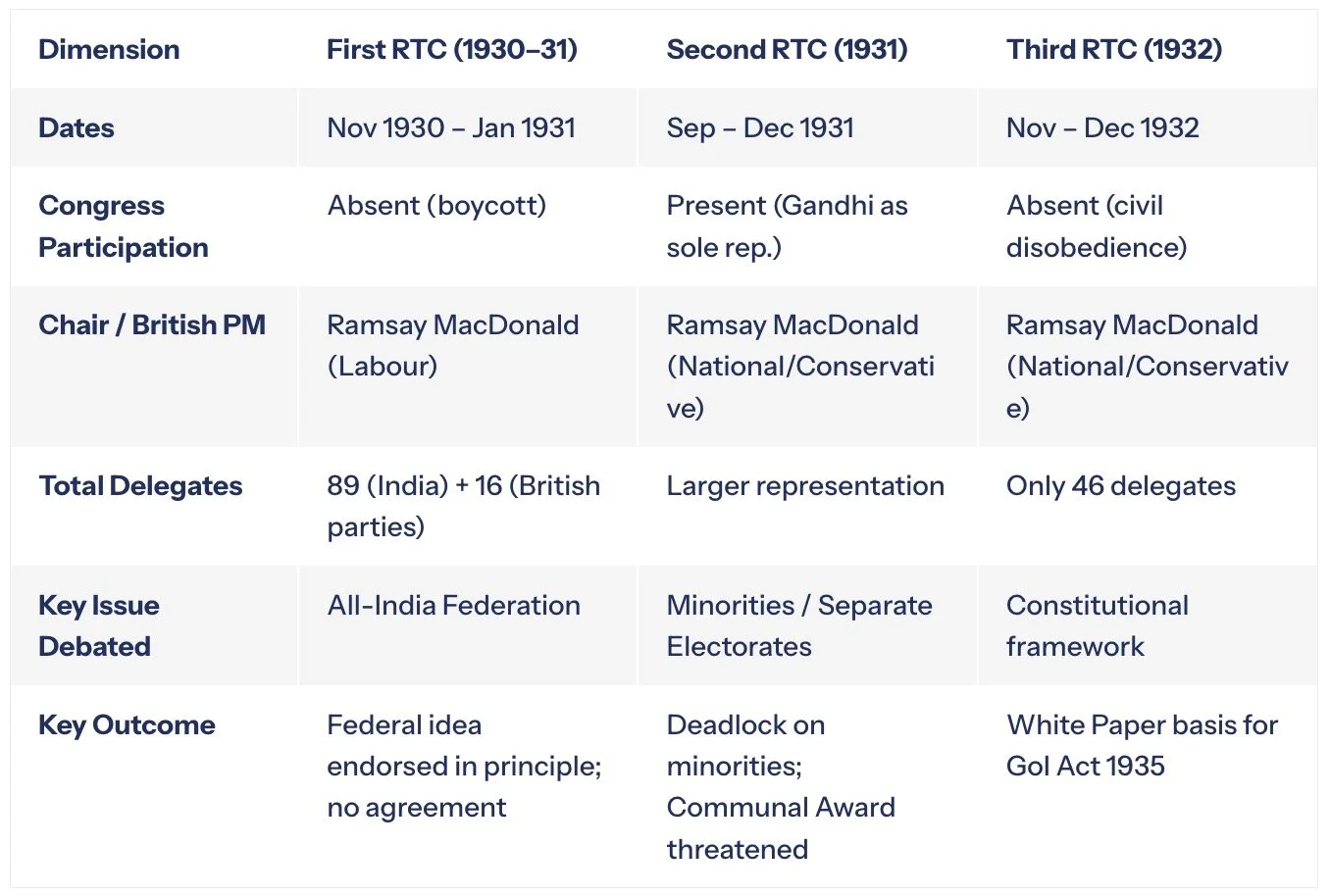
Each conference differed significantly in composition, context, and outcome.
Round Table Conferences
The comparative view underscores a clear trajectory that each conference was progressively less representative of Indian political opinion, more dominated by British conservative interests, and further removed from the Congress's constitutional demands. The story of the Round Table Conferences is, in many ways, the story of a negotiating process that was structurally skewed from the beginning — and yet one that set the stage for the legislative changes that would define the final decade of British rule in India.
Historical Significance
Legacy and Historical Significance
The Round Table Conferences occupy an important and complex place in the history of Indian nationalism. On one hand, they represented a grudging British acknowledgement that India's constitutional future could not be determined unilaterally — that Indian voices, however selectively chosen, had to be part of the process. On the other hand, they illustrated with painful clarity the limits of colonial reform: the British were willing to discuss how power would be transferred, but only under conditions that preserved essential imperial controls and divided Indian political opinion along communal lines.
Congress's Strategic Dilemma
The conferences forced the Congress to choose between boycott — which preserved ideological purity but ceded the field to communal and loyalist forces — and participation, which risked legitimising a process designed to dilute nationalist demands. Gandhi's attendance at the Second RTC was a calculated gamble that ultimately did not pay off.
Ambedkar and Minority Rights
Dr. B.R. Ambedkar's consistent advocacy for separate electorates for the Depressed Classes at the conferences highlighted the internal complexities of the independence movement and set the stage for the later Poona Pact (1932), which resolved the deadlock between Gandhi and Ambedkar over political representation for untouchables.
Path to the Government of India Act, 1935
Despite their failures, the conferences produced a documented record of negotiations that directly informed the Government of India Act, 1935. Though criticised by the Congress as a "charter of slavery," the Act introduced provincial autonomy and laid some groundwork for federalism — elements that would later influence the Constitution of independent India.
Ultimately, the Round Table Conferences demonstrated that constitutional reform imposed from above — without the genuine consent and participation of the most representative political forces — could not resolve the fundamental contradiction of colonial rule. The failure of the conferences did not delay Indian independence indefinitely; rather, it accelerated the radicalisation of the national movement and deepened the conviction of Congress leaders and ordinary Indians alike that freedom could only be won through sustained mass struggle, not through negotiated compromise on British terms.
"Responsibility for the Government of India should be placed upon legislatures, Central and Provincial, with such provisions as may be considered necessary…and also with guarantees…required by minorities." — Prime Minister Ramsay MacDonald, at the close of the First Round Table Conference
Key Takeaways
The Round Table Conferences are a rich case study in the politics of colonial reform, nationalist strategy, and communal negotiation. Understanding them requires appreciating both the macro-level dynamics of British imperial policy and the micro-level tensions within Indian political society. The following points are essential for any student seeking a clear, comprehensive grasp of this period.
Why the Congress Boycotted the First RTC
Congress demanded a Constituent Assembly — not a government-appointed conference. The vague offer of "dominion status" was seen as inadequate. The Lahore Session (1929) committed Congress to Poorna Swaraj and civil disobedience.
The Importance of the Gandhi-Irwin Pact
This pact was a landmark diplomatic moment — the first time the British negotiated with Indian nationalists as equals. It enabled Congress participation in the Second RTC, though it stopped short of Gandhi's core demands (including commutation of Bhagat Singh's death sentence).
Why the Second RTC Failed
The deadlock on separate electorates for minorities, Gandhi's isolation, a Conservative-dominated British cabinet, and the financial crisis of Britain going off the Gold Standard all contributed to the collapse of negotiations.
The Third RTC's Diminished Significance
With only 46 delegates and absent Labour and Congress representation, the Third RTC was largely a formality. Its main contribution was feeding into the White Paper (1933) and eventually the Government of India Act, 1935.
The Broader Lesson
The conferences show that genuine self-determination cannot be granted piecemeal by a colonial power on its own terms. The failure of the RTCs strengthened the resolve of the Indian national movement and made the mass civil disobedience path appear both necessary and inevitable.
