
The Punjab: Origins of Sikh Power
The history of the Sikh Panth in Punjab paralleled that of the Mughal empire itself, beginning when Guru Nanak was born in 1469—the same era when Babur was founding Mughal rule in India. Within the bhakti and sant tradition of medieval India, Sikhism began attracting millions of devotees and acquiring distinctive shape and definition under subsequent gurus' leadership. Aurangzeb's initially tolerant attitude toward Sikhs transformed to hostility as the community grew and challenged Mughal central authority, culminating in Guru Tegh Bahadur's execution in Delhi in 1675—an event that would fundamentally alter the Sikh community's trajectory.
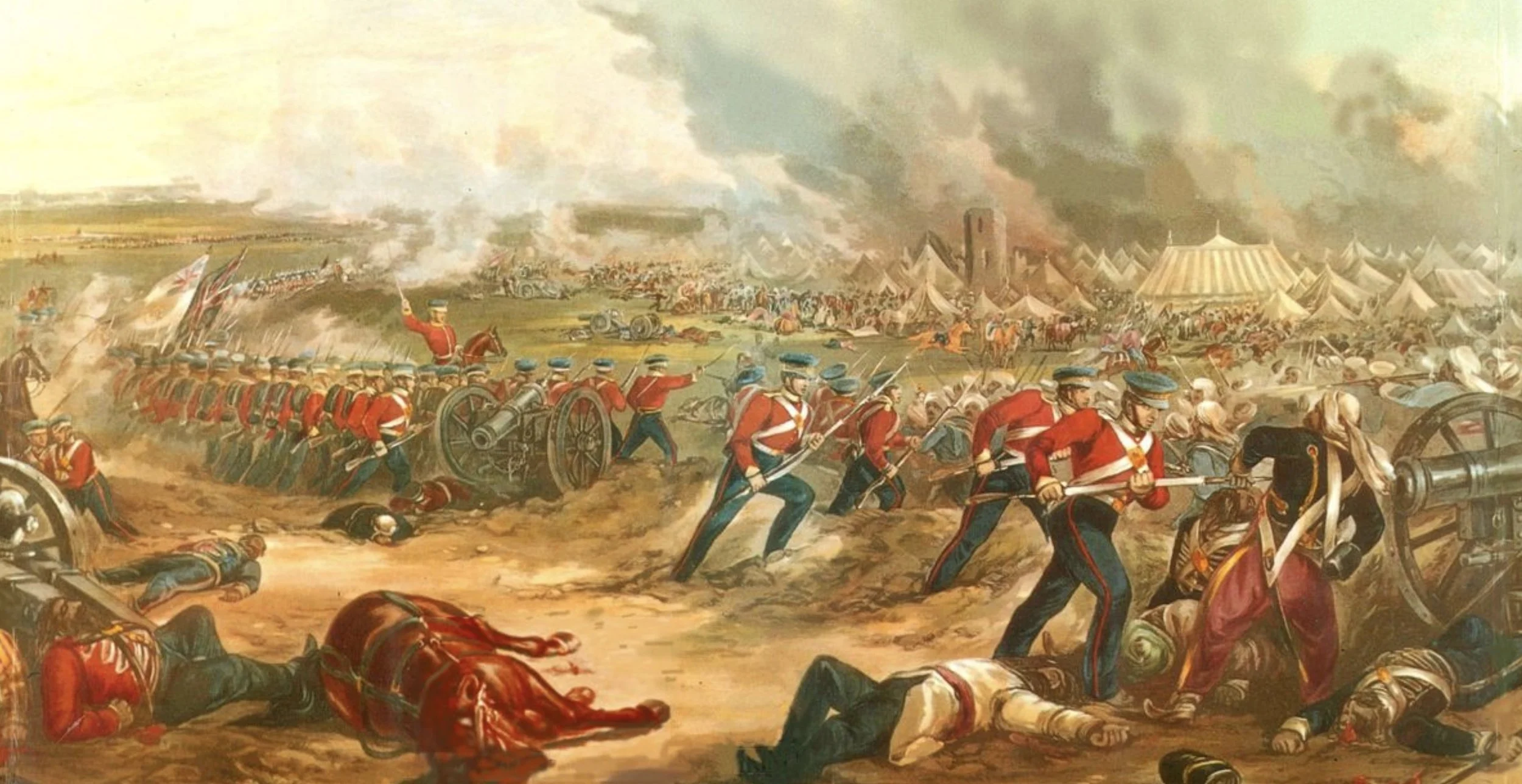
Battle of Ferozeshah, Anglo Punjab Wars
The Founding of the Khalsa (1699)
The tenth guru, Guru Gobind Singh, took a revolutionary step in 1699 by transforming Sikhs into a military organisation through establishing the Khalsa brotherhood. This ceremony saw the guru himself (not deputies or masands) initiating disciples, who were obliged to maintain five distinctive insignia creating a visible Sikh identity: Kesh (uncut hair), Kangha (wooden comb), Kara (iron/steel wrist bracelet), Kirpan (sword/dagger), and Kacchera (short breeches). These Five K's became the external markers of Khalsa membership, distinguishing Sikhs from surrounding populations.
Multiple factors likely motivated this transformation. The continuing Mughal conflict had convinced gurus—first Guru Hargobind, then Guru Gobind Singh—of armed resistance necessity for Panth defence. Additionally, the Jat peasantry's rise among Sikhs was significant, as bearing arms and resolving disputes through force were already integral to Jat cultural tradition, which the Khatri trader component of the Sikh community accepted. The Khalsa projected the Sikh community as a militant outfit, though not all Sikhs necessarily became Khalsa members.
Kesh
Uncut hair symbolising natural state
Kangha
Wooden comb for cleanliness
Kara
Steel bracelet of strength
Kirpan
Sword of dignity and defence
Kacchera
Short breeches of modesty
Jat peasants came to dominate the Khalsa at the Khatri leadership's expense, fulfilling aspirations for equality when Guru Gobind Singh terminated the guru position after his death, vesting guru power henceforth in the Panth (community) and Granth (sacred texts). By invoking cultural resources—sacred texts, initiation rituals, life-cycle ceremonies—the Khalsa provided order in Sikhs' lives during the uncertain eighteenth century, constructing a distinctive Sikh social and political identity that would prove remarkably durable through subsequent challenges.
Sikh Resistance and the Emergence of Misls
Guru Gobind Singh's conflict with the Mughals followed a complex trajectory involving multiple actors and shifting alliances. From approximately 1696, he attempted carving an autonomous domain around Anandpur, which provoked hostility from Himachal Pradesh hill chiefs who approached the Mughal faujdar for protection. The resulting 1704 siege of Anandpur by combined forces compelled Guru Gobind to flee. Although Aurangzeb, then occupied in the Deccan, soon reversed course and sought conciliation with the guru, after Aurangzeb's death Guru Gobind met Bahadur Shah at Agra in 1707, who promised Anandpur's return but continued postponing final decision to appease hill chiefs. On 7 October 1708, Guru Gobind was murdered in a conspiracy, after which Banda Bahadur continued the Sikh revolt.
Banda Bahadur's Rebellion (1708-1716)
The rebellion's focus shifted to Punjab's Majha (between Beas and Ravi) and Doab (between Beas and Sutlej) regions, inhabited mainly by Jat peasants suffering under Mughal oppression that pressured small zamindars and peasants tremendously. Banda Bahadur's main supporters were small mulguzari zamindars from the Jat community, though not all supported him. Within a year, he controlled large areas between Jamuna and Ravi rivers, establishing his own administration with appointed faujdars, diwan and kardars, minted coins, and used his seal for issuing orders—effectively creating an independent state.
Bahadur Shah proceeded to Punjab in 1710 but failed crushing the Sikh revolt. Farruksiyar, ascending in 1713, appointed Abdus Samad Khan as Lahore faujdar with special orders to end the Sikh upsurge. Banda Bahadur's position had weakened due to internal Sikh community dissension. Though Jat peasants generally supported him, some Jat zamindars—notably Churaman Jat of Agra—sided with Mughals. From around 1710, the Khatri business class opposed the Sikh movement, as political stability and secure trade routes were essential for their business. When Mughals introduced the ijaradari system in Punjab for land revenue collection, many Khatri traders became revenue farmers, naturally linking their interests to the Mughal state.
Emperors tried exploiting this internal dissension. During Jahandar Shah and Farruksiyar's reigns, many Khatris received high Mughal nobility positions. Farruksiyar used Guru Gobind's widow to drive wedges between Banda and his followers. However, this didn't necessarily weaken Banda's movement, as oppressive Khatri ijaradars often drove desperate Jat peasants into the rebel camp. Ultimately in 1715, Banda surrendered to Abdus Samad Khan, was taken to Delhi with close followers, and in March 1716 all were executed. Yet Banda's execution didn't end Sikh power in Punjab—even without centralised leadership, roving Sikh rebel bands exploited north India's imperial control breakdown to assert independence. Even Afghan invader Ahmad Shah Abdali failed bringing Punjab under his command, as his governors were soon expelled.
The Misl System
At this stage, Sikh polity power became horizontally structured, as misls (combinations based on kinship ties) held territories as units. When a misl conquered new territory, it was distributed among members according to each member's contribution toward conquest. The chief received the highest share, but even the lowest soldier got his patti (land portion) as co-sharer with absolute freedom. By 1770, over sixty misls held territories. Above them stood the Dal Khalsa with a chosen leader.
Misl Confederation Dynamics
Mughal weakness and Ahmad Shah Abdali's invasions created general confusion and anarchy in Punjab, helping the organised Dal Khalsa consolidate further. Misls did occasionally unite—as in 1765 against Afghans—but generally, political authority in Punjab remained decentralised and horizontally dispersed until Ranjit Singh, chief of the Sukerchakia misl, attempted raising a more centralised Sikh state at the eighteenth century's end.
Ranjit Singh and the Sikh Kingdom
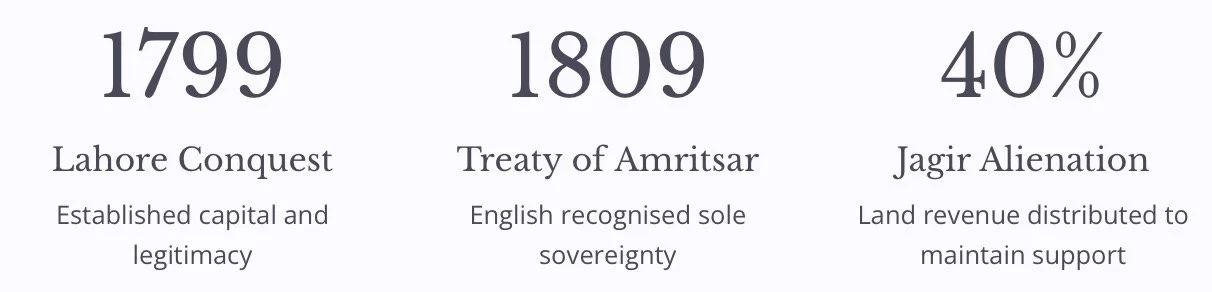
After repelling the third Afghan invasion under Abdali's successor Zaman Shah in 1798-99, Ranjit Singh emerged as one of the outstanding Sikh chiefs and conquered Lahore, marking the beginning of a unified Sikh kingdom. Born on 2 November 1780 as son of Mahan Singh, leader of the Sukarchakiya misl, Ranjit Singh inherited leadership at merely twelve years old upon his father's death. At the close of the 18th century, all important misls except Sukarchakiya were disintegrating, while Afghanistan was engulfed in civil war due to power struggles continuing for three decades—regional circumstances Ranjit Singh fully exploited following a ruthless 'blood and iron' policy to carve out a central Punjab kingdom.
Building the Sikh Empire
Leading an army with improved artillery and infantry trained by European officers, by 1809 Ranjit Singh controlled large areas across Punjab's five doabs. The Treaty of Amritsar that year saw the English recognise him as Punjab's sole sovereign ruler, providing opportunity to complete conquests by ousting Afghans from Multan (1818) and Kashmir (1819), subduing most other Sikh chiefs—many reduced to tribute-paying vassal status. By his death, his authority was recognised in territories between River Sutlej and the mountain ranges of Ladakh, Karakoram, Hindukush and Sulaiman.
Like the Marathas, Ranjit Singh's new administration was a careful blend of Mughal system and local traditions. Mughal institutional continuity was remarkable in administrative division organisation, officials' nomenclature, and tax collection systems. Trade and commerce flourished as a powerful state provided safe passage to traders and caravans, though land revenue remained the state's main income source. While land revenue collection amounts increased, about 40 percent was alienated as jagir. In remaining territories, land revenue was directly collected through kardars, but state penetration stopped at village level, not infringing upon clan and chief power. Local traditional hierarchies and centralised monarchical state concepts existed in delicately balanced relationship—dualism between 'national' and 'local' governance systems.
This incorporation and adjustment process as part of constructing a monarchical state was visible culturally as well, where the Khalsa's attempt to construct an exclusive Sikh identity gradually incorporated non-Khalsa Sikhs or sahajdharis. At the central durbar politics level, Ranjit Singh maintained careful balance between powerful Sikh chiefs on one hand and freshly recruited military commanders from central Punjab peasants and non-Punjabi nobles like Dogra Rajputs from Jammu on the other. This delicate balancing functioned well until Ranjit Singh's 1839 death. Within a decade of his death, independent Sikh rule disappeared from Punjab, as power struggles among mighty Sikh chiefs and royal family feuds helped the English take over without much difficulty—demonstrating how personal authority, rather than institutional structures, held his kingdom together.
The Anglo-Sikh Wars and Punjab's Annexation
Ranjit Singh's death in June 1839 marked the beginning of Punjab's political disintegration. A succession of rulers ascended the throne quickly, plunging the region into prolonged and bloody succession battles. Kharak Singh, Ranjit Singh's only legitimate son and successor, proved inefficient, and during his brief reign, court factions became highly active. His sudden 1839 death and his son Prince Nav Nihal Singh's accidental death (returning from his father's funeral) led to anarchic situations in Punjab, including contests between Sher Singh (another Ranjit Singh son) and Maharani Chand Kaur (Kharak Singh's widow) for the throne.
1839
Ranjit Singh dies; Kharak Singh becomes ruler
1839
Kharak Singh and Nav Nihal Singh both die
1841-43
Sher Singh's brief, unstable reign
1843
Sher Singh murdered; Dalip Singh proclaimed
1845-46
First Anglo-Sikh War; Treaty of Lahore
1848-49
Second Anglo-Sikh War; Punjab annexed
Sher Singh ultimately became maharaja through bizarre Dogra conspiracy, becoming dependent on overmighty Dogra wazir Raja Dhian Singh, but was murdered in late 1843. Subsequently, Dalip Singh, a minor son of Ranjit Singh, was proclaimed Maharaja with Rani Jindan as regent. These family feuds and court conspiracies resulted from the delicate power balance breakdown that Ranjit Singh had carefully maintained between hereditary Sikh chieftains and upstarts, and between Punjabi and Dogra Jammu nobles in the royal court. Bureaucratic corruption and internecine sardar strife put Punjab's economy into shambles.
Countryside revenue demands increased after 1839 due to rising army costs, resulting in zamindar resistance to revenue collection. Conversely, kardars increased their extortion of landed zamindars while defrauding the central treasury. These developments encouraged centrifugal tendencies within Punjabi society, while commercial classes were disenchanted by political disruptions—the entire situation offering British intervention opportunities. The army—the Sikh state's pillar—was far less strong than it appeared, with Ranjit Singh's able generals already dead, troop discontent growing from irregular payment, and unworthy officer appointments leading to indiscipline.
Treaty of Lahore (1846)
The First Anglo-Sikh War's end forced Sikhs to sign humiliating terms on 8 March 1846: over 1 crore rupees war indemnity, Jalandhar Doab annexation to Company dominions, British resident establishment at Lahore under Henry Lawrence, Sikh army strength reduction, Dalip Singh recognised as ruler under regency, and Kashmir including Jammu sold to Gulab Singh for Rs 75 lakh since Sikhs couldn't pay entire war indemnity.
The First Anglo-Sikh War (1845-46) began when Sikh army crossed River Sutlej on 11 December 1845—seen as aggressive manoeuvre justifying English war declaration. However, treachery by Lal Singh and Teja Singh caused five successive Sikh defeats despite their numerical superiority (50,000 Sikhs versus 20,000-30,000 British troops). Lahore fell to British forces on 20 February 1846 without a fight. Leadership failure and sardar treachery led to the formidable Sikh army's defeat. The Treaty of Bhairowal (December 1846) removed Rani Jindan as regent, establishing an eight-member Sikh sardar council presided over by English Resident Henry Lawrence.
The Second Anglo-Sikh War (1848-49) resulted from humiliation over earlier defeats and Lahore and Bhairowal treaty provisions, with inhuman treatment of Rani Jindan (sent to Benares as pensioner) adding to Sikh resentment. The immediate pretext was rebellion by two Sikh governors—Diwan Mul Raj of Multan and Sardar Chartar Singh Atariwala with his son Raja Sher Singh of Haripur. Lord Dalhousie, a hardcore expansionist, used this pretext for complete Punjab annexation. On 29 March 1849, Maharaja Dalip Singh signed the annexation document; Punjab became an East India Company empire province. A three-member board (Lawrence brothers Henry and John, plus Charles Mansel) initially governed Punjab; in 1853, the board was nullified and Punjab placed under a chief commissioner, with John Lawrence becoming the first chief commissioner. The Anglo-Sikh wars created mutual respect for each other's fighting prowess—Sikhs would fight loyally on the British side in the 1857 Revolt and many subsequent campaigns until Indian independence in 1947.
