
Early Structure of the British Raj
The evolution of British administrative control in India represents one of the most significant transformations in colonial history. From the East India Company's initial commercial ventures to the establishment of direct governmental authority, this period witnessed the gradual construction of an administrative machinery that would govern India for nearly two centuries. Understanding this progression—from the infamous Dual System to the sophisticated regulatory frameworks of the late 18th century—is essential for comprehending how British imperialism translated commercial success into political dominance. This document examines the key legislative acts, administrative reforms, and judicial innovations that shaped the early Raj, providing insights into the mechanisms through which a trading company became an empire.
The Treaty of Allahabad and the Birth of Dual Government
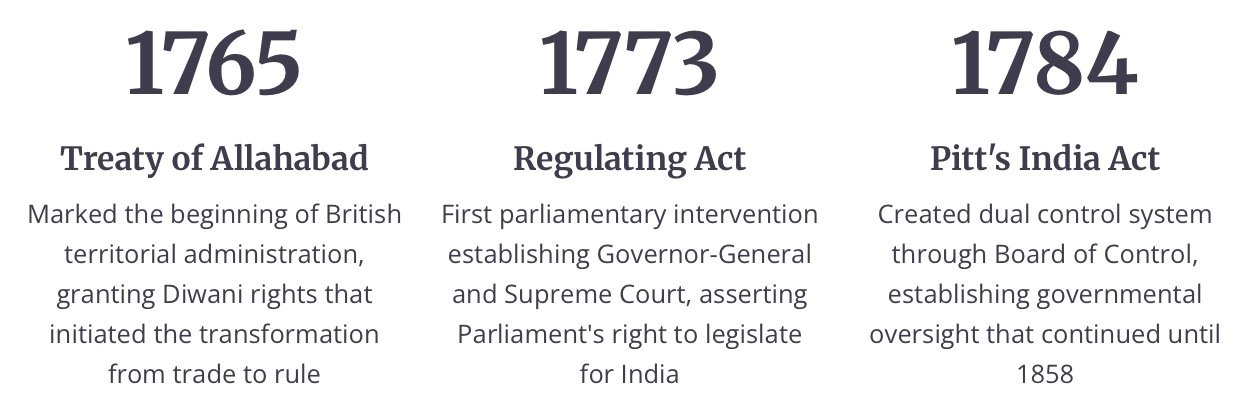
On 12th August 1765, Robert Clive secured from Shah Alam II, the powerless Mughal Emperor, a farman granting the East India Company the Diwani of Bengal, Bihar, and Orissa. This momentous agreement, stemming from the Treaty of Allahabad, fundamentally altered the Company's role in India—transforming it from a mere trading entity into a revenue-collecting administrative power. In return for these rights, the Company agreed to pay the Emperor an annual subsidy of 26 lakh rupees, whilst the Nawab of Bengal was reduced to a pensioner receiving 53 lakh rupees annually for maintaining the Nizamat.
This arrangement created what became known as the Double Government in theory, with the Company functioning as Diwan and the Nawab as Nizam. However, the reality was far more complex and problematic. The system divided Bengal's administration into two spheres: Diwani, concerning revenue and civil justice, was controlled by the Company; whilst Nizamat, encompassing police and criminal justice, remained nominally with the Nawab. This division would prove to be the source of immense administrative chaos and popular suffering in the years to come.
Key Date: 12th August 1765 marked the formal beginning of British territorial administration in India, establishing the legal foundation for future expansion.
The Mechanics of Dual Administration (1765-1772)
The Dual System established by Clive represented an ingenious yet fundamentally flawed administrative arrangement. Though theoretically divided between the Company and the Nawab, actual power rested entirely with the British. The Company, as Diwan, was authorised to collect provincial revenues, whilst through its right to nominate the deputy Nizam (deputy subahdar), it effectively controlled police and judicial powers as well. The deputy subahdar could not be removed without Company consent, and the English Resident at the Durbar decided every matter of importance, rendering the Nawab a mere figurehead devoid of independent military or financial support.
However, at this juncture, the Company was neither willing nor able to collect revenue directly. Consequently, it appointed two deputy diwans: Mohammad Reza Khan for Bengal and Raja Sitab Roy for Bihar, with Mohammad Reza Khan also serving as deputy Nizam. This arrangement meant the entire administration was exercised through Indian agency, though actual authority remained with the Company. During the Dual System, Nawab-ud-Daulla and Saif-ud-Daulla served as Nawabs of Bengal, presiding over an administration that was rapidly deteriorating. The system continued under Clive's successors Verelst (1767-69) and Cartier (1769-72), each witnessing the progressive collapse of effective governance in Bengal.
Treaty Negotiation
Shah Alam II grants Diwani rights to the Company in exchange for annual tribute
Administrative Division
Power split between Company (Diwani) and Nawab (Nizamat) creating dual authority
Indirect Control
Company exercises authority through Indian deputies whilst maintaining fiction of native sovereignty
System Collapse
Administrative breakdown leads to widespread suffering and eventual British intervention
Strategic Merits of Dual Government
Despite its eventual failure, Clive's Dual Government was not without strategic merit from the Company's perspective. The arrangement served multiple pragmatic purposes that reflected both the political realities of mid-18th century India and the Company's own limitations. Understanding these merits helps contextualise why such an imperfect system was deliberately chosen and maintained for seven years.
Financial Protection
The primary objective was bolstering Company finances through revenue collection without incurring the burden of formal dominion. This allowed the Company to maintain armies and territorial control whilst avoiding the costs and responsibilities of direct administration.
Political Prudence
Clive's policy of decentralisation saved the British from the wrath of Indian rulers who might have taken drastic measures against overt British occupation. The fiction of Mughal sovereignty provided a buffer against united Indian resistance.
European Diplomacy
The system protected the Company from jealousy of other European powers—French, Dutch, and Portuguese—who might have withdrawn tariff payments or formed hostile coalitions had Britain openly occupied Bengal.
Administrative Capacity
Company servants were not conversant with Bengali languages, customs, traditions, or laws. Their numbers were too small to manage direct administration effectively. Using Indian intermediaries was a practical necessity.
Home Authority Compliance
Both the Board of Directors and British Parliament opposed direct administration. Dual Government allowed Clive to honour the Directors' wishes whilst avoiding Parliamentary wrath, particularly from figures like Pitt who advocated Crown takeover.
Responsibility Shield
The system freed the Company from real administrative responsibility. The English obtained power and wealth whilst the Nawab bore responsibility for governance failures—a cynical but effective political arrangement.
The Catastrophic Demerits of Dual Government
Whilst Clive's Dual Government possessed strategic rationale, its implementation led to disastrous consequences for Bengal's population and administrative integrity. The system's fundamental flaw—divorcing power from responsibility—created a perfect storm of corruption, oppression, and governmental collapse. These demerits far outweighed any temporary advantages the arrangement provided to the Company.
Power Without Responsibility
The British possessed power and revenue whilst the Nawab had neither, yet bore full responsibility for administration with merely 50 lakh rupees annually. This divorce of authority from accountability led to rampant abuse and corruption, with no effective mechanism for redress.
Collapse of Law and Order
The Nawab lacked power and funds to enforce law, resulting in widespread lawlessness. Theft and robbery increased dramatically as judicial systems broke down. Judges, appointed through British influence, failed to deliver impartial verdicts, undermining public confidence in justice.
Peasant Oppression
Agricultural conditions deteriorated rapidly as the Nawab could not provide irrigation or advance loans to farmers. Private trade by Company servants reduced Company revenues, leading to higher demands on zamindars who, in turn, oppressed the peasantry mercilessly. The devastating famine of 1770 was an indirect but inevitable outcome.
Revenue Collapse
Agricultural decline caused dramatic falls in revenue collection. Despite being on the verge of bankruptcy, the Company had to request Parliament excuse its £400,000 annual payment obligation.
Abuse of Private Trade
Company servants engaged in duty-free private trade, earning enormous profits whilst local merchants struggled under tax burdens, devastating indigenous commerce.
Industrial Destruction
Local weavers were forced to work exclusively for the Company. Small industries fell under Company control, crippling traditional economic structures.
By 1772, the system's failures had become undeniable. Warren Hastings ended the Dual Government on the Directors' orders, with Mubaraq-ud-Daulla serving as the last Nawab under this arrangement. The experiment had conclusively proven that masked authority without genuine responsibility inevitably produces administrative chaos and human suffering.
Crisis and the Road to the Regulating Act
The period leading to the Regulating Act of 1773 was marked by multiple converging crises that forced Parliament's hand. The Bengal Famine of 1770 stands as one of history's most appalling disasters, with Company agents blamed for governmental collapse. Simultaneously, the Company's three Presidencies—Bengal, Madras, and Bombay—operated with little coordination, each making wars and concluding treaties independently, creating diplomatic chaos and military overextension.
Administrative confusion reached its zenith under the Dual Government system. Corruption climaxed, confusion and chaos prevailed, and cases of plunder and oppression became routine. The divorce of power from responsibility made the system suffer from every conceivable defect, yet Parliament could no longer remain a passive spectator.
The Financial Paradox
A striking paradox emerged that would prove fatal to Company independence. In 1766, the Company agreed to pay £400,000 annual tribute to the British Government. Initially paid, this obligation soon became impossible. The Company blamed loss of American tea sales since 1768 due to Dutch competition. With £15 million pounds of tea rotting in British warehouses, owing money to both the Bank of England and the government, the Company was forced to apply for a £1 million loan in 1772.
This bankruptcy shocked the British establishment—how could a company whose servants returned to England laden with gold be insolvent? In seeking governmental loans, the Directors signed their Company's independence death warrant.
The Nabobs and Social Resentment
The rich resources of Bengal had created a new class of wealthy Company servants who excited widespread resentment in British society. The Company raised dividends to 10% in 1767 and proposed 12.5% in 1771, whilst its officials amassed fabulous fortunes through illegal trade and forced extraction of bribes from Indian chiefs and zamindars. Robert Clive himself returned to England at age 34 with wealth and property yielding £40,000 annually—an enormous fortune that symbolised the exploitation many Britons found unconscionable.
The Nabob Phenomenon
Returning officials received the derisive title of "nabobs" and were ridiculed in press and theatre. The aristocracy boycotted them, condemning them as exploiters and oppressors of Indians.
Merchant Class Resentment
Merchants excluded from Eastern trade, manufacturers, and advocates of free enterprise attacked the Company's monopoly, seeking to share India's profitable trade and riches.
Parliamentary Questions
When Directors declared a 12.5% dividend in March 1772 yet requested a £1 million loan by August, Parliament demanded answers about this apparent contradiction.
These factors combined to make the Company deeply unpopular across British society. Prime Minister Lord North decided to overhaul Company management and provide legal government for Indian possessions. Parliament appointed Secret and Select Committees to investigate Company affairs. The Secret Committee examined the financial crisis whilst the Select Committee investigated Dual Government failures. Since the Government sought to regulate rather than nationalise the Company—partly due to the powerful Company lobby in Parliament—the resulting legislation became known as the "Regulating Act". This marked the first step along the road to governmental control of India, establishing a system of supervised regulation rather than direct takeover.
The Regulating Act of 1773: Key Provisions
Landmark Legislation
Passed by Lord North's Government
The Regulating Act of 1773 represented Parliament's first major intervention in Company affairs, remodelling the Company's constitution both in England and in India. Though it failed as a long-term solution—necessitating Pitt's India Act in 1784—it established crucial precedents for parliamentary oversight and centralised administration. The Act permitted the Company to retain possessions and Indian powers whilst bringing management under British Government control.
Directorial Reform in England
Directors elected for four-year terms instead of annually. Number fixed at 24, one-quarter retiring yearly. Retiring Directors barred from immediate re-election. Voting rights raised from £500 to £1,000 shareholding.
Government Oversight
Directors required to place all civil and military correspondence before the Secretary of State. Revenue correspondence submitted to the Treasury. This established Cabinet control over Company operations.
Anti-Corruption Measures
No person holding civil or military office could accept presents, gifts, donations, or rewards. Company servants prohibited from private trade. These provisions aimed at honest administration.
Governor-General and Council: The New Executive
The Act elevated Bengal's Governor to Governor-General, assisted by a four-member Council. This new executive structure aimed to provide unified leadership whilst preventing autocratic rule through collective decision-making. The first Governor-General, Warren Hastings, was named in the Act alongside Councillors Philip Francis, Clavering, Monson, and Barwell—a composition that would prove contentious and occasionally paralysing.
Council decisions required majority votes, with the Governor-General possessing only a casting vote in equal divisions. Three members formed a quorum, ensuring decisions could be made even with one absence. Appointees held office for five years and could only be removed by the King upon Directors' recommendation, providing security of tenure that encouraged independent judgement. Future appointments were vested in the Company, maintaining a degree of corporate autonomy.
Powers and Responsibilities
The Governor-General in Council received comprehensive authority over Fort William's civil and military government in Bengal. Critically, they were empowered to superintend and control the subordinate Presidencies of Madras and Bombay regarding war and peace with Indian states, except in emergencies. This represented the first attempt at centralised governance across British Indian territories.
The Governor-General and Council were mandated to keep Directors fully informed of all activities affecting Company interests and to work in obedience to Directors' orders and instructions. This created a dual reporting structure—accountable both to Company Directors and increasingly to Parliament through the Directors—that would evolve into more direct Crown control in subsequent decades.
Generous Salaries
Governor-General: £25,000
Each Councillor: £10,000
Chief Justice: £8,000
Puisne Judges: £6,000 each
These substantial salaries aimed to reduce corruption by ensuring officials could maintain appropriate status without illicit income.
India's First Supreme Court
The Regulating Act empowered the Crown to establish by charter a Supreme Court of Judicature at Fort William, Calcutta, comprising a Chief Justice and three puisne judges. Constituted in 1774, Sir Elijah Impey became the first Chief Justice, with Chambers, Lemaister, and Hyde as puisne judges. This court marked a watershed in Indian legal history, introducing English judicial principles whilst grappling with their application in an Indian context.
Jurisdiction Over British Subjects
The Court held jurisdiction over all British subjects in Bengal, Bihar, and Orissa, their servants, and persons employed by the Company. However, the Act failed to clearly define "British subjects"—creating ambiguity about whether all Calcutta residents or only English-born individuals qualified.
Civil Jurisdiction
Civil jurisdiction covered His Majesty's subjects, persons employed directly or indirectly by the Company, and those who voluntarily agreed in writing to submit disputes to the Court. This broad reach aimed to provide legal recourse against oppression.
Original and Appellate Powers
The Court possessed both original and appellate jurisdiction, hearing cases with British subject juries following British custom. It could determine all case types and grant redress through methods then prevalent in English judicial procedure.
Cases Against Officials
The Court could accept cases against the Governor-General and Council members, though it lacked power to arrest or imprison them. This provided theoretical accountability whilst preserving executive dignity.
The Court was directed to consider and respect Indians' religious and social customs, acknowledging cultural sensitivity requirements. Appeals from provincial courts went to the Governor-General-in-Council as the final appellate authority. Significantly, the Governor-General-in-Council's rules and regulations did not require Supreme Court registration, maintaining executive-judicial separation. Later amendments, particularly the 1781 Act, exempted public servants' official actions from Supreme Court jurisdiction, addressing conflicts that emerged between judicial and administrative authorities.
Fatal Flaws: Criticisms of the Regulating Act
Despite its ambitious scope, the Regulating Act suffered from fundamental design flaws that rendered it ineffective within years. Based on checks-and-balances theory, it broke down under Indian circumstances and its inherent defects. The Act's compromises and intentional vagueness, arising from Parliament's inability to properly define sovereignty in India, created more problems than it solved.
Governor-General's Powerlessness
Without veto power, Warren Hastings was perpetually outvoted by his Council majority during the first two years. As "first among equals," he lacked authority to implement his vision. The Act's ambiguity gave rise to serious conflicts between Governor-General and Council members, worsening rather than improving governance.
Vague Supreme Court Jurisdiction
The Act failed to clearly define Supreme Court jurisdiction or its relationship with the Governor-General-in-Council. This created hostile camps on "borderland of debatable jurisdictions." The Council could make no laws that judges didn't condescend to notice. Ambiguity about whether British or Indian law applied led to travesties like Nanda Kumar's hanging—a case that epitomised the system's injustices.
Inadequate Presidential Control
Provincial governors exploited vague wordings to act independently. On emergency pretexts, Madras and Bombay started wars and made alliances without reference to the Governor-General-in-Council, undermining centralisation efforts and increasing vulnerability to attacks.
Failure to Address Indian Suffering
Nothing in the Act addressed Indians paying revenue to the Company yet dying of starvation in Bengal, Bihar, and Orissa. The Act focused entirely on Company governance and British interests, ignoring the welfare of millions under Company rule.
Persistent Corruption
Despite anti-corruption provisions, the system failed to stop malfeasance. Warren Hastings himself faced corruption charges and impeachment. The entire Council divided into Hastings and Francis factions fighting over corruption allegations, paralysing effective governance.
The Act neither gave the state definite control over the Company, nor Directors control over servants, nor the Governor-General control over his Council, nor Calcutta control over Madras and Bombay. Many defects were addressed by the Declaratory Act 1781, Pitt's India Act 1784, and the Amendment Act 1786. Nevertheless, the Regulating Act remained relevant as Parliament's first attempt to regulate Company administration in India, formally recognising parliamentary right to control Indian affairs and marking the beginning of India's constitutional history.
The Nanda Kumar Case: Justice Perverted
Landmark Injustice
The Nanda Kumar case exemplifies corruption, nepotism, and injustice during early British rule, revealing how judicial mechanisms could be manipulated to serve political ends. Raja Nanda Kumar, a prominent Bengali zamindar, laid charges before the Council in March 1775 alleging Warren Hastings received bribes from former Nawab's wife, Munni Begum, for granting zamindari rights. The allegation claimed Hastings received Rs. 3,45,105 as bribe.
The Political Context
Sir Philip Francis, a Council member and Hastings' rival, encouraged Nanda Kumar to expose Hastings. The Council majority directed Hastings to refund the alleged bribe to Company treasury. However, Hastings overruled these charges. Whilst charges against Hastings remained pending (subsequently dropped), Nanda Kumar was suddenly arrested at a Calcutta merchant Mohan Das's instigation on forgery charges—clearly at Warren Hastings' behest.
The Trial's Irregularities
Tried under Elijah Impey—Hastings' close friend and India's first Chief Justice—Nanda Kumar was found guilty and hanged in Kolkata on 5th August 1775 under British parliamentary statute. The trial's peculiarities were glaring: charges were preferred shortly after Nanda Kumar accused Hastings; every Supreme Court judge cross-examined defence witnesses, collapsing the entire defence; Nanda Kumar's appeal application to the King-in-Council was rejected.
5 Years Before Court
The forgery offence occurred nearly five years before the Supreme Court's establishment, raising questions about retrospective jurisdiction
0 Capital Offences
Under neither Hindu nor Mohammedan law was forgery regarded as a capital crime, yet British law was applied
1795: Hastings Acquitted
The House of Lords finally acquitted Hastings on all charges in April 1795, though his impeachment trial exposed systemic corruption
This judicial murder demonstrated how the ambiguous provisions of the Regulating Act could be exploited to eliminate political opponents. Warren Hastings was later impeached for crimes and misdemeanours during his Indian tenure, with the alleged judicial killing of Nanda Kumar featuring prominently. Though ultimately acquitted in 1795, the Company compensated him with £4,000 sterling annually—a tacit acknowledgement of the controversy surrounding his administration.
The Act of Settlement 1781: Attempted Corrections
The Act of Settlement 1781, also known as the Declaratory Act, was passed by British Parliament on 5th July 1781 to remove defects in the Regulating Act 1773. Its main purpose was establishing a court system to address grievances against the Supreme Court and mitigate the Regulating Act's failure to control administration through judiciary. The circumstances precipitating this legislation included serious administrative issues under Warren Hastings—particularly the Patna, Cosijurah, and Nanda Kumar cases—which generated extensive criticism.
Exemption of Company Servants
Company servants previously within Supreme Court jurisdiction were now exempted, particularly regarding their official actions. This addressed conflicts between judicial and administrative authorities.
Revenue Matters Excluded
The Court lost jurisdiction over revenue matters concerning collection thereof. Government became independent of Court control in revenue administration.
Appellate Jurisdiction Shift
Appeals from Provincial Courts now went to the Governor-General-in-Council rather than the Supreme Court, strengthening executive authority.
Personal Law Assertion
The Act asserted that Mohammedan law should apply to Muslim cases and Hindu law to Hindu cases, respecting religious legal traditions.
Impact and Continuing Defects
The Act gave superior authority to the Council over the Court, favouring the Council and strengthening its position to maintain control over the Indian empire. It represented the first attempt to separate executive from judiciary by defining respective jurisdictional areas. However, the Act failed to provide vibrant impact or remove all Regulating Act flaws.
Significant defects remained: the Governor-General still lacked veto power; he was answerable to Directors for all administrative acts yet had no independent adjudication authority; confusion persisted about Supreme Court powers and jurisdiction; and the Act failed to address concerns of Indian-origin people, the system's real victims. The issuance of writs remained confusing, with the charter providing certain writs in some cases but creating uncertainty in others.
The Touchet Committee, appointed by the House of Commons in 1777 to enquire about Bengal, Bihar, and Orissa administration, produced a report that led to this Act's enactment.
Warren Hastings: From Dual System to Direct Control
Warren Hastings' arrival in Bengal as Governor of Fort William Presidency in 1772 proved a turning point in British Indian administration. That year, the Court of Directors ordered the Company to stand forth as 'Diwan', terminating the dual government system and imposing administrative tasks upon commercial men—formally laying the civil service foundation. This transition from masked to direct control marked a fundamental shift in British governance philosophy in India.
Administrative Restructuring
Englishmen were appointed as District Collectors under a Board of Revenue at Calcutta—a weak system Hastings characterised as "petty tyrants and heavy rulers of the people". Nevertheless, the foundation of modern civil service was laid during his regime, establishing administrative precedent that profoundly shaped later British India governance.
The Oriental Elite Vision
Hastings, possessing proficiency in Bengali, Urdu, and Persian, understood the relationship between an acculturated civil servant and an efficient one. He emphasised creating an "oriental elite club of civil servants" competent in Indian languages and respectful of Indian traditions, lifting servants' moral tone and intellectual standards.
Anti-Corruption Measures
Dastaks (duty-free trading permits) were abolished in 1773; private traders had to pay 2.5% duty to the Board of Customs. Hastings separated revenue and commercial branches. The Regulating Act 1773 prohibited all officials—from Governor-General to Supreme Court judges—from accepting gifts, donations, or rewards, with legal conviction consequences.
By 1780-81, revenue and judicial administration in districts was entrusted to English officers, beginning the civil service "nucleus" with systematisation and specialisation of functions essential to such service. Pitt's India Act 1784 provided definite salary scales and emoluments. Hastings demonstrated great respect for Hindu ancient scripture, setting British governance as one looking back to earliest precedents possible—though this allowed Brahmin advisers to mould law until Sir William Jones thoroughly understood Sanskrit.
Judicial Reforms Under Warren Hastings
The grant of diwani in 1765 gave the East India Company revenue collection rights in Bengal, Bihar, and Orissa, but the nawabi administration and Mughal judicial system remained initially in place. Between 1765 and 1772, Indian officers administered judicial matters under the Mughal system in both civil and criminal justice. Clive appointed Muhammad Reza Khan to represent the Company's civil jurisdiction; as Naib Nazim, he also administered the nawab's criminal jurisdiction.
The Mughal System's Character
The Mughal system was never centrally organised, depending largely on local faujdars and their executive discretion. Although sharia (Islamic law) was referenced for legitimation, its application varied widely depending on case seriousness and mufti/kazi interpretation. This system focused more on mutual conflict resolution than punitive justice (except in rebellion cases), with punishment depending on the accused's status.
British Criticism
Many Company officials attributed this system to 18th-century degeneration when zamindars and revenue farmers allegedly usurped judicial authority, driven more by pecuniary considerations than justice. This led to complaints about justice system "venality". By 1769, it was argued that direct European supervision was needed to ensure judicial prerogative centralisation, retrieved from zamindars and revenue farmers, thereby asserting Company sovereignty.
1772: New Court System
Hastings established two courts per district: civil court (diwani adalat) and criminal court (faujdari adalat), retaining Mughal nomenclature whilst applying Muslim law in criminal justice and Muslim/Hindu law in personal matters.
Civil Court Structure
European District Collectors presided over civil courts, assisted by maulvis and Brahman pundits interpreting indigenous laws. An appeal court in Calcutta was presided over by the President and two Council members.
Criminal Court Arrangement
Criminal courts operated under a kazi and mufti but were supervised by European collectors. The Sadar Nizamat Adalat (appeal court) moved from Murshidabad to Calcutta under Hastings' personal supervision until 1774.
System Failure
Hastings finally acknowledged failure to improve law and order, reluctantly accepting Directors' decision to reappoint Reza Khan at the nizamat adalat's head, which moved back to Murshidabad.
Evolution Towards Codification
Between 1773 and 1781, further civil justice changes occurred, partly responding to revenue collection demands and partly deferring to the Whig principle of separating executive functions from justice administration. According to plans by Hastings and Sir Elijah Impey, district collectors were divested of judicial duties. Instead of district courts, initially six provincial courts, later eighteen mofussil courts, were created, presided over solely by European covenanted officers.
Supreme Court as Appeal Court
For some time, the new Supreme Court created by the Regulating Act 1773 acted as an appeal court, introducing English judicial principles into the Indian system.
Code of 1781
Prescribed specific rules and regulations for all civil courts down to the lowest level. All judicial orders were henceforth required to be in writing, establishing documentary procedure.
The Interpretation Problem
Conflicting and varying interpretations of indigenous laws hindered certainty and uniformity. Brahman pundits often gave divergent dharmashastra interpretations, varying widely from case to case.
Legal Digests Compiled
A committee of eleven pundits compiled a Hindu law digest in 1775, translated into English by N.B. Halhed in 1776 to lessen European judges' dependence on indigenous interpreters. A Muslim law code was compiled by 1778.
This law standardisation meant legal practice now required professional expertise from specially trained people—lawyers. Reform effects tended to centralise judicial authority and reduce administration to a system, establishing foundations for the elaborate judicial machinery that would characterise later British India.
Pitt's India Act 1784: Dual Control Established
The East India Company Act 1784, known as Pitt's India Act, was enacted to address Regulating Act 1773 shortcomings by bringing the East India Company's Indian rule under British Government control. William Pitt the Younger, becoming England's youngest Prime Minister in 1783 at age 24, was an outstanding administrator working for efficiency and reform, bringing in a new generation of outstanding administrators. The Act established dual control of India by the British government and the British East India Company, continuing until 1858.
Board of Control Creation
Six members: Chancellor of the Exchequer, Secretary of State, and four Privy Councillors nominated by the King. The Secretary of State served as President, empowered to control all civil/military government or revenue matters.
Dual Government Structure
The Act provided joint government by Company and Crown. The Company was represented by the Court of Directors; the Crown by the Board of Control. A Secret Committee of three Directors transmitted Board orders to India.
Board's Oversight Powers
Full access to Company records. Powers to send Governors to India and full authority to alter them. Approval necessary for all non-commercial dispatches. No independent executive power or patronage—veiled authority.
Court of Directors' Rights
Retained patronage and right of dismissing servants. Court of Proprietors lost right to rescind, suspend, or revoke Directors' resolutions approved by the Board of Control.
The Act differentiated the Company's political functions from commercial activities. In political matters, the somewhat sovereign Company was made directly subordinate to the British government. Company's territorial possessions remained untouched; only public affairs and Indian administration came under more direct government control. This arrangement created a system where authority remained divided between Company Directors and the Board of Control, giving virtual autonomy to the man on the spot—the Governor-General.
Governance Changes in India Under Pitt's Act
Pitt's India Act significantly restructured governance within India itself, strengthening the Governor-General's position whilst attempting to create clearer hierarchies of control. These changes aimed to address the administrative chaos that had characterised earlier arrangements, though implementation would reveal new challenges and ambiguities.
Reduced Council Size
The Governor-General's council was reduced to three members, one being the Commander-in-Chief of the King's army in India. This smaller council gave greater power to the Governor-General, making decision-making more efficient and reducing paralysis from divided councils.
Casting Vote Authority
The Governor-General received the right of casting vote when council members were equally divided in opinion. With only three councillors, he could make his will predominate with one supporter, addressing earlier impotence when outvoted by larger councils.
Presidency Subordination
Madras and Bombay Presidencies were subordinated to the Governor-General and Council of Bengal in diplomacy, revenue, and war matters. Calcutta became effectively the capital of Company possessions in India, establishing clear command hierarchy.
War Prohibition
Striking provisions prohibited all aggressive wars in India and treaties of guarantee with Indian Princes, declaring that "schemes of conquest and extension of dominion in India are measures repugnant to the wish, honour and policy of this nation"—though honoured more in breach than observance.
Property Disclosure Requirements
All civil and military East India Company officers were ordered to provide the Court of Directors a full inventory of their property in India and Britain within two months of joining posts. Severe punishment was provisioned for corrupt officials, though enforcement proved challenging given distances and limited oversight mechanisms.
Covenanted Servants Only
Only covenanted servants could be appointed as Governor-General Council members. The experiment of appointing outsiders had proved calamitous under the Regulating Act, and this provision sought to ensure administrative expertise and Company loyalty amongst the highest officials.
Assessment and Legacy of Early British Administrative Structure
The evolution from Dual Government to direct control through regulatory legislation represents a critical chapter in understanding British imperialism's administrative foundations in India. This progression—from Clive's pragmatic but disastrous Dual System through the well-intentioned but flawed Regulating Act to Pitt's more sophisticated dual control—reveals how commercial interests gradually transformed into sovereign authority.
Assessment and Legacy of Early British Administrative Structure
Pitt's India Act, though itself imperfect, constituted a skilful political compromise that settled main lines of Company's Home and Indian Government down to 1858. Burke admitted it was "as able and skilful a performance for its own purposes as ever issued from the wit of man." Pitt avoided conferring patronage on the Crown whilst avoiding the appearance of radically altering Company and Government structure in England. The Board of Control President became ultimately responsible for British India governance until succeeded by the Secretary of State for India in 1858.
Fundamental Compromise
The system divided responsibility between Board of Control, Court of Directors, and Governor-General-in-Council. Boundaries remained nebulous and subjective, allowing the "man on the spot" virtual autonomy by playing two masters against each other.
Persistent Defects
A factious council and the Governor-General's inability to override decisions could make him ineffective. The 1786 Act addressed this by giving the Governor-General Commander-in-Chief powers and authority to override Council in extraordinary cases on his own responsibility.
Enduring Framework
Despite limitations, the constitution established by Pitt's India Act underwent no major changes until Company rule ended in 1858, providing surprising stability for administering an expanding empire.
The judicial reforms under Hastings and particularly Cornwallis established foundations for a legal system that, whilst bringing certain procedural standards, also introduced distance, expense, and incomprehensibility for ordinary Indians. The concept of equality before law often didn't apply to Europeans, and significant domains—police, army—remained unaffected by colonial "Rule of Law". Nevertheless, these early administrative and judicial structures created the machinery through which British imperialism would govern India for the next century, transforming the subcontinent's governance fundamentally and irreversibly. For UPSC aspirants, understanding this transformation is essential for comprehending not merely colonial history but the very foundations of modern Indian administrative and legal systems.
Cornwallis and the Separation of Powers
Major Reform
Lord Cornwallis and his Code of 1793 finally established the rule of separating revenue collection from civil justice administration as a safeguard for property rights against revenue officials' power abuse. The new system provided a hierarchy from zillah (district) and city courts to four provincial courts and the Sadar Diwani Adalat with appellate jurisdiction. All courts were headed by European judges, with provision for appointing 'native commissioners'.
Criminal Justice Overhaul
District magistrates complained to Cornwallis about Islamic law anomalies and criminal court corrupt practices. It was felt that such an important administration branch could no longer be left in an Indian's charge. The faujdari adalats, functioning under Naib Nazim Reza Khan, were abolished and replaced by circuit courts headed by European judges. The Naib Nazim office itself was abolished, and the Sadar Nizamat Adalat was brought back to Calcutta under direct Governor-General-in-Council supervision.
Racial Exclusion
Cornwallis' entire judicial reform saw total Indian exclusion from the system, becoming less ambiguous in its authoritarian and racially superior tone. This marked a significant departure from earlier attempts at Indian participation in judicial administration. The Cornwallis regulations were extended to Banaras province in 1795 and to the Ceded and Conquered Provinces in 1803 and 1805 respectively.
Bengal System Limitations
By 1806, the Bengal system based on permanent settlement assumptions faltered seriously in Madras, where it was introduced due to Lord Wellesley. In a Ryotwari area where collectors functioned as Settlement Officers assessing revenue, and where no powerful zamindar class existed, separating revenue collection from magisterial and judicial powers posed serious problems.
Madras Alternative System
On Thomas Munro's insistence, the Court of Directors in 1814 proposed a different Madras system, including provisions for greater lower-level Indianisation (village panchayats, district and city courts) and uniting magisterial, revenue collection, and some judicial powers in the collector's office. Fully introduced in Madras by 1816, it was later extended to Bombay by Elphinstone in 1819.
