
British Expansion in India: The Rise and Fall of the Marathas
As the mighty Mughal Empire crumbled in the 18th century, the Maratha confederacy emerged as one of the most formidable indigenous powers in India. From controlling vast territories and extracting tributes across the subcontinent to ultimately falling before British imperial ambitions, the Maratha story represents a crucial chapter in understanding India's colonial transition. This comprehensive study examines the rise of Maratha power under visionary leaders, the structural complexities of their confederacy, their three decisive wars with the British, and the factors that led to their eventual defeat—lessons that remain relevant for understanding state formation, military organisation, and diplomatic strategy in the UPSC examination context.
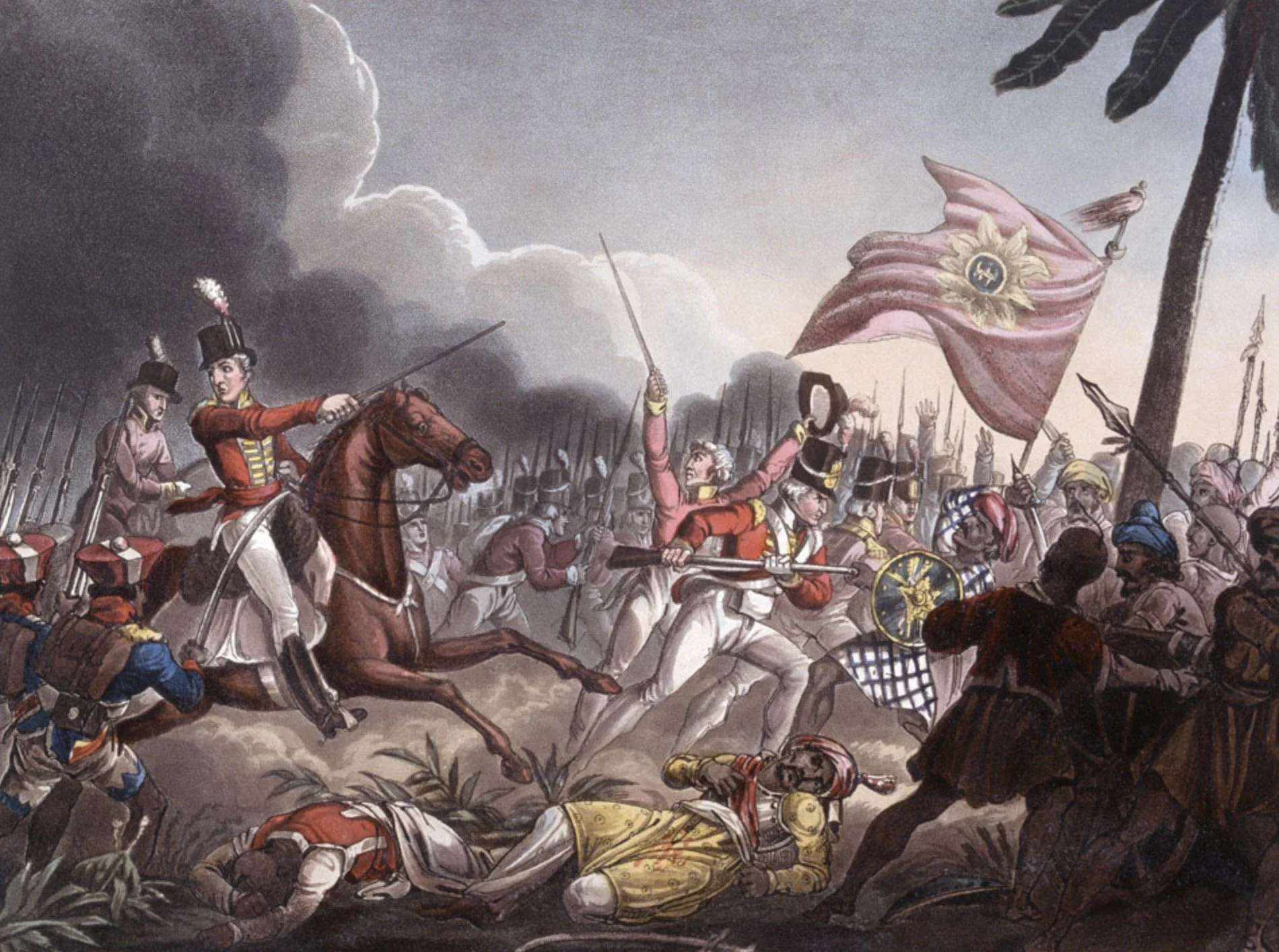
Anglo Maratha Wars
The Genesis of Maratha Power
From Mughal Adversaries to Continental Power
The decline of the Mughal Empire in the early 18th century created a political vacuum that the Marathas were uniquely positioned to fill. As one of the empire's staunchest adversaries, they had developed formidable military capabilities and administrative experience. By the mid-eighteenth century, Maratha influence extended from Lahore in the north to the Deccan plateau, with tributary arrangements covering territories they didn't directly control. Their presence in the Mughal court as kingmakers demonstrated their transformation from regional challengers to continental power brokers.
However, the Maratha state possessed an inherent duality. It had the potential to develop into a pan-Indian empire replacing the Mughals, yet this potential was never fully realised due to the very nature of Maratha polity itself. The horizontal structure of power-sharing among chiefs, the existence of heritable vatan rights at local levels, and the tension between centralised kingship and local loyalties created a complex political ecosystem that both enabled rapid expansion and limited effective consolidation.
Shivaji's Foundation
Establishment of Maratha kingdom (1674-1680)
Succession Crisis
Dynastic factionalism after Shivaji's death
Civil War Period
Contest between Shahu and Tarabai (1707-1718)
Peshwa Ascendancy
Rise of Brahman administrative elite
The period following Shivaji's death in 1680 witnessed tremendous turbulence. His sons Shambhaji and Rajaram ruled briefly, constantly battling the Mughal war machine. When Rajaram died in 1699, his widow Tarabai ruled as regent for infant Shivaji II. Aurangzeb's death in 1707 after forty years of futile Deccan warfare found the Marathas unbowed but weakened. The release of Shahu, Shivaji's grandson, from Mughal captivity that same year triggered an eight-year civil war that nearly destroyed the Maratha kingdom before it could truly consolidate.
Balaji Vishwanath: Architect of Peshwa Power
The transformation of the Maratha state from a kingdom torn by civil war into an expansionist power capable of challenging for all-India hegemony owes much to the political genius of Balaji Vishwanath, a Chitpavan Brahman who served as peshwa (prime minister) to Chhatrapati Shahu. By 1712-13, Maharashtra teetered on the brink of complete anarchy. The civil war between Shahu and Tarabai's factions had drained resources and fractured loyalties. In this critical juncture, Balaji Vishwanath emerged as the stabilising force that would fundamentally reshape Maratha political structure.
Supported by independent sardars and Brahman banking families, Balaji helped Shahu emerge victorious from the succession contest by 1718-19. But his most significant achievement lay in diplomatic manoeuvring at the imperial level. In 1719, by assisting the Sayyid brothers in establishing a puppet emperor in Delhi, he secured a crucial Mughal sanad (imperial order) for Shahu. This document recognised Shahu's right to collect chauth (one-quarter of revenue) and sardeshmukhi (an additional ten percent) in six Mughal Deccan provinces, similar rights in Malwa and Gujarat, and effectively acknowledged Maratha independence in Maharashtra itself.
Chauth Rights
25% of land revenue from Deccan provinces, Malwa and Gujarat—legitimised Maratha extraction from Mughal territories
Sardeshmukhi Rights
Additional 10% levy recognised as hereditary right—transformed tribute into quasi-sovereign taxation
Independent Status
De facto sovereignty in Maharashtra—Mughal recognition of autonomous Maratha homeland
The contest with Tarabai's faction found resolution in the Treaty of Warna (1731), which created the state of Kolhapur for Shivaji II, effectively partitioning Maratha territories but ending the civil war. From Balaji Vishwanath's time forward, the office of peshwa became the true fountainhead of authority in the Maratha kingdom, the source of all patronage and the centre of political gravity. When he died in 1720, he bequeathed to his son Baji Rao not just an office but a transformed political system where Brahman administrative expertise had become indispensable to Maratha military power.
Bajirao I: The Greatest Peshwa
1720
Became Peshwa at young age
1728
Victory at Palkhed over Nizam
1729
Acquired Malwa, reached Rajasthan
1737
Attacked Delhi, captured emperor
1738
Treaty of Bhopal, gained Malwa subah
1740
Death after two decades of expansion
Bajirao I, who served as peshwa from 1720 to 1740, is universally regarded as the greatest among all Maratha peshwas—a military genius whose campaigns transformed the Marathas from a regional Deccan power into a force capable of dictating terms across northern India. His two-decade tenure witnessed unprecedented territorial expansion and the consolidation of Maratha supremacy over vast swathes of the former Mughal empire. Where his father Balaji Vishwanath had secured diplomatic recognition, Bajirao converted potential into actual power through relentless military campaigns.
Military Achievements
Defeated the Nizam at Palkhed (March 1728), forcing recognition of Shahu as sole Maratha monarch with rights to Deccan revenues
Led campaigns into Malwa's fertile lands, reaching Rajasthan by 1729 and establishing Maratha presence in regions never before under Deccan control
Controlled Gujarat's countryside while Mughals held only cities; Surat's trade declined precipitously under this political pressure
Attacked Delhi in 1737, briefly holding the Mughal emperor captive—unprecedented humiliation for the once-mighty empire
Defeated massive Mughal army under Nizam's generalship (1738); Treaty of Bhopal granted Malwa subah and sovereignty over lands between Narmada and Chambal rivers
Beyond military conquests, Bajirao initiated the Maratha confederacy—a system where prominent chiefs were assigned spheres of influence to conquer and rule in the Maratha king's name. This innovation attempted to balance the kshatriya warrior class (led by senapati Dabodi) with the growing Brahman administrative class. The major families that emerged—Gaekwad of Baroda, Bhonsle of Nagpur, Holkar of Indore, Sindhia of Gwalior, and the Peshwa of Poona—would dominate Maratha politics for the next century. Initially cooperative under Bajirao I through Madhavrao I, this confederacy's cohesion would prove its greatest strength and, ultimately, its fatal weakness.
Balaji Bajirao and the Zenith of Maratha Power
Following Bajirao I's death in 1740, his son Balaji Bajirao—better known as Nana Saheb—assumed the peshwaship and ruled until 1761. Though more administrator than warrior, he paradoxically presided over the most extensive Maratha territorial expansion. After Chhatrapati Shahu's death in 1749, Nana Saheb became the supreme authority in Maratha polity, marking the complete ascendancy of the peshwa over the nominal Maratha monarchy. This period represented the absolute zenith of Maratha glory, when virtually all regions of India faced Maratha military expeditions and revenue demands.
Eastern Expansion
From 1745, Raghuji Bhonsle of Nagpur regularly raided Orissa, Bengal and Bihar. Treaty of 1751 with Alivardi Khan surrendered Orissa and established annual chauth of Rs. 120,000 for three provinces
Deccan Dominance
Regular raids on Nizam's Konkan territories and tribute extraction. Treaty of Bhalke (1751) with Salabutjung effectively ceded entire Khandesh control to Marathas
Northern Campaigns
Regular raids on Rajput kingdoms (Jaipur, Bundi, Kotah, Udaipur) and Gond kingdom of Deogarh. Intervention in succession disputes, annual tributes extracted
Imperial Authority
Treaty of 1752 placed Mughal emperor under Maratha protection. Succession dispute (1753) gave opportunity to install chosen candidate on Mughal throne
However, Maratha expansion followed a distinctive pattern that ultimately limited their ability to create a true empire. Only in Khandesh, Malwa and Gujarat did they establish actual administrative systems; elsewhere, Maratha presence consisted primarily of plunder and chauth/sardeshmukhi collection. They intervened in regional politics, extracted tributes, and maintained military superiority, but rarely attempted permanent conquest or systematic governance. This made their supremacy inherently unstable and dependent on continuous military pressure—a model that worked brilliantly during Maratha ascendancy but left them vulnerable when their military machine faltered.
The Punjab expedition proved short-lived, as Sikh rebellion ended Maratha authority in that region. More catastrophically, Ahmad Shah Abdali's Afghan invasion in 1761, supported by Rohillas and Shuja-ud-daula of Awadh, would deliver a devastating blow to Maratha ambitions at the Third Battle of Panipat—a defeat that would forever alter the trajectory of Maratha power and Indian history.
The Third Battle of Panipat: Catastrophe and Aftermath
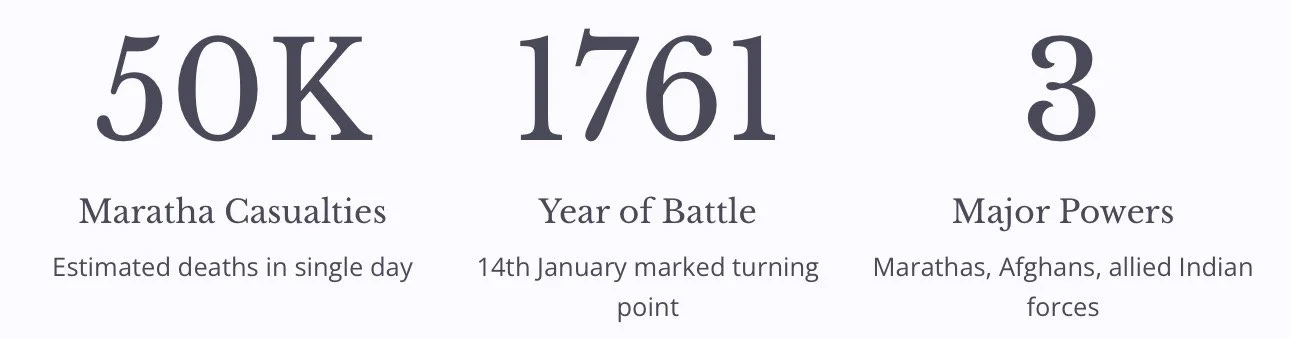
On 14 January 1761, the Third Battle of Panipat became one of the bloodiest encounters in 18th-century military history. The Maratha forces under Sadashivrao Bhau faced Ahmad Shah Abdali's Afghan army, supported by numerous indigenous allies including Rohillas and Nawab Shuja-ud-daula of Awadh. The battle represented not merely a contest between two armies but a civilisational collision with profound implications for India's political future.
The Maratha defeat was comprehensive and devastating. Approximately fifty thousand casualties—killed or captured—represented not just a military setback but the destruction of Maratha military leadership and prestige accumulated over decades. Sadashivrao Bhau himself perished in the battle along with numerous other commanders. The psychological impact exceeded even the massive material losses, as the aura of Maratha invincibility—carefully constructed through Bajirao I and Balaji Bajirao's victories—shattered irreparably.
Peshwa Balaji Bajirao died within weeks of receiving news of the catastrophe, reportedly of a broken heart. His death created a succession crisis as his young son Madhavrao attempted to consolidate control amid resurgent factionalism among Maratha sardars. The confederacy system that Bajirao I had created began showing its inherent weaknesses—when central authority weakened, centrifugal forces pulled the Maratha polity apart. The carefully balanced arrangement of shared power and cooperative expansion gave way to competitive rivalry and territorial disputes among the major Maratha houses.
The Third Battle of Panipat: Catastrophe and Aftermath
"The field of Panipat was strewn with the bodies of Maratha soldiers. The defeat marked the beginning of the end for Maratha aspirations to all-India hegemony, though their regional power would persist for another six decades before final British conquest."
Young Peshwa Madhavrao (1761-1772) made valiant attempts to restore Maratha authority, achieving considerable success in reasserting control over northern territories. However, his premature death in 1772 at age 27 removed the last figure capable of maintaining confederacy cohesion. His uncle Raghunathrao's subsequent seizure of power, opposed by other Maratha chiefs, led directly to the involvement of the English East India Company in Maratha affairs—an involvement that would ultimately prove fatal to Maratha independence.
The Structural Contradictions of Maratha Polity
Understanding why the Maratha state failed to become a viable alternative to the Mughal Empire requires examining its fundamental structural characteristics. Unlike the Mughal system with its centralised bureaucracy and clear hierarchical lines of authority, the Maratha polity embodied a tension between horizontal confederacy principles and vertical monarchical aspirations. This tension, never fully resolved, ultimately limited Maratha capacity for empire-building despite impressive military capabilities and extensive territorial control.
Nominal Centre
Chhatrapati then Peshwa as supreme authority
Confederacy Chiefs
Bhonsle, Gaikwad, Holkar, Sindhia—autonomous power centres
Heritable Rights
Village headmen, mirasidars, deshmukhs with vatan rights
Local Assemblies
Vatandars exercising political power, resolving disputes
Loyalty Tensions
Regional versus centralised allegiances in constant negotiation
The confederacy structure meant power-sharing among chiefs who had made fortunes as military commanders since Shahu's reign. Parts of the Maratha state had been alienated to these commanders, making it extraordinarily difficult for the peshwa to regulate their activities effectively. This resulted in increasing factional rivalry, and though a strong centre always existed, the inner circle's composition changed generationally, preventing institutional stability.
At local levels, heritable vatan rights—belonging to village headmen, mirasidars and deshmukhs—could not be arbitrarily revoked by kings. Regional assemblies of vatandars exercised genuine political power and dispute resolution, representing local loyalties opposed to centralised kingship concepts. The Maratha state attempted to overlay this horizontal "brotherhood" ethos with vertical service relationships, distributing temporary transferable land rights (saranjam, similar to Mughal jagirs) among clients. However, the old system persisted, with locally powerful Brahmans and Marathas enjoying "bundles" of different overlapping rights—local loyalties and centralised authority coexisting in permanent tension.
Maratha-Mughal Relationship
Historians debate whether Marathas represented rebellion against or continuation of Mughal tradition. Irfan Habib sees zamindar revolt against oppressive bureaucracy; Satish Chandra emphasises regional Deccan focus. Andre Wink argues Marathas operated within Mughal tradition using fitva (sedition) concept. Even in 1770s, Marathas acknowledged Mughal emperor's symbolic authority, and their administration in Malwa, Khandesh and Gujarat closely resembled Mughal systems, retaining terminology and differential urban tax rates favouring Muslims.
The First Anglo-Maratha War (1775-1782)
The last quarter of the 18th century witnessed three major conflicts between Marathas and the English East India Company, with the English ultimately emerging victorious and establishing themselves as the paramount power in India. These Anglo-Maratha Wars resulted from the intersection of English imperial ambition, particularly concerning Bombay and Gujarat cotton trade with China, and internal Maratha divisions that provided opportunities for British intervention. The English desired to replicate in the Deccan what Clive had achieved in Bengal, Bihar and Orissa—a system of controlled native government under British supervision.
1772: Succession Crisis
Madhavrao's death creates power vacuum; uncle Raghunathrao has nephew Narayanrao assassinated
1775: Treaty of Surat
Raghunathrao cedes Salsette, Bassein and revenues for 2,500 British soldiers
1776: Treaty of Purandhar
Calcutta Council annuls Surat treaty, promises pension to Raghunathrao
1779: Battle of Wadgaon
Marathas under Nana Fadnis defeat British using scorched earth tactics
1779-1781: British Offensives
Warren Hastings sends forces capturing Ahmedabad, Bassein, Gwalior, defeating Sindhia at Sipri
1782: Treaty of Salbai
Twenty-year peace guaranteed; territories restored to Marathas with mutual security commitments
The succession dispute following Madhavrao's death provided the initial opportunity. Raghunathrao, having orchestrated his nephew Peshwa Narayanrao's assassination, faced opposition from twelve Maratha chiefs (Barabhai) led by Nana Phadnavis, who declared infant Sawai Madhavrao as rightful peshwa with themselves as regents. Desperate Raghunathrao turned to Bombay's English, signing the Treaty of Surat (1775) that ceded Salsette, Bassein and revenue portions from Surat and Bharuch for military support. However, the Calcutta Council condemned this arrangement, sending Colonel Upton to negotiate the Treaty of Purandhar (1776), which renounced Raghunathrao in favour of recognising the regency.
This inconclusive treaty, unratified by Bengal authorities, led to continued conflict. When Nana Phadnavis violated agreements by granting France a western port (1777), the English retaliated. The Marathas, regrouped under Nana Fadnis, Sindhia and Holkar, inflicted crushing defeat at Wadgaon (1779) using scorched earth tactics—burning farmland and poisoning wells. The subsequent Treaty of Wadgaon forced the Bombay government to relinquish all post-1775 territorial gains. This period witnessed Nana Fadnis's rise to political prominence and his formation of a grand alliance with the Bhonsle family, Nizam and Haidar Ali against the British by 1781.
However, Warren Hastings rejected Wadgaon's terms, sending substantial forces that captured Ahmedabad, Bassein and Gwalior, ultimately defeating Sindhia at Sipri (1781). Sindhia's proposal for new negotiations led to the Treaty of Salbai (1782), which Hastings and Phadnavis ratified, guaranteeing twenty years of peace. The treaty restored Maratha territories conquered since Purandhar while requiring them to return English and Nawab of Arcot lands taken by Haidar Ali, maintain trading privileges, exclude other European nations, and ensure mutual peace among allies. Critically, it committed Marathas to friendship with the Company and confrontation with Mysore—a strategic alignment favouring British interests in southern India.
The Second Anglo-Maratha War (1803-1805)
The Second Anglo-Maratha War emerged from circumstances remarkably similar to the first—internal Maratha dissension providing opportunities for British intervention. However, the strategic context had transformed dramatically. By 1800, the arrival of Governor-General Wellesley introduced an aggressively expansionist "Subsidiary Alliance" system that had already subordinated Hyderabad (1798) and crushed Mysore (1799). This brought the Company into direct confrontation with the Marathas, now the only remaining significant indigenous power capable of challenging British supremacy in the subcontinent.
Internal Maratha Collapse (1795-1802)
The Maratha state descended into chaos following Peshwa Madhavrao Narayan's suicide in 1795. Bitter rivalries among sardars had already rendered the peshwa virtually powerless under Nana Fadnis's chief ministership. The subsequent succession dispute placed Bajirao II—the worthless son of Raghunathrao—as peshwa, with Nana Phadnavis, his father's bitter enemy, as chief minister. This impossible arrangement guaranteed instability.
Nana Phadnavis's death in 1800 removed the last figure capable of maintaining confederacy discipline, providing additional British advantage. On 1 April 1801, Peshwa Bajirao II brutally murdered Vithuji, brother of Jaswantrao Holkar, triggering Holkar's furious military campaign against the combined Sindhia-Peshwa forces. At Hadaspar near Poona (25 October 1802), Holkar decisively defeated them, placing Vinayakrao (son of Amritrao) on the peshwa's seat. Terrified Bajirao II fled to Bassein, where on 31 December 1802 he signed a subsidiary alliance treaty with the English—the act that sparked full-scale war.
Treaty of Bassein Terms
Peshwa accepted permanent British infantry contingent (minimum 6,000 troops with artillery) in Maratha territories, ceded lands yielding Rs 26 lakh annually, surrendered Surat city, abandoned chauth claims on Nizam's dominions, accepted Company arbitration with Nizam and Gaekwad, excluded Europeans from nations warring with Britain, and subjected all foreign relations to British control
Maratha Resistance
Despite Bajirao II's installation at Poona under British escort, independent Maratha power didn't immediately collapse. Holkar raised rival peshwa candidate and sought allies, while Sindhia and Bhonsle attempted to preserve Maratha independence through combined military action against the subsidiary alliance system
Defeat and Vassalage
Arthur Wellesley's well-prepared forces defeated Sindhia-Bhonsle combined armies, forcing separate subsidiary treaties: Bhonsle at Devgaon (17 December 1803), Sindhia at Surajianjangaon (30 December 1803), and Holkar at Rajpurghat (1806). Treaties subordinated Marathas to British vassalage and isolated them from each other
The Treaty of Bassein is often described as providing "the key to India" for the Company—perhaps exaggerated but understandable given its strategic significance. The permanent stationing of British troops in Maratha territory, added to existing forces in Mysore, Hyderabad and Lucknow, meant even distribution enabling rapid deployment anywhere in India. Though not immediately delivering complete control, Bassein positioned the Company to systematically expand its influence spheres. The treaty with Sindhia particularly secured British control over territories north of Jamuna (including Delhi and Agra), all Sindhia's Gujarat possessions, and claims over other Maratha houses—effectively dismembering the confederacy.
Additionally, treaties of subordination were imposed on numerous Maratha tributaries including Rajput states, Jats, Rohillas and Bundellas in northern Malwa. The agreements forbade other Europeans from serving in Maratha armies and established British arbitration in inter-Maratha disputes. However, this didn't immediately end Maratha power. The wars' enormous expenses and Court of Directors' dissatisfaction with Wellesley's forward policy led to his 1805 recall. Lord Cornwallis's reappointment with non-intervention instructions allowed Maratha sardars like Holkar and Sindhia to regain some power, while their irregular Pindari soldiers plundered Malwa and Rajasthan countryside—setting conditions for the final confrontation.
The Third Anglo-Maratha War (1817-1819)
The arrival of Lord Hastings as governor-general in 1813 marked a decisive shift toward aggressive imperial expansion. Armed with the Charter Act of 1813—which ended the Company's China trade monopoly (except tea) and created pressure for new markets—Hastings initiated a policy of "paramountcy" that privileged Company interests as paramount over all other Indian powers. This doctrine asserted the Company's legitimate right to annex or threaten annexation of any Indian state's territories to protect British interests, fundamentally altering the relationship between the Company and indigenous polities.
The Pindari Pretext and Maratha Unity
The Pindaris—mercenaries of diverse castes attached to Maratha armies—had become autonomous plunderers when regular Maratha employment ceased. Their raids on neighbouring territories, including Company domains, provided Hastings with justification for intervention. The British charged Marathas with sheltering Pindaris, though leaders like Amir Khan and Karim Khan surrendered while Chitu Khan fled to jungles. However, Maratha leaders perceived Hastings's anti-Pindari actions as sovereignty violations—transgressions that served to unite the confederacy one final time.
The Treaty of Bassein remained a festering wound to Maratha pride—"a treaty with a cipher" that wounded other Maratha leaders' feelings as absolute surrender of independence. In 1817, a repentant Bajirao II made his last bid, rallying Maratha chiefs against the British in the Third Anglo-Maratha War, which began with an attack on the British Residency at Poona.
June 1818
Peshwa's final surrender and confederacy dissolution
Peshwaship Abolished
British took complete control over Peshwa dominions
Multiple Treaties
Poona (Peshwa), Gwalior (Sindhia), Mandasor (Holkar) signed
Maratha Power Crushed
Army and Pindaris thoroughly defeated and dispersed
The war's outcome was comprehensive and final. By June 1818, the Peshwa surrendered and the Maratha confederacy was formally dissolved. The peshwaship itself was abolished, with British authority assuming complete control over the Peshwa's dominions. Bajirao II became a British retainer at Bithur near Kanpur, where he would live out his days as a pensioner. The Maratha army and Pindari forces were thoroughly crushed, their military capacity permanently broken. Important treaties—of Poona with the Peshwa, Gwalior with Sindhia, and Mandasor with Holkar—formalised British supremacy and Maratha subordination.
In a symbolic gesture acknowledging Shivaji's legacy while ensuring continued division, the British created a small principality of Satara, carved from the Peshwa's dominions, and installed Pratap Singh—a lineal descendant of Shivaji—as its ruler. This preserved the fiction of Maratha royal continuity while ensuring real power remained with the British. By 1819, the English East India Company had achieved complete mastery over all territories south of the Vindhyas. The Maratha confederacy, which for nearly a century had been the most formidable indigenous challenge to European power in India, had been comprehensively defeated and dismembered—never again to threaten British imperial supremacy.
Why the Marathas Lost: Structural and Strategic Failures
The Maratha defeat in their three wars with the British East India Company resulted not from a single cause but from an accumulation of structural weaknesses, strategic failures, and fundamental disparities in political organisation, military modernisation, economic policy, and diplomatic capability. Understanding these factors provides crucial insights for UPSC aspirants studying state formation, military history, and the dynamics of colonial conquest in 18th-century India.
Inept Leadership
The Maratha state's despotic character meant the head of state's personality profoundly affected governance. Unfortunately, later leaders—Bajirao II, Daulatrao Sindhia, and Jaswantrao Holkar—were worthless and selfish, no match for capable British officials like Elphinstone, John Malcolm, and Arthur Wellesley (who later defeated Napoleon). The quality disparity in leadership proved decisive in critical moments of conflict and negotiation.
Defective State Structure
Maratha cohesion was artificial and precarious rather than organic. From Shivaji's time, there was no systematic effort toward organised communal improvement, education spread, or genuine popular unification. The rise based on religio-national movement lacked the institutional depth needed when contending with a European power organised on Western patterns. This structural defect became glaringly obvious in confrontation with the systematically organised British power.
Loose Political Configuration
The Maratha empire functioned as a loose confederation under Chhatrapati and later Peshwa leadership. Powerful chiefs—Gaikwad, Holkar, Sindhia, Bhonsle—carved semi-independent kingdoms and merely paid lip service to Peshwa authority. Irreconcilable hostility between confederacy units, with chiefs frequently taking opposing sides, proved detrimental. The lack of cooperative spirit among Maratha chiefs became their undoing against a unified British command structure.
Inferior Military Organisation
Despite personal prowess and valour, Marathas were inferior in force organisation, weaponry, disciplined action, and effective leadership. Divided command's centrifugal tendencies and rampant treachery weakened Maratha forces significantly. Modern warfare technique adoption remained inadequate—particularly, Marathas neglected artillery's paramount importance. Though the Poona government established an artillery department, it barely functioned effectively, leaving Marathas vulnerable to British firepower superiority.
Unstable Economic Foundation
Maratha leadership failed to evolve stable economic policies suiting changing needs. With no industries or foreign trade development, the Maratha economy couldn't support a stable political setup. Dependence on plunder and tribute extraction—rather than systematic revenue administration and economic development—meant the state lacked the financial resources necessary for sustained military competition with the commercially sophisticated and fiscally organised British power.
Superior British Diplomacy
The British possessed better diplomatic skills to win allies and isolate enemies. Disunity among Maratha chiefs simplified the British task enormously. Diplomatic superiority enabled quick offensives against isolated targets. Unlike Marathas' ignorance about their enemy, the British maintained well-knit espionage systems gathering comprehensive knowledge of foes' potentialities, strengths, weaknesses, and military methods—intelligence advantages that repeatedly proved decisive in conflict.
Progressive British Outlook
The British were rejuvenated by Renaissance forces, emancipating them from Church shackles and devoting energies to scientific inventions, extensive ocean voyages, and colonial acquisition. Indians, conversely, remained steeped in medievalism marked by old dogmas and notions. Maratha leaders paid little attention to mundane state matters. Insistence on maintaining traditional social hierarchy based on priestly class dominance made empire unification difficult. The encounter represented medieval against modern, with predictable results.
"In the end, the British attacked a divided house that started crumbling after a few pushes. The Maratha defeat was not inevitable but resulted from accumulated failures in political unity, military modernisation, economic policy, and strategic vision—lessons that remain relevant for understanding state power and imperial dynamics in modern examinations."
