
British Expansion in India: The Road to Colonial Dominance
The British expansion in India represents one of the most significant transformations in the subcontinent's history. What began as commercial ventures by the East India Company gradually metamorphosed into political conquest and territorial dominance. This document explores the critical phases of British expansion, focusing on two pivotal regions—Bengal and Mysore—where the foundations of the British Raj were laid through a combination of military prowess, diplomatic manipulation, and exploitation of internal divisions among Indian rulers.
The eighteenth century witnessed the decline of Mughal authority and the emergence of regional powers that sought independence whilst maintaining symbolic allegiance to the Mughal emperor. This political fragmentation created opportunities for European trading companies, particularly the English East India Company, to transform themselves from merchants into kingmakers and eventually into rulers. Understanding this transformation is crucial for UPSC aspirants, as it illuminates the mechanisms through which colonialism established itself in India.
India on the Eve of British Conquest: A Fragmented Political Landscape
Mughal Decline
The death of Aurangzeb in 1707 marked the beginning of the Mughal Empire's rapid decline. Wars of succession and incompetent rulers like Muhammad Shah (1719-48) accelerated this process. Despite ruling for 29 years, Muhammad Shah could not revive imperial fortunes.
The symbolic authority of the Mughal emperor continued, as he remained a source of political legitimacy. New states constantly sought his sanction to legitimise their rule, never directly challenging his nominal sovereignty.
Transformation, Not Collapse
The eighteenth century represented a transformation rather than collapse of the polity. It signified decentralisation of power, not a power vacuum or political chaos.
These developments witnessed the establishment of independent states like Hyderabad, Bengal, Awadh, and Punjab. Local chiefs asserted independence whilst the Marathas made their bid to inherit the imperial mantle.
Successor States
Founded by Mughal provincial governors who never formally severed links with the centre but exercised virtual autonomy
Bengal
Hyderabad
Awadh
Rebel States
Established by rebels against the Mughal state, asserting complete independence
Marathas
Sikhs
Jats
Afghan kingdoms
Independent Kingdoms
Previously autonomous but dependent polities that now asserted complete independence
Rajput kingdoms
Mysore
Travancore
Bengal: The Foundation of British Power
The province of Bengal gradually became independent of Mughal control after Murshid Quli Khan became governor in 1717. He received the unprecedented privilege of holding two offices simultaneously—nazim (governor) and diwan (revenue collector). This consolidation of power, which broke the traditional Mughal system of checks and balances, enabled Murshid Quli to establish almost dynastic rule whilst maintaining the façade of formal allegiance to the Mughal emperor.
The foundation of Murshid Quli's power was his exceptionally successful revenue administration. Even during periods of political chaos elsewhere in the empire, Bengal remained a constant revenue-paying surplus area. Revenue collection increased by 20 per cent between 1700 and 1722 through detailed surveys and compelling zamindars to pay in full and on time.
Consolidation of Zamindaris
He encouraged the development of powerful zamindaris at the expense of smaller, inefficiently managed ones. By 1727, fifteen largest zamindaris were responsible for about half of the province's revenue.
Rise of Merchants and Bankers
Political stability and increased agricultural productivity provided impetus to trading activities. Merchants and bankers gained unprecedented importance in provincial governance.
The House of Jagat Seth
The most significant collaboration was the rise of the banking house of Jagat Seth, who became treasurer of the provincial government in 1730 with strategic control over the mint.
Bengal's Lucrative Trade: Economic Prosperity and European Interest
Traditional Trade Routes
In the 17th century, Bengal's silk, cotton textiles, sugar, oil, and clarified butter travelled through:
Overland routes to Persia and Afghanistan via north and west Indian centres
Oceanic routes through Hughli port to Southeast Asian, Persian Gulf, and Red Sea ports
18th Century Transformation
During the political turmoil of the 18th century, traffic through overland routes partially declined, but oceanic trade thrived with increasing investment from European Companies—Dutch, French, and English.
Europe became the major destination for Bengal goods, significantly impacting the region's textile industry. Bengal maintained a favourable balance of trade, with surplus bullion brought by European Companies absorbed smoothly into the cash economy.
Merchant Magnates
The trade was dominated by various merchants—Hindus, Muslims, and Armenians. Hindu merchant Umi Chand and Armenian tycoon Khoja Wajid, who controlled a fleet of ships, enjoyed cordial relations with the state and bureaucracy.
Financial Networks
Constant pressure on zamindars to pay revenue regularly brought powerful financiers and bankers into great demand. They provided securities at every stage of transactions and enjoyed unprecedented patronage of the governor.
Alivardi Khan and the Coup of 1739-40: Power Shifts in Bengal
The gradual rise in the power of merchants, bankers, and zamindars meant a relative diminution of the nazim's authority. This became evident in the coup of 1739-40, when Sarfaraz Khan, the new nazim, was ousted by his army commander Alivardi Khan with the help of the banking family of Jagat Seths and powerful zamindars. Sarfaraz had to go not merely because he was an inefficient administrator, but because he had alienated the house of Jagat Seth and lost the support of powerful officials.
Virtual Break with Mughals
Alivardi Khan's reign marked a virtual break with the Mughals. All major appointments were made without reference to the emperor, and the regular flow of revenue to Delhi was stopped.
Autonomous Administration
Although there was never formal defiance of Mughal authority, an autonomous administration free of imperial control emerged in Bengal, Bihar, and Orissa.
Strict Attitude to Europeans
Alivardi's attitude to Europeans was strict. During his wars with Marathas, he allowed strengthening of fortifications by Europeans and construction of the Maratha Ditch in Calcutta, whilst collecting large amounts for war upkeep.
The Maratha Ditch: A three-mile long moat excavated by British around Calcutta in 1742 as protection against possible Maratha attacks. This defensive structure symbolised the growing British military presence in Bengal.
Siraj-ud-daula's Succession: Seeds of Conflict
Alivardi died in 1756, nominating his 23-year-old grandson Siraj-ud-daula as his successor. However, his succession was challenged by two other contenders—Shaukat Jung (Faujdar of Purnea) and Ghaseti Begum (Alivardi's daughter). This resulted in intense court factionalism, as overmighty zamindars and commercial people felt threatened by an extremely ambitious and assertive young nawab.
This destabilisation of Bengal's administration provided the perfect opportunity for the English East India Company to acquire a foothold in Bengal politics through what is popularly known as the Plassey conspiracy of 1757, which ended Siraj-ud-daula's rule and fundamentally altered the course of Indian history.
Court Factionalism
Overmighty zamindars and commercial elites felt threatened by Siraj's assertive policies and ambitious reforms
Weak Support Base
Unlike his grandfather, Siraj lacked the support of key power brokers including Jagat Seths and influential military commanders
British Opportunity
The internal divisions and weakened administration created the perfect conditions for British intervention and manipulation
The English East India Company in Bengal: Growing Tensions
Bengal had become critically important in the Company's trade structure by the early eighteenth century, with Bengal goods comprising nearly 60 per cent of English imports from Asia—at the expense of the west coast centres like Bombay, Surat, and Malabar. In 1690, Aurangzeb's farman granted the Company the right to duty-free trade in Bengal in return for an annual payment of Rs. 3,000.
1690
Foundation of Calcutta and beginning of British territorial presence in Bengal
1696
Fortification of Calcutta, transforming it into a military stronghold
1698
Grant of zamindari rights in three villages: Kolikata, Suranuri, and Gobindapur
1717
Emperor Farruksiyar's farman granting extensive trading privileges and territorial rights
The farman of 1717 granted the Company the right to carry on duty-free trade, rent thirty-eight villages around Calcutta, and use the royal mint. However, this farman became a new source of conflict between the Company and Murshid Quli Khan, who refused to extend duty-free provisions to cover private trade of Company officials. The latter therefore took to rampant misuse of dastaks (trade permits), and the nawab resented the loss of revenue. The conflict between the Bengal nawab and the English Company had thus started developing right from 1717.
The Road to Conflict: Siraj-ud-daula and British Provocations
Austrian Succession War (1740)
European hostilities between English and French Companies extended to India. Alivardi Khan kept both under control in Bengal.
French Victories in South
Made the English apprehensive in Bengal as they had little trust in the nawab's ability to protect them from French onslaught.
British Fortifications (1755)
English began renovating fortifications in Calcutta without nawab's permission, offering protection to fugitives from his court.
Siraj's Accession (1756)
The new nawab threatened lucrative English private trade by stopping misuse of dastaks and asserting his sovereign authority.
Immediate Issues of Discord
Grant of asylum to Krishna Ballabh, charged with fraud by the nawab
New fortifications at Calcutta without permission
Both posed challenges to the nawab's authority and sovereignty
Siraj's Response
Unhappy with the Company's interference in internal affairs and perceiving a threat to provincial independence, Siraj immediately ordered them to stop unauthorised activities. When warnings were ignored, he showed his strength by taking over the factory at Kasimbazar.
The Fall of Calcutta and the Black Hole Controversy
Governor Drake believed he could avenge the defeat at Kasimbazar by force and ignored the nawab's overtures for diplomatic reconciliation. This was followed by Siraj's attack on Calcutta and its capture on 20 June 1756. The garrison's commander organised an escape, leaving behind 146 soldiers under the command of Holwell, a senior East India Company bureaucrat who had been a military surgeon.
The Black Hole of Calcutta: A small dungeon in the old Fort William where troops of Siraj ud-Daulah allegedly held British prisoners of war after capturing the fort on 20 June 1756. Holwell claimed that 123 prisoners died out of 146 held from suffocation, heat exhaustion, and crushing. However, the precise number of deaths and accuracy of Holwell's claims have been subjects of controversy.
Controversy: Floor Space
A floor area of 267 square feet could not contain 146 European adults, raising questions about the physical possibility of Holwell's account.
Controversy: Missing Soldiers
Only 43 garrison members were listed as missing from Fort William after the incident, suggesting the maximum deaths could only be 43.
Controversy: Lack of Confirmation
Apart from Holwell's account, no other source mentioned such an incident. Given its nature, it seems unlikely all traces would have disappeared.
Controversy: Unreliable Witness
Some argue that Holwell was an unreliable witness whose veracity is questionable, casting doubt on the entire narrative.
When news of Calcutta's fall reached Madras on 16 August 1756, the Council immediately sent an expeditionary force under Colonel Robert Clive and Admiral Watson. The force dislodged the enemy from the fort of Budge Budge, then moved against Calcutta on 2 January 1757. The garrison of 500 men surrendered after offering scanty resistance.
The Bengal Campaign and Treaty of Alinagar
Military Operations
On 9 January 1757, a force of 650 men under Captain Coote and Major Kilpatrick stormed and sacked Hooghly, 37 km north of Calcutta. Learning of this attack, the nawab raised his army and marched on Calcutta, encamping beyond the Maratha Ditch.
Despite British successes, they were cut off from trade and resupply whilst war lasted. It was in the nawab's interest to prolong it. Instead, he made the strategic mistake of trying to finish off the war quickly.
Pre-emptive Attack
The nawab brought his army—with 40,000 horses, 60,000 soldiers on foot, and 50 elephants—up to Calcutta and began preparing to attack the city. Clive decided to launch a pre-emptive attack. It proved a winning decision.
The nawab's army broke up and many fled. The British lost 57 men, the nawab 1,300. Faced with surprising defeat, Siraj preferred a negotiated settlement. On 9 February, the Treaty of Alinagar was signed.
Factory Restoration
Nawab agreed to restore the Company's factories to their previous status
Recognition of 1717 Provisions
Nawab would recognise all provisions of Mughal Emperor Farrukh Siyar's 1717 firman
Duty Exemption
All British goods passing through Bengal would be exempt from duties
Fortification Rights
British would not be hindered from fortifying Calcutta and minting coins in the city
The nawab withdrew his army back to Murshidabad. However, the signing of the treaty was merely one of the events leading up to the famous Battle of Plassey. For the moment there was peace, but it wasn't to last. Clive had come to Bengal not just to retake Calcutta—even before setting sail, he had written that "this expedition will not end with the retaking of Calcutta only—and that the Company's estate in these parts will be settled in a better and more lasting conditions than ever."
The Plassey Conspiracy: A Web of Betrayal
Concerned by the approach of French forces to Bengal and the Seven Years' War in Europe, the Company turned its attention to the French threat in Bengal. The English fear about Siraj's friendship with the French and apprehension that their trading privileges would be curtailed led to the destruction of Hughli and a French defeat at Chandernagore. The nawab was infuriated upon learning of the attack on Chandernagar. His former hatred of the British returned, but he now felt the need to strengthen himself by alliances against the British.
Disaffected Faction
There was already a disaffected faction at the nawab's court consisting of merchants, bankers, financiers, and powerful zamindars who felt threatened by the young nawab
Jagat Seth Brothers
The influential Jagat Seth brothers, along with Mahtab Rai, Swarup Chand, Raja Janki Ram, Rai Durlabh, Raja Ramnarain, and Raja Manik Chand formed the core of opposition
Merchant Interests
Natural communion of interests existed between Indian mercantile community and European traders, as many Indian merchants operated in collaboration with the English Company
Mir Jafar's Ambition
A conspiracy emerged to replace Siraj with Mir Jafar, his commander-in-chief, who was the choice of the Jagat Seths—without whose support any coup was virtually impossible
The question whether there was already a conspiracy in existence at the Murshidabad court which the English took advantage of, or whether it was the English who hatched up the conspiracy—a question over which historians have fought futile polemical battles—is less important. What is important is the fact that there was a collusion, which resulted in the Battle of Plassey in June 1757, in which Siraj was finally defeated by Clive.
The Battle of Plassey: A Transaction, Not a Battle
On 23 June 1757, the Battle of Plassey was fought between the forces of Siraj Ud Daulah and the troops of the British East India Company, led by Robert Clive. It was hardly more than a skirmish. The arrival of a strong force under Robert Clive at Calcutta from Madras strengthened the English position in Bengal. Clive forged a secret alliance with the traitors of the nawab—Mir Jafar, Rai Durlabh, Jagat Seth, and Omichand. Under the deal, Mir Jafar was to be made nawab who in turn would reward the Company for its services.
Forces Engaged
Nawab's Army:
50,000 infantry
28,000 cavalry
Divided into three divisions
Clive's Army:
Only 3,000 men including English soldiers
Technologically superior artillery
Unified command structure
The Betrayal
Out of three divisions of the nawab, the largest was commanded by Mir Jafar. From the beginning of the battle, Mir Jafar, Rai Durlabh, and Yar Lutuf Khan assembled their troops near the battlefield but made no move to actually join the battle.
Only two generals, Mohan Lai and Mir Madan, fought desperately on behalf of the nawab. When Mir Madan fell dead on the field, the nawab lost courage.
Siraj, who distrusted his generals and had already been warned of impending defeat by his astrologer (who had possibly been bribed), lost his nerve when Mir Jafar advised retreat. Siraj fled from the battlefield on a fast camel. His demoralised army followed suit. Siraj-ud-daula fled for his life but was killed by Miran, the son of Mir Jafar.
"It was a transaction in which the bankers of Bengal and Mir Jafar sold out the nawab to the English. Lord Clive's diplomacy excelled. He won the battle almost without fighting."
Mir Jafar's Puppet Regime and the Road to Buxar
After the Battle of Plassey, Mir Jafar became nawab of Bengal in name only. He was entirely dependent on the British to maintain his position and for protection against foreign invasions. An English army of 6,000 troops was maintained in Bengal to help the nawab. The sovereignty of the English over Calcutta was recognised, and the English posted a Resident at the nawab's court. Real power remained in the hands of the English throughout his reign.
Financial Crisis (1757-1760)
Mir Jafar faced great financial crisis as Company servants extracted money from him in various ways. He had committed to pay huge amounts to Clive as gratitude, whilst the English Company pressed him for payment of instalments.
Dutch Challenge (1759)
Mir Jafar encouraged the Dutch to advance against the British. The Dutch sent seven large ships and 1,400 men from Java. However, Clive initiated immediate offensive operations and defeated the much larger Dutch force at the Battle of Chinsura on 25 November 1759.
Replacement by Mir Kasim (1760)
The treachery of Mir Jafar and his failure to make payments due to the Company annoyed the English. Governor Vansittart agreed to support Mir Kasim's claim after a treaty was signed in 1760, promising territorial cessions and financial payments.
Mir Kasim was the ablest nawab among the successors of Alivardi Khan—more talented, vigorous, and ambitious than his father-in-law Mir Jafar. He ruled from 1761 to 1763 and did not appreciate the idea of being a mere puppet in the hands of the British. He shifted the capital from Murshidabad to Munger in Bihar to maintain safe distance from the Company at Calcutta, reorganised the bureaucracy with men of his own choice, trained his army in Western fashion, and set up factories for manufacturing arms. Unable to stop the misuse of dastaks, he abolished internal duties altogether so that Indian merchants could enjoy the same privileges.
The Battle of Buxar: A Decisive Victory
Background of Conflict
The seeds of the Battle of Buxar were sown after Plassey when Mir Kasim became nawab. The primary cause was conflict between the English and Mir Kasim. The Company had thought Mir Kasim would prove an ideal puppet, but he belied their expectations.
Ram Narayan, deputy governor of Bihar, was not responding to the nawab's requests to submit revenue accounts. Mir Kasim could not tolerate this open defiance, but Ram Narayan was supported by English officials of Patna.
The nawab-Company tussle over transit duty led to outbreak of wars between the English and Mir Kasim in 1763. The English gained successive victories, which eventually compelled Kasim to flee to Allahabad where he met Shuja-ud-Daulah. In Allahabad, Kasim tried to form a grand alliance with Mughal emperor Shah Alam II and Shuja-ud-daula of Awadh.
1763
English-Mir Kasim wars begin over transit duty disputes
Early 1764
Mir Kasim flees to Allahabad and negotiates alliance with Shah Alam II and Shuja-ud-daula
23 October 1764
Battle of Buxar fought at Katkauli, 6 kilometres from Buxar. British under Hector Munro defeat combined army decisively
1765
Treaty of Allahabad signed. Clive returns to settle the fate of northern India
British Advantages
Technically efficient English army with unitary command versus eighteenth-century Indian army with segmentary social organisation
Allied Weakness
Lack of basic co-ordination among the three desperate allies responsible for their decisive debacle
Treaty of Allahabad 1765: Consolidation of British Power
Clive was in England when the Battle of Buxar was fought and won by the British. In 1765, Clive returned, and the important outcome of the Battle of Buxar was the Treaty of Allahabad. Two separate treaties were signed at Allahabad with far-reaching consequences for the future of India.
First Treaty: Company and Mughal Emperor
Diwani Rights Granted: Mughal Emperor granted fiscal rights (Diwani) or right to administer territory and collect taxes to the East India Company in Bengal, Bihar, and Orissa.
Nizamat Rights: Police and judicial rights were given to Nawab of Bengal.
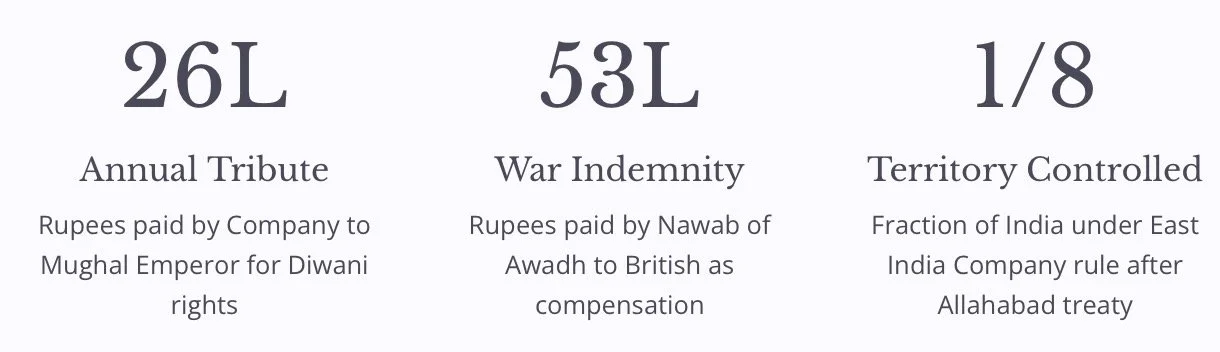
Annual Tribute: In lieu of this right, the Company gave an annual tribute of 26 lakh rupees to the Mughals.
Territorial Return: The districts of Kora and Allahabad were returned to the Mughal Emperor.
Second Treaty: Company and Nawab of Awadh
Territorial Settlement: Awadh was returned to Shuja-ud-Daulah but Allahabad and Kora were taken from him.
War Indemnity: The Nawab of Awadh paid 53 lakhs rupees of war indemnity to the British.
Zamindari Grant: The zamindari of Banaras region was given to Balwant Rai.
Resident System: An English Resident would be stationed at Lucknow with all expenses borne by the nawab.
Trading Rights: The Company would enjoy duty-free trading rights in Awadh.
Historical Significance of the Battle of Buxar
Complete British Dominance
The importance of this battle lay in the fact that not only the Nawab of Bengal but also the Mughal Emperor of India was defeated by the English. The victory made the English a great power in northern India and contenders for supremacy over the whole country.
More Important Than Plassey
The seeds of British imperialism sown at Plassey flowered after Buxar. This makes Buxar historically more important. If Plassey saw defeat of the Nawab of Bengal, Buxar saw defeat of the Mughal Emperor and powerful Awadh. Buxar war completed the work of Plassey.
Military Superiority Established
Battle of Buxar proved the military superiority of the English and exposed the inherent weakness of native forces. It brought out the political weaknesses and military shortcomings of the Indians and the hollowness of the Mughal Empire.
While the Battle of Plassey secured a foothold for the British East India Company in India, the Battle of Buxar made them the dominant force. The East India Company, after Buxar, gained dominance over entire Bengal. The Mughal emperor came fully under British control. All duties and revenues from the most prosperous Indian province (Bengal, Bihar, and Orissa) went to the Company. It also gained administrative power by controlling the army, finances, and revenues.
The Company treated the defeated Mughal emperor with respect because of his continuing symbolic significance in eighteenth-century Indian politics. Indeed, not before 1857 did the British ever formally repudiate the sovereignty of the Mughal emperor.
With the wealth of Bengal, the British could conquer other regions of India. The supremacy of the British was established in the eastern parts of India. Buxar finally riveted the shackles of Company's rule upon Bengal. The Treaty of Allahabad heralded the establishment of the rule of the East India Company in one-eighth of India with a single stroke.
Mysore: Rise of Haidar Ali and Tipu Sultan
After the Battle of Talikota (1565) gave a deadly blow to the great kingdom of Vijayanagara, many small kingdoms emerged from its remnants. In 1612, a Hindu kingdom under the Wodeyars dynasty emerged in the region of Mysore. Its centralised military power began to increase from the late seventeenth century under Chikkadevaraja Wodeyar (1672-1704), but it reached its real period of glory under Haidar Ali.
Rise of Haidar Ali
A man of humble origin, Haidar started his career as a junior officer in the Mysore army and gradually rose to prominence. Though uneducated, he possessed a keen intellect and was a man of great energy and determination.
By 1761, he took over political power in Mysore by ousting the corrupt Nanjraj (prime minister), who had usurped real power by reducing the Wodeyar king into a mere titular head.
Military Modernisation
Haidar modernised his army with French experts, who trained an efficient infantry and artillery and infused European discipline into the Mysore army.
He took the help of the French to set up an arms factory at Dindigul (now in Tamil Nadu), and introduced Western methods of training for his army, organised on a European model through the system of risalas.
Consolidation of Power
His power was further consolidated by subjugation of local warrior chiefs or hereditary overlords like deshmukhs and palegars (poligars).
Diplomatic Skills
He started to use his considerable diplomatic skill to outmanoeuvre his opponents, including the Marathas who had defeated him in 1764, 1766, and 1771.
Revenue Reforms
He introduced the system of imposing land taxes directly on peasants and collecting them through salaried officials and in cash, enhancing the resource base of the state.
Tipu Sultan's Modernisation and Anglo-Mysore Wars
Agricultural Development
Tipu provided encouragement for agriculture development through tax remission for reclamation of wasteland and protected peasants from rapacity of tax collectors. He repaired old irrigation systems and constructed new ones, promoting agricultural manufacturing and introducing sericulture in Mysore.
Naval Ambitions
He sent ambassadors to France to bring in European technology and went on to build a navy, with ambition to participate in oceanic trade. In 1793, he launched what can be described as a "state commercial corporation" with plans to set up factories outside Mysore.
State Trade
Mysore state began to participate in lucrative trade in valuable goods like sandalwood, rice, silk, coconut, and sulphur, establishing thirty trading centres in and outside Mysore, including overseas locations like Muscat.
Break with Mughal Tradition
Tipu issued coins without any reference to the Mughal emperor and inserted his own name in the khutba (Friday sermons) instead of Emperor Shah Alam's name. He sought a sanad from the Ottoman Khalif to legitimise his rule.
Pragmatic Realism
Yet he "did not completely sever links" with the Mughal monarch, who still commanded respect in the subcontinent. Being a "realist", Tipu recognised Mughal authority when it suited him and defied it when it did not.
His plans of modernisation went far beyond his resources and therefore, Mysore remained, as Irfan Habib argues, "far away from a real opening to modern civilisation". The state of Mysore under Haidar Ali and Tipu Sultan was involved in establishing a centralised military hegemony. Its territorial ambitions and trading interests got it engaged in a state of constant warfare, which overshadowed all other aspects of its history during this period.
Anglo-Mysore Wars and the Fall of Mysore
First Anglo-Mysore War (1767-69)
Background: English concluded treaty with Nizam of Hyderabad (1766) for Northern Circars. Haidar faced alliance of Nizam, Marathas, and English.
Outcome: Haidar changed strategy, suddenly appeared before Madras gates, forcing English to conclude humiliating Treaty of Madras (April 4, 1769). Treaty provided for exchange of prisoners and mutual restitution of conquests.
Second Anglo-Mysore War (1780-84)
Background: Haidar accused English of breach of faith when they failed to help him during Maratha attack (1771). English attempted to capture Mahe, which Haidar regarded under his protection.
Outcome: Haidar forged anti-English alliance with Marathas and Nizam. Despite initial successes, Haidar died of cancer (December 7, 1782). Tipu Sultan carried on war for one year. Treaty of Mangalore (March 1784) provided for mutual restitution.
Third Anglo-Mysore War (1790-92)
Background: Cornwallis worked on anti-Tipu suspicions of Nizam and Marathas, arranging Triple Alliance (1790). Tipu attacked Travancore, which English treated as declaration of war.
Outcome: In 1790, Tipu defeated English under General Meadows. In 1791, Cornwallis took leadership. Treaty of Seringapatam (1792): Nearly half of Mysorean territory taken. War damage of three crore rupees imposed.
Fourth Anglo-Mysore War (1799)
Background: Lord Wellesley (1798) concerned about Tipu's growing friendship with French. Tipu sent emissaries to Arabia, Afghanistan, France, and Versailles.
Outcome: War began April 17, 1799 and ended May 4, 1799 with fall of Seringapatam. Tipu died fighting bravely. English chose boy from earlier Hindu Wodeyar family as maharaja and imposed Subsidiary Alliance system.
The fall of Mysore marked the end of a significant chapter in Indian resistance to British expansion. Tipu Sultan's death defending Seringapatam symbolised the last major indigenous challenge to British supremacy in southern India. The English felt their political and commercial interests in south India were threatened because of Mysore's proximity with the French and Tipu's control over the rich trade of the Malabar coast. Most significantly, Tipu Sultan was trying to build a strong centralised and militarised state with ambitious territorial designs and political aspiration to control south Indian politics. This made him the most potent danger to the Company state in the south. Young army officers like Thomas Munro and Alexander Read could see that the "mercantilist state" of Mysore represented the same kind of hegemonic ambition as those of the Company state and therefore could never be relied upon in any arrangement of indirect rule based on the principle of balance of power among the Indian states.
Mysore, placed once again under the former Wodeyar dynasty, was brought under Lord Wellesley's 'Subsidiary Alliance' system. This meant an end to the independent state of Mysore and consolidated British control over southern India, paving the way for eventual dominance over the entire subcontinent.
