
European Penetration into India: The Portuguese Era
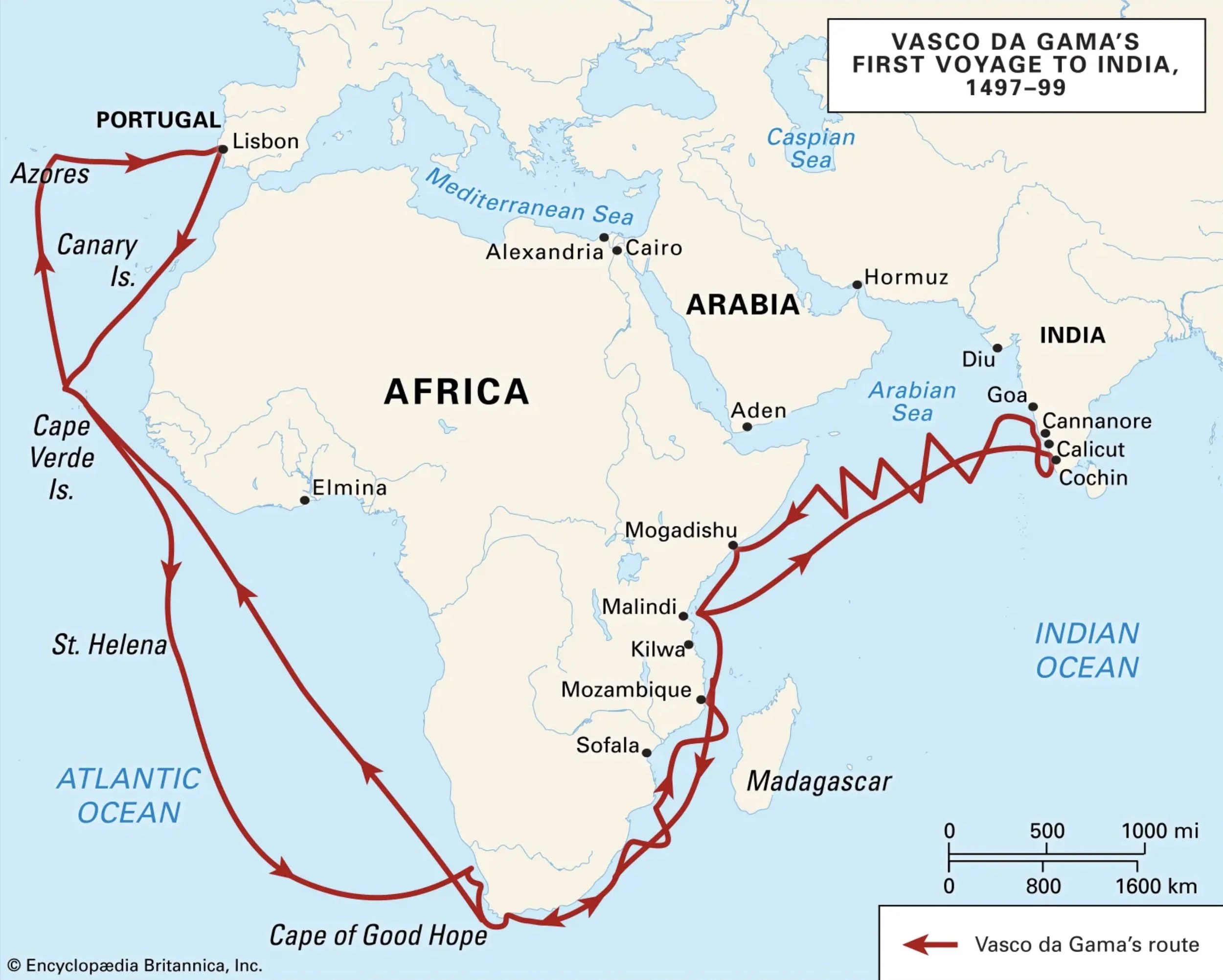
The arrival of Vasco da Gama at Calicut in 1498 marked a watershed moment in Asian-European relations, initiating what historians term the "European era" in India. This epochal event not only established direct maritime connections between two continents but fundamentally transformed the nature of international trade, introducing armed commerce and naval power politics to the Indian Ocean. The Portuguese pioneering voyage was driven by a confluence of commercial ambitions, religious zeal, and geopolitical rivalries that would reshape India's engagement with the world for centuries to come.
The Portuguese endeavour represented more than mere mercantile expansion; it symbolised Europe's response to Ottoman control of traditional trade routes and embodied the Renaissance spirit of exploration. Their arrival initiated profound changes in India's political economy, introducing new agricultural products, trade patterns, and military technologies whilst simultaneously challenging established conventions of peaceful maritime commerce that had prevailed for centuries in the Indian Ocean.
Catalysts for Portuguese Exploration
Ottoman Expansion
The fall of Constantinople in 1453 to Ottoman Turks disrupted traditional land routes to India. Arab-Muslim intermediaries monopolised the Red Sea trade route, earning tremendous revenues whilst European powers faced increasing costs and political obstacles in accessing eastern goods, particularly the lucrative spice trade.
Economic Imperatives
Europe's growing prosperity increased demand for oriental luxury goods and spices. Dietary changes, particularly increased meat consumption requiring preservation and flavouring, made spices indispensable. A direct sea route would bypass Arab monopolies and dramatically reduce costs.
Religious Motivation
The Portuguese sought to strike at Muslims from multiple directions, hoping to link with the legendary Prester John's kingdom in Africa. The Pope's 1453 Bull granted Portugal discovered lands "in perpetuity" on condition of converting "heathens" to Christianity.
Renaissance Spirit
The intellectual awakening challenged traditional thought patterns and inspired daring exploration. Advances in ship-building, navigation techniques, and the example of Genoese and Venetian traders in the Indian Ocean encouraged ambitious maritime ventures seeking unknown eastern territories.
Vasco da Gama's Historic Voyage and Initial Encounters
In May 1498, three Portuguese ships under Vasco da Gama's command, guided by Gujarati pilot Abdul Majid, reached Calicut on the Malabar coast. The Zamorin, recognising Calicut's prosperity as an entrepôt, accorded a friendly reception and permitted Portuguese trade in spices and establishment of a factory. This initial cordiality, however, masked fundamental differences in commercial philosophy that would soon erupt into conflict.
Gama secured trading rights despite Arab merchant objections but faced difficulties paying customs duties in gold. The Portuguese demand for trade monopoly and rights to search Arab ships sparked violent conflict, resulting in massacre of Portuguese factory residents. In retaliation, Portuguese ships bombarded Calicut before withdrawing, establishing a pattern of violence that would characterise Portuguese operations.
The commercial success proved extraordinary—spices Gama carried back sold at sixty times the expedition's cost. Europeans purchasing through Muslim middlemen would have paid ten times more for equivalent pepper quantities. This dramatic profit differential attracted numerous European merchants and ensured Portuguese persistence despite initial conflicts.
Economic Impact
The spices carried back by Vasco da Gama were valued at sixty times the cost of the entire expedition, demonstrating the extraordinary profitability of direct access to Indian markets.
Contrasting Trade Philosophies: Asian Convention versus Mediterranean Tradition
Asian Open Trade Convention
Centuries-old system where governments supported trade but avoided using military force. Multiple participants—Indians, Arabs, Africans, Chinese, Javanese—operated according to tacit rules. None sought overwhelming dominance; ports remained open to all merchants regardless of religion or origin.
Portuguese Armed Commerce
Mediterranean tradition combining trade with warfare on land and sea. Sought monopoly over profitable eastern trade by excluding competitors, especially Arabs. Used naval power to enforce commercial objectives, fundamentally disrupting established trading conventions and threatening small trading states.
This philosophical clash profoundly upset Asian traders and small coastal states like Calicut and Cochin, which depended heavily on trade but followed peaceful commercial conventions. The Portuguese introduction of armed commerce represented a revolutionary departure from centuries of relatively peaceful maritime trade in the Indian Ocean, establishing precedents that subsequent European powers would follow and expand upon in their imperial ventures.
Portuguese Governors and Territorial Expansion
The systematic consolidation of Portuguese power in India was achieved through three remarkable governors whose strategies shaped Portuguese colonial policy for decades.Water
Francisco de Almeida (1505-1509): Blue Water Policy
Appointed for three years to establish forts at Anjediva Island, Cannanore, Cochin, and Quilon. Advocated naval supremacy through his "Blue Water Policy" (Cartaze system), declaring "As long as you may be powerful at sea you will hold India as yours." His decisive naval victory over the combined Egyptian-Gujarati-Zamorin fleet in 1509 established Portuguese supremacy in the Indian Ocean, enabling expansion towards Persian Gulf and Red Sea regions.
Alfonso de Albuquerque (1509-1515): Fortress Strategy
Real founder of Portuguese power in the East, advocating forts at strategic Asian and African locations supplemented by strong navy. Captured Goa from Bijapur Sultan in 1510, establishing it as Portuguese commercial-political headquarters. Extended possessions to Colombo, Achin, Malacca, Socotra, and Ormuz. Introduced permit system for ships, controlled shipbuilding centres, abolished sati, and encouraged Portuguese-Indian marriages for permanent settlement.
Nino da Cunha (1528-1538): Gujarat Expansion
Shifted Portuguese headquarters from Cochin to Goa, centralising administration. Capitalised on Bahadur Shah's conflict with Mughals to acquire Bassein (1534) and secure Diu base. Following Bahadur Shah's death during negotiations on Portuguese ship (1537), acquired Daman, Salsette, Bombay, and formally Diu. Increased Portuguese influence in Bengal with Hooghly as headquarters, establishing comprehensive territorial network along western Indian coast.
Ottoman-Portuguese Rivalry: The Turkish Challenge
The Ottoman Turks, under Sulaiman the Magnificent, represented the most formidable challenge to Portuguese naval dominance in the Indian Ocean. Having conquered Syria, Egypt, and Arabia by 1517, the Ottomans controlled both the eastern Mediterranean and significant portions of the Red Sea trade routes, positioning themselves as natural allies for Indian rulers resisting Portuguese encroachment.
Ottoman-Gujarat Alliance
Bahadur Shah of Gujarat initiated diplomatic exchanges with Ottoman Sultan, seeking support against Portuguese aggression. In response, the Ottomans expressed determination to combat the "infidels" disrupting Arabian shores. After expelling Portuguese from the Red Sea in 1529, a strong fleet under Sulaiman Rais was dispatched to aid Gujarat.
Turkish officials received Indian appointments as governors of Surat and Diu. Rumi Khan, a master gunner, earned particular distinction repelling Portuguese attacks on Daman and Diu in 1531. The Turkish presence significantly complicated Portuguese monopolistic ambitions.
The 1538 Siege of Diu
The largest Ottoman naval demonstration occurred in 1538 when Sulaiman Pasha, 82-year-old Cairo governor, commanded a fleet with pressed Venetian sailors. The two-month siege of Diu ultimately failed due to the admiral's arrogant behaviour alienating the Gujarat Sultan and arrival of formidable Portuguese reinforcements.
Despite continued Turkish threats through the 1550s, a 1566 agreement established shared oriental trade between Portuguese and Ottomans, effectively ending their Arabian Sea conflicts. This precluded future Ottoman-Mughal alliance against Portuguese interests.
The Cartaz System: Institutionalising Trade Control
Introduction and Purpose
Introduced by Vasco da Gama in 1502 after Zamorin of Calicut refused exclusive trading rights. The Cartaz was a sea-pass or trading licence enabling Portuguese to control and enforce trade monopoly across Indian Ocean whilst ensuring merchants paid taxes at Portuguese trading posts. All ships engaged in maritime trade required this permit.
Royal Monopoly Commodities
Spices, drugs, dyes (including indigo), copper, silver, gold, arms, ammunition, and war horses declared royal monopoly. No traders—Asian, European, or even Portuguese private merchants—could trade these commodities without royal permission. This comprehensive list covered the most profitable trade items of the era.
Enforcement Mechanisms
Portuguese forced all ships to pass through Goa, paying customs duty. They maintained right to search any suspected vessels. Ships carrying "contraband" or refusing search could be sunk or captured, with people aboard enslaved. Even powerful rulers like Akbar, Ahmednagar, Bijapur kings, and Malabar rulers purchased Portuguese passes.
System Limitations
Complete control proved elusive due to Asia's vast coastlines and established trade networks. Local merchants continued trading with or without Cartaz. Portuguese officials, receiving meagre salaries, often accepted bribes from private traders. Estimated three-fourths of Malabar pepper production evaded Portuguese control through "illegal" channels to other ports.
Critical Impact: The Cartaz system ended the era of unarmed, open sea-trade in Indian waters, fundamentally transforming maritime commerce from a peaceful, cooperative enterprise into an armed, monopolistic endeavour controlled by European naval power.
Factors Limiting Portuguese Monopoly
Despite formidable naval power and strategic fort networks, Portuguese attempts at complete trade monopoly confronted insurmountable obstacles arising from geographical, economic, political, and technological factors.
Geographical Challenges
Failure to capture Aden prevented Red Sea control. Ottoman conquest of Syria, Egypt, and Arabia strengthened naval power in eastern Mediterranean and Red Sea, making Bab-el-Mendel blockade ineffective. Portuguese monopoly never succeeded in Red Sea zone.
Asian Merchant Resilience
Experienced Arab, Gujarati, and Tamil merchants with deep knowledge of trade networks found ways around Portuguese restrictions. They established alternative routes via Acheh in Sumatra to Red Sea through Laccadives, bypassing Portuguese-controlled Malabar waters.
Regional Naval Powers
Sultan Ali Mughayat Shah of Sumatra defeated Portuguese in multiple naval engagements, captured Portuguese guns, and received Ottoman military equipment. Acheh emerged as major spice export centre competing with Portuguese-controlled Malacca, breaking their monopoly.
Internal Portuguese Limitations
Small population, limited financial resources, and dependence on Italian-German financiers restricted operations. Private Portuguese traders, unhappy with royal monopoly, conducted illicit trade. Royal officials on small salaries accepted bribes, undermining official policy.
Portuguese-Mughal Relations
1579: Akbar's Theological Interest
Akbar invited Jesuit priests Rodolfo Aquaviva and Antonio Monserrate to Fatehpur Sikri, driven by interest in theological questions. Portuguese authorities saw conversion opportunity. Priests departed in 1583 without achieving hoped-for imperial conversion, though Jesuit-Mughal contacts continued under Jahangir.
1609: Captain Hawkins at Mughal Court
William Hawkins arrived seeking trading rights for English East India Company. Portuguese attempted preventing his court access but failed. Jahangir, impressed by Hawkins's Turkish language skills, appointed him Mansabdar of 400. Portuguese intrigues and vacillating Mughal policies forced Hawkins's departure in 1611.
1612: Battle of Swally
English Captain Best's successful naval engagement against Portuguese fleet impressed Jahangir, who lacked significant navy. This English victory demonstrated Portuguese vulnerability, encouraging Mughal reconsideration of Portuguese privileges and opening doors for other European powers.
1613: Portuguese Piracy Crisis
Portuguese captured Mughal ships, imprisoned Muslims, and plundered cargoes, enraging Jahangir. He ordered Muqarrab Khan at Surat to obtain compensation. This incident marked beginning of serious Portuguese-Mughal tensions that would culminate in Shah Jahan's decisive action.
1632: Siege and Capture of Hooghly
Portuguese settlement at Hooghly had monopolised salt manufacture, enforced tobacco duties, and engaged in cruel slave trade, including seizing two slave girls of Mumtaz Mahal. Shah Jahan ordered Qasim Khan to besiege Hooghly. After three months, Portuguese fled. Four hundred prisoners offered conversion to Islam or slavery.
The Hooghly episode marked the definitive end of Portuguese advantages at the Mughal court. Shah Jahan's forceful action demonstrated that the Mughal Empire, unlike smaller coastal states, possessed the military capacity and political will to challenge European armed commerce when imperial interests were directly threatened. This established precedents for future Mughal interactions with European trading companies.
Portuguese Contributions to Indian Society
Agricultural Innovations
Portuguese introduced numerous Latin American crops that transformed Indian agriculture: maize, potato, corn, pineapple, tobacco, and chilli entered rural economy. Papaya (Mexican origin), cashew (Brazilian native), and guava (Central-South American) became integral to Indian agriculture.
Tobacco emerged as major trade commodity. Portuguese improved quality of mangoes and citrus fruits, introduced superior coconut plantation varieties, and established extensive groves. Indian peasants readily accepted profitable new crops, demonstrating agricultural adaptability.
Military and Maritime Technology
Portuguese mastered improved sea techniques. Under their supervision, Western-technique ship-building commenced at Cochin. Multi-decked, heavily constructed ships permitted heavier armament. Portuguese demonstrated military innovation through body armour, matchlock men, and ship-landed guns in sixteenth-century Malabar.
They possibly influenced Mughal field gun usage and "artillery of the stirrup" development. Portuguese built new roads and irrigation works, contributing to infrastructure development alongside military applications of their technological knowledge.
Cultural and Trade Linkages
Portuguese established India's trade links with Japan, Philippines, and Latin America, expanding commercial horizons beyond traditional Asian-European routes. They paved the way for subsequent European powers: Spanish, Dutch, English, and French.
Portuguese introduced Cruzado coins in Goa and neighbouring areas, accepted in Vijayanagar and Bahmani Kingdoms. Missionaries and Church served as teachers and patrons of painting, carving, and sculpture, interpreting European art to India whilst maintaining cultural exchange.
Structural Factors Behind Portuguese Decline
Metropolitan Constraints
Portugal's small size and limited financial resources despite commercial development. Discovery of Brazil diverted colonising activities westward. Spanish-Portuguese union (1580-81) dragged Portugal into Spain's conflicts with England and Holland, undermining Indian trade monopoly.
Indian Political Dynamics
Emergence of powerful dynasties in Egypt, Persia, and North India reduced local Portuguese advantages. Rise of turbulent Marathas as immediate neighbours culminated in Maratha capture of Salsette and Bassein (1739), demonstrating Portuguese military vulnerability on land.
Religious Antagonism
Jesuit activities raised political fears. Conversion policies antagonised both Muslims and Hindus. Religious intolerance, including Goa Inquisition's "auto da fe" (burning at stake for heresy), generated widespread resentment among local populations undermining Portuguese legitimacy.
Commercial Malpractices
Dishonest trade practices evoked strong reactions. Portuguese earned notoriety as sea pirates. Arrogance and violence brought animosity from small state rulers and imperial Mughals. Their monopolistic demands contradicted established Asian open-trade conventions.
Competition from European Rivals
Portuguese monopoly on sea-route knowledge couldn't remain secret indefinitely. Dutch and English acquired ocean navigation skills and route knowledge. These emerging powers, backed by stronger metropolitan economies and more sophisticated commercial organisations, systematically displaced Portuguese dominance throughout seventeenth century.
Significance and Legacy of Portuguese Presence
Pioneering European Presence
Portuguese were first Europeans arriving (1498) and last departing (1961), spanning 463 years. They initiated the "European era" marking emergence of foreign naval power in India. Their presence established precedents for subsequent European colonial ventures, demonstrating viability of armed commerce backed by naval supremacy.
Economic Integration
Opening direct sea-route facilitated India's closer integration with growing world economy, contributing to market economy expansion. It challenged India's "introspectiveness," establishing maritime connections that would intensify over subsequent centuries and fundamentally reshape India's position in global trade networks.
Trade Philosophy Transformation
Portuguese ended unarmed open sea-trade era in Indian waters, introducing armed commerce concept. They delivered significant blow to Muslim monopoly over western Indian Ocean trade and European-bound eastern goods. This established template of using military force for commercial objectives that characterised European expansion.
Limited Political Impact
Despite commercial significance, Portuguese political impact remained small. Insufficient numbers prevented large mainland territorial conquests. Their "redistributive enterprise" focused on taxing others' trade rather than expanding commerce, limiting long-term influence. Real trade expansion awaited Dutch and English arrival in seventeenth century.
"The Portuguese enterprise in the western part of the Indian Ocean remained largely a 'redistributive enterprise', i.e., its main source of income was taxing the trade of others rather than expanding trade, or opening up new lines of trade."
The Portuguese experience in India combined commercial innovation with military coercion, and cultural exchange with religious intolerance. Their presence established crucial precedents for European colonialism—demonstrating how naval power could enforce trade monopolies and how armed commerce could reshape traditional trading systems. This legacy provided the template that subsequent European powers would refine and expand in their colonial ventures across Asia.
