
Early European Settlements in India
The arrival of European trading companies in India during the 16th and 17th centuries marked a transformative period in Indian history. Driven by the lucrative spice trade and the promise of immense commercial profits, various European powers—including the Dutch, English, and French—established their presence along India's vast coastline. What began as purely commercial enterprises gradually evolved into political dominance, fundamentally altering India's economic landscape and setting the stage for colonial rule. Understanding these early settlements is crucial for UPSC aspirants as it provides insights into the commercial motivations, political strategies, and competitive dynamics that shaped India's colonial experience. These European companies didn't merely trade; they negotiated with local rulers, established fortified settlements, and eventually transformed from merchants into territorial powers, leaving an indelible mark on India's administrative, economic, and social structures.
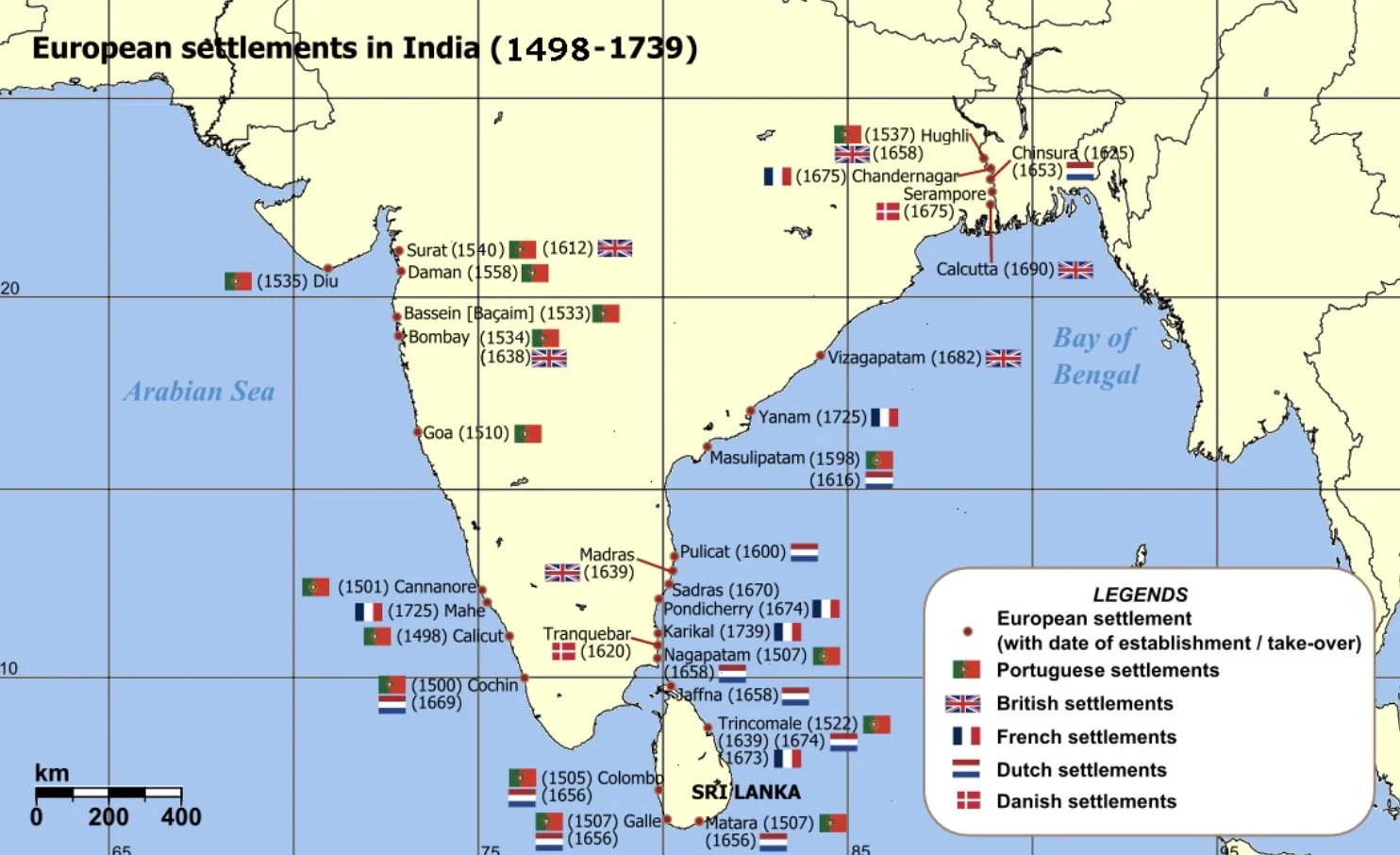
Early European settlements in India
The Dutch East India Company: Commercial Ambitions
Formation and Arrival
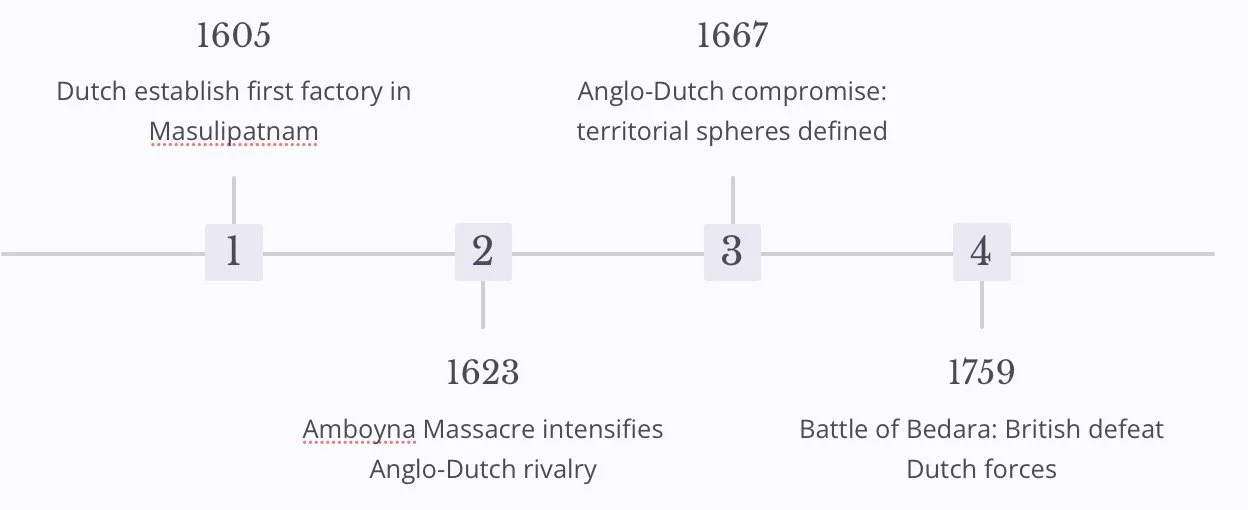
The Dutch entry into Indian trade was marked by corporate consolidation and state backing. In 1602, the States General of the Netherlands merged multiple trading companies into the powerful East India Company of the Netherlands (VOC—Vereenigde Oostindische Compagnie). This wasn't merely a commercial entity; it was empowered with quasi-sovereign powers including the authority to wage war, conclude treaties, capture territories, and construct fortresses. The Dutch established their first factory in Masulipatnam (Andhra Pradesh) in 1605, strategically positioning themselves along India's eastern coast.
The Dutch quickly expanded their network of trading centres across India, posing a significant challenge to Portuguese dominance. Their capture of Nagapatam near Madras from the Portuguese demonstrated their military capabilities and strategic acumen. This fortified settlement became their principal stronghold in South India, serving as the nerve centre for their commercial operations in the region.
Indigo & Textiles
From Yamuna valley, Central India, Bengal, Gujarat and Coromandel
Saltpetre
Extracted from Bihar for gunpowder manufacturing
Opium & Rice
Sourced from the fertile Ganga valley
Anglo-Dutch Rivalry: The Amboyna Massacre
The commercial interests of the Dutch and English companies inevitably collided as both sought to dominate Eastern trade. What began as commercial rivalry escalated into violent confrontations, with the most infamous incident being the Amboyna Massacre of 1623. At Amboyna (present-day Indonesia), which the Dutch had captured from the Portuguese in 1605, Dutch forces brutally executed ten Englishmen and nine Japanese. This atrocity became a defining moment in Anglo-Dutch relations, intensifying mutual animosity and fuelling decades of bitter competition.
The prolonged warfare between these two European powers drained resources and diverted attention from commercial activities. Eventually, pragmatism prevailed over hostility. In 1667, both parties reached a historic compromise that reshaped their spheres of influence in Asia. The British agreed to withdraw all claims on Indonesia, recognizing Dutch supremacy in the Spice Islands. In exchange, the Dutch retired from India, allowing the English to consolidate their position on the subcontinent. This settlement reflected a rational division of commercial territories, with each power focusing on regions where they held strategic advantages.
Decline of Dutch Power in India
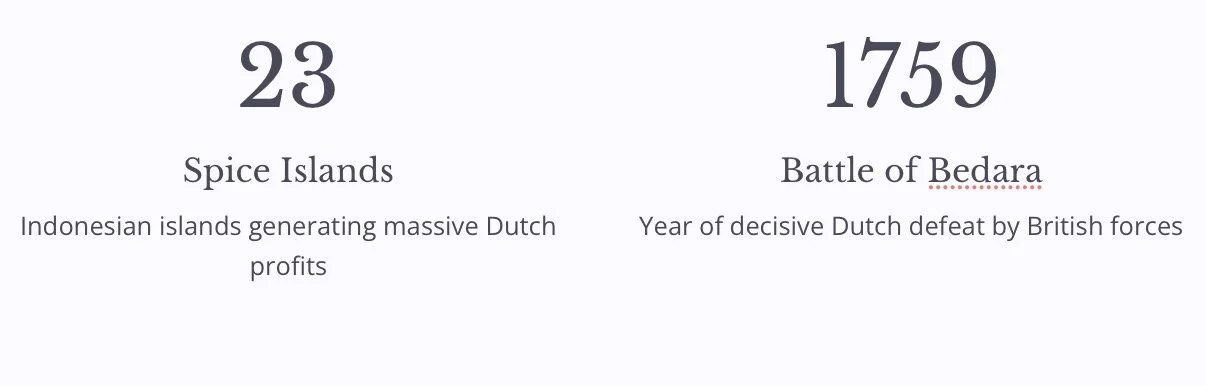
The Dutch decline in India resulted from strategic choices rather than military defeat alone. Their primary commercial interests gravitated towards the Malay Archipelago, particularly the Spice Islands of Indonesia, where profit margins far exceeded those available in India. The Dutch calculated that spices—pepper, nutmeg, cloves, and cinnamon—offered substantially higher returns than Indian textiles and agricultural products. This economic calculus determined their strategic priorities.
The Battle of Bedara in November 1759 delivered a decisive blow to Dutch ambitions in India. British forces comprehensively defeated the Dutch Army, demonstrating the shifting balance of power. Unlike the English, who pursued territorial expansion and political dominance, the Dutch remained focused on trade without aspirations for empire-building. Their lack of interest in acquiring territory and establishing administrative control meant they never developed the institutional mechanisms necessary for long-term dominance in India. Consequently, they gradually withdrew from the Indian subcontinent, concentrating their formidable commercial and naval resources on Indonesia, where they would rule for centuries.
The English East India Company: Foundation and Charter
England's maritime ambitions received tremendous impetus from Francis Drake's circumnavigation of the globe in 1580 and the spectacular victory over the Spanish Armada in 1588. These achievements generated national confidence and entrepreneurial spirit, encouraging English merchants to seek their fortunes in Eastern trade. As knowledge spread of the enormous profits Portuguese traders were earning, English merchants grew determined to secure their share of this lucrative commerce. In 1599, a group of enterprising merchants formed a company, styling themselves as 'Merchant Adventurers', signalling their willingness to take commercial risks in distant lands.
On December 31, 1600, Queen Elizabeth I granted a charter to the 'Governor and Company of Merchants of London trading into the East Indies', conferring upon them exclusive trading rights. Initially granted a fifteen-year monopoly, this privilege was extended indefinitely through a fresh charter issued in May 1609. This royal backing provided legal protection and eliminated domestic competition, enabling the Company to consolidate resources and pursue long-term strategies. With the Dutch concentrating on the East Indies, the English turned their attention to India, seeking textiles, spices, indigo, and other valuable commodities that commanded high prices in European markets.
Drake's Circumnavigation (1580)
Demonstrated English maritime capabilities and global reach
Spanish Armada Defeat (1588)
Established England as formidable naval power
Merchant Adventurers Formation (1599)
English traders organized to pursue Eastern commerce
Royal Charter Granted (1600)
Queen Elizabeth I authorized exclusive trading rights
English Expansion: West and South India
The English Company's initial attempts to establish a foothold in India faced significant obstacles. Captain Hawkins arrived at Emperor Jahangir's court in April 1609, seeking permission to establish a factory at Surat, India's premier port for Western trade. However, Portuguese opposition, combined with their influence at the Mughal court, thwarted this mission. Hawkins departed Agra in November 1611 without achieving his objective. Meanwhile, the English had already begun trading at Masulipatnam on India's south-eastern coast in 1611, formally establishing a factory there in 1616.
The breakthrough came in 1612 when Captain Thomas Best decisively defeated the Portuguese fleet off Surat's coast. This naval victory impressed Emperor Jahangir and demonstrated English military prowess. In early 1613, the Mughal emperor granted permission to establish a factory at Surat, marking the English Company's first major success in Western India. To consolidate these gains, King James I dispatched Sir Thomas Roe as his accredited ambassador to Jahangir's court in 1615. Roe remained until February 1619, and though unsuccessful in negotiating a formal commercial treaty, he secured valuable privileges including permission to establish factories at Agra, Ahmedabad, and Broach.
Surat Factory (1613)
First major English settlement in Western India
Bombay Acquisition (1668)
Leased from Crown for £10 annually
Bombay Presidency (1687)
Headquarters shifted from Surat
Bombay's acquisition proved transformative for English interests. When King Charles II married Portuguese princess Catherine in 1662, Bombay came as part of her dowry. In 1668, the Crown leased Bombay to the East India Company for a nominal annual rent of ten pounds. This strategic port became the headquarters of the Western Presidency in 1687, replacing Surat. The Anglo-Portuguese marriage alliance created tacit peace between these two European powers, while the 1667 Anglo-Dutch compromise eliminated another major rival. The 'Golden Farman' issued by the Sultan of Golconda in 1632 further strengthened English commercial position, granting them freedom to trade in Golconda's ports for an annual payment of 500 pagodas.
Establishment of Madras: Fort St. George
Francis Day's Negotiation
British merchant secured crucial land grant in 1639
Fort St. George
Fortified factory became English stronghold
Southern Headquarters
Replaced Masulipatnam as administrative centre
The establishment of Madras represented a strategic masterstroke in English commercial expansion. Francis Day, a member of the Masulipatnam council, obtained permission in 1639 from the ruler of Chandragiri to construct a fortified factory at Madras. This settlement, which evolved into the imposing Fort St. George, possessed several advantages: a natural harbour, proximity to textile-producing regions, and relative independence from immediate Mughal oversight. The fortification provided security against both European rivals and local powers, enabling the English to conduct trade with minimal interference.
Fort St. George rapidly grew in commercial and strategic importance, eventually replacing Masulipatnam as the headquarters of English settlements in South India. The fort's robust defences, combined with English naval superiority, made it virtually impregnable. Madras became a magnet for merchants, weavers, and traders, transforming into a thriving commercial hub. The settlement's success demonstrated the English strategy of combining commercial enterprise with military fortification, a model they would replicate across India.
English Foothold in Bengal: Strategic Consolidation
Bengal represented the jewel in India's commercial crown—a vast, prosperous province renowned for its advanced trade networks, agricultural productivity, and textile manufacturing. Control over Bengal promised immense profits, making it an irresistible target for the commercially ambitious English East India Company. In 1651, Shah Shuja, Bengal's Mughal subahdar, permitted English trade in return for an annual payment of Rs 3,000, exempting them from all duties. The Company established factories at strategic locations including Hooghly (1651), Kasimbazar, Patna, and Rajmahal, creating a commercial network spanning Bengal's interior.
However, the Company's operations faced persistent obstacles. Despite possessing imperial farmans (decrees), local customs officers at numerous checkpoints demanded toll payments, disrupting trade and reducing profits. The Company's leadership, pursuing an increasingly aggressive policy, sought to establish a fortified settlement at Hooghly, positioning themselves to use force if necessary to protect their commercial interests. William Hedges, the Company's first agent and governor in Bengal, appealed to Shayista Khan, Bengal's Mughal governor, in August 1682 for redressal of these grievances. When his appeals yielded no results, tensions escalated into open hostilities.
1651: Permission Granted
Shah Shuja allows English trade for Rs 3,000 annual payment
1682: Hedges' Appeal
First governor seeks resolution of trade obstruction issues
October 1686: Hooghly Sacked
Imperial Mughal forces attack English settlement
August 1690: Return to Sutanuti
Job Charnock negotiates settlement after forced exile
February 1691: Imperial Farman
Treaty allows continued trade for Rs 3,000 annually
1700: Fort William Established
Fortified settlement becomes Eastern Presidency seat
In October 1686, imperial Mughal forces sacked Hooghly, forcing the English to withdraw to an unhealthy location at the Ganga's mouth. The English retaliated by capturing imperial forts at Thana, raiding Hijli, and storming Mughal fortifications at Balasore, but were ultimately forced to negotiate. Job Charnock, a senior Company agent, conducted protracted negotiations, eventually signing a treaty in February 1690 that permitted English return to Sutanuti in August 1690. The imperial farman of February 10, 1691, formalized this arrangement, allowing the English to "continue contentedly their trade in Bengal" for Rs 3,000 annually. When Sobha Singh, a zamindar in Bardhaman district, rebelled in 1696, the English seized this opportunity to fortify their Sutanuti settlement. In 1698, they purchased the zamindari rights to three villages—Sutanuti, Gobindapur, and Kalikata—for Rs 1,200. The fortified settlement, named Fort William in 1700, became the seat of the Eastern Presidency (Calcutta), with Sir Charles Eyre as its first president, establishing the foundation for what would become British India's administrative capital.
Farrukhsiyar's Farmans: The Magna Carta
The year 1717 marked a watershed moment in the English East India Company's Indian operations. An English mission led by John Surman successfully negotiated with Mughal Emperor Farrukhsiyar, securing three celebrated farmans that contemporaries termed the "Magna Carta of the Company." These decrees granted unprecedented privileges that fundamentally transformed the Company's commercial and political position across India. The farmans' generous terms revealed either Farrukhsiyar's lack of foresight or the English delegation's remarkable diplomatic skills, possibly involving flattery, gifts, and strategic negotiations.
Bengal Privileges
Company's imports and exports exempted from additional customs duties
Annual payment remained Rs 3,000 as previously established
Authorized to issue dastaks (passes) for goods transportation
Permission to rent additional lands around Calcutta
Hyderabad Concessions
Retained existing trade duty exemptions
Required only prevailing rent payment for Madras settlement
Surat Benefits
Exempted from all trade duties
Annual payment of Rs 10,000 covered all obligations
Imperial Currency Rights
Company coins minted at Bombay granted currency throughout Mughal empire
Enhanced commercial operations and financial transactions
These farmans provided the legal and commercial framework that enabled the Company's transformation from a trading entity into a territorial power. The duty exemptions significantly enhanced profit margins, while the authority to issue dastaks created opportunities for abuse and further commercial expansion. The permission to rent lands around Calcutta facilitated territorial growth. However, one formidable obstacle remained: the French East India Company, whose ambitions in India directly conflicted with English interests. The inevitable Anglo-French rivalry would determine which European power would ultimately dominate the subcontinent.
The French East India Company: Late Arrival and Challenges
The French arrived last among European trading powers in India, but their late entry was compensated by royal backing and strategic vision. During Louis XIV's reign, his renowned minister Colbert established the Compagnie des Indes Orientales (French East India Company) in 1664, with the king taking personal interest and investment. The Company received a 50-year monopoly on French trade in Indian and Pacific Oceans, plus a perpetual concession for Madagascar and any territories it could conquer. Initial focus on Madagascar colonies consumed resources without success. In 1667, François Caron led an expedition to India, establishing a factory at Surat.
Mercara, a Persian accompanying Caron, founded another factory at Masulipatnam in 1669 after obtaining patents from the Golconda Sultan. In 1673, the French secured permission from Shaista Khan, Bengal's Mughal Subahdar, to establish a township at Chandernagore near Calcutta. The same year, Sher Khan Lodi, governor of Valikondapuram under the Bijapur Sultan, granted the French a settlement site, leading to Pondicherry's foundation in 1674. Under François Martin's leadership, Pondicherry developed into the nerve centre of French power in India. The French established factories across India, particularly in coastal regions including Mahe, Karaikal, Balasore, and Qasim Bazar.
Early Setbacks
Dutch captured Pondicherry (1693); restored by Treaty of Ryswick (1697)
War of Spanish Succession
Forced abandonment of Surat, Masulipatnam, Bantam factories
Martin's Death (1706)
Loss of visionary leader dealt severe blow to French prospects
French fortunes in India experienced dramatic fluctuations tied to European conflicts. When war erupted between Dutch and French, the Dutch, bolstered by English alliance since 1688's Revolution, captured Pondicherry in 1693. The Treaty of Ryswick (September 1697) restored Pondicherry to France, and under Martin's able guidance, it flourished again as France's most important Indian settlement. However, the War of Spanish Succession brought fresh disasters, forcing abandonment of factories at Surat, Masulipatnam, and Bantam in early 18th century. Martin's death on December 31, 1706, deprived the French of exceptional leadership at a critical juncture. In 1720, reorganization as the 'Perpetual Company of the Indies' revived French strength, backed by possessions at Mauritius and Reunion in the southern Indian Ocean. The stage was set for the momentous Anglo-French conflict that would determine India's colonial future—a rivalry that UPSC aspirants must thoroughly understand as it fundamentally shaped modern India's emergence.
