
The Nehru Report, Delhi Proposals & Jinnah's Fourteen Demands
The period between 1927 and 1929 witnessed one of the most consequential constitutional debates in the history of India's freedom struggle. In response to the all-white Simon Commission's exclusion of Indian voices, Indian political leaders undertook the ambitious task of drafting their own constitutional framework. The resulting Nehru Report of August 1928, the Delhi Proposals of December 1927, and Jinnah's Fourteen Demands of 1929 collectively defined the contours of communal politics and constitutional imagination in late colonial India — shaping not only the Round Table Conferences but also the eventual trajectory towards Partition.
Context
The Simon Commission & the Indian Challenge
The immediate backdrop to the Nehru Report was the appointment of the all-white Simon Commission in 1927, tasked with reviewing India's constitutional progress under the Government of India Act 1919. The Commission's complete exclusion of Indian members generated widespread outrage across all political parties and communities, uniting them in a rare moment of shared indignation. The Commission carried on its work in deliberate isolation from Indian public opinion, rendering its findings suspect in the eyes of Indian leadership from the outset.
Into this politically charged atmosphere stepped Lord Birkenhead, the Secretary of State for India, who delivered a provocative speech in the House of Lords openly challenging Indians to draft a constitution of their own — implying that the diversity of Indian communities would make any such exercise impossible. Far from silencing Indian leaders, this challenge galvanised them into collective action. It was a miscalculation of considerable consequence.
The Simon Commission (1927)
Exclusively British membership — no Indian representation
Tasked with reviewing the 1919 Government of India Act
Boycotted by all major Indian political parties
Met with protests and the slogan "Simon Go Back"
Lord Birkenhead's Challenge
Speaking in the House of Lords, Birkenhead challenged Indians to produce a mutually acceptable constitutional framework, implying the impossibility of inter-communal agreement. This provocation served as the direct catalyst for the All Parties Conference and the Nehru Committee.
Formation
The All Parties Conference & the Nehru Committee
In direct response to Lord Birkenhead's challenge, an All Parties Conference was convened in February 1928 under the presidency of Dr. M.A. Ansari. The Conference appointed a subcommittee to draft a constitutional framework for India — a historic undertaking that represented the first major indigenous attempt at constitutional imagination in colonial India. The subcommittee was chaired by the veteran Congress leader Motilal Nehru, with his son Jawaharlal Nehru serving as secretary, symbolically bridging generational and ideological perspectives within the nationalist movement.
The committee comprised nine additional members, including two Muslim representatives, reflecting its intended inter-communal character. However, the final report was ultimately signed by only eight persons, as internal disagreements — particularly over communal representation — made full consensus elusive. Shuaib Qureshi dissented from certain recommendations, foreshadowing the broader communal fractures that would soon consume the constitutional exercise.
Motilal Nehru
Chairman of the subcommittee; senior Congress leader and barrister
Jawaharlal Nehru
Secretary; represented the younger, more radical nationalist voice
Subhas Chandra Bose
Signed the report; later led opposition to its dominion status recommendation
Tej Bahadur Sapru
Liberal leader and jurist; key contributor to constitutional framing
The remaining signatories — Ali Imam, M.S. Aney, Mangal Singh, and G.R. Pradhan — represented the breadth of political opinion that the Conference sought to bring under one constitutional roof. Their collective effort, however provisional, was a landmark moment in Indian political history.
August 1928
Main Recommendations of the Nehru Report
The Nehru Report, published in August 1928, was a memorandum outlining a proposed new dominion status constitution for India. It confined itself to British India, envisaging a future federal link between British India and the princely states. The report was a comprehensive document addressing the structure of government, fundamental rights, linguistic policy, and the critical question of communal representation. Its recommendations were unanimous except on one fundamental point: while the majority of committee members favoured dominion status as the constitutional goal, a vocal minority — led by Jawaharlal Nehru — demanded complete independence, and was granted the liberty to maintain that position independently.
Dominion Status
Self-governing dominion status on the lines of other British dominions — the majority recommendation, though deeply contested by younger nationalists
Joint Electorates
Rejection of separate electorates; reserved seats for Muslims only in provinces where they were in a minority, proportional to their population
Federal Structure
Federal form of government with residuary powers vested in the centre, a Supreme Court, and linguistically determined provinces
Fundamental Rights
Nineteen fundamental rights including equal rights for women, right to form unions, and universal adult suffrage
Additional recommendations included responsible government at both the centre and in the provinces, complete dissociation of the state from religion, and the recognition of Indian languages — Devanagari, Hindi, Telugu, Kannada, Marathi, Gujarati, Bengali, Tamil, and Urdu — alongside the continued permissibility of English. Full protection to cultural and religious interests of Muslims was also guaranteed, and new provinces on linguistic lines were to be created to accommodate Muslim majority regions.
Legislature & Executive
Proposed Structure of Government
The Nehru Report envisaged a bicameral Parliament for India and a carefully calibrated executive structure at both the central and provincial levels. The proposed framework drew upon established parliamentary traditions whilst adapting them to India's complex political landscape. The Governor General was to be appointed by the British Government but paid from Indian revenues, and crucially, was to act on the advice of an Executive Council collectively responsible to Parliament — a significant step towards genuine responsible government.
The Bicameral Parliament
The Senate (Upper House)
200 members
Elected for 7 years
Elected by Provincial Councils
The House of Representatives (Lower House)
500 members
Elected for 5 years
Elected through adult franchise
Provincial Structure
Provincial Councils were to be elected on the basis of adult franchise for a period of five years. The Governor, though appointed by the British Government, was required to act on the advice of the Provincial Executive Council — mirroring the responsible government model at the centre.
The establishment of a Supreme Court was also proposed, representing a significant institutional innovation for a future self-governing India. The proposal for linguistically determined provinces was equally far-sighted, anticipating the States Reorganisation that would come nearly three decades later.
December 1927
The Delhi Proposals
Before the Nehru Committee had even convened, a crucial prior development had shaped the Muslim community's constitutional expectations. In December 1927, a large number of Muslim leaders assembled at Delhi during the Muslim League session and collectively evolved four key proposals — subsequently called the 'Delhi Proposals' — that they wished to see incorporated in any future constitutional draft. These proposals were notable for their spirit of inter-communal accommodation: most significantly, they offered to give up separate electorates — long a non-negotiable Muslim demand — in exchange for guaranteed representation in the legislature and the creation of new Muslim majority provinces.
The Delhi Proposals were accepted by the Madras session of the Congress in December 1927, representing a moment of extraordinary potential convergence between the Congress and the Muslim League. Had this agreement held through the drafting process, the constitutional negotiations of 1928–29 might have taken an entirely different course.
Joint Electorates
Acceptance of joint electorates in place of separate electorates, with reserved seats for Muslims — a significant concession by the Muslim leadership
One-Third Central Representation
One-third representation for Muslims in the Central Legislative Assembly to safeguard Muslim interests at the national level
Proportional Representation in Punjab & Bengal
Representation to Muslims in Punjab and Bengal in proportion to their population, reflecting their demographic weight in these provinces
New Muslim Majority Provinces
Formation of three new Muslim majority provinces — Sindh (separated from Bombay), Baluchistan, and the North-West Frontier Province
Communal Politics
Hindu Communal Responses & the Growing Divide
The apparent consensus between the Congress and Muslim leadership over the Delhi Proposals proved short-lived. The Hindu Mahasabha emerged as a powerful opposing voice, vehemently rejecting the proposals for creating new Muslim-majority provinces and opposing the reservation of seats for Muslim majorities in Punjab and Bengal — provisions that would have ensured Muslim control over legislatures in both provinces. The Hindu Mahasabha additionally demanded a strictly unitary constitutional structure, directly contradicting the federal aspirations of Muslim leaders.
This Hindu communalist opposition fundamentally complicated the work of Motilal Nehru and his colleagues. The drafters found themselves navigating an impossible triangular dilemma: satisfying Muslim communal demands alienated Hindu communalists; accommodating Hindu communalist positions estranged Muslim leaders; and maintaining any semblance of nationalist unity required compromises that satisfied neither side fully. The concessions that were ultimately made in the Nehru Report tilted perceptibly towards Hindu communalist preferences.
Muslim League Demands
Reserved seats in central legislature, proportional representation in Punjab & Bengal, new Muslim-majority provinces
The Nehru Dilemma
Drafters caught between irreconcilable communal demands — any concession to one community alienated the other
Hindu Mahasabha Position
Opposed new Muslim-majority provinces, Muslim legislative majorities in Punjab & Bengal, and demanded a unitary state
The concessions built into the final Nehru Report to placate Hindu communalists were significant: joint electorates were proposed everywhere, but reservation of seats for Muslims was limited only to provinces where they were in a minority; Sindh's separation from Bombay was made conditional upon the grant of dominion status and subject to adequate safeguards for the Hindu minority there; and the political structure remained broadly unitary, with residual powers resting with the centre rather than the provinces.
Jinnah's Amendments at the Calcutta Conference
The All Parties Conference that convened at Calcutta in December 1928 to consider the Nehru Report proved to be a watershed moment in the history of Indian constitutional negotiations. It was here that Mohammad Ali Jinnah, representing the Muslim League, proposed a series of amendments to the Report in a final attempt to make it acceptable to Muslim opinion. These amendments were moderate in character and sought to incorporate the core substance of the Delhi Proposals that the Congress had itself endorsed just a year earlier.
Jinnah's intervention at Calcutta has been interpreted by historians as the last serious attempt to bridge the growing constitutional chasm between the Congress and the Muslim League within a shared nationalist framework. The rejection of three of his four amendments effectively ended this possibility and set the stage for the hardening of positions that would characterise the following decade.
Amendments Rejected ✗
One-third representation to Muslims in the Central Legislature
Reservation for Muslims in Bengal and Punjab legislatures proportionate to their population, until adult suffrage was established
Residual powers to be vested in provinces rather than the centre
Amendment Accepted ✓
The constitution should not be amended unless both Houses of Parliament separately passed the amendment by a four-fifths majority, and a joint session of both Houses approved it unanimously.
The acceptance of this single amendment did little to offset the damage caused by the rejection of the three substantive demands regarding Muslim political representation.
Key Document
Jinnah's Fourteen Demands (March 1929)
The rejection of his amendments at the Calcutta conference prompted Jinnah to abandon his effort to work within the framework of the Nehru Report. He returned to the Shafi faction of the Muslim League, and in March 1929, articulated what became known as his Fourteen Demands — a document that would serve as the foundational basis of all subsequent Muslim League political propaganda and constitutional negotiation. These demands represented a systematic articulation of Muslim political interests as Jinnah and the League then understood them, and went considerably beyond the earlier Delhi Proposals in scope and firmness.
Federal Constitution with Residual Powers to Provinces
A federal constitution where residuary powers would vest in the constituent provinces, not in the central government
Provincial Autonomy
Full autonomy for provinces as the fundamental organising principle of the Indian federation
Constitutional Amendment Safeguard
No constitutional amendment by the centre without the concurrence of the states constituting the Indian federation
Adequate Muslim Representation
All legislatures and elected bodies to have adequate representation of Muslims in every province without reducing a Muslim majority to a minority or equality
Representation in Services
Adequate representation to Muslims in the services and in self-governing bodies throughout the country
One-Third Central Legislature
One-third Muslim representation in the Central Legislature — the demand that had been rejected at Calcutta
One-Third Cabinet Representation
In any cabinet at the centre or in the provinces, one-third of members to be Muslims
Separate Electorates
Retention of separate electorates as the basis of Muslim political representation — a reversal of the Delhi Proposals' offer to accept joint electorates
Minority Veto Provision
No bill or resolution in any legislature to be passed if three-fourths of a minority community considers such a bill or resolution to be against their interests
Territorial Redistribution Safeguard
Any territorial redistribution not to affect the Muslim majority character of Punjab, Bengal, and the North-West Frontier Province
Separation of Sindh
Separation of Sindh from the Bombay Presidency — without the conditions that the Nehru Report had attached to this proposal
Constitutional Reforms for NWFP & Baluchistan
Introduction of constitutional reforms in the North-West Frontier Province and Baluchistan on the same basis as other provinces
Full Religious Freedom
Full religious freedom to all communities — a provision guaranteeing liberty of belief, worship, and observance
Protection of Muslim Rights
Statutory protection of Muslim rights in religion, culture, education, and language throughout the Indian federation
Analysis
Significance of the Fourteen Demands
The Fourteen Demands represented a qualitative shift in Muslim League politics. Compared to the Delhi Proposals of 1927 — which had offered to surrender separate electorates in exchange for guaranteed representation — the Fourteen Demands reintroduced separate electorates as a non-negotiable requirement. This reversal signalled the collapse of the brief window of inter-communal accommodation that the Delhi Proposals had opened. The demands moved the Muslim League from a position of negotiated compromise to one of enumerated constitutional prerequisites.
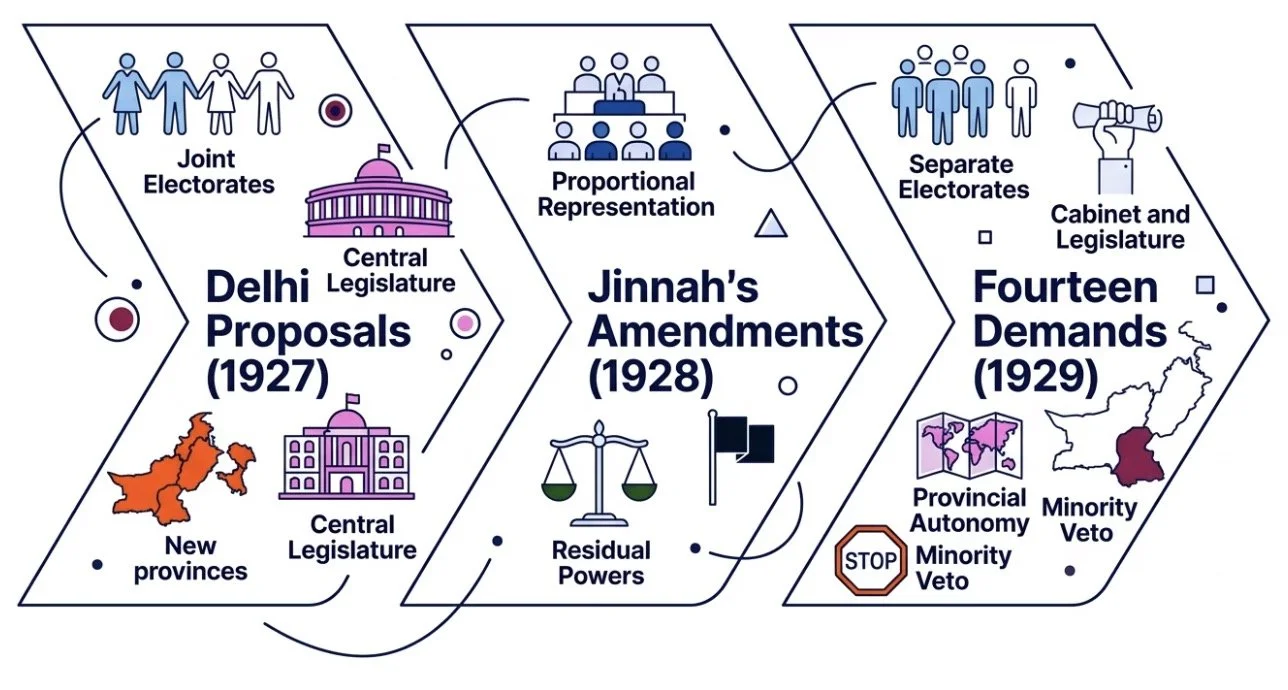
Significance of the Jinah’s Fourteen Demands
Historians have debated the precise character of the Fourteen Demands. Some view them as a reasonable articulation of minority protections in a plural democracy; others see them as the beginnings of a two-nation logic that would ultimately culminate in the demand for Pakistan in 1940. What is not disputed is their historical importance: the Fourteen Demands became the minimum basis on which the Muslim League engaged in all subsequent constitutional negotiations throughout the 1930s and beyond, including the Round Table Conferences of 1930–32.
Responses
Congress and Muslim League Responses to the Nehru Report
The formal political responses to the Nehru Report from the two principal organisations — the Indian National Congress and the Muslim League — revealed the depth of the divergence that had opened between them by the close of 1928. The Congress, at its annual session on 31 December 1928, adopted a resolution welcoming the All Parties Conference Report and declaring its conditional acceptance: if the British Parliament approved the constitution in its entirety within one year — that is, by 31 December 1929 — the Congress would accept dominion status as its constitutional goal. If, however, the constitution was rejected or simply ignored, the Congress would organise a campaign of non-violent non-cooperation, including non-payment of taxes.
This deadline, it should be noted, was never met. The British government's failure to act on the Nehru Report's framework within the stipulated year was directly instrumental in the Congress' adoption of the demand for Purna Swaraj (complete independence) at the Lahore session in December 1929 — a development that transformed the character of the nationalist movement.
Congress Response (December 1928)
Passed a resolution welcoming the Nehru Report. Conditionally accepted dominion status if British Parliament approved within one year (by 31 December 1929). If rejected or ignored, declared it would organise non-violent non-cooperation and non-payment of taxes.
Muslim League Response (March 1929)
The Subjects Committee initially approved the Nehru Report subject to Jinnah's stipulated safeguards. However, the open session of the Muslim League at Delhi on 31 March 1929 decisively rejected the Nehru Report and formally affirmed Jinnah's Fourteen Demands as the minimum condition for any political settlement acceptable to Muslims.
Internal Dissent
The Younger Section of the Congress: Opposition from Within
The dissatisfaction with the Nehru Report was by no means limited to organisations outside the Congress. Within the Congress itself, a powerful younger section — led most prominently by Jawaharlal Nehru and Subhas Chandra Bose — was deeply angered by the report's central recommendation of dominion status. For this younger generation of nationalists, who had been radicalised by the experience of colonial rule and inspired by international currents of anti-imperialism, the acceptance of dominion status represented not a constitutional advance but a political retreat.
The developments at the All Parties Conference, where communal pressures had forced concessions that appeared to compromise the nationalist framework, only strengthened their critique. Jawaharlal Nehru and Subhas Chandra Bose together rejected the Congress's modified constitutional goal and jointly established the Independence for India League— an organisation dedicated to the singular demand for complete independence (Purna Swaraj) rather than dominion status within the British Empire.
"Dominion status within the British Empire was, for us, not a goal but a concession — one that betrayed the aspirations of a generation that had grown up dreaming of a free and sovereign India."
— Reflecting the spirit of the younger nationalist critique, 1928–29
This internal division within the Congress — between the older, gradualist leadership represented by Motilal Nehru and the younger radical wing led by his own son — reflected a generational fault line that ran through the nationalist movement. The Independence for India League, while relatively short-lived as a formal organisation, gave institutional expression to the demand for Purna Swaraj that would ultimately prevail at the Lahore Congress of December 1929, effectively superseding the Nehru Report's dominion status framework altogether.
Legacy
Historical Legacy & Long-Term Consequences
The Nehru Report, the Delhi Proposals, and Jinnah's Fourteen Demands together constitute a crucial episode in the unravelling of the inter-communal constitutional consensus that Indian nationalism had, briefly, seemed capable of sustaining. The failure of the Calcutta Convention to accommodate Jinnah's amendments — which were themselves rooted in the Delhi Proposals the Congress had previously accepted — marked a point of no return in Congress–League relations. After 1929, negotiations between the two organisations were characterised by increasing mutual suspicion and hardening positions rather than the collaborative spirit of February 1928.
The Nehru Report itself had a mixed institutional legacy. It was made available to participants in all three Round Table Conferences of 1930–32, and its provisions on fundamental rights, the Supreme Court, and linguistic provinces anticipated features of post-independence constitutional arrangements. However, the Government of India Act 1935 — the most significant British constitutional intervention of the interwar period — drew much more heavily from the Simon Commission's report than from the Nehru Report. In this sense, the Report's immediate constitutional influence was limited, even as its historical importance as the first major indigenous constitutional draft remains undiminished.
A Constitutional Crossroads
The years 1927–1929 were, in retrospect, a constitutional crossroads for India. The brief window of inter-communal cooperation opened by the All Parties Conference and ratified in the Delhi Proposals was rapidly narrowed by the pressures of Hindu and Muslim communalism. The Nehru Report, for all its intellectual sophistication and historical importance as the first indigenous constitutional draft, was ultimately unable to reconcile the competing demands of the communities it sought to unite.
First Indigenous Draft
The Nehru Report was the first major Indian attempt to draft a constitutional framework, anticipating fundamental rights, a Supreme Court, and linguistic provinces
Communal Fault Lines
The episode exposed irreconcilable tensions between Hindu and Muslim communal demands, and between older gradualists and younger radicals within Congress
The Fourteen Demands
Jinnah's Fourteen Demands became the foundational basis of all Muslim League constitutional negotiation throughout the 1930s, shaping the road to Partition
Towards Purna Swaraj
The failure of the Nehru Report framework — rejected by both the League and younger Congress nationalists — directly propelled the Congress towards the demand for complete independence in 1929
Jinnah's Fourteen Demands, articulated in the immediate aftermath of the Calcutta Convention's failure, set the terms of Muslim League politics for the following two decades. The trajectory from the Delhi Proposals of 1927 — with their offer of joint electorates — to the Fourteen Demands of 1929 — with their insistence on separate electorates — encapsulates the rapid deterioration of inter-communal trust in the late 1920s. For students and researchers of Indian modern history, this episode offers an indispensable lens through which to understand the constitutional origins of the communal problem that would culminate in 1947.
