
The Civil Disobedience Movement
The Civil Disobedience Movement of 1930 stands as one of the most transformative episodes in India's struggle for independence. From the historic Declaration of Purna Swaraj on 26 January 1930 to the iconic Dandi March and the widespread defiance of British salt laws, this movement mobilised millions of Indians across every region, religion, and social class. It challenged the legitimacy of British rule not through armed revolt, but through disciplined, non-violent resistance — and in doing so, changed the course of history.
Purna Swaraj: The Demand for Complete Independence
Before 1930, the Indian political landscape was divided on the question of independence. Most major parties — including the All India Home Rule League, the All India Muslim League, and the Indian Liberal Party — either favoured dominion status within the British Empire or explicitly opposed outright independence. The idea of complete self-rule, or Purna Swaraj, was initially considered radical and was championed by a minority of visionary leaders.
Congress leader and poet Hasrat Mohani was the first to demand complete independence from the British at an All-India Congress Forum in 1921. Veteran leaders such as Bal Gangadhar Tilak, Aurobindo Ghose, and Bipin Chandra Pal had also advocated explicit independence from the Empire. For the younger generation, Jawaharlal Nehru promoted the Hindustan Sewa Dal, and in December 1927, he founded the Republican Party within the Congress for radical members demanding independence.
In August 1928, the Independence of India League was formed, with Jawaharlal Nehru and Subhash Chandra Bose as Secretaries and S. Srinivasa Iyengar as President. The Nehru Report (1928) demanded dominion status, but younger nationalists like Bose and Nehru pressed for a complete break from Britain.
At the December 1928 Congress in Calcutta, Gandhi proposed giving the British two years to grant dominion status — a deadline he later reduced to one year following pressure from Nehru and Bose.
On 31 October 1929, Viceroy Lord Irwin announced a Round Table Conference but could not assure that it would proceed on the basis of dominion status. This proved to be the decisive turning point. When Gandhi asked Irwin directly whether dominion status was on the table and received no assurance, the meeting ended — and the Congress resolved to escalate its demands.
The Lahore Session and the Declaration of Purna Swaraj
The Lahore Session of the Indian National Congress (December 1929), presided over by Jawaharlal Nehru, was a landmark moment in Indian political history. Veteran leaders such as C. Rajagopalachari and Vallabhbhai Patel returned to the Congress Working Committee. The session passed a resolution declaring that the Nehru Committee Report had lapsed, and that dominion status was no longer acceptable to the Congress.
December 1929
Lahore Session of Congress; Purna Swaraj resolution passed under Nehru's presidency
31 December 1929
Nehru unfurls the tricolour flag of India's independence on the bank of River Ravi at midnight
2 January 1930
Congress Working Committee decides that 26 January 1930 shall be observed as Purna Swarajya Day
26 January 1930
Indian National Congress publicly issues the Declaration of Independence — Purna Swaraj
The Purna Swarajya Resolution declared that swaraj meant complete independence — not mere self-governance within the Empire. All Central and Provincial Legislatures were to be boycotted, future elections were to be rejected, and a programme of Civil Disobedience was to be launched. A historic Congress legacy emerged from this session: the date of 26 January was commemorated each year as India's Independence Day, and when the new Constitution of India came into effect in 1950, it was deliberately enacted on 26 January 1950 to honour the 1930 declaration — which is why we celebrate Republic Day on this date.
Why Salt? The Genius of Gandhi's Choice
The Congress Working Committee gave Gandhi the responsibility of organising the first act of civil disobedience. His plan was to target the British salt tax, established under the Salt Act of 1882, which gave the British a complete monopoly on the collection and manufacture of salt. Violation of the Salt Act was a criminal offence. Even though salt was freely available to those living on the coast, Indians were forced to purchase it from the colonial government.
Gandhi's choice was initially met with scepticism. Jawaharlal Nehru and Dibyalochan Sahoo were ambivalent; Sardar Patel suggested a land revenue boycott instead. Even Viceroy Lord Irwin was unmoved, writing to London: "At present the prospect of a salt campaign does not keep me awake at night."
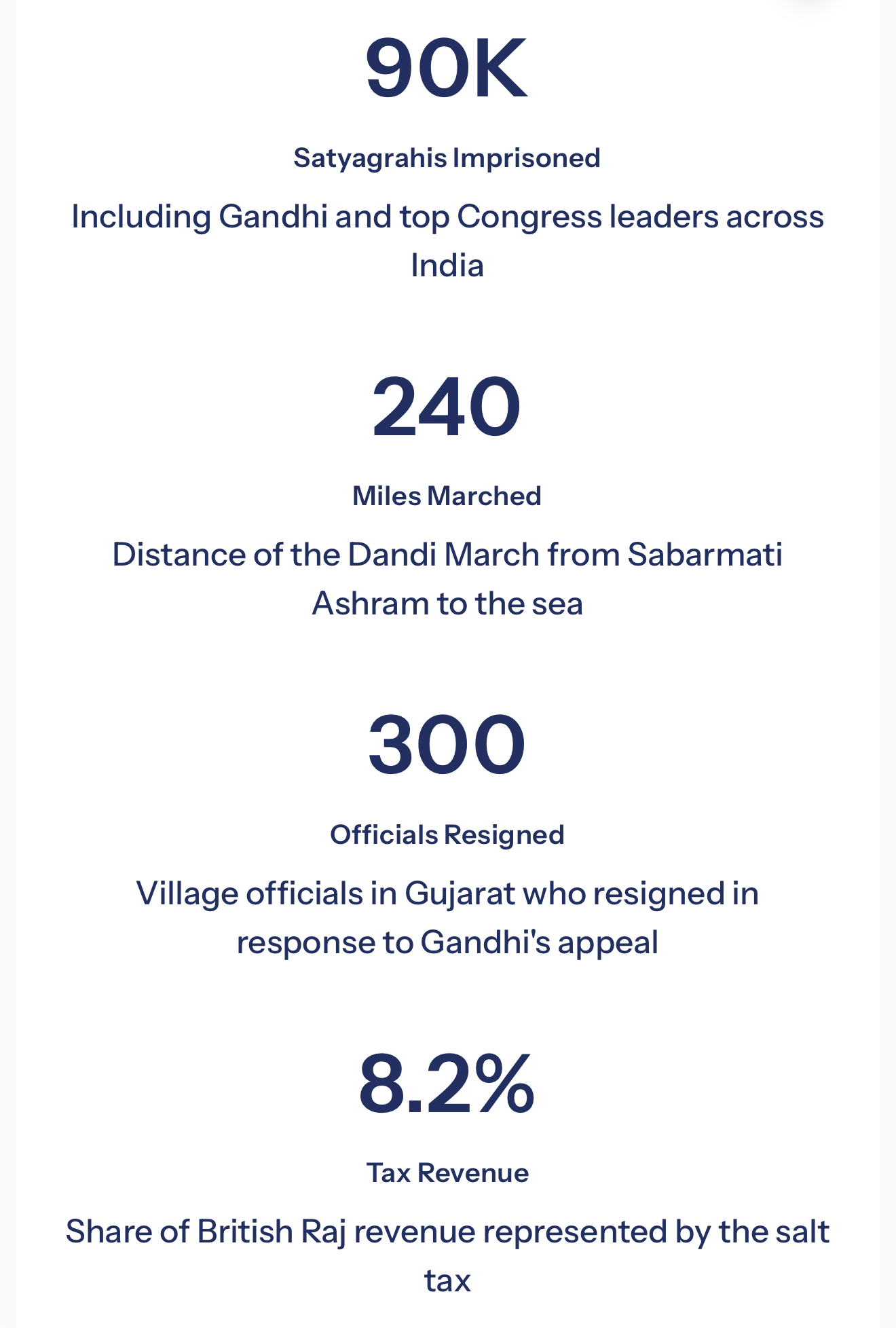
But Gandhi had sound reasons for his decision. Salt was used by nearly everyone in India — it was an item of daily use that could resonate with all classes of citizens far more effectively than an abstract demand for political rights. The salt tax represented 8.2% of British Raj tax revenue and hurt the poorest Indians the most.
Gandhi's Logic for Choosing Salt
Salt was used by every Indian, regardless of religion, caste, or class
It was a tangible, everyday injustice — not an abstract political concept
The tax disproportionately burdened the poorest citizens
It would unite Hindus and Muslims against a common wrong
It would dramatise Purna Swaraj in a way meaningful to the lowliest Indians
"Next to air and water, salt is perhaps the greatest necessity of life." — Mahatma Gandhi
The Dandi March: March 12 – April 6, 1930
On 2 March 1930, Gandhi informed the Viceroy of his plan of action. Gandhi, along with seventy-eight members of Sabarmati Ashram, was to march from his headquarters in Ahmedabad through the villages of Gujarat for 240 miles to the coastal village of Dandi, where the salt law would be violated by collecting salt from the beach.
Even before the march began, thousands thronged to the ashram. Gandhi issued directions for future action: civil disobedience of the salt law wherever possible; picketing of foreign liquor and cloth shops; refusal to pay taxes; lawyers giving up practice; boycott of law courts; resignation of government servants. All actions were to be guided by truth and non-violence. Local leaders were to be obeyed after Gandhi's arrest.
The historic march began on March 12, 1930. On April 6, 1930, Gandhi broke the salt law by picking up a handful of salt at Dandi. The violation was a powerful symbol of the Indian people's resolve not to live under British-made laws. The march was extensively covered by newspapers. In Gujarat alone, 300 village officials resigned in answer to Gandhi's appeal. Gandhi then urged women followers in Bombay to picket liquor shops and foreign cloth, declaring that "a bonfire should be made of foreign cloth."
Spread of Salt Disobedience Across India
Once Gandhi performed his ritual act of defiance at Dandi, the Salt Satyagraha spread like wildfire across the length and breadth of India. Every region found its own way to challenge British authority over salt, and local leaders stepped forward to organise marches and acts of civil disobedience.
Tamil Nadu
C. Rajagopalachari led a march from Tiruchirapally to Vedaranniyam to make salt at the coast
Malabar
K. Kelappan led a march from Calicut to Poyannur as part of the salt protest movement
Assam
Satyagrahis walked from Sylhet to Noakhali (Bengal) to manufacture salt in defiance of the law
Andhra
A number of sibirams (camps) came up in different districts as headquarters of Salt Satyagraha
Nehru's arrest in April 1930 for defiance of the salt law evoked huge demonstrations in Madras, Calcutta, and Karachi. Gandhi's arrest followed on 4 May 1930, when he had announced a raid on the Dharsana Salt Works. This triggered massive protests in Bombay, Delhi, and Calcutta. The fiercest response came from Sholapur.
After Gandhi's arrest, the Congress Working Committee sanctioned further measures: non-payment of revenue in Ryotwari areas; a no-chowkidara-tax campaign in zamindari areas; and violation of forest laws in the Central Provinces. The movement had expanded far beyond salt — it had become a comprehensive challenge to British authority in every sphere of Indian life.
Other Forms of Upsurge: Regional Revolts and Resistance
The Civil Disobedience Movement was not confined to the salt law alone. Across India, various regions witnessed distinctive and courageous acts of resistance that reflected the depth of anti-colonial sentiment among ordinary Indians.
Chittagong
Surya Sen's Chittagong Revolt Group carried out a raid on two armouries and declared the establishment of a provisional government — a bold armed challenge to British authority in Bengal.
Peshawar (NWFP)
Khan Abdul Gaffar Khan — the "Frontier Gandhi" — organised the Khudai Khidmatgars (Red Shirts), a non-violent volunteer brigade. On 23 April 1930, arrests of Congress leaders led to mass demonstrations. Peshawar was virtually in the hands of crowds for over a week. A section of Garhwal Rifles soldiers refused to fire on an unarmed crowd — a remarkable act of solidarity. The upsurge in a province with 92% Muslim population alarmed the British Government.
Sholapur
This industrial town of southern Maharashtra saw the fiercest response to Gandhi's arrest. Textile workers went on strike from 7 May; protesters burnt liquor shops and symbols of government authority. Activists established a virtual parallel government, which could only be dislodged with martial law after 16 May.
Dharsana
On 21 May 1930, Sarojini Naidu, Imam Sahib, and Manilal Gandhi led a raid on the Dharsana Salt Works. The unarmed, peaceful crowd was met with
The Movement Across States: Bihar, Bengal, Gujarat and Beyond
The Civil Disobedience Movement penetrated deep into rural India, drawing in peasants, tribals, zamindars, and ordinary citizens across a remarkable range of regions and social circumstances.
Bihar
A campaign for refusal to pay chowkidara tax was launched, with calls for resignation of chowkidars. The campaign was particularly successful in Monghyr, Saran, and Bhagalpur. The Government retaliated with beatings, torture, and confiscation of property.
Bengal
An anti-chowkidara tax and anti-union-board tax campaign was organised. The movement was met with repression and confiscation of property by colonial authorities.
Gujarat
Strong impact was felt in Anand, Borsad, Nadiad (Kheda district), Bardoli (Surat district), and Jambusar (Bharuch district). A determined no-tax movement included refusal to pay land revenue. Villagers crossed into neighbouring princely states such as Baroda with their families and belongings, camping in the open for months to evade police repression.
Maharashtra, Karnataka & Central Provinces
These areas saw defiance of forest laws — grazing and timber restrictions were violated and forest produce was sold publicly in acts of deliberate civil disobedience.
Assam
A powerful agitation was organised against the infamous 'Cunningham Circular', which forced parents, guardians, and students to furnish assurances of good behaviour to colonial authorities.
United Provinces
A no-revenue campaign targeted zamindars, urging them to refuse payment to the Government. A no-rent campaign simultaneously called upon tenants to withhold rent from zamindars. Since most zamindars were loyalists, the movement effectively became a combined no-rent and no-revenue campaign, gaining momentum in Agra and Rai Bareilly from October 1930.
Manipur and Nagaland: Rani Gaidinliu — A Young Heroine
The northeastern regions of Manipur and Nagaland took a brave part in the Civil Disobedience Movement, representing the extraordinary reach of the national struggle into India's most remote frontiers. Their participation is best embodied by one remarkable young woman whose courage became legendary.
At the young age of thirteen, Rani Gaidinliu of Nagaland raised the banner of revolt against foreign rule. She was captured in 1932 and sentenced to life imprisonment by the British rulers.
Gaidinliu (1915–1993) was a Naga spiritual and political leader who joined the Heraka religious movement of her cousin Haipou Jadonang at the age of thirteen. The movement evolved into a political campaign to drive the British out of Manipur and the surrounding Naga areas. Within the Heraka cult, Gaidinliu came to be considered an incarnation of the goddess Cherachamdinliu, giving her movement both spiritual and political authority among her people.
She was arrested in 1932, aged just 16, and sentenced to life imprisonment. Jawaharlal Nehru met her at Shillong Jail in 1937 and promised to pursue her release, bestowing upon her the title of "Rani" — a title that gave her enduring popular recognition as Rani Gaidinliu. She was finally released in 1947 after India's independence. A staunch advocate of ancestral Naga religious practices, she resisted the conversion of Nagas to Christianity. The Government of India honoured her as a freedom fighter and awarded her the Padma Bhushan.
Mass mobilisation during the movement was also carried out through prabhat pheries (morning processions), vanar senas and manjari senas (youth volunteer corps), secret patrikas (underground pamphlets), and magic lantern shows — making the movement a truly grassroots phenomenon.
Mass Participation: Who Joined the Movement?
One of the defining features of the Civil Disobedience Movement was the sheer breadth of its social participation. Unlike earlier agitations that were led primarily by the educated middle class, this movement drew in women, students, peasants, workers, traders, and tribals — making it a genuinely national uprising.
Women
Gandhi specially asked women to play a leading role. They became a familiar sight picketing liquor shops, opium dens, and foreign cloth shops. The movement marked their true entry into the public sphere — a liberating and transformative experience for Indian women.
Students & Youth
Along with women, students and youth played the most prominent role in the boycott of foreign cloth and liquor, bringing energy and enthusiasm to the movement across cities and towns.
Merchants & Traders
Traders' associations and commercial bodies were very enthusiastic, actively implementing the boycott — especially in Tamil Nadu and Punjab. Their economic leverage gave the movement significant commercial impact.
Tribals & Workers
Tribals participated actively in Central Provinces, Maharashtra, and Karnataka. Workers in Bombay, Calcutta, Madras, and Sholapur joined in, as did peasants across UP, Bihar, and Gujarat.
Muslim participation, however, was notably lower than during the Non-Cooperation Movement of 1920–22. Appeals by Muslim leaders to stay away from the movement, combined with active government encouragement of communal divisions, limited broad Muslim participation. Yet notable exceptions existed — overwhelming participation in the NWFP, significant middle-class Muslim participation in Senhatta, Tripura, Gaibandha, Bagura, and Noakhali, and active involvement of Muslim weavers in Bihar, Delhi, and Lucknow.
Impact of the Agitation
Key Economic Impacts
Imports of foreign cloth and other items fell significantly
Government income from liquor, excise, and land revenue declined
Elections to the Legislative Assembly were largely boycotted
Salt tax revenue is disrupted across coastal regions
Scale of Repression
The Government's response throughout 1930 was ambivalent and perplexed. It faced a classic dilemma: applying force led Congress to cry "repression," while inaction led Congress to declare "victory." Either way, the hegemony of the Government was eroded. Once repression began, ordinances banning civil liberties were freely used, including gagging of the press. Provincial governments were given freedom to ban civil disobedience organisations.
Lathi charges and firing on unarmed crowds left several killed and wounded, while 90,000 satyagrahis — including Gandhi and other Congress leaders — were imprisoned. The publication of the Simon Commission Report, which contained no mention of dominion status, further alienated even moderate political opinion.
Government Response and Efforts for Truce
As the Civil Disobedience Movement gained momentum through 1930, the British Government found itself increasingly on the back foot — unable to ignore the scale of the uprising, yet unwilling to make meaningful political concessions. The colonial administration oscillated between repression and negotiation, neither approach proving entirely effective.
In July 1930, the Viceroy suggested a Round Table Conference and reiterated the goal of dominion status. He accepted a suggestion that Tej Bahadur Sapru and M.R. Jayakar be allowed to explore the possibility of peace between the Congress and the Government. In August 1930, Motilal and Jawaharlal Nehru were taken to Yeravada Jail to meet Gandhi and discuss a possible settlement.
Congress Demands — Unequivocally Reiterated
The right of secession from Britain
Complete National Government
Full Indian control over defence and finance — not just internal affairs
Independent Financial Tribunal
A neutral body to settle Britain's financial claims against India
Talks broke down at this point. The British were unwilling to concede full independence or control over defence and finance. Yet the very fact that the Viceroy was negotiating with the Congress — treating Gandhi as a political equal — was itself a significant shift in the balance of power. The moral authority of the satyagrahis had forced the British to the negotiating table.
Was the Gandhi-Irwin Pact a Retreat?
Gandhi's decision to suspend the Civil Disobedience Movement under the Gandhi-Irwin Pact sparked considerable debate, particularly among the youth who had participated with great enthusiasm and expected a decisive victory. Critics called it a retreat. Gandhi and his supporters disagreed — and their reasoning reveals much about the philosophy of Satyagraha itself.
Arguments That It Was NOT a Retreat
Mass movements are necessarily short-lived by their nature
The capacity of ordinary people to make sacrifices is limited, unlike that of full-time activists
There were visible signs of exhaustion after September 1930, especially among shopkeepers and merchants
In Satyagraha, a compromise is neither heresy nor treason — it is a natural and necessary step
If the compromise proved premature, the Satyagrahi could return to non-violent battle
The sheer fact that the Government signed a pact with Gandhi — treating him as an equal — was itself a moral victory
Disappointments and Reservations
Youth were disappointed — they had participated enthusiastically and wanted a decisive outcome
Peasants of Gujarat were upset that their confiscated lands were not immediately restored
Subhash Chandra Bose and other radicals felt that too much had been conceded to the British
The Broader Significance
Vast masses of people were jubilant that the Government had been forced to regard their movement as significant and treat their leader as an equal. Political prisoners released from jails were given a hero's welcome across the country — a powerful signal of changed public sentiment.
The object of Satyagraha was not to achieve the physical elimination or moral breakdown of an adversary — but, through suffering at his hands, to initiate a psychological process that could make it possible for minds and hearts to meet.
Civil Disobedience vs. Non-Cooperation: A Comparison
The Civil Disobedience Movement of 1930 differed from the Non-Cooperation Movement of 1920–22 in several important ways, reflecting both the radicalisation of the Indian national movement and the lessons learned from earlier struggles.
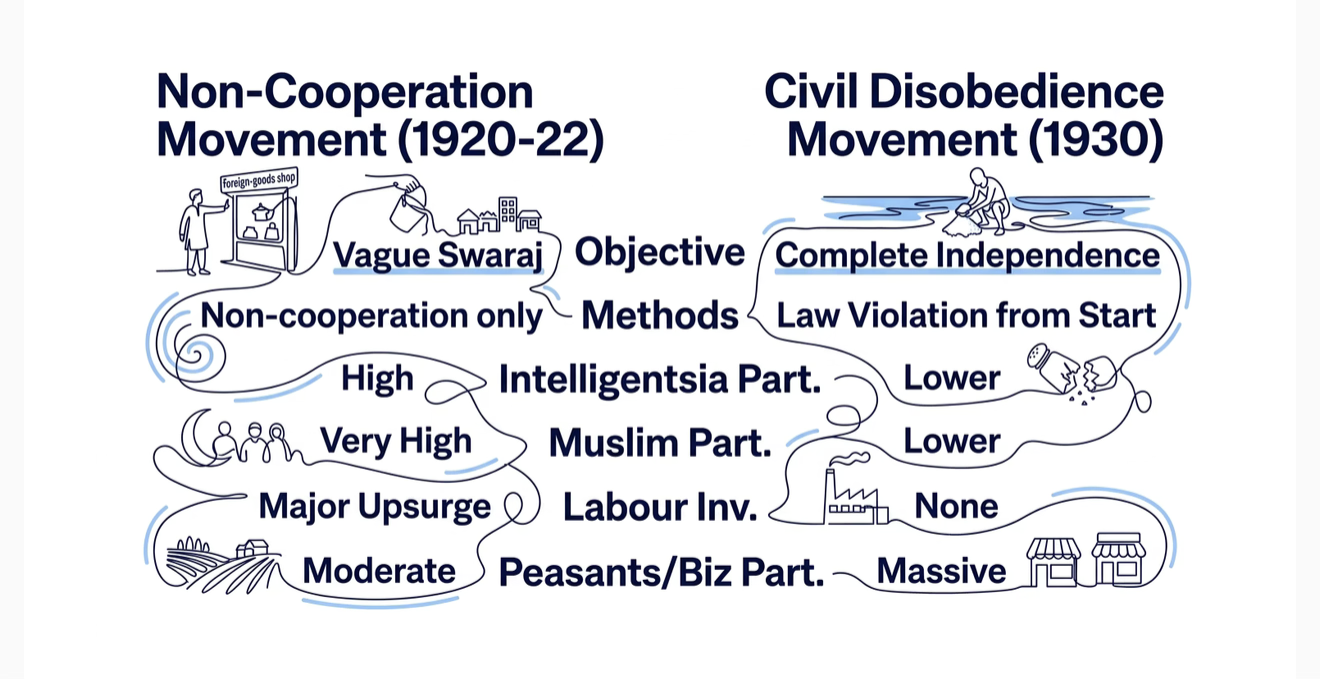
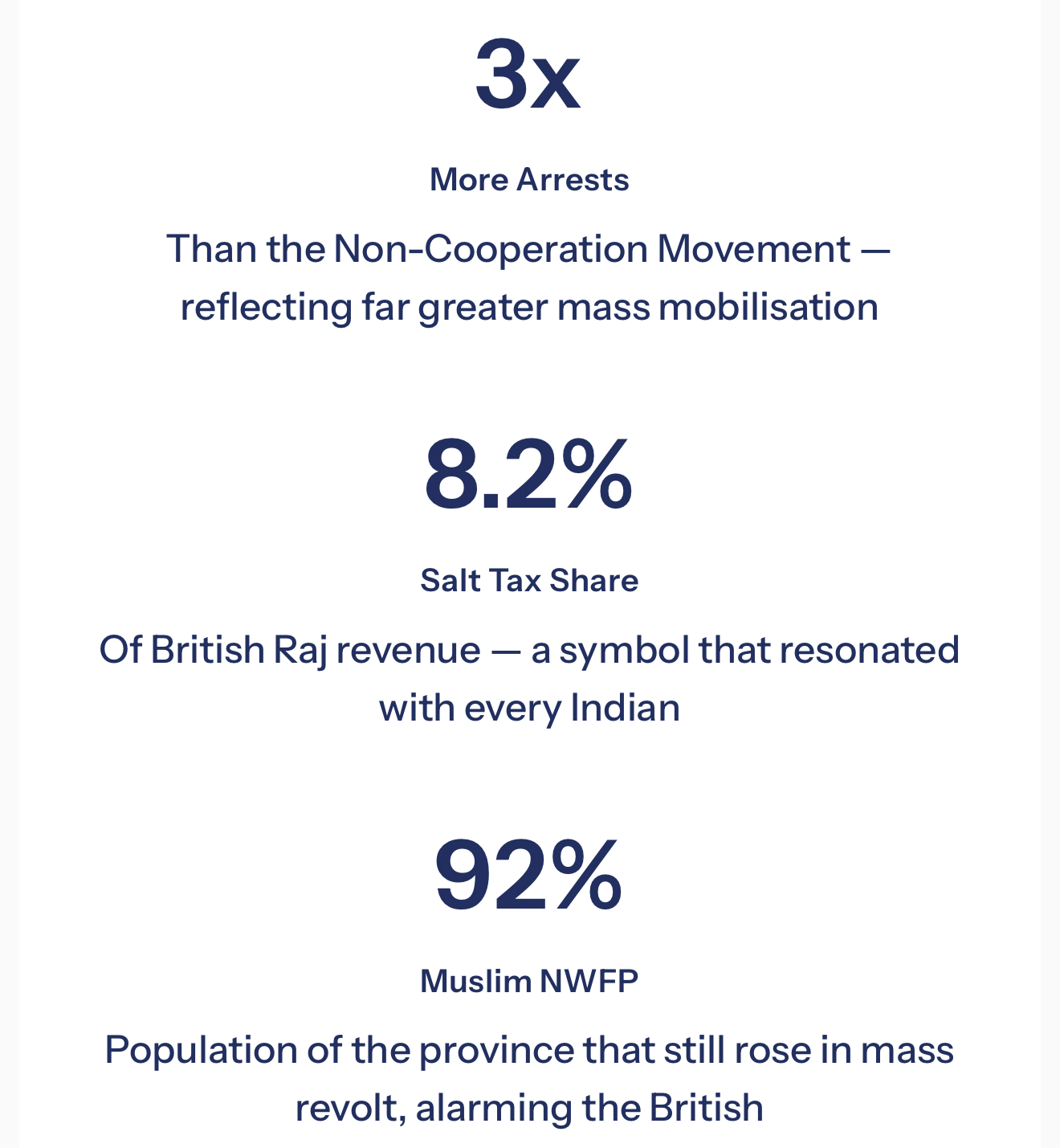
Despite the lower Muslim participation and the absence of a major labour upsurge, the Civil Disobedience Movement compensated with massive participation of peasants and business groups. The number of those imprisoned was approximately three times more than during the Non-Cooperation Movement, and the Congress was far more organisationally robust. The explicit demand for complete independence — Purna Swaraj — also gave the movement a clarity of purpose that its predecessor had lacked.
The Karachi Congress Session — March 1931
In March 1931, a special session of the Congress was held at Karachi to endorse the Gandhi-Irwin (Delhi) Pact. The session was overshadowed by tragedy: just six days before (on 23 March 1931), Bhagat Singh, Sukhdev, and Rajguruhad been executed. Throughout Gandhi's route to Karachi, he was greeted with black flag demonstrations by the Punjab Naujawan Bharat Sabha, protesting his failure to secure commutation of the death sentences.
The Congress, while disapproving of political violence, passed a resolution admiring the "bravery" and "sacrifice" of the three martyrs. The Delhi Pact was endorsed and the goal of Purna Swaraj reiterated. But the session's lasting significance lay in two landmark resolutions that spelled out, for the first time, what Swaraj would actually mean for ordinary Indians.
Fundamental Rights Guaranteed
Free speech and free press
Right to form associations and to assemble
Universal adult franchise
Equal legal rights irrespective of caste, creed, and sex
Neutrality of state in religious matters
Free and compulsory primary education
Protection of culture, language, and script of minorities
National Economic Programme
Substantial reduction in rent and revenue
Exemption from rent for uneconomic holdings
Relief from agricultural indebtedness and control of usury
Living wage, limited hours of work, and protection of women workers
Right of workers and peasants to form unions
State ownership and control of key industries, mines, and transport
"In order to end the exploitation of the masses, political freedom must include economic freedom of starving millions." — Karachi Resolution, 1931
The Karachi Resolution was to remain, in essence, the basic political and economic programme of the Congress in subsequent years. It represented a pivotal maturation of the independence movement — from a struggle against colonial rule into a vision for a just and equitable nation.
The Legacy of the Civil Disobedience Movement
How does history judge the Civil Disobedience Movement? Its outcomes were complex — it achieved less than its most ardent supporters hoped, yet its impact on Indian and world history was profound and enduring.
Global Attention
The Salt Satyagraha drew worldwide attention. Millions saw newsreels of the Dandi March. Time magazine declared Gandhi its 1930 Man of the Year, comparing the march to the defiance of the British tea tax by New Englanders.
Equal Negotiations
The Gandhi-Irwin Pact marked the first time the two sides negotiated on equal terms. It led to the Second Round Table Conference at the end of 1931 — a significant political achievement.
Shifting Legitimacy
Even though British authorities regained control by the mid-1930s, Indian, British, and world opinion increasingly began to recognise the legitimacy of claims for independence. The Satyagraha campaign forced the British to acknowledge that their control of India depended entirely on Indian consent.
Global Inspiration
More than thirty years later, Satyagraha and the March to Dandi profoundly influenced Martin Luther King Jr. and his civil rights movement for Black Americans in the 1960s — one of the most powerful testaments to Gandhi's legacy.
Salt Satyagraha produced limited progress toward dominion status or independence in the immediate term, and did not win major concessions from the British. It also failed to sustain high levels of Muslim support. Congress leaders ultimately decided to end Satyagraha as official policy in 1934. Nehru and other Congress members drifted further from Gandhi, who withdrew to concentrate on his Constructive Programme — including the Harijan movement against untouchability. Yet the movement's moral and political impact was immeasurable.
Key Figures of the Civil Disobedience Movement
The Civil Disobedience Movement was shaped by an extraordinary constellation of leaders, each bringing a distinct vision, strategy, and regional base to the national struggle for independence.
Mahatma Gandhi
The architect of the movement. Gandhi chose the salt tax as the instrument of defiance, led the Dandi March, negotiated the Gandhi-Irwin Pact, and embodied the philosophy of non-violent resistance that gave the movement its moral authority.
Jawaharlal Nehru
Presided over the landmark Lahore Session of 1929; unfurled the tricolour on the banks of River Ravi at midnight; was arrested for defying the salt law; and represented the aspirations of India's youth and progressive nationalists.
Subhash Chandra Bose
Pressed Gandhi for more immediate and decisive action against the British; co-founded the Independence of India League; represented the radical wing of the Congress that was impatient with compromise.
Khan Abdul Gaffar Khan (Frontier Gandhi)
Organised the Khudai Khidmatgars (Red Shirts) among the Pathans of the NWFP; combined social and educational reform with political mobilisation; led a majority-Muslim province in a powerful non-violent uprising that troubled the British greatly.
Sarojini Naidu
Led the raid on the Dharsana Salt Works after Gandhi's arrest; became a symbol of women's active participation in the freedom struggle; witnessed the brutal lathi charge that drew global condemnation.
C. Rajagopalachari
Led the Tiruchirapally-to-Vedaranniyam salt march in Tamil Nadu; returned to the Congress Working Committee at the Lahore Session; remained a key figure in southern India's participation in the movement.
The Civil Disobedience Movement at a Glance
The Civil Disobedience Movement of 1930 remains one of the most significant chapters in India's independence struggle. Its carefully chosen symbolism, its unprecedented mass mobilisation, and its articulation of a comprehensive vision for independent India together make it a turning point not just in Indian history, but in the global story of non-violent resistance.
The movement demonstrated that ordinary Indians — women, peasants, students, traders, and tribals — were not passive subjects but active agents of their own liberation. Its echo in the American civil rights movement of the 1960s, and its enduring influence on protest movements worldwide, are a testament to the transformative power of principled non-violence.
Remember: The date 26 January 1930 (Purna Swaraj Declaration) directly inspired the choice of 26 January 1950 as the date for the Indian Constitution to come into effect — which is why India celebrates Republic Day on 26 January each year.
