The Simon Commission (1927–1930)
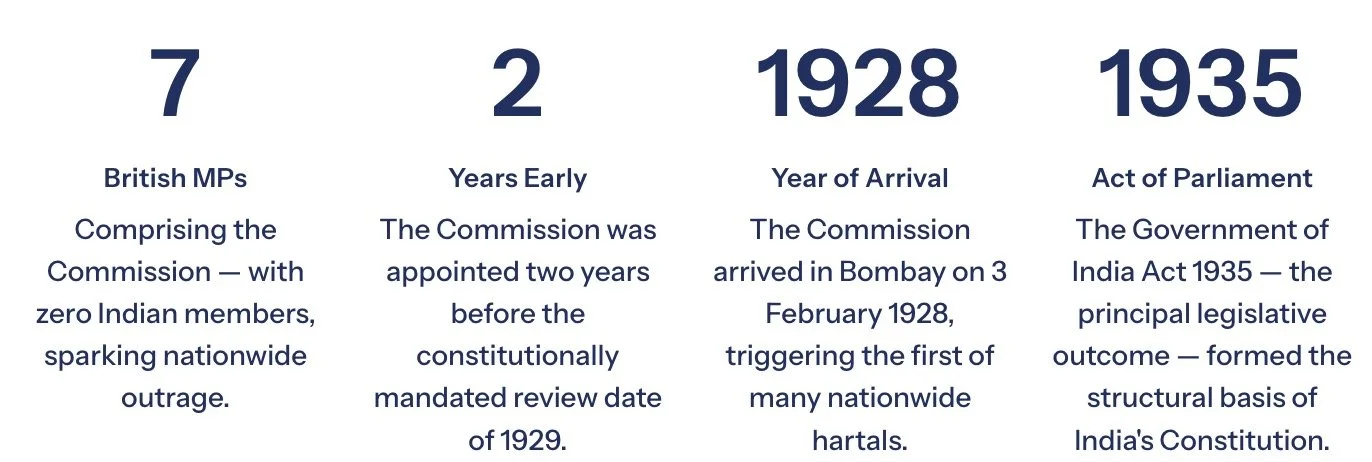
The Indian Statutory Commission, popularly known as the Simon Commission after its chairman Sir John Simon, stands as one of the most consequential and controversial episodes in the history of India's constitutional struggle. Comprising seven British Members of Parliament with no Indian representation, its appointment in 1927 ignited a nationwide protest movement that galvanised both seasoned politicians and a new generation of youth activists, ultimately accelerating India's march towards self-governance. This document examines the Commission's origins, composition, public response, police repression, and its lasting legacy in shaping modern India's constitutional framework.
Background and Origins
The roots of the Simon Commission lie in the Government of India Act 1919, which introduced the system of dyarchy to govern the provinces of British India. Under dyarchy, certain subjects were transferred to elected Indian ministers while others were retained under British control — a compromise arrangement that satisfied neither side. The Indian public increasingly clamoured for a revision of this cumbersome and unsatisfactory form of government, and the Act of 1919 itself contained a provision that a commission would be appointed after ten years to investigate the progress of the governance scheme and recommend new steps for reform.
However, rather than waiting until 1929 as stipulated, the Conservative Government in Britain — then under considerable political pressure — chose to act two years early. In appointing the Simon Commission in November 1927, the British Government virtually acknowledged the failure of the Reforms of 1919. The Conservative Party, fearing imminent defeat at the hands of the Labour Party in the coming elections, was unwilling to leave the question of India's constitutional future — the governance of Britain's most prized colonial possession — in what they described as "irresponsible Labour hands." This political calculation on the part of the British establishment set the stage for a decision that would prove deeply inflammatory.
The Government of India Act 1919
Introduced dyarchy in Indian provinces — a dual system of governance that satisfied neither British administrators nor Indian political leaders.
Transferred subjects under elected ministers
Reserved subjects under British control
Mandated a review commission after 10 years
Why the Commission Was Premature
The Conservative Government, fearing Labour victory in upcoming elections, did not wish to leave India's constitutional future to a rival party. This partisan anxiety precipitated the early appointment of the Commission in November 1927 — a full two years before it was due.
Composition of the Commission
The Indian Statutory Commission was constituted by seven British Members of Parliament, with Sir John Simon serving as its chairman. One of its notable members was Clement Attlee, who would later become Prime Minister of the United Kingdom and oversee the granting of independence to India and Pakistan in 1947. Despite being charged with the immense responsibility of determining the constitutional future of a vast and complex subcontinent, the Commission contained not a single Indian member.
Lord Birkenhead, the Conservative Secretary of State for India who was responsible for the Commission's appointment, justified the exclusion of Indians by asserting that since the Commission was appointed by Parliament, its membership had to be confined to Members of Parliament. This justification was widely regarded as specious and insulting by Indian political opinion. Birkenhead had also persistently argued that Indians were incapable of formulating a concrete scheme of constitutional reforms enjoying broad political support — a provocation that would ironically stimulate precisely the kind of united Indian constitutional thinking he claimed was impossible.
Sir John Simon
Chairman of the Commission and a prominent British Liberal statesman. His name became synonymous with the Commission and, by extension, with imperial arrogance in Indian political memory.
Clement Attlee
A member of the Commission who later became British Prime Minister and, in a remarkable historical irony, presided over the independence of India and Pakistan in 1947.
Zero Indian Members
Despite being tasked with determining India's constitutional future, the Commission included no Indian representatives — a deliberate exclusion that outraged Indian public opinion across political lines.
Lord Birkenhead
The Conservative Secretary of State who orchestrated the Commission's appointment and justified Indian exclusion on parliamentary grounds, whilst doubting Indians' capacity for self-governance.
The Indian Response: Boycott and Outrage
The announcement of the Simon Commission provoked immediate and nearly unanimous outrage across the Indian political spectrum. What angered Indians most profoundly was not merely the composition of the Commission, but the fundamental premise it embodied: that foreigners would discuss and determine India's fitness for self-government. This was seen as a brazen violation of the principle of self-determination and a deliberate insult to the dignity and self-respect of Indians. The response was swift, coordinated, and unprecedented in its breadth.
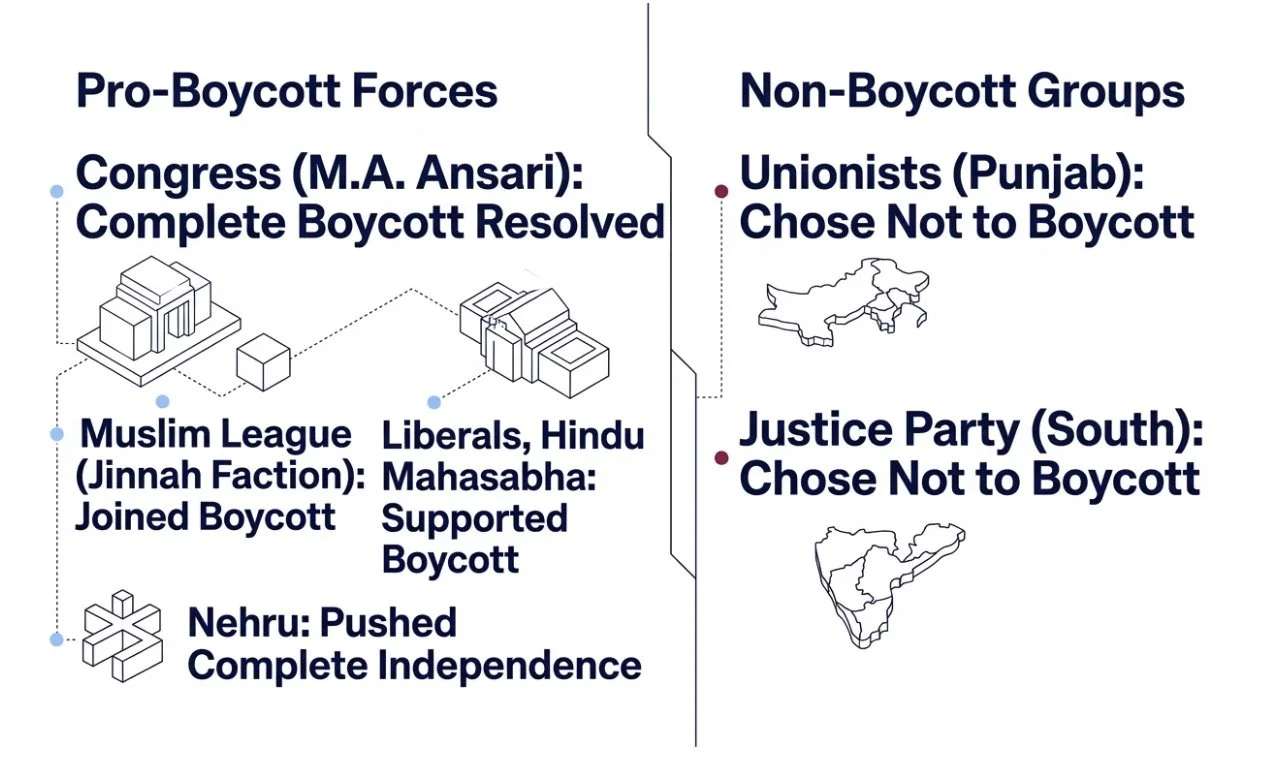
The Indian National Congress, at its December 1927 session in Madras (now Chennai), held under the presidency of Dr M.A. Ansari, resolved to boycott the Commission "at every stage and in every form." At the same session, Jawaharlal Nehru succeeded in having a snap resolution passed declaring complete independence — not mere dominion status — as the goal of the Congress. This represented a significant radicalisation of the Congress platform. A faction of the Muslim League, led by Mohammed Ali Jinnah, also decided to boycott the Commission. The Liberals and the Hindu Mahasabha similarly supported the Congress call for boycott, demonstrating a rare moment of cross-communal political solidarity.
Not all political formations, however, joined the boycott. The Unionists in Punjab and the Justice Party in the south chose not to participate in the protest, reflecting the complex and sometimes divergent political interests at play in colonial India. Nonetheless, the overwhelming weight of Indian political opinion was united against the Commission, making the boycott one of the most broadly supported political actions of the late 1920s.
The Indian Response: Boycott and Outrage
Public Protests: "Simon Go Back"
When the Simon Commission landed in Bombay on 3 February 1928, it was met not with official welcome but with a countrywide hartal and mass rallies that signalled the depth of popular feeling. Wherever the Commission travelled across the country, it was greeted with black flag demonstrations, work stoppages, and the resounding slogan — "Simon Go Back" — which became one of the most iconic protest cries in the history of India's freedom struggle. The Central Legislative Assembly was invited to form a Joint Committee to co-operate with the Commission, but it refused to do so, a significant institutional endorsement of the boycott.
A particularly important feature of this upsurge was the active and energetic participation of India's youth. For a new generation of young men and women, the anti-Simon Commission protests provided their first real taste of organised political action. They brought a militancy and enthusiasm to the movement that reinvigorated older political formations. Youth leagues and conferences received a decisive fillip. Jawaharlal Nehru and Subhash Chandra Bose emerged prominently as the leading voices of this new wave, travelling extensively across the country, addressing conferences, and inspiring thousands.
The protests also provided fertile ground for the spread of radical and socialist ideas amongst Indian youth. Organisations such as the Punjab Naujawan Bharat Sabha, the Workers' and Peasants' Parties, and the Hindustani Sewa Dal in Karnataka emerged from or were strengthened by this political ferment, introducing a new ideological dimension into the Indian national movement that would deepen in the years to come.
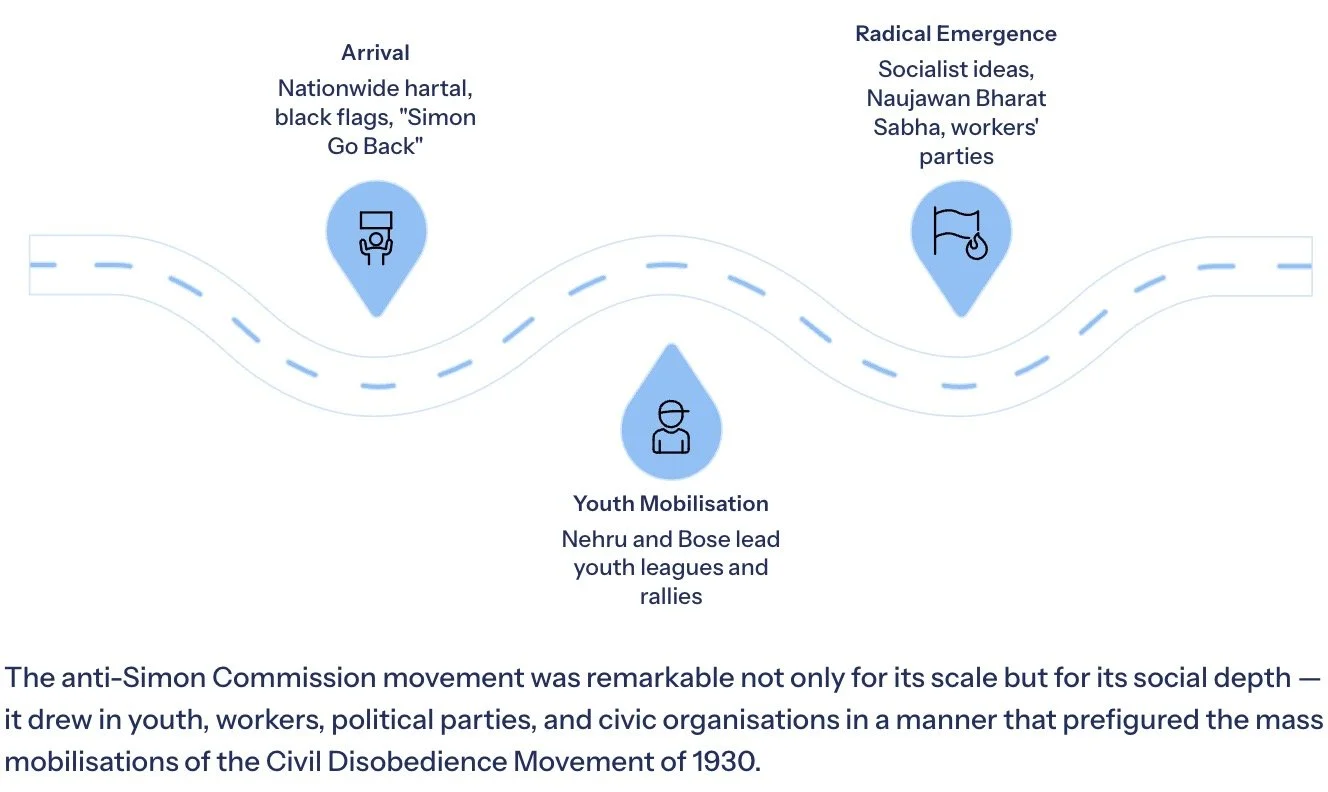
The anti-Simon Commission movement was remarkable not only for its scale but for its social depth — it drew in youth, workers, political parties, and civic organisations in a manner that prefigured the mass mobilisations of the Civil Disobedience Movement of 1930.
Police Repression and the Death of Lala Lajpat Rai
The colonial administration responded to the protests with characteristic force. Police came down heavily on demonstrators across the country, conducting lathi charges that spared no one, not even senior and respected leaders. Jawaharlal Nehru and G.B. Pant were beaten up in Lucknow, incidents that only intensified public anger and demonstrated the contempt with which the colonial state regarded even distinguished Indian parliamentarians and politicians.
The most grievous episode of repression occurred in Lahore. On 30 October 1928, the Simon Commission arrived in Lahore, where it was met — as everywhere else — by massive crowds of protesters carrying black flags. The Lahore protest was led by the veteran Indian nationalist Lala Lajpat Rai, who had earlier moved a resolution against the Commission in the Legislative Assembly of Punjab in February 1928. As the police moved to clear a path for the Commission, they resorted to a brutal lathi charge against the assembled protesters, targeting Lala Lajpat Rai with particular ferocity.
The injuries sustained by Lala Lajpat Rai in the police attack proved fatal. He died on 17 November 1928, just weeks after the assault. His death sent shockwaves through India's political establishment and public. The martyrdom of "Punjab Kesari" — the Lion of Punjab — at the hands of colonial police transformed popular anger into fierce determination. Bhagat Singh and his revolutionary comrades would subsequently avenge Lajpat Rai's death by assassinating the British police official responsible, setting in motion a chain of events that would further radicalise Indian politics in the years leading up to 1930.
Lathi Charges Across India
Police forces across the country resorted to violent lathi charges against peaceful demonstrators. Senior leaders including Jawaharlal Nehru and G.B. Pant were beaten in Lucknow, exposing the brutality of the colonial response.
The Lahore Protest — 30 October 1928
Lala Lajpat Rai led the Lahore demonstration against the Commission's arrival. Police conducted a particularly brutal lathi charge targeting the senior nationalist leader directly, inflicting severe injuries upon him.
The Death of Lala Lajpat Rai — 17 November 1928
Lala Lajpat Rai succumbed to his injuries on 17 November 1928. His death became a defining moment of the anti-Simon Commission movement and a rallying point for a generation of radical nationalists, including Bhagat Singh.
The Nehru Report: India's Counter-Proposal
Lord Birkenhead's persistent and provocative challenge — that Indians were incapable of arriving at an agreed constitutional scheme — was taken up directly by Indian political leaders as a gauntlet to be answered. In September 1928, ahead of the Simon Commission's report, Motilal Nehru presented what became known as the Nehru Report, a comprehensive constitutional document produced by an all-Indian committee representing a broad cross-section of political opinion.
The Nehru Report was a landmark document in the history of Indian constitutional thinking. It advocated that India be given the status of a dominion, enjoying complete internal self-government on the model of the self-governing dominions of the British Commonwealth. The Report also addressed the contentious question of communal representation, recommending joint electorates rather than separate communal electorates — a position that would prove controversial and would ultimately contribute to the deepening divide between the Congress and the Muslim League.
The production of the Nehru Report was in itself a significant political achievement. It demonstrated, against Birkenhead's assertions, that Indian political leaders of varying persuasions could come together to produce a coherent and sophisticated constitutional framework. It also represented the most detailed articulation yet of what Indian leaders envisioned for their country's future governance, placing the terms of constitutional debate firmly in Indian hands for the first time.
"The challenge of Lord Birkenhead to Indian politicians to produce an agreed constitution was accepted by various political sections, and thus prospects for Indian unity seemed bright at that point of time."
Purpose
Directly countered Birkenhead's challenge that Indians could not agree on a constitutional framework. Proved Indian political maturity on the world stage.
Core Demand
Advocated Dominion Status for India — complete internal self-government, modelled on the dominion constitutions of Australia and Canada.
Communal Question
Recommended joint electorates over separate communal electorates — a progressive but controversial position that widened the Congress–League divide.
Political Significance
Represented the first comprehensive, all-Indian constitutional document, placing the terms of India's constitutional future firmly in Indian hands for the first time.
The Commission's Findings and Report
The Simon Commission published its report in May 1930, more than two years after its controversial arrival in India. During the course of its enquiry, the Commission had become increasingly aware that the constitutional problems of British India could not be meaningfully addressed without also taking into account the complex relations between British India and the hundreds of Indian Princely States. Accordingly, the subject of these relations was added to the purview of the Commission's investigation, broadening its scope considerably.
The Commission's principal recommendations included the abolition of dyarchy — the unsatisfactory system of dual governance introduced by the Act of 1919 — and the establishment of fully representative government at the provincial level. This was a significant concession in principle, acknowledging that the experiment of dyarchy had failed. The report also recommended that separate communal electorates be retained for the time being, but only until communal tensions between Hindus and Muslims had sufficiently diminished. This recommendation on communal electorates was particularly criticised by Indian nationalist opinion as perpetuating a divisive colonial device.
The publication of the report was largely overtaken by events. By 1930, the political landscape of India had shifted dramatically with the launch of Gandhi's Civil Disobedience Movement. The Commission's recommendations nonetheless formed an important basis for subsequent legislative deliberations at the Round Table Conferences and ultimately fed into the Government of India Act 1935.
The funnel above illustrates the successive narrowing of constitutional authority — from the broad framework of the 1919 Act through the Simon process to the eventual legislative outcome of 1935, each stage filtering and concentrating the direction of constitutional change.
Aftermath: Dominion Status Declaration and Round Table Conferences
Even before the Simon Commission's report was published, significant political changes were underway in Britain. The Labour Party under Ramsay MacDonald came to power, raising considerable hopes — some of them exaggerated — in Indian political circles. The change in government signalled a potentially more sympathetic approach to Indian aspirations. The new political environment in London created an opening for fresh dialogue between the British Government and Indian representatives.
On 31 October 1929, the Viceroy, Lord Irwin, made a momentous announcement upon returning from a visit to England. He declared that the British Government had authorised him to clarify that it was implicit in the Declaration of 1917 that the natural issue of India's constitutional progress was the "attainment of Dominion Status." This statement — known as the Irwin Declaration or the October Declaration — was a significant, if carefully worded, acknowledgement of India's constitutional destination, though it deliberately stopped short of committing to any timeline.
The Viceroy further announced that the Government had accepted a Simon Commission suggestion: that after the publication of the Report and before its examination by a Joint Parliamentary Committee, a Round Table Conference should be convened. This conference would bring together representatives of the British Government, British India, and the Indian Princely States to seek the widest possible agreement on final proposals to be submitted to Parliament. The Round Table Conferences, held between 1930 and 1932, thus became the next major arena of constitutional negotiation, leading ultimately to the Government of India Act 1935.
November 1927
Simon Commission appointed by the Conservative Government, two years ahead of schedule.
February 1928
Commission arrives in Bombay; nationwide hartal and "Simon Go Back" protests erupt across India.
November 1928
Lala Lajpat Rai dies following a police lathi charge in Lahore during anti-Commission protests.
October 1929
Irwin Declaration announces Dominion Status as India's constitutional goal; Round Table Conference proposed.
May 1930
Simon Commission publishes its Report, recommending abolition of dyarchy and provincial representative government.
Legacy and Impact on Indian Constitutional History
The Simon Commission, despite its deeply flawed composition and the near-universal opposition it generated, left a profound and lasting imprint on the trajectory of India's constitutional development. Its most tangible legislative legacy was the Government of India Act 1935, which established representative government at the provincial level across India and remains one of the most significant constitutional documents in the subcontinent's modern history. Notably, a substantial portion of the Indian Constitution of 1950 drew directly upon the provisions and architecture of the Government of India Act 1935, making the Simon Commission a somewhat paradoxical contributor to independent India's foundational law.
In 1937, the first provincial elections were held under the framework established by the 1935 Act, resulting in Congress governments being returned to power in almost all provinces. This electoral success was a vindication of the Congress's long struggle and demonstrated the party's mass political base. It also provided the Congress with practical experience of government administration that would prove invaluable in the transition to independence a decade later.
Beyond its constitutional outcomes, the Simon Commission had far-reaching political consequences. It gave a decisive stimulus to radical forces within the Indian national movement who were now demanding not merely constitutional reform or dominion status, but complete independence alongside major socio-economic reforms on socialist lines. The youth radicalised during the anti-Simon protests — including figures such as Bhagat Singh, Sukhdev, and Rajguru — carried that militancy forward into increasingly bold revolutionary action. The Commission thus accelerated a generational shift within Indian nationalism, moving its centre of gravity towards a younger, more assertive, and more ideologically diverse leadership.