
The Indian Renaissance
The Indian Renaissance: Reimagining a Nation in the 19th Century
The 19th century witnessed a profound intellectual awakening across the Indian subcontinent—a period historians have termed the Indian Renaissance. This transformative movement emerged as the educated Indian elite grappled with the complex challenges posed by colonial rule and Western civilisation's critiques of Indian society. At its heart lay a fascinating paradox: reformers sought to modernise Indian traditions whilst simultaneously defending their cultural heritage against colonial disparagement. The movement represented neither wholesale acceptance of Western values nor blind adherence to tradition, but rather a sophisticated attempt to reconcile post-Enlightenment rationalism with India's ancient philosophical and religious foundations.
Though the term "renaissance" remains contested amongst scholars, this cultural phenomenon fundamentally reshaped how Indians understood their own civilisation. The educated elite, particularly in Bengal, embarked on an ambitious intellectual project: to discover rationalism within India's past and reposition her religious and philosophical traditions within the critical terrain of reason. This wasn't merely defensive—it was creative, generative, and forward-looking, laying the groundwork for modern Indian identity.
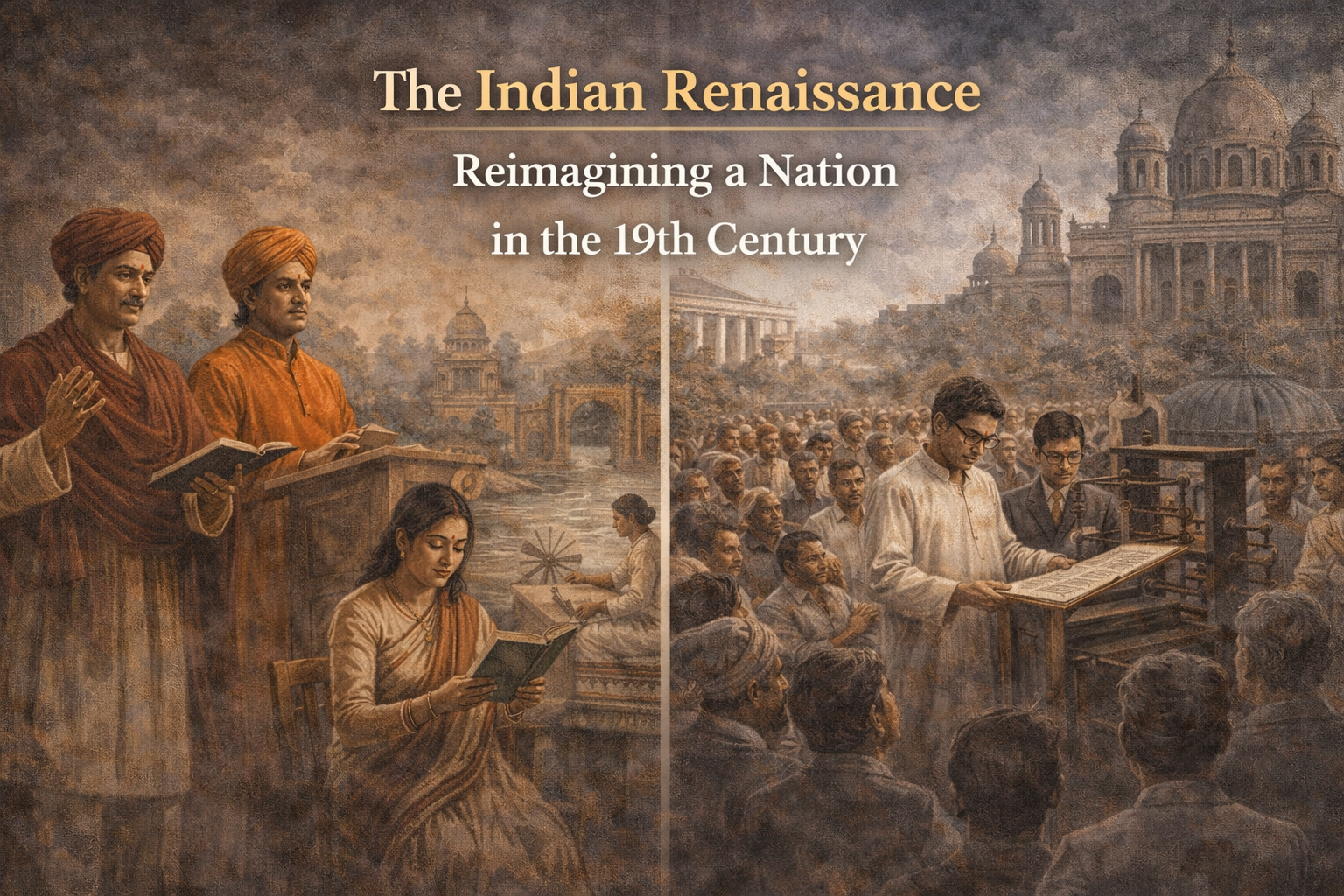
The Indian Renaissance: Reimagining a Nation in the 19th Century
Religious Reform
Reclaiming Spiritual Heritage: Religious Reformation
The Renaissance sparked a comprehensive reimagining of religious practice across all of India's faith communities. Hindus, Muslims, Parsis, Sikhs, and Christians alike sought to modernise and simplify their religious traditions, stripping away what reformers perceived as superstitious accretions whilst preserving essential spiritual truths. This wasn't secularisation—rather, it represented a profound reengagement with religion through the lens of reason.
Hindu reformers led particularly ambitious efforts. Raja Ram Mohan Roy's Brahmo Samaj sought to purify Hinduism by returning to monotheistic Vedantic principles. Swami Dayanand Saraswati's Arya Samaj went further, declaring the Vedas as Hinduism's sole authoritative source whilst rejecting later Puranic texts as corruptions. Meanwhile, Swami Vivekananda elevated Hindu spiritualism onto the world stage, presenting it not as inferior to Western rationalism but as its complement—a sophisticated philosophical system addressing dimensions of human experience that materialism could not reach.
"It was Dayanand Saraswati who proclaimed India for the Indians." —Annie Besant
Brahmo Samaj
Founded by Raja Ram Mohan Roy, promoted monotheism and rational religion
Arya Samaj
Dayanand Saraswati championed Vedic authority and social reform
Ramakrishna Mission
Vivekananda spread universal spiritualism and practical Vedanta
Foreign scholars unexpectedly became allies in this project. Max Müller, Sir William Jones, and Charles Wilkins translated Sanskrit texts—the Vedas, Upanishads, Bhagavad Gita, Ramayana, and Mahabharata—revealing to Western audiences the philosophical sophistication of Hindu thought. These translations provided reformers with powerful ammunition: their religious heritage could stand alongside, even surpass, Western philosophical traditions. This scholarly validation proved crucial in rebuilding Indian self-confidence after decades of colonial cultural assault.
Social Transformation
Challenging Orthodoxy: The Social Reform Agenda
Religious reform inevitably demanded social transformation. Reformers recognised that revitalising Indian civilisation required confronting deeply entrenched social evils—practices that contradicted both reason and humanity. They launched campaigns against the caste system's most pernicious manifestations, untouchability, child marriage, sati (widow immolation), purdah (female seclusion), and polygamy. These weren't merely moral crusades; they represented a fundamental reimagining of social organisation based on principles of human dignity and equality.
1829: Sati Prohibition
Raja Ram Mohan Roy's campaign led to the abolition of widow immolation
1856: Widow Remarriage Act
Ishwar Chandra Vidyasagar's efforts legalised widow remarriage
1860: Age of Consent
Legislation raised minimum marriage age for girls to 10 years
1866: Further Protections
Additional laws strengthened women's legal status and rights
Women's upliftment emerged as a central concern. Reformers established schools and colleges for female education, challenging the notion that women's intellectual development was unnecessary or dangerous. The impact proved transformative—women gradually emerged from seclusion to participate in public life, a revolutionary shift in a society where female invisibility had been normative. Legal measures accompanied social activism: sati and female infanticide were criminalised, widow remarriage gained legal sanction, and minimum marriage ages were established (though the age of 10 seems shockingly young by modern standards, it represented progress in its context).
Reform movements also attacked caste barriers, promoting inter-caste marriages and inter-dining—practices that directly challenged Brahmanical orthodoxy. They established institutions serving the broader public good: hospitals, dispensaries, orphanages, and libraries. These weren't merely charitable gestures but embodied a new social vision—one where community welfare, rather than ritual purity, defined righteousness.
Political Impact
From Cultural Revival to Political Awakening
Though not explicitly political, the Renaissance movements profoundly shaped Indian nationalism. By reviving pride in India's civilisational achievements, reformers cultivated the self-respect and confidence necessary for political assertion. They taught Indians to see themselves not as backward peoples requiring civilising but as inheritors of a sophisticated cultural legacy temporarily eclipsed by political misfortune.
The reformers themselves were patriots. Raja Ram Mohan Roy, Swami Dayanand Saraswati, Swami Vivekananda, Ishwar Chandra Vidyasagar, and Annie Besant combined cultural work with love for India. They understood that political liberation required psychological decolonisation—Indians had to overcome internalised inferiority before they could effectively challenge British rule.
Cultural Defence
Reformers provided intellectual resources to resist colonial cultural assault and assertions of Western superiority
National Consciousness
Pan-Indian reform movements created feelings of unity transcending regional and linguistic boundaries
Political Language
Concepts like "Swaraj" emerged from reform discourse, later becoming rallying cries for independence
Swami Dayanand Saraswati exercised particularly significant nationalising influence. He was the first major figure to use the term "Swaraj" (self-rule) and to advocate for Hindi as a national language—linguistic choices with profound political implications. Many Arya Samaj leaders subsequently joined the nationalist movement, particularly its more radical wing. As Annie Besant observed, Dayanand "proclaimed India for the Indians," articulating national aspirations that would intensify in subsequent decades.
The movements created what Jawaharlal Nehru described as cultural roots for the emerging middle class—"something that gave them assurance of their own worth; something that would reduce the sense of frustration and humiliation that foreign conquest and rule had produced." This psychological transformation proved essential for political mobilisation. Sister Nivedita's characterisation of Vivekananda captured this fusion of spirituality and patriotism: he was "a great patriot and the queen of his adoration was his motherland."
Economic Awakening: Recognising Colonial Exploitation
The Renaissance extended beyond cultural and social spheres to encompass economic consciousness. Reformers began analysing India's impoverishment not as the result of inherent backwardness but as the consequence of systematic colonial exploitation. This represented a crucial intellectual shift—from accepting British narratives of Indian economic incompetence to recognising the structural mechanisms extracting wealth from India to enrich Britain.
Recognition
Understanding that British rule existed to exploit India economically, not develop it
Industrialisation
Realising that economic progress required industrial development under Indian control
Self-Governance
Concluding that economic revival was impossible without political independence
Several reformers articulated sophisticated critiques of colonial economic policy. They argued that India's deindustrialisation—the destruction of traditional manufacturing, particularly textiles—resulted from deliberate British policy designed to transform India into a captive market for British manufactured goods and a source of raw materials. The systematic drainage of wealth through taxation, tribute, and trade imbalances impoverished India whilst enriching Britain.
Reformers recognised that addressing this exploitation required industrialisation. However, they understood that Indian industries could not flourish under colonial rule, which would always privilege British economic interests. Economic revival therefore necessitated political transformation—an Indian government that could protect and promote indigenous economic development. This analysis directly connected economic concerns with the nationalist project, demonstrating that cultural, social, and political reforms were ultimately inseparable from economic justice.
This economic consciousness marked a crucial evolution in Indian political thought. Early reformers had often collaborated with colonial authorities, believing benevolent British rule might facilitate modernisation. However, as economic analysis deepened, the contradictions became apparent: colonial exploitation was not incidental but fundamental to British presence in India.
Intellectual Foundation
Reason and Humanism: A New Intellectual Framework
Perhaps the Renaissance's most profound contribution was establishing reason and humanism as central values in Indian intellectual life. Before these movements, tradition and faith had dominated Indian thought—religious and social practices were validated primarily through appeal to ancient authority and scriptural sanction. The reformers introduced a different standard: practices must also conform to reason and promote human welfare.
Rationalism
Subjecting religious beliefs and social practices to critical examination rather than accepting them on authority alone
Questioning ritualism and superstition
Seeking logical consistency in doctrine
Rejecting practices that contradicted reason
Humanism
Evaluating traditions based on whether they promoted human dignity, welfare, and flourishing
Centring human needs and rights
Opposing practices causing suffering
Emphasising social welfare over ritual purity
Scriptural Reinterpretation
Reformers didn't reject tradition entirely but reinterpreted scriptures to align with rationalist and humanist values
Discovering rational elements in ancient texts
Distinguishing essential principles from cultural accretions
Using scripture strategically to legitimise reform
This intellectual framework proved revolutionary. Reformers opposed ritualistic, superstitious, irrational, and obscurantist elements across Indian religions. They argued that true religion aligned with reason—that faith and rationality were complementary rather than contradictory. This position allowed them to advocate modernisation without appearing to betray their cultural heritage. They weren't importing alien Western values but recovering authentic Indian traditions that had been corrupted over centuries.
The emphasis on humanism particularly distinguished 19th-century reform from earlier religious movements. Reformers evaluated practices not merely by scriptural conformity but by their impact on human welfare, especially concerning vulnerable groups like women and lower castes. This humanistic turn, whilst influenced by Enlightenment thought, also drew on indigenous philosophical traditions emphasising compassion and non-violence. The synthesis created a distinctively Indian modernity—rational and humanitarian whilst remaining rooted in indigenous cultural idioms.
Forging National Consciousness: The Path to Unity
The Renaissance movements' contribution to nationalism extended beyond inspiring patriotism amongst reformers themselves. These movements created conditions for national consciousness to emerge—a sense of shared identity transcending regional, linguistic, caste, and religious divisions that had historically fragmented Indian society.
Pan-Indian Scope
Reform movements operated across India, not just in isolated regions. The Brahmo Samaj in Bengal, Prarthana Samaj in Maharashtra, and Arya Samaj in Punjab and northern India created networks connecting reformers nationwide. Though each movement had regional characteristics, they shared common goals and methods, creating a sense of unified purpose.
Attacking Divisive Institutions
By challenging caste hierarchies and untouchability, reformers undermined social structures that prevented unity, fostering a sense of common humanity amongst Indians
Creating Modern Outlook
Reform movements helped Indians develop secular, national perspectives replacing narrow identifications based solely on caste, religion, or region
Addressing National Issues
Reformers tackled social evils on a pan-Indian basis rather than as localised problems, reinforcing the notion of India as a single society requiring collective solutions
Building Cultural Confidence
By defending Indian civilisation against colonial critiques, reformers gave Indians pride in shared cultural heritage, creating emotional bonds transcending particular identities
"The rising middle class were politically inclined and were not so much in search of religion; but they wanted some cultural roots to cling on to; something that gave them assurance of their own worth; something that would reduce the sense of frustration and humiliation that foreign conquest and rule had produced. The religious reform movement after all transformed India into a nation in the making."
—Jawaharlal Nehru
These movements helped Indians come to terms with modernity without completely abandoning tradition. They provided frameworks for synthesising indigenous and Western ideas, creating a distinctively Indian modernity. This intellectual work proved essential for nationalism—it allowed Indians to imagine a modern nation-state whilst maintaining cultural distinctiveness. The reformers' activities formed the prelude to explicit political nationalism, creating the cultural and psychological preconditions for mass political mobilisation that would emerge in the early 20th century.
Critical Analysis
Limitations and Contradictions: A Critical Assessment
Despite their achievements, Renaissance movements exhibited significant limitations that constrained their impact and introduced problematic elements into Indian modernity. A critical assessment reveals how their elite character, urban focus, and ambivalent relationship with colonialism limited their transformative potential.
Elite Character and Narrow Social Base
The movements appealed primarily to Western-educated elites who were economic and cultural beneficiaries of colonial rule. In Bengal, the "bhadralok" (gentlefolk)—comprised largely of Brahmans, Kayasthas, and Baidyas who had prospered through collaboration with British administration—dominated reform movements. The Brahmo Samaj, though spreading beyond Calcutta, remained alienated from masses. Reformers used Sanskritised Bengali prose incomprehensible to uneducated peasants and artisans. Similarly, Maharashtra's Prarthana Samaj comprised English-educated Chitpavan and Saraswat Brahmans, a few Gujarati merchants, and some Parsis—in 1872, merely 68 members and 150-200 sympathisers. This narrow base meant reform ideas never percolated to the masses.
Urban Concentration
Renaissance movements remained fundamentally urban phenomena. Their activities concentrated in cities like Calcutta, Bombay, Madras, and Lahore, producing minimal impact on rural populations comprising the vast majority of Indians. This urban-rural divide meant most Indians remained untouched by reformist ideas, limiting movements' ability to generate mass consciousness necessary for comprehensive social transformation.
Neglect of Caste and Untouchability
The high-caste character of reform movements explains relative silence on caste's most oppressive dimensions. Untouchability as a reform issue had to await the 20th century and Mahatma Gandhi's leadership. Early reformers, themselves from privileged castes, lacked urgency about dismantling caste hierarchy's foundations. This failure would have profound consequences—caste-based inequalities persisted, poisoning Indian democracy long after independence.
Religious Revivalism's Negative Aspects
Some movements' association with religious revivalism proved double-edged. Whilst cultural pride had positive aspects, revivalism sometimes fostered orthodoxy and fundamentalism. The tendency towards religious solidarity had wider political implications—it contributed to communal tensions that would intensify in the 20th century. By organising along religious lines (Hindu reform, Muslim reform, etc.), movements inadvertently reinforced religious identities as primary political categories, a legacy that would haunt the subcontinent.
Colonial Modernity's Ambivalences
Perhaps the most complex limitation involved reformers' ambivalent relationship with colonialism itself. Lacking broad social bases, early 19th-century reformers exhibited intrinsic faith in colonial rule's benevolent nature, relying on legislation to impose reform from above rather than creating reformist social consciousness at grassroots levels. This top-down approach had profound implications for how reform unfolded and its ultimate effectiveness.
Scriptural Obsession
Both colonial rulers and Indian reformers gave supreme importance to ancient texts. The dominant colonial assumption held that religion formed the basis of Indian society and was encoded in scriptures, with social evils resulting from scriptural distortions by cunning Brahman priests. The colonial "civilising mission" thus involved restoring to Indians the truths of their own little-read shastras.
Indian reformers, influenced by this framework, also grounded arguments in scriptures. The sati debate centred on textual interpretation—the colonial government prohibited sati only after being convinced the custom wasn't scripturally enjoined. The practice's brutality, its irrationality, or women's suffering were lesser concerns in debates more focused on defining tradition than addressing human welfare.
Women as Ground, Not Subjects
As scholar Lata Mani argues, in sati debates "women are neither subjects nor objects but, rather, the ground of the discourse on sati; … women themselves are marginal to the debate". The same applied to widow remarriage and female infanticide discussions. Women were denied agency in their own emancipation—reform happened to them, not through them. The scriptures, lately valorised by Orientalists, provided legitimacy for social reforms whilst maintaining patriarchal frameworks.
Reform from Above
Early 19th-century reforms followed through government fiat—legislation imposed from above without corresponding social consciousness from below. Predictably, many reforms remained on paper, unimplemented in practice. The lack of grassroots mobilisation meant traditional and irrational ethos largely continued, with religious revivalism later finding fertile ground where reformist consciousness had failed to take root.
A More Nuanced View
However, it's improper to say Indian reformist discourses merely reflected colonial formulations. Raja Ram Mohan Roy's early writings contain "humanistic pleas" to ameliorate Indian womanhood's conditions. He discussed scriptures when advocating sati's abolition because that's how he could persuade a cautious colonial government and a reticent Hindu society. But his "clinching arguments" anticipated contemporary feminism's idiom and stances. Roy's rationalism was pre-colonial—his early Persian writings took totally rational approaches to religion nearly amounting to religion's negation. After encountering Christianity and Western free-trade thinking in Calcutta, he became more moderate, perhaps more ambivalent.
Although Indian modernisers looked towards the colonial state for support and post-Enlightenment rationality shaped their visions, they could neither abandon their tradition nor forget their Indian identity. The Indian modernisation project therefore felt compelled to construct modernity located within Indian cultural space. As Christophe Jaffrelot summarises, reformers "undertook to reform their society and its religious practices in order to adapt them to Western modernity whilst preserving the core of Hindu tradition." Through this project, Indian nationhood's cultural essence—its difference from the colonising West—was gradually imagined by the Indian intelligentsia.
Legacy: Transforming India into a Nation in the Making
Despite their limitations, the 19th-century Renaissance movements fundamentally transformed India. They didn't achieve all their reformers envisioned—traditional practices persisted, social evils continued, and the masses remained largely untouched by reformist ideas. Yet these movements initiated processes that would reshape Indian society over subsequent generations, laying crucial groundwork for both Indian nationalism and modern Indian identity.
Cultural Confidence
Overcoming colonial-induced inferiority through civilisational pride
Rational Framework
Establishing reason and humanism as values in Indian intellectual life
Social Reform
Initiating struggles against oppressive practices affecting women and lower castes
National Unity
Creating pan-Indian consciousness transcending regional and communal divisions
Political Awakening
Preparing psychological ground for nationalist mobilisation and independence struggle
The Renaissance movements' greatest achievement was perhaps psychological—they helped Indians reimagine themselves. No longer passive objects of colonial rule or backwards peoples requiring civilising, Indians could see themselves as inheritors of sophisticated civilisational traditions, temporarily eclipsed but capable of revival and renaissance. This psychological transformation proved essential for the political mobilisations that would eventually achieve independence.
The movements also established frameworks for negotiating modernity that remain relevant today. They demonstrated that modernisation need not mean Westernisation—that Indians could adopt new ideas and technologies whilst maintaining cultural distinctiveness. This project of creating indigenous modernities, of finding ways to be both modern and authentically Indian, continues to animate Indian intellectual and political life.
Ultimately, as Nehru observed, the reform movements "transformed India into a nation in the making." They created the cultural, intellectual, and psychological conditions necessary for Indian nationalism to emerge and flourish. By giving Indians cultural roots to cling to, assurance of their own worth, and frameworks for reducing frustration and humiliation under foreign rule, these movements made possible the mass political mobilisations that would eventually achieve independence. Their legacy, complex and contradictory, nonetheless remains foundational to modern India's identity and ongoing project of democratic self-realisation.
