
Social and Religious Reform Movements
The 19th century witnessed a remarkable awakening in Indian society, particularly in Bengal and other regions. This period, often called the Indian Renaissance, saw pioneering reformers challenge deeply entrenched social evils and religious orthodoxy. These movements sought to reconcile traditional Indian values with modern progressive thought, creating a unique synthesis that would shape the nation's future. From Raja Ram Mohan Roy's Brahmo Samaj to Ishwar Chandra Vidyasagar's crusade for widow remarriage, these reform movements represented the first organised efforts to modernise Indian society whilst maintaining cultural roots.
Social and Religious Reform Movements
Raja Ram Mohan Roy: The Pioneer of Modern India
The Herald of a New Age
Raja Ram Mohan Roy (1774-1833) stands as a towering figure in Indian history, recognised as the forerunner of Modern India. Born into an upper-caste Bengali family whose fortunes had improved under colonial rule, Roy embodied a remarkable synthesis of traditional learning and modern thought. Rabindranath Tagore famously declared that "Raja Ram Mohan Roy inaugurated the modern age in India," whilst Dr. Macnicol called him "the herald of new age," noting that "the fire he kindled in India has burnt ever since."
Roy represented a unique bridge between worlds—between ancient caste structures and modern humanity, between superstition and science, between despotism and democracy, between immobile custom and progressive reform, and between bewildering polytheism and pure theism. His intellectual journey was shaped by diverse influences: he imbibed rationalism from eighteenth-century Perso-Arabic literature, studied Vedantic monism deeply, and engaged with Christian Unitarianism after settling in Calcutta in 1815 following his retirement from the East India Company's service.
Roy's Religious Reformation
Confronting Religious Orthodoxy
Roy was born during a period when Hinduism was overshadowed by numerous evils—blind faith, sacrificial rituals, rigid caste divisions, and idol worship. He rejected these barriers and stood as a high priest of universalism and love, advocating for the fundamental truth and unity of all religions.
Vedantic Revival
Roy attempted to revive the doctrine of the Unity of Godhead in Hinduism. He condemned idolatry, priestcraft, and polytheism, translating the Upanishads into Bangla to demonstrate that ancient Hindu scriptures themselves propagated monotheism. He reinterpreted Hindu doctrines through the lens of reason.
Comparative Religion Scholar
According to Monier Williams, Roy was "a great investigator of the science of comparative religions." Whilst influenced by Islam's monotheism and Christianity's moral principles, he rejected the divinity of Jesus Christ, instead admiring the humanitarian message of Christianity whilst defending Hinduism from missionary attacks.
Roy's intellectual approach was characterised by his ability to contest missionary claims of Christian superiority whilst simultaneously reforming Hinduism. He sought to purge Hinduism of accumulated abuses by returning to its purest Vedantic form. His rationalist perspective made him equally critical of Christian doctrines like the Trinity and miracle stories. Ultimately, Roy sought to effect a cultural synthesis between East and West, accepting the humanism of Europe whilst rejecting its theological dogmas.
Organisational Foundations: From Atmiya Sabha to Brahmo Samaj
1815: Atmiya Sabha
Roy founded the Atmiya Sabha, an association dedicated to free dissemination of religious truth and promotion of theological discussions. This organisation lasted until 1819 and represented his first organised attempt at religious reform.
1828: Brahmo Samaj
On 20th August 1828, Roy established what would become famous as the Brahmo Samaj, with Tarachand Chakravarty as secretary. This organisation's new theistic service excited hostility from orthodox Hindus, who formed the Dharma Sabha in opposition.
Opposition Emerges
The orthodox organisation Dharma Sabha, led by Bhavani Charan Banerjee with the newspaper Samachar Chandrika as its organ, actively opposed Roy's reformist Bengali weekly, Samvada Kaumudi, marking the beginning of organised resistance to reform.
The Battle Against Sati: Roy's Greatest Social Victory
Perhaps Roy's most celebrated achievement was his relentless campaign against the inhuman practice of sati—the burning of widows on their husbands' funeral pyres. His approach to this reform demonstrated his characteristic combination of rational argument, scriptural scholarship, and practical activism.
Grassroots Activism
Roy would personally visit cremation grounds in Calcutta, attempting to prevent sati by reasoning with the relatives of widows. He wrote articles in newspapers and delivered impassioned speeches at public meetings.
Scriptural Argumentation
By extensively quoting from ancient Hindu scriptures, Roy declared that Hinduism itself was against the practice of sati. This scriptural basis was crucial for gaining legitimacy amongst traditionalists.
Political Lobbying
Roy wrote numerous letters to Governor General Lord William Bentinck, urging legal proceedings against those who encouraged sati. He maintained persistent pressure on the colonial administration.
Counter-Petition Strategy
When conservatives petitioned Parliament to continue sati, Roy presented a powerful counter-petition declaring the custom inhuman and unjust, successfully arguing his case before British authorities.
Roy's co-operation proved decisive when Governor General Bentinck prohibited sati in 1829 through government regulation. The conservative Dharma Sabha's petition to the Privy Council in 1830 attempting to overturn this ban ultimately failed, marking a historic victory for social reform.
Championing Women's Rights and Status
A Comprehensive Reform Agenda
Roy recognised that merely suppressing sati would remain meaningless without broader reforms to improve women's status in society. His advocacy extended to multiple interconnected issues affecting Indian women.
He preached vigorously in favour of widow remarriage, understanding that without this option, the abolition of sati would leave widows in desperately vulnerable positions. Roy quoted extensively from Vedic literature to demonstrate that Hindu tradition actually supported higher status for women than contemporary practice allowed.
Beyond widow remarriage, Roy demanded property inheritance rights for women, challenging the patriarchal structures that left women economically dependent and vulnerable. He also condemned polygamy, arguing that women could never achieve respectful status in society whilst men were permitted multiple wives. His approach was always to ground progressive reforms in interpretations of ancient scriptures, thereby challenging orthodoxy on its own terms.
Educational Reformer and Modern Learning Advocate
Roy recognised education as the primary instrument for spreading modern ideas and combating superstition. His educational initiatives represented a deliberate attempt to create the intellectual foundations for a reformed Indian society capable of engaging with the modern world whilst retaining cultural identity.
Hindu College (1819)
Roy provided enthusiastic assistance to David Hare in founding the famous Hindu College, which became a crucible for modern thought in Bengal. He also supported Hare's other educational projects, recognising the transformative potential of Western-style education.
Personal Educational Ventures
From 1817, Roy maintained an English school in Calcutta at his own expense, where subjects including mechanics and Voltaire's philosophy were taught—remarkably progressive curriculum choices for the period.
Vedanta College (1825)
Roy established this institution offering courses in both Indian learning and Western social and physical sciences, embodying his vision of cultural synthesis and his belief that Indians needed access to both intellectual traditions.
Roy's commitment to Bengali language development was equally significant. He was keen on making Bengali the vehicle of intellectual discourse in Bengal, compiling a Bengali grammar book. Through his translations, pamphlets, and journals, he helped evolve a modern and elegant prose style for the Bengali language, making sophisticated ideas accessible to ordinary Bengalis rather than restricting intellectual discourse to Sanskrit-knowing elites.
Political Pioneer and Advocate for Rights
Constitutional Reforms
Indianisation of superior services
Separation of executive and judiciary
Trial by jury system
Judicial equality between Indians and Europeans
Press Freedom Campaign
Roy condemned the Press Regulations of 1823 and carried on vigorous agitation against them. He submitted a memorial to the Supreme Court defending freedom of speech and expression, establishing himself as a pioneer of press freedom in India.
Peasant Rights Advocacy
Roy condemned oppressive practices of Bengal zamindars that reduced peasants to misery. He demanded that maximum rents paid by cultivators be fixed permanently, allowing them to benefit from the Permanent Settlement of 1793.
Economic Justice
Roy protested against attempts to impose taxes on tax-free lands and demanded abolition of the East India Company's trading rights, demonstrating concern for economic fairness and colonial exploitation.
Roy was the initiator of public agitation on political questions in India. Influenced by English philosophers like Bacon and Bentham, he was anxious to reform the country's administrative system. Remarkably, he became the first Indian consulted by the British Parliament on Indian affairs, giving evidence before a select committee of the House of Commons—a recognition of his intellectual stature and political significance.
Journalism Pioneer and Global Citizen
Multilingual Media Empire
Roy was a pioneer of Indian journalism, bringing out journals in Bengali, Persian, Hindi, and English to spread scientific, literary, and political knowledge. His extensive linguistic abilities—proficiency in Oriental languages (Arabic, Persian, Sanskrit) and European languages (English, French, Latin, Greek, Hebrew)—freed his mind from the bigotry characterising contemporary Bengali society.
In 1821, Roy established the first press in India and started Sambad Kaumudi, the first vernacular newspaper in the country. These publications served to educate public opinion on current topics, represent popular demands and grievances to the government, and create an informed citizenry capable of engaging with political and social issues.
International Solidarity
Roy was a firm believer in internationalism and cooperation between nations. He took keen interest in international events, supporting causes of liberty, democracy, and nationalism worldwide whilst opposing injustice, oppression, and tyranny in every form.
He cancelled all social engagements when the Revolution in Naples failed in 1821, showing profound disappointment
He celebrated the success of the Spanish American Revolution in 1823 with a public dinner
He condemned Ireland's miserable condition under oppressive absentee landlordism
He publicly declared he would emigrate from the British Empire if Parliament failed to pass the Reform Bill
The Brahmo Samaj: Principles and Evolution
The Brahmo Samaj represented the earliest reform movement of the modern type in India, profoundly influenced by Western ideas yet rooted in Hindu philosophical traditions. Originally founded as Brahmo Sabha in 1828 and renamed Brahmo Samaj, it emerged from Roy's earlier organisation, Atmiya Sabha (founded 1815).
Monotheism
The Trust Deed (1830) defined its object as "worship and adoration of the Eternal, Unsearchable, Immutable Being who is the Author and Preserver of the Universe"—a conception of one formless, invisible, omnipresent, omnipotent yet personal God.
Rejection of Idolatry
The Samaj firmly opposed idol worship, with no place for priesthood or sacrifices. Worship was performed through prayers, meditation, and readings from the Upanishads, emphasising direct connection with the divine.
Universal Brotherhood
Great emphasis was placed on "promotion of charity, morality, piety, benevolence, virtue and strengthening of bonds of union between men of all religious persuasions and creeds," embodying Roy's universalist vision.
Humanitarian Service
Love for mankind and service of humanity were considered the highest goals. The movement focused on practical social reform alongside theological revision, understanding that religious transformation must translate into social progress.
Roy never intended to establish a new religion or separate sect. He wanted to purge Hinduism of accumulated evil practices. He remained a devout Hindu throughout his life, always wearing the sacred thread. His early death in 1833 left the Brahmo Samaj without its guiding spirit, leading to steady decline until Debendranath Tagore's revitalisation.
Debendranath Tagore and Organisational Consolidation
After Roy's death in 1833, the Brahmo Samaj entered a period of decline until Debendranath Tagore (1817-1905) infused new life into the movement. Tagore joined the Samaj in 1842, having earlier headed the Tattvabodhini Sabha (founded 1839), which was engaged in searching for spiritual truth. The informal association of these two organisations gave the Brahmo Samaj renewed strength in membership and purpose.
Tattvabodhini Sabha (1839)
Established by Tagore to carry on Roy's ideals, it aimed to counteract Christianity's rapid progress in India and advocated Vedantism's development. The Sabha emphasised indigenous language and culture, establishing Tattvabodhini Press (1843) and publishing Tattvabodhini Patrika to propagate its ideas.
Structural Reforms
Tagore provided the Brahmo Samaj with better organisational structure and ideological consistency. Under his leadership, branches were established throughout Bengal, expanding the movement's reach beyond Calcutta's educated elite.
Dual Strategy
Tagore worked on two fronts: within Hinduism, the Brahmo Samaj was a reformist movement; externally, he resolutely opposed Christian missionaries' criticism of Hinduism and their conversion attempts. He condemned idol worship and discouraged pilgrimages whilst maintaining Hindu identity.
Keshab Chandra Sen and the Radical Turn
Keshab Chandra Sen joined the Brahmo Samaj in 1858, and Tagore soon appointed him Acharya (spiritual leader). Sen's energy, vigour, and persuasive eloquence popularised the movement dramatically. Branches opened outside Bengal—in Uttar Pradesh, Punjab, Bombay, Madras, and other towns. By 1865, Bengal itself had 54 branches. However, Sen's radicalism also introduced unprecedented tensions into the movement.
Sen's Radical Reforms
Attacked caste system fundamentally, not just its superficial aspects
Focused on women's rights, promoting widow remarriage and inter-caste marriages
Challenged Brahmanical monopoly on priesthood, opening Brahmo preacher positions to non-Brahmans
Universal scripture reading: introduced readings from Christian, Muslim, Parsi, and other religious texts alongside Hindu scriptures
These innovations looked too radical to Debendranath Tagore, who dismissed Sen from the Acharya office in 1865. The schism reflected differing priorities: Sen's followers prioritised social progress and reform, whilst Debendranath's followers preferred maintaining identification with Hindu society.
The 1866 Split
Sen and his followers left in 1866, forming the Brahmo Samaj of India. Debendranath's group became the Adi (original) Brahmo Samaj. This division represented perennial dilemmas of Indian modernisation—the tension between reform and tradition, between universal values and cultural rootedness.
The crisis deepened with the Brahmo Marriage Act (1872), which legalised Brahmo marriages including inter-caste and widow marriages, but required contracting parties to declare themselves non-Hindus. This condition made the act unpopular, forcing Brahmos to choose between reform and Hindu identity.
The Second Split and Movement's Decline
Growing Authoritarianism (1870s)
Sen's close disciples began regarding him as an incarnation, whilst his progressive followers accused him of increasingly authoritarian behaviour. Tensions mounted as Sen's leadership style became more autocratic and his theological positions more idiosyncratic.
The Marriage Scandal (1878)
In 1878, Sen married his thirteen-year-old daughter to the minor Hindu Maharaja of Cooch-Bihar with full orthodox Hindu ceremonials, directly contradicting the Brahmo Samaj's advocacy of minimum marriage age. He justified this action claiming it was "God's will" and he had "acted on intuition."
Sadharan Brahmo Samaj (1878)
Most of Sen's followers, disgusted by this blatant negation of the Samaj's basic tenets, broke away and established the Sadharan Brahmo Samaj. This organisation attempted to return to the reform-oriented principles that had initially attracted them to Sen's leadership.
Naba Bidhan (1881)
In 1881, Sen formed his Naba Bidhan (New Dispensation), moving towards a new universalist religion. However, by this time, successive ideological rifts and organisational divisions had fatally weakened the Brahmo movement, confining it to a small elite group. It soon succumbed to neo-Hindu "revivalism" campaigns.
These divisions revealed fundamental tensions within Indian reform movements: How radical should reform be? Should reformers maintain or sever connections with traditional Hindu society? Can universal religious values be reconciled with specific cultural identities? These questions would continue troubling Indian modernisers throughout the colonial period and beyond.
Legacy and Contributions of the Brahmo Samaj
Despite its organisational fragmentation and limited elite membership, the Brahmo Samaj played a notable role in the Indian Renaissance. H.C.E. Zacharias wrote: "Rammohan Roy and his Brahmo Samaj form the starting point for all the various Reform Movements—whether in Hindu religion, society or politics—which have agitated Modern India." The movement provided intellectuals cut off from traditional moorings by Christian propaganda a new spiritual anchor rooted in reformed Hinduism.
Religious Innovation
Discarded divine Avatars, rejected scriptural ultimate authority over human reason, denounced polytheism and idol-worship, criticized caste system, took no definite stand on Karma and transmigration (leaving it to individual belief).
Social Reform
Attacked dogmas and superstitions, condemned prejudice against foreign travel, worked for women's status (opposing sati, purdah, child marriage, polygamy; supporting widow remarriage and education), challenged untouchability.
Educational Advancement
Promoted Western education, established schools and colleges, developed vernacular prose literature, encouraged rational and scientific thinking, created intellectual infrastructure for modern Indian thought.
National Consciousness
Glorified ancient Indian culture, helped develop confidence in Indian religion and heritage, participated indirectly in resurgence of Indian nationalism by providing ideological foundations for cultural self-respect and political awakening.
The Brahmo Samaj's significance lay not in what it retained of traditional Hinduism but in what it discarded of old beliefs. By the late 19th century, however, such reformism was challenged by movements emphasising cultural assertion over accommodation with Western values—marking a shift from reformism to revivalism in Indian religious politics.
Prarthana Samaj: Reform in Western India
In western India, reformism began in the early nineteenth century through two distinct approaches. The Orientalist method involved exploring and translating ancient Sanskrit texts to rediscover Indian civilisation's glories—undertaken by scholars like T. Telang, V.N. Mandalik, and Professor R.G. Bhandarkar. The other trend involved direct social reform attacking institutions like caste or prohibition of widow remarriage, pursued by individuals such as Mehtaji Durgaram Mancharam, Karsondas Mulji, and Dadoba Pandurang through organisations like Manav Dharma Sabha (1844) and Paramhansa Mandali (1849).
Paramhansa Mandali (1849)
Maharashtra's first socio-religious organisation was a secret society founded by Dadoba Pandurang and Durgaram Mehtaji. It believed in one God, advocated demolishing all caste distinctions, and organised initiation ceremonies where recruits ate bread baked by Christians and drank water from Muslims' hands—radical acts of caste defiance. It advocated women's education and widow remarriage but operated secretly to avoid confrontation with wider society. Revelation of its membership in 1860 led to its quick demise.
However, Western education had meanwhile created a critical core group in Maharashtra and Gujarat seeking reform. Keshub Chandra Sen's visits to Bombay in 1864 and 1867 had profound impact. As a direct consequence, the Prarthana Samaj (Prayer Society) was founded in Bombay in 1867.
Prarthana Samaj: Philosophy and Approach
Under Keshub's guidance, the Prarthana Samaj was established in 1867 under leadership of Dr. Atmaram Pandurang (founder president), though the real driving spirit was Mahadev Gobind Ranade (joined 1870), ably assisted by R.G. Bhandarkar and N.G. Chandavarkar. All leading personalities were Western-educated Marathi Brahmans. Unlike Bengal's Brahmos, Prarthana Samaj followers "looked upon themselves as adherents of a movement within" Hinduism rather than a new religion or sect outside it.
Religious Principles
Preached monotheism, denounced idolatry and priestly domination, opposed caste distinctions. However, it developed syncretism connecting to Maharashtra's bhakti tradition. Unlike Brahmos, it didn't reject Vedas or Upanishads but emphasised Bhakti (devotion). True love of God lay in serving humanity without social or religious distinction.
Social Reform Focus
Primarily a social reform and social work movement with four main objects: disapproval of caste system, raising marriage age for males and females, widow remarriage, and women's education. It was gradualist rather than confrontational in approach.
Practical Initiatives
Maintained night-schools and reading rooms for working people, Depressed Classes Mission, Ladies' Association for girls' education, Orphanage at Pandharpur, Social Service League (founded by Narayan Malhar Joshi), Deccan Education Society, and published Subodh Patrika newspaper.
The Prarthana Samaj maintained distinction from Bengal's Brahmo movement through its cautious, gradualist approach. As Ranade explained, "the peculiar feature of the movement in Bombay Presidency" was its goal "not to break with the past and cease all connection with our society." Reforms were to come gradually, not cataclysmically. Modernisation was to be accommodated within tradition's cultural space without sharp breaks. This approach made Prarthana Samaj relatively more acceptable to larger society, enabling it to open branches in Poona, Surat, Ahmedabad, Karachi, Kirkee, Kolhapur, and Sarara.
Ishwar Chandra Vidyasagar: Pillar of Bengal Renaissance
Ishwar Chandra Vidyasagar (1820-1891), born to impoverished Brahmin parents in Paschim Midnapore District, became one of Bengal Renaissance's towering cultural icons. Michael Madhusudan Dutt described him as possessing "the genius and wisdom of an ancient sage, the energy of an Englishman and the heart of a Bengali mother." A polymath who reconstructed the modern Bengali alphabet and initiated pathbreaking reform in upper-caste Hindu society, Vidyasagar sought to transform orthodox Hindu society from within.
Academic Excellence (1829-1841)
Studied Vedanta, Grammar, Literature, Rhetoric, Smriti, and Ethics at Sanskrit College. In 1839, at age nineteen, received the title 'Vidyasagar' (Ocean of Learning) for his unusual talent—a recognition of his extraordinary scholarly achievements at remarkably young age.
Fort William College (1841-1846)
At age twenty-one, joined Fort William College as head of Sanskrit department. Began developing his vision for educational reform and modern learning, though his tenure was marked by intellectual restlessness and desire for greater impact on society.
Sanskrit College Leadership (1846-1851)
Joined Sanskrit College as Assistant Secretary, immediately recommending numerous changes to the education system. His reform proposals created serious altercation with College Secretary Rasomoy Dutta, leading to his resignation and return to Fort William College temporarily.
Principal of Sanskrit College (1851)
Became professor and later Principal at age thirty-one on January 22, 1851. In this position, he revolutionised Bengali education, opening college doors to lower-caste students previously excluded, democratising access to higher learning in unprecedented ways.
Vidyasagar's Educational Revolution
Transforming Bengali Education
Vidyasagar firmly believed India's regeneration was possible only through education. He aimed at extending learning's benefits to common people, stressing instruction through vernacular language and emphasising vernacular textbooks. His Bengali primer, Borno Porichoy, remains the alphabet introduction for Bengali children more than 125 years after his death—testament to his pedagogical genius.
To liberate young learners' minds from 'unsophisticated scholarship,' Vidyasagar urged study of Western science and philosophy. Most revolutionary was opening college doors to lower-caste students, previously reserved only for Brahmins. This democratisation of education earned him the affectionate title "Daya Sagar" (Ocean of Kindness) from a grateful populace.
Having spent his early life in villages, Vidyasagar understood rural women's sorrowful condition. He believed women's emancipation was impossible whilst they remained ignorant. Noticing British Government's indifference toward female education, he started several model schools for girls himself. He collaborated with Drinkwater Bethune in establishing Hindu Female School (now Bethune School and College) in 1849, pioneering women's education in Bengal.
Vidyasagar also authored several influential books including Bornoporichoy, Betal Panchabinsati, Upakramanika, Kotha Mala, Banglar Itihas, and Sitar Bonobas. His first book, 'Betal Panchabingsati' (1847), demonstrated his literary talent. In 'Barno-Porichoy' (Introduction to the Letter), he refined Bengali language, making it accessible to common people. He invented Bengali prose through translation and original writing—his Sakuntala is a facile prose translation of Kalidas's classic.
The Widow Remarriage Campaign: Vidyasagar's Greatest Battle
Vidyasagar initiated the concept of widow remarriage and raised concern for abolishing child-marriage and polygamy. His campaign for widow remarriage represented one of nineteenth-century India's most significant social reform efforts, combining scriptural scholarship, rational argumentation, and persistent advocacy. The movement culminated in the Hindu Widows' Remarriage Act of 1856 but faced enormous social resistance.
Attacking Child Marriage (1850s)
Vidyasagar's earliest social reform effort came in late 1850 with a powerful paper on child marriage evils, launching vigorous attack on marrying girls aged ten or younger. He pointed to social, ethical, and hygiene issues whilst rejecting Dharma Shastras' validity that advocated the practice.
Scriptural Arguments (1855)
In January and October 1855, Vidyasagar wrote two famous tracts on Hindu widow marriage. Basing arguments entirely on reason and logic, he showed no prohibition on widow remarriage existed in entire 'Smriti' literature (Sutras and Shastras). His second tract gave crushing reply to critics after the first publication.
Moral Appeal
From a high moral pedestal, Vidyasagar implored Indians: "Countrymen! How long will you suffer yourselves to be led away by illusions?...India, once the land of virtue, is being overflooded with the stream of adultery and foeticide…Habit has so darkened your intellect and blunted your feelings, that it is impossible for you to have compassion for your helpless widows."
Legislative Success
On October 14, 1855, Vidyasagar petitioned Government of India for law enabling Hindu widow remarriage. On July 16, 1856, Act XV—The Hindu Widows' Remarriage Act—was passed, legalising such marriages and declaring their issue legitimate under Governor-General Lord Canning.
Vidyasagar stressed: "I did not take up my pen before I was fully convinced that the Sastras explicitly sanction widow remarriage. This conviction I have come to after diligent, dispassionate and careful examination…I can now safely affirm that in the whole range of our original Smritis there is not one single text which can establish anything to the contrary."
Reform Movements' Legacy and Continuing Challenges
The social and religious reform movements of nineteenth-century Bengal and other regions laid crucial foundations for modern India. They represented the first systematic attempts to reconcile Indian traditions with modern progressive values, creating space for rational inquiry, social justice, and human dignity within Indian cultural frameworks. These movements' leaders—Roy, Tagore, Sen, Ranade, Bhandarkar, Vidyasagar, and others—demonstrated that reform could emerge from within Indian society rather than being merely imposed by colonial authorities.
1829: Sati Abolished
Through Roy's tireless advocacy, demonstrating reform movements could achieve concrete legislative victories against entrenched social evils through combination of grassroots activism, scriptural scholarship, and political lobbying.
1856: Widow Remarriage Legalised
Vidyasagar's campaign resulted in Act XV, though social acceptance lagged far behind legal recognition. The act's limitations—widows forfeited deceased husbands' property and couldn't be their children's guardians—showed reform's incomplete nature.
1867: Regional Expansion
Prarthana Samaj's founding in Bombay demonstrated reform ideas spreading beyond Bengal. Similar movements emerged in Madras, Punjab, and other regions, creating nationwide network of social reform organisations with shared progressive values.
54: Brahmo Branches (1865)
Number of Brahmo Samaj branches in Bengal alone by 1865, illustrating movement's rapid growth under Sen's energetic leadership. Additional branches opened outside Bengal in UP, Punjab, Bombay, Madras, and other towns.
However, these movements faced significant limitations. Their appeal remained largely confined to Western-educated urban elites. Organisational divisions—the Brahmo Samaj's multiple splits exemplified this—weakened their impact. Legislative victories like widow remarriage legalisation didn't automatically translate into social acceptance; deeply entrenched customs proved remarkably resistant to legal reform alone.
By the late nineteenth century, reform movements confronted challenges from revivalist movements emphasising cultural assertion over accommodation with Western values. The tension between reformism and revivalism, between modernisation and tradition, between universal values and cultural specificity—these dilemmas first articulated by nineteenth-century reformers continue resonating in contemporary Indian society. Their legacy lies not in creating perfect solutions but in establishing frameworks for ongoing dialogue between tradition and modernity, between inherited values and progressive aspirations. As Rabindranath Tagore said of Vidyasagar: "One wonders how God, in the process of producing forty million Bengalis, produced a man!"—recognising these reformers' exceptional courage in challenging their times' orthodoxies.
The Young Bengal Movement: Intellectual Revolution in 19th Century India
In the vibrant intellectual landscape of early 19th-century Calcutta, a remarkable group of young radical thinkers emerged from Hindu College, challenging the very foundations of religious and social orthodoxy. Known as the Derozians, after their charismatic teacher Henry Louis Vivian Derozio, these pioneering free thinkers launched what came to be called the Young Bengal Movement. This movement represented one of India's earliest encounters with Western rationalism and marked a crucial turning point in Bengali intellectual history. The Derozians posed fundamental questions about tradition, questioned accepted norms, and dared to imagine a society built on reason rather than custom. Their story is one of youthful rebellion, intellectual courage, and the complex tensions that arose when Eastern traditions met Western Enlightenment ideals.
Biography
Henry Louis Vivian Derozio: The Radical Teacher
Henry Louis Vivian Derozio was an extraordinary figure in Indian educational history—a poet, teacher, and radical thinker who became one of the first Indian educators to disseminate Western learning and science amongst the youth of Bengal. Born to an Anglo-Indian family (his father was Indian and his mother English), Derozio brought a unique perspective to his role as an educator. In 1826, at the remarkably young age of 17, he was appointed as a teacher of English literature and history at Hindu College, Calcutta. Despite his youth, Derozio possessed a brilliant intellect and passionate commitment to education that would leave an indelible mark on his students.
Through his reportedly brilliant teaching methods, Derozio developed amongst his pupils a spirit of free thinking that was revolutionary for its time. His intense zeal for teaching and his dynamic interactions with students created a sensation at Hindu College. He organised regular debates where ideas and social norms were freely questioned and discussed—a practice that was radical in a society dominated by rigid orthodoxy. His students, who came to be known as Derozians, were deeply inspired by this spirit of intellectual freedom and revolt against the existing social and religious structures of Hindu society.
Key Facts: Born Anglo-Indian, appointed teacher at age 17 (1826), died of cholera at age 22 (1831), authored the famous poem "To India – My Native Land"
The Philosophy of Free Thought
Question Everything
Derozio constantly encouraged students to think freely, to question accepted wisdom, and never to accept anything blindly without rational examination.
Liberty & Equality
His teachings inspired the development of revolutionary ideals of liberty, equality, and freedom amongst his students.
Intellectual Revolution
His activities brought about what can only be described as an intellectual revolution in Bengal, challenging centuries of orthodox thinking.
Derozio's educational philosophy was deeply influenced by the spirit of English rationalism and the ideals of the French Revolution. He encouraged his students to apply reason and critical thinking to all aspects of life, including long-held religious beliefs and social practices. This approach was radical in a society where tradition and religious authority were rarely questioned. In the spirit of Enlightenment rationalism, Derozio criticised the social practices and religious beliefs of orthodox Hinduism, arguing that many customs lacked rational foundation and perpetuated social inequalities. Around Derozio rallied many young students of the College who began to ridicule old traditions, defy social and religious rites, and demand progressive reforms such as education for women. Their intellectual rebellion was not merely theoretical—to demonstrate their independence from orthodox restrictions, some students openly engaged in practices forbidden by Hindu custom, such as wine-drinking and beef-eating. This controversial behaviour made the Young Bengal group notorious in their own times, but it represented their sincere belief in the importance of individual freedom and rational choice over blind adherence to tradition.
The Academic Association: A Forum for Radical Ideas
In 1828, shortly after joining Hindu College, Derozio established the Academic Association under his guidance. This organisation became a crucial platform for intellectual discourse and debate on subjects that were considered highly controversial for the time. The Association arranged regular discussions on profound topics including free will, free ordination, fate, faith, the sacredness of truth, the high duty of cultivating virtue and the meanness of vice, the nobility of patriotism, arguments for and against the existence of deity, the hollowness of idolatry, and the shortcomings of priesthood. These discussions drew both British and Indian participants, creating a unique space for cross-cultural intellectual exchange.
After moving around various locations for its meetings, the Association finally settled at Mainktala. Derozio served as its president, whilst one of his talented students, Uma Charan Basu, took on the role of secretary. The sessions of the Academic Association attracted considerable attention from Calcutta's intellectual elite. Regular attendees included prominent figures such as David Hare and Colonel Benson, who served as private secretary to Lord William Bentinck. The Derozians maintained the Academic Association until approximately 1839, keeping alive the spirit of free inquiry even after their mentor's untimely death.
Key Organisation
Society for the Acquisition of General Knowledge
The radical activities taking place in England during this period seem to have exercised considerable influence over the Derozians, inspiring them to establish new organisations dedicated to learning and social reform. Following the continuation of the Academic Association, the Young Bengal group founded the Society for the Acquisition of General Knowledge on 20th February 1838. This Society became another important platform where members discussed various aspects of Western science and advocated for numerous social reforms.
Leadership Structure
Trachand Chakrabarti served as president, Ramgopal Ghosh as vice president, and the Society elected David Hare as honorary visitor.
Reform Agenda
The Society stood firmly for prohibition of caste taboos, opposition to child marriage and kulin polygamy, and removal of the ban on widow remarriage.
Notable Publications
Important papers included "Nature of Historical Studies and Civil and Social Reform" by Krishna Mohan Banerjee, and "Interests of the Female Sex and the State of Hindustan" by Peary Chand Mitra.
In 1839, the Derozians established a Mechanical Institute, further expanding their educational initiatives. These associations created by the Young Bengal group served as important forerunners of later organisations such as the Landholders' Society, British India Society, and British Indian Association, all of which had connections with members of the Young Bengal group. Through these institutional efforts, the Derozians sought to create lasting structures for social and intellectual progress.
Controversy and Derozio's Tragic End
Derozio's radical teaching methods and the controversial behaviour of his students inevitably led to conflict with orthodox Hindu society. The parents of his students, alarmed by what they perceived as their children's loss of religious faith and disrespect for tradition, began to complain to the College authorities. Accused of irreverence and of corrupting the minds of young Hindus, Derozio faced mounting pressure from conservative elements in Bengali society. The directors of Hindu College, unable to withstand the pressure from influential orthodox families, forced Derozio to resign from his teaching position in 1831. This was a devastating blow to the young educator, who had poured his heart and soul into teaching and had developed deep bonds with his students. Tragically, Derozio's story came to an abrupt end shortly after his dismissal. He died of cholera later that same year, 1831, at the young age of just 22. His death cut short a brilliant career that had already left a profound mark on Bengali intellectual life. However, long after Derozio's death, his influence continued to live on amongst his former students, who remained known as Young Bengal and many of whom went on to become prominent figures in social reform, law, and journalism. Derozio's brief but intense career had planted seeds that would continue to bear fruit for generations, making him perhaps the first nationalist poet of modern India, as exemplified by his famous poem "To India – My Native Land".
The Legacy and Impact of Young Bengal
The Derozian ideas had a profound influence on the social and intellectual movement that came to be known as the Bengal Renaissance in the early 19th century. Despite being viewed as something of an iconoclast by evangelical Christian missionaries like Alexander Duff, Derozio's emphasis on rational thinking found partial acceptance, particularly when his critiques targeted orthodox Hinduism rather than Christianity. The Derozians carried forward Raja Rammohan Roy's tradition of educating the people on social, economic, and political questions through newspapers, pamphlets, and public associations.
The Young Bengal group engaged in vigorous public agitation on numerous important questions of the day. They campaigned for revision of the East India Company's Charter, fought for freedom of the press, advocated for better treatment of Indian labour in British colonies abroad, demanded trial by jury, called for protection of ryots from oppressive zamindars, and insisted on employment of Indians in the higher grades of government services. Their political activism helped lay the groundwork for later nationalist movements.
Women's Rights
The Derozians were passionate advocates for women's rights and demanded education for women at a time when female education was virtually non-existent.
Economic Thought
In economic matters, Young Bengal followed classical economics and free trade principles, drawing inspiration from Jeremy Bentham, Adam Smith, and David Ricardo.
Religious Conversions
Ironically, Derozio's radical questioning of Hinduism led some of his followers, including Krishna Mohan Banerjee and Lal Behari Dey, to convert to Christianity.
Why the Young Bengal Movement Failed to Endure
Despite their initial impact and the brilliance of their ideas, the Young Bengal movement ultimately failed to create a lasting mass movement or bring about the sweeping reforms they envisioned. Understanding why this movement, which began with such promise and intellectual vigour, failed to sustain itself provides important insights into the challenges of social reform in 19th-century India. The reasons for its decline were complex and interconnected, involving both ideological limitations and practical difficulties in connecting with broader Indian society.
Lack of Positive Ideology
The Derozians excelled at critiquing existing systems but failed to develop a coherent, progressive ideology to replace what they rejected. Their stand lacked positive content.
Disconnect from Masses
Their total faith in British rule, English education, and Western rationalism set them apart from ordinary Indians. They never succeeded in organising any social movement amongst the masses.
Social Conditions Not Ripe
The ideas they promoted—radical equality, women's rights, rejection of caste—were too advanced for their time. Indian society was not yet ready to embrace such revolutionary concepts.
Alienation from Indigenous Leaders
Even Raja Rammohan Roy, the great reformer, was out of sympathy with them. Their atheism and social radicalism offended his sense of decency and theistic idealism.
Backsliding with Age
Their professed atheism declined over time, and their social radicalism showed signs of retreat as they grew older and became established in society.
Bookish Radicalism
Their radicalism remained theoretical and bookish. They failed to come to grips with Indian reality, particularly ignoring the peasants' cause entirely.
The Derozians: "A Generation Without Fathers and Children"
"The Derozians were the pioneers of modern civilisation of Bengal, the conscript fathers of our race whose virtues will excite veneration and whose failings will be treated with gentlest consideration."
— A famous leader of the nationalist movement
The Derozians represented a unique phenomenon in Indian intellectual history—a band of brilliant young men united by their loyalty to a charismatic teacher and bound to each other by deep bonds of affection and friendship. They were individuals of exceptional talent who made significant contributions in their respective fields of social reform, law, and journalism. However, despite their individual achievements, they failed to evolve into a growing school of thought that could attract new adherents from wider circles. They made their mark in their own day but ultimately faded out like what historians have described as "a generation without fathers and children"—a movement that neither built substantially upon existing traditions nor succeeded in creating lasting successors to carry their ideas forward.
The common people of Bengal, unfamiliar with the Western ideologies that inspired the Derozians, often viewed these young radicals with suspicion and hostility. They were seen as arrogant revolutionaries attacking customary thinking and beliefs, extremists who had declared war against religion and established customs. The radical politics of a Western type that the Derozians attempted to introduce were hardly possible in Bengal at that time, and thus the rich promise visible in their early years never matured into anything solid or lasting. The Young Bengal movement was like a mighty storm that tried to sweep away everything before it—a tempest that lashed society with violence, causing some good but also, naturally, considerable discomfort and distress. A number of Derozians were attracted to the Brahmo Samaj movement much later in life, but by then they had lost their youthful fire and excitement, and their later involvement lacked the revolutionary spirit of their college years.
New Chapter
Dayananda Saraswati and the Arya Samaj
In the latter half of the 19th century, as the Young Bengal movement was fading, a very different kind of reform movement emerged in North India under the leadership of Dayananda Saraswati. Born as Mulshankar in 1824 into a Brahmin family in the old Morvi state of Gujarat, Dayananda represented a distinctly different approach to reform—one that looked backwards to ancient Vedic traditions rather than forwards to Western rationalism. His father, a great Vedic scholar, served as his early teacher, helping young Mulshankar acquire deep insight into Vedic literature, logic, philosophy, and ethics. This grounding in traditional learning would shape Dayananda's entire reformist vision.
Dayananda's quest for spiritual truth drove him to leave home and spend fifteen years (1845-1860) wandering across India as an ascetic, studying Yoga and seeking deeper understanding of Hindu spirituality. In 1875, he formally organised the first Arya Samaj unit at Bombay, and a few years later, the headquarters of the Arya Samaj were established at Lahore. For the remainder of his life until his death in 1883, Dayananda toured India extensively, propagating his ideas with remarkable energy and conviction. His movement would have a profound and lasting impact on Indian society, particularly in Punjab and the North-Western Provinces.
Back to the Vedas: Dayananda's Revolutionary Slogan
Dayananda's reformist vision was encapsulated in his famous motto: "Go back to the Vedas". However, this slogan requires careful interpretation. Dayananda invoked the authority of the Vedas as the most authentic Indian religious texts and sought to purge Hinduism of all its post-Vedic accretions. He gave his own interpretation of the Vedas, disregarding the authority of later Hindu scriptures like the Puranas, which he described as the work of lesser men and held responsible for evil practices such as idol worship and other superstitious beliefs that had crept into Hindu religion. His views were comprehensively published in his famous work Satyartha Prakash (The True Exposition).
It is crucial to understand that Dayananda's call to "go back to the Vedas" was not a call for revival of Vedic times or ancient social structures. Rather, it was a call for revival of Vedic learning and Vedic purity of religion. He accepted modernity and displayed a patriotic attitude towards national problems. Dayananda condemned idol worship and preached the unity of Godhead. He launched a frontal attack on the numerous abuses that had crept into 19th-century Hindu practice, including idolatry, polytheism, belief in magic and charms, animal sacrifices, and the feeding of the dead through shraddhas.
Dayananda's Ideal: To unite India religiously, socially, and nationally—with Aryan religion as the common faith, a classless and casteless society, and India free from foreign rule.
Challenging Hindu Orthodoxy: Social and Philosophical Reforms
Rejecting Fatalism
Dayananda rejected the popular belief that the physical world is an illusion (maya) and that man's destiny is predetermined (niyati). He insisted humans must work out their own salvation through right deeds.
Attacking Caste Hierarchy
He challenged the dominant position of the Brahmin priestly class and asserted every Hindu's right to read the Vedas. He condemned caste based on birth, supporting instead a varna system based on occupation.
Gender Equality
Dayananda was a strong advocate of equal status between men and women. He pleaded for widow remarriage and strongly condemned child marriages.
Democratic Spirituality
He ridiculed the claim of priests to act as intermediaries between man and God, democratising access to spiritual knowledge and religious texts.
Dayananda rejected the popular Hindu philosophy of maya (the physical world as illusion) and the belief that man's soul is merely a part of God, temporarily separated by embodiment in the illusory body. Against this, he held that God, soul, and matter (prakriti) were distinct and eternal entities, and that every individual had to work out his own salvation in light of eternal principles governing human conduct. By rejecting monism, Dayananda also dealt a severe blow to the popular belief in predetermination. He contended that human beings were not playthings of fate, and no one could avoid responsibility for his actions on the plea that human deeds were predetermined. He accepted the doctrine of karma but rejected the theory of niyati (destiny), explaining that the world is a battlefield where every individual must work out salvation through right deeds.
Western Influence on Dayananda: The Scholarly Debate
Historians have engaged in considerable debate regarding the extent to which Western influence shaped the reform policies of leaders like Dayananda Saraswati. This question goes to the heart of understanding whether 19th-century Indian reform movements were primarily reactive responses to colonial modernity or whether they drew from indigenous sources of renewal. The debate reveals complex dynamics of cultural encounter and transformation.
Argument for Western Influence
Lala Lajpat Rai stated that "the Arya Samaj may quite logically be pronounced as the outcome of conditions imported into India by the West." The reforms Dayananda advocated—opposing idolatry, polytheism, supporting female education and widow remarriage—mirrored those promoted by Western reformers and Christian missionaries.
Argument Against Western Influence
Har Bilas Sarda remarked that there was no influence of Western civilisation on Dayananda as he did not know English and was in no way influenced by European culture. His inspiration was derived entirely from indigenous sources, particularly the Vedas.
Synthesis Position
A better explanation suggests that exposure to the West brought out latent elements already present in Hinduism. The conditions brought by the West prompted reformers to rediscover and emphasise reform ideas rooted in ancient Indian sources.
The Arya Samaj: Principles and Organisation
The creed and principles of the Arya Samaj were first defined by Swami Dayananda Saraswati at Bombay in 1875 and subsequently revised at Lahore in 1877. The Arya Samaj movement emerged as an outcome of reaction to Western influences, though it was revivalist in form but not in content. Whilst Dayananda rejected many Western ideas and sought to revive ancient Aryan religion, his movement nonetheless engaged with modernity in significant ways.
Primary Source of Knowledge
God is the primary source of all true knowledge, and only that which is All-truth, All-knowledge, Almighty, Immortal, and Creator of the universe is worthy of worship.
Authority of Vedas
The Vedas are the books of true knowledge, containing eternal truths that should guide human conduct and spiritual understanding.
Acceptance of Truth
An Arya should always be ready to accept truth and abandon untruth, demonstrating intellectual flexibility and commitment to rational inquiry.
Conformity to Dharma
All actions must conform to dharma, meaning they should be undertaken after due consideration of right and wrong.
Universal Well-being
The principal aim of the Samaj is to promote the world's well-being—material, spiritual, and social—treating all with love and justice.
Social Upliftment
Social well-being of mankind should be placed above individual well-being, with everybody's progress depending on the uplift of all others.
Educational and Social Achievements of Arya Samaj
D.A.V. Institutions
Perhaps the most phenomenal achievement of the Arya Samaj has been in the field of social reform and spread of education. The D.A.V. (Dayananda Anglo-Vedic) institutions, spread over the length and breadth of the country, stand as enduring proof of the Samaj's educational achievements. The nucleus for this movement was provided by the Anglo Vedic School established at Lahore in 1886. The education imparted in D.A.V. institutions successfully combines the best of modern and classical Indian studies, creating a unique educational model.
In 1892, the Arya Samaj split into two factions. One faction, led by Lala Hansraj and controlling the Dayananda Anglo-Vedic College, advocated a meat diet and worked for liberal education and programmes. The other faction, under Munshi Ram (later famous as Swami Shraddhananda), advocated a return to traditional Vedic ideals rather than modern approaches. This latter group founded in 1902 a remarkable educational institution, the Gurukul Pathsala near Haridwar, where students were taken from their parents at age seven or eight for a residence of sixteen years under vows of poverty, chastity, and obedience, placed under the complete control of their gurus.
Social Reform Programme
The Arya Samaj's social ideals comprise the Fatherhood of God and brotherhood of man, equality of sexes, absolute justice and fair play between individuals, and love and charity towards all. The Samaj based its social programme entirely on the authority of the Vedas, conditioned by rationalism and utilitarianism.
Political Impact and the Shift Towards Revivalism
The Arya Samaj movement gave "proud" self-confidence and self-reliance to Hindus, undermining belief in the superiority of the White race and Western culture. Whilst the Brahmo Samaj and Theosophical Society appealed primarily to the English-educated elite, Dayananda's message reached the masses of India as well. The movement took deep roots in Punjab, Haryana, Uttar Pradesh, Bihar, and Rajasthan. The Arya Samaj infused a spirit of intense patriotism and always remained in the forefront of political movements, producing leaders of the eminence of Lala Hans Raj, Pandit Guru Dutt, and Lala Lajpat Rai. Dayananda's political slogan "India for the Indians" resonated powerfully with growing nationalist sentiment.
However, Dayananda's aggressive reformism failed to convince orthodox Hindus or even the Brahmos, and remained marginal in eastern and western India. It received warm acceptance primarily in Punjab and the North-Western Provinces. After his death in 1883, the movement became increasingly popular but also more aggressive. The moderates among his disciples, who focused on education and community work, were gradually marginalised after 1893. A militant group under Pandit Guru Dutt and Pandit Lekh Ram launched an aggressive campaign for preaching the religion of the Vedas, attacking Muslims and initiating shuddhi (reconversion) of those who had converted to Christianity, Sikhism, or Islam. In the 1890s, the Arya Samaj became intensely involved in the cow-protection movement, thus moving decisively from reformism to revivalism—a shift with significant consequences for Hindu-Muslim relations and the broader trajectory of Indian nationalism.
New Chapter
The Theosophical Society: Western Seekers and Indian Wisdom
The Theosophical Society represents a unique chapter in India's 19th-century reform movements—founded by Westerners who drew inspiration from Indian thought and culture. Madame H.P. Blavatsky (1831-1891), of Russo-German birth, laid the foundation of the movement in the United States in 1875. Later, Colonel M.S. Olcott (1832-1907) of the U.S. Army joined her in this venture. In 1882, they shifted their headquarters to India, establishing themselves at Adyar, an outskirt of Madras (now Chennai). This movement would play a significant role in the Hindu Renaissance, offering educated Indians a framework for understanding their own traditions through the appreciative lens of Western seekers.
Members of the Theosophical Society believe that a special relationship can be established between a person's soul and God through contemplation, prayer, and revelation. The Society accepts Hindu beliefs in reincarnation and karma, drawing inspiration from the philosophy of the Upanishads and the Samkhya, Yoga, and Vedanta schools of thought. The movement's work in India focused first on the revival, strengthening, and uplifting of ancient religions—Hinduism, Zoroastrianism, and in Ceylon and Burma, Buddhism.
Annie Besant: From British Radical to Hindu Revivalist
The growth of the Theosophist movement as a significant force in Indian history is largely connected with the election of Mrs. Annie Besant (1847-1933) as its President following the death of Olcott in 1907. Annie Besant's journey to this position was remarkable. Early in her life, she lost all faith in Christianity, divorced her husband (an Anglican clergyman), and came into contact with theosophy in 1882. In 1889, she formally joined the Theosophical Society, and after the death of Madame Blavatsky in 1891, she felt increasingly drawn to India, arriving in the country and gradually immersing herself in its culture and spirituality.
1847-1882: Early Life in Britain
Born in Britain, loses faith in Christianity, divorces Anglican clergyman husband, encounters theosophy
1889: Joins Theosophical Society
Formally becomes a member of the Theosophical Society, beginning her deep engagement with Indian philosophy
1891-1898: Arrives in India
Comes to India after Blavatsky's death, establishes Central Hindu College in Benares (1898)
1907: Becomes President
Elected President of Theosophical Society, transforms it into a movement of Hindu Revival
1916: Benares Hindu University
Central Hindu College becomes nucleus for formation of Benares Hindu University
Political Activism: Home Rule League
Forms Home Rule League on pattern of Irish Home Rule movement, enters nationalist politics
Impact and Limitations of the Theosophical Movement
Mrs. Annie Besant was well acquainted with Indian thought and culture, and her approach was distinctly Vedantic, as evidenced by her translation of the Bhagavad Gita. Whilst Madame Blavatsky's main emphasis had been on the occult aspects of theosophy, Mrs. Besant found a bridge between matter and mind in Indian spirituality. Gradually, she transformed into a Hindu not only in her philosophical views but also in her dress, food habits, company, and social manners. Under her guidance in India, Theosophy evolved into a movement of Hindu Revival.
Annie Besant laid the foundation of the Central Hindu College in Benares in 1898, where both Hindu religion and Western scientific subjects were taught together. This college became the nucleus for the formation of Benares Hindu University in 1916, a major achievement in Indian education. She also worked extensively for the cause of female education. Additionally, she formed the Home Rule League on the pattern of the Irish Home Rule movement, thus entering directly into nationalist politics.
Positive Contributions
Provided common denominator for various Hindu sects
Fulfilled urge of educated Hindus for spiritual framework
Stood for development of national spirit
Brought new self-respect and pride in India's past
Limitations
Philosophy seemed vague to average Indian
Deficient in positive programme
Impact limited to small segment of westernised class
Failed to create mass movement
The Ramakrishna Movement and Swami Vivekananda
The late 19th century witnessed a profound transformation in India's socio-religious landscape. As modernist reform movements like the Brahmo Samaj weakened due to internal divisions, a new spiritual force emerged that would reshape Indian spirituality and national consciousness. The Ramakrishna-Vivekananda movement of the 1880s combined traditional Hindu spirituality with progressive social ideals, offering Indians a path to reclaim their cultural heritage whilst addressing contemporary challenges. This movement would prove instrumental in shaping modern Indian identity and inspiring future generations of freedom fighters.
Ramakrishna Paramahansa: The Saint of Dakshineswar
Ramakrishna Paramahansa (1834-86) emerged as an unlikely spiritual force in colonial Bengal. Born into poverty, he served as a humble priest at the Kali temple in Dakshineswar near Calcutta. Unlike the Western-educated reformers of his time, Ramakrishna was completely untouched by rationalist education, yet his profound spiritual experiences and simple teachings attracted the educated Bengali middle class tormented by the drudgery of clerical jobs under colonial rule.
His thinking remained deeply rooted in Indian thought and culture, though he recognised truth in all religions. "Krishna, Hari, Rama, Christ, Allah are different names for the same God," he emphasised, offering a vision of religious harmony that transcended sectarian boundaries. His teachings stood for selfless devotion to God with the ultimate aim of absorption in the Divine.
Ramakrishna's appeal lay in his ability to interpret Hinduism in ways that resonated with Western-educated Bengalis. He offered the possibility of escape into an inner world of bhakti (devotion), providing spiritual solace despite the binding disciplines of alien jobs and chakri (time-bound employment). Though his teachings rarely directly referenced colonial rule, they represented an open rejection of values imposed by Western education and the routines of colonial employment.
The Revolutionary Appeal of Ramakrishna's Teachings
The educated middle class of nineteenth-century Bengal found themselves caught in a peculiar predicament. The domain of reason, championed by colonial education, had become oppressive, as it implied the historical necessity of "civilising" colonial rule. Western rationalism, whilst promising progress, also justified foreign domination.
Religious Eclecticism
Ramakrishna inculcated a form of religious eclecticism that acknowledged multiple paths to the Divine whilst maintaining respect for distinct traditions.
Cultural Appropriation
The subordinated middle class found in his teachings a formulation of "sanitised" and "classicised" popular traditions into a national religious discourse.
Spiritual Resistance
His message offered a form of cultural resistance without direct political confrontation with colonial authorities.
Ramakrishna's catholicity soon came to be projected as the very essence of Hinduism. For his most famous disciple, Vivekananda, this became grounds for claiming Hinduism's superiority over all other religions. Though Ramakrishna preached that there are various ways to achieve God, he argued that one must stick to one's own path in a world of fairly rigid divisions. This approach avoided the fluidity of syncretism whilst promoting religious tolerance—a delicate balance that would profoundly influence modern Hindu identity.
Swami Vivekananda: The Messenger to the West
Swami Vivekananda (born Narendranath Datta, 1862–1902) transformed Ramakrishna's mystical experiences into a coherent philosophy accessible to the modern mind. Eleven years after his master's death in 1886, Vivekananda founded the Ramakrishna Mission in 1897, infusing the spiritual discourse with unprecedented missionary zeal. Unlike his guru, Vivekananda directly engaged with social and political questions, though always through a spiritual lens.
His most celebrated moment came at the Parliament of Religions in Chicago in 1893, where his learned interpretations of Hindu philosophy captivated Western audiences. The keynote of his opening address emphasised the need for a healthy balance between spiritualism and materialism. He envisaged a new culture blending Western materialism with Eastern spiritualism to produce happiness for mankind—a vision that resonated powerfully in both India and abroad.
The Ramakrishna Mission: Objectives and Activities
The Ramakrishna Mission, founded as a philanthropic organisation, pursued multiple interconnected goals that distinguished it from earlier reform movements. Vivekananda's vision combined spiritual upliftment with practical social service, creating a unique approach to reform.
Protecting Indian Culture
The Mission aimed to shield India from materialistic influences of Western culture whilst idealising Hinduism and India's spiritual genius.
Spiritual Conquest
It strove for the spiritual conquest of the world through resurrected Hinduism, with Vedanta positioned as the grand, universal super-religion.
Social Reform
The Mission actively worked for humanitarian service, social reforms, and education through a network of Ramakrishna schools.
Self-Help
It emphasised building individual strength and self-reliance, moving beyond mere charity to empowerment.
Unlike the Arya Samaj, the Ramakrishna Mission recognised the utility and value of image worship in developing spiritual fervour. This pragmatic approach acknowledged traditional practices whilst promoting reform. The Mission established charitable dispensaries and hospitals, provided relief during natural calamities like famines, floods, and epidemics, and created educational institutions that continue to operate throughout India.
Vivekananda's Social Vision: Beyond Rituals
Vivekananda emerged as a preacher of neo-Hinduism, but his message extended far beyond spiritual matters into social reform territory. His critique of Hindu society was comprehensive and unflinching, addressing issues that many reformers avoided.
Against Untouchability
He decried untouchability and the caste system, strongly condemning the "touch-me-not" attitude in religious matters. He regretted that Hinduism had been reduced to kitchen regulations.
Economic Justice
He frowned upon religion's tacit approval of the rich oppressing the poor, declaring it an insult to God and humanity to teach religion to a starving man.
Service as Worship
He famously stated: "Him I call a Mahatma whose heart bleeds for the poor, otherwise he is a Duratma." Service to humanity became the highest form of worship.
"So long as millions live in hunger and ignorance, I hold every man a traitor who, whilst educated at their expense, pays not the least heed to them."
This powerful statement encapsulated Vivekananda's philosophy of social responsibility. He gave Hinduism a new social purpose, emphasising that the best worship of God is through service to humanity. This practical spirituality distinguished his teachings from purely contemplative approaches and made them relevant to addressing India's social challenges.
Redefining Masculinity: The Spiritual Warrior
Vivekananda introduced a revolutionary concept of "alternative manliness" that combined Western concepts of masculinity with the Brahmanic tradition of spiritual celibate asceticism. This new ideal responded to colonial narratives that portrayed Indians, particularly Bengalis, as effeminate and weak.
A physical culture movement gained momentum across Bengal, with gymnasiums (vyayamshalas) appearing in various regions. However, the emphasis remained on spiritual power and self-discipline, claiming superiority over the purely physical body privileged in Western masculinity. This spiritual strength, Vivekananda argued, represented true power—the strength to resist temptation, maintain discipline, and serve others selflessly.
This redefinition had profound implications. It allowed Indians to claim a form of superiority over their colonial masters—not in physical or military terms, but in spiritual and moral dimensions. The ideal of the spiritual warrior, strong in body but stronger in spirit, became a powerful counter-narrative to colonial stereotypes and inspired generations of young Indians.
Vivekananda's Political Legacy
Though Vivekananda never explicitly delivered political messages, his influence on India's nationalist movement proved immense. Through his speeches and writings, he infused the new generation with pride in India's past, faith in its culture, and confidence in its future. Subhas Chandra Bose, the revolutionary nationalist leader, declared: "So far as Bengal is concerned, Vivekananda may be regarded as the spiritual father of the modern nationalist movement."
His impact on nationalist consciousness operated on multiple levels. First, he restored Indians' faith in their own civilisation after decades of colonial criticism had created a crisis of confidence. Second, he provided a framework for cultural nationalism rooted in spiritual rather than merely political terms. Third, his emphasis on service to the poor and oppressed gave nationalist politics a social dimension that resonated with the masses.
1893
Parliament of Religions speech establishes Vivekananda's international reputation
1897
Foundation of Ramakrishna Mission channels spiritual energy into social service
1902
Vivekananda's death leaves lasting legacy for nationalist movement
1920s-30s
Extremist leaders and revolutionaries draw inspiration from his teachings
The Revivalist Debate: Understanding Vivekananda
Was Vivekananda a revivalist? This question has generated considerable scholarly debate. To describe him simply as a revivalist ignores the "universalistic" aspects of his teachings. He advocated for a Hinduism that could accommodate all religions, promoted social reform, and condemned numerous traditional practices. His vision extended beyond India to encompass humanity as a whole.
Arguments Against Revivalism
Promoted universal religious tolerance
Condemned casteism and untouchability
Emphasised social service over ritual
Advocated women's education and empowerment
Sought synthesis of East and West
Revivalist Elements
Drew inspiration from Vedantic tradition
Followed some orthodox Hindu rituals
Exhibited faith in Hindu civilisation's glories
Believed in recent degeneration of Indian culture
Emphasised India's spiritual superiority
The reality lies in this complexity. Vivekananda's evocation of Hindu glory mixed with patriotism had tremendous popular impact. His message sought to restore the masculinity of the Indian nation denied by colonial masters. However, this very ambiguity made it possible for revivalists to appropriate him selectively, emphasising his celebration of Hindu civilisation whilst conveniently forgetting his trenchant criticisms of Hindu society's evils.
The Misappropriation of Vivekananda's Legacy
The tragedy of Vivekananda's legacy lies partly in its misuse and misinterpretation. Subsequent generations of extremist leaders and militant revolutionaries made him their "patron prophet," selectively reading his message to suit their purposes. His evocation of Hindu glories became popularised, but his condemnation of Hinduism's evils was conveniently forgotten.
What Was Remembered
His celebration of India's ancient glory, spiritual superiority, and the need for cultural pride resonated powerfully with nationalist sentiment.
What Was Forgotten
His criticism of Brahmanical oppression, gender inequality, casteism, and ritual obsession received far less attention from his admirers.
What Was Ignored
His philanthropic activities and emphasis on service to the poor were scarcely emulated by those claiming his inspiration.
This selective appropriation gave a revivalist slant to nationalism in Bengal and beyond, contributing to the communal divisions that would later plague Indian politics. The universalism and social reformism at the heart of Vivekananda's teachings were overshadowed by a narrow Hindu nationalism he would likely have rejected. Understanding this distortion remains crucial for appreciating both his actual contributions and the complex ways spiritual movements interact with political nationalism.
The Singh Sabha Movement: Sikh Renaissance
The rationalist and progressive ideas of the 19th century profoundly influenced the Sikh community, leading to the establishment of the Singh Sabha movement in 1873 at Amritsar. This reform movement emerged from the educated middle class connected with broader socio-religious movements in Punjab, responding to both internal challenges and external pressures on Sikh identity.
The movement pursued a dual objective. First, it aimed to bring Western enlightenment's benefits to the Sikh community through modern education, recognising that social evils persisted due to lack of learning. Second, it countered proselytising activities of Christian missionaries and Hindu revivalists who were attempting to absorb Sikhs into their fold. The Singh Sabha represented an effort to define and strengthen distinct Sikh identity in an era of competing religious movements.
Educational Initiatives of the Singh Sabha
The Singh Sabha's major contribution lay in creating a culture of learning through the Sikh Educational Conference. The leadership believed education held the key to social and religious reform, and they pursued this goal with remarkable energy and organisational skill.
Khalsa College Foundation
In 1892, Khalsa College was established at Amritsar, becoming the premier institution for Sikh higher education and a symbol of community pride.
Network Expansion
The Sabha opened a comprehensive network of Khalsa schools and colleges throughout Punjab, making modern education accessible to Sikh youth.
Curriculum Development
These institutions combined Western scientific education with Sikh religious and cultural teachings, creating well-rounded citizens.
This educational infrastructure transformed the Sikh community, creating an educated middle class that would play crucial roles in both colonial administration and the independence movement. The emphasis on education whilst maintaining religious identity became a model that other communities would study and emulate.
The Akali Movement: Liberating the Gurdwaras
Tracing its origins to the broader Singh Sabha movement, the Akali campaign began in October 1920 when the Shiromani Gurdwara Prabandhak Committee (SGPC) was formed. This movement emerged from Sikh reformers' determination to purify their religious places by removing evil social practices and freeing gurdwaras from corrupt management.
The Problem
Well-known gurdwaras had been endowed with rich, tax-free jagirs by Maharaja Ranjit Singh and other Sikh chiefs. However, property and privileges led to complicated rites and rituals and the emergence of rich, powerful, and corrupt mahants (hereditary custodians). These mahants misused temple premises and banned entry of backward-caste people into holy shrines, contradicting Sikhism's egalitarian principles.
The mahants enjoyed government support, as colonial authorities manipulated loyalist committees that included non-Sikhs. Followers of Sikhism organised a movement to liberate Sikh shrines from hereditary mahants' control through social protest. In December 1920, the Akali Dal was formed as an auxiliary of the SGPC to coordinate jathas (volunteer groups) to wrest control of shrines. The name "Akali" ("servants of the Eternal God") derived from the small band of martyr-warriors formed during Ranjit Singh's time to defend the faith.
Akali Satyagraha: Non-Violent Resistance
The Akali movement's confrontation with colonial authorities intensified when, in early 1921, the government took keys of the Golden Temple at Amritsar and appointed a new manager. Already irritated by martial law administration and the Jallianwala Bagh massacre, Akalis protested vigorously. The government responded with repression, but Akalis launched a non-violent, non-cooperation satyagraha movement.
Early 1921
Government seizes Golden Temple keys; Akalis protest and launch satyagraha campaign
Mid-1921
Gandhi and Congress support the campaign; government forced to return temple administration to Akalis
November 1922
Movement spreads to countryside; Guru-ka-bagh shrine liberated after sustained resistance
January 1923
Akalis control approximately one hundred shrines throughout Punjab region
September 1923
Jaito campaign launched after deposition of Nabha ruler; movement becomes militant
1925
Gurdwara Reform Act restores shrines to Sikh management, concluding the movement
The Akali Movement's Significance
The Akali campaign became closely related to the Non-Cooperation Movement, with Gandhi and Congress providing crucial support. It has been described as representing "the largest and longest application of the Gandhian programme of satyagraha, or non-violent resistance," demonstrating the power of organised non-violent protest.
After the Amritsar victory, the movement expanded to Punjab's countryside. By January 1923, Akalis had taken control of about one hundred shrines. When the government deposed Nabha's ruler in September 1923 for alleged Akali support, the movement launched a militant anti-colonial campaign in Jaito for his restoration. During its rural phase, the campaign sometimes crossed non-violence boundaries, with peasants openly defying British authority.
Gandhi withdrew support at this point, disapproving of the campaign for the deposed ruler. The government responded with heavy repression but ultimately compromised, fearing effects on Sikh soldiers' loyalty. The Gurdwara Reform Act of 1925 restored shrine control to Sikh management, marking a significant victory. Though sectarian and regional, the Akali movement was not communal. Akali leaders played notable roles in the national liberation struggle, though dissenting voices occasionally emerged.
Nirankari and Namdhari Movements
The Nirankari movement, founded by Baba Dyal Das (died 1855) in northwest Punjab in 1851, represented the first reform effort within Sikhism. "Nirankari" means "Followers of the Formless One"—God—reflecting the movement's core theological emphasis.
Nirankari Principles
Disapproved worship of tombs and graves; believed God is formless (nirankar); preached against idol worship of human gurus; stressed meditation's importance
Anand Karaj Marriage
Introduced simplified marriage performed in Guru Granth's presence with four hymns; disapproved dowry, marriage processions, drinking, dancing, and rituals
Living Guru Tradition
Unlike mainstream Sikhs, accepted living guru authority; recognised Dyal Das and successors as gurus; followed primarily by urban trading communities
The Namdhari movement, popularly known as the Kuka Movement (due to followers' shrieks or "kuks" during ecstasy), was founded in western Punjab in the 1840s by Bhagat Jawahar Mal (Sian Sahib). With headquarters at Hazro in NWFP, it proclaimed Gobind Singh as the only true Guru and advocated abolition of caste, restrictions on inter-marriages, and abstinence from meat, liquor, and drugs.
The Kuka Movement's Political Turn
Under Baba Ram Singh's leadership after 1831, the Namdhari movement transformed from religious reform to political resistance. Ram Singh declared himself Guru Gobind Singh's incarnation and militarised the movement, introducing distinctive practices including a unique turban-tying style and exclusive use of white handwoven cloth.
Religious Reform
Initial focus on purifying Sikh practices and promoting vegetarianism and social equality
Political Activism
Movement evolved to seek resurgence of Sikh rule in Punjab under British colonialism
British Suppression
In January 1872, approximately 65 Namdharis executed by cannon; Ram Singh exiled to Rangoon
Movement's End
Ram Singh died in exile in 1885, effectively ending the Kuka Movement's militant phase
Despite brutal suppression, Namdharis maintained their identity as Khalsa members whilst differing from mainstream Sikhs. They regard both the Adi Granth and Dasam Granth equally and believe the living Gurus' lineage continued after Gobind Singh. Namdharis maintain separate gurdwaras and practice strict vegetarianism, preserving their distinct religious identity to the present day.
The Parsi Reform Movement
The Parsi community, despite its small size, could not remain unaffected by the winds of change sweeping nineteenth-century India. In 1851, a group of English-educated Parsis established the Rahnumai Mazdayasnan Sabha (Religious Reform Association) with the objective of "the regeneration of the social condition of the Parsis and the restoration of the Zoroastrian religion to its pristine purity."
Leaders including Naoroj Furdonji, Dadabhai Naoroji, K.R. Cama, and S.S. Bengalee spearheaded the movement. The newspaper Rast-Gofter (Truth-Teller) propagated the Association's message, creating public awareness about reform needs.
The movement focused on two main areas. First, Parsi religious rituals and practices were reformed and the Parsi creed redefined for modern times. Second, in social reform, attention focused on improving Parsi women's status—removing the purdah system, raising marriage age, and promoting women's education. The movement also struggled for uniform inheritance and marriage laws for the Parsi community. Through these efforts, Parsis gradually emerged as the most Westernised section of Indian society, whilst maintaining their distinct religious identity and contributing significantly to Indian commerce, industry, and public life.
Social Reform and Women's Emancipation
The nineteenth century marked a watershed in Indian women's history. Though the eighteenth century remained mired in conservative practices, the nineteenth century experienced reform movements that awakened society to women's plight. This transformation resulted from multiple converging factors: English education exposing Indians to liberal Western thought, contact with Enlightenment ideas, Christian missionaries' work, concepts of equality and rule of law, and the press's contribution to public discourse.
English education proved particularly revolutionary, leading Indians to revolt against ignorance, superstition, fatalism, and lethargy. The English language provided a common platform across sections, cultures, and language groups, facilitating communication of reformist ideas. It brought to everyone's notice the flaws and shortcomings in Indian religious and social life, motivating people to embrace liberal concepts from Western literature.
English Education Impact
Western education introduced Indian reformers to Enlightenment philosophy, scientific reasoning, and liberal political thought that questioned traditional orthodoxy.
Missionary Influence
Christian missionaries' criticism of Hinduism and their egalitarian schools provoked educated Indians to reform their own traditions rather than convert.
Press Contribution
Printing press and orientalist scholarship revived awareness of India's glorious past, inspiring reformers to restore ancient ideals whilst rejecting medieval corruptions.
The Long Struggle for Women's Rights
Indian women faced numerous interconnected problems since ancient times: child marriage, female infanticide, illiteracy, restrictions on widow remarriage, polygamy, concubinage, sati, purdah, and divorce restrictions. The purdah system, entering India with Muslim arrival, tightened further during the British period, restricting women's mobility to their homes' four walls. Average Indian women had no access to schools, colleges, or public places, living as "deaf and dumb driven cattle." Only an urban elite minority enjoyed relative freedom.
Major Reform Achievements
Abolition of sati (1829) through Raja Ram Mohan Roy's efforts and Lord Bentinck's legislation
Age of Consent Act (1891) raised minimum marriage age after B.M. Malbari's campaign
Sharda Act (1930) prohibited marriage of girls below fourteen years
Hindu Widow Remarriage Act (1856) legalised widow remarriage
Establishment of schools and colleges for female education
Reformers like Raja Ram Mohan Roy, Ishwar Chandra Vidyasagar, Jyotiba and Savitribai Phule, M.G. Ranade, D.K. Karve, Pandita Ramabai, and G.G. Agarkar dedicated their lives to women's emancipation. Their collective efforts gradually transformed society, though progress remained uneven. Women's participation in the national movement from the 1920s onwards accelerated their emancipation, with figures like Sarojini Naidu, Kasturba Gandhi, and countless others demonstrating women's capacity for leadership and sacrifice. The struggle initiated in the nineteenth century laid foundations for women's constitutional rights and continuing advancement in independent India.
Islamic Reform Movements in 19th Century Bengal
The 19th century witnessed a profound transformation in Bengal's Islamic landscape, characterised by a series of reform movements that sought to purify religious practices, address social injustices, and respond to colonial rule. These movements—the Faraizi, Wahabi, Deoband, Ahmedia, and Aligarh—emerged from diverse contexts but shared common concerns about Islamic authenticity and Muslim welfare. This document examines their origins, evolution, leadership, and lasting impact on South Asian Muslim society. Understanding these movements is essential for comprehending the complex interplay between religion, politics, and social reform that shaped modern Muslim identity in the Indian subcontinent.
The Faraizi Movement: Origins and Ideology
Founding Principles
The Faraizi Movement emerged in early 19th century eastern Bengal as an indigenous religious reform initiative. Founded by Haji Shariatullah of Faridpur, the movement derived its name from 'farz', signifying the obligatory duties prescribed by Allah. This terminological choice reflected the movement's core mission: to restore Islamic practice to its fundamental obligations as outlined in the Quran.
The movement gained substantial traction amongst the Muslim peasantry in various districts of Bengal during British rule. Its appeal lay in addressing both spiritual and material concerns of the rural Muslim population, who faced exploitation from zamindars and indigo planters whilst simultaneously feeling their religious practices had been compromised by Hindu influences.
Core Objectives
Purification of Islam by eliminating un-Islamic practices
Recognition of Quran as sole spiritual guide
Opposition to British colonial influence
Social justice for Muslim peasantry
Rejection of indigenous customs incompatible with Islam
Haji Shariatullah: The Founding Leader
1781: Birth in Faridpur
Born in Bahadurpur village, Faridpur district (modern Bangladesh) into a peasant family.
Journey to Mecca
Travelled to Mecca to study Quran and Islamic theology, encountering Hanafi ideals.
Twenty Years Abroad
Spent two decades mastering Islamic scholarship in Arabia before returning home.
1818: Launch of Movement
Returned to Bengal and initiated Faraizi Movement to reform Muslim practices.
1837: Death and Succession
Passed leadership to his son Muhammad Mushin (Dudu Mian).
Haji Shariatullah's formative experiences in Mecca profoundly shaped his reformist vision. Upon returning to Bengal, he found Muslims following numerous indigenous customs, rituals, and ceremonies that diverged significantly from Islamic principles. He rejected superstitions and corruptions that had infiltrated Islamic practice over centuries. His declaration that British-ruled India constituted "Dar-ul-Harb" (land of the enemy) established both the religious and political dimensions of the movement. Though initially focused on religious reform, the movement rapidly acquired political characteristics as Shariatullah mobilised the discontented peasantry and craftsmen. The importance of this movement lay fundamentally in its social roots—the rural Muslim poor of eastern Bengal united under this religious sect to challenge landlords, indigo planters, and British rulers. Whilst Hindu landlords bore the brunt of their resistance, Muslim landlords also faced scrutiny. Shariatullah garnered public opinion against exploiting zamindars and indigo planters, attracting millions of poor Muslim farmers, artisans, and unemployed weavers across Barisal, Mymensingh, Dhaka, and Faridpur. This represented a significant awakening for Bengali Muslims, empowering them to protest against zamindari oppression.
Dudu Mian: Transformation to Political Movement
Following Haji Shariatullah's death in 1837, his son Muhammad Mushin, known as Dudu Mian (1819-1860), assumed leadership and fundamentally transformed the movement's character. Where his father had emphasised religious reform, Dudu Mian deliberately shifted the movement from a socio-religious orientation towards a comprehensive socio-economic-political agenda. This transformation marked a critical evolution in the movement's trajectory and significantly expanded its appeal and influence.
Religious Discipline
Required disciples to abstain from anti-Islamic activities whilst maintaining religious orthodoxy.
Egalitarian Ideology
Mobilised peasantry around principles of equality, challenging feudal hierarchies.
Land Rights Theory
Proclaimed Allah as sole landowner, delegitimising zamindari tax collection.
Economic Resistance
Called for tax boycotts, refusal to cultivate indigo, and withdrawal of British support.
Dudu Mian established his headquarters at Bahadurpur, from where he directed his followers in raids against zamindari treasuries and offices of indigo planters. Throughout the 1840s and 1850s, violent confrontations with zamindars and planters erupted across eastern Bengal. The movement's unique feature under Dudu Mian's leadership was the establishment of an alternative judicial system. Recognising that British courts served zamindari interests, the Faraizis boycotted government courts and created their own legal institutions. A Munshi was appointed to exercise control over every two or three villages, adjudicating and settling both civil and criminal cases. These alternative courts gained considerable popularity amongst Muslim peasants, who found redress against zamindari oppression through this parallel system. This institutional innovation demonstrated the movement's comprehensive challenge to colonial authority, extending beyond mere resistance to the creation of alternative governance structures.
Organisational Structure and Expansion
Dudu Mian demonstrated remarkable organisational acumen in structuring the Faraizi Movement. He created a sophisticated network of village organisations spanning the districts of Faridpur, Bakarganj, Dacca, Pabna, Tippera, Jessore, and Noakhali. His administrative innovation involved dividing Bengal into multiple zones called halkas, each led by a Caliph who exercised considerable authority within his jurisdiction.
The Caliph's responsibilities were multifaceted: organising farmers, thwarting exploitation by zamindars and indigo planters, raising funds for resistance activities, and promoting the Faraizi sect. This decentralised structure enabled effective coordination across vast territories whilst maintaining local autonomy. Dudu Mian also collected taxes systematically to finance movement operations, creating a sustainable funding mechanism that supported long-term organisational viability.
Administrative Divisions
Territory divided into halkas (zones) for efficient management and coordination.
Caliph Leadership
Each zone led by Caliph with authority over farmer organisation and conflict resolution.
Fund Collection
Systematic taxation to finance resistance activities and organisational expenses.
Village Networks
Grassroots connections across multiple districts ensuring widespread mobilisation capacity.
Suppression and Continuity of the Faraizi Movement
The Faraizi Movement's expansion and militant activities inevitably attracted British attention. Zamindars and indigo planters, threatened by the movement's growing influence, allied with colonial authorities to suppress Dudu Mian's activities. Between 1838 and 1847, he faced imprisonment at least four times, though authorities repeatedly released him owing to insufficient witness testimony against him. This pattern of arrest and release reflected both British concern about the movement and the difficulty of securing convictions against a popular leader.
During the Sepoy Mutiny of 1857, colonial authorities took precautionary measures by imprisoning Dudu Mian at Alipore Jail, recognising his potential to mobilise resistance. For over a quarter-century, he remained a controversial figure throughout Eastern Bengal, becoming a household name in affected regions. The movement had spread from Dhaka and Faridpur to Bakarganj, Comilla, Mymensingh, Jessore, Khulna, and large portions of South 24-Parganas.
1838-1847
Multiple imprisonments of Dudu Mian; repeated releases due to lack of evidence.
1857
Precautionary imprisonment during Sepoy Mutiny at Alipore Jail.
1862
Death of Dudu Mian; succession by son Noah Mian with shift to religious focus.
1870s
Renewal under Naya Mian; eventual merger with Wahabi Movement.
Dudu Mian's death in 1862 created a leadership vacuum that profoundly affected the movement's character. His son, Noah Mian, assumed leadership but redirected focus from anti-British political activities towards purely religious matters. Without a strong centralised leadership, the movement became sporadic, with isolated actions against landlords continuing primarily in areas where Faraizis maintained traditional centres. The 1870s witnessed temporary revival under Naya Mian's leadership, though operating at a different scale. Eventually, the Faraizi Movement merged with the broader Wahabi Movement, losing its distinct identity whilst contributing to the larger tradition of Islamic reform in Bengal.
Critical Assessment of the Faraizi Movement
Movement Strengths
Successfully mobilised Muslim peasantry against economic exploitation
Created alternative judicial institutions providing access to justice
Developed sophisticated organisational structure enabling sustained resistance
Awakened political consciousness amongst Bengali Muslims
Integrated religious reform with social and economic concerns
Demonstrated capacity for long-term sustained mobilisation
Critical Weaknesses
Lack of political education amongst leaders limiting strategic vision
Anti-Hindu attitudes preventing broader alliance formation
Religious narrow-mindedness alienating potential supporters
Forcible induction tactics undermining voluntary participation
Extortion practices damaging movement's moral authority
Inadequate succession planning after charismatic leadership
Historical analysis reveals the Faraizi Movement's dual nature: whilst ostensibly religious, it fundamentally constituted an agrarian movement addressing economic grievances through religious vocabulary. Dudu Mian's achievement lay in invoking new awareness amongst peasants by uniting them against zamindars and indigo planters. The movement successfully demonstrated that religious identity could serve as an effective basis for economic and political mobilisation.
However, the movement ultimately weakened and devolved into merely another religious sect. Its failure stemmed from multiple factors, including insufficient political sophistication amongst leaders, sectarian attitudes preventing inclusive coalition-building, authoritarian recruitment methods, financial corruption, and inadequate institutional mechanisms for leadership succession. Despite these limitations, the Faraizi Movement significantly contributed to Bengali Muslim political consciousness and established precedents for religiously framed resistance against economic exploitation that would influence subsequent movements.
The Wahabi Movement: Origins and Ideology
The Wahabi Movement represented one of the most serious and methodically planned challenges to British supremacy in India, spanning from the 1820s through the 1870s. As a revivalist movement, it sought to purify Islam by eliminating un-Islamic practices that had accumulated over centuries and restoring the faith to its pristine form. The movement's significance extended beyond religious reform to encompass direct political and military resistance against colonial rule.
Religious Purification
Elimination of un-Islamic beliefs and practices that had infiltrated Muslim society over time.
Quranic Authority
Establishing Quran as ultimate spiritual guide, rejecting later accretions and innovations.
Anti-Colonial Resistance
Organised opposition to British rule through both ideological and military means.
Pan-Indian Mobilisation
Network spanning multiple regions including Bengal, UP, Punjab, and North-West Frontier.
The movement's founder, Saiyid Ahmad of Rai Bareilly (1786-1831), drew inspiration from multiple sources. Whilst influenced by Abdul Wahab of Arabia's teachings, he was more profoundly shaped by the preachings of Delhi saint Shah Waliullah (1702-1762) and his son Abdul Aziz. Shah Waliullah's contribution proved foundational: he advocated creating harmony amongst the four schools of Muslim jurisprudence that had divided Indian Muslims, seeking to integrate their best elements. Crucially, he emphasised individual conscience in religious interpretation, arguing that where Quran and Hadis permitted conflicting interpretations, individuals could exercise personal judgement. Shah Abdul Aziz and Syed Ahmed Barelvi popularised Waliullah's teachings whilst adding political dimensions, ultimately aiming to create a Muslim homeland. The beginning came through Abdul Aziz's fatwa declaring India "Dar-ul-Harb" (land of unbelievers), establishing the religious imperative for resistance.
Saiyid Ahmad Barelvi: Leadership and Strategy
Saiyid Ahmad initially preached his doctrines in Rohilkhand before establishing Patna as his operational centre in 1822. From there, he appointed four Khalifas (spiritual agents) responsible for propagating his ideas across different regions. His ideology represented a purist interpretation of Islam, condemning all accretions and innovations whilst advocating return to the Arabia of the Prophet's times.
For achieving these objectives, Syed Ahmad identified three essential requirements: proper leadership, robust organisation, and secure territory from which to launch jihad. His declaration of India as Dar-ul-Harb provided religious justification for military action, establishing dual objectives: ousting Sikhs from Punjab and expelling the British from Bengal.
Military Transformation
Converted movement from purely religious reform to armed resistance, establishing military training and organisation.
Doctrine of Hijrat
Presented concept of migration to pure Islamic territories, similar to Prophet's journey from Mecca to Medina.
North-West Base
Relocated to North-West Frontier Province, establishing stronghold in tribal territories beyond direct British control.
Peshawar Conquest
Captured Peshawar in 1830, issuing coins bearing his name, symbolising sovereign authority.
Syed Ahmad created a sophisticated countrywide organisation employing elaborate secret codes for communication. The movement maintained particular strength at Sithana in the North-Western tribal belt and at Patna, though establishing missions in Hyderabad, Madras, Bengal, Uttar Pradesh, and Bombay. Wahabism spread rapidly across Bihar, Bengal, UP, and North-Western India. However, Peshawar fell back to Sikh forces in 1831, with Syed Ahmad losing his life during the Battle of Balakot against the Sikhs. Following his death, Patna became the movement's headquarters, with his followers known as Maulvis. The campaign initially targeted Punjab's Sikh kingdom under Ranjit Singh, with jihad formally declared in 1826 and the pamphlet "Targhiz-ul-Jihad" issued against Sikhs. After the Sikh ruler's overthrow and Punjab's incorporation into the East India Company's dominion in 1849, the Wahabis redirected their entire focus towards English rule in India.
Suppression of the Wahabi Movement
During the Revolt of 1857, Wahabi activists played notable roles in spreading anti-British sentiments across northern India. General Bakht Khan, who led mutineers at Delhi during the uprising, identified as a Wahabi, demonstrating the movement's influence within military circles. British rulers recognised the potential danger posed by the Wahabi's operational base at Sithana, particularly considering possible conflicts with Afghanistan or Russia that might provide opportunities for coordinated resistance.
1860s Context
British concern about Sithana base in context of potential Afghan or Russian conflicts creating strategic vulnerabilities.
Military Operations
Series of military campaigns launched against Wahabi stronghold at Sithana to eliminate operational base.
Legal Persecution
Multiple sedition cases registered against Wahabi leaders throughout India to dismantle organisational structure.
Major Trials
Ambala Trial (1864) and Patna Trial (1865) arrested principal leaders, severely weakening movement coordination.
In the 1860s, the government launched a multi-pronged assault combining military operations against Sithana with numerous sedition prosecutions targeting Wahabi leadership across India. The period 1863-1865 witnessed systematic trials aimed at dismantling the movement's organisational infrastructure. The Ambala Trial of 1864 and Patna Trial of 1865 proved closely interlinked, resulting in the arrest of virtually all principal leaders. Superior British military force crushed the movement by the 1870s, though the movement lost vitality rather than disappearing entirely. Wahabi activists continued supporting frontier hill tribes in their encounters with the British during the 1880s and 1890s, demonstrating the movement's enduring ideological influence despite organisational collapse. The Wahabi Movement's ultimate failure reflected both British military superiority and the movement's inability to build broad-based coalitions. Its exclusively Muslim character and confrontational approach limited its appeal, preventing the inclusive mobilisation necessary for sustained resistance against colonial power. Nevertheless, the movement established important precedents for religiously motivated political action that would influence subsequent Muslim politics in South Asia.
Titu Mir's Tariqah-i-Muhammadiya Movement
During the 1820s and 1830s, Bengal witnessed development of Tariqah-i-Muhammadiya, a religious movement led by Titu Mir (Syed Mir Nisar Ali), representing an independent offshoot of Wahabi ideology. Beginning his career as hired enforcement for local zamindars, Titu Mir's trajectory changed dramatically following his pilgrimage to Mecca, where Sayyid Ahmad Barelvi initiated him into Wahabi teachings.
Returning to Bengal in 1827, Titu Mir began preaching Wahabi doctrine at Barasat, establishing influence across a 250-square-mile area in northern 24 Parganas district. His followers came predominantly from poor Muslim peasants and weavers, whom he organised into a distinctive community marked by particular dress codes and beard styles serving as identity markers.
Religious Reform
Challenged customs and beliefs borrowed from popular Hinduism, advocating distinctive Muslim identity through dress modifications.
Social Resistance
Peasant self-assertion challenged established power relations, prompting zamindari retaliation including beard taxes.
Multi-Front Conflict
Confrontation with Hindu landlords, British indigo planters, and ultimately colonial administration.
Alternative Authority
Established parallel regime, collected taxes, and exercised autonomous authority across Nadia, Faridpur, and 24 Parganas.
Titu Mir proclaimed the end of British Raj, leading raids that struck terror throughout the region. His lieutenant, Ghulam Masum, played crucial roles in military operations. The movement defied existing authority structures—zamindars, indigo planters, and state apparatus—establishing an alternative regime complete with tax collection mechanisms. This direct challenge to colonial authority ultimately provoked military response. On 16 November 1831, British forces deployed army and artillery against Titu Mir's bamboo fortress, destroying it and killing him in action. The movement's suppression demonstrated British determination to crush any challenge to their authority, regardless of whether religiously or economically motivated. Titu Mir's uprising, whilst ultimately unsuccessful, exemplified how religious reform movements could rapidly transform into direct political and military challenges to colonial rule when combined with peasant grievances against economic exploitation.
Analysis of Wahabi and Tariqah-i-Muhammadiya Movements
Critical evaluation of the Wahabi and related movements reveals both their significance and limitations within the broader context of 19th-century Indian Muslim politics. These movements fundamentally represented attempts by Muslims to address their community's religious, social, and political concerns through religiously framed mobilisation and, ultimately, armed resistance.
50+: Years of Active Resistance
Combined duration of Wahabi and Tariqah-i-Muhammadiya armed opposition to colonial rule.
6: Major Provinces
Number of provinces where Wahabi missions established significant organisational presence.
1831:Year of Titu Mir's Defeat
British military suppression of bamboo fortress, ending Tariqah-i-Muhammadiya armed resistance.
The Wahabi Movement was fundamentally a movement of the Muslims, by the Muslims, and for the Muslims, aimed at establishing Dar-ul-Islam in India. At no stage did it assume the character of a nationalist movement. Rather, it left behind a legacy of isolationist and separatist tendencies amongst Indian Muslims.
This assessment highlights the movements' crucial limitation: their exclusively communal character prevented broader coalition-building necessary for successful anti-colonial struggle. Whilst the movements successfully mobilised Muslim populations around religious identity and addressed genuine grievances regarding economic exploitation and cultural preservation, their sectarian nature precluded alliances with Hindu reformers, nationalist movements, or other anti-colonial forces. The emphasis on establishing specifically Islamic rule rather than inclusive self-governance limited their appeal beyond Muslim communities. Furthermore, the movements' reliance on military confrontation without adequate political strategy or organisational depth made them vulnerable to British military superiority. The suppression of these movements through combined military force and legal persecution demonstrated that religious mobilisation alone, without broader political alliances and strategic sophistication, proved insufficient to challenge colonial power effectively. Nevertheless, these movements established important precedents: they demonstrated that religious identity could serve as powerful mobilising force, created organisational models for later movements, and contributed to evolving Muslim political consciousness that would shape subsequent developments in South Asian Muslim politics.
The Deoband Movement: Educational Reform
The Deoband Movement represented a distinct approach within Islamic revivalism, emphasising educational reform over military confrontation. Organised by the orthodox section of Muslim ulema, it pursued twin objectives: propagating pure teachings of Quran and Hadis amongst Muslims whilst keeping alive the spirit of jihad against foreign rulers. The movement aimed at Muslim upliftment through religious education and the resuscitation of classical Islam.
Under leadership of Muhammad Qasim Wanotavi (1832-1880) and Rashid Ahmad Gangohi (1828-1905), the ulema founded a school at Deoband in Saharanpur district, Uttar Pradesh, in 1866. The institution's purpose was training religious leaders for the Muslim community, explicitly rejecting English education and Western culture.
Religious Curriculum
Instruction focused on original Islamic religion, emphasising moral and religious regeneration of Muslim community.
Ulema Training
Prepared religious scholars and preachers rather than government employees or worldly careers.
Pan-Islamic Appeal
Attracted students from across India and neighbouring Muslim countries, establishing international influence.
Anti-Colonial Stance
Maintained spirit of resistance whilst avoiding direct military confrontation with British authorities.
The Deoband school's curriculum deliberately excluded English education and Western influences, prioritising Islamic scholarship and traditional learning. In stark contrast to the Aligarh Movement, which sought Muslim welfare through Western education and British government support, Deoband prepared students for religious vocations rather than government service. This philosophical divergence reflected fundamentally different visions of Muslim advancement: Aligarh emphasised adaptation to colonial realities and Western modernity, whilst Deoband advocated preservation of Islamic authenticity through traditional education. The school attracted students not merely from India but from neighbouring Muslim countries, establishing itself as a centre of Islamic learning with international influence. Its success in creating an alternative educational model demonstrated that Muslim advancement need not require acceptance of Western education or collaboration with colonial authorities.
Deoband's Political Philosophy and Evolution
Politically, the Deoband School adopted positions that distinguished it sharply from Aligarh's loyalism. In 1885, Deoband ulema welcomed the Indian National Congress's formation, supporting its nationalist agenda. This support intensified in 1888 when Deoband ulema issued a fatwa against Syed Ahmed Khan's organisations—the United Patriotic Association and the Muhammaden Anglo-Oriental Association—representing explicit rejection of Aligarh's pro-British stance.
1866: Foundation
School established at Deoband by Muhammad Qasim Wanotavi and Rashid Ahmad Gangohi.
1885: Congress Support
Deoband ulema welcomed Indian National Congress formation, embracing nationalist politics.
1888: Anti-Aligarh Fatwa
Issued religious ruling against Syed Ahmed Khan's pro-British organisations.
Mahmud-ul-Hasan Era
New leadership synthesised Islamic principles with national aspirations under Mahmud-ul-Hasan (1851-1920).
Jamiat-ul-Ulema
Organisation gave concrete form to Hasan's ideas protecting Muslim religious and political rights within Indian unity framework.
Critics observe that Deoband ulemas' Congress support stemmed less from positive political philosophy or opposition to British rule than from determination to oppose Syed Ahmed's activities. This interpretation suggests that Deoband's nationalism derived primarily from religious conservatism rather than fully developed political ideology. However, under new leadership of Mahmud-ul-Hasan (1851-1920), the school's political engagement deepened significantly. Hasan worked out a synthesis of Islamic principles and national aspirations, imparting political and intellectual content to the school's religious ideas. His vision sought to protect Muslim religious and political rights within the context of Indian unity and national objectives. The Jamiat-ul-Ulema gave concrete organisational form to Hasan's ideas, establishing a framework for Muslim political participation that balanced religious identity with Indian nationalism. This represented a significant evolution from the school's initial focus on purely religious education, demonstrating how educational institutions could evolve into platforms for political mobilisation whilst maintaining their religious character and educational mission.
The Ahmedia Movement: Controversial Reform
The Ahmedia (Quadiani) Movement, initiated around 1899 in Quadiyan, Gurdaspur district of Punjab, represented one of the most controversial reform movements in modern Islamic history. Its founder, Mirza Ghulam Ahmad of Quadim (1835-1908), made extraordinary claims in 1891, declaring himself simultaneously a prophet, revivalist (mujaddid), and the messiah (mahdi) anticipated by Muslims to appear during end times and peacefully bring about Islam's final triumph.
Ahmadi thought emphasised belief that Islam constituted the final dispensation for humanity as revealed to Muhammad, stressing the necessity of restoring it to its true intent and pristine form, which had been lost over centuries. The movement emphasised Islam's humanitarian and universal character, advocating that Muslims should regard technological progress as part of God's purpose deserving religious recognition. This modernist interpretation distinguished Ahmadis from more conservative reform movements.
Prophetic Claim
Mirza Ghulam Ahmad's assertion of prophethood challenged orthodox Islamic tenet that Muhammad was the final Abrahamic prophet.
British Loyalty
Movement's unwavering loyalty to colonial British rule during rising nationalist sentiment alienated orthodox Muslims.
Socioeconomic Profile
Ahmadi community tended towards better education and greater prosperity compared to other Muslims, creating social tensions.
Apolitical Stance
Movement remained strictly apolitical whilst maintaining conservative positions on social morality.
Following Maulana Nur ad-Din's death in 1914, the movement split into two distinct groups: the Ahmadiyya/Quadiyani Movement affirming Ahmad's messianic status, and the Lahore Ahmadiyya Movement regarding him as reformer whilst adhering to mainstream Islamic belief in Muhammad's finality as prophet. These religious, cultural, and political factors contributed to Ahmadis' targeting by Muslim political groups, particularly severe in Pakistan where they were legally categorised as non-Muslim minority in 1974. The movement's controversial nature stemmed from its fundamental challenge to Islamic orthodoxy combined with its political loyalism, creating opposition from both religious conservatives and nationalist activists.
The Aligarh Movement: Syed Ahmed Khan's Vision
The Revolt of 1857 left a lasting official impression that Muslims were arch conspirators in the uprising, suspicions confirmed by Wahabi political activities during the 1860s and 1870s. However, the 1870s witnessed perceptible change. W.W. Hunter's influential book "The Indian Musalman" made vigorous pleas for reconciling and "rallying the Muslims" around British government through thoughtful concessions. A section of the Muslim community, led by Syed Ahmed Khan, prepared to accept this stance of official patronage, believing Muslims would forfeit their rightful share in administrative services if they resisted modern ideas.
Educational Reform
Founded Scientific Society (1864) for Urdu translations of Western sciences; established Anglo-Mohammadan Oriental College at Aligarh (1875), later becoming Muslim University (1920).
Religious Modernisation
Published "Commentaries on the Quran" emphasising rational interpretation; validated free enquiry and found similarities between Quranic revelation and modern scientific laws.
Social Reform
Condemned piri-muridi system and slavery as un-Islamic; propagated progressive ideas through Urdu magazine "Tahdhib-ul-Akhlaq" (Improvement of Manners and Morals).
Sir Syed Ahmed Khan (1817-1898), born in Delhi into respectable Muslim family, received traditional Muslim education. During the 1857 Rebellion, he served in the Company's judicial service and remained loyal to the Government, retiring in 1876. His 1860 book "The Loyal Muhammadans of India" defended Muslim loyalty. In 1878, he became Imperial Legislative Council member; his loyalty earned him knighthood in 1888. His programmes encompassed educational, religious, and political reforms aimed at modernising Muslim outlook. He sought to reconcile co-religionists with modern scientific thought and British rule, urging acceptance of government service, achieving considerable success. The Muhamadan Anglo-Oriental Education Conference, started in 1886, promoted Western education amongst Muslims. His progressive social ideas condemned exploitative religious practices and slavery whilst his liberal Quranic interpretation emphasised validity of free enquiry and compatibility between divine revelation and natural laws discovered by modern science.
Syed Ahmed Khan's Political Philosophy
As David Lelyveld demonstrated, Syed Ahmed Khan's political philosophy revolved around conceiving Indian society as an aggregate of contending groups brought together by superior power—previously the Mughal emperor, now replaced by Queen Victoria, presiding over a hierarchy of distinct social units. Muslims, as an ex-ruling class, were entitled to special positions of authority and power in this new cosmopolitan British empire. However, achieving this required education and acquisition of new skills empowering them to assert themselves within colonial India's new institutional framework.
British Crown
Ex-Ruling Classes (Muslims)
Other Ethnic Communities (Qaums)
General Population
His conception of Muslim identity was not opposed to being Indian, but he rejected India as a nation-state based on individual citizenship. For him, India constituted a federation of qaums (ethnic communities based on common descent). These groups would enjoy cultural autonomy and share power according to ancestry and inherited subculture rather than achievement. Muslims as an ex-ruling class, though a minority, would therefore have greater representation in power-sharing and maintain special relationships with the political order.
"Hindus and Muslims are two eyes of India." — Syed Ahmed Khan
This philosophy fundamentally diverged from Indian National Congress's vision, which imagined India as a nation-state based on individual citizens' rights. This divergence of perceptions caused Muslim politics to drift away from Congress and mainstream nationalism. His opposition to the Ilbert Bill (which would have allowed Indian judges to try European defendants) and his establishment of organisations opposing Congress—the United Patriotic Association and Muhamadan Anglo-Oriental Defence Association (1893)—institutionalised this separation. Persons associated with him included Altaf Hussain Hali, Maulavi Nazir Ahmad, and Maulavi Shibli Numani. Aligarh under Syed Ahmed Khan developed in opposition to Congress-led nationalism and in loyalty to British Raj, conceived as legitimate successor to the Mughal empire.
Limitations of Aligarh Movement and Path to Muslim League
Syed Ahmed Khan's leadership was never universally accepted within the north Indian Muslim community. The ulama particularly disliked his thrust towards westernisation, threatening their pre-eminence in Muslim society. Opposing his modernism and rationality, they invoked Islamic universalism and exclusivism. Figures like Jamaluddin al-Afghani, rabid anti-colonialists, ridiculed his imitative Western ways and unabashed championing of specific class interests.
Internal Opposition
Ulama resistance to westernisation; anti-colonial intellectuals like al-Afghani criticising loyalism; many Muslims tilting towards Congress by late 1880s.
Post-1898 Shift
After Syed's death, younger Aligarh generation became restless, feeling inadequately organised to voice demands effectively.
Islamisation of Politics
Leaders like Muhammad Ali and Shaukat Ali, influenced by ulama like Maulana Abdul Bari, rediscovered Islam as mobilising force.
Policy Grievances
Lieutenant Governor Macdonnell's unsympathetic policies; Nagri Resolution (1900) recognising Nagri script alongside Persian sparked Hindi-Urdu controversy.
Organisational Need
Recognition that older loyalist politics inadequate; need for independent political organisation to articulate Muslim interests.
By the late 1890s, many Urdu newspapers in Punjab asserted that Aligarh School "did not represent the Indian Muhammadans". The younger generation at Aligarh deviated from existing political traditions, feeling they were losing out due to inadequate organisation. Unlike earlier politicians who kept ulama at arm's length favouring Western-educated intelligentsia, younger leaders were profoundly influenced by ulama, resulting in gradual Islamisation of Muslim politics. They also departed from Syed's loyalist stance, partly due to Lieutenant Governor Macdonnell's alleged preference for Hindus. The Hindi-Urdu controversy, triggered by the Nagri Resolution of 18 April 1900, made language a trope for community honour and mobilisation focus. Demands for an all-India Muslim University as cultural centre of pan-Indian Islam emerged. However, older generation leaders like Mohsin-ul-Mulk backed away when Macdonnell threatened to cut Aligarh College grants, leaving younger generation to protest alone. They soon realised inadequacies of loyalist politics; some threatened joining Congress. This context created urgent need for Muslim political organisation to mobilise the community against Congress whilst offering independent platform, as many Bengal, Punjab, and Bombay Muslim leaders rejected Aligarh's leadership.
Simla Deputation and Birth of Muslim League
Bengali Muslims had been approaching north Indian co-religionists since 1899, when the annual Mohammedan Educational Conference convened at Calcutta. Events of 1906 brought them closer, though not entirely cordially. In eastern Bengal, Lieutenant Governor Bampfylde Fuller's resignation (known for pro-partition and pro-Muslim sympathies) and the possibility of partition rescission made Bengal Muslim leadership anxious. Secretary of State Morley's 1906 budget speech indicated representative government's introduction in India, alarming Muslim leaders who feared Hindu majority dominance in new self-governing bodies, now well-organised under Congress.
Initiative from Aligarh
Aligarh veterans like Mohsin-ul-Mulk, secretary of Aligarh College, initiated deputation to assuage younger Muslims' feelings.
1 October 1906
Deputation met Governor General Lord Minto at Simla, presenting petition representing primarily Aligarh interests.
Separate Identity Claim
Petition depicted Muslims as separate community with distinct political interests, claiming minority rights and proportional representation.
Positive Reception
Viceroy provided patient hearing and assured eastern Bengalees their rights would not be jeopardised.
Recent analyses challenge the prevalent theory that Simla deputation was entirely "command performance" stage-managed by British through European principal of Aligarh College, W.A.J. Archbald. Evidence shows initiative came from Aligarh veterans hoping Bengal Muslims would join. However, Bengali Muslim grievances were bypassed as too sensitive or divisive; no Bengali joined the Simla deputation. The petition drafted by Aligarh leaders represented only their interests, depicting Muslims as separate community with political interests different from Hindus, therefore having legitimate claims to minority rights and proportional representation in representative bodies and public employment.
The deputation's success tremendously boosted Muslim politics morale, yet verbal assurances hardly satisfied younger Muslims who long felt the need for separate political organisation. Religious orientation was also on their agenda, reflecting a shift from qaum (community based on common descent) to ummah (community based on common faith allegiance). The thirty-five Simla delegates decided to organise the community for independent political action, securing recognition as "a nation within a nation" using Aga Khan's words. The next Mohammedan Educational Conference, scheduled for December 1906 in Dacca (capital of new Eastern Bengal and Assam province), provided the opportunity. Dacca's situation was volatile; nationalist agitation against partition had gained unexpected momentum, creating widespread Muslim fear that government might annul partition to Muslim disadvantage. Nawab Salimullah of Dacca, eastern Bengali Muslim leader, had already proposed forming a Muslim political party. Thus, at the Dacca Educational Conference on 30 December 1906, the All India Muslim League was launched with professed goals: safeguarding Muslim political rights and interests, preaching British loyalty, and furthering inter-communal amity. Muslim Congress supporters immediately tried counteracting this move, but in vain; the majority of educated Muslims had decided upon a different path.
Muslim League: Consolidation and Significance
Until approximately 1910, the All India Muslim League maintained existence primarily as an adjunct of the Mohammedan Educational Conference before the two bodies separated. Scholarly interpretations of the League's origins vary. M.S. Jain (1965) considered it a logical culmination of the Aligarh movement. However, Jayanti Maitra believed the Muslim League resulted from political developments amongst Bengali Muslims, who were always more politicised than north Indian counterparts. After all, Bengal's 1906 situation catalysed the new Muslim party's creation. Yet even Dacca's Nawab believed the new party represented "the next stage of political life" that first blossomed at Aligarh, expected to provide greater opportunities in public institutions for young educated Muslims.
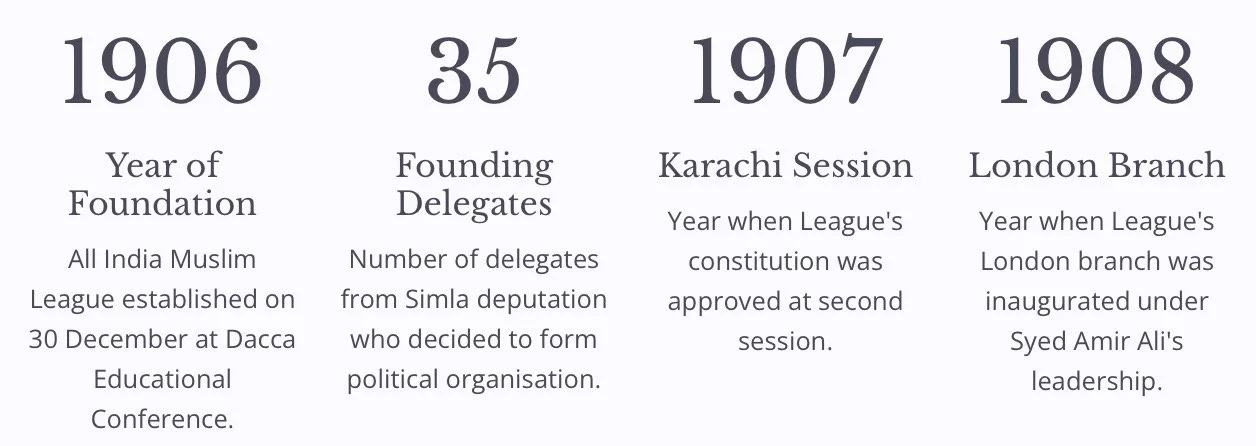
Muslim League: Consolidation and Significance
During its first decade, the League remained dominated by UP Muslims, establishing Aligarh's position at centre stage of all-India Muslim politics. Viqar-ul-Mulk and Mohsin-ul-Mulk became joint secretaries of a provisional committee drafting its constitution, approved at Karachi in December 1907. Aligarh veterans, with Punjabi leaders' assistance, moulded the League according to their ideological preferences. The constitution ensured the organisation remained under "men of property and influence" control, excluding many angry young men under whose pressure the party was created at Dacca. Between 1907 and 1909, provincial Muslim Leagues formed in all major provinces, enjoying liberty to frame their own constitutions. They were not formally controlled by the all-India body, nor could they interfere with central organisation affairs. Hence provincial Leagues exhibited varied political complexions, often with policies diverging from the central body. The London branch, inaugurated in May 1908 under Syed Amir Ali's leadership, played significant roles in shaping the 1909 constitutional reform—the Morley-Minto Reforms. This new act provided reserved seats for Muslims in imperial and provincial legislatures, in numbers much exceeding their proportions and keeping with their political importance. Granting separate electorates for Muslims thus provided official legitimacy to their minority status and separate political identity. The League represented its public face. The subsequent evolution of this Muslim identity from minority status to nationhood took a long and tortuous trajectory, profoundly shaping South Asian political developments throughout the 20th century. These 19th-century reform movements—Faraizi, Wahabi, Deoband, Ahmedia, and Aligarh—established foundational patterns of Muslim political mobilisation, religious reform, and communal identity that would culminate in the demand for Pakistan and the subcontinent's partition in 1947.
Diverse Paths of 19th-Century Reform
The 19th-century reform movements in India—from the radical Young Bengal to the revivalist Arya Samaj to the spiritualist Theosophical Society—represent diverse responses to the challenge of colonial modernity. The Young Bengal movement, inspired by Western rationalism and the French Revolution, challenged Hindu orthodoxy with youthful passion but ultimately failed to create lasting change because their ideas were too advanced for their time and too disconnected from the masses. Their "bookish radicalism" and inability to develop positive ideology meant they faded like "a generation without fathers and children", though they planted important seeds for future reform.
In contrast, Dayananda Saraswati's Arya Samaj succeeded in creating a mass movement by grounding reform in indigenous sources—the Vedas—even whilst advocating progressive changes like women's education, widow remarriage, and caste reform. His slogan "Back to the Vedas" allowed him to challenge orthodoxy whilst claiming authenticity, though the movement's later shift towards aggressive revivalism and cow-protection campaigns represented a troubling departure from its reformist origins. The Theosophical Society, founded by Western seekers, offered educated Indians a framework for appreciating their own traditions, contributing to Hindu revival and nationalist consciousness, though its vague philosophy limited its mass appeal.
Together, these movements—along with others examining Sikh and Parsi reform efforts—illustrate the complex negotiations between tradition and modernity, East and West, elite and masses that characterised 19th-century Indian intellectual history. They laid crucial groundwork for the nationalist movement whilst revealing the tensions and contradictions inherent in the project of reforming colonised societies. Understanding these movements helps us appreciate both the promise and limitations of reform in contexts of profound social transformation and political subjugation.
