
Progress of Science in Colonial India
The story of scientific development in colonial India is a complex narrative of exploitation, resistance, and eventual awakening. From the sixteenth century onwards, Europe began to outdistance India in scientific and material advancement, establishing an era where the colonisers used science as a tool for empire-building whilst deliberately keeping the colonies scientifically backward. This document examines how British rule shaped India's scientific landscape, the role of Christian missionaries in education and social reform, and the eventual emergence of an indigenous scientific community that would lay the foundations for independent India's scientific achievements.
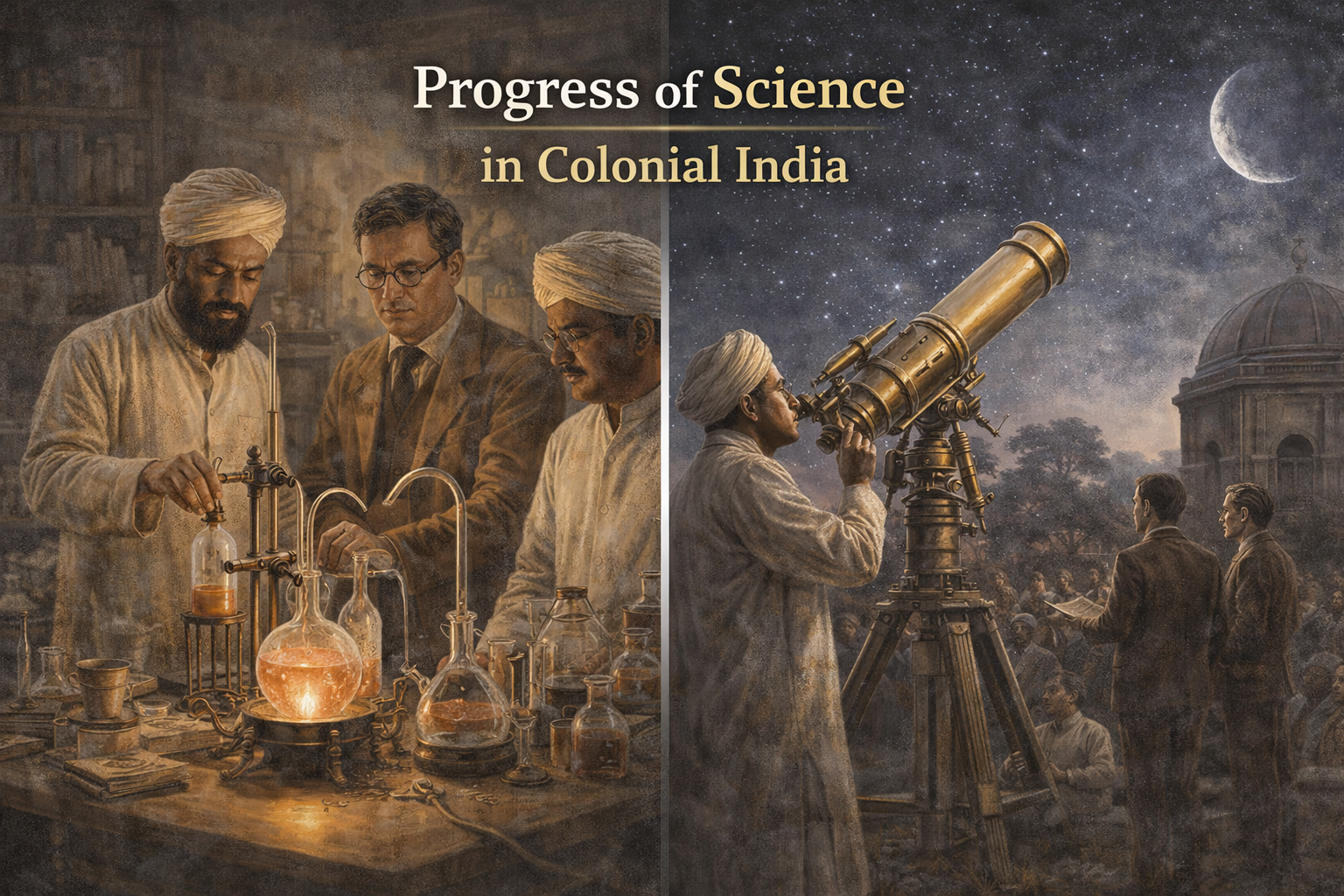
Progress of Science in Colonial India
The Dawn of Colonial Scientific Enterprise
After establishing supremacy over the Indian subcontinent, the British colonisers embarked on an ambitious project of data collection. This was an exciting time for the empire-builders, as they sought to catalogue and understand every aspect of their new dominion. The rulers were quick to recognise that knowledge of geography, geology, and botany was essential for effective control and exploitation of the territories they had conquered.
British scientists and administrators faithfully reported on India's technological traditions, natural resources, and economic potential. However, their primary loyalty was not to scientific truth but to their employers in London. They fully recognised the role and importance of science in empire-building, but this science was always subordinate to imperial interests.
Data Collection
Systematic surveys of resources and people
Strategic Knowledge
Geography and geology for military advantage
Economic Intelligence
Identifying exploitable resources
Characteristics of Early Colonial Science
The early phase of colonial scientific activity in India exhibited several distinctive features that reflected its subordinate role in the imperial project. Understanding these characteristics is crucial to comprehending how science developed—or failed to develop—under colonial rule.
Multi-disciplinary Generalists
Colonial scientists would simultaneously work across several fields—botany, geology, geography, and education. As data-gatherers, individual scientists were efficient, but for analysis and drawing conclusions, they depended upon scientific institutions in Britain, which received such data from many colonies. This created a system where Indian scientists remained perpetual assistants rather than independent researchers.
Selective Investment
The British made substantial investments in botanical, geological, and geographical surveys from which they hoped to gain direct economic and military advantages. However, medical and zoological sciences did not hold such immediate promise and were consequently neglected. Research in physics or chemistry was simply out of question because these subjects related to industrial development, which the British actively discouraged in India.
Economic Subordination
India was considered merely a source of raw materials and a captive market for British manufactured goods—from needles, nibs, and pencils to shoes, textiles, and medicines. Scientific development that might challenge this arrangement was systematically prevented, ensuring India's continued economic dependence on Britain.
Birth of Scientific Institutions
Despite the restrictive colonial policies, the establishment of some scientific bodies and museums marked a positive step forward. Pre-British India had a weak scientific base, with neither scientific institutions nor journals to disseminate knowledge. Recognising this gap, William Jones, a judge of the Supreme Court of Calcutta, along with other European intellectuals, founded the Asiatic Society in Calcutta in 1784.
This society soon became the focal point of all scientific activity in India, inspiring the creation of similar organisations across the country. These societies rendered invaluable service, particularly through their journals, which compared very favourably with European publications.
1784
Asiatic Society, Calcutta
1817
Agricultural-Horticultural Society of India
1818
Madras Literary and Scientific Society
1823
Calcutta Medical & Physical Society
1829
Bombay Branch of the Asiatic Society
Consolidation of Survey Organisations
When the Crown formally assumed Indian administration in 1858, activities for exploring natural resources had already passed their formative stage. The challenge now was consolidating the gains that individual efforts had made possible. This led to the establishment of numerous institutions and the expansion of survey organisations.
Survey of India (1878)
Three survey branches—trigonometrical, topographical, and revenue—which had been separate departments, were amalgamated. Naturally, the Revenue Survey gained the upper hand, reflecting the economic priorities of colonial rule.
Geological Survey (1851)
Geological explorations were generously patronised because of their direct economic benefits. The Geological Survey of India was created to identify and catalogue mineral resources that could be exploited for imperial profit.
Botanical Surveys
Unlike the Geological Survey or Survey of India, an organisation for carrying out botanical explorations did not materialise as a unified entity. This reflected the lower priority assigned to fields without immediate economic returns.
Development of Scientific Cadres
The establishment and development of various scientific departments and institutions necessitated the creation of different professional cadres. However, the development of these services was uneven and reflected colonial priorities rather than India's actual needs.
Indian Medical Service
The biggest and oldest cadre, raised and maintained primarily to serve the army. This reflected the colonial priority of keeping British troops healthy rather than improving public health for Indians.
Agricultural Service
The most disorganised sector despite agriculture generating maximum revenue. Though an Indian Agricultural Service was organised in 1906, it never developed into a well-knit, integrated department due to financial and administrative constraints.
Industrial Research
Branches with military or immediate economic significance managed to develop, but overall efforts remained ad hoc, sporadic, and local. The government wanted practical results rather than research papers.
Excessive administrative control, exercised at different levels, ensured that colonial scientists would always conform to official priorities, stifling independent scientific inquiry and innovation.
Science in Colonial Education
In the colonial educational scheme, science was never given high priority. The Charter of 1813 called for "the introduction and promotion of knowledge of science amongst the inhabitants of British India," but this remained merely a pious wish. The indigenous educational system was also not sympathetic to scientific education, compounding the problem.
In 1835, Macaulay succeeded in making English the medium of instruction. His personal distaste for science led to a curriculum that was purely literary, further delaying the entry of science into schools. The few medical and engineering institutions that opened were designed merely to supply assistants to British-trained doctors and engineers, not to create an independent class of scientific professionals.
1813 Charter
Promise of science education remains unfulfilled
1835 Policy
English medium with literary focus, science neglected
Limited Institutions
Medical and engineering schools train assistants only
The University System Emerges
Ancient universities in India had once been leading centres of learning, attracting scholars from across the world. Similarly, famous centres of Islamic learning flourished during the mediaeval period. However, these traditions did not survive into the colonial era. In 1857, the Universities of Calcutta, Bombay, and Madras were established, modelled on London University.
It was only in 1870 that Indian universities began showing interest in science education. In 1875, Madras University decided to examine matriculation candidates in geography and elementary physics instead of British history. Bombay became the first to grant degrees in science, whilst Calcutta University divided its B.A. into 'A' course (literary) and 'B' course (science).
Calcutta University
Divided B.A. into literary and science courses
Bombay University
First to grant science degrees in India
Madras University
Introduced science subjects in matriculation
The Colonial Educational Legacy
A fact of great significance was that the entire direction of colonial education discouraged independent thinking and the development of a questioning attitude. Rather, it encouraged passive acceptance of what was taught or written in books. The textbooks were in English, mostly written and printed abroad, depicting British culture. This education tended to alienate educated people from their own culture.
Cultural Alienation
Education in English using foreign textbooks depicting British culture created a disconnect between educated Indians and their own heritage, fostering a sense of inferiority about indigenous knowledge and traditions.
Lack of Enterprise
The educational milieu ensured lack of initiative and readiness to take orders from above, which was indeed the intention of the rulers. This produced administrators rather than innovators.
Imitative Approach
Institutions and teachers looked at the British educational model as the ideal, attempting to copy it even though they were in a very different social and economic situation, resulting in an inappropriate system.
Scientific Research Under Colonial Rule
In the absence of higher scientific education, scientific research remained an exclusive governmental exercise for a long time. Research was therefore directly linked to the economic policies pursued by the imperial power, serving colonial interests rather than India's development needs.
Research Priorities
Plantation research for cash crops (cotton, indigo, tobacco, tea) destined for export to Britain
Geological surveys to exploit mineral resources as raw materials
Health research focused on survival of army, planters, and colonisers
No support for research benefiting Indian industrial development
Scientists serving the colonial power were expected not only to discover new economic resources but also to help in their exploitation. This utilitarian approach ensured that research remained narrowly focused on immediate colonial benefits rather than broad scientific advancement or social welfare.
Notable Medical Achievements
Despite difficult conditions and the government's lukewarm attitude, several significant scientific works emerged during this period, particularly in medical sciences. These achievements came about largely through individual brilliance rather than systematic institutional support.
Ronald Ross
Conducted original work on the relationship between malaria and the mosquito, a breakthrough that would save countless lives worldwide.
Multiple Researchers
Macnamara worked on cholera, Haffkine on plague, and Rogers on kala-azar. The famous medical scientist Robert Koch visited Calcutta to work on cholera.
Laboratory Network
Bacteriological laboratories were established in Bombay, Madras, Coonoor, Kasauli, and Mukteswar, leading to growth in clinical treatment and the pharmaceutical industry.
However, preventive measures such as sanitary reforms or even supply of drinking water to villages and towns remained neglected, revealing the colonial priority of treating the colonisers rather than improving public health for Indians.
Indigenous Response to Colonial Science
British scientific activities evoked responses from the local populace, particularly educated Indians seeking employment in colonial administration and economy. Whilst some participated in officially patronised scientific associations, many sought to establish their own distinct identity through independent institutions and initiatives.
Petitions for Reform
Ram Mohun Roy's petition to Lord Amherst requesting proper science education became well known and inspired others.
Science Popularisation
Individuals like Bal Gangadhar Shastri, Master Ramchander, and Aukhoy Dutt worked to popularise modern science in Indian languages.
Challenging Myths
Geography and astronomy were prioritised to counter Puranic myths. Reformers explained that ancient texts were poetic rather than scientific.
Creating Awareness
Even Urdu poets like Hali and Ghalib acknowledged Western scientific achievements, bringing awareness to broader audiences.
Formation of Indian Scientific Societies
The next logical step from individual efforts was organisational development. Indian scientists and intellectuals established their own societies to promote scientific inquiry and education, free from colonial control and priorities.
In 1864, Syed Ahmed Khan founded the Aligarh Scientific Society, calling for technology introduction in industrial and agricultural production. Four years later, Syed Imdad Ali founded the Bihar Scientific Society. Though these gradually became defunct, they represented important early attempts at indigenous scientific organisation.
1864
Aligarh Scientific Society founded by Syed Ahmed Khan
1868
Bihar Scientific Society established by Syed Imdad Ali
1876
Indian Association for Cultivation of Science by M.L. Sarkar
1909
Indian Institute of Science, Bangalore, by Jamshedji Tata
Pioneering Indigenous Research Institutions
In 1876, M.L. Sarkar established the Indian Association for the Cultivation of Science, completely under Indian management without any government aid or patronage. Sarkar's ambitious scheme aimed at both original investigations and science popularisation. The association gradually developed into an important centre for research in optics, acoustics, scattering of light, and magnetism.
In Bombay, Jamshedji Tata drew up a similar scheme for higher scientific education and research, leading to the establishment of the Indian Institute of Science at Bangalore in 1909. This represented a significant milestone—Indians taking control of their scientific destiny.
Complete Independence
These institutions operated without government control or patronage, allowing truly independent scientific inquiry for the first time in colonial India.
Research Excellence
Focus on cutting-edge research in physics, chemistry, and other fundamental sciences that the colonial government had neglected.
Indian Management
Entirely managed and funded by Indians, these institutions demonstrated Indian capability in scientific administration and research.
Impact of the Freedom Movement on Science
By the early twentieth century, Indian society witnessed the first stirrings for freedom from colonial rule. Political aspirations for self-rule and frustration with economic stranglehold found expression in the Swadeshi Movement, which provided further impetus for promoting education along national lines and industrialising the country.
In 1904, an Association for the Advancement of Scientific and Industrial Education of Indians was formed with the objective of sending qualified students to Europe, America, and Japan for studying science-based industries. This represented a conscious effort to overcome the colonial education system's limitations.
The Swadeshi Movement emphasised using goods made in India, which naturally required developing indigenous industrial and scientific capabilities. This created a direct link between nationalism and scientific development.
Discrimination Against Indian Scientists
The colonial environment was profoundly hostile to Indian scientists, who faced systematic discrimination and obstruction. This institutional racism in science provoked strong reactions and became a political issue that the nationalist movement took up vigorously.
J.C. Bose's Struggle
India's first noted physicist refused to accept reduced salary for three years. Until the Royal Society recognised him, college authorities refused research facilities and considered his work purely private. He later pioneered interdisciplinary research, inventing the crescograph to measure plant growth.
P.C. Ray's Experience
After returning from England with a doctorate in chemistry in 1888, he waited a year before being offered a temporary assistant professorship. He remained in Provincial Service throughout his career, never receiving the recognition he deserved.
P.N. Bose's Resignation
In 1903, he was superseded for the directorship of the Geological Survey by T. Holland, who was 10 years his junior. Rather than accept this humiliation, P.N. Bose chose to resign.
Political Mobilisation for Scientific Development
The discrimination faced by Indian scientists became a political issue. The Indian National Congress took up the question of technical education in its third session (1887) and passed resolutions on it annually thereafter. Leaders like K.T. Telang and B.N. Seal pointed out how the government merely imparted lower forms of practical training under the guise of technical education.
Educational Reform Demands
Congress resolutions criticised the government's approach to technical education and demanded genuine scientific education rather than mere training of assistants.
Medical Service Criticism
In 1893, Congress passed a resolution asking the government to raise a scientific medical profession by opening fields to indigenous talent, not just Europeans.
Comprehensive Approach
Whether education, agriculture, or mining, Congress addressed numerous problems, linking scientific development to national self-determination.
The Rise of Indian Scientific Excellence
Despite hostile conditions, Indian scientists put India on the world scientific map through their groundbreaking contributions. Taking advantage of the University Act of 1904, Sir Asutosh Mookherjee established a University College of Science in Calcutta where eminent scientists like P.C. Ray, C.V. Raman, S.N. Bose, and K.S. Krishnan taught.
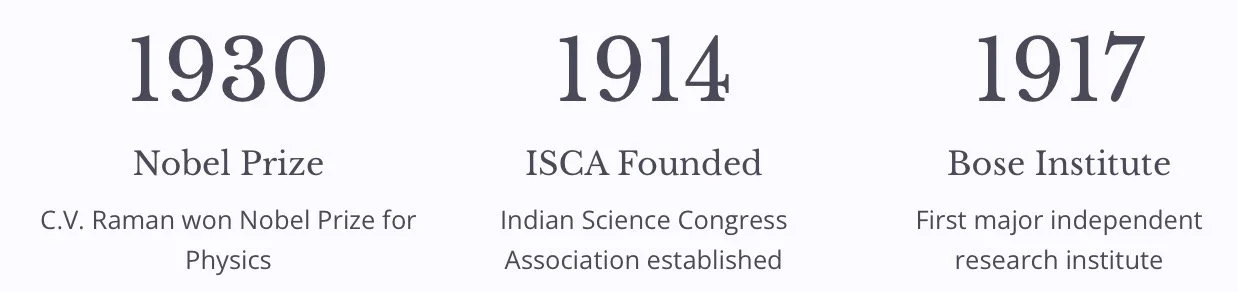
The Rise of Indian Scientific Excellence
Pioneer Scientists
J.C. Bose: Electric responses in plant tissues
S. Ramanujan: Number theory
P.C. Ray: Mineral analysis, industrial chemistry
C.V. Raman: Light scattering
S.N. Bose: Elementary particles, Bose-Einstein Statistics
D.N. Wadia: Geology
Birbal Sahni: Palaeobotany
P.C. Mahalanobis: Statistics
Towards Scientific Self-Reliance
The First World War (1914-18) made the government realise India must become more scientifically and industrially self-reliant. An Indian Industrial Commission in 1916 examined steps to lessen India's dependence on Britain. However, few recommendations were implemented, as colonial and nationalist interests fundamentally clashed.
When Gandhiji campaigned for cottage industries, debates erupted at the Indian Science Congress. Whilst P.C. Ray supported traditional industries as preconditions for progress, M.N. Saha and the Science & Culture group advocated heavy industrialisation. Socialist experiments in Russia revealed science's immense potential, and national leadership veered towards industrialisation and socialism.
National Planning Committee (1938)
Under Jawaharlal Nehru's chairmanship
Technical Subcommittees
29 subcommittees on technical subjects
CSIR Established (1942)
Central research organisation created
Post-War Planning
A.V. Hill's 1944 report on research problems
The Second World War (1939-45) forced greater industrial capability development in India. The Council of Scientific and Industrial Research was established in 1942. These developments offered greater opportunities to Indian scientists in policy-making and management, laying foundations for independent India's science policy.
Legacy and Foundations for the Future
The colonial period's impact on Indian science was profoundly ambivalent. Whilst the British established some scientific infrastructure, their primary interest was strengthening political and economic domination. They exploited India's resources fully, developing only nominal scientific capacity for this purpose. Areas like physics, chemistry, and agriculture—where scientific development was not immediately profitable—received no attention.
Colonial Damage
Destruction of India's cultural heritage and scientific traditions
Educational system designed to produce subservience rather than inquiry
Systematic discrimination against Indian scientists
Prevention of industrial and technological development
Research priorities serving colonial rather than Indian interests
Seeds of Renaissance
Emergence of world-class Indian scientists despite obstacles
Establishment of indigenous research institutions
Integration of scientific development with nationalist movement
Creation of planning frameworks for post-independence development
Building of scientific community and infrastructure
However, through the efforts of pioneering Indian scientists, educators, and nationalist leaders, foundations were laid for independent India's scientific advancement. The struggle for scientific self-reliance became inseparable from the struggle for political freedom. The origins of free India's science policy and national reconstruction can be traced to activities during this period—particularly the National Planning Committee's work and the establishment of CSIR. These achievements, accomplished despite colonial obstruction, demonstrated Indian scientific capability and created institutional foundations that would serve the independent nation. The colonial period thus ended with India poised to reclaim its rightful place in the world of science, not as a subordinate collector of data, but as an independent contributor to human knowledge.
