
The Rise of Press, Literature and Public Opinion in India
From ancient stone inscriptions to modern digital journalism, India's press has evolved through centuries of transformation. This document traces the remarkable journey of Indian media—from Emperor Ashoka's edicts carved in stone to the vibrant newspapers that fueled the freedom movement. Discover how the printing press revolutionized communication, how Indian writers created modern literature in multiple languages, and how the press became a powerful force for social change and national awakening.
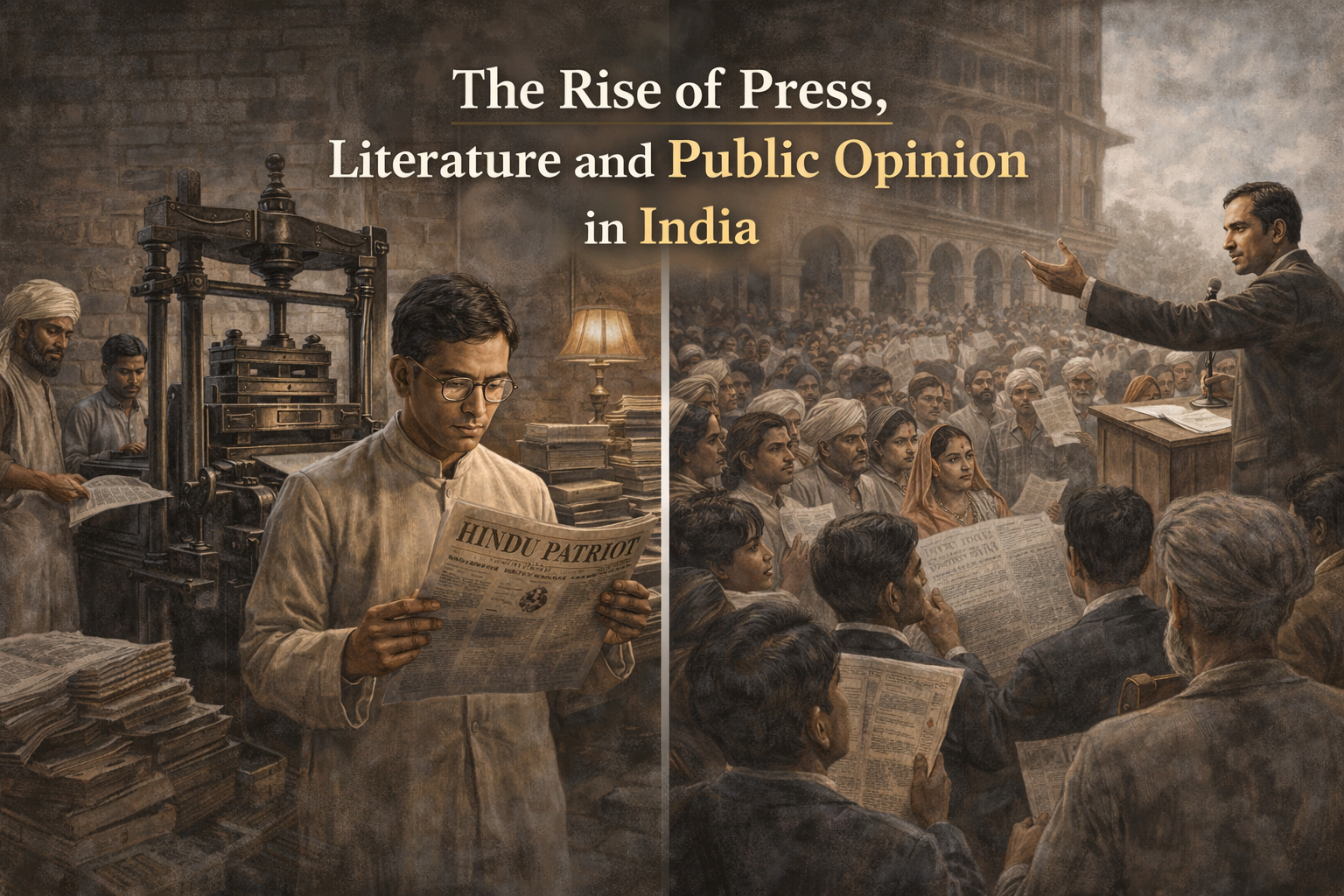
The Rise of Press, Literature and Public Opinion in India
Origins
The Ancient Roots of Indian Press
The "press" in India is as ancient as human curiosity itself. Long before newspapers existed, information spread through various means across the Indian subcontinent. The human instinct to know what was happening around them drove people to create systems of communication and record-keeping that laid the foundation for modern journalism.
The earliest evidence of public communication in India dates back several centuries before Christ, when messages were carved on walls and stones. These inscriptions served as official announcements, reaching citizens across vast territories. Emperor Ashoka's famous edicts, renouncing violence after the devastating Kalinga war, remain preserved on stone pillars and rock surfaces to this day—powerful testimonies to early mass communication.
As civilization advanced, paper and writing materials were invented, transforming how information was stored and transmitted. Royal courts maintained state records, and intelligence networks employed spies whose reports were compiled in rudimentary form. According to historian J. Natarajan, "newsletters" represented the earliest rough form of what we recognize today as newspapers.
During the Mughal period, these newsletters were regularly issued, functioning as "manuscript newspapers"—the primary source of information about developments across the empire. This practice of handwritten news bulletins continued until the East India Company began ruling over India, creating the conditions that would eventually inspire the birth of printed journalism in the subcontinent.
The Revolutionary Printing Press Arrives
1454
John Gutenberg invents the printing press in Europe, transforming human communication forever
1465-1640
Printing spreads across Europe: Italy (1465), France (1470), Spain (1483), Portugal (1495), Russia (1555), Austria (1640)
1557
Portuguese Jesuits introduce the printing press to India for Christian literature
1674-1779
Printing presses established in Bombay (1674), Madras (1772), and Calcutta (1779)
1780
James Augustus Hickey launches Bengal Gazette—India's first newspaper
Johannes Gutenberg's invention of the printing press in 1454 stands as a pivotal turning point in human history. This revolutionary technology enabled the rapid dissemination of information to the masses, facilitating the development of ideas through debates, writings, and counterarguments in subsequent years. The technique spread like wildfire across Europe, reaching major centres of learning and commerce within two centuries. By the eighteenth century, newspapers had become popular fixtures of European life, shaping public opinion and political discourse. When the printing press finally arrived in India through Portuguese missionaries in 1557, it initially served religious purposes—printing Christian literature for conversion efforts. However, the technology's potential for broader communication soon became apparent, and presses were established in India's major colonial cities: Bombay in 1674, Madras in 1772, and Calcutta in 1779.
Hickey's Bold Adventure: India's First Newspaper
"I have no particular passion for printing of a newspaper. I have no propensity: I was not bred to slavish life of hard work, yet I take a pleasure in enslaving my body in order to purchase freedom for my mind and soul."
— James Augustus Hickey
The birth of Indian journalism was an act of defiance. Although the British were responsible for bringing the printing press to India, they were deeply allergic to the emergence of independent newspapers in the country. About fourteen years before the Bengal Gazette appeared, William Bolts, a Dutch merchant, had posted a notice on the door of the Council House in Calcutta, declaring that "the want of a Printing press in this city is a great disadvantage." The colonial authorities' response was swift and harsh—on 17 April 1767, the council at Fort William ordered Bolts to quit Bengal and proceed to Europe. As Dr. R. Das Gupta, former Director of the National Library in Calcutta, observed, "The history of the Indian press begins with the deportation of a person who wanted to found a newspaper."
James Augustus Hickey, an Englishman employed as a clerk by the East India Company, launched India's first newspaper on 29 January 1780. The Bengal Gazette, also known as the Calcutta General Advertiser, boldly described itself as "A weekly Political and Commercial Paper Open to All Parties but Influenced by None." True to this declaration, Hickey's newspaper was devoted primarily to gossip, rumours, and scandalous stories about the doings and misdoings of East India Company officials—including his own employers. His fearless exposure of the private lives of people in high places, particularly targeting the establishment led by Warren Hastings, led to his imprisonment and the temporary banning of his paper. The venture suffered heavy financial losses, and in March 1782, an order was issued for the seizure of his printing types, bringing India's pioneering newspaper to an end. Nevertheless, Hickey's audacious initiative had opened the floodgates—several newspapers soon appeared in Bombay, Calcutta, and Madras, though most had short lives.
Early Newspapers and Colonial Repression
1784: Calcutta Gazette
Peter Reed founded the Calcutta Gazette and Oriental Advertiser, securing government patronage
1785: Madras Courier
Richard Johnston established the Madras Courier in southern India
1791: Bombay Gazette
The Bombay Gazette began publication in western India
1795: Censorship Begins
The Madras Gazette required to submit all material for scrutiny before publication
After Hickey's pioneering effort, newspapers proliferated in rapid succession across India's major colonial cities. Peter Reed founded the Calcutta Gazette and Oriental Advertiser in 1784, managing to secure patronage from the government. In Madras, Richard Johnston founded the Madras Courier in 1785, whilst the Bombay Gazette commenced publication in 1791. However, these early newspapers operated in an increasingly hostile environment. The East India Company had begun taking a serious view of newspaper content and imposed ruthless restrictions on printing presses and editors. Censorship was formally introduced in Madras in 1795, when the Madras Gazette was required to submit all material meant for publication for official scrutiny. In Bengal, several papers including the Bengal Journal, Indian World, and Bengal Harkaru incurred the displeasure of Company authorities in various ways. As historian J. Natarajan noted, "the first two decades of the 19th century saw the imposition of rigid control of the press by Lords Wellesley and Warren Hastings." The May 1799 regulations required newspapers to carry the names of the printer, editor, and proprietor in every issue and to submit all material for pre-publication scrutiny. Though these censorship rules were not always strictly enforced, they created a climate of fear and self-censorship that would characterize Indian journalism for decades to come.
The Missionary Press and Raja Ram Mohan Roy
Between 1813 and 1818, significant developments transformed the Indian press landscape. Christian missionaries began publishing weekly and monthly newspapers in Bengal, including influential publications such as Dig Darshan, Samachar Darpan, and the Friend of India—the precursor to today's Statesman. These missionary publications, whilst primarily serving religious purposes, inadvertently created infrastructure and trained personnel that would benefit secular journalism.
In 1818, the Adams regulations were issued, giving editors considerable freedom whilst maintaining strict governmental oversight of content. Around this pivotal time, two towering figures emerged as champions of press freedom: Raja Ram Mohan Roy and James Silk Buckingham. Though pre-censorship was withdrawn, numerous restrictive rules remained in force.
Raja Ram Mohan Roy, the great social reformer, launched two influential weeklies: Sambad Kaumudi in Bengali and Mirat-ul-Akhbar in Persian. In Bombay, the Mumbai Samachar commenced publication—remarkably, this newspaper continues to exist today, making it one of the oldest continuously published newspapers in India. Roy and Buckingham's vocal advocacy for press freedom laid important groundwork for future journalistic independence, even as the colonial government maintained its grip on what could and could not be published.
Tightening the Screws: The 1823 Press Ordinance
Stringent Regulations
The 1823 ordinance laid down strict regulations for editors, with heavy penalties and fines for infractions
Employment Ban
East India Company staff were prohibited from having any relations with newspapers
Content Restrictions
Political writings were forbidden, whilst social and religious news—particularly from missionaries—was encouraged
As the press began offering criticism of colonial administration, the authorities responded with the first comprehensive Press Ordinance in 1823. This legislation imposed stringent regulations on editors and prescribed heavy penalties for any violations. The ordinance effectively prohibited East India Company employees from maintaining any connections with newspapers, creating a clear separation between the colonial apparatus and the fourth estate. Political commentary was strictly forbidden, though the government actively encouraged social and religious content, especially missionary writings that aligned with colonial interests.
The climate began to shift when William Bentinck became Governor-General of India. Bentinck, working alongside Raja Ram Mohan Roy, proved instrumental in improving the social climate and adopted a somewhat more liberal attitude towards the press. The authorities began allowing newspapers a measure of freedom they had not previously enjoyed. This trend continued when Charles Metcalfe became Governor-General in 1835, as he relaxed several restrictions previously imposed on the press. This period of relative liberalism, however, would prove temporary, as future crises would prompt the colonial government to reimpose harsh controls on Indian journalism.
The Flourishing of Indian Language Press
The mid-nineteenth century witnessed the remarkable growth of newspapers in Indian languages across the subcontinent. According to historian N. Krishna Murthy, the Bengal Gazette started by Gangadhar Bhattacharya was the first Indian-owned newspaper. The press in several Indian languages began making rapid strides, with each linguistic region developing its own vibrant newspaper culture. In north-west India, Urdu and Persian papers attracted numerous readers amongst the educated Muslim population. The Marathi and Gujarati press established their presence felt in western India, whilst newspapers in Hindi began proliferating across the Hindi-speaking heartland. By 1850 or shortly thereafter, newspapers had appeared in Malayalam, Kannada, Tamil, Oriya, Assamese, and Punjabi—virtually every major Indian language had developed its own press. This multilingual explosion of print journalism created a rich tapestry of public discourse, with each language press addressing issues specific to its regional context whilst also contributing to broader national conversations. The diversity of the Indian language press became one of its greatest strengths, allowing ideas to permeate different communities and fostering a truly pluralistic public sphere that would prove crucial during the independence movement.
The 1857 War and Its Aftermath
1857: War Erupts
The War of Independence breaks out, press growth receives severe setback
Press Freedom Curtailed
Colonial authorities drastically restrict press freedoms in response to the uprising
1858: Crown Rule
Governance transfers from East India Company to British Crown
1859: Lord Canning
New Viceroy arrives as India enters new administrative era
1860: Indian Penal Code
IPC adopted with provisions affecting press freedom
When the 1857 War of Independence erupted, the growth of the Indian press received a severe setback. Press freedom was curtailed drastically as colonial authorities struggled to maintain control during the widespread uprising. After the failure of the war of independence, governance of India changed hands from the East India Company to the British Crown in 1858. The following year, Lord Canning became Viceroy of India, overseeing the adoption of the Indian Penal Code in 1860—legislation that included provisions significantly affecting press operations and freedom of expression for decades to come.
The Bengali Press and English Language Newspapers
Following the tumultuous events of 1857-1860, a remarkable array of newspapers from Bengal began influencing Indian public opinion significantly. Publications such as Nil Darpan, The Hindu Patriot, Shome Prakash, Indian Mirror, Bengalee, and numerous others shaped public discourse and challenged colonial narratives. The appearance of the Amrita Bazar Patrika marked a watershed moment—initially published in Bengali, it dramatically switched to English overnight to evade restrictive press laws, fundamentally transforming journalism in India.
This period witnessed the establishment of several noted English language newspapers that would become pillars of Indian journalism. The Times of India emerged from the amalgamation of four papers: The Bombay Times, The Courier, The Standard, and The Telegraph. Three other distinguished English newspapers—The Pioneer, Civil and Military Gazette, and The Statesman—were also born during this era. In Madras, both The Mail (an evening paper) and The Hindu appeared, with the latter eventually becoming the largest circulated newspaper in contemporary India.
Simultaneously, the Indian language press experienced an unprecedented boom across the country. Newspapers appeared in almost all major Indian languages, with the Bengali language press leading the charge, followed closely by publications in Hindi, Marathi, Urdu, Tamil, Gujarati, Malayalam, Kannada, Punjabi, and other languages. This multilingual flowering created a diverse and vibrant media landscape that would prove instrumental in shaping Indian nationalism.
Nationalism and the Press: Great Men Join the Cause
"One of the objectives of a newspaper is to understand the popular feelings and give expression to it; another is to arouse among the people certain desirable sentiments; and the third is to fearlessly expose popular defects."
— Mahatma Gandhi
A constellation of India's greatest men—intellectuals, political leaders, thinkers, and journalists—became intimately associated with the press in English and other Indian languages. Mahatma Gandhi, Jawaharlal Nehru, Lala Lajpat Rai, Kasturi Ranga Iyengar, Surendra Nath Banerjee, Gopal Krishna Gokhale, Mahadev Govind Ranade, Bal Gangadhar Tilak, Motilal Ghosh, Syed Abdulla Brelvi, Aurobindo Ghose, Maulana Abul Kalam Azad, and many others made remarkable contributions to the development of the press. Most eminent journalists were also eminent freedom fighters, and vice versa—the roles were often inseparable.
Famous newspapers proliferated during this golden age of nationalist journalism. Bande Matram in Hindi, Kesari and Maratha in Marathi, Swadeshmitran in Tamil, Amrita Bazar Patrika, National Herald, The Civil and Military Gazette, Free Press Journal, Bombay Chronicle, The Leader, The Tribune, Madras Standard, The Hitavada, and numerous other English and vernacular papers were established. These publications confronted enormous problems—kaleidoscopic restrictions on news-gathering, printing, and display were imposed through a battery of repressive legislation. The Vernacular Press Act, Official Secrets Act, Newspaper (Incitement to Offences) Act, newly introduced sections of the Indian Penal Code (124-A, 153-A, and 505), Defence of India Rules, Post Office Act, Press and Registration of Books Act, Sea Customs Act, and numerous ordinances throttled press growth from the very beginning. Yet remarkably, this plethora of ruthless laws could not effectively suppress the Indian press. The support newspapers received from the people at large was truly extraordinary, sustaining journalism through decades of colonial repression.
The Infamous Vernacular Press Act of 1878
Background
The 1857 Rebellion left a legacy of racial bitterness. The European press sided with the government, whilst the growing vernacular press became increasingly critical of colonial policies. The terrible famine of 1876-77, which killed over six million people, and lavish expenditure on the 1877 Imperial Darbar created public outrage.
Lord Lytton's Response
Viceroy Lytton considered the rising intellectual class "a deadly legacy from Macaulay and Metcalfe" and sought to stifle their views. The Vernacular Press Act of 1878 was conceived in great secrecy and passed at a single sitting of the Imperial Legislative Council—designed to "better control" vernacular newspapers.
Discriminatory Provisions
The Act targeted only Indian language newspapers, not English publications. District Magistrates could require printers and publishers to enter bonds not to publish "seditious" content, demand security deposits, and forfeit deposits or seize equipment for violations. Worst of all, magistrates' decisions were final—no appeals to courts were permitted.
Resistance and Repeal
The Act partly succeeded in making vernacular newspapers submissive, but Indian nationalist opinion firmly opposed it. Large demonstrations were organized, including a historic meeting at Calcutta's Town Hall. The Amrita Bazar Patrika famously converted overnight from Bengali to English to evade the Act. In 1882, the liberal Governor-General Lord Ripon repealed the Act, marking a victory for press freedom.
Bal Gangadhar Tilak: Champion of Press Freedom
Bal Gangadhar Tilak remains the figure most frequently associated with the struggle for press freedom during the nationalist movement. In 1881, along with G.G. Agarkar, he founded two newspapers: Kesari in Marathi and Mahratta in English. By 1888, Tilak had taken sole control of both publications, using their columns to spread discontent against British rule and preach national resistance.
Tilak proved innovative in using cultural platforms for political mobilization. In 1893, he began using the traditional religious Ganapati festival to propagate nationalist ideas through patriotic songs and speeches. Three years later, he started the Shivaji festival to stimulate nationalism among young Maharashtrians. That same year, he organized an all-Maharashtra campaign for boycotting foreign cloth to protest the imposition of excise duty on cotton.
Tilak was perhaps the first national leader to grasp the important role that lower middle classes, peasants, artisans, and workers could play in the national movement. Criticizing the Congress for ignoring peasants, he initiated a no-tax campaign in Maharashtra during 1896-97 with help from young workers of the Poona Sarvajanik Sabha. He printed thousands of copies of the official famine code in Marathi, asking famine-stricken peasants to withhold land revenue if their crops had failed.
In 1897, when plague broke out in Poona, Tilak stayed to help whilst criticizing harsh official measures. Popular resentment led to the assassination of Rand, the Plague Committee Chairman, by the Chaphekar brothers in 1898. The government seized this opportunity to prosecute Tilak under Section 124-A for sedition, sentencing him to eighteen months' rigorous imprisonment despite his being a member of the Bombay Legislative Council. His imprisonment sparked nationwide protests, and overnight Tilak became a popular all-India leader, earning the title "Lokamanya" (respected and honoured by the people).
Tilak's Second Trial and the 1908 Press Act
With the rise of individual terrorism after the Swadeshi movement, the government once again turned its attention to Lokamanya Tilak. He had written articles on the arrival of the "Bomb" on the Indian scene, condemning violence but simultaneously holding the government responsible for suppressing dissent. On 24 June 1908, Tilak was arrested and tried again for sedition, receiving a sentence of six years' transportation to Mandalay prison in Burma.
Public reaction was massive. Newspapers proclaimed they would defend press freedom by following Tilak's example. All markets in Bombay city closed on 22 July—the day his sentence was announced—and remained closed for a week. Workers from all textile mills and railway workshops went on strike for six days. When authorities attempted to force them back to work, sixteen workers died and nearly fifty were seriously injured in clashes with police and army. Lenin hailed this as "the entrance of the Indian working class on the political stage."
The Newspapers Act of 1908
Enacted to combat "disaffection," this Act empowered magistrates to confiscate printing presses and property of newspapers publishing "objectionable material." Local governments could annul declarations made under the Press and Registration of Books Act. The Act launched prosecutions against nine newspapers and confiscated seven presses, forcing publications like Yugantar, Sandhya, and Bandemataram to stop publication.
The Indian Press Act of 1910
This legislation revived the worst features of Lytton's 1878 Press Act. It required security deposits of Rs. 500-2,000 at registration, which could be forfeited for publishing objectionable content. Fresh registration could require security up to Rs. 10,000. Under this Act, action was taken against 991 printing presses and newspapers—286 received warnings, 705 had heavy securities demanded, and over Rs. 60,000 worth of security was forfeited from 300 newspapers.
World Wars and the Press: 1914-1947
From 1914 to 1947, the freedom struggle continued gathering momentum as the British government anxiously sought press support for its war efforts. When World War I broke out in 1914, the government released nationalist leaders from jail to solicit their support. However, several newspapers including The Madras Standard, New India, Bombay Chronicle, and Maratha took divergent stands. Consequently, some 180 newspapers were required to deposit security and pledge government support in 1914-1915.
The Defence of India Rules, promulgated during World War I, gave the executive sweeping powers—used not merely for war purposes but also for repressing political agitation and free public criticism. The press eventually softened its stance, and by 1918, only 30 newspapers (down from 180 in 1914) were required to deposit security. However, after the war's conclusion in the 1920s, the British government adopted a stiff stand on granting freedom, particularly as several noted political leaders started the non-cooperation programme. The press actively supported the nationalist agenda.
During this difficult period, proprietor-editors emerged as powerful voices. Mahatma Gandhi wrote in Young India on 2 July 1925: "I have taken up journalism not for its sake, but merely as an aid to what I have conceived to be my mission in life." In 1942, he declared: "It is better not to issue newspapers than to issue them under a feeling of suppression." Motilal Ghosh owned and edited Amrita Bazar Patrika, Surendranath Banerjee ran the Bengalee, and Kasturi Ranga Iyengar led The Hindu—examples of journalists who combined ownership with editorial leadership in service of the freedom movement.
Repressive Legislation of the 1930s
Press Committee, 1921
The Sapru Committee reviewed press laws, leading to the repeal of the Press Acts of 1908 and 1910
Indian Press (Emergency Powers) Act, 1931
The Civil Disobedience Movement prompted this Act reviving provisions of the 1910 Press Act, with security deposits and forfeiture powers
Criminal Amendment Act, 1932
Amplified the 1931 Press Act, making it comprehensive to include all activities undermining government authority
Foreign Relations Act, 1932
Penalized publications interfering with friendly relations with foreign states adjoining India's frontiers
Indian States (Protection) Act, 1934
Prevented attacks on Indian States' administration and dealt with semi-military demonstrations
The 1931 Act took action against numerous newspapers. The Bombay Chronicle's printers and publishers were called to deposit Rs. 3,000 each. Anand Bazar Patrika received demands for Rs. 1,000, whilst Amrita Bazar Patrika was required to deposit Rs. 6,000. The Liberty of Calcutta deposited Rs. 10,000, and the Free Press Journal deposited Rs. 6,000, which was later forfeited by the Bombay Government. These harsh measures aimed to suppress reporting on the Civil Disobedience Movement and nationalist leaders, even restraining publication of their pictures and news.
World War II and the Birth of AINEC
For approximately two decades during 1925-1946, Gandhiji and his ideology dominated Indian press development, promoting opinion journalism where editorials overshadowed news. These decades witnessed newspaper proliferation in almost all Indian languages, particularly Hindi and English. During World War II (1939-45), the press initially supported the British government's war efforts. However, conflict soon arose over war news reporting. When Gandhi resorted to civil disobedience, several newspapers supported him wholeheartedly.
The government responded with a notification "prohibiting the printing and publishing of any matter calculated directly or indirectly to foment opposition to the prosecution of war." The Defence of India Act, 1939, enabled wartime control of newspapers, depriving the press of freedom. Pre-censorship was reinforced, the Press Emergency Act and Official Secrets Act were amended, and publication of all Congress-related news was declared illegal. The special wartime powers ended in 1945 as victory approached.
During this turbulent period, the All India Newspapers' Editors Conference (AINEC) came into being with clear objectives: "to preserve high traditions and standards of journalism; to safeguard the freedom of publication of news and comment; to represent the press in India in its relations with the public and the government." As the Second World War concluded and Mountbatten revealed the partition plan, newspapers demonstrated "a general tone of acquiescence with satisfaction that after all freedom of the country was ultimately becoming a reality."
The Press Enquiry Committee and Road to Freedom
Committee Establishment
In March 1947, the Government of India appointed the Press Enquiry Committee to examine press laws considering fundamental rights formulated by the Constituent Assembly
Key Recommendations
Repeal of the Indian Emergency Powers Act of 1931, amendments to the Press and Registration of Books Act, modifications to Sections 124-A and 153-A of the IPC
States Protection
Repeal of the Indian States (Protection against Disaffection) Act, 1932, and the Indian States (Protection) Act, 1934
Dawn of Freedom
As independence approached, the press stood ready to play its role in building a new democratic nation
The Press Enquiry Committee's recommendations marked a turning point, acknowledging that repressive colonial press laws were incompatible with the fundamental rights being enshrined in India's new constitution. Though full implementation would take time, the committee's work signalled recognition that a free press was essential for the democracy India was about to become. After decades of struggle against censorship, security deposits, pre-publication scrutiny, and imprisonment, Indian journalists had finally won their battle for press freedom—a victory achieved alongside political independence itself.
The Rise of Modern Vernacular Literature
Throughout its history, the literature of the Indian subcontinent has been characterized by exuberant diversity of languages, enriched by ever-shifting dialogues among these languages and the regions and cultures they represent. The development of modern Indian literature in the second half of the nineteenth century resulted from such dialogues—between English, a colonial import that replaced Sanskrit and Persian as the medium of education, and the more than twenty regional languages of India, many with literary traditions stretching back a thousand years or more.
The Bengal Renaissance
The "Bengal Renaissance" in Calcutta, the British capital, stood at the vanguard of new literary and cultural movements. Pioneer writer Bankim Chandra Chatterji wrote Bengali novels on social reform and resistance to colonial rule. His Bisha briksha (1873; The Poison Tree, 1884) treated the plight of upper caste Hindu widows forbidden to remarry. His Rājsingha (1881) depicted Rajput chiefs' glory, whilst Ānanda Math (1882; The Abbey of Bliss, 1906) allegorized violent overthrow of British rule.
By 1885, when the Indian National Congress was founded, nationalism and social justice had become inspiration not only for political activists but also for Indian writers. Many early novelists dealt with social issues, especially women's treatment in Indian society—the object of trenchant European criticism and a sore point for Indians, both reformers and traditionalists.
Rabindranath Tagore
Rabindranath Tagore, a towering figure in modern Indian writing, was a great humanist whose contributions spanned multiple genres. In the 1880s and 1890s, he published short stories sensitively depicting ordinary villagers' lives in East Bengal, introducing the genre to Bengali and Indian literature. Ghare bāire (1915; Home and the World, 1919) criticized fanatic nationalism whilst sympathetically portraying women's dilemmas between tradition and modernity.
Tagore pioneered modern Bengali poetry, departing from archaizing verse. In 1913, he won the Nobel Prize for Gītānjali(Song offering, 1912), translated into English at W.B. Yeats's request. His musical dramas were performed at Santiniketan, the modern school he founded near Calcutta to nourish Indian culture and arts, and throughout India.
Tamil Literature: Ancient Roots to Modern Expression
Caṅkam Poetry
Tamil, the oldest Dravidian language, has history dating to early centuries BCE. The earliest surviving Tamil literature is Caṅkam or "academy" poetry from Madurai, organized into anthologies. This poetry divided into akam (interior love poems) and puram (exterior poetry on war and kings), relying on complex conventions of seasons, times, and landscapes.
Medieval Period
Between 3rd-6th centuries CE, longer poems and didactic works emerged, including Iḷaṅkō Aṭikaḷ's Cilappatikāram("Tale of an Anklet") and Tiruvaḷḷuvar's Tirukkural, gnomic verses on love, politics, and righteousness. By the 7th century, Hindu devotional hymns by wandering saints gained popularity, composed in simpler, more direct style.
Chola Renaissance
The Chola kingdom period (c. 950-1250 CE) saw major literary innovations at court, heavily influenced by Sanskrit kāvya. Famous works include Kampan's Irāmavatāram (Tamil Rāmāyaṇa) and Cayaṅkoṇṭar's Kaliṅkattupparaṇi. Rich commentarial and scholastic literature emerged in grammar, poetics, and theology.
Modern Revival
European missionary activity in 18th-19th centuries led to proliferation of indigenous printing presses from 1835. Modern genres like novels, autobiographies, and newspapers became widespread throughout the 19th century. By early 20th century, important writers sparked public interest in Tamil literature and history, becoming caught up in anti-Brahman movement and organized Dravidian nationalism.
Tamil literature's journey from ancient Caṅkam poetry to modern democratic expression mirrors the broader transformation of Indian letters—a tradition that honoured its past whilst embracing new forms and ideas, creating a vibrant literary culture that continues to flourish in contemporary India.
