
Education Under British Rule
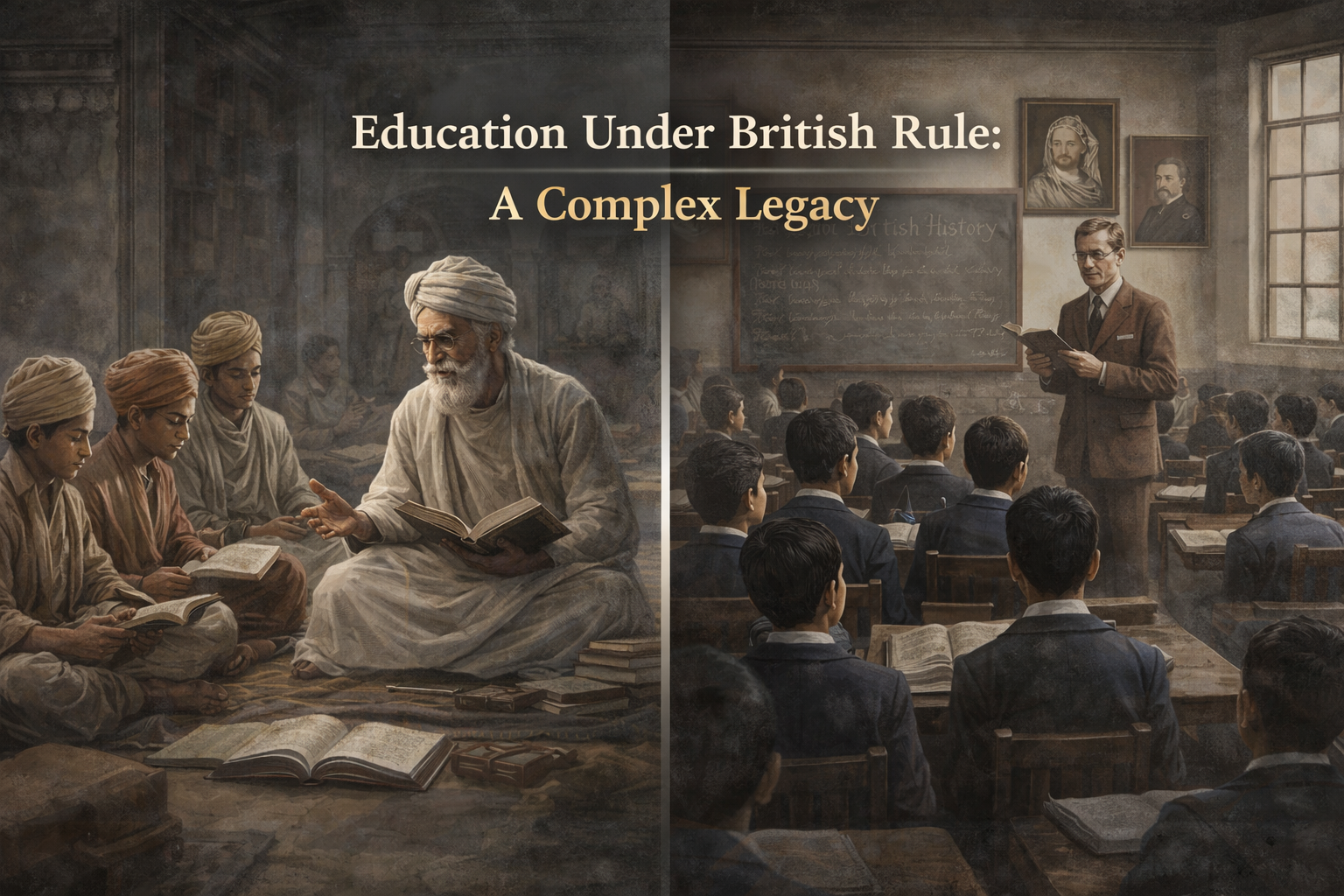
The story of education under British colonial rule in India represents one of the most significant and controversial chapters in the nation's history. Beginning in the eighteenth century and extending through independence, the British educational system fundamentally transformed the intellectual and social landscape of the Indian subcontinent. This transformation was neither simple nor entirely beneficial—it involved the systematic dismantling of indigenous learning systems, the imposition of Western knowledge structures, and the creation of a new educated class that would serve both as intermediaries for colonial rule and, ironically, as the vanguard of the independence movement.
Education Under British Rule: A Complex Legacy
The Decline of Indigenous Learning Systems
Political Turmoil and Educational Decay
The eighteenth century witnessed a profound deterioration of traditional Indian educational institutions. Hindu and Muslim centres of learning, which had flourished for centuries, languished under the weight of numerous political convulsions that created conditions hardly conducive to intellectual pursuits. The constant warfare, shifting political boundaries, and social upheaval made it nearly impossible for both teachers and students to focus on education.
When the East India Company assumed ruling power in Bengal in 1765, the situation worsened dramatically. The indigenous schools lost their primary source of sustenance—public endowments that had been maintained by previous rulers. Warren Hastings, writing to the Court of Directors on 21 February 1784, poignantly described finding "decayed remains of schools in every capital town and city of Northern India and the Deccan." These institutions, once vibrant centres of learning, had become shadows of their former glory.
Historical Context: Traditional Indian education systems included gurukulas, madrasas, and pathshalas that had operated for centuries with support from rulers, wealthy patrons, and religious endowments.
The Company's approach to this educational crisis reflected contemporary British governmental philosophy. Following the example of the English Government, the Court of Directors explicitly refused to accept responsibility for educating the people of India, preferring instead to leave education to private initiative. This laissez-faire policy might have worked in England, where civil society institutions were well-established, but in India it meant abandoning a crumbling educational infrastructure at precisely the moment when intervention was most needed. The loss of state patronage, combined with ongoing political instability, created an educational vacuum that would take decades to address.
Early British Attempts at Oriental Learning
1781: Calcutta Madrasa
Warren Hastings, himself an intellectual, established the Calcutta Madrasa for the study of Persian and Arabic languages. This represented the first institutional effort by the Company to foster education, focusing on oriental languages valued in administration.
1791: Benares Sanskrit College
Through the persistent efforts of Jonathan Duncan, the British Resident at Benares, a Sanskrit College opened for "the cultivation of the laws, literature and religion of the Hindus." This institution aimed to preserve traditional learning.
1800: Fort William College
Lord Wellesley established Fort William College to train the Company's civil servants in Indian languages and customs. The College published an English-Hindustani Dictionary and grammar books, though it was ordered closed in 1802.
These early educational experiments represented half-hearted efforts by the Company's Government to maintain oriental learning. Indian officers of the East India Company had urged the Court of Directors to promote learning, recognising that complete neglect would undermine the Company's legitimacy. However, these institutions met with limited success. A telling indication of their failure was that there were often more teachers than students—the traditional system held little appeal when it offered no clear pathway to employment or social advancement.
The Christian missionaries viewed these attempts at reviving oriental education as futile exercises in preserving an outdated system. They advocated instead for teaching Western literature and Christian religion through English. The Serampore missionaries proved particularly enthusiastic for spreading education, though their motives combined genuine educational zeal with proselytising ambitions. This tension between preserving Indian traditions and introducing Western knowledge would define educational debates for decades.
The Charter Act of 1813: A Modest Beginning
The Charter Act of 1813 marked a watershed moment in British educational policy in India, representing the first formal commitment by the Court of Directors to educational development. The Act mandated an annual expenditure of one lakh of rupees (₹1,00,000) "for the revival and promotion of literature and the encouragement of the learned natives of India, and for the introduction and promotion of a knowledge of the sciences among the inhabitants of the British territories." Though modest in amount, this provision established the principle of state responsibility for education.
Ambiguous Language
The Act's wording was deliberately vague, failing to specify whether "literature" meant oriental or Western literature. This ambiguity would fuel decades of debate between Orientalists and Anglicists about the proper direction of educational policy.
Dual Objectives
The Act mentioned both "revival and promotion of literature" (suggesting support for traditional learning) and "introduction and promotion of knowledge of the sciences" (implying Western education). This dual mandate created inherent tensions in implementation.
Financial Commitment
Though one lakh of rupees was a small sum for a vast territory, it represented a permanent annual commitment that would grow over time. More importantly, it established the precedent that the Company bore some responsibility for its subjects' education.
The Charter Act emerged from a complex interplay of factors in British politics. Evangelical and utilitarian reformers in England had been pressing the Company to take greater responsibility for the moral and intellectual improvement of Indians. The Act represented a compromise between these reform pressures and the Company's reluctance to undertake expensive social commitments. By leaving the specifics vague, Parliament avoided resolving fundamental questions about educational content and methods, effectively postponing difficult decisions about whether to support traditional Indian learning or introduce Western education.
Factors Shaping British Education Policy
British education policy in India was never primarily motivated by philanthropic concerns or genuine desire to enlighten the Indian population. Rather, it served as an instrument to buttress and perpetuate colonial rule. The British imperial authorities favoured Western education through English medium not because they believed it would benefit Indians, but because it served specific colonial interests. Understanding these motivating factors reveals the fundamentally exploitative nature of educational policy during this period.
Administrative Motive
The expanding British Empire required an extensive administrative structure. Importing personnel from England proved expensive and politically inadvisable, making it expedient to recruit Indians with basic education and working knowledge of English for lower-level posts.
Political Motive
Western education was expected to dispel "reactionary attitudes" and create a sense of belonging amongst educated Indians. The goal was producing a class "English in taste, opinion, morals and intellect" who would serve as intermediaries between rulers and ruled.
Commercial Motive
The English-educated Indian middle class would become consumers of British goods, helping expand markets in India. Commercial interests strongly supported anglicisation of education for this reason.
Moral Consideration
Missionaries considered education "the soundest weapon for attracting heathens to Christianity." Though conversion rates remained low, this moral dimension provided ideological justification for Western education.
Administrative Requirements and Language Skills
The principle motive behind introducing Western education was making lower-level administration economical. As the British Empire expanded across India, its administrative structure grew increasingly elaborate and extensive, necessitating staffing of numerous low-cadre posts. The Company faced a practical dilemma: importing large numbers of British personnel was prohibitively expensive and politically unwise, as it would create resentment amongst Indians who saw opportunities monopolised by foreigners. The solution lay in recruiting Indians after providing them with sufficient education and general working knowledge to perform clerical and administrative tasks.
Revenue and Judicial Departments
Clerical and middle-level staff required English language knowledge for record-keeping and correspondence. The Judicial Department particularly needed Indians conversant with Sanskrit and Arabic-Persian to serve as assessors alongside English judges, expounding Hindu or Muslim law from classical texts.
Political Department
Knowledge of Persian and vernacular languages proved invaluable for correspondence with rulers of Indian states. Political officers needed interpreters and assistants who could navigate the complex linguistic landscape of princely India.
Revenue and Commercial Departments
Clerical staff maintaining direct contact with uneducated masses required vernacular language skills. Tax collection, land records, and commercial transactions all necessitated employees who could communicate effectively with ordinary Indians.
Higher-Grade Positions
For higher-grade staff in the Company's services, knowledge of both English and vernacular languages became essential. These positions required individuals who could bridge linguistic and cultural gaps between British officers and Indian populations.
This administrative needs created a specific educational demand: a class of Indians with sufficient English to understand British administrative procedures and enough vernacular knowledge to implement them amongst local populations. The education system was thus designed not to create critical thinkers or promote intellectual development, but to produce clerks, interpreters, and low-level administrators who would facilitate colonial governance. This instrumental view of education as mere job training for colonial service profoundly shaped curriculum and pedagogy for decades.
Raja Ram Mohan Roy and the Case for Western Learning
The main factor tipping the scale towards English language and Western literature was economic—Indians wanted education that could help them earn their livelihood. However, this pragmatic consideration found eloquent intellectual expression in the arguments of progressive Indian reformers, most notably Raja Ram Mohan Roy. His intervention in the education debate proved crucial in legitimising the push for Western education, though his motivations differed fundamentally from those of British administrators.
Ram Mohan Roy's Critique of Oriental Education
In 1823, Raja Ram Mohan Roy wrote a powerful letter to Lord Amherst protesting the Government's proposal to strengthen oriental colleges. He argued that Sanskrit education would "load the minds of youth with grammatical niceties and metaphysical distinctions of little or no practical use to their possessors or to society."
He particularly criticized Vedantic doctrines teaching that "all visible things have no real existence" and that relationships with "father, brother, etc." have "no real entity" and "consequently deserve no real affection." Such teachings, he argued, encouraged young people to "escape from them and leave the world" rather than becoming productive members of society.
Advocacy for Scientific Learning
Advocating for modern scientific education, Ram Mohan Roy wrote: "The Sanskrit system of education would be the best calculated to keep the country in darkness, if such had been the policy of British Government. But as the improvement of the native population is the object of the Government, it will consequently promote a more liberal and enlightened system of instruction, embracing Mathematics, Natural Philosophy, Chemistry, Anatomy with other useful sciences."
Ram Mohan Roy's protests did not go unheeded. The Government agreed to encourage study of English alongside Oriental languages. A grant was sanctioned for the Calcutta Hindu College, established in 1817 by enlightened Bengalis, which imparted instruction mainly in English and emphasised Western humanities and sciences. The Government also set up three Sanskrit Colleges at Calcutta, Delhi, and Agra, and allocated funds for translating European scientific works into Oriental languages. This represented a compromise position—supporting both oriental and Western learning—though the balance would soon shift decisively towards English education.
The Orientalist-Anglicist Controversy
Prior to the 1830s, the Orientalists dominated the General Committee of Public Instruction (GCPI), created in 1823 to administer the Government's education programme in Bengal. The Committee consisted of ten members divided into two opposing groups: the Orientalists, led by H.T. Prinsep, who advocated encouragement of Oriental literature, and the Anglicists or English Party, who favoured adopting English as the medium of instruction. This equal division created a deadlock that paralysed educational policy.
Intellectual Improvement Debate
Should "improvement" come through exposure to Western knowledge via English, or through traditional knowledge in Sanskrit and Arabic? Both sides claimed their approach would best elevate Indian minds.
Pedagogical Philosophy
Macaulay advocated direct exposure to European sciences, while Wilson argued for reviving native culture first to make Indians more receptive to British culture and ethics—a gradual transformation approach.
Economic Considerations
Should funds support printing English books with clear demand, or translate Western knowledge into Oriental languages for easier acceptance and understanding? Cost-effectiveness clashed with accessibility concerns.
Concepts of Liberty
Macaulay's liberal ideas suggested superior knowledge would free Indians from irrationality and superstition. Wilson countered that withdrawing scholarships for native learning violated British principles of justice and liberty.
The appointment of Charles Trevelyan to the GCPI intensified resistance against Orientalist policies. Disputes over allocating the one lakh of rupees from the 1813 Act created frequent stalemates. Eventually, both parties submitted their dispute to the Governor General in Council for resolution. Macaulay, Trevelyan's future brother-in-law, was appointed to break the deadlock—a choice that predetermined the outcome in favour of the Anglicists.
Macaulay's Minute: The Anglicist Victory
As a member of the Executive Council, Thomas Babington Macaulay wrote his famous Minute on educational policy dated 2 February 1835, which he placed before the Council. This document would become one of the most consequential and controversial in Indian educational history. Macaulay's Minute demonstrated both brilliant rhetorical skill and profound cultural arrogance, combining compelling arguments about practical utility with dismissive contempt for Indian learning traditions.
"A single shelf of a good European library was worth the whole native literature of India and Arabia."
—Thomas Babington Macaulay
"In India, English is the language spoken by the ruling class. It is likely to become the language of commerce throughout the seas of the East."
—Macaulay's Minute, 1835
Macaulay's Core Arguments
The Charter Act funds should prioritize "introduction and promotion of knowledge of sciences" over merely "reviving literature"
"Intellectual improvement" of Indians couldn't be achieved through vernacular languages with "little intrinsic value"
Translation of English works into multiple dialects was impractical
Sanskrit and Arabic education couldn't win native cooperation since Indians themselves preferred learning English
Indians willingly paid to learn English but required scholarships to study traditional subjects
Western learning offered employment prospects while Sanskrit and Arabic had no remunerative value
The Infiltration Theory
Macaulay explicitly aimed to create "a class of persons who should be Indian in blood and colour, but English in tastes, in opinions, in morals and in intellect." He envisioned these "brown Englishmen" filling lower cadres in the Company's administration and serving as "a class of interpreters" between the Government and the masses.
This infiltration theory assumed that English-educated persons would naturally enrich vernacular languages and literature, allowing Western knowledge to filter down to ordinary people. It provided justification for concentrating resources on educating a small elite rather than attempting mass education, which Macaulay deemed impossible with limited means.
Macaulay cited European Renaissance examples and Russia's transformation to illustrate "the great impulse given to the mind of a whole society—of prejudice overthrown, of knowledge diffused, of taste purified, of arts and sciences planted in countries which had recently been ignorant and barbarous." This historical analogy ignored fundamental differences between European contexts and colonial India, particularly the absence of indigenous control over the educational process.
H.H. Wilson's Rebuttal: The Orientalist Defence
H.H. Wilson, an influential Orientalist scholar, strongly rebutted Macaulay's Minute with arguments based on the "empire-of-opinion" ideology. Wilson's response demonstrated greater cultural sensitivity and political sophistication than Macaulay's dismissive approach, though his paternalistic assumptions about Indian capabilities ultimately undermined his position. Wilson understood that educational policy had profound political implications for British-Indian relations.
Breach of Trust Argument
Wilson argued that withdrawing scholarships from colleges teaching native knowledge represented "a breach of trust" that would "defeat the very purpose in view—the intellectual, moral and religious improvement of people of India" by "impressing upon the minds of the natives that they and their rulers had conflicting feelings and interests." This would undermine the carefully cultivated relationship between British rulers and Indian subjects.
Evidence of Continued Interest
Wilson challenged the Anglicist assumption that Indians had no interest in their own languages. When Macaulay's Minute became known, 8,000 Muslims signed a petition pleading for the Madrassa's continuance. Wilson noted that withdrawing scholarships effectively meant closing institutions because students depended on them for livelihood. Stipends were common even in Britain and more necessary in India.
Language of Instruction Debate
English was too foreign to effectively engage Indians with Western knowledge, Wilson argued. Knowledge should be presented "in forms familiar to them"—through their own languages and learned interpreters. This approach would make Indians gradually recognize errors in their practices and voluntarily look toward Western culture and learning.
Revenue and Rights
From a practical perspective, Wilson argued that Indians providing revenue to the British had a right to demand funding for studies they deemed appropriate. Able pundits and maulvis who "should add English to Sanskrit and Arabic" and "expose the absurdities of their own systems" would advocate adoption of European knowledge more effectively than superficial English education.
Wilson believed fundamental change would come through learned Indians voluntarily accepting Western culture's soundness, rather than through rudimentary English language acquisition that wouldn't genuinely inculcate intended values. His vision of gradual transformation through indigenous intermediaries offered a more culturally sensitive path, though it still assumed Western superiority and Indian backwardness. Ultimately, however, Wilson's sophisticated arguments couldn't overcome the practical and political appeal of Macaulay's approach.
Bentinck's Resolution: The Decisive Turning Point
One month after its circulation, Macaulay's Minute became official policy when William Bentinck, the Governor General of India, signed the Resolution of 7 March 1835. This resolution accepted Macaulay's viewpoint that henceforth the Company's Government should promote European literature and sciences through English medium, with all funds spent for that purpose. For Macaulay, this represented complete victory over the Orientalists—those East India Company officials, scholars, translators, and collectors who had supported instruction in Sanskrit, Arabic, and Persian languages.
Bentinck's Resolution (1835)
The formal adoption of English as the medium of instruction and European knowledge as the content of education. Oriental learning would receive no further government support or funding.
Freedom of Press Act (1825)
Already passed, this Act now accelerated the growth of English education by encouraging printing and publication of books, making English books available at low costs throughout British territories.
Abolition of Persian (1837)
To Muslim dismay, Persian was abolished as the language of record and courts. English replaced it in higher courts, while Indian vernacular languages were used in lower courts—a change with far-reaching consequences.
Following these decisive changes, the Government made half-hearted efforts to develop vernacular languages, largely leaving literature development in these languages to the genius and needs of the people who spoke them. This abandonment of vernacular development created a linguistic divide that would persist for generations—an English-educated elite separated by language from the vernacular-speaking masses.
James Thomason's Vernacular Initiative
One notable exception to the neglect of vernacular education came in the North West Provinces (modern Uttar Pradesh). James Thomason, Lieutenant Governor during 1843-53, developed a comprehensive village education scheme through vernacular languages. He abolished smaller English schools, confining English education to colleges. His village schools taught useful subjects like mensuration and agricultural science through vernacular medium.
Thomason organized a Department of Education for inspection and improvement of indigenous schools. The motivating force behind his plan was training personnel for the newly established Revenue and Public Works Departments. Though limited in scope, Thomason's initiative demonstrated that vernacular education could be practical and effective when properly supported.
Wood's Despatch of 1854: The Magna Carta of English Education
Sir Charles Wood, President of the Board of Control in Britain, prepared a comprehensive dispatch on future education in India in 1854. Wood firmly believed in the superiority of English race and institutions, sincerely thinking these could serve as useful models for the world. His dispatch came to be considered the "Magna Carta of English education in India," envisaging for the first time a coordinated system of education on an all-India basis.
Declared Aim
The Government's educational policy aimed at "teaching of Western education"—the "diffusion of the improved arts, science, philosophy and literature of Europe." This explicitly prioritized European knowledge over indigenous learning traditions.
Medium of Instruction
For higher education, English was deemed "the most perfect medium." However, the dispatch emphasized vernacular languages' importance for elementary education, as European knowledge would "infiltrate to the masses" through vernaculars.
Educational Structure
The dispatch proposed vernacular primary schools in villages at the lowest stage, followed by Anglo-Vernacular high schools and affiliated colleges at the district level—creating a complete educational ladder.
Grants-in-Aid System
A system of grants-in-aid was recommended to encourage private enterprise in education. These grants were conditional on institutions employing qualified teachers and maintaining proper teaching standards, establishing quality benchmarks.
Department of Public Instruction
Each of the five Company provinces would have a Department of Public Instruction under a Director to review educational progress and submit annual reports to the Government, creating administrative oversight.
University System
Universities modelled on London University were proposed for Calcutta, Bombay, and Madras. These would hold examinations and confer degrees, standardizing higher education credentials across regions.
Vocational Education
The dispatch emphasized vocational instruction's importance and recommended establishing technical schools and colleges, recognizing education's practical economic dimension.
Teacher Training
Teachers' Training Institutions on the English model were recommended, addressing the critical need for qualified instructors to implement the ambitious educational programme.
Women's Education
The dispatch gave "frank and cordial support" for fostering women's education, marking an important, if limited, recognition of female educational needs in a deeply patriarchal society.
Almost all proposals in Wood's Despatch were implemented. The Department of Public Instruction was organized in 1855, replacing the earlier Committee of Public Instruction and Council of Education. The three universities of Calcutta, Madras, and Bombay came into existence in 1857. Girls' schools were established, largely due to Bethune's efforts, and brought under the Government's grant-in-aid and inspection system. The ideals and methods advocated in Wood's Despatch dominated education for about five decades, witnessing rapid Westernization of the Indian educational system as indigenous systems gradually gave way to Western models.
The Hunter Education Commission (1882-83)
In 1882, the Government appointed a Commission under W.W. Hunter's chairmanship to review educational progress since the 1854 Despatch. Another reason for the Commission's appointment was missionary propaganda in England claiming India's education system wasn't carried on according to Wood's Despatch policy. The Commission was instructed to reorganize education so "different branches of public instruction should, if possible, move forward together and with more equal step."
Primary Education Focus
The Commission emphasized the State's special care for extending and improving primary education. "Primary instruction should be regarded as the instruction of the masses through the vernacular, in such subjects as will best fit them," it declared.
However, it condemned hasty expansion policies or attempts to introduce compulsory education, instead recommending consolidation and improvement. Control of primary education was to be transferred to newly established District and Municipal Boards, which were empowered to levy educational cess.
Secondary Education Division
For secondary education, the Commission reported that the system was dominated by the Matriculation Examination, with many undeserving students viewing it as the pathway to university education.
It recommended a selective admission system and urged retaining most boys intended for rural pursuits at the Middle Vernacular School stage. After the Middle Stage, students should be diverted to diversified courses leading to industrial and commercial careers rather than university preparation.
University Standards
The Commission pointed out weaknesses in university education and criticized the policy of indiscriminate admission that led to lowering standards.
It recommended that "all efforts should be concentrated in improving university work, in confining the university to its proper function of giving good advanced education to students who are fit to receive it"—essentially advocating for restricting higher education to an elite.
Encouraging Private Enterprise
The Commission recommended all-out efforts to encourage private enterprise in education through extension and liberalization of the grants-in-aid system. It suggested recognizing aided schools as equal to Government institutions in status and privileges, and recommended the Government withdraw as early as possible from direct management of secondary and collegiate education, shifting to a regulatory and funding role.
Female Education
The Commission drew attention to inadequate facilities for female education outside the Presidency towns and made recommendations for its spread. This acknowledgment of women's educational neglect, particularly in rural areas, represented important progress in recognizing gender inequalities in educational access.
The twenty years following the Commission's report saw unprecedented growth and expansion of secondary and collegiate education. The marked feature of this expansion was participation of Indian philanthropic activity—a number of denominational institutions sprang up throughout the country. Interest was kindled in Indian and Oriental studies apart from pursuing Western knowledge. The Punjab University was founded in 1882 as "the supreme literary, supreme teaching and supreme examining body," followed by Allahabad University in 1887, beginning the transformation of universities from purely examining bodies to teaching institutions.
Curzon's Policies and the Universities Act of 1904
The early twentieth century was a period of growing political unrest and educational controversies. Political developments acted and reacted on educational developments in complex ways. The official view held that educational expansion had not proceeded on the right lines—quality had deteriorated under private management, schools and colleges suffered from indiscipline, and educational institutions had become "factories for the production of political revolutionaries." These unhealthy developments were attributed to unregulated rapid expansion under irresponsible private enterprise.
Curzon's Diagnosis
In his characteristic zeal for improving all branches of administration, Curzon sought to reconstruct Indian education. He deprecated "too slavish imitation of English models" and Macaulay's "colossal blunder in erecting an inverted pyramid" with prejudice against Indian vernaculars. He found fault with poor teacher quality and the examination-ridden system.
Political Motivations
Curzon's motives were mainly political and only partly educational. He justified increased official control over education in the name of quality and efficiency, but actually sought to restrict education and discipline educated minds towards Government loyalty. The nationalist mind saw in Curzon's policies an attempt to strengthen imperialism and sabotage development of nationalist feelings.
Simla Conference (1901)
In September 1901, Curzon summoned high educational officers and university representatives to a round-table conference at Simla. He opened with a speech surveying India's entire educational field, claiming: "We have not met here to devise a brand new plan of educational reform which is to spring fully armed from the head of the Home Department and to be imposed nolens volens upon the Indian public." Later developments proved this assertion's hypocrisy.
Raleigh Commission
The Simla conference was followed by appointing the Sir Thomas Raleigh Commission on 27 January 1902 to enquire into universities' condition and prospects and recommend improvements to their constitution and working. The Commission was precluded from reporting on primary or secondary education, focusing exclusively on higher education.
The Indian Universities Act of 1904: Tightening Control
As a result of the Raleigh Commission's recommendations, the Indian Universities Act was passed in 1904. This legislation fundamentally altered the relationship between Government and universities, dramatically increasing state control over higher education. The Act's provisions revealed the colonial Government's determination to regulate and discipline the educated class, whom they increasingly viewed as politically unreliable and potentially subversive.
Teaching Functions
Universities were required to make provision for promoting study and research, appoint university professors and lecturers, establish university laboratories and libraries, and undertake direct instruction of students—transforming them from purely examining bodies to teaching institutions.
Fellowship Changes
The number of Fellows was fixed between fifty and one hundred, with Fellows holding office for six years instead of for life. Most Fellows were to be nominated by the Government, with the elective element at Calcutta, Madras, and Bombay universities limited to twenty each, and fifteen for other universities.
Government Veto Power
Governor control over universities was further increased by vesting the Government with powers to veto regulations passed by the Senate. The Government could also make additions or alterations in Senate-framed regulations and even frame regulations itself—essentially removing university autonomy.
College Affiliation Control
The Act increased university control over private colleges by laying down stricter affiliation conditions and requiring periodical Syndicate inspection. Private colleges were required to maintain proper efficiency standards. Government approval became necessary for granting or withdrawing college affiliation.
Territorial Limits
The Governor General in Council was empowered to define universities' territorial limits and decide college affiliation to universities—allowing the Government to shape the entire higher education landscape according to its preferences.
Nationalist Opposition
Nationalist opinion both inside and outside the Legislative Council strongly opposed the measure. G.K. Gokhale described the bill as "a retrograde measure" casting "unmerited aspersion on the educated classes of the country" and designed to perpetuate "the narrow, bigoted and inexpensive rule of experts."
The Sadler Commission of 1917 later commented that the Act of 1904 made "the Indian universities among the most completely governmental universities in the world." Indian opinion believed Curzon sought to reduce universities to State departments and sabotage private enterprise development in education.
Positive Outcome
However, one good outcome of Curzon's policy was the sanction in 1902 of a grant of ₹5 lakhs per annum for five years for improving higher education and universities. Government grants have remained a permanent feature ever since, establishing the principle of state financial support for higher education even as the Government tightened political control.
Resolution of 1913 and the Sadler Commission (1917-19)
In 1906, the progressive State of Baroda introduced compulsory primary education throughout its territories, demonstrating that such policies were feasible in Indian contexts. Nationalist opinion could see no reason why the Government of India couldn't introduce compulsory primary education in British India. During 1910-13, G.K. Gokhale made heroic efforts in the Legislative Council urging the Government to accept responsibility for compulsory primary education.
Resolution of 21 February 1913
The Government of India refused to recognize the principle of compulsory education but accepted the policy of removing illiteracy. It urged provincial governments to take early steps to provide free elementary instruction to poorer and more backward sections of the population, whilst encouraging private effort in this direction.
Sadler Commission Appointment (1917)
The Government appointed a Commission to study and report on Calcutta University's problems. Dr. M.E. Sadler, Vice Chancellor of the University of Leeds, was appointed Chairman. The Commission included two Indian members: Sir Asutosh Mukherjee and Dr. Zia-ud-din Ahmad.
Comprehensive Review
Whilst the Hunter Commission reported on secondary education and the 1902 University Commission on higher education, the Sadler Commission reviewed the entire field from school to university education. It held that improving secondary education was a necessary condition for improving university education.
Although the Sadler Commission reported specifically on Calcutta University, its recommendations and remarks were broadly applicable to other Indian universities. The Commission recognized that revolutionary changes in higher education were impossible without changes in secondary education, and therefore suggested fundamental reforms in secondary education to improve university education. This holistic approach marked an important shift in thinking about educational policy.
Intermediate Colleges
The Commission recommended drawing the dividing line between university and secondary courses at the Intermediate examination rather than Matriculation, and creating a new type of institution called Intermediate Colleges with courses in Arts, Science, Engineering, and Industrial education.
University Admission
After clearing the Intermediate examination rather than Matriculation, students would be entitled to enter university. The degree course duration after the intermediate stage should be limited to three years, with Honours courses provided for abler students distinct from Pass courses.
Board of Education
A Board of Secondary and Intermediate Education, consisting of representatives of Government, University, High Schools, and Intermediate Colleges, should be established and entrusted with administration and control of Secondary Education, decentralizing some authority.
Sadler Commission Recommendations and Impact
The Sadler Commission's recommendations extended well beyond structural reforms to address fundamental questions about the nature and purpose of higher education in India. The Commission recommended less rigidity in framing university rules and regulations, establishment of an Inter-University Board for coordinating activities of different Indian universities, and giving more encouragement to autonomous institutions. These proposals aimed at creating a more flexible, responsive educational system better suited to India's diverse needs.
Residential Teaching Universities
Centralized residential-teaching universities were to be encouraged and given autonomy to facilitate day-to-day working. This model contrasted sharply with the existing examining universities and promised to create stronger academic communities.
Women's Education
Women's education was to be encouraged significantly. The establishment of a special Board of Women's Education in Calcutta University, besides many other facilities, would help more women take up courses in schools, colleges, and universities.
Teacher Training
Provisions were to be made for training teachers and setting up Departments of Education at the Universities of Calcutta and Dacca, recognizing that qualified teachers were essential for implementing educational reforms.
Academic Development
The Commission encouraged growth of new university centres so higher education could be propagated properly, and emphasized growth of colleges in towns to expand educational access beyond major cities.
The Sadler Commission's Lasting Impact
Expansion of Universities: The Commission's suggestions led to opening numerous new universities including Patna, Osmania, Aligarh, Dacca, Lucknow, Delhi, Agra, Nagpur, Hyderabad, and Annamalai. The number increased to 30 by 1930, dramatically expanding higher education opportunities across India.
Teaching Function Introduction: The first three universities established in India—Calcutta, Bombay, and Madras—were confined to affiliation, examination, and conferring degrees. Teaching was the function of degree colleges with no provision for postgraduate education. After the Commission's recommendations, the number of teaching and residential universities increased significantly, with most newly established universities being teaching universities.
Enhanced Academic Activities: Academic activities increased in universities and colleges with the introduction of Honours courses. Studies of different Indian languages started and facilities for higher studies and research were created. The post of professor was created in universities and the process of inviting learned faculty from abroad to broaden academic outlook was started. Departments of Education opened in Calcutta and Dacca universities.
Improved Administration: Internal university administration improved through formation of University Courts and Executive Councils replacing previous Senates and Syndicates. Creation of Academic Councils to deal with curriculum construction, examination, and research greatly helped improve universities' academic standards. An Inter-University Board was established in 1925 for connection and coordination amongst different Indian universities.
Education Under Dyarchy and the Hartog Committee
As a result of the Montagu-Chelmsford Reforms of 1919, the Department of Education was transferred to control of popular ministers in various provinces—a system known as dyarchy. The Central Government ceased taking direct interest in educational matters, amalgamating the Education Department with other departments. Central special grants for education, liberally sanctioned since 1902, were discontinued. These changes occurred against a backdrop of financial difficulties preventing provincial governments from taking up ambitious schemes of educational expansion or improvement.
42% Increase in Primary Schools
Despite financial constraints, philanthropic effort led to considerable expansion of primary education between 1921-1929
35% Growth in Secondary Students
Secondary education saw significant quantitative expansion, though concerns about quality deterioration grew
28% Rise in College Enrollment
Higher education continued expanding, raising questions about standards and graduate employment prospects
Despite handicaps, there was considerable educational expansion, mostly through philanthropic effort. However, the quantitative increase inevitably led to quality deterioration and lowering of standards. There was considerable dissatisfaction with the educational system. The Indian Statutory Commission appointed a committee to report on educational development—the Hartog Committee of 1929.
Main Findings of the Hartog Committee
Primary Education
The Committee emphasized national importance of primary education but condemned hasty expansion policies or attempts to introduce compulsion. It recommended consolidation and improvement policies, suggesting that quality should take precedence over rapid quantitative expansion.
Secondary Education
The Committee reported that the system was dominated by the Matriculation Examination, with many undeserving students viewing it as the path to university education. It recommended a selective admission system and urged retaining most boys intended for rural pursuits at the Middle Vernacular School stage. After the Middle Stage, students should be diverted to diversified courses leading to industrial and commercial careers rather than university preparation.
University Education
The Committee pointed out weaknesses of university education and criticized indiscriminate admission policies that lowered standards. It recommended that "all efforts should be concentrated in improving university work, in confining the university to its proper function of giving good advanced education to students who are fit to receive it"—essentially advocating for restricting higher education access.
The Hartog Committee's recommendations reflected ongoing tensions between expanding educational access and maintaining quality standards. Its emphasis on selectivity and restriction rather than expansion revealed the colonial Government's continued reluctance to commit resources to mass education, preferring to maintain an elite system serving a small proportion of the population.
Wardha Scheme and the Sargent Plan
The Government of India Act 1935 introduced provincial autonomy, and popular ministries started functioning from 1937. The Congress party came to power in seven provinces and set to work evolving a national scheme of education for the country. In 1937, Mahatma Gandhi published a series of articles in his paper, The Harijan, proposing a scheme of education called Basic Education, better known as the Wardha Scheme. The main principle of Basic Education was 'learning through activity'—a revolutionary pedagogical approach.
Wardha Scheme of Basic Education
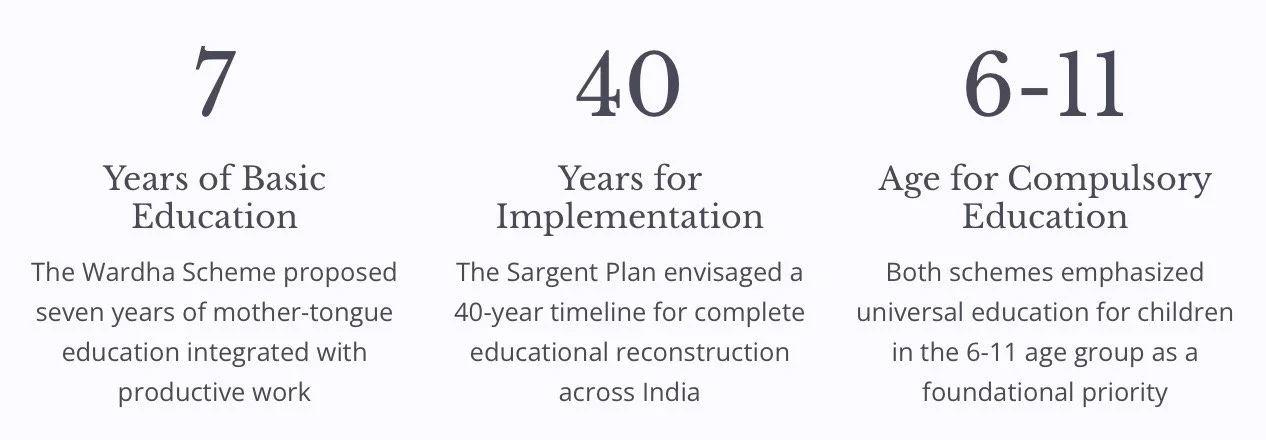
The Zakir Husain Committee worked out the scheme's details and prepared detailed syllabi for numerous crafts, making suggestions concerning teacher training, supervision, examination, and administration. The scheme centred around 'manual productive work' which might cover teachers' remuneration. It envisaged a seven-year course through students' mother tongue.
The Wardha Scheme represented a fundamentally different educational philosophy from the British system. Rather than separating intellectual work from manual labour (a distinction that reinforced class hierarchies), Basic Education integrated productive work with learning. Students would learn academic subjects through practical activities—mathematics through measuring and calculating for craft work, science through understanding processes involved in production, and so forth.
The outbreak of war in 1939 and the resignation of Congress Ministries led to postponement of the scheme. However, the Wardha Scheme's influence persisted, shaping post-independence educational philosophy and debates about appropriate education for newly independent India.
The Sargent Plan of 1944
In 1944, the Central Advisory Board of Education drew up a national scheme of education, generally known as the Sargent Plan (Sir John Sargent was the Educational Advisor to the Government of India). The plan's recommendations included:
Establishment of elementary schools and high schools (junior and senior basic schools)
Introduction of universal free and compulsory education for children aged 6-11
A school course of six years for children aged 11-17
High schools of two types: (a) academic and (b) technical and vocational, with different curricula
Abolition of the Intermediate course and addition of an extra year each at high school and college stages
The Sargent Scheme envisaged a 40-year educational reconstruction plan for the country—a comprehensive, long-term vision that would extend well beyond the colonial period.
Wardha Scheme and the Sargent Plan
Legacy and Continuing Challenges
The history of education under British rule reveals a complex legacy of transformation, exploitation, and resistance. The British educational system fundamentally altered India's intellectual landscape, creating new opportunities whilst simultaneously destroying indigenous learning traditions and deepening social inequalities. The anglicized education system produced a class of Indians who could serve colonial administration whilst also developing the intellectual tools to critique and resist that same colonialism. This paradox defines the British educational legacy in India.
Access and Inequality
Colonial education expanded access for some whilst neglecting mass education. The emphasis on English-medium higher education created linguistic and class barriers that persist today, with quality education remaining concentrated amongst urban elites whilst rural areas struggle with inadequate facilities.
Language and Identity
The privileging of English over vernacular languages created lasting linguistic hierarchies. Whilst English provided access to global knowledge and employment, it also alienated educated elites from vernacular-speaking masses, creating communication gaps that hindered social cohesion and democratic participation.
Education and Employment
The colonial system's focus on producing clerks and administrators rather than critical thinkers established a pattern of viewing education primarily as job training. This instrumental approach neglected education's broader purposes—character development, civic engagement, and intellectual inquiry for its own sake.
Indigenous Knowledge
The systematic devaluation of Indian knowledge systems—Sanskrit learning, indigenous sciences, traditional pedagogies—resulted in loss of valuable intellectual traditions. Recovery and integration of these traditions with modern knowledge remains an ongoing challenge for contemporary Indian education.
Social Reform
Colonial education did contribute to social reforms—challenging caste hierarchies, promoting women's education, and introducing modern scientific thinking. However, these progressive elements coexisted with efforts to maintain colonial control and social hierarchies that served British interests.
Nationalist Response
The educated class produced by colonial education became the leadership of India's independence movement. They used their English education to articulate powerful critiques of colonialism, drawing on Western liberal and democratic ideals to challenge British rule's legitimacy.
Understanding this complex educational history remains essential for addressing contemporary challenges in Indian education. The persistent emphasis on rote learning and examinations, the neglect of vernacular languages, the urban-rural divide in educational quality, and the disconnect between education and employment all have deep roots in colonial educational policies and practices. As India continues reforming its educational system, grappling honestly with this colonial legacy—acknowledging both its destructive impacts and the ways educated Indians resisted and transformed it—provides crucial context for building an educational system that serves all Indians whilst respecting and integrating diverse knowledge traditions. The journey from Macaulay's Minute to contemporary educational debates spans nearly two centuries, but the fundamental questions about language, access, content, and purpose of education remain strikingly relevant.
