
European Business Enterprise and Its Limitations
The European business enterprise and managing agencies represented a pivotal force in shaping India's industrial landscape during the colonial era. These sophisticated commercial entities controlled a substantial sector of Indian industries, mobilizing capital, establishing joint stock companies, and providing management expertise that would fundamentally transform the subcontinent's economic structure. Until the First World War, these agencies wielded considerable influence over India's industrial development, creating business empires that spanned multiple sectors from tea and jute to coal mining and railways.
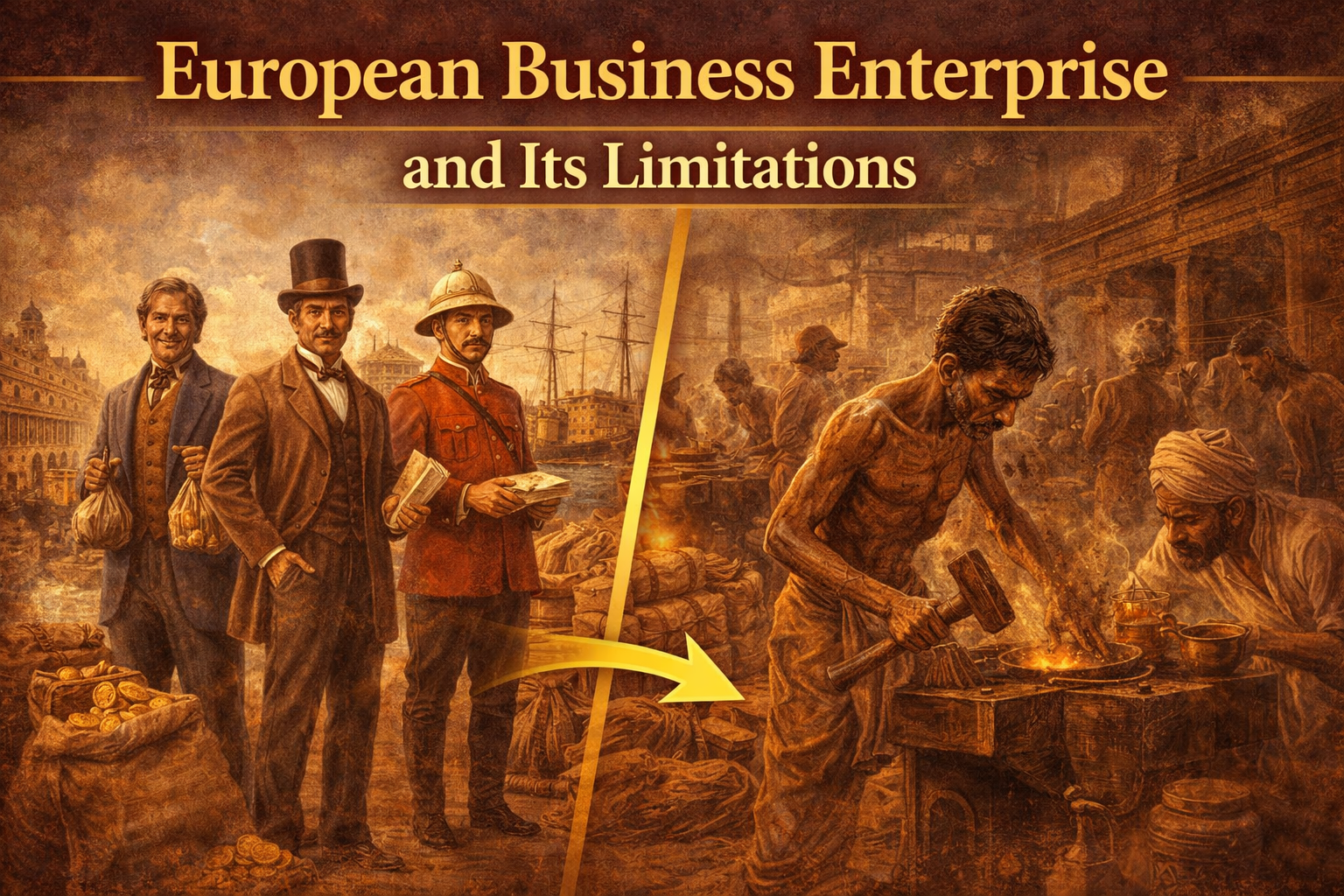
European Business Enterprise and Its Limitations
The Rise of Bird & Company: From Railway Contractors to Industrial Giants
Established in 1864 by the Scottish brothers Sam and Paul Bird in Allahabad, Bird & Company emerged as one of the most successful managing agencies in colonial India. The firm's journey from humble railway contractors to industrial magnates exemplifies the expansion of European business enterprise across the subcontinent.
Initially contracted to load and unload goods for the East Indian Railway (EIR) and North Western Railway (NWR), the Bird brothers quickly recognised the immense opportunities presented by India's burgeoning infrastructure development. Their strategic decision to relocate their head office to Calcutta positioned them at the commercial heart of British India.
1864
Company founded in Allahabad as railway contractor
1873
First labour supplied to Calcutta Port operations
1874
Completed major rice import contract, unloading 400,000 tons
1880
Won railway contract at Calcutta Port
1917
Acquired F W Heilgers & Company, expanding empire
Bird & Company's Diverse Business Operations
Bird & Company's success stemmed from its remarkable diversification across multiple industrial sectors. The firm's transformation from a labour contractor to a comprehensive managing agency demonstrates the expansive nature of European business enterprise in colonial India. By strategically positioning itself across infrastructure, mining, manufacturing, and shipping, Bird & Company created an integrated business empire that exemplified the managing agency model.
Shipping Operations
Operated the Bird Line with two 6,000-ton coal ships: the Flamingo and the Florican, facilitating bulk transport across Indian waters
Contract Labour
Supplied skilled and unskilled labour to East Indian Railway, East Bengal Railway, and Calcutta Port Commissioners' Railway
Jute Mills
Managed multiple jute mills including Dalhousie (704 looms) and Northbrook (544 looms) at Champdani
Mining Ventures
Owned and operated Barajamda, Gua Iron Ore Mines with broad gauge locomotive infrastructure
Manufacturing Excellence
The firm established the Assam Saw Mill & Timber at Sadiya in 1920, which manufactured plywood specifically for constructing tea chests for the local tea industry, demonstrating their understanding of supply chain integration.
Strategic Acquisitions
In 1917, Bird & Company acquired F W Heilgers & Company, absorbing their coal and jute interests and adding mills like Titagarh, Kinnison, and Naihati to their expanding portfolio.
Andrew Yule & Company: The Scottish Enterprise
When young Scottish entrepreneur Andrew Yule arrived in Calcutta in 1863, he established what would become the largest managing agency house in India. Founded during a transformative period when railways, telegraph, and postal services were just beginning, Andrew Yule & Company epitomised the entrepreneurial spirit that characterised European business enterprise in colonial India. The company's rapid expansion across diverse sectors demonstrated the immense opportunities available to well-capitalised European firms operating within the colonial framework.
Foundation Era (1863-1875)
Andrew Yule established the managing agency in Calcutta. By 1875, the company had established substantial business interests across jute, tea, cotton, coal, and insurance sectors, laying the foundation for future expansion.
George Yule's Leadership (1875-1902)
George Yule, Andrew's elder brother, took control in 1875. A liberal thinker and public figure, he became Sheriff of Calcutta (1886) and President of the Indian National Congress (1888), bridging business and politics.
Sir David Yule's Expansion (1902-1913)
Under Sir David Yule, the company managed over 30 businesses by 1902. He received Knighthood in 1912 for providing employment to over 200,000 people. By 1913, Andrew Yule was India's largest managing agency with 37 companies.
Corporate Transformation (1919-1946)
In 1919, the business was sold to Andrew Yule Company Pvt. Ltd., a new private limited company. This was subsequently converted into a public limited company in 1946, modernising its corporate structure.
Andrew Yule's Business Empire: Diversity and Scale
Comprehensive Portfolio
Sir David Yule's vision extended beyond traditional trading. The company managed an extraordinary range of enterprises that touched nearly every aspect of India's industrial economy, from primary production to manufacturing and infrastructure.
Tea Companies
Extensive tea estate operations across Assam and Bengal, managing cultivation, processing, and export of premium Indian tea to global markets
Jute & Cotton Mills
Multiple manufacturing facilities producing jute goods for export and cotton textiles for domestic and international markets
Coal Companies
Mining operations extracting coal for railways, industry, and domestic consumption during India's industrial expansion
Railway Company
Investment in railway infrastructure supporting India's transportation network and facilitating trade
Printing Press
Publishing and printing operations contributing to India's growing media and information landscape
Zamindari Company
In Midnapur District, West Bengal, promoting agriculture, forestry, fisheries, infrastructure, schools, hospitals, and dispensaries—demonstrating social responsibility alongside profit
"Sir David Yule was the only non-official to be honoured with Knighthood in 1912 when King George V and Queen Mary visited India, recognised for providing food and employment to more than 200,000 people."
Jardine Skinner & Company: Trading, Opium, and Expansion
Founded in 1825 in Bombay and reformed in Calcutta in 1844 by David Jardine and Charles B. Skinner, Jardine Skinner & Company represented another significant Scottish managing agency that shaped India's colonial economy. Initially dealing in textiles, the company later branched into controversial but highly profitable ventures including opium, tea, timber, and petroleum, exemplifying the opportunistic nature of European business enterprise.
Foundation Phase
Started with textile trading, importing cotton goods from Manchester and Glasgow, exporting indigo and silk
Opium Dominance
By 1860, dominated opium trade with Jardine Matheson, shipping to China and Southeast Asia, earning substantial profits
Tea Expansion
Large tea trade by 1860, joint ownership of estates with Matheson & Co. in early 1860s, diversifying revenue streams
Jute Manufacturing
Controlled six jute mills by 1890, becoming fourth largest operator by 1910-11, despite fluctuating market conditions
Financial Challenges
Despite prosperity, Jardine Skinner operated with relatively modest capital—just £100,000 in 1845-48. The company weathered financial crises in 1848, 1866, and 1890, supported by credit arrangements with Matheson & Co., demonstrating the interconnected nature of Scottish trading houses.
Strategic Positioning
By 1880s, returns had declined to just 2-3% on capital, forcing the company to seek new investment opportunities. The original indigo and silk filature businesses became unprofitable, pushing diversification into timber, petroleum, and expanded jute operations.
Nature and Character of Managing Agencies
The managing agency system represented a unique organisational structure that dominated India's industrial landscape during the colonial period. These enterprises combined multiple functions—promotion, financing, and management—creating powerful commercial entities that controlled substantial sectors of the Indian economy. Understanding their operational character reveals both their effectiveness in mobilising capital and their inherent structural weaknesses.
Partnership Structure
These were typically partnership firms or private limited companies where control was concentrated in the hands of 4-5 individuals. Management was hereditary, passed down through family lines or through Scottish kinship networks, ensuring continuity but limiting fresh perspectives.
Triple Role: Promoter, Financier, Manager
Managing agencies acted as promoters by identifying investment opportunities and establishing new companies. They served as financiers by providing loans to companies and temporarily purchasing shares in initial public offerings before selling them later. They also provided comprehensive management expertise to the companies under their control.
Capital Mobilisation
In the absence of developed capital markets, managing agencies played a crucial role in mobilising capital for industrial ventures. Sometimes Indian financiers provided capital while European agencies made all investment and business decisions, creating an asymmetric power dynamic that favoured European interests.
Export-Oriented Focus
Managing agencies concentrated on products primarily for export: tea, coffee, indigo, and jute plantations. By acquiring land at cheap rates from the colonial government, they established extensive plantations and invested heavily in mining and cash crop production, integrating India into global commodity chains.
The managing agency system created powerful commercial networks that connected Scottish capital, Indian labour and resources, and global markets, fundamentally reshaping India's economic structure during the colonial era.
Fundamental Limitations of Managing Agencies
Despite their role in industrial development, managing agencies suffered from serious structural and ethical limitations that ultimately led to their abolition. These deficiencies created barriers to Indian entrepreneurship, fostered poor corporate governance, and prioritised European interests over broader economic development.
Excessive Concentration of Power
Managing agencies wielded disproportionate power over the companies they controlled. This concentration discouraged Indian capitalists from floating their own ventures, even when they provided the capital, as European agencies retained all decision-making authority. The system perpetuated European dominance and stunted indigenous entrepreneurship.
Exclusionary Practices
Managing agencies established their own chambers of commerce and systematically disallowed Indian businessmen from joining. This institutional discrimination prevented Indian entrepreneurs from accessing networks, information, and opportunities, reinforcing economic inequality along racial lines.
Poor Corporate Governance
Agencies operated with remarkable opacity, hereditary control structures, and minimal shareholder power. This lack of transparency created opportunities for self-dealing and mismanagement, with little accountability to the actual owners of capital.
Misaligned Incentives
Remuneration structures often linked managing agency compensation to goals contrary to shareholder interests—for example, sales maximisation instead of profit maximisation. This misalignment encouraged short-term thinking and decisions that benefited agencies at shareholders' expense.
Lack of Pioneering Spirit
Many managing agencies were seldom true pioneers. Numerous firms were floated by unscrupulous speculators whose primary goal was quick enrichment through offloading shares and selling mismanaged mills at profit, rather than building sustainable enterprises.
Monopolistic Tendencies
The straddling of different fields by the same managing agency house, combined with concentration of capital in few European hands, facilitated maintenance of individual or collective monopolies. British businessmen fully appreciated and exploited these monopolistic advantages.
Advantages and Contributions to Indian Development
Despite significant limitations, the history of managing agencies encompasses important contributions to India's socio-economic and industrial development. These enterprises introduced modern business practices, mobilised capital when indigenous institutions were weak, and created employment on an unprecedented scale. A balanced assessment requires acknowledging both their exploitative aspects and their role in India's economic transformation.
Capital Provision
Managing agencies provided capital when few other sources existed. The banking sector was underdeveloped and inaccessible to most entrepreneurs. By mobilising resources for industrial ventures, agencies filled a critical gap in India's financial infrastructure.
Market Modernisation
Agencies modernised Indian markets by introducing the practice of raising public capital through joint stock companies, replacing the traditional model of family capital. This transformation laid foundations for India's future capital markets and corporate structures.
Brand Reputation
In sectors like tea, jute, and engineering, the largest European managing agencies had such strong brand names that their involvement made it significantly easier to raise capital from public issues, reducing risk for investors and facilitating larger projects.
Employment Generated
Sir David Yule alone provided employment to over 200,000 people across his business empire
Companies Managed
Andrew Yule managed 37 companies by 1913, demonstrating scale of operations
Jute Mills in India
By 1890, just three managing agencies controlled significant portions of India's 21 jute mills
"The history of managing agencies is not only about business empires but also about the immense contributions made towards socio-economic and industrial development of the country."
Legacy and Transformation: The End of an Era
The managing agency system ultimately proved incompatible with independent India's economic aspirations and governance standards. Through successive Companies Acts and amendments, their powers were progressively curtailed and eventually abolished. However, their legacy persisted in modified forms, with inter-corporate investments becoming prevalent as an alternative control mechanism even before formal abolition.
Recognition of Limitations
Growing awareness of the system's excessive power concentration, poor governance, and barriers to Indian entrepreneurship prompted regulatory scrutiny
Legislative Reforms
Successive Companies Acts introduced restrictions on managing agency powers, remuneration structures, and governance practices
Gradual Abolition
The system was progressively dismantled through legislation, reflecting independent India's commitment to economic democracy and indigenous control
Structural Transformation
Inter-corporate investments and holding company structures emerged as alternative control mechanisms, adapting to new regulatory realities
Historical Significance
Managing agencies represented a distinctive phase in India's industrial history—a system that simultaneously facilitated capital mobilisation and perpetuated colonial economic structures. Their rise and fall illuminate the complex relationship between foreign capital, indigenous entrepreneurship, and economic development in colonial and post-colonial contexts.
Lessons for Contemporary Business
The managing agency experience offers valuable lessons about corporate governance, the importance of aligning managerial incentives with shareholder interests, the dangers of excessive power concentration, and the need for inclusive economic institutions that don't systematically exclude participants based on origin or identity.
The European managing agency system thus stands as a testament to both the dynamism of colonial capitalism and its fundamental contradictions—creating wealth and infrastructure whilst simultaneously constraining indigenous economic agency and perpetuating structural inequality. Understanding this history remains essential for comprehending India's contemporary economic institutions and ongoing development challenges.
