
Famines in Colonial India: A Humanitarian Catastrophe
Whilst ancient and medieval India experienced famines periodically, the colonial period witnessed unprecedented frequency and severity of these humanitarian disasters. The Arthashastra mentions famine relief measures, and famines occurred during the reigns of Muhammad Bin Tughlaq, Akbar, Shah Jahan, and Aurangzeb. However, pre-colonial famines differed significantly in their frequency and in the proactive measures undertaken by rulers, who generally took responsibility for their subjects' welfare during crises.
Famines in Colonial India: A Humanitarian Catastrophe
The nineteenth and twentieth centuries witnessed numerous factors contributing to recurring famines in colonial India. These weren't merely natural disasters but reflected systemic failures in governance, exploitative economic policies, and callous disregard for Indian lives. The frequency and severity of these famines under British rule represented one of the darkest aspects of colonial administration, revealing the fundamental tension between imperial profit-seeking and humanitarian responsibility.
Structural Causes of Colonial Famines
Commercialisation of Agriculture
Reduced area under food crop cultivation due to substitution of commercial non-food grains. Between 1893-94 and 1945-46, commercial crop production increased 85% whilst food crop production fell 7%
Revenue Settlements
Permanent, Ryotwari, and Mahalwari settlements imposed excessive land revenue on peasants, leading to rural indebtedness and reduced purchasing power
Absentee Landlordism
Permanent settlement created subinfeudation and absentee landlordism, reducing agricultural investment and productivity as population increased
Environmental Imperialism
British intrusion into tribal areas and enactment of various forest acts restricted tribals' access to forest produce and prohibited jhum cultivation, creating famine conditions in tribal regions. These policies disrupted traditional subsistence patterns that had sustained communities for centuries.
Deindustrialisation Impact
The ruin of Indian artisans due to deindustrialisation reduced their purchasing power to such an extent that food prices became unaffordable. This urban poverty combined with rural distress to create conditions where large populations lacked the means to purchase available food.
The commercialisation of agriculture had devastating effects on the rural economy that often manifested as famines. The changeover to cash crops like indigo, cotton, and opium discouraged cultivation of poor people's food crops like jowar, bajra, and pulses. The Orissa and Bengal famines of 1866 bore testimony to this process of crop substitution, where export-oriented agriculture displaced subsistence farming, leaving populations vulnerable to market fluctuations and harvest failures.
Early Colonial Famines: Company Rule Era (1757-1858)
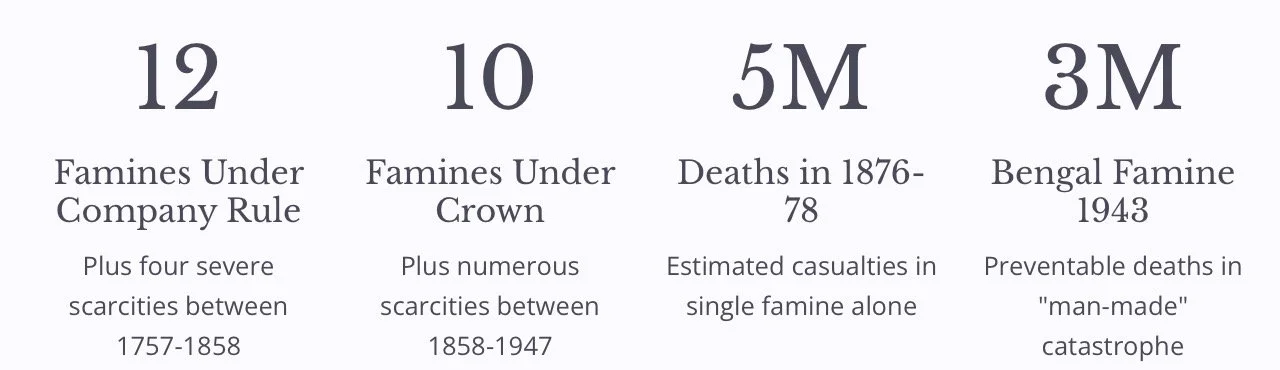
During East India Company rule, India suffered from twelve famines and four severe scarcities across different regions. The first major catastrophe was the Bengal Famine of 1769-70, which claimed approximately one-third of Bengal's population. Horrifyingly, no significant relief measures were taken; rather, Company servants made substantial profits by buying up rice and retailing it at inflated prices—profiteering from human suffering.
1769-70: Bengal Famine
One-third of Bengal's population perished; Company servants profited from grain speculation
1781-82: Madras Scarcity
Years of scarcity affected southern India with limited relief efforts
1784: Northern India Famine
Severe famine afflicted entire northern India; minimal systematic response
1792: Madras Famine
State opened relief works for famine-stricken—first organised relief attempt
1833: Guntur Famine
200,000 deaths from population of 500,000—devastating mortality rate
1837: Upper India Famine
Public works opened at several centres; relief for helpless left to charity
The Famine Commission of 1880 noted that "till the end of the 18th century, the position of the British in India was not such as either to create any sense of general obligation to give relief or to supply sufficient means of affording it." This statement reveals the Company's fundamental disregard for its subjects' welfare. During various famines, provincial governments and district officers experimented with different relief methods—storage of grain by government, penalties on hoarding, bounties on imports, and loans for well-sinking—but no general system of famine relief or prevention was formulated under Company rule.
Crown Rule Famines and the Orissa Catastrophe (1866)
The transfer of power from Company to Crown in 1858 brought some changes in approach, though not immediate improvement in outcomes. The state began realising its responsibility for irrigation expansion, agrarian legislation, and famine relief policy formulation. However, the Orissa Famine of 1866 demonstrated that recognition of responsibility didn't automatically translate into effective action.
The drought of 1865, followed by famine in 1866, severely affected Orissa, Madras, Northern Bengal, and Bihar. The calamity was most severe in Orissa, giving the disaster its name. Despite being forewarned, government officers took no steps to meet the approaching catastrophe and appeared helpless when it arrived.
Ideological Failure
Government adhered rigidly to free trade principles and the law of demand and supply, refusing to intervene in grain markets despite obvious market failure during crisis
Inadequate Relief
Government provided employment only to able-bodied persons, leaving charitable relief to voluntary agencies that did very little
Catastrophic Mortality
Estimated 1.3 million persons died in Orissa alone due to inadequate relief measures and delayed government response
George Campbell Committee (1866): Following the Orissa catastrophe, Sir George Campbell's committee made recommendations that anticipated those of the 1880 Royal Commission. The committee abandoned the old doctrine that the public was solely responsible for relief of the helpless, establishing government responsibility for preventing deaths. It recommended borrowing money for railways and canals, and made district officers responsible for saving all preventable deaths.
The Great Famine of 1876-78: Colonial Policy's Darkest Hour
The great famine of 1876-78 was perhaps the most grievous calamity experienced since the early nineteenth century, affecting Madras, Bombay, Uttar Pradesh, and Punjab. The famine-affected area was estimated at 257,000 square miles with a population exceeding 58 million. Many villages were completely depopulated, and large tracts of territory went out of cultivation. R.C. Dutt estimated that five million persons perished in a single year—a staggering humanitarian catastrophe.
257k Square Miles Affected
Vast geographical extent of famine impact
58M Population at Risk
Number of people in affected areas
5M Estimated Deaths
Casualties in single year according to R.C. Dutt
Government Failures
Half-hearted efforts to help famine-stricken populations
Inadequate and ineffective famine machinery
Refusal to recognise responsibility for saving human lives
Adherence to laissez-faire economic principles despite obvious market failures
Insufficient allocation of resources for relief operations
Long-term Consequences
Massive loss of productive agricultural labour
Abandonment of cultivated lands and villages
Destruction of rural economy and social structures
Increased indebtedness amongst surviving populations
Deepening poverty and vulnerability to future crises
Famine Commissions and Policy Evolution
Strachey Commission (1880)
Formulated general principles and protective measures: famine code creation, revenue suspension/remission, state duty to offer relief, and peasant condition monitoring
Famine Code (1883)
Provisional code implemented in 1886 with four parts: normal-time precautions, imminent relief instructions, relief work duties, and famine-prone area mapping
James Lyall Commission (1898)
Following 1896-97 famine affecting 34 million people, adhered to 1880 views with modifications based on recent experience
Anthony MacDonnell Commission (1901)
After 1899-1900 famine, recommended famine commissioners, agricultural banks, irrigation improvements, and moral strategy implementation
The Strachey Commission of 1880 represented a watershed in famine policy, establishing that wages should be adjusted to provide sufficient food for labourers' support, provincial governments should bear relief costs (with central assistance when necessary), and private trade should handle food supply and distribution unless export prohibition became necessary. The commission's recommendations led to creation of a Famine Fund and incorporation of a new budget head for famine relief and insurance, with Rs. 15 million allocated annually.
Between 1883 and 1896, droughts in different provinces afforded opportunities for testing and revising provincial codes. However, the 1896-97 famine, affecting almost every province with 34 million people impacted, revealed continued inadequacies despite policy evolution. The 1899-1900 famine proved even more challenging—authorities failed or refused to open relief works in early stages, and when finally opened, vast numbers overwhelmed the system, causing near-complete breakdown in many cases despite Rs. 10 crores in relief expenditure.
The Bengal Famine of 1943: Man-Made Catastrophe
The Great Bengal Famine of 1942-43 represented one of the most devastating humanitarian disasters in colonial India's history, taking an enormous toll of life through what many historians characterise as a "man-made" rather than natural catastrophe. The root causes lay in a series of crop failures Bengal experienced from 1938 and conditions created by the Second World War, but the catastrophic mortality resulted primarily from policy failures and deliberate neglect.
Contributing Factors
Normal rice imports from Burma stopped due to Japanese occupation; trade and food grain movement dislocated due to wartime controls; Bengal's proximity to eastern war theatre created panic and hoarding
Human Exploitation
Man exploited situation created by nature and war—profiteering, hoarding, and speculation drove prices beyond reach of ordinary people whilst grain remained available
Policy Failures
Relief measures belated and inadequate; delay in facing the problem; non-declaration of famine bound up with wartime propaganda policy of "no shortage"
Administrative Callousness
Relief expenditure limited on financial grounds; Central Government showed callous disregard for Bengal's misfortunes, wanting provincial government alone to organise relief
The Bengal famine exposed the fundamental bankruptcy of colonial governance when Indian lives were weighed against imperial priorities. Winston Churchill's government diverted food supplies to build stockpiles for post-war Europe whilst millions starved in Bengal. When requests for food imports were made, Churchill reportedly asked why Gandhi hadn't died yet if the famine was so severe—revealing the profound racism and indifference underlying colonial administration.
John Woodhead Commission (1943-44): Appointed in the famine's aftermath, this last famine commission recommended creation of an All-India Food Council, increased food crop production, and amalgamation of Food and Agriculture departments. These recommendations came too late for famine victims but influenced post-independence food security policies.
Colonial Infrastructure and Famine: A Complex Legacy
Railways
Built to extract resources and control territory, inadvertently united India and enabled post-independence development
Telegraph
Strengthened colonial control whilst facilitating modern communication and coordination
Postal System
Created accessible communication network benefiting administration and society
Famine Policy
Evolved slowly and inadequately, prioritising financial considerations over human lives
Economic Exploitation
Infrastructure served extraction of wealth, contributing to poverty that caused famines
Human Cost
Millions died in preventable famines whilst infrastructure facilitated imperial profits
The legacy of British colonial infrastructure in India presents profound contradictions. Railways, telegraph, and postal systems created physical and communication networks that would prove invaluable for independent India's development. These systems integrated markets, facilitated movement of people and ideas, and inadvertently contributed to nationalist consciousness by enabling coordination across vast distances. However, these unintended benefits cannot obscure the fundamental reality: colonial infrastructure was designed to serve imperial extraction and control, not Indian development.
The recurring famines that plagued colonial India—claiming millions of lives across the 19th and 20th centuries—reveal the human cost of prioritising imperial profits over Indian welfare. Whilst infrastructure could theoretically have mitigated famine impacts through better food distribution, the reality was that railways facilitated export of grain from famine-stricken areas to profitable markets, and relief policies remained inadequate because colonial administrators valued financial prudence over Indian lives. The Bengal Famine of 1943, occurring after nearly a century of railway development, demonstrated that infrastructure alone couldn't prevent humanitarian catastrophe when governance prioritised empire over humanity.
For contemporary students of history, this complex legacy demands nuanced analysis. We must acknowledge both the material infrastructure that colonialism left behind and the enormous human suffering it caused. The railways that now connect democratic India were built on exploitation and served empire first. Understanding this contradiction—recognising that systems of oppression can inadvertently create tools of liberation—remains essential for comprehending colonialism's enduring impact on post-colonial nations.
