
British Colonial Infrastructure in India: Railways, Telegraph, and Postal Networks
The period of British colonial rule in India witnessed the introduction of modern infrastructure systems that fundamentally transformed the subcontinent's economic, social, and political landscape. Between 1848 and 1947, the British Empire established an extensive network of railways, telegraph lines, and postal services that connected India's diverse regions like never before. Whilst these developments brought unprecedented connectivity and technological advancement, they were primarily designed to serve imperial interests rather than Indian development. This document examines the complex legacy of colonial infrastructure, exploring how systems meant to facilitate British control inadvertently contributed to India's eventual modernisation whilst simultaneously reinforcing patterns of economic exploitation and resource extraction.
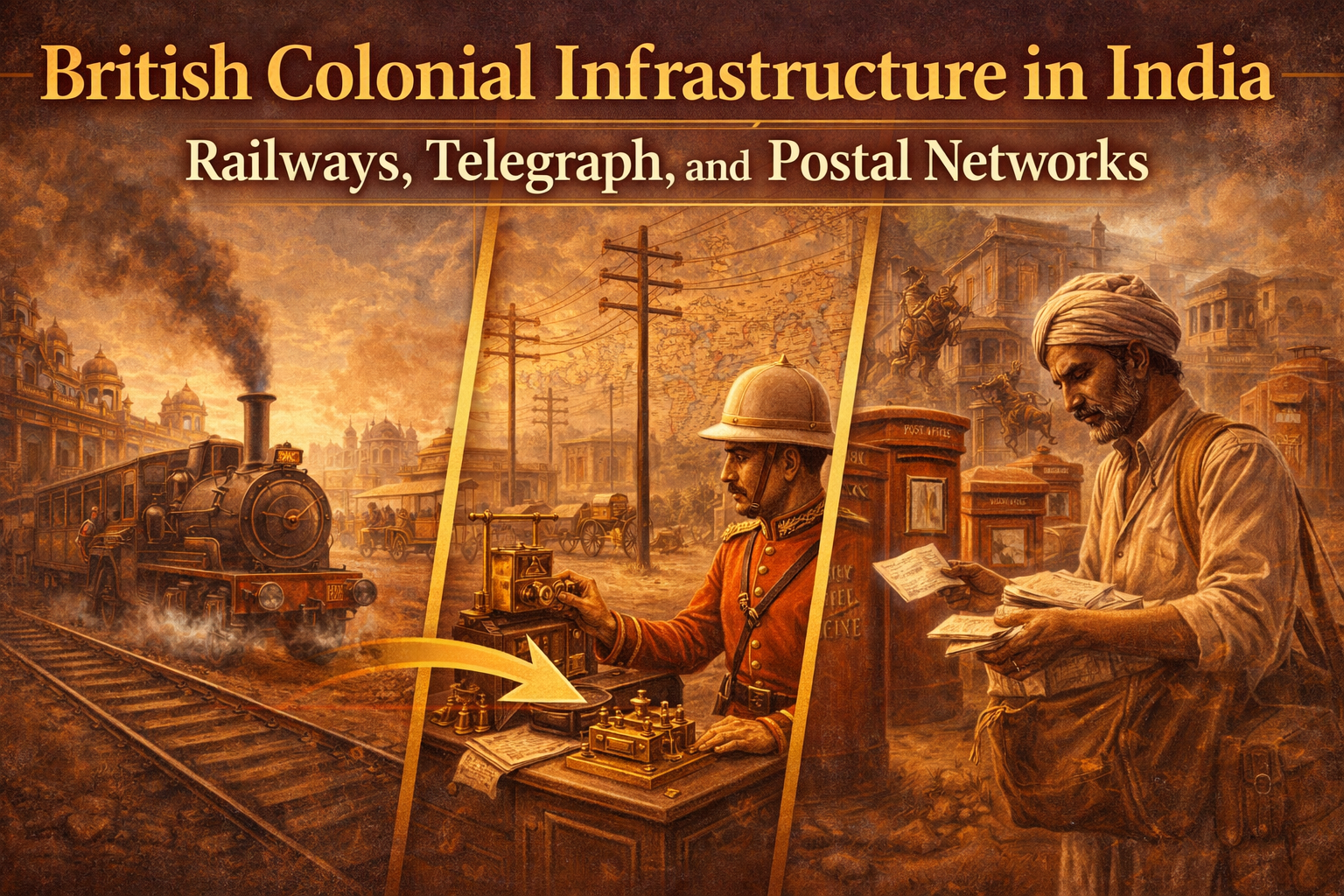
British Colonial Infrastructure in India: Railways, Telegraph, and Postal Networks
Lord Dalhousie: The Architect of Colonial Modernisation
Lord Dalhousie served as Governor-General of India from 1848 to 1856, a transformative period that saw the introduction of modern infrastructure systems across the subcontinent. Unlike many of his predecessors, Dalhousie identified himself as an Orientalist and moderniser, believing his mission was to bring the British intellectual revolution to India. As a staunch utilitarian, he sought to improve Indian society according to the prevalent Benthamite ideals of the period, determined to advance Mill's vision of Britain's civilising mission in India.
However, his approach was marked by authoritarian governance, which he believed was necessary to accelerate India's material development and progress. Dalhousie's policies, particularly the infamous Doctrine of Lapse, contributed significantly to growing discontent amongst various sectors of Indian society. This resentment culminated in the Great Indian Uprising of 1857, which erupted directly following his departure from India, revealing the deep tensions his aggressive modernisation policies had created.
"I have laboured to harness to India's bullock-cart civilisation three great engines of social improvement—Railways, Uniform Postage and Electrical Telegraph."
— Lord Dalhousie
The Railway Minute of 1853: Blueprint for Colonial Connectivity
1848
Dalhousie becomes Governor-General, recognising the strategic importance of railway development
1853
Famous Railway Minute convinces home authorities of railway necessity and outlines development framework
1853
First railway line connecting Bombay with Thane inaugurated, marking India's railway era
1854
Railway line constructed from Calcutta to Raniganj coal-fields to facilitate resource extraction
Dalhousie's Railway Minute of 1853 represented a watershed moment in Indian infrastructure development. This document convinced the British authorities of the railways' necessity and established the fundamental principles for their construction. Under Dalhousie's plan, railway construction was undertaken by British private enterprises under government supervision and control, creating a system that would have far-reaching implications for India's economy.
The plan was driven by both military and economic considerations. Dalhousie believed railways would enhance the British forces' striking power, attract British capital and enterprise to India, and provide ports with better access to the country's interior. This would facilitate the extraction of raw materials for British manufacturing whilst simultaneously opening new Indian markets for British goods. The military motive remained paramount—railways would enable rapid army deployment to suppress internal disturbances and guard India's frontiers.
The Government Guarantee System: Private Enterprise at Public Risk
5% Guaranteed Interest
British government guaranteed 5% interest on capital investment, paid from Indian revenues if necessary—far above contemporary European rates
Free Land Grants
Companies received free land with 99-year leases, after which railways would become government property
Full Compensation
Companies could return lines anytime before lease expiry and claim full compensation for all capital expended
The Government Guarantee System represented one of the most controversial aspects of railway development in colonial India. Railway lines were not built from the Indian Exchequer but by private English companies under this system, which epitomised private enterprise at public risk. The Government of India provided private enterprises with free grants of land and guaranteed interest at approximately 5% on capital outlay, to be paid from Indian revenues if necessary. This return was significantly higher than contemporary rates in Europe, making Indian railways an exceptionally attractive investment for British capital.
Imperial Benefits
Massive capital investment opportunities for British investors with guaranteed returns
Export market for British machinery, railway lines, and equipment
Strengthened military and administrative control over distant regions
Enhanced ability to suppress peasant and tribal revolts through rapid troop deployment
Indian Burdens
Enormous financial burden on government through guaranteed interest payments
Increased public debt and home charges
Reckless expenditure by companies with no financial risk
Technology transfer limited to low-skill areas like plate-laying and bridge-building
Evolution of Railway Policy: From Guarantee to State Control
Initial Guarantee System (1853-1869)
Private companies construct railways with 5% guaranteed interest and free land grants, leading to wasteful expenditure and massive financial drain
Government Takes Control (1869)
Guarantee system abolished; government assumes direct responsibility for railway construction to prevent further wastage
Modified Guarantee Returns (1879-1900)
Guarantee system revived with reduced interest of 4% or less; railways declared state property with lower risk to exchequer
Complete Nationalisation (1920s)
Government adopts policy to purchase all private railway companies; Railway Board constituted in 1905 for systematic development
The evolution of railway policy reflected growing recognition of the guarantee system's failures. Two significant changes were gradually implemented to curtail wastage: the government began directly undertaking construction of some railways, and a new guarantee system was introduced where railways were declared state property whilst the interest rate on invested capital was reduced to approximately 3.5%. The guarantee system was abolished in 1869 as the government took full responsibility for railway construction, though it was briefly revived in 1879 with more favourable terms.
Railways as Instruments of Colonial Exploitation
Import-Export Facilitation
Railways primarily linked raw material-producing interior areas with ports for export, enabling efficient collection of agricultural goods whilst facilitating distribution of imported British manufactured goods to India's interior markets.
Discriminatory Tariff Structure
Freight rates were deliberately fixed to favour import of British goods and export of Indian raw materials whilst discriminating against internal movement of Indian goods, making distribution of domestic products more difficult and costlier than imported items.
Neglect of Industrial Needs
Planning provided no interconnection between internal market cities, and preferential freight charges betrayed the colonial motive of suppressing Indian industrial development by ignoring domestic industries' requirements regarding markets and raw material sources.
The railway system's planning, construction, and management prioritised colonial interests over India's economic and political development. Railway lines were laid primarily to serve British strategic and economic objectives rather than Indian developmental needs. This colonial orientation manifested in multiple dimensions—from route planning that connected resource-extraction points to export ports, to tariff structures that systematically disadvantaged Indian manufacturers and traders. Lord Hardinge candidly acknowledged this reality, stating that Indian railways were planned for prevention of insurrection, speedy termination of war, and safety of empire.
Economic Imperialism Through Railway Construction
Financial Imperialism
The railway boom created extraordinary opportunities for British capital investment in railway companies operating in India. This encouraged the development of capital goods industries in Britain rather than India, as all machinery, equipment, and initially even coal were imported from England. The multiplier effect of railway construction benefited the British economy exclusively, whilst India bore the financial burden.
The constant drainage of wealth through guaranteed interest payments encouraged reckless expenditure and imposed an enormous financial burden on the government. Railway development significantly increased India's home charges, as heavy interest payments flowed to British investment companies. The Government of India had to ensure payment of interests on guaranteed railway stock and debt bonds whilst meeting annual home charges, invariably increasing India's public debt.
Missing Backward Linkages: In Western Europe and the USA, railway construction encouraged auxiliary industries like engineering, iron and steel, and mining—creating chains of development. India was deliberately denied such auxiliary industry development due to railway companies' policy of importing everything needed, preventing the technological and industrial spillover effects that transformed other economies.
Ecological and Social Costs of Railway Expansion
Ecological Imperialism
Railways facilitated large-scale exploitation of forest resources, with exploited timber used for laying sleepers. Massive deforestation occurred to supply railway construction needs.
Environmental Disruption
Construction work disturbed local ecology and subverted natural sewage systems. In Bengal, this created conditions conducive to malaria epidemics during the 19th century.
Displacement and Disruption
Railway construction displaced communities, disrupted traditional trade routes, and altered social patterns without adequate compensation or rehabilitation measures.
Beyond the economic exploitation, railway expansion carried significant ecological and social costs that are often overlooked in discussions of colonial infrastructure. The railways' appetite for timber led to systematic deforestation across India, as vast quantities of wood were required for sleepers and construction. This ecological imperialism fundamentally altered India's forest cover and biodiversity. Furthermore, construction activities frequently disrupted local ecosystems, with particularly severe consequences in regions like Bengal where natural drainage systems were compromised, creating breeding grounds for disease vectors. These environmental costs were never factored into the railways' economic calculus, representing another form of uncompensated extraction from India's natural wealth and public health.
Unintended Positive Impacts: Integration and Nationalism
Despite their colonial origins and exploitative nature, railways inadvertently produced several positive outcomes for Indian society. By 1946-47, when the British departed, India possessed 65,217 kilometres of railway tracks covering 78% of the total area—a substantial infrastructure legacy. The railways had also encouraged construction of feeder roads and strategic roads interconnecting different regions, creating an integrated transportation network that would prove invaluable after independence.
Market Integration
Railways integrated the Indian market to some extent and provided cheaper transportation for people and goods, which Indian businesses later leveraged after independence
National Unity
Railways minimised distances and facilitated movement across regions, contributing significantly to creating a sense of Indian national identity
Rise of Nationalism
Improved communication enabled spread of nationalist ideas and facilitated organisation of political movements across the country
"Railways may do for India what dynasties have never done—what the genius of Akbar the Magnificent could not effect by governance, nor the cruelty of Tipu Sahib by violence—they may make India a nation."
— Sir Edwin Arnold, 1865
However, one must remember that these social and cultural impacts—the unification of India, rise of nationalism, and national integration—were unintended consequences of British imperialism rather than deliberate policy objectives. The railways were designed to serve empire, not nation-building.
The Electric Telegraph: Revolutionary Communication Technology
Lord Dalhousie may be regarded as the Father of Electric Telegraph in India, introducing this revolutionary communication system in 1852. The project faced seemingly insurmountable obstacles, but these were overcome through the untiring zeal and energy of O'Shaughnessy, who was appointed Superintendent of the Electric Telegraph Department in 1852. His dedication and technical expertise proved instrumental in establishing India's telegraph network.
The first telegraph line from Calcutta to Agra was opened in 1854, covering an impressive distance of 800 miles. By 1857, this network had been extended to Lahore and Peshawar, creating a communication backbone across northern India. Nearly 4,000 miles of electric telegraph lines were constructed, connecting Calcutta with Peshawar, Bombay, and Madras, along with other significant parts of the country. In Burma, a line was laid from Rangoon to Mandalay, extending British communication infrastructure beyond the Indian subcontinent.
Administrative Control
Enabled rapid communication between distant administrative centres and colonial headquarters
Military Advantage
Facilitated quick coordination of troop movements and strategic responses to threats
Commercial Efficiency
Allowed faster business communication and coordination of trade activities across regions
Impact on 1857 Uprising: The Telegraph Department proved invaluable during the Great Rebellion of 1857-58. "It is that accursed string (the telegraph) that strangled us," proclaimed a rebel at his execution, acknowledging how this technology had strengthened British control and facilitated suppression of the uprising.
Postal Reforms: Creating a Modern Communication System
The basis of India's modern postal system was laid under Lord Dalhousie's governance. Following the findings of an expert commission, a comprehensive Post Office Act was passed in 1854, revolutionising postal services across the subcontinent. This legislation established the framework for a unified, efficient postal system that would serve India for generations.
Centralised Administration
A Director-General was appointed to supervise Post Office operations across all Presidencies, creating unified management
Uniform Pricing
A standard rate of half-anna per letter was introduced, regardless of distance, making postal services accessible and predictable
Postage Stamps
For the first time, postage stamps were issued in India, modernising payment systems and reducing corruption
Financial Success
Post offices transformed from a treasury drain into a revenue source for the government, demonstrating system efficiency
Social Benefits
Improved personal communication across vast distances
Enhanced commercial correspondence and business transactions
Facilitated spread of education and information
Strengthened family connections across regions
Developmental Impact
Administrative efficiency in governance
Financial inclusion through money order services
Educational advancement through correspondence
Social development through information access
The social, administrative, financial, and educational development resulting from the postal system's extension and improvement demonstrated Dalhousie's genuine desire to promote India's material progress. Unlike railways, which primarily served colonial exploitation, the postal system provided more equitable benefits to Indian society, though it too emerged from imperial needs for efficient administration and control.
Legacy of Colonial Communication Infrastructure
Railways
65,217 km of tracks by 1947, creating India's transportation backbone
Telegraph
4,000 miles of lines connecting major cities and administrative centres
Postal Service
Unified system with standardised rates and nationwide coverage
Integrated Network
Combined infrastructure enabling economic activity and social connection
The railways and other communication systems—postal and telegraph services—certainly had significant social and cultural impact on Indian society and the nation, contributing to the rise of nationalism and helping unite India. However, one must remember that these were unintended results of British imperialism rather than deliberate objectives of colonial policy. The infrastructure was designed to serve empire, not Indian development, yet paradoxically created conditions that would eventually facilitate India's independence movement and post-colonial development.
The modern political sector that gradually evolved in India benefited from the rapid spread of education and development of communication systems such as railways and telegraph. These technologies enabled nationalist leaders to organise across vast distances, disseminate ideas, and coordinate political activities that would eventually challenge British rule. The very infrastructure built to strengthen colonial control became instrumental in its eventual overthrow—an irony of imperial history that underscores the unpredictable nature of technological and social change.
