
Economic Impact of British Colonial Rule in India Part 4: From Golden Sparrow to Colonial Exploitation
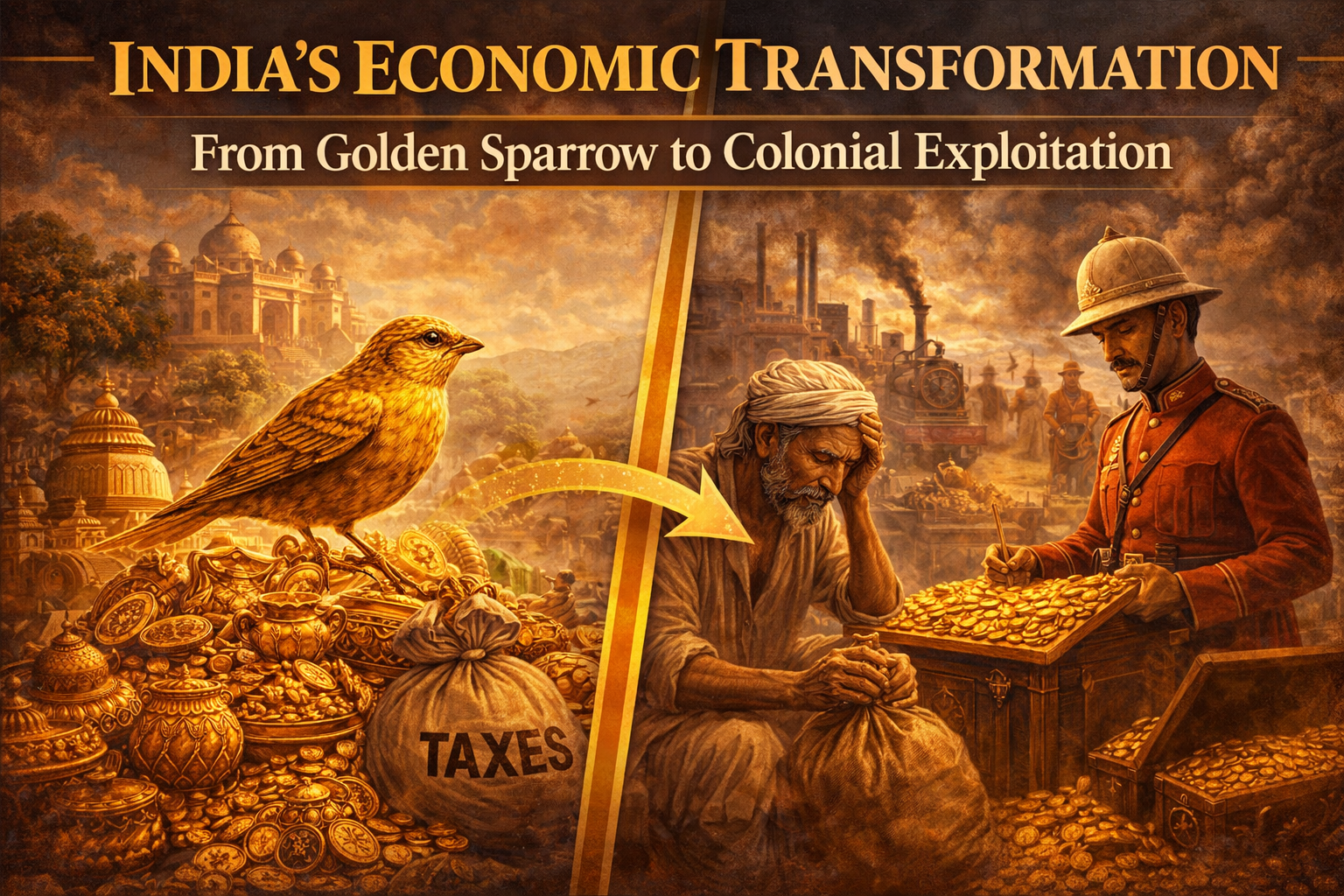
India's Economic Transformation: From Golden Sparrow to Colonial Exploitation
Ancient India earned the magnificent title of 'Golden Sparrow' for its abundant wealth and prosperity. Foreign travellers frequently reported the general prosperity they witnessed, marvelling at India's high industrial development and exceptional living standards. The country's industrial skills were admired worldwide, with even the mighty Roman Empire purchasing large quantities of Indian luxury fabrics, paying handsomely in gold and silver. The muslin of Dacca, the beautiful woollen shawls of Kashmir, and the fine linens and brocades of Delhi were celebrated throughout the world. India's metal industry flourished, evidenced by the famous iron pillar at Delhi, whilst the shipbuilding industry thrived alongside numerous handicrafts in both rural and urban areas.
However, this golden era came to a devastating end with British colonial rule, which lasted approximately 200 years. During this period, a systematic policy of exploitation and economic looting transformed India's fortune. The old economic organisation broke down completely, the industrial structure collapsed, the burden on agriculture mounted unbearably, and poverty spread across the land like wildfire. This document examines the profound economic transformation that occurred during British rule, analysing how policies, practices, and systematic exploitation reshaped India's economic landscape and left lasting scars on the nation's development.
From Golden Sparrow to Colonial Exploitation
The East India Company: From Trade to Political Dominance
Initial Establishment
The East India Company arrived in India as a commercial entity with seemingly straightforward aims—to develop trade relations with eastern countries. The Company's directors carefully studied India's political conditions and recognised opportunities amidst the declining Mughal Empire.
Commercial Beginnings
Established as trading company focused on eastern commerce
Political Opportunity
Exploited Mughal decline and political disintegration across India
Administrative Control
Bengal first, then gradual expansion throughout the country
The process of political disintegration in India accelerated rapidly after the decline of the Mughals. The English astutely exploited this situation, establishing not only their trade but also seizing administrative control. Bengal became the first province where English control was firmly established, and from this foothold, British influence gradually expanded across most parts of the country. In this manner, the East India Company transformed from merely a commercial institution into a formidable political power, wielding authority that would reshape India's destiny for the next two centuries.
The True Nature of British Rule: Economic Exploitation as Policy
Despite their growing political power, there remains no denying that the English came to India as traders and maintained this fundamental character until the very end. Their interest in administration stemmed entirely from their recognition that India's economic resources were rich enough for commercial development. They harboured no genuine interest in India's development; rather, they sought to utilise the country's vast resources exclusively for their own benefit.
Primary Objective
Economic exploitation of India's resources for British commercial gain, not Indian development
Systematic Destruction
Deliberate dismantling of traditional economic structures without allowing new systems to emerge
Poverty Creation
Policies systematically impoverished Indians whilst enriching British coffers and industries
Thus, the chief characteristic defining the British regime was the relentless economic exploitation of India, which resulted in widespread poverty for Indians. To strengthen their economic system, the British deliberately spoiled India's traditional economic structure whilst simultaneously preventing the country from developing her own new economic system based on indigenous resources. The entire economic system faced exploitation during the British regime, with revolutionary—yet destructive—changes occurring in agriculture, trade, commerce, and handicrafts. This systematic approach to economic control would prove devastating for India's prosperity and self-sufficiency.
Agricultural Transformation: The Zamindari System's Devastating Impact
India has always been fundamentally an agricultural country, with agriculture forming the very foundation of its economic system from ancient times. Recognising agriculture's central importance, the British Government introduced significant changes to the agricultural setup, which profoundly affected India's entire economic system. The introduction of the Zamindari system for realising land revenue became one of the most destructive policies implemented during colonial rule.
Land Redistribution
Real owners' lands transferred to moneylenders, wealthy merchants, and influential persons through the Zamindari system
Exploitation of Illiteracy
Ambitious individuals conspired with revenue officers, using forgery to illegally possess poor villagers' lands
Revenue Maximisation
New landlords prioritised extracting maximum tax rather than agricultural development or land fertility
With the development of the Zamindari policy, land ownership dramatically shifted away from actual cultivators. Taking advantage of village folks' illiteracy and poverty, some ambitious and wealthy persons conspired with revenue officers to illegally possess the land of poor and ignorant villagers. They resorted to committing forgery in revenue records, becoming owners of lands previously possessed by poor farmers. Their motivation was not agricultural development but rather establishing control over land to accumulate wealth rapidly.
The Landlord-Peasant Divide: Economic and Social Consequences
The evil results of land transfer soon became glaringly evident when landlords started leasing their lands at exorbitant rates, attempting to extract maximum tax from peasants. If revenue payments were not made punctually, landlords possessed the right to alienate peasants from cultivation rights of that particular land. This created an atmosphere of constant insecurity and exploitation that poisoned rural life.
Declining Productivity
Landlords ignored land fertility, focusing solely on extracting money from highest bidders
Economic Imbalance
Rural economic equilibrium shattered as landlords grew richer whilst farmers fought poverty
Wealth Gap
Great gulf created between poor and rich, impossible to bridge
Social Tension
Class struggle and social tensions emerged from extreme inequality
Debt Trap
Farmers forced into heavy debts at high interest rates for basic agricultural needs
The Zamindari system adversely affected the entire rural economic structure with devastating consequences. Land productivity decreased gradually because landlords paid no attention to fertility. They only wanted to extract more money by leasing land to the highest bidder, regardless of agricultural considerations. Consequently, the equilibrium of the rural economic system broke down completely. Landlords accumulated wealth continuously whilst farmers struggled desperately to keep body and soul together. A great gulf widened between poor and rich that could not be bridged, giving birth to intense social tension and class struggle that would persist for generations.
The Debt Crisis and Social Chaos in Rural India
The Vicious Cycle
As the economic system's balance was disturbed, rural people fell victim to crushing debts. Farmers required loans at high interest rates for seeds, manures, irrigation, and other essential agricultural purposes. The autocratic and dictatorial attitude of moneylenders made farmers' positions far worse, forcing them to lead deplorable lives at the mercy of these local exploiters.
Forced Borrowing
Farmers compelled to take high-interest loans for basic agricultural inputs like seeds, manures, and irrigation facilities
Moneylender Exploitation
Local moneylenders exercised autocratic control, trapping farmers in cycles of unpayable debt and dependency
Land Transfer
Unable to repay loans, farmers lost ancestral lands to moneylenders and wealthy merchants permanently
Social Disruption
Dispossessed landowners created chaos, taking law into their own hands, leading to widespread litigation and disorder
Critical Impact: The transfer of land from real owners to moneylenders and merchants proved fatal for society's peace and order. Various dissatisfied landowners, deprived of their ancestral lands, took law and order into their own hands, creating chaos and confusion throughout society.
Litigations proliferated between cultivators and landlords as disputes escalated. All these demerits totally undermined the rural economic structure, leaving villages impoverished, divided, and vulnerable. The social fabric of rural India, once characterised by relative stability and community cohesion, was torn apart by economic exploitation and the systematic transfer of resources from cultivators to intermediaries who contributed nothing to agricultural productivity.
Destruction of Small-Scale Industries: The Backbone Broken
Another significant drawback of the British administrative system was its systematic destruction of small-scale industries, which had previously contributed substantially to India's economic prosperity. The small-scale industry of India served as the pillar of foreign trade and national prosperity, but this foundation was deliberately undermined through colonial policies designed to favour British manufacturing interests.
Pre-British Era
Thriving small-scale industries, especially cotton and silk cloth production, supporting local prosperity and international trade
Political Supremacy (Bengal)
Company began exploiting artisans immediately upon establishing control, making cloth trade unprofitable for producers
Charter Act of 1813
English merchants permitted to establish trade relations, multiplying exploiters and accelerating industry ruin
Tariff Manipulation
Heavy duties on Indian exports, light duties on British imports, systematically destroying competitive advantage
Free Trade Policy (1833)
Complete destruction of small-scale industry as cheap British factory goods flooded Indian markets
As soon as the Company established political supremacy in Bengal, it began systematically exploiting the artisans of cotton and silk cloth. The cloth trade ceased to be a profitable source for artisans, and Bengal's cloth industry rapidly disintegrated. The Charter Act of 1813 permitted English merchants to establish trade relations in India, thereby multiplying the number of exploiters and accelerating the country's economic ruin. England imposed prohibitively heavy duties on goods exported from India whilst patronising British industry, and the Indian Government simultaneously imposed minimal duties on goods imported into India, ensuring British products could be sold easily in Indian markets.
The Free Trade Catastrophe and Industrial Stagnation
The 1833 Policy
In 1833, the Indian Government declared a policy of free trade, which delivered the final blow to small-scale industry. Tax-free trade enabled the British to acquire raw materials at exceptionally low prices, allowing British factory goods to be sold cheaply in Indian markets.
Market Displacement
Indian goods, being costlier due to traditional production methods, could not compete in markets and remained unsold. The small-scale industry faced near-complete ruination as British machine-made products dominated.
Big Industry Impact
The development of big industries remained painfully slow. Indian industrialists received no governmental help, and the lack of fundamental industries prevented industrial development altogether.
Slow Development
Big industries developed at an agonisingly slow pace due to lack of government support and infrastructure
Zero Support
Indian industrialists received absolutely no assistance from the colonial government, unlike British counterparts
Missing Foundations
Absence of fundamental industries prevented broader industrial development; steel production began only in 1913
Regional Inequality
Industries established only in exclusive parts of the country, creating severe regional economic disparities
Steel production, a fundamental requirement for industrial development, began in India only in 1913—shockingly late compared to industrialised nations. Furthermore, Indian industries were established exclusively in certain parts of the country, which contributed to further regional economic inequality. This geographic concentration meant that vast areas of India remained industrially underdeveloped, creating economic imbalances that would persist long after independence. The British had no interest in balanced industrial growth across India; their focus remained on extracting resources and preventing competition with British manufacturing.
Positive Aspects: The Unconscious Tool of History
Whilst the British rule in India was predominantly exploitative and destructive, inspired invariably by narrow self-interest, there existed certain positive aspects that emerged, often unintentionally. Karl Marx, the Father of Communism, characterised the British as 'the unconscious tool of history' in India's political, social, and economic development. Despite their exploitative intentions, British actions inadvertently laid foundations for certain modernising changes.
New Social Order
By destroying the old social order, the British laid material basis for a new social order—a precondition for economic growth
Breaking Caste Rigidities
The new social order helped break down the rigid hierarchies of the traditional caste system
English Education
Anglicised education opened avenues to English democratic and popular thought, planting seeds of Indian Nationalism
Railway System
Introduction of railways and vast transportation networks became forerunners of India's future industrial development
The new social order that emerged helped break the rigidities of the caste system that had constrained social mobility for centuries. Anglicised education, though imposed primarily to create a class of intermediaries between rulers and ruled, inadvertently opened avenues to the great stream of English democratic and popular inspiration. This education laid the seeds of Indian Nationalism, finding expression in movements like Swadeshi. The British introduced the railway system and a vast network of transportation and communications, which, despite being built for colonial purposes, became the forerunner of India's industrial development.
Communication Revolution and Political Unification
Above all, the political and economic unification of the country was achieved for the first time under British rule—an accomplishment with far-reaching implications for India's future as a nation-state. The British developed the most modern and efficient communication system available at that time. The first telegraph line was operated in 1853 between Calcutta and Agra, revolutionising long-distance communication. The first postage stamp was released in 1852, and adequate improvements were made to postal services, making it possible to avail postal facilities at a uniform rate throughout the country.
Telegraph Introduction (1853)
First telegraph line between Calcutta and Agra revolutionised communication speed
Postal System (1852)
First postage stamp released, uniform postal rates established across country
Network Expansion
Communication infrastructure expanded to connect distant regions efficiently
Regional Integration
Post and telegraph services helped integrate different regions of the subcontinent
Economic Acceleration
Facilitated development of trade, commerce, and industry through rapid information flow
Historical Significance: The development of post and telegraph systems helped integrate different regions and accelerated the process of economic growth by facilitating the development of trade, commerce, and industry. These infrastructure developments, though built for colonial administration, provided the foundation for India's future communication networks.
The Destructive Role: Decay of Indigenous Industries
It is for its destructive role that British rule in India is primarily remembered by historians and economists. Before British rule, India possessed a well-organised industry that served domestic needs and international markets. With the British arrival, Indian industry began an inexorable decline. The process of decline began as early as the end of the 18th century, becoming very steep towards the middle of the 19th century. Multiple interconnected causes were responsible for this industrial devastation.
Courts Disappear
Native rajas, nawabs, and courtiers—main patrons of luxury goods—vanished with British rule
Lost Patronage
New upper classes—European officials and educated Indians—preferred European goods over traditional crafts
Guilds Weakened
Traditional guilds that supervised quality and regulated trade lost power, leading to adulteration and poor workmanship
Machine Competition
European machine-made goods, though inferior in quality, were cheaper and flooded Indian markets
Government Policy
British Government sacrificed Indian industrial interests to promote industries at home in England
The disappearance of native Indian courts proved devastating for urban organised industry. These industries produced chiefly luxury and semi-luxury articles purchased primarily by aristocrats consisting of native rajas, nawabs, and their courtiers. With British rule establishment, native rulers vanished, their courtiers and officials were pushed into the background. Their disappearance meant closure of the main source of demand for these industries' products. The abolition of courts meant that fine articles demanded by nobles for state occasions were no longer required, triggering the decline of numerous handicrafts and artistic traditions.
New Patrons, New Problems: Cultural and Economic Shifts
European Officials
European officials and tourists demanded local products merely as souvenirs and curios, wanting goods at cheap prices. This demand lowered the artistic value of goods produced. In many cases, artisans were forced to copy European designs and patterns, working hard to satisfy customers but producing bad copies of originals.
Educated Indians
The new class of educated Indians proudly copied European fashions, despising everything Indian. They blindly imitated western ways to please their masters. Sometimes unwritten rules or conventions forced these Indians to behave this way, further accelerating indigenous industries' decline.
"The decay of the embroidered shoe industry was brought about by a strange convention. This convention permitted an Indian to retain a pair of leather shoes on slacking feet only. It also required him to put off shoes of native make when in the presence of a superior."
As the old aristocracy and courts vanished, their position in towns was occupied by two distinct classes: European officials and the new educated class. European officials and European tourists demanded local products merely as souvenirs and curios, wanting these goods at cheap prices. This demand tended to lower the artistic value of goods produced. In many cases, artisans were forced to copy European designs and patterns, working diligently to satisfy their customers, yet the products were occasionally bad copies of originals.
The new class of educated Indians was proud to copy European fashions, despising everything Indian. They blindly imitated western ways to please their colonial masters. Apart from this slavish mentality, sometimes unwritten rules or conventions also forced these Indians to behave accordingly. Lack of patronage and demand from this new class accelerated indigenous industries' decline significantly, destroying markets that had sustained craftsmen for generations.
Machine-Made Competition and Unfair Trade Policies
Competition from European manufacturers proved ultimately responsible for local industry's decline. The construction of roads and railways made it possible to distribute imported goods to every nook and corner of the country. The opening of the Suez Canal reduced the physical distance between England and India dramatically, enabling English goods to flood Indian markets in unprecedented quantities. Textiles formed the most important item amongst these goods.
Price Advantage
British machine-made goods sold at prices 75% lower than handcrafted Indian products
Quality Difference
Despite being 60% inferior in quality, British textiles captured mass markets through affordability
Market Penetration
By 1850s, British goods comprised over 90% of certain textile categories in Indian markets
Quality vs. Price
The quality of British clothes was definitely inferior compared to Indian textiles. However, they were remarkably cheap, within reach even of poor people. Hence, imported clothes and other machine-made goods came to be demanded in large quantities. Local handicrafts lost their demand completely.
Zero Import Duties
British goods entered India without duties or barriers, giving them immediate price advantage
Heavy Export Duties
Indian manufactured goods faced prohibitive customs duties when exported, destroying competitiveness
Unfair Competition
Systematic policy created impossible conditions for Indian industries to survive or compete
Deindustrialisation: A Tragic Irony
The British Government in India demonstrated far greater interest in developing industries at home than in India. Thus, the Government systematically sacrificed all interests of local industries, implementing policies that proved catastrophically harmful for indigenous industries. British goods were allowed to enter India without any duty or barrier, whilst Indian exports of manufactured goods had to pay heavy customs duties. This created grotesquely unfair competition with predictable consequences.
2oo Years of Exploitation
Duration of systematic deindustrialisation under British colonial rule
85% Industrial Decline
Estimated reduction in indigenous industrial output by mid-19th century
1913 Steel Production
Year when Indian steel production finally began—shockingly late for such a vast economy
A tragic irony defined this era: whilst the Industrial Revolution boomed in England and other Western countries—previously considered backward relative to India—simultaneously in rich India, industries began to decline. In other words, a process of 'deindustrialisation' of India commenced.
It appears profoundly ironical when examining the following situation: the Industrial Revolution was booming in England and other Western countries, which were previously considered backward in relation to India. However, simultaneously in wealthy India, industries began their devastating decline. In other words, a process of 'deindustrialisation' of India commenced. Industrial labour was rendered unemployed and began falling back upon agriculture, increasing pressure on land. Land was divided and subdivided into smallholdings, agricultural productivity fell dramatically, and agriculture thus became a backward industry. This process of decline continued relentlessly until the end of the First World War.
Urban Transformation: Decay and Growth
Another significant impact of British rule in India was the dramatic movement of population from old towns to new trading centres situated in emerging cities. Thus many new cities developed rapidly, whilst simultaneously, many historically important towns began to decay. This geographic economic shift fundamentally altered India's urban landscape and economic geography.
Towns in Decay
Mirzapur
Murshidabad
Malda
Santipore
Tanjore
Amritsar
Dacca
Cities in Growth
Delhi
Bombay (Mumbai)
Calcutta (Kolkata)
Madras (Chennai)
Bangalore
Nagpur
Kanpur
Handicraft Decay
Disappearance of royal courts caused urban handicraft decline, decreasing old town populations as craftsmen shifted to villages
Trade Route Changes
Railway introduction opened new transportation means; old routes and towns lost importance as commerce shifted
Epidemics & Insanitation
Old towns became stagnant and vulnerable to diseases; frequent plague and cholera outbreaks drove populations away
Trade Concentration
Commerce and trade concentrated in big cities with better marketing facilities, attracting traders from small towns
The emerging cities grew in importance as great commercial towns. The decay of urban handicrafts following the disappearance of royal courts brought about a significant decrease in old Indian towns' populations. As craftsmen lost their occupations, they turned to agriculture, shifting to villages. Introduction of railways opened new transportation means, causing some old towns that had prospered due to location on important trade routes—like Mirzapur on the River Ganga—to lose significance as new railway routes bypassed them.
Railways: Tool of Exploitation or Agent of Progress?
India extends from Kanyakumari in the South to Kashmir in the North—a vast territory requiring efficient means of transportation and communication for political, social, and economic integration. The British introduced railways, with the first train running from Bombay (Mumbai) to Thane, covering 21 miles on 16th April 1853. Railways' economic advantages appeared clear: fighting famines, facilitating trade, enabling better resource utilisation, and supporting urban development.
The Colonial Reality
However, during British rule, railways did not genuinely contribute towards India's economic development. The British never intended railways to act as agents of economic progress. The motive behind railway construction was never India's industrial and economic development. The real motive was opening up India more completely, making far-flung areas easily accessible for resource exploitation.
Raw Material Transportation
Lancashire textile mills needed clean cotton; railways ensured efficient delivery from distant production areas to ports
Market Access
Railways opened vast Indian markets to British manufactured goods, reaching even remote regions efficiently
Military Mobilisation
Fast troop and military stores movement essential for maintaining colonial control over vast territories
Following reasons explain why the British accepted railway construction schemes in India, revealing their true motives: The Industrial Revolution in England required raw materials from colonies. India supplied raw cotton to British industries, but bullock cart transportation mixed dirt with cotton. Lancashire mills demanded clean cotton—only railway transport could meet this need. England needed profitable markets for manufactured goods; India offered a vast market, but required accessible transportation. Railways served this purpose perfectly. Military considerations were paramount; controlling vast India required rapid troop mobilisation that only railways could provide.
Railways' Adverse Effects: Deepening Colonial Character
Railways have contributed immensely to economic progress, especially after independence, and India acknowledges its debt to the British for this infrastructure gift. However, during British rule, railways contributed more to India's economic destruction rather than construction. The adverse effects of railway construction were numerous and profound, fundamentally reshaping India's economic structure in ways that reinforced colonial exploitation.
Urban Handicraft Decline
One of the most serious consequences of railway construction was accelerated urban handicraft decline. Railways enabled Lancashire and Manchester mills to penetrate Indian markets extensively. Mill-made goods posed serious challenges to local handicrafts, which could not withstand 'cost price warfare' and ultimately decayed.
Colonial Trade Growth
Railways contributed to trade expansion, but this expansion reinforced colonial character. Railways enabled mass distribution of English manufactured goods whilst facilitating collection of agricultural raw materials from remote corners for supply to England. India imported manufactured goods and exported raw materials—a genuinely colonial trade pattern.
Exploitation Tool
The British used railways as tools of economic exploitation. Railways failed to act as growth agents during this historical period, serving primarily British trade and military interests rather than India's industrial development needs.
Critical Assessment: The composition of trade that emerged was distinctly colonial: India used to import manufactured goods and export raw materials. Railways facilitated this one-sided trade pattern, making India increasingly dependent on British manufactured goods whilst destroying indigenous industrial capacity. This pattern would persist for decades, handicapping India's industrial development long after independence.
The Economic Drain: Systematic Wealth Extraction
The British were tempted by India's immense wealth and took to large-scale plunder of it. They began carrying India's capital and wealth to England on such a massive scale that many historians and economists correctly labelled it as the 'Economic Drain'. Prominent scholars like Dadabhai Naoroji and C. N. Vakil documented this systematic wealth extraction meticulously.
200 Years
Unchecked Plunder
Wealth Transfer to England
Complete Economic Devastation
Shattered Economy at Independence (1947)
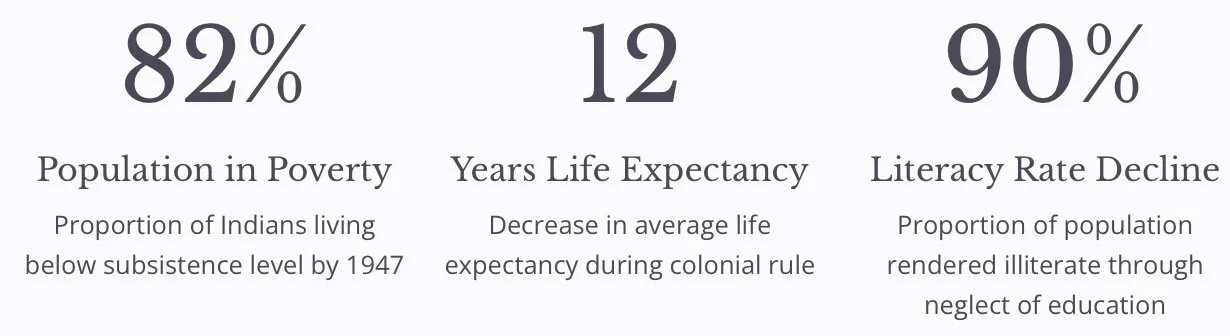
This process of wealth and capital drain from India continued unchecked for almost 200 years. Even the richest nation would have been ruined when subjected to such inhuman treatment. India could not survive these constant onslaughts. When the British finally left India in 1947, the Indian economy was completely shattered and thrown out of balance. The rich and prosperous land of India—the legendary 'Golden Sparrow'—had been converted into a country of hewers of wood and drawers of water, reduced to providing raw materials and cheap labour whilst its own people suffered grinding poverty.
Famines: The Ultimate Tragedy of Colonial Rule
Famine means non-availability of bare minimum food for subsistence, arising when widespread drought conditions prevail. Before British arrival, Indian villages were self-sufficient, catering to urban population's food requirements as well. The British transformed village setups, making economic life stagnant. Recurrence of famines became a normal and regular phenomenon, with about 22 major famines reported throughout the country during 1770-1900.
Bengal Famine 1770
Took toll of 35 percent of Bengal's population—millions dead from starvation
Western UP Famine 1860-61
Approximately 2 lakh people lost their lives in devastating food shortage
Bengal Famine 1943
Most devastating, killing over 30 lakh people—a humanitarian catastrophe
Monsoon Failure & Natural Calamities
Indian agriculture depended fully on monsoons; British neglected irrigation development, making crop failures catastrophic
Commercialisation & Lost Self-Reliance
British destroyed old economic structure; cultivators forced to sell produce for cash rent, losing food security buffers
Inadequate Transportation
Despite railways, transport system remained inadequate for moving food quickly to famine-affected regions
Food Grain Exports
Laissez-faire policy encouraged massive exports even during shortages; no buffer stocks maintained
Hoarding & Profiteering
Business community aggravated conditions through hoarding, black marketing, and profit-making activities
Chronic Poverty
People couldn't store food for emergencies due to poverty; farmers under heavy debt with low productivity
Legacy and Conclusion: From Golden Sparrow to Colonial Appendage
The early phase of British rule in India was characterised by direct loot and plunder of wealth. Gradually, this evolved into more systematic colonial exploitation—first by industrial capitalists, then by finance capital. All interests of the Indian economy were sacrificed at the altar of British interests. India's old system, which showed fine harmony between agriculture and industry, crumbled under the weight of British interests. India was reduced to the status of a colonial appendage of the British Empire.
Structural Destruction
Traditional economic harmony between agriculture and industry systematically destroyed
Colonial Dependence
India reduced to raw material supplier and captive market for British goods
Mass Impoverishment
Systematic exploitation created widespread poverty and economic stagnation
Recurring Famines
Neglect and exploitative policies led to devastating famines killing millions
Deindustrialisation
Indigenous industries destroyed through unfair competition and hostile policies
Social Disruption
Traditional social and economic structures dismantled without viable alternatives
The devastating effects of British colonial rule fundamentally transformed India from the prosperous 'Golden Sparrow' into an impoverished colonial economy. Though certain infrastructure developments like railways and communication systems provided foundations for future growth, these were built primarily to serve British interests rather than Indian development. When India finally achieved independence in 1947, it inherited a shattered economy characterised by extreme poverty, agricultural backwardness, industrial underdevelopment, and massive unemployment. The task of rebuilding from this colonial devastation would require decades of determined effort and strategic planning by independent India's leaders and people.
"The British in India fulfilled the role of—as Karl Marx puts it—'the unconscious tool of history', bringing unintended modernisation alongside deliberate exploitation. Understanding this complex legacy remains essential for comprehending contemporary India's economic challenges and aspirations."
