
The Drain of Wealth: Economic Impact of British Colonial Rule in India: Part 3
The Drain of Wealth
The constant flow of national wealth from India to England, for which India received no adequate economic, commercial, or material return, has been described by Indian national leaders and economists as the 'drain' of wealth. This drain of wealth theory became a prominent theme in nationalist economic thinking and was identified as one of the most important causes of India's poverty. The economic drain was an integral feature of the East India Company's administrative and economic policies, whereby the colonial government utilised Indian resources—revenues, agriculture, and industry—not for developing India but for Britain's benefit. Had these resources been utilised within India, they could have been invested domestically, increasing the income of the people and spurring economic development.
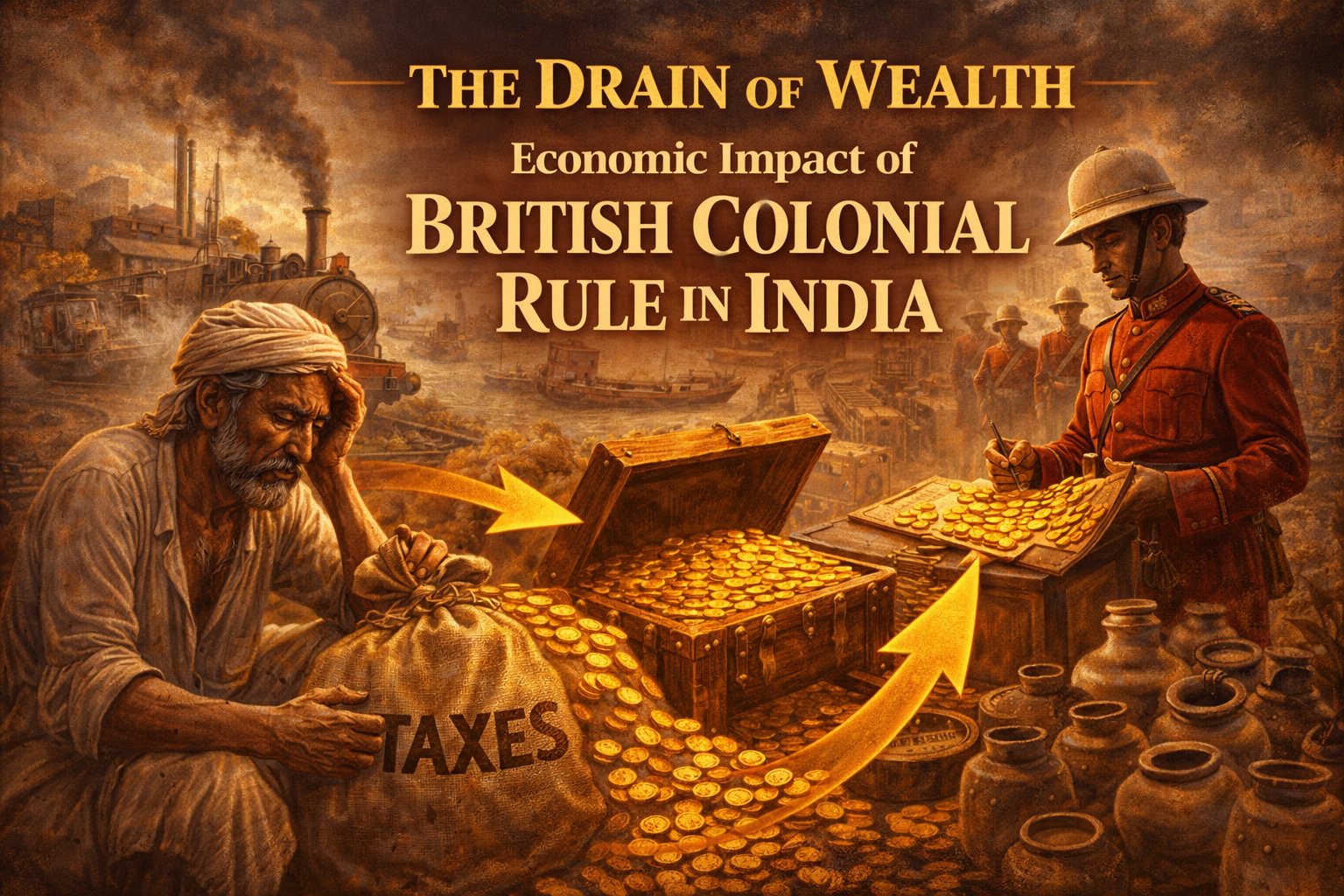
The Drain of Wealth: Economic Impact of British Colonial Rule in India
Historical Background: The Mercantilist Shift
Before Plassey (Pre-1757)
In the mercantilist concept, an economic drain occurs if gold and silver flow out of the country as a consequence of an adverse balance of trade. In the 50 years before the Battle of Plassey, the East India Company had imported bullion worth £20 million into India to balance the exports over imports from India. Indian textiles were highly sought after in European markets, creating a favourable trade balance for India.
After Plassey (Post-1757)
After the Battle of Plassey, the situation was reversed and the drain of wealth took an outward direction as England gradually acquired monopolistic control over the Indian economy. The British government adopted a series of measures to restrict or prohibit the imports of Indian textiles into England. In 1720, the British government forbade the wear or use of Indian silks and calicoes in England on pain of penalty on the weaver and seller.
Early Mechanisms of Wealth Extraction (1757-1780)
The 'Drain of Wealth' from India to England started after 1757, when the Company acquired political power and its servants acquired a 'privileged status'. They amassed wealth through various means including dastak (trade permits), dastur (commissions), nazarana (gifts), and private trade. After the East India Company extended its territorial aggression and began administering territories, it acquired control over the surplus revenues of India through multiple channels.
Oppressive Land Revenue
Profits from exploitative land revenue policies that extracted maximum resources from peasants
Monopolistic Trade
Profits from trade resulting from monopolistic control over Indian markets
Illegal Presents
During 1757-1766, individual Englishmen received no less than 50 million current rupees in illegal presents and perquisites from princes and other persons in Bengal
Private fortunes obtained by the Company's servants and other Europeans in India were remitted to Europe through various means, including sending diamonds to Europe and issuing bills of exchange on the East India Company. This practice continued even after the prohibition imposed by the Court of Directors in 1766, with prominent figures like Warren Hastings and Barwell facing charges of such activities.
The Company's Direct Responsibility for Bengal's Drain
For the most serious drain on Bengal's capital, the East India Company itself was directly responsible. The mechanisms through which this drainage occurred were systematic and devastating to Bengal's economy.
Territorial Revenue Exploitation
The Company purchased its investments from Bengal out of the surplus territorial revenues of this province after the acquisition of Dewani in 1765. It became the supreme ruler of a rich and fertile kingdom and used its revenues partly for purposes with which its people had no concern.
Inter-Presidency Financial Assistance
The Company's Government in Bengal frequently provided financial assistance to the Governments at Madras and Bombay for their ordinary civil purposes as well as for their wars—the First and Second Anglo-Mysore Wars and the First Anglo-Maratha War, for instance.
China Trade Financing
The Company's China trade was fully financed from Bengal, although this province gained nothing in return. This drain took the form of export of bullion. One pernicious effect of this export was scarcity of silver in Bengal, which was largely responsible for the currency muddle in the province in the second half of the 18th century.
This entire 'surplus' was used by the Company as an "investment"—for making purchases of exportable items in India and elsewhere. Against the exports of goods made out of this 'investment', India did not get anything in return. This is how there began the 'Drain of Wealth', which was nothing but a unilateral transfer of funds. The early nationalist leaders made this point central to their economic criticism of British colonialism.
Quantifying the Early Drain
There are different estimates of the total amount of the economic drain, primarily because it is not possible to extract full and accurate statistics from incomplete and conflicting contemporary records. Nevertheless, various contemporary observers and historians have attempted to quantify the magnitude of this economic extraction.
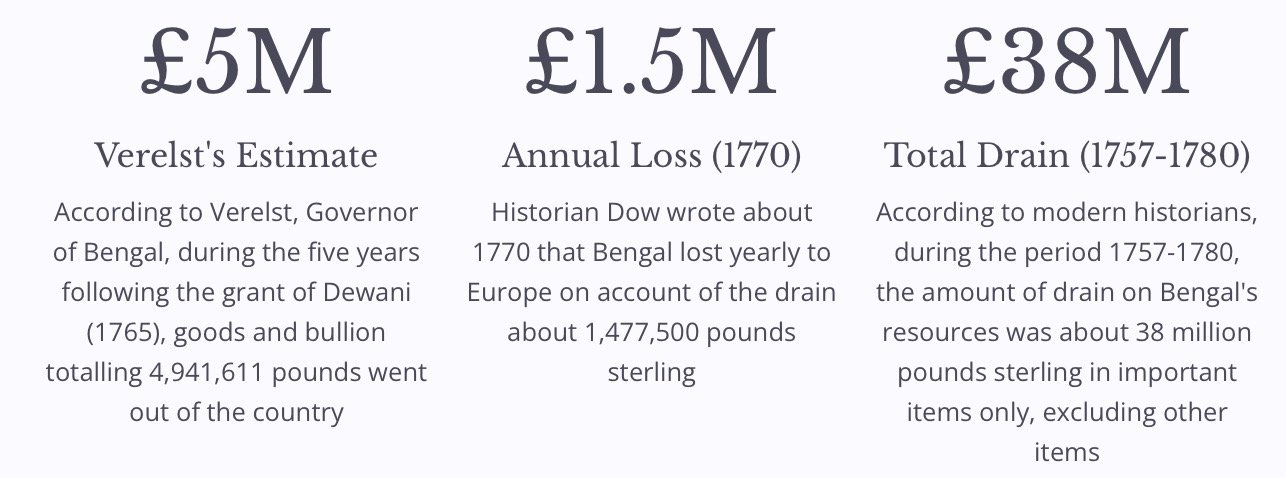
Quantification the Early Drain
Bengal was affected much more than Madras and Bombay because the incomes of these two Presidencies were less than their actual needs. The systematic extraction of wealth from Bengal laid the foundation for the impoverishment that would characterise the colonial period.
Dadabhai Naoroji: Pioneer of the Drain Theory
Dadabhai Naoroji was the first man to systematically argue that internal factors were not the reasons for poverty in India, but that poverty was caused by colonial rule draining the wealth and prosperity of India. The drain of wealth was the portion of India's wealth and economy that was not available to Indians. The Drain of Wealth theory was systematically initiated by Dadabhai Naoroji in 1867 and further analysed and developed by R.P. Dutt, M.G. Ranade, and others.
In 1867, Dadabhai Naoroji put forward the 'drain of wealth' theory in which he stated that Britain was completely draining India. He mentioned this theory in his book Poverty and Un-British Rule in India. He put forward the idea that Britain was draining and bleeding India, and that too for nothing.
Naoroji's Economic Analysis: The Knife of Sugar
"Materially, British rule caused only 'impoverishment'; it was like 'the knife of sugar'. That is to say there is no oppression, it is all smooth and sweet, but it is the knife, notwithstanding."
— Dadabhai Naoroji
Naoroji stated that out of the revenues raised in India, nearly one-fourth goes out of the country and is added to the resources of England. He argued that this amount, if not drained away, would have been invested in India and increased the people's income. He considered it as a major evil of British rule in India.
Naoroji observed in 1880: "It is not the pitiless operations of economic laws, but it is thoughtless and pitiless action of the British policy; it is pitiless eating of India's substance in India and further pitiless drain to England, in short it is pitiless perversion of Economic Laws by the sad bleeding to which India is subjected, that is destroying India."
R.C. Dutt's Contribution
On the footsteps of Dadabhai Naoroji, R.C. Dutt promoted the same theory by keeping it as a major theme of his book Economic History of India in 1901. He protested that taxation raised by a king is like the moisture sucked up by the sun, to be returned to earth as fertilising rain, but the moisture raised from the Indian soil now descends as fertilising rain largely on other lands, not on India.
M.G. Ranade's Analysis
M.G. Ranade published Essay on Indian Economics in 1899. He also talked about drain of wealth and saw the need for heavy industry for economic progress and believed in Western education as a vital element to the foundation of an Indian nation.
The Sponge Metaphor: Understanding the Drain
"Our system acts very much like a sponge, drawing up all the good things from the banks of the Ganges, and squeezing them down on the banks of the Thames."
— John Sullivan, President of the Board of Revenue, Madras
Other economic critics of colonialism included G.V. Joshi, G. Subramaniam Iyer, G.K. Gokhale, P.C. Ray, and others. These nationalist economists gave several factors that caused external drain, which formed the basis of a comprehensive critique of colonial economic policies. Their analysis revealed the systematic nature of wealth extraction from India to Britain.
Major Components of the Drain
Dadabhai Naoroji and other economic nationalists identified several key factors that caused the external drain of wealth from India to England. These components represented systematic channels through which India's economic resources were transferred to Britain without adequate compensation.
Home Charges
Paying for the Secretary of State and his establishment at the India Office in London, as well as pay, pension and training costs for civilian and military personnel—"the men who ruled India"
Railway Annuities
Annuities on account of railway and irrigation works; guaranteed interest on foreign investments in railways, irrigation, road transport and various other infrastructural facilities
Remittances
Remittances to England by Europeans to their families and for purchase of British goods for consumption of British employees in India, including government purchase of all stationery from England
Military Expenditure
Interest on foreign debt incurred by the East India Company, pensions to retired officials, and extensive military expenditure for imperial purposes
Additionally, trade and Indian labour were deeply undervalued, contributing further to the economic exploitation of the colony.
Comparative Estimates of Annual Drain
The Indian leaders' estimates of the drain differed from person to person and from year to year. The general basis of calculation was the difference between exports and imports, but there were other factors as well. These varying estimates all pointed to the massive scale of economic extraction occurring under colonial rule.
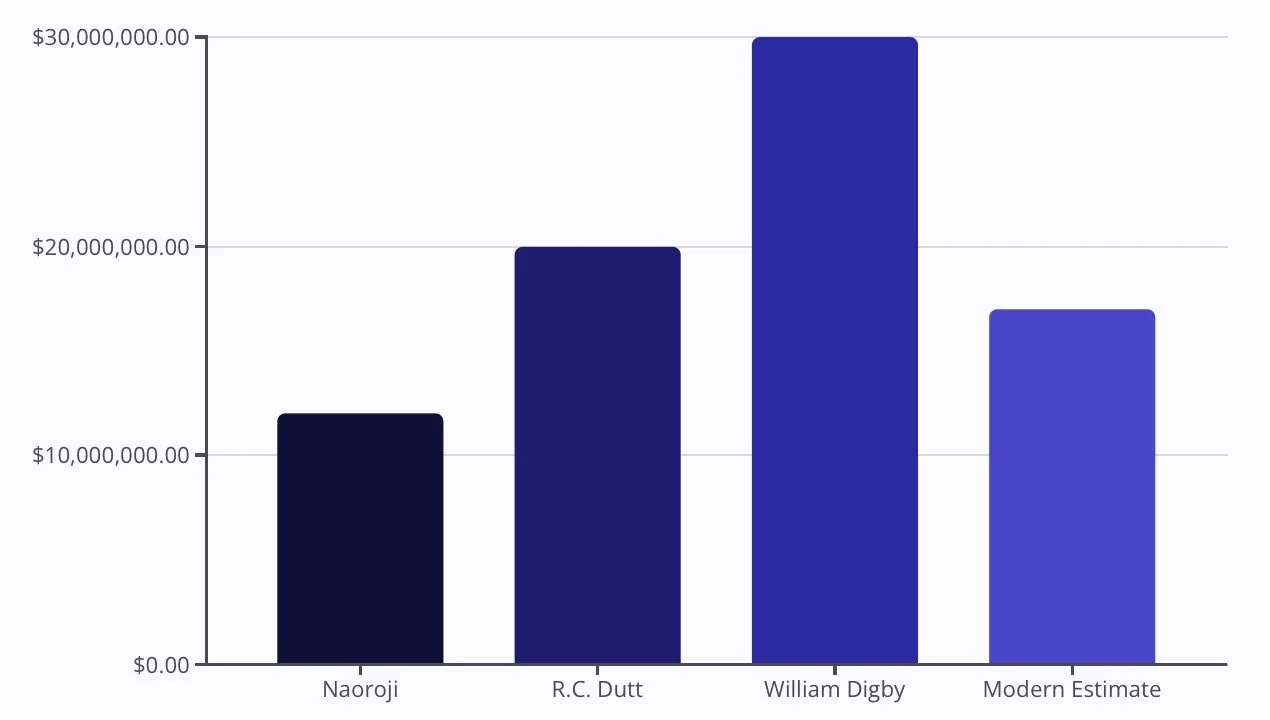
Comparative Estimates of Annual Drain
R.C. Dutt observed that one-half of the net revenues of India flowed annually out of India. Ranade declared that of the national income of India, more than one-third was taken away by the British in one form or another. In average, this amounted to at least half of the total revenue income of the British Indian government. A modern historian would put the amount of drainage at £17 million per annum in the late nineteenth and early twentieth centuries, pointing out that this "represented less than 2 per cent of the value of India's exports of commodities in that period".
Economic Impact: Beyond Simple Export of Money
The drain theory was not limited to the narrow concept of export of money or goods, but was based on wider economic reasoning and consideration. The drain affected the country's prospects of employment and income in fundamental ways that hindered India's economic development.
Circulation of Wealth
As R.C. Dutt pointed out, when taxes paid by the people are spent in the country, the money circulates among the people, fructifies trades, industries and agriculture, and in one shape or another reaches the mass of the people. But when the money is sent out of the country, it does not stimulate her trades, industries, or reach the people in any form.
Capital Shortage
The drain really denuded India of its productive capital and created that shortage of capital which hindered industrial development. This directly impoverished India and stultified the process of capital formation.
Peasant Impoverishment
In R.C. Dutt's view, the drain flowed mainly out of land revenue and thus caused impoverishment of the peasantry. Dadabhai Naoroji argued that what was being drained out was "potential surplus" that could generate more economic development if invested in India.
Colonial Policies and Stunted Growth
The Colonial Reality
Some recent historical writings point out that the fact still remains that India was not transformed into a full-fledged capitalist economy. As in the case of agrarian economy, so also in other sectors, British policies failed to foster growth. This was due to the colonial nature of those policies—the policy of gearing up the colonial economy to the needs of the economy of the mother country.
Regional Variations
A revisionist view claims that on the whole "colonial India experienced positive economic growth". But this growth varied widely in both time and space. There were periods of growth (for example, 1860-1920) and regions of prosperity (such as Punjab, coastal Madras and western Uttar Pradesh), and a generalised view of colonial policies cannot explain these regional and periodic variations.
Where stagnation prevailed, it was to a large extent because the government did not do as much as it should have by investing in resource generation, such as irrigation, education and healthcare. The revisionist view acknowledges that it was the presence or absence of these critical resources which determined regional development or lack of it.
Home Charges: The Primary Mechanism of Drain
"Home charges" represented payments for the Secretary of State and his establishment at the India Office in London, as well as pay, pension and training costs for civilian and military personnel. This was one of the most significant components of the systematic drain of wealth from India.
Before 1857
The Home charges varied from 10% to 13% of the average revenues of India
1897-1901
After the Revolt, the proportion shot up to 24% of average revenues
1901-02
The Home charges amounted to £17.36 million
1921-22
The Home charges sharply increased to 40% of the total revenue of the Central Government
Components of Home Charges
The Home charges consisted of multiple components, each representing a different channel through which India's wealth was systematically transferred to Britain. These charges were solely due to India's subjection to foreign rule and had no parallel in independent nations.
Dividends to Shareholders
Payments to the shareholders of the East India Company, representing returns on their investment in colonial enterprise
Interest on Public Debt
The East India Company had piled up public debt to dislodge Indian rulers from their principalities. By 1900, the public debt had risen to £224 million. Only part of the debt was raised for productive purposes—construction of railways, irrigation facilities and public works.
Civil and Military Charges
Payments towards pensions and furloughs of British officers in civil and military departments in India, expenses on India Office establishment in London, and payments to the British War Office
Store Purchases
The Secretary of State and Government of India purchased stores for Military, Civil and Marine Departments in the English market. Annual average expenditure on stores varied from 10% to 12% of Home charges between 1861-1920.
Council Bills: The Mechanism of Transfer
The actual transfer of money took place through the sale of "Council Bills", which were sold in London in sterling to purchasers of Indian goods who received Indian rupees in exchange. This mechanism was central to facilitating the drain of wealth from India to Britain.
Purchase of Council Bills
Would-be British purchasers of Indian exports bought Council Bills from the Secretary of State in return for sterling, which was used to meet the Home Charges
Exchange for Rupees
The Council Bills were then exchanged for rupees from the Government of India's revenues
Purchase of Indian Goods
The rupees were used to buy Indian goods for export to Britain
Sterling Bills Transaction
British officials and businessmen in India bought Sterling Bills in return for their profits in rupees from British-owned Exchange Banks; the London branches of these banks paid in pounds for such bills with money from Indian exports
As Sir John Strachey explained in 1888: "The Secretary of State draws bills on the Government treasury in India, and it is mainly through these bills, which are paid in India out of the public revenues, that the merchant obtains the money that he requires in India and the Secretary of State the money that he requires in England."
Foreign Capital and Banking: Additional Drains
Interest on Foreign Capital
Interest and profits on private foreign capital were another important leakage from the national income stream. Finance capital entered the Indian market in the last quarter of 19th century as a result of extension of railways, growth of internal and external trade, and setting up of plantations, mines, cotton and jute mills, engineering works, etc.
Foreign capitalists were least interested in industrial development of India. Rather, they exploited Indian resources for their own benefit and in fact thwarted indigenous capitalist enterprise by fair and foul means.
Foreign Banking Services
For banking, insurance and shipping services, India had to make huge payments. Apart from constituting a drain on Indian resources, unrestricted activities of these foreign companies stunted the growth of Indian enterprise in these spheres.
The British Response: Justifying the Drain
The British reply to the nationalist arguments was that the drain really represented payments for services of capital and personnel. The imperial argument was that some of this expenditure was to encourage economic development in India in the way it had happened in the West.
Sir John Strachey (1888)
"England receives nothing from India except return for English services rendered, English capital expended. The export surplus was accounted for by invisible exports such as shipping services, insurance charges on exports and imports."
Colonial Justification
"In return for the interest paid to British capital, India got railways, irrigation works, plantation industries, etc. In return for the Home Charges, India got the services of efficient officers, security against external aggression."
India was brought into the larger capitalist world market, and that was in itself progress towards modernisation. Much of the foreign loans and investments were for the development of infrastructure, for integrating internal markets and, therefore, for the modernisation of the Indian economy itself. The substance of the argument was that the drain really represented payments which benefited India in different ways and contributed to her modernisation.
Indian nationalist thought never reconciled itself to the very high price exacted by the British rulers for these benefits. The British capitalists sent to England not only the amount of legitimate interest on their capital invested in India but the entire amount of profits. The British pensioners spent their pensions in England.
The Drain Theory and Economic Nationalism
Of all the national movements in colonial countries, the Indian national movement was the most deeply and firmly rooted in an understanding of the nature and character of colonial economic domination and exploitation. The Moderates, or early Congress leaders, were the first in the 19th century to develop an economic critique of colonialism. This critique was perhaps their most important contribution to the development of the national movement in India.
Popular Lectures
Newspapers
Pamphlets
Dramas
Songs
The themes built around this critique were later popularised on a massive scale through these various mediums and formed the very pith and marrow of the nationalist agitation. This multi-pronged approach ensured that the economic critique of colonialism reached all sections of Indian society.
From Hope to Disillusionment: The Intellectual Journey
Indian intellectuals of the first half of the 19th century had adopted a positive attitude towards British rule. They hoped that Britain, the most advanced nation of the time, would help modernise India. The early Indian nationalists were not unaware of the many political, psychological and economic disabilities of foreign domination, but they still supported colonial rule as they expected it to rebuild India as a mirror image of the Western metropolis.
Initial Hope (Early 19th Century)
Expectation that British rule would modernise India and transform it into an advanced nation similar to Western countries
Growing Doubts (Post-1860)
The process of disillusionment set in gradually after 1860 as the reality of social development in India failed to conform to their hopes. They began to notice that whilst progress in new directions was slow and halting, overall the country was regressing and underdeveloping.
Critical Analysis (1870s-1900s)
Gradually, their image of British rule began to take on darker hues. They began to probe deeper into the reality of British rule and its impact on India, developing a systematic economic critique of colonialism.
Legacy and Impact: The Foundation of Economic Nationalism
The economic critique developed by early nationalist leaders—Dadabhai Naoroji (the Grand Old Man of India), Justice Mahadev Govind Ranade, Romesh Chandra Dutt, G.V. Joshi, G. Subramaniya Iyer, G.K. Gokhale, and others—subjected every aspect of the economy and colonial economic policies to minute scrutiny. After analysing, they concluded that colonialism was the main obstacle to India's economic development.
Key Achievements
Demonstrated that colonialism operated through the disguised mechanism of free trade and foreign capital investment
Showed that 19th century colonialism transformed India into a supplier of food stuffs and raw materials to the metropolis
Organised powerful intellectual agitations against important official economic policies
United different regions and sections of Indian society around the issue of poverty and underdevelopment
Lasting Impact
Undermined the ideological hegemony of alien rulers over Indian minds
Corroded popular confidence in the benevolent character of British rule
Led to the period 1875-1905 becoming a time of intellectual unrest and spreading national consciousness
By 1905, prominent nationalists were putting forward demands for self-government
The drain theory became the focal point of the nationalist critique of colonialism, incorporating all threads of the economic analysis. It possessed the great political merit of being easily grasped by a nation of peasants. The contradiction between the Indian people and British imperialism was seen to be insoluble except by the overthrow of British rule. Thus, the early nationalists rooted their nationalism in a brilliant scientific analysis of the complex economic mechanism of modern colonialism, providing a firm foundation upon which later nationalists would stage powerful mass agitations and mass movements.
