
Economic Impact of British Colonial Rule in India: Part 2
Deindustrialization & Decline of traditional crafts
The British colonial period fundamentally transformed India's economic landscape, initiating profound structural changes that would reverberate through centuries. What began as mercantile exploitation evolved into systematic deindustrialisation and economic restructuring, reshaping India from a prosperous manufacturing hub into a predominantly agrarian economy serving imperial interests. This comprehensive analysis examines the multifaceted economic consequences of British rule, exploring the deliberate dismantling of traditional industries, the forced ruralization of the economy, and the contested emergence of modern industrial capitalism under colonial constraints.
India's Pre-Colonial Industrial Glory
At the beginning of British rule in the mid-eighteenth century, Indian handicraft industries occupied a position of global eminence, supplying approximately one-quarter of all manufactured goods produced worldwide. This remarkable industrial capacity reflected centuries of accumulated expertise, sophisticated production techniques, and extensive trading networks that connected India to markets across Asia, Africa, and Europe.
The Indian subcontinent possessed thriving centres of textile production in Bengal and Gujarat, renowned metalworking traditions in South India, and sophisticated craftsmanship in luxury goods that catered to royal courts and wealthy patrons across the known world. Cities like Dhaka, Murshidabad, and Surat functioned as bustling commercial and manufacturing hubs, employing thousands of skilled artisans and generating substantial wealth through both domestic consumption and international trade.
25% Global Market Share
India's portion of world manufactured goods before British rule
Coastline
Extensive maritime trade connections
The Process of Deindustrialisation
Deindustrialisation refers to the systematic decline of traditional manufacturing and handicraft industries during the nineteenth and early twentieth centuries—a phenomenon that occurred precisely when Western nations were experiencing rapid industrialisation. Unlike the natural economic transitions observed in Europe and North America, where declining handicraft production was compensated by the rise of modern factory-based industries, India experienced a net decline in industrial employment without corresponding industrial growth.
Mid-18th Century
India supplies 25% of global manufactured goods with thriving handicraft industries
1813-1850
Charter Act opens Indian markets; British machine-made goods flood local markets
1850-1880
Railways accelerate market penetration; major industrial centres begin declining
1881-1921
Census data reveals population dependent on agriculture rises from 61% to 73%
Post-WWI
Limited modern industry emerges but fails to absorb displaced artisans
This peculiar situation manifested in two interconnected developments: firstly, a steep and continuous decline of handicraft production extending well into the twentieth century, and secondly, the absence of sufficient compensatory growth in modern industrial sectors. The result was a fundamental transformation of India's occupational structure, with millions of displaced artisans forced into an already overcrowded agricultural sector, creating what economic historians term "de-peasantisation" alongside deindustrialisation.
Competition from British Machine-Made Goods
The Industrial Revolution in Britain fundamentally altered the competitive landscape for Indian handicrafts. The ability to mass-produce textiles using mechanised processes enabled British manufacturers to flood Indian markets with cheap cotton goods that traditional hand-loom weavers simply could not match in price, despite often superior quality and craftsmanship.
Initially, British imports—primarily woollen textiles—found limited markets in India's tropical climate and established consumption patterns. However, the industrial revolution's technological breakthroughs, particularly in cotton textile production, changed everything. Steam-powered looms and spinning jennies could produce cotton cloth at unprecedented volumes and dramatically reduced costs, creating an almost insurmountable price advantage over hand-produced Indian textiles.
"The misery hardly finds a parallel in the history of commerce. The bones of the cotton weavers are bleaching the plains of India."
— Government of William Bentinck, 1834
This observation captured the devastating human cost of economic displacement. Karl Marx similarly remarked that "it was the British intruder who broke up the Indian handloom and destroyed the spinning wheel," recognising the deliberate nature of this industrial destruction. The competition was not merely economic but represented a systematic undermining of India's manufacturing base through superior industrial technology deployed within a colonial framework that prevented Indian adaptation and modernisation.
Discriminatory Trade Policies
British trade policy deliberately engineered the decline of Indian manufactures through asymmetric tariff structures and legislative frameworks that privileged British industrial interests. The Charter Act of 1813 marked a watershed moment, abolishing the East India Company's monopoly and ushering in an era of so-called "free trade" that was anything but free or fair to Indian producers.
One-Way Free Trade
After 1813, British goods entered India duty-free whilst Indian exports to Britain faced prohibitive tariffs of 70-80%, effectively closing British markets to Indian textiles whilst forcing open Indian markets to British manufactures.
Preferential Tariff Policies
Between 1878 and 1895, systematic tariff discrimination was designed to solve crises in British industrial economy by creating a captive market in India, increasingly integrated and accessible through railway networks.
Excise Duties on Indian Production
When Indian cotton mills began competing successfully in the late nineteenth century, the colonial government imposed excise duties on Indian-produced cloth whilst simultaneously removing import duties on British textiles, deliberately handicapping domestic industry.
Reversal of Trade Patterns
India transformed from a primarily exporting nation to an importing one, with English twist and cotton stuffs flooding markets and spelling ruination for the Indian weaving industry.
This discriminatory trade regime represented economic policy as imperial weapon, consciously deployed to maintain British industrial supremacy whilst subordinating Indian economic development to metropolitan interests. The persistent lobbying of Britain's rising industrialists and trading interests, championing principles of "free trade" that applied only selectively, created the legislative framework for systematic deindustrialisation.
Infrastructure
Railways as Instruments of Economic Penetration
The Indian railway system, often celebrated as a modernising force and gift of colonial rule, functioned primarily as an instrument of economic penetration that facilitated the destruction of traditional industries whilst serving imperial commercial and military interests. Railways enabled British manufactured goods to reach the remotest corners of the subcontinent whilst simultaneously facilitating the extraction of raw materials from India's interior to port cities for export.
The impact of railway development on traditional handicrafts was devastating and multifaceted. Firstly, railways dramatically reduced transportation costs for British imports, enabling cheap machine-made goods to compete effectively even in distant markets previously protected by transportation barriers. Secondly, the same railways that brought British goods inland also facilitated the procurement of raw materials—particularly cotton—from India's agricultural regions, transforming India into a supplier of raw materials for British industries rather than a manufacturing centre in its own right.
Market Penetration
Reduced costs enabled British goods to reach remote villages, eliminating natural protection that distance once provided to local artisans
Raw Material Extraction
Facilitated movement of cotton, jute, and other materials from interior to ports for export to British factories
Military Control
Enabled rapid deployment of troops to suppress dissent and maintain colonial order across vast territories
Freight Rate Discrimination
Railway pricing policies favoured imported goods over domestic products, making distribution of Indian goods more expensive than foreign imports
The railway freight rate structure itself embodied discriminatory policies: it was often cheaper to transport imported British textiles from Bombay inland than to move domestically produced Indian textiles equivalent distances. This pricing strategy was not accidental but reflected conscious policy choices that privileged imperial commercial interests over indigenous industrial development.
Decline of Traditional Patronage Systems
The establishment of British paramountcy systematically dismantled the complex patronage networks that had sustained India's handicraft industries for centuries. Indian courts, princely states, and aristocratic households had historically functioned as major consumers and sponsors of specialised crafts, maintaining artisans through regular salaries, commissions, and hereditary positions that ensured transmission of skills across generations.
Royal Courts
Disappearance of sovereign courts eliminated demand for luxury textiles, jewellery, and ceremonial items
Princely States
Subordination to British authority reduced autonomous spending on traditional weapons, armour, and military equipment
Aristocratic Households
Economic decline of traditional elites under colonial taxation reduced patronage of fancy arts and handicrafts
Artistic Excellence
Loss of connoisseur patrons led to decline in both quality and innovation in traditional crafts
Hereditary Craftsmen
Breaking of intergenerational skill transmission as patronage relationships dissolved
The British policy of subordinating princely states through subsidiary alliances and direct annexations eliminated autonomous centres of demand for traditional manufactures. Articles of pleasure, ceremonial weapons, elaborate textiles, and other specialised products that had sustained thousands of highly skilled artisans found vanishing markets. The rapid decline in demand for these peculiar, extraordinary, and specific kinds of goods represented not merely economic change but cultural transformation, as indigenous aesthetic traditions and consumption patterns were devalued and displaced by European preferences.
Moreover, the economic subordination of Indian rulers through heavy tribute demands and restricted fiscal autonomy meant that even those princely states that retained nominal independence lacked resources to maintain traditional levels of patronage. The artistic excellence and economic viability of Indian handicrafts, which had reached extraordinary heights under Mughal and regional court patronage, declined precipitously as these support systems crumbled under colonial pressure.
Transformation of Consumer Preferences
British colonial rule catalysed fundamental transformations in Indian consumption patterns and aesthetic preferences, creating new classes whose purchasing choices systematically disadvantaged traditional handicrafts. The emergence of European colonial bureaucracy and Western-educated Indian professional classes established new arbiters of taste who valorised European goods whilst pouring scorn on indigenous products as backward or inferior.
The European official class naturally patronised imported British manufactures, viewing consumption of "home country" products as markers of civilisational superiority and maintaining cultural connections to Britain. More significantly, the new Indian educated professional class—products of colonial education systems that denigrated indigenous knowledge and culture—enthusiastically embraced European consumption standards as symbols of modernity and progress.
This was not merely preference but cultural conditioning: colonial education systems and administrative structures created psychological dispositions that associated British goods with civilisation, progress, and social advancement, whilst traditional Indian products were stigmatised as backward, primitive, or lower class. The psychological dimensions of colonial domination thus translated directly into consumption patterns that accelerated handicraft decline.
Colonial Bureaucracy
European officials exclusively patronised British imports, creating demonstration effects
Western-Educated Indians
Professional classes imitated European standards, viewing traditional goods as inferior
Zamindars & New Elites
Land revenue beneficiaries adopted British lifestyles and consumption patterns
Traditional Indian handicrafts, evolved over centuries to meet indigenous aesthetic preferences and functional requirements, found themselves unable to adapt rapidly enough to satisfy demands based on European ideals. The failure was not of quality or craftsmanship but of cultural relevance in a colonised society where power, prestige, and modernity were defined through European frameworks. The psychological conquest achieved through education and cultural conditioning proved as economically devastating as any tariff policy or railway freight rate.
Revisionist Interpretations and Scholarly Debates
The nationalist narrative of deliberate deindustrialisation has faced scholarly challenges from revisionist economic historians, particularly Western scholars who question both the extent and causes of handicraft decline. These debates illuminate important methodological issues whilst revealing how historical interpretation reflects contemporary ideological frameworks and nationalist versus imperial perspectives on colonialism's economic impacts.
Colonial Stimulus Thesis
Morris challenged the "imperial exploitation thesis," arguing that colonial rule "probably stimulated economic activity in India in a way which had never been possible before." He contended that handloom weavers were "at least no fewer in number and no worse off economically" by the early twentieth century, suggesting possible absolute growth rather than decline. This perspective minimised colonial responsibility whilst emphasising natural economic evolution.
Industrial Stagnation Not Decline
Daniel Thorner compared census data from 1881 and 1931, concluding that "the industrial distribution of the modern working force from 1881 to 1931 stood still." This suggested stagnation rather than decline, though Thorner conceded that major shifts from industry to agriculture likely occurred between 1815 and 1880—precisely when census data is unavailable, creating methodological challenges for quantifying deindustrialisation's extent.
Methodological Critiques
Modern economic historians question deindustrialisation's measurability, citing paucity of reliable data, difficulties in tracking artisans with multiple occupations (many combining handicrafts with seasonal agriculture), and problems distinguishing between absolute decline and relative stagnation against population growth. These methodological concerns raise important questions about historical certainty whilst sometimes obscuring overwhelming qualitative evidence of handicraft collapse.
Regional Survival Evidence
Scholars like Tirthankar Roy emphasise that Indian handlooms continued producing coarse cloth for poorer consumers well into the 1930s, only being displaced by Indian mill-produced goods rather than British imports. This regional persistence suggests complex, uneven patterns rather than universal catastrophe, though it doesn't negate overall trends of industrial displacement and forced agricultural dependence.
Critical Assessment: Whilst revisionist scholars raise valid methodological concerns, their minimisation of colonial responsibility often ignores qualitative evidence of artisan immiseration, the demonstrable discriminatory trade policies, and the psychological testimonies of contemporaries who witnessed handicraft communities' destruction. Statistical ambiguities should not obscure the fundamental transformation of India's occupational structure or the policy choices that enabled it.
Economic Data
Statistical Evidence and Regional Variations
Despite methodological controversies, available statistical evidence from the late nineteenth and early twentieth centuries provides compelling quantitative support for the deindustrialisation thesis, revealing dramatic shifts in occupational structures that transformed India from a manufacturing economy into an overwhelmingly agricultural one.
Colin Clark's influential analysis demonstrated that between 1881 and 1911, the proportion of the working force engaged in "manufacture, mining and construction" fell by half—from 35% to merely 17%. Simultaneously, statistical data from Gangetic Bihar revealed that industrial population as percentage of total population declined from 18.6% in 1809-1813 to just 8.5% in 1901. Even more dramatically, weavers and spinners declined from 62.3% to 15.1% of the industrial working population during this period.
Regional Variations in Decline
Deindustrialisation was neither universal nor simultaneous across India's diverse regions. Areas varied significantly in timing and intensity of handicraft collapse, reflecting differential railway penetration, proximity to ports, and pre-existing industrial structures.
Bengal and Bihar experienced earliest and most severe decline, beginning in early nineteenth century
Rajasthan remained relatively isolated until railway development after 1911, experiencing later industrial displacement
Coastal trading centres like Surat and Masulipatnam declined as new port cities (Bombay, Calcutta) emerged under colonial infrastructure
Interior regions maintained handicraft production longer, protected temporarily by transportation costs
These regional variations underscore the complex, uneven nature of economic transformation under colonialism. Yet the overall trajectory remained consistent: traditional manufacturing centres declined whilst population increasingly depended on agriculture, creating unprecedented demographic pressure on land and widespread rural impoverishment. The statistical record, despite its limitations, reveals fundamental structural transformation that dispossessed millions of artisans and restructured India's economy to serve imperial requirements rather than indigenous development needs.
Negative Consequences of Handicraft Decline
The destruction of traditional handicraft industries generated cascading negative consequences that fundamentally destabilised India's economy and society, effects that persisted well into the twentieth century and shaped the challenges confronting independent India after 1947.
Destruction of Village Self-Sufficiency
Traditional Indian villages functioned as relatively self-contained economic units where artisans, agriculturists, and service providers existed in symbiotic relationships. Handicraft decline shattered this integrated structure, forcing formerly diversified village economies into overwhelming agricultural dependence and creating vulnerability to crop failures and market fluctuations.
Agrarian Overcrowding and Pauperisation
Millions of displaced artisans, lacking alternative employment opportunities in non-existent modern industries, were forced into agriculture. This generated unprecedented pressure on land resources, fragmenting holdings, depressing agricultural wages, and creating widespread rural poverty. The Indian Planning Commission calculated that persons engaged in processing and manufacturing fell from 10.3 million in 1901 to 8.8 million in 1931, despite 40% population growth—these millions crowded into agriculture.
Decline of Commercial and Industrial Centres
Historic centres of handicraft production and trade—Dhaka, Murshidabad, Surat, and others—experienced precipitous decline as their economic foundations crumbled. These cities, which had sustained diverse populations of merchants, bankers, artisans, and supporting service workers, degenerated into shadows of former prosperity, representing not merely economic but cultural loss as centres of learning and artistic excellence disappeared.
Industrial Void and Lost Opportunities
Most critically, the void created by handicraft decline was not filled by modern industrial development. Unlike European nations or Japan, where traditional manufacture's decline accompanied rapid industrialisation that absorbed displaced workers into factory employment, India experienced deindustrialisation without compensatory industrial growth, resulting in net decline of manufacturing employment and widespread economic distress.
Poverty and Economic Hollowness
The decline of handicrafts represented loss of a crucial productive sector that had generated substantial national wealth and employment. This economic hollowness manifested in pervasive poverty and penury that characterised nineteenth and early twentieth-century India, contributing to recurring famines, declining per capita incomes, and widespread immiseration documented by contemporary observers and later economic historians.
These interconnected consequences created a vicious cycle of rural poverty, agricultural stagnation, and industrial underdevelopment that proved extraordinarily difficult to break. The social and economic distortions generated by colonial deindustrialisation shaped the inherited challenges confronting independent India's planners, who faced the daunting task of rebuilding industrial capacity whilst addressing centuries of accumulated rural poverty and agricultural overcrowding.
Positive Dimensions of Economic Transformation
Whilst nationalist historiography rightly emphasises the devastating costs of deindustrialisation, a balanced assessment must acknowledge certain modernising effects and structural transformations that, however unintentionally and inadequately, laid groundwork for later industrial development. These positive dimensions do not justify colonial exploitation but represent dialectical complexities in historical processes of economic change.
The growth of industrial markets within India, stimulated by improved transportation and expanding commercial networks, created unprecedented demand for both domestic and foreign manufactured goods. This market expansion extended beyond luxury consumption to encompass daily-use items, facilitating growth of modern exchange systems and gradual integration of India's fragmented regional markets into more unified economic spaces.
3.5% Growth Rate
Annual income increase in secondary sector before WWII
60 Agency Houses
European firms dominating industrial capital by WWI
Market Development and Commercial Integration
Growth of extensive industrial markets created foundations for modern commercial networks, banking systems, and market integration that would prove essential for later industrial development.
Economic Infrastructure Creation
Railways, telegraphs, and ports—though built primarily for imperial purposes—provided physical infrastructure that independent India could leverage for indigenous industrial development.
Pre-Capitalist Transition
Decline of feudalistic handicraft production cleared ground for modern industrial capitalism, however inadequately this transition was managed under colonial constraints.
Emergence of Modern Working Class
Displaced artisans formed nucleus of modern industrial labour force, representing new social class with historical dynamism and potential for organised political action.
Capitalist Relations of Production
Introduction of wage labour, market-based production, and capitalist accumulation patterns—despite foreign domination—established economic relationships that would characterise independent India's development trajectory.
These transformations must be understood dialectically: whilst colonial policies deliberately retarded Indian industrial development and caused immense suffering, the very processes of economic destruction and restructuring inadvertently created preconditions for modern industrial capitalism. The tragedy lies not in change itself but in colonial management that maximised costs whilst minimising benefits to Indian society, enriching Britain whilst impoverishing India.
Ruralisation and Peasantisation of the Economy
Deindustrialisation's most profound structural consequence was the fundamental shift in India's occupational distribution—the process of "ruralisation" or "peasantisation" whereby the economy became increasingly and overwhelmingly dependent on agriculture. This represented reversal of historical trends toward economic diversification and urban commercial development that had characterised Mughal and pre-colonial periods.
"British writers of the 19th and 20th centuries took pride in describing India as traditionally an agricultural country"—a characterisation that served to naturalise and justify the forced transformation of India's economy into "an agricultural farm" supplying raw materials to industrialised Britain.
Statistical Evidence of Ruralisation
R.P. Dutt's systematic analysis of census data revealed stark trends in agricultural dependence:
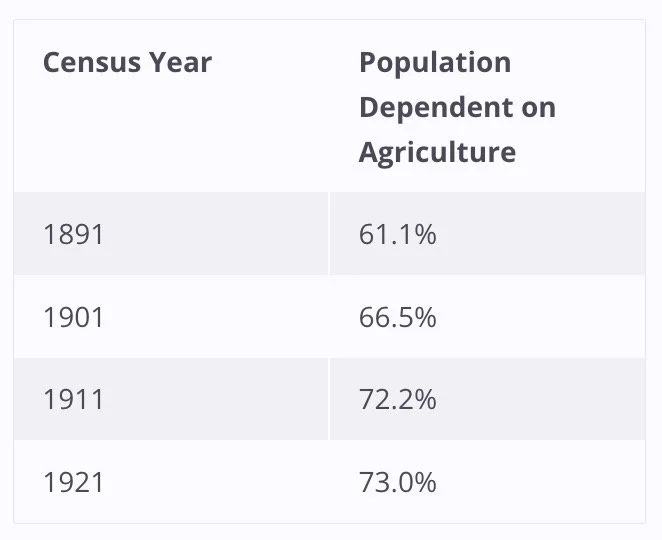
This represented massive shift of millions from manufacturing to agricultural dependence within three decades—an historically unprecedented transformation achieved through systematic destruction of alternative livelihood opportunities.
Deliberate Policy Framework
British economic policy consciously encouraged this transformation through multiple mechanisms:
Court of Directors (1769) ordered discouragement of silk fabric manufacture whilst encouraging raw silk production
Select Committee (1783) advocated changing "the whole face of that industrial country" to render it producer of crude materials
Charter Acts (1813, 1833) abolished trade monopolies favouring British manufactures whilst opening India to European settlement and capital
Discriminatory railway freight rates that favoured raw material exports over domestic industrial distribution
This deliberate policy framework aimed to restructure India as complementary appendage to Britain's industrial economy—supplier of raw materials and consumer of British manufactures. The Thorners estimated that major shift from industry to agriculture occurred between 1815 and 1880, precisely the period when systematic colonial policies were implemented to achieve this transformation. The result was economic structure that trapped millions in impoverished agricultural dependence whilst blocking pathways to industrial modernisation.
Development of Plantation Industries
Tea Plantations
Developed after 1850 in Assam, Bengal, South India, and Himalayan foothills, tea plantations represented archetypal colonial enterprise—European-owned, export-oriented, and dependent on coerced labour. Government actively facilitated development through grants of rent-free land, favourable legislation, and labour recruitment systems bordering on slavery.
Indigo Cultivation
Introduced in late eighteenth century, indigo flourished in Bengal and Bihar until synthetic dye invention destroyed markets. Indigo planters gained notoriety for brutal oppression of peasants forced into cultivation—memorialised in Dinabandhu Mitra's play "Neel Darpan" (1860). Represented early form of plantation capitalism's coercive labour relations.
Coffee and Rubber
Coffee plantations developed in South India whilst rubber emerged briefly before Brazilian competition eliminated both from international markets after 1920-21. These failures illustrated vulnerability of export-oriented monoculture to global market fluctuations beyond Indian control.
Colonial Character of Plantations: Foreign-owned plantations provided minimal benefits to Indian economy—profits repatriated abroad, equipment imported, technical staff foreign, products sold in external markets. Indians gained only unskilled employment under oppressive conditions legalised through acts like the Inland Emigration Act (1859) that criminalised contract breaches, effectively binding workers to plantation sites.
The plantation sector epitomised colonial economic relationships: extraction of value through control of land and labour, production oriented toward metropolitan consumption rather than Indian needs, and systematic barriers preventing Indian entrepreneurship or economic advancement. Whilst plantations generated export earnings and tax revenues for colonial government, they contributed little to broader industrial development or poverty alleviation, instead creating enclaves of coerced labour and environmental degradation that persisted long after independence.
Rise of Modern Industries: Context and Contradictions
The emergence of modern, machine-based industries in late nineteenth-century India represented complex and contradictory development—simultaneously progressive in introducing new technologies and productive forces, yet retarded and distorted by colonial constraints that prevented comprehensive industrialisation. This limited industrial development occurred primarily after Britain had accumulated sufficient surplus capital requiring investment outlets abroad and when specific strategic or economic circumstances made Indian industrialisation compatible with imperial interests.
Capital Availability
British surplus capital seeking higher returns than available domestically found India attractive—cheap labour, accessible raw materials, and colonial government guarantees minimised risk whilst maximising profit potential.
Strategic Raw Materials
Control over jute, tea, coal, and other resources required processing infrastructure; establishing factories in India proved more economical than transportation of bulk raw materials to Britain.
Market Considerations
Local production could undercut shipping costs and tariff complications, particularly after nationalist agitation created political pressures for tariff protection.
Critically, Indian industrialisation was initiated and dominated by British capital, with profits systematically extracted and repatriated rather than reinvested in comprehensive development. Indian entrepreneurs faced formidable barriers: discrimination in access to capital and credit, preferential treatment for European firms in government contracts and concessions, British control of crucial commercial infrastructure (banking, shipping, insurance), and systematic policy favouritism that advantaged foreign over domestic enterprise.
World Wars provided crucial impetus to industrial development—elimination of foreign competition during wartime created temporary protection for Indian industries, whilst military demands necessitated expanded production. However, this growth occurred within fundamental structural constraints that prevented India from achieving the comprehensive industrial transformation experienced by Japan or even China in comparable periods.
Major Industrial Sectors: Cotton and Jute
Cotton Textiles
First cotton mill erected Calcutta (1818), but Bombay emerged as primary centre after Cowasjee Nanabhoy established mill (1853). By 1905, 206 mills employed 196,000 workers. Industry remained predominantly Indian-owned, representing rare sector where indigenous capital competed successfully against British manufacturing interests.
Competitive Struggles
British manufacturers responded to Indian cotton mill success with political pressure: abolition of import duties (1879), then reimposition with simultaneous excise duties on Indian production (1896). These discriminatory policies deliberately handicapped domestic industry to protect Lancashire textile interests.
WWI Expansion
Import decline during war (halved between 1913-14 and 1917-18) due to transport disruptions, 7.5% import duty (1917), military demand, and Swadeshi boycotts enabled dramatic expansion. By 1947, 421 mills with 202,814 looms; 1941-46 exported cloth even to Britain.
Jute Industry
First jute mill established by George Acland at Rishra, Bengal (1855). Proximity to raw materials and cheap labour gave competitive advantage over Scottish industry. By 1901, 36 mills employed 115,000 workers. Overwhelmingly British-owned through Indian Jute Mills Association (IJMA) controlling output and maintaining high prices.
From 1920s, Calcutta-based Marwari traders—G.D. Birla, Swarupchand Hukumchand—began intrusion into European-dominated sector through stock purchases, money-lending, and board positions. This marked beginning of Indian jute mills around Calcutta and broader Marwari expansion into coal, sugar, paper, and other industries, representing indigenous capital's gradual penetration of sectors previously monopolised by British managing agencies.
Heavy Industries and Infrastructure Sectors
Iron and Steel (1907)
Jamshedji Tata established plant at Jamshedpur representing milestone in indigenous heavy industry. Developed to full capacity during WWI due to increased demand, then faced competition from imports. WWII provided renewed impetus, establishing firm foundation by 1947 despite colonial government's consistent refusal to provide financial support or protection comparable to European or Japanese industrial promotion.
Coal Mining
Developed under European joint-stock companies driven by railway fuel requirements and industrial demands. Employed approximately 100,000 persons by 1906. Production expanded during both World Wars with partial export but primarily domestic industrial consumption. Represented extractive industry where profits flowed predominantly to foreign capital whilst environmental and social costs were borne locally.
Railways
Massive infrastructure project initiated in 1850s, reaching 67,000 miles by 1947. Whilst celebrated as modernising achievement, primarily served imperial military, administrative, and commercial interests. Freight rate policies discriminated against Indian goods, facilitating British import penetration whilst handicapping domestic distribution. Capital-intensive construction provided profits to British investors through guaranteed returns whilst costs were borne by Indian taxpayers.
Engineering and Machinery
Remained severely underdeveloped—few petty repair workshops represented entire engineering sector. India lacked capacity to produce machinery, forcing dependence on imports for industrial equipment. Government refused support for Indian projects in ship construction, locomotives, automobiles, or aeroplanes, deliberately maintaining technological dependence that ensured continued British industrial dominance.
The absence of comprehensive heavy industry development—steel, machinery, chemicals, electrical equipment—represented most fundamental limitation of colonial industrialisation. Without capital goods sectors, India lacked capacity for self-sustaining industrial growth, remaining dependent on foreign technology and equipment. This structural weakness reflected deliberate colonial policy: Britain benefited from maintaining India as consumer of British machinery and manufactures rather than competitor in advanced industrial sectors.
Structural Features and Limitations of Colonial Industrialisation
Foreign Capital Monopoly
British capital dominated most modern industries except cotton textiles and, later, sugar. Of sixty managing agency houses by WWI, European firms controlled 75% of industrial capital and nearly half of total industrial employment. Foreign dominance extended to banking, shipping, insurance, and commercial infrastructure, systematically disadvantaging Indian entrepreneurs through discriminatory access to credit, government contracts, and commercial networks.
Absence of Capital Goods Industries
India possessed virtually no heavy industries—no large plants for iron and steel production, minimal machinery manufacturing, negligible chemical or oil industries. Engineering sector consisted of petty repair workshops; metallurgical industry comprised few iron and brass foundries. First steel produced only in 1913. This absence of basic industries prevented self-sustaining industrial development and maintained technological dependence on imports.
Discriminatory Government Policies
Colonial government actively favoured foreign over domestic capital—railway freight rates advantaged imports over Indian products, government contracts preferentially awarded to British firms, systematic refusal of financial support or protective tariffs for Indian industries competing with British manufactures. When Indian cotton mills succeeded, government imposed excise duties to handicap domestic production—illustrating how state power was wielded against indigenous industrial development.
Limited Sectoral Scope
Industrial development concentrated in cotton textiles, jute, tea plantations, and coal mining—these four sectors accounted for majority of industrial employment through 1946. Sugar and cement developed only in 1930s. Vast range of consumer goods, intermediate products, and industrial equipment remained imported or unproduced, reflecting colonial economy's narrow, export-oriented character rather than comprehensive industrial transformation serving domestic needs.
Regional Concentration
Industries clustered in Bombay, Calcutta, and few other centres whilst large regions remained completely underdeveloped. This geographical concentration created massive regional disparities in income and development, complicating national integration and leaving independent India with enormous spatial inequalities requiring decades of planned regional development to address.
Labour Oppression
Industrial workers faced extremely low wages, harsh working conditions, excessively long hours, and near-slavery conditions in plantations. Absence of labour protections or collective bargaining rights enabled super-exploitation that maximised profits for capital whilst condemning workers to misery—vividly documented in investigations and literature of the period, contributing to emergence of labour movements and socialist politics.
These structural features reflected fundamental reality: colonial industrialisation occurred not to develop India but to extract value for British capital whilst maintaining India's subordinate position within imperial economic structures. Limited industrial growth that did occur happened despite rather than because of colonial policies, which consistently privileged metropolitan over Indian interests.
Labour Conditions and Early Labour Legislation
The emergence of modern industry created India's modern working class—a social force that would play crucial role in independence struggle and post-colonial politics. However, this class formation occurred under conditions of extreme exploitation that revealed colonial government's priorities: protecting capital whilst offering minimal, grudging concessions to labour only when forced by agitation or international pressure.
Early labour legislation represented responses to specific crises or pressures rather than systematic concern for worker welfare. The Factory Acts addressed most egregious abuses—child labour, dangerous machinery, excessive hours—but left intact fundamental structures of exploitation enabling super-profits for industrialists.
First Factory Act (1881)
Prohibited child labour below 7 years, required fencing of dangerous machinery, fixed working hours for children under 12. Minimal protections responding to industrial accidents and international criticism.
Second Factory Act (1891)
Raised minimum age to 9 years, fixed hours for children under 14, mandated 90-minute recess and weekly holiday for women. Incremental improvements still leaving workers vulnerable to exploitation.
Abolition of Indentured Labour (1922)
Ended system begun in 1830 that had enabled near-slavery conditions in plantations. Abolition came only after sustained nationalist agitation and international pressure.
Trade Union Act (1926)
Provided legal status to labour unions, enabling collective organisation and bargaining—representing significant advance in worker rights and capacity for political mobilisation.
Trade Disputes Act (1929)
Created special courts for dispute settlement but declared strikes illegal in public utility services, reflecting government's dual approach of managing labour discontent whilst protecting essential imperial interests.
Wartime Labour Regulations (1940-41)
Recognised duty to work, protected worker rights, prohibited arbitrary dismissal—measures necessitated by wartime labour requirements rather than welfare concerns, revealing instrumental attitude toward labour policy.
Despite these legislative measures, conditions remained deplorable for most industrial workers through 1947—wages barely sufficient for subsistence, working conditions dangerous and unhealthy, housing inadequate, social protections minimal. The colonial government's labour policy prioritised industrial peace and productivity over worker welfare, offering minimum necessary concessions to prevent disruption of production whilst maintaining structures enabling capital accumulation through labour exploitation.
Colonial Economic Legacy and Historical Significance
The economic impact of British colonial rule on India represents one of history's most consequential instances of externally imposed structural transformation—reshaping a prosperous, diversified economy into subordinate appendage serving metropolitan industrial interests. This transformation's multifaceted dimensions—deindustrialisation of handicrafts, forced ruralisation, discriminatory trade policies, limited and distorted industrial development—created enduring legacies that shaped independent India's developmental challenges and trajectories.
Historical Significance for UPSC
Understanding colonial economic impact is crucial for civil service aspirants across multiple dimensions: economic history's role in nationalist movement, structural constraints inherited at independence, policy debates over industrialisation strategies, regional disparities rooted in colonial patterns, and contemporary debates over globalisation and foreign capital. Questions frequently examine causes and consequences of deindustrialisation, nature of colonial economic drain, emergence of nationalist economic thought, and contrasts between colonial and post-independence development patterns.
Analytical Frameworks
Multiple interpretative frameworks—nationalist, Marxist, dependency theory, modernisation theory, and revisionist—offer different lenses for analysing colonial economic impact. UPSC aspirants must understand these perspectives' strengths and limitations, recognising how ideological positions shape historical interpretation whilst developing nuanced understanding that acknowledges both colonial exploitation and historical complexities. Avoid simplistic narratives whilst recognising overwhelming evidence of systematic economic subordination and extraction.
Contemporary Relevance
Colonial economic history illuminates contemporary debates over development strategies, foreign investment, trade policies, and North-South economic relations. Parallels between colonial trade patterns and contemporary globalisation, between nineteenth-century deindustrialisation and twenty-first-century "premature deindustrialisation," between colonial capital dominance and contemporary multinational corporations provide historical perspective on current policy dilemmas confronting developing nations.
Integrated Understanding
Economic transformation cannot be understood in isolation but must be integrated with political, social, and cultural dimensions of colonialism. Economic exploitation generated political resistance (Swadeshi movement, nationalist agitation), transformed social structures (emergence of working class, decline of artisan communities), and shaped cultural attitudes (regarding indigenous versus foreign goods, traditional versus modern production). Comprehensive UPSC preparation requires understanding these interconnections.
Key Takeaways
Causation: Distinguish between immediate causes (discriminatory tariffs, railway development) and deeper structural factors (colonial state's role, imperial economic logic) of deindustrialisation
Quantification: Familiarise with statistical evidence whilst recognising methodological debates and data limitations
Regional Variations: Understand differential timing and intensity of economic transformation across Indian regions
Dialectical Perspective: Acknowledge both destructive and (unintentionally) modernising dimensions of colonial economic impact
Comparative Analysis: Contrast India's colonial deindustrialisation with Japan's Meiji industrialisation or China's treaty-port development
Legacy Assessment: Connect colonial economic structures to post-independence development challenges and policy choices
At Independence
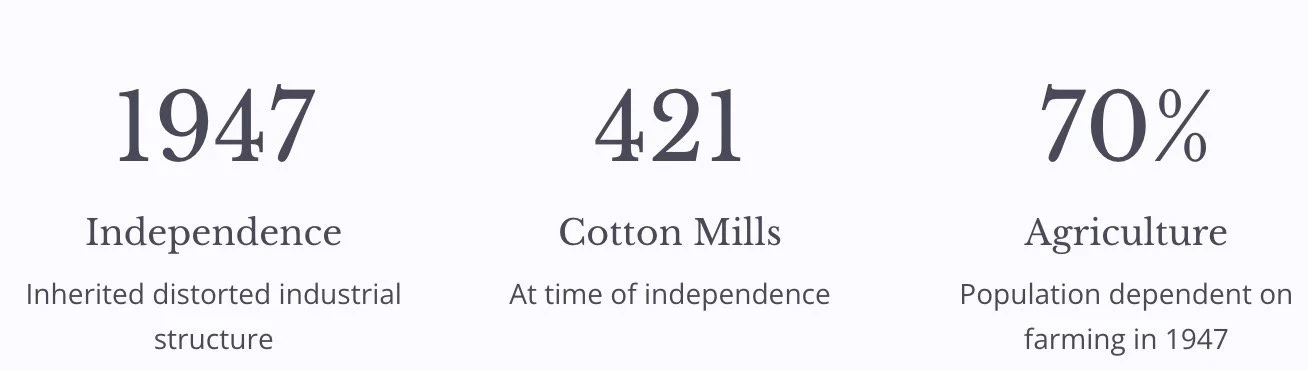
Situation at Independence in 1947
The colonial economic experience fundamentally shaped modern India's development trajectory, nationalist economic thought, and policy debates that continue today. For UPSC aspirants, mastering this history provides essential foundation for understanding contemporary Indian economy, development challenges, and ongoing debates over economic policy—demonstrating how historical structures persist and constrain present possibilities whilst also revealing agency exercised by colonised peoples in resisting exploitation and building alternative economic visions.
