
Economic Impact of British Colonial Rule in India: Part 1
Land and Agriculture
The British colonial period fundamentally transformed India's agrarian structure through systematic land revenue policies that prioritised extraction over development. Between 1765 and 1947, the East India Company and later the British Crown implemented three distinct land tenure systems—Zamindari, Ryotwari, and Mahalwari—each designed to maximise revenue collection whilst creating new social hierarchies. These policies dismantled traditional village economies, introduced concepts of absolute private property in land, and unleashed far-reaching consequences that continue to shape India's rural landscape. This comprehensive analysis examines the genesis, implementation, and profound socio-economic impacts of British land revenue systems, essential knowledge for understanding colonial economic history and its lasting legacy on contemporary India.
Economic Impact of British Colonial Rule in India
Pre-British Agrarian Structure: The Traditional System
The Village Economy Framework
In the pre-capitalist stage of Indian economy, the concept of absolute ownership of land was conspicuously absent. Instead, a sophisticated system of shared rights prevailed, where multiple stakeholders possessed defined entitlements connected with land. The cultivator enjoyed security of tenure and the right to cultivate, conditional upon payment of a relatively fixed share of the year's produce to the overlord. This share typically ranged from one-sixth to one-third of the rental value, creating a flexible arrangement responsive to agricultural realities.
The Patil or village headman occupied a pivotal position, functioning simultaneously as collector, magistrate, and head farmer. This multifaceted role embodied the integrated nature of village administration, where revenue collection was inseparable from broader community welfare and governance responsibilities.
Key Features
No concept of absolute ownership
Multiple stakeholders with defined rights
Security of tenure for cultivators
Flexible revenue arrangements
Integrated village administration
Village Panchayats
Internal arrangements regarding cultivation, land allotment, irrigation facilities, and revenue collection were settled by the Patil in consultation with village Panchayats according to local customs and practices, ensuring contextually appropriate decision-making.
Customary Practices
Different categories of land were allocated to specific categories of cultivators through customary mechanisms, maintaining social cohesion whilst optimising agricultural productivity based on traditional knowledge systems.
Revenue Collection
The state demand for land revenue was passed on to the ruler through established channels, with assessments that reflected actual production rather than arbitrary impositions, creating a sustainable revenue model.
British Land Revenue Philosophy: Extractive Imperialism
The British sought to derive maximum economic advantage from their rule in India, fundamentally transforming land revenue systems to serve imperial interests. British industrial and mercantile interests, advocating Free Trade principles, prevented the East India Company from raising substantial revenue through high custom tariffs. Consequently, the Company's government had to rely on land revenue as the principal source of state income, leading to unprecedented attention on land revenue matters from colonial rulers.
Imperial Revenue Logic
Early British administrators considered India a vast estate, operating on the principle that the Company was entitled to the entire economic rent, leaving cultivators merely with expenses of cultivation and subsistence wages. This represented a fundamental departure from traditional revenue systems.
Village Communities Disregarded
In almost all Company territories, early administrators resorted to 'farming' of land revenues, completely bypassing village communities and their traditional arrangements. This marked the beginning of systematic dismantling of indigenous governance structures.
Counter-productive Excess
Excessive land revenue demands proved counter-productive—agriculture languished, large areas went out of cultivation, and famines threatened populations. This necessitated serious deliberations both in India and England about sustainable land revenue policies.
Three Land Tenure Systems
The English adopted three main types of land tenures across British India, each with distinct features and geographical distribution, reflecting both ideological debates and pragmatic considerations of revenue maximisation.
Dual Government in Bengal (1765-1772): Chaos and Exploitation
In 1765, following the Battle of Buxar, the East India Company acquired Diwani rights through the Treaty of Allahabad—the right to collect revenue for Bengal, Bihar, and Orissa from Mughal Emperor Shah Alam II. This marked the beginning of a catastrophic period of dual government where the Company held revenue authority whilst the Nawab retained administrative responsibilities, creating a system designed for maximum extraction with minimal accountability.
1765: Grant of Diwani
The Company received revenue collection rights whilst retaining Muhammad Reza Khan as Naib Diwan, creating administrative confusion and opportunities for corruption from the outset.
Revenue Escalation
Revenue demand increased dramatically from Rs. 8,180,000 in 1764 to Rs. 23,400,000 in 1771—a nearly threefold increase that bore no relation to agricultural productivity or peasant capacity to pay.
1769-70: Devastating Famine
Approximately one-third of Bengal's population perished in a catastrophic famine, stark evidence of complete agrarian disorganisation caused by excessive revenue extraction and administrative chaos.
1772: Warren Hastings' Intervention
Warren Hastings removed Indian administrators entirely, making the British sole controllers of provincial resources whilst introducing the disastrous Ijardari (farming) system.
European officers of the Company were given supervisory authority over native officials, and their corruption as well as lack of understanding of the local situation led to complete disorganisation of the agrarian economy and society within a few years. The devastating famine was but one indication of the prevailing chaos.
The Ijardari System (1772-1790): Institutionalised Extraction
Warren Hastings' Experiment
In 1772, Warren Hastings introduced the Ijardari or farming system in Bengal, auctioning revenue collection rights to the highest bidders. European District Collectors assumed charge of revenue administration whilst revenue collecting rights were farmed out, initially for five years and later converted to annual settlements in 1777.
Systemic Failure
The system proved catastrophic as revenue farmers sought to extract maximum amounts without any concern for the production process. The burden on peasants increased dramatically, often becoming so onerous that revenue could not be collected at all. Warren Hastings appointed the Amini Commission in 1776—the first commission in British India—to enquire into the real value of land, submitting its report in 1778, but the fundamental problems persisted.
Revenue Instability
The system created profound instability in Company revenues at a time when funds were desperately needed. Neither ryots nor zamindars would invest in cultivation improvements when future assessments and revenue collectors remained unknown, paralysing agricultural development.
Administrative Confusion
The Company's administration profoundly confused the situation by retaining some zamindars whilst replacing others with new revenue farmers (Ijardars). Old customary assessment rates were ignored, and by the time Cornwallis arrived, complete confusion prevailed.
Agricultural Population Ruined
The net outcome of this period of rash experimentation was the ruination of the agricultural population. Many peasants abandoned lands, becoming dacoits and robbers. In 1784, Lord Cornwallis was sent to India with a specific mandate to streamline revenue administration and end the chaos.
Foundations of Permanent Settlement
Since 1770, even before Cornwallis arrived, numerous Company officials and European observers were advocating for land tax to be permanently fixed. Despite their various ideological orientations, they shared common faith in the Physiocratic school of thinking that assigned primacy to agriculture in a country's economy. This intellectual movement profoundly influenced British land revenue policy, creating the theoretical justification for what would become the Permanent Settlement.
Alexander Dow (1768-72)
In his book History of Hindustan, Dow introduced the foundational idea of permanent settlement, arguing for stable revenue arrangements that would encourage agricultural investment and economic development.
Henri Patullo (1772)
An economist who elaborated Dow's ideas systematically, providing detailed arguments about the economic benefits of permanent revenue settlements for both the state and agricultural producers.
Philip Francis (1776)
Put forward the crucial idea of recognising zamindars as proprietors of land on a permanent basis, arguing this would create a stable landed aristocracy loyal to British interests.
Pitt's India Act (1784)
Influenced by Philip Francis's ideas, this Act laid down directions for establishing Permanent Rules for land revenue, providing the legal framework for Cornwallis's subsequent reforms.
Ideological Context
The Permanent Settlement represented more than administrative reform—it embodied Enlightenment ideas about property, progress, and political economy. British officials believed that creating a landed aristocracy similar to England's would modernise India whilst ensuring political stability and revenue security for the empire.
Cornwallis and the Permanent Settlement (1793)
When Lord Cornwallis arrived in India as Governor-General in 1786, he confronted a revenue system that had created multiple problems, with different officials expressing conflicting opinions about its future. As a member of Britain's landed aristocracy and imbued with ideas of improving landlordism, Cornwallis naturally preferred the zamindars. He realised the existing system was impoverishing the country, ruining agriculture, and failing to produce the large, regular surplus the Company hoped for. The Company's trade also suffered due to difficulties in procuring Indian goods for export to Europe, particularly silk and cotton—two major export items whose production was agro-based.
James Grant's Position
Zamindars had no permanent rights whether as proprietors or as officials. The State was not bound by any definite limit in its demand from them, allowing for flexible revenue extraction based on changing circumstances.
Sir John Shore's Minute (1789)
Proprietary rights in land belonged to zamindars, a
nd the state was entitled only to customary revenue. Shore's framework created the basis for the Zamindari settlement, initially as a ten-year arrangement in 1790.
Directors' Instructions
The Court of Directors instructed Cornwallis to assess revenue records of past years and make settlements with zamindars for several years, with a view towards making it permanent in the future.
The 1793 Settlement
After prolonged discussion and debate, the Permanent Settlement was introduced in Bengal and Bihar in 1793 by Lord Cornwallis. The ten-year settlement of 1790 based on Shore's Minute was made permanent, introducing the policy of "assessment for ever." Land revenue was fixed at Rs. 26.8 million (approximately £3 million), based on the 1789-90 assessment as the standard.
Revenue Impact
Historians debate the actual increase: P.J. Marshall argues revenue demand in 1793 was just 20% higher than pre-1757 levels, whilst B.B. Chaudhuri calculates it "nearly doubled" between 1765 and 1793. The settlement was introduced in Bengal, Bihar, Orissa, Varanasi, and some Northern districts of Madras, later extending to tribal areas of Chota Nagpur, replacing the traditional Khuntkatti System.
Main Features of the Permanent Settlement
Zamindars as Proprietors
Zamindars, many of whom had been merely revenue collectors, were recognised as owners/proprietors of land who could mortgage, bequeath, transfer, and sell land. Ownership was made hereditary and transferable, creating a new class of absolute landlords.
Cultivators Reduced to Tenants
Cultivators were reduced to the status of mere tenants, deprived of long-standing rights to soil, pasture and forests, irrigation lands, fisheries, homestead plots, and protection against rent enhancement. Bengal's tenancy was left entirely at the mercy of zamindars.
Fixed Revenue Demand
Zamindars paid 10/11th (89%) of rental to the state, keeping only 1/11th (11%) for themselves. However, any increase in rental from extended cultivation or improved extraction accrued entirely to the zamindar, with no further state demand.
Sunset Law (1794)
If zamindars failed to pay revenue by sunset on the due date, their zamindari rights were auctioned by the government. This draconian provision led to widespread sales of estates and transfer of land ownership.
No State Interference
The government maintained no direct contact with peasants and did not interfere in zamindars' internal dealings with tenants, provided fixed land revenue was paid. This created opportunities for unlimited exploitation.
Arbitrary Initial Fixation
Initial revenue fixation was made arbitrarily without consultation with zamindars. John Shore calculated that of Bengal, Bihar, and Orissa's gross produce (taken as 100), the government claimed 45, zamindars and intermediaries received 15, and only 40 remained with actual cultivators.
Enhanced Zamindar Powers
Regulations of 1799 and 1812 gave zamindars the right to seize tenants' property for non-payment of rent without court permission. Bengal Rent Acts of 1859 and 1885 provided limited relief to cultivators.
A critical snag in the Permanent Settlement was that whilst the State's land revenue demand was permanently fixed, the rent to be realised by the landlord from the cultivator was left unsettled and unspecified. This resulted in rack-renting and frequent ejections of tenants from their traditional holdings.
Absentee Landlordism: An Unintended Consequence
Absentee landlordism emerged as a consequential feature of Bengal's Permanent land settlement. Many zamindars found it difficult to pay the amount demanded by the British and resorted to sub-feudalisation of their estates to unofficial middlemen. The Raja of Burdwan, for example, divided most of his estate into 'lots' or fractions called parni taluqs. Each unit was permanently rented to a patnidar who promised to pay fixed rent; if he defaulted, his patni could be taken away and sold. Other zamindars also adopted this practice, commencing a process of extensive subinfeudation.
Subletting to Middlemen
Zamindars sublet land to middlemen to ensure revenue payment whilst relocating to cities like Calcutta for luxurious living, transforming into absentee landlords disconnected from rural realities.
Urban-based Zamindars
Old rural-based zamindars were replaced by new urban landlords who obtained zamindari by various means to earn money and social distinction, viewing estates purely as revenue-generating assets.
Agents and Servants
Urban zamindars left servants and agents to collect revenue from peasants, creating layers of intermediaries between land and its cultivators, each extracting their share.
Intensified Exploitation
This furthered peasantry exploitation because agents and middlemen would extort almost all that peasants produced, leaving cultivators with barely subsistence levels whilst multiple intermediaries profited.
Subinfeudation Complexity
The subinfeudatory patni tenures sometimes proliferated up to twelve grades between the zamindar and the peasants, creating an absurdly complex tenurial structure. Each layer of intermediaries increased demands on cultivators, making agriculture increasingly unviable for small producers.
Claimed Merits of the Permanent Settlement
Views expressed by scholars and historians regarding Cornwallis's Permanent Settlement differ widely. Marshman claimed it was "a bold step and a wise measure," arguing that under the influence of this territorial Charter which for the first time created indefeasible interest in population, cultivation extended and gradual improvements became visible in people's habits and comforts. However, these claimed benefits require careful examination against actual outcomes.
Financial Advantages
The settlement secured fixed and stable income for the state, independent of monsoons. It saved government from income fluctuations, ensured steady revenue for commercial and administrative needs, eliminated expenses of periodical assessments, and abolished the entire revenue collecting machinery of Tehsildars, Quanungoes, and Patwaris.
Political Benefits
The settlement took away zamindars' political powers and executive authority, eliminating their capacity to create trouble. It created a loyal class of zamindars prepared to defend British interests because their rights were guaranteed by the British. This proved correct during the 1857 Mutiny when zamindars remained firmly loyal.
Expected Agricultural Improvements
It was claimed that zamindars would devote attention to land improvement, instruct tillers to work hard and improve soil. Wasteland and jungles would be converted into cultivable land, thus increasing land value. With state demand fixed, the entire benefit from increased production would accrue to zamindars, encouraging investment.
Administrative Improvements
The settlement facilitated revenue collection, removing the need for large annual or five-yearly assessment establishments. It freed the ablest Company servants for judicial services. The system would avoid evils associated with temporary settlements—harassment of cultivators and tendency to abandon land.
Social Expectations
Hope was expressed that zamindars would act as natural leaders of peasantry, showing public spirit in helping spread education and charitable activities. The Permanent Settlement would create conditions for developing the fullest power of soil, creating contented and resourceful peasantry.
Economic Optimism
The settlement would make zamindars wealthy enough to invest surplus capital in trade, industry, and commerce. Though government could not enhance land revenue directly, it could raise income by taxing trade and commerce as people became richer.
Demerits and Actual Consequences of Permanent Settlement
Many scholars contend that the Permanent Settlement adversely affected the interests of the Company, the zamindars, and worst of all, the peasants. Holmes declared: "The permanent settlement was a great blunder. The inferior tenants derived from it no benefit whatsoever." Whatever little economic or political purposes the Settlement might have served during its first few years, it soon turned into an engine of exploitation and oppression, creating "feudalism at the top and serfdom at the bottom." Many claimed advantages proved illusory.
Peasant Rights Sacrificed
The system overlooked peasant interests entirely. It vested land ownership in zamindars who previously enjoyed only revenue collecting rights. Peasants' customary occupancy rights were ignored, reducing them to tenant status. They became mere Kashtakars (landless labourers) working on land, with all traditional rights relating to land taken away—rights to pastures, forests, and canals were abolished.
Arbitrary Rent and Eviction
Peasants could not appeal against rent increases. The provision of patta (written agreement specifying rent) was rarely followed by zamindars. In 1799, zamindars received rights to evict peasants unable to pay tax and seize their property. When natural calamities or other causes prevented payment, land was taken by zamindars.
Government Financial Loss
The state proved a great loser long-term. Advantages of fixed, stable income were secured at tremendous sacrifice of any prospective share in increased revenue from land. Even when new areas were cultivated and rents increased manifold, the state could claim no share. Bengal's fixed income meant other provinces faced extra taxes to meet governmental deficits.
Land Sales in Bengal-Bihar
Between 1794 and 1807, land yielding about 41% of revenue in Bengal and Bihar was sold in auction due to zamindar defaults on revenue payments.
Orissa Zamindar Elimination
In Orissa between 1804 and 1818, 51.1% of original zamindars were wiped out because of auction sales, completely restructuring landholding patterns.
As Metcalfe wrote: "Cornwallis instead of being the creator of property in India was the great destroyer of it." The cultivators reduced to tenant positions suffered miserably at their landlord masters' hands because the government made no law till 1859 for their protection.
Political and Agricultural Consequences
Political Alienation
The Permanent Settlement divided rural society into two hostile classes—zamindars and tenants. Instead of co-operating in administration, zamindars embarrassed the government in all possible ways. Zamindari areas suffered from law and order problems, and zamindars often promoted and connived in criminal activities. There was loosening of the bond between government and people. So long as rents were paid regularly, the government left zamindars free to do as they liked, with collectors remaining in the background.
This lack of knowledge of the interior and real contact with masses adversely affected government's capacity to control the country, weakening its authority. British Administration gained loyalty of the few at the cost of alienating the masses—a fundamental flaw in colonial governance strategy.
Agricultural Stagnation
The Permanent Settlement retarded Bengal's economic progress. Most landlords took no interest in land improvements, being merely interested in extracting maximum possible rent from ryots. The cultivator, under constant fear of ejectment, had no incentive to improve land. Zamindars did not live on estates but away in cities where they wasted time and money on luxury. The process of sub-infeudation sometimes reached ridiculous proportions, with as many as 50 intermediaries in some cases. All intermediaries looked to their profits, and the ryot was reduced to pauper position.
State Revenue Share
The state claimed 89% (10/11th) of rental income, an exorbitant demand that left zamindars with minimal incentive to invest in agricultural improvements or tenant welfare.
Cultivator's Share
According to John Shore's calculation, of gross produce taken as 100, only 40 remained with the actual cultivator after state demand and intermediary extractions, barely sufficient for subsistence.
Contradictory Positions
British officials clearly differentiated between British landlords and Bengal zamindars. The landlord in Britain was land owner in relation to both tenant and state, paying small land tax. But Bengal zamindars, whilst landlords over tenants, were subordinated to the state. In contrast to British landlords, zamindars had to pay 10/11th of income as tax and could be evicted unceremoniously if revenue wasn't paid in time. They were virtually reduced to the status of tenants of the East India Company.
Ryotwari Settlement
The establishment of British rule in South and South-Western India brought new problems of land settlement. Lord Cornwallis expected his Permanent Settlement would extend to other parts of India. When Wellesley arrived, he and Henery Dundas of the Board of Control equally shared faith in the Bengal system, and in 1798 Wellesley ordered its extension to Madras Presidency. However, the problem was finding a sizeable zamindar class as in Bengal. Officials believed these regions had no zamindars with large estates and that introducing the zamindari system would upset existing affairs.
1792: Alexander Reed
The Ryotwari experiment started with Alexander Reed in Baramahal (Madras Presidency) after its acquisition by the Company, establishing the foundational principles of direct settlement with cultivators.
1801: Thomas Munro
Thomas Munro took charge of revenue administration of the ceded districts, continuing and refining Reed's experimental system, introducing it in Kanara (1799-1800), Bellary and Cuddapah (1801-02).
1820: Full Implementation
Thomas Munro, as Governor of Madras, introduced the Ryotwari system across the Madras Presidency, making it the predominant land revenue system in southern India.
Intellectual Influences
Growing disillusionment with the Permanent Settlement influenced policy. Scottish Enlightenment ideas celebrated the yeoman farmer's importance within agricultural societies. These ideas influenced Scottish officials like Thomas Munro and Mountstuart Elphinstone. David Ricardo's rent theory suggested the state had legitimate claim to surplus at the expense of unproductive intermediaries.
Financial Pressures
A more powerful reason for new settlement was Madras Presidency's perennial financial crisis, worsened by rising war expenses. The Permanent Settlement provided no means to raise government income, whilst increased income from land was being garnered by zamindars. This was the genesis of the Ryotwari Settlement, eventually implemented in Madras and Bombay Presidencies and later introduced in Sind, Assam, and Coorg.
Features and Evolution of Ryotwari Settlement in Madras
The Ryotwari system represented a radical departure from the Permanent Settlement. In this system, land revenue was not collected by zamindars but by ryots or cultivators who themselves deposited it in the government treasury. According to this system, cultivators became landowners and there was no intermediary for revenue collection. Every 'registered' holder of land was recognised as a proprietor with rights to sub-let, transfer, mortgage, or sell holdings. Ryots were not evicted so long as they paid the State demand of land revenue.
Initial Phase (1792-1807)
Captain Reed assisted by Thomas Munro fixed State demand at 50% of estimated produce of fields, which worked out to be more than the whole economic rent. The first assessments were very severe and caused widespread misery. The system was almost abandoned after Munro's departure for London in 1807.
Second Phase (1820 onwards)
Thomas Munro returned as Governor of Madras around 1820. He argued Ryotwari was the ancient Indian land-tenure system and therefore best suited to Indian conditions. He believed the British empire needed a unified concept of sovereignty and the Ryotwari system could provide foundation for that.
Third Phase (1855-1864)
In 1855, an extensive survey and settlement plan was decided upon based on 30% of gross produce. Actual work began in 1861. The Rule of 1864 limited state demand to half the net value of produce (50% of rental), with settlements made for thirty years.
Theoretical Framework
It created individual proprietary right in land, vested in peasants rather than zamindars. Munro preferred it to be in hands of forty to fifty thousand small proprietors than four or five hundred great ones. However, it made significant distinction between public and private ownership, defining the state itself as supreme landlord, and individual peasants as landowners who obtained title by paying annual cash rents to the government.
Implementation Challenges
This was a field assessment system requiring detailed land survey—quality of soil, area of field, and average produce of every piece of land had to be assessed. But in practice, estimates were often guesswork and revenue demanded was often so high that it could only be collected with great difficulty or not at all. Peasants were coerced to agree to unjust settlements.
Munro justified his position by arguing that historically land in India was owned by the state, which collected revenue from individual peasants through officials paid through grant of inam land. When state military strength declined, poligars appropriated land and usurped sovereignty. This process of alienation needed to be reversed—an argument that briskly set aside contrary observations about community or tribal property rights.
Impact of Ryotwari System on Madras Agrarian Society
By redefining property rights, the Ryotwari system actually strengthened the power of village magnates where they existed, thus intensifying social conflict. However, this impact had wide regional variations, depending on existing social structures and ecological conditions. Contrary to Munro's insistence that cultivators be given freedom to take as much or as little land as they chose, this "right of contraction or relinquishment" was effectively dropped by 1833.
Mirasidars in Wet Zones
David Ludden's study of Tirunelveli district shows how locally powerful mirasidars manipulated the system to get privileged rents and convert collective rights into individual property rights. The Madras government since 1820 showed absolutely no interest in protecting tenant rights, despite their active but futile resistance to mirasidari power. Mirasidars in wet zones did much better than counterparts in dry or mixed zones.
Kaveri Delta Dynamics
Willem Van Schendel's study of Kaveri delta in Tanjavur district shows the golden age of mirasidars who entrenched their control over land and labour, intensifying polarisation of local society. Their power eroded somewhat in the second half of nineteenth century due to greater social and economic differentiation within their community and older families giving way to new commercial groups.
Regional Variations
Among other Tamil districts, the situation was largely similar in wet taluks of Tiruchirapalli, whilst in South Arcot and Chingleput such privileged landownership rights were increasingly challenged by actual cultivators. In other vast areas of Tamilnad where there was abundance of cultivable land, the situation was dominated by large numbers of owner-cultivators and a small group of middle landowners.
Peasant Differentiation
In Andhra districts of the Madras Presidency, the Ryotwari system resulted in differentiation within peasantry. By the beginning of twentieth century there was an affluent group of big landholders—peasant-bourgeoisie—who controlled large farms and leased out surplus lands to landless tenants and sharecroppers. The intermediate strata also did well under stable economic conditions.
Poor Peasant Misery
Poor peasants, constituting the majority of rural population, lived in squalid conditions, were exploited by rich ryots, creditors and lessors, were forced to hire themselves despite wretched conditions and remained tied to small plots of land with no prospects for improvement or escape from debt cycles.
Torture Commission Report (1855)
Excesses of revenue officials were revealed in abundant and gory details in the Madras Torture Commission Report in 1855, indicating urgent need for effective reform. In the British Parliament members asked questions about vile practices of torture of defaulters. The peasantry sank deeper in poverty, falling into moneylenders' clutches for payment of land revenue.
Ryotwari Settlement in Bombay Presidency
The Ryotwari system in the Bombay Presidency had its beginning in Gujarat after its annexation in 1803, and when the Peshwa's territories were conquered in 1818, it was extended in those areas under the supervision of Munro's disciple, Mountstuart Elphinstone. Elphinstone, Governor of Bombay 1819-27, submitted a detailed 'Report on the Territories Conquered from the Peshwa' in October 1819, emphasising two important features of Maratha Government: the existence of village communities as units of local administration and the existence of mirasi tenure (mirasdars were hereditary peasant proprietors).
Initial Direct Collection
Initially, British collected revenue through the Deshmukh and village headmen (patil). This did not yield as much revenue as hoped, so from 1813-14 they began collecting directly from peasants. Abuses characterising the Madras system soon appeared in Bombay too.
Pringle Survey (1830)
R.K. Pringle undertook a land survey, classifying land and fixing revenue at 55% of net value of produce. First introduced in Indapur taluk in 1830, the scheme was soon found faulty with erroneous estimates of field produce, resulting in over-assessment and oppression of peasantry.
Wingate System (1835)
Replaced in 1835 by reformed Bombay Survey System devised by G. Wingate and H.E. Goldsmid. It was a practical settlement aiming at lowering demand to a reasonable limit where it could be regularly paid. Assessment began in 1836 on basis of thirty years settlement.
The Wingate System Features
Actual assessment of each field depended on what it paid in the immediate past, expected price rise, nature of soil and location. Assessment was placed upon each field instead of holdings of a cultivator, so that each cultivator could give up any field or take up other unoccupied fields. The new assessment was more or less based on guesswork and erred on the side of severity.
The 1875 Crisis
The American Civil War (1861-65) temporarily pushed up demand for Bombay cotton, boosting prices. This temporary boom gave Survey officers opportunity to push up assessment by 66% to 100%, without giving cultivators any right to appeal to a court of law. The Deccan witnessed agrarian riots in 1875.
The Government responded by enacting the Deccan Agriculturists' Relief Act, 1879, providing relief against moneylenders, but did nothing to restrain excessive State demand—the root of all evils. This highlighted the selective nature of colonial responses to agrarian distress.
Mahalwari Settlement: The Village Community System
Vast stretches of territory in north and north-western India were overrun between 1801 and 1806, including the Ganga-Yamuna Doab. The agrarian structure featured a small group of magnates (taluqdars or "intermediary zamindars") who contracted with the state to realise revenue, and a large group of "primary zamindars" who held proprietary rights over agricultural and habitational lands. The 'village community' was figured neither in the Permanent Settlement nor in the Ryotwari system, leading to development of the Mahalwari system.
Village as Revenue Unit
Under the Mahalwari system, the unit for revenue settlement is the village or the mahal (the estate). Village land belongs jointly to the village community technically called 'the body of co-sharers', who are jointly responsible for payment of land revenue, though individual responsibility also exists.
Community Ownership
If any co-sharer abandons his land, it is taken over by the village community as a whole. The village community is the owner of village 'common land' including forest land, pastures, etc., preserving some elements of traditional communal arrangements.
Geographical Coverage
The Mahalwari system was first experimented in Awadh in 1801, then in territory acquired from Marathas in 1803-04. It was introduced in North-West provinces in 1822, major portions of UP, Central Provinces, Punjab (with variations), covering nearly 30% of British India.
Regulation VII of 1822 (Holt Mackenzie Plan)
Holt Mackenzie's Minute of 1819 emphasised existence of village communities in Northern India. He recommended survey of land, preparation of record of rights, settlement mahal by mahal, and collection through village headmen. Regulation VII of 1822 gave legal sanction to these recommendations. Settlements were made on basis of 80% of rental value, payable by zamindars.
Regulation IX of 1833 (Robert Martins Bird Plan)
William Bentinck's government reviewed the 1822 scheme, concluding it had caused widespread misery. The 1833 Regulation provided for detailed survey to assess revenue of entire mahal based on net value of potential produce. It introduced fixing average rents for different classes of soil, use of field maps and registers, reduced rate to 66% of net income, and assessment for 30 years.
Saharanpur Rules of 1855
Lord Dalhousie felt need for fresh Directions to Settlement Officers. Under revised Saharanpur Rules, State revenue demand was limited to 50% of rental value. Unfortunately, Settlement officers evaded new rules in practice, interpreting 50% to mean half of "prospective and potential" rental rather than "actual rentals," creating widespread discontent.
Variants: Malgujari and Taluqdari Settlements
Malgujari Settlement (1863)
Introduced in 1863 in Central Provinces (created in 1861). Settlement was made with Malgujars who were traditional land revenue collectors. Malgujars were given proprietary rights, with rate fixed at 50% according to Saharanpur rules. Settlement was made for 30 years. It was a variant of Mahalwari Settlement. The man behind this settlement was Richard Temple, who sought to create a loyal class of intermediaries in the newly organised Central Provinces.
Traditional revenue collectors recognised
Proprietary rights conferred
30-year settlement period
50% rental demand
Taluqdari Settlement (1860-1878)
Introduced in Awadh during 1860-1878. Settlement was made with Taluqdars—a move to pacify their discontent during the Revolt of 1857. Taluqdars were made proprietors of their estates. Sub-proprietary rights vested in village communities in relation to Taluqdars. Settlement was made for 30 years. This represented British recognition that alienating powerful intermediaries had contributed to the 1857 uprising.
Taluqdars as estate proprietors
Village communities retained sub-rights
Political pacification objective
30-year settlement period
19% Zamindari Settlement
According to rough estimate in 1928-29, under zamindari settlement 19 percent of cultivable land in India, primarily in Bengal, Bihar, Orissa, and parts of Madras.
29% Mahalwari Settlement
Under Mahalwari settlement 29 percent of cultivable land, covering North-West Provinces, Central Provinces, and Punjab with variations in implementation.
52% Ryotwari Settlement
Under Ryotwari system 52 percent of cultivable land, predominantly in Madras and Bombay Presidencies, making it the most widespread system.
Common Feature: Over-Assessment
A common feature of all the settlements was over-assessment, as the primary aim of the Company's government was to maximise revenue income. The results were arrears of payment, mounting debt, increasing land sales, and dispossession across all three systems, regardless of their theoretical differences.
Disintegration of Traditional Village Economy
The overall impact of the East India Company's revenue systems and excessive state demand, coupled with new judicial and administrative set-up, turned Indian rural economy upside down. The village Panchayats were deprived of their two main functions: land settlements and judicial and executive functions. With the Patel merely acting as a Government official charged with revenue collection duty, the old politico-economic social framework of village communities broke down irreversibly.
Commercialisation of Land
The introduction of the concept of private property in land turned land into a market commodity. Land could now be bought, sold, mortgaged, and transferred—fundamentally altering relationships between people and land that had persisted for centuries.
New Social Classes
New social classes like the landlord, the trader, the moneylender, and the landed gentry shot into importance. The class of rural proletariat, the poor peasant proprietor, the sub-tenant, and agricultural labour multiplied in number.
Competition Replaces Cooperation
The climate of cooperation gradually gave place to the system of competition and individualism. Traditional communal arrangements for managing village resources were replaced by individual profit-seeking behaviour.
Capitalist Prerequisites
The prerequisites of the capitalist development of agriculture were created. New modes of production, introduction of money economy, commercialisation of agriculture, better means of transport and linkage with world market added new dimensions.
Distorted Modernisation
The Government policies ushered in an era of distorted modernisation—modernisation in form but serving extractive rather than developmental purposes, benefiting imperial interests whilst impoverishing agricultural producers.
The British imperial rulers of India unleashed far-reaching changes in Indian agrarian structure. New land tenures, new land ownership concepts, tenancy changes, and heavier state demand for land revenue triggered profound changes in rural economy and social relationships. However, this transformation served imperial extraction rather than Indian development.
Colonial State's Track Record: Limited Development Investment
There was limited colonial initiative to develop agricultural production, except construction of some irrigation canals in parts of northern, north-eastern and south-western India—specifically in non-Permanent Settlement areas where there was scope for enhancing land-revenue rates. Between 1900 and 1939, the area under irrigation almost doubled in absolute terms. However, in relative terms, in 1947 when the British empire ended its long career in India, only a quarter of the total cropped area was under public irrigation system—a testament to colonial priorities.
Profitability Over Development
The real reason for limited investment was that public investment in irrigation was guided only by profitability factor and extreme contingencies, such as prevention of famines. Development for Indian welfare was never the primary consideration—only revenue enhancement and strategic necessity motivated colonial infrastructure investment.
Unequal Benefits
Regions where irrigation facilities developed favoured only the more prosperous among peasantry, as canal rates were very high. In Punjab, canal colonies became the model of commercial agriculture in Asia, but new prosperity was shared only by limited social groups—a few agricultural castes and medium and large-sized landlords.
Stagnant Agricultural Yields
Aggregate agricultural yields were largely static in colonial India. Between 1920 and 1947, especially the production of food crops lagged far behind the rate of population growth. Near-famine conditions were therefore not rarities in India during the British period.
The Bengal Famine of 1943
In 1943, two to three million people perished in a major famine in Bengal—one of the most devastating famines in human history. This catastrophe occurred not due to shortage of food but due to colonial policies, wartime priorities, and systematic neglect of Indian welfare. The famine exposed the fundamental contradiction of colonial rule: a system that claimed to bring progress and development whilst allowing millions to starve under its watch.
The British land revenue systems, regardless of their theoretical differences, shared common features: over-assessment, extraction prioritised over development, creation of new intermediaries, dispossession of traditional cultivators, and transformation of land into a commodity. These policies fundamentally altered India's agrarian structure, creating legacies that persist in contemporary rural India's challenges of landlessness, debt, and agricultural distress.
Lasting Legacy
Understanding these colonial land revenue systems is essential for UPSC aspirants, as they provide crucial context for contemporary agrarian issues, land reform debates, and the structural challenges facing Indian agriculture. The colonial period's extractive policies established patterns of inequality, indebtedness, and agricultural stagnation that independent India has struggled to overcome, making this historical knowledge vital for policy analysis and administrative decision-making.
Understanding Commercialisation of Agriculture
Definition and Context
Commercialisation of agriculture represents a fundamental shift where agricultural production transitions from subsistence farming for local consumption to cultivation of specialised crops for sale in national and international markets. This transformation was not an organic evolution driven by Indian farmers' economic incentives but rather a deliberate policy imposed by British colonial authorities to serve imperial interests.
The revolutionary changes in agrarian property relations began towards the end of the 18th century. However, the process gained significant momentum post-1813, coinciding with the acceleration of the Industrial Revolution in England. The watershed moment arrived around 1860 during the American Civil War, which dramatically boosted demand for Indian cotton as American exports to Britain ceased.
Colonial Purpose
The commercialisation of Indian agriculture was fundamentally designed to feed British industries rather than develop India's own industrial base. India remained far behind European countries in industrial development during the eighteenth century. The British systematically encouraged only those agricultural products that British industries required or that could generate commercial profits in European and American markets.
For instance, extensive efforts were undertaken to increase cotton production to supply raw materials to Britain's rapidly expanding cotton-textile industries following the Industrial Revolution. Similarly, indigo cultivation, tea and coffee plantations were promoted because these commodities commanded ready markets abroad. The production of jute, sugarcane, oilseeds, opium, black pepper, and silk was intensified purely for export purposes.
Mechanisms of Agricultural Commercialisation
Land Tenure Reforms
The introduction of new land tenure systems—Permanent Settlement and Ryotwari Settlement—fundamentally transformed agricultural land into a freely exchangeable commodity. The Permanent Settlement granted ownership rights to zamindars, creating a wealthy landlord class that could buy and sell land freely. This commercialisation of land ownership marked a departure from traditional communal land relationships.
Shift from Subsistence to Market
Agriculture, which had traditionally been a way of life rather than a business enterprise, began to be practised for sale in national and international markets. Farmers increasingly cultivated crops like cotton, jute, sugarcane, groundnuts, and tobacco that commanded high market demand rather than focusing on food security and local consumption needs.
East India Company Procurement
The East India Company established systematic procurement and export mechanisms for Indian agricultural commodities, generating substantial profits. Initially, the Company exported agricultural products directly. Later, these exports expanded significantly to supply raw materials for burgeoning industries in Britain, creating an integrated supply chain serving imperial interests.
Plantation Agriculture
The introduction of plantation crops like tea, coffee, rubber, and indigo heralded a new era in agricultural practices. These plantations, predominantly controlled by English planters, represented industrial-scale agriculture focused entirely on export markets, fundamentally altering land use patterns and labour relations in affected regions.
Critical Analysis: The commercialisation of agriculture was a forced and artificial process for the majority of Indian peasants. Unlike typical capitalist agricultural development where initiative comes from within peasant society, in India's case, coercion by British authorities drove the transformation. Peasants did not benefit from commercialisation; instead, they faced increased oppression. For example, indigo planters had to force local peasants to accept advances for producing indigo, as planters had no land purchase rights until 1829.
Regional Patterns of Commercial Crop Cultivation
Punjab
Wheat cultivation dominated Punjab's agricultural landscape, with production specifically intended for export markets. The fertile plains and irrigation infrastructure made Punjab the breadbasket for British markets.
Gujarat and Berar
Cotton regions of Gujarat and Berar became crucial suppliers of raw cotton to British textile industries. The cotton boom during the American Civil War transformed these regions into specialised cotton-growing areas.
East Bengal
Jute cultivation in East Bengal grew exponentially, earning it the moniker of "golden crop." However, primary producers rarely benefited from market booms as British manufacturers and exporters exercised monopsony power.
Assam
Tea plantations in Assam represented a completely new agricultural model. Large-scale plantations controlled by British companies transformed the region's economy and social structure fundamentally.
Bihar
Opium cultivation in Bihar served the notorious triangular trade between London, Calcutta, and Canton. This cultivation helped Britain address its trade deficit with China through forced drug trade.
This regional specialisation of crop production based on climatic conditions and soil types was an outcome of the commercial revolution in agriculture. However, this specialisation made regions vulnerable to price fluctuations in international markets and disrupted traditional crop diversity that had ensured food security.
Factors Facilitating Commercialisation
Political Unity and National Market
The political unity established by the British and the resultant rise of a unified national market was an important facilitating factor. For the first time, agricultural goods could move freely across the subcontinent, creating integrated market structures.
Money Economy
The spread of money economy replaced barter systems, transforming agricultural goods into market commodities with cash values. This monetisation fundamentally altered traditional exchange relationships and economic calculations.
Colonial Subjugation
India's reduction to supplier of raw materials and food grains to Britain whilst being forced to import British manufactured goods was the chief factor. Many commercial crops were introduced specifically to meet British demand.
Transport Infrastructure
Rapid development of railways and shipping made long-distance trade in agricultural products feasible. This connectivity ended rural isolation and linked villages directly to urban and international markets, though primarily serving British interests.
Monetised Revenue
Monetisation of land revenue payments forced peasants to sell produce for cash rather than paying in kind.
Industrial Revolution
Britain's accelerating Industrial Revolution created insatiable demand for agricultural raw materials from India.
International Trade
Enlargement of international trade and entry of British finance capital further propelled agricultural commercialisation.
The American Civil War and Cotton Boom
Temporary Prosperity and Lasting Consequences
The American Civil War (1861-1865) indirectly but significantly encouraged commercialisation of agriculture in India. When American cotton exports to Britain ceased, British demand was diverted to India, creating unprecedented opportunities for Indian cotton cultivators. This sudden surge in demand created a cotton boom, particularly in western India.
The cotton boom created a temporary pocket of prosperity in the Deccan cotton belt during the 1860s. Farmers who could produce cotton experienced windfall profits, leading to expansion of cotton cultivation areas. However, this prosperity proved short-lived and was followed by devastating consequences.
After the American Civil War ended, the boom collapsed rapidly. The sudden withdrawal of demand left farmers who had invested heavily in cotton cultivation vulnerable. This was followed by severe famine in the 1870s and agrarian riots as farmers found themselves unable to sustain their livelihoods. The demand for cotton was partially maintained due to the rise of cotton textile industries in India, but this could not compensate for the loss of international premium prices.
Historical Significance
The cotton boom and subsequent bust demonstrated the vulnerability of commercialised agriculture to international market fluctuations. It illustrated how linking Indian agriculture to distant markets created instability and risk for farmers who had no control over price mechanisms or market conditions.
The Triangular Trade: Opium, Tea, and China
One particularly significant aspect of agricultural commercialisation involved India's role in Britain's trade with China. Initially, the balance of trade favoured China, creating a problem for the British East India Company. The Company addressed this challenge through a calculated two-pronged strategy that had profound implications for Indian agriculture.
Opium Cultivation Strategy
The Company aggressively encouraged opium cultivation in India, particularly in Bihar. This opium was then exported to China, where it was sold despite Chinese government opposition. The illegal opium trade generated enormous revenues for the Company whilst simultaneously creating a massive drug addiction problem in China. This immoral trade eventually led to the Opium Wars, demonstrating the extent to which British commercial interests would go to maintain profitable trade.
Tea Plantation Development
Simultaneously, the Company promoted tea farming in India itself, particularly in Assam and the Himalayan foothills. This reduced British dependence on Chinese tea whilst creating another profitable export commodity. Indian tea plantations employed oppressive labour practices and transformed large tracts of land into monoculture estates.
Triangular Trade Network: A sophisticated triangular trade developed between London, Calcutta, and Canton (Guangzhou). British manufactured goods went to India, Indian opium and raw materials went to China, and Chinese tea and silk went to Britain. This network exemplified how India was systematically integrated into global imperial commerce, not for India's benefit but to serve British economic interests and address Britain's trade imbalances with other nations.
Forced Cultivation and Peasant Coercion
Revenue Pressure
Peasants were forced to cultivate commercial crops due to high revenue demands from the British government. The necessity to pay revenue and rent in cash, rather than in kind, compelled farmers to grow marketable crops regardless of their preference or local food needs.
Planter Coercion
European planters, particularly in indigo cultivation, had to persuade and later force local peasants to accept advances for producing cash crops on their lands. Since planters had no right to buy land until 1829, they relied on coercive contracts that bound peasants to cultivation agreements.
Debt Servicing
The imperative of debt servicing trapped peasants in a vicious cycle. To repay moneylenders, peasants had to grow commercial crops that could be sold for cash, even when this compromised their food security and long-term agricultural sustainability.
Specified Land Allocation
Under planter oppression, cultivators had to grow commercial crops on specified tracts of their land, losing autonomy over their own agricultural decisions. This undermined traditional crop rotation practices and agricultural wisdom developed over generations.
The cultivation of commercial crops was thus undertaken under duress rather than economic incentive. Historical evidence persistently shows that peasants were "forced" to cultivate cash crops, contradicting claims that commercialisation represented natural market-driven agricultural development. The peasantry's lack of choice in this transformation is crucial for understanding the exploitative nature of colonial agricultural policies.
Negative Impacts: Increased Inequality and Exploitation
Concentration of Benefits
Commercialisation of agriculture should theoretically have acted as a catalyst for increasing agricultural productivity. However, due to poor agricultural organisation, obsolete technology, and lack of resources among most peasants, this did not materialise. Only rich farmers benefited from commercialisation, which accentuated inequalities of income in rural society.
Historian Tirthankar Roy has argued that whilst capitalists captured most or all of the increase in value-added and the rich became richer, this doesn't necessarily mean the poor got poorer. Total income had increased. However, critics counter that if the rich got richer whilst the poor remained poor or became only marginally better off, this represented a deeply inequitable and unsatisfactory development pattern.
Colonial Beneficiaries
The commercialisation of agriculture proved most beneficial to British planters, traders, and manufacturers, who were provided opportunities to make huge profits by procuring commercialised agricultural products at throwaway prices. The entire profit structure was designed to extract value from Indian agriculture for British benefit.
The commercialisation also partly benefited Indian traders and moneylenders who made fortunes by working as middlemen for the British. However, this created a comprador class whose interests aligned with colonial exploitation rather than peasant welfare. These intermediaries often proved more oppressive to peasants than direct British control.
The structural inequality embedded in agricultural commercialisation meant that those who laboured in the fields rarely received fair compensation for their work, whilst those who controlled trade, credit, and markets accumulated disproportionate wealth. This pattern of exploitation continues to influence Indian agriculture even today.
Decline in Food Production and Recurring Famines
One of the most devastating consequences of agricultural commercialisation was the dramatic reduction in area under cultivation of food crops. As commercial non-food grain crops were substituted for food grains, India's food security was systematically undermined. Between 1893-94 to 1945-46, the production of commercial crops increased by 85 percent whilst that of food crops fell by 7 percent. This shift had catastrophic effects on the rural economy.
Famine Frequency and Severity
The decline in food production manifested in a series of devastating famines that took enormous toll of life. The jute economy crashed in the 1930s and was followed by the catastrophic Bengal Famine of 1943, which killed millions. These famines were not merely natural disasters but were substantially caused by colonial policies that prioritised export crops over food security.
Contested Historical Interpretations
Historian Sekhar Bandopadhyay notes the difficulty in establishing direct connections between commercialisation and famines. When colonial rule ended, food crops were still being grown in 80 percent of cropped acreage. However, aggregate food crop production consistently lagged behind population growth, creating structural food insecurity.
Declining Per Capita Entitlements
Claims by some historians that growth of trade and market integration through infrastructure development actually increased food security remain highly contentious, particularly regarding the Bengal Famine of 1943. This famine was preceded by a long period of consistently declining per capita entitlement of rice in the province, directly contradicting theories about commercialisation improving food security.
Linking to World Market Volatility
Agricultural commercialisation linked India's farming sector to the world market, making Indian farmers vulnerable to price movements and business fluctuations in international markets to a degree never experienced before. Farmers had to give greater importance to market demand and prices than to their home needs in crop selection. This external dependency created instability and unpredictability in peasant livelihoods, as they had no control over global market forces.
Destruction of Self-Sufficiency
Commercialisation assisted the Industrial Revolution in Britain but adversely affected the self-sufficiency of village economies. It acted as a major factor in bringing about the declining state of rural economy. Traditional village-level economic integration and autonomy were systematically dismantled, making villages dependent on external markets and undermining their resilience.
Disruption of Agriculture-Industry Relations
Commercialisation disrupted traditional relations between agriculture and industry in India. Previously, these sectors had complementary relationships that fostered mutual development. The colonial restructuring broke these linkages, subordinating both agriculture and traditional industry to British industrial and commercial interests rather than allowing organic integration of India's productive sectors.
Technological Stagnation
Despite representing a commercial revolution, agricultural commercialisation was devoid of any technological revolution. Without technological support, the potential benefits for agriculture and associated fields remained unrealised. Commercialisation neither boosted agricultural production significantly nor imparted organised form to the agricultural system. Farming methods remained primitive and productivity stagnant.
Peasant Revolts and Social Unrest
The Indigo Revolt of 1859
The worst effect of commercialisation was the systematic oppression of Indian peasants at the hands of European planters. This exploitation found its most famous expression in the Indigo Revolt of 1859 in Bengal. Indigo planters had forced peasants to cultivate indigo through a combination of advances, contracts, and coercion. The peasants received minimal compensation whilst planters reaped enormous profits.
The revolt demonstrated peasants' desperation and their willingness to resist despite risks. The planters' oppressive practices, including physical violence, illegal exactions, and manipulation of contracts, pushed peasants beyond endurance. The revolt, though ultimately suppressed, forced some policy changes and brought attention to the exploitative nature of plantation systems.
Pattern of Agrarian Disturbances
The Indigo Revolt was not an isolated incident but part of a pattern of agrarian disturbances throughout the colonial period. These revolts reflected the fundamental contradiction between commercial imperatives imposed by colonialism and peasants' needs for livelihood security and dignity. Agrarian unrest became a recurring feature of rural India, culminating in the broader anti-colonial movements of the twentieth century.
Positive Dimensions of Commercialisation
Despite its overwhelmingly negative impacts, commercialisation had some progressive elements that merit acknowledgment for a balanced understanding. However, these benefits were largely unintended consequences rather than deliberate policy outcomes, and their positive effects were substantially outweighed by negative impacts.
Social and Economic Integration
Commercialisation encouraged social exchange and made possible the gradual transformation of Indian economy towards capitalistic forms. It broke down some traditional isolations and created networks of economic relationships across regions. This integration, whilst serving colonial interests, also laid groundwork for future economic development and national market formation.
Global Economic Linkages
Commercialisation linked India with the world economy, exposing Indian agriculture and traders to international markets and commercial practices. This connection, though exploitative, introduced new crops, market mechanisms, and economic concepts that would later prove useful. It contributed to the growth of a more sophisticated economic system with higher levels of social organisation.
National Economic Consciousness
The integration of economy created a base for the growth of a national economy. Agricultural problems acquired national rather than merely local or regional character. This nationalisation of economic issues contributed to the development of national consciousness and unified economic thinking that would prove crucial for independence movements and post-independence economic planning.
Regional Specialisation
Commercialisation brought about regional specialisation of crops on an efficient basis, encouraging production of specific crops suited to particular regions and favourably affecting their distribution. This specialisation, though problematic when it undermined food security, also demonstrated potential for productivity gains through appropriate crop selection based on comparative advantages of different regions.
Rise of Landless Agricultural Labourers
One of the most significant and tragic consequences of British colonial policies was the dramatic rise in landless agricultural labourers. This transformation represented a fundamental restructuring of rural social relations and created a class of desperately impoverished workers who owned no land and survived by selling their labour at starvation wages.
Loss of Land Ownership
Multiple factors contributed to cultivators losing their land: inability to pay revenue demands, accumulation of debts to moneylenders, and manipulation by legal and commercial systems. Once land could be freely bought and sold under British legal frameworks, peasants who fell into debt or faced revenue arrears quickly lost their holdings. Moneylenders, merchants, and wealthy peasants accumulated land whilst former owner-cultivators became landless.
Tenant Insecurity
Even those who retained some land often lost secure tenancy rights. In zamindari areas, tenants could be ejected from land or reduced to subtenants of moneylenders who had acquired rights from zamindars. The lack of legal protections for tenant rights meant cultivators faced constant insecurity, unable to invest in land improvement or plan for future seasons with any confidence.
Creation of Labour Class
Dispossessed cultivators and ruined artisans had few options other than becoming agricultural labourers. They either became tenants paying rack-rent to zamindars and moneylenders, or agricultural labourers working for starvation wages. This process created a substantial class of rural proletariat who owned no means of production and survived by selling their labour power in extremely unfavourable conditions.
Factors Contributing to Increasing Landlessness
Population Growth Impact
India's population grew substantially during colonial period, increasing pressure on fixed agricultural land. Fragmentation of holdings through inheritance and population growth created holdings too small to be economically viable, forcing sale and creating landlessness.
Poverty Trap
Extensive poverty in rural areas meant peasants had no savings for emergencies. Crop failures, famines, or family crises forced immediate land sale to survive, with over half of rural population vulnerable to such shocks.
Mechanisation Effects
Introduction of agricultural machinery, whilst limited, reduced demand for labour in some regions. Approximately 60% of traditional agricultural tasks could potentially be mechanised, threatening livelihoods of landless labourers.
Debt Accumulation
Most agricultural labourers became entangled in debt due to landlessness and necessity of borrowing for survival. Studies suggest 75% of landless families carried chronic debt, perpetuating their impoverishment across generations.
Climate and Environmental Factors
Climate change and recurrent natural disasters contributed to growing prevalence of landless labourers. Droughts, floods, and other environmental catastrophes destroyed crops and livelihoods, forcing vulnerable peasants to sell land for immediate survival. The absence of any state support or insurance mechanisms left peasants entirely exposed to environmental risks.
Lack of Alternative Employment
The absence of alternative occupations due to de-industrialisation and lack of modern industrial development meant displaced peasants had nowhere to turn except agricultural labour. Limited policies for agricultural development in rural areas and complete neglect of rural non-farm sectors trapped landless people in cycles of poverty with no escape routes.
Impoverishment of Peasantry: Mechanisms and Consequences
The systematic impoverishment of Indian peasantry under British rule occurred through multiple interlocking mechanisms. Peasants faced oppression from three main sources: the government (through excessive land revenue), zamindars or landlords (through rack-renting and illegal exactions), and moneylenders (through usurious interest and debt traps). After these three extracted their shares, cultivators and their families were left with barely enough for survival.
Moneylenders
Landlords/Zamindars
Government Revenue
Peasant Cultivators
Estimates suggest that by 1950-51, land rent and moneylenders' interest totalled Rs. 1,400 crore—approximately one-third of total agricultural output. This massive extraction of surplus from agriculture left peasants in perpetual poverty, unable to invest in improvements, education, or better living conditions.
Revenue Oppression
Government revenue demands were exorbitant and had to be paid on time regardless of harvest quality. Initially set at one-third to one-half of produce, revenue remained crushing even when proportionally reduced in later years, as population pressure and agricultural stagnation meant the lower demands still weighed heavily. The strict collection methods—including land sales for non-payment—created constant anxiety and forced peasants into debt to meet revenue obligations.
Moneylender Exploitation
Moneylenders charged usurious interest rates and used cunning tactics—false accounting, forged signatures, forcing debtors to sign for larger amounts than borrowed—to trap peasants in deepening debt. Once in debt, peasants rarely escaped. The new legal system empowered moneylenders to seize land, transforming temporary borrowing into permanent loss of property. By century's end, rural debt had become a major curse of the countryside.
Decline of Agricultural Productivity and Stagnation
Indian agriculture stagnated and even declined during colonial rule, resulting in extraordinarily low yields per acre. Overall agricultural production fell by 14 percent between 1901 and 1939—a shocking statistic indicating systematic failure of the agrarian economy. Multiple factors contributed to this productivity decline.
Congestion and Fragmentation
Increasing population pressure on agriculture led to extreme congestion and subdivision of land into tiny holdings, most of which could not sustain their cultivators. Land fragmentation made efficient cultivation impossible and prevented economies of scale.
Poverty of Cultivators
Extreme poverty left peasants with no resources for improving agriculture through better implements, more manure and fertilisers, or improved techniques. The cultivators had neither capacity nor incentive for investment when any surplus was immediately extracted through rent, revenue, or debt payments.
Absentee Landlordism
Landlords, both old and new, performed no useful function. They were mere rent-receivers with no roots in land and no personal interest beyond collecting rent. They found it easier to increase income by further squeezing tenants rather than making productive investments in their properties.
Government Neglect
The government refused to recognise any responsibility for agricultural improvement. Whilst spending vast sums on railways serving British commercial interests (over Rs. 360 crore by 1905), the government spent negligible amounts (less than Rs. 50 crore) on agriculture despite it being the primary revenue source and employer.
Technological Stagnation: At a time when agriculture worldwide was being modernised and revolutionised through new technologies, scientific methods, and mechanisation, Indian agriculture remained trapped in techniques and implements unchanged for centuries. Irrigation was the only field where government invested significantly, and even this investment primarily served commercial crop areas rather than addressing broader agricultural needs or food security concerns.
Conclusion: Legacy of Colonial Agricultural Policies
Summary
Lasting Impact and Contemporary Relevance
British colonial rule fundamentally transformed India's agrarian structure, creating problems that persist even today. The commercialisation of agriculture, whilst linking India to global markets, primarily served British imperial interests rather than Indian development. The introduction of various land revenue systems—Permanent Settlement, Mahalwari, and Ryotwari—all prioritised revenue extraction over agricultural development or peasant welfare.
The systematic impoverishment of peasantry through oppressive revenue demands, landlord exploitation, and moneylender debt traps created structural poverty in rural India. The rise of landless agricultural labourers represented a tragic social transformation that continues to affect millions. Agricultural productivity stagnated due to fragmentation, poverty, absentee landlordism, and government neglect, leaving India vulnerable to devastating famines.
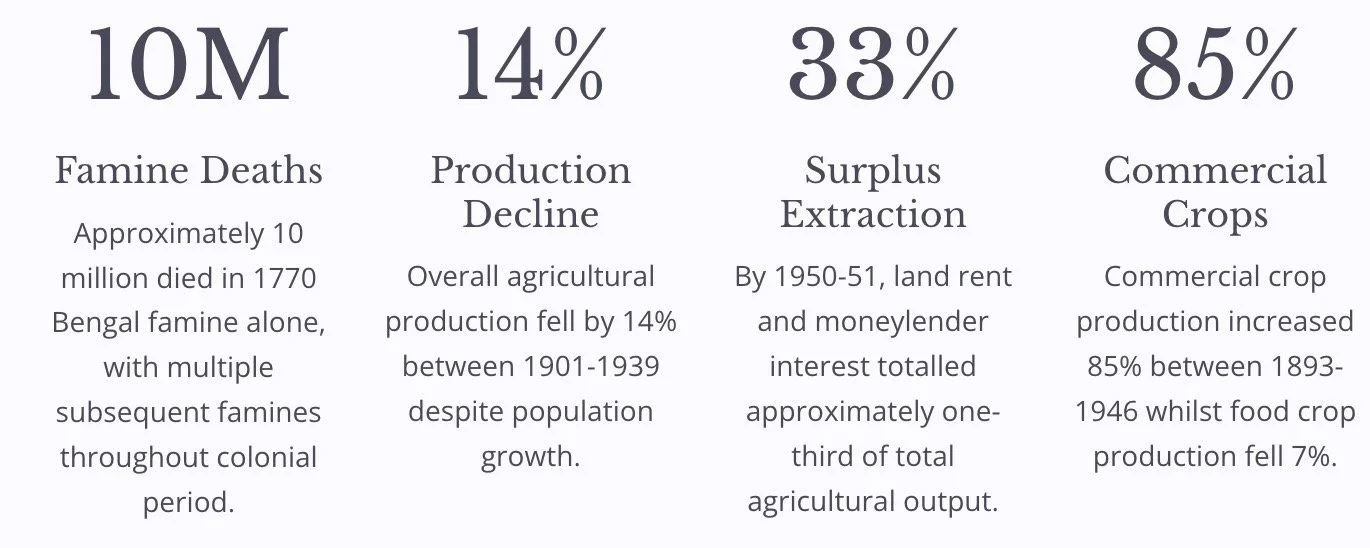
Famine Deaths
Approximately 10 million died in 1770 Bengal famine alone, with multiple subsequent famines throughout colonial period.
Production Decline
Overall agricultural production fell by 14% between 1901-1939 despite population growth.
Surplus Extraction
By 1950-51, land rent and moneylender interest totalled approximately one-third of total agricultural output.
Commercial Crops
Commercial crop production increased 85% between 1893-1946 whilst food crop production fell 7%.
Key Takeaways: British colonial agricultural policies systematically exploited Indian resources for imperial benefit, creating lasting structural problems in rural economy. Commercialisation served British industrial needs rather than Indian development. Oppressive revenue systems, landlord exploitation, and moneylender debt traps impoverished peasantry. Agricultural productivity stagnated due to multiple interconnected factors. The rise of landless labourers represented tragic social transformation. Understanding these colonial impacts is essential for analysing contemporary agricultural and rural development challenges in India.
