
Early Indian Response to British Rule
Indian Response to British Rule
The establishment of British colonial rule in India triggered profound upheaval across the subcontinent, fundamentally transforming agrarian relations, tribal autonomy, and social structures that had existed for centuries. From the late 18th century through the early 20th century, various communities—peasants, tribal groups, and cultivators—mounted fierce resistance against the oppressive systems imposed by the East India Company and later the British Crown. These rebellions, though often brutally suppressed, represent pivotal chapters in India's prolonged struggle for freedom and dignity.
This document examines three major uprisings that exemplify the diverse forms of resistance to British rule: the Rangpur Dhing Rebellion of 1783, the Kol Rebellion of 1832, the Santhal Rebellion of 1855-56, and the Moplah Rebellion of 1921. Each movement arose from distinct circumstances yet shared common threads—exploitation by revenue contractors, dispossession of traditional lands, and the disruption of established social orders. Through detailed analysis of these rebellions, we trace the evolution of anti-colonial resistance and its significance in shaping India's independence movement.
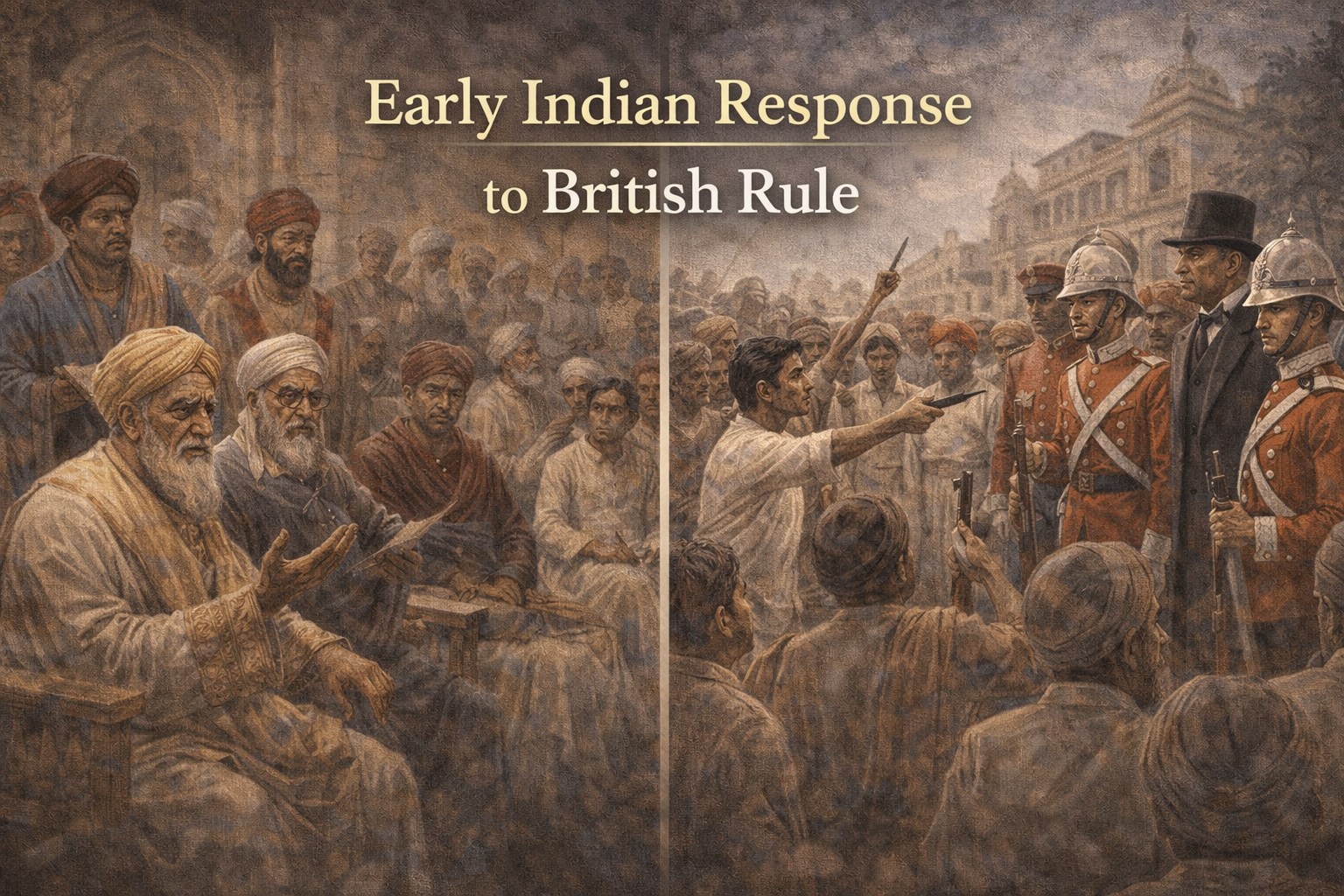
Early Indian Response to British Rule
The Acquisition of Diwani and Colonial Exploitation
The year 1765 marked a transformative moment in Indian history when the British East India Company acquired the Diwani—the right to collect territorial revenues—in Bengal, Bihar, and Orissa. This grant from the Mughal Emperor Shah Alam II provided the Company with access to potentially vast wealth but fundamentally altered the relationship between rulers and the ruled. What had been a system of shared rights and obligations devolved into naked exploitation as Company officials sought to extract maximum revenue from an already overburdened population.
Governor Henry Verelst, who assumed office in January 1767, observed with concern the unprecedented levels of "oppression and intrigues" that followed the Diwani acquisition. The Company's singular obsession with raising "as large a sum from the country as could be collected" created systematic suffering. Traditional checks and balances dissolved as the Company operated through a network of revenue farmers (ijardars) who contracted to pay fixed amounts whilst extracting whatever surplus they could from cultivators. This system bred corruption at every level—European collectors enriched themselves through illicit trade and misappropriation of funds, whilst revenue farmers unleashed terror upon villages to meet their contractual obligations.

The Acquisition of Diwani and Colonial Exploitation
Rangpur District: Burden Beyond Capacity
The Rangpur district in northern Bengal became a microcosm of colonial exploitation, where the theoretical promise of systematic revenue collection collapsed into practical tyranny. When the five-year settlement was introduced in 1772, the district was already in what officials euphemistically termed "a languishing condition." Yet rather than providing relief, the Company increased assessment rates. Even the district's own Collector admitted that the enhanced burden exceeded the region's capacity to bear it—a damning acknowledgement that went unheeded as revenue targets trumped economic reality.
By 1777, the five-year settlement's failure forced the Company to revert to annual settlements, the very system they had previously condemned as inefficient and oppressive. This policy reversal ushered in another period of "indecisive experiments" that lasted until the Permanent Settlement's introduction. For the zamindars and cultivators of Rangpur, each new policy meant only fresh opportunities for exploitation. The European collector and Indian revenue farmer operated in profitable tandem—the former benefiting from illicit private trade, the latter from surplus extorted beyond his contractual obligations. Between these grinding millstones, the peasantry was crushed.
Overburdened Assessment
Revenue demands increased despite district's "languishing condition" and admitted incapacity to bear enhanced burden
Failed Experiments
Five-year settlement collapsed by 1777, forcing return to condemned annual settlement system until Permanent Settlement
Systematic Corruption
European collectors and Indian revenue farmers colluded to extract maximum profit through legal and illegal means
The Rangpur Dhing Rebellion of 1783
In 1783, the peasants of Rangpur could endure no more. The immediate spark came from revenue contractors like Debi Singh and Gangagobinda Singh, who had been appointed ijardar of Rangpur and Dinajpur in 1780 and proceeded to unleash what contemporaries described as "a reign of terror" upon the villages. Debi Singh in particular practised "untold severity" to realise revenue, employing every conceivable form of compulsion against zamindars to enforce payment of the farmer's heavy demands. As pressure intensified, zamindars passed their burden to the ryots—the actual cultivators—who found themselves stripped of everything.
In a mass petition, the ryots laid bare their desperate condition: "We raiyats are ruined. In our house we have nothing left, our grain, our cattle, and other effects we have sold." The final provocation came with large-scale disposal of defaulting ryots' agricultural holdings at nominal prices—a practice that destroyed not merely livelihoods but the very possibility of survival. When the ryots' petition to Goodland, the district chief, failed to produce any relief, they took the revolutionary step of taking law into their own hands.
The Peasants Organise for Revolution
The transformation from petitioners to revolutionaries reveals the peasantry's sophisticated political consciousness. The Rangpur ryots did not simply riot; they organised themselves with remarkable discipline and purpose. They elected their own leader, Kena Sarkar of Gotamari in pargana Kakina, and raised a substantial army equipped with primitive weapons—bows, arrows, and swords. Their targets were carefully chosen symbols of oppression: they attacked the local cutchery (court of law), looted grain stores that represented their extracted surplus, and forcibly released prisoners who had been incarcerated for debt or revenue default.
On 18th January 1783, the uprising exploded across Rangpur. For five full weeks, the rebels exercised virtual control over the parganas of Tepa, Kazirhat, and Kakina. The movement's mass character manifested in huge assemblages of peasants cutting across caste and community—Hindu and Muslim cultivators fighting side by side against common oppressors. Most remarkably, the rebels didn't merely destroy the old order; they constructed an alternative. They formed their own government, invoking what historian Sugata Bose termed "symbols of the pre-colonial state system" to legitimise their movement. They called their leader "Nawab," appointed officers including a Dewan and Bakshi to run regular administration, issued proclamations forbidding revenue payments to the existing government, and levied taxes to finance their uprising. The trouble soon spread to neighbouring Dinajpur, threatening to engulf the entire region.
Petition Phase
Ryots petition Goodland for relief from oppression
Organisation
Elect leader Kena Sarkar, raise army with primitive weapons
18 Jan 1783
Uprising begins, rebels attack symbols of British authority
Rebel Government
Establish alternative administration with Nawab, Dewan, Bakshi
Five-Week Control
Rebels control Tepa, Kazirhat, Kakina; movement spreads to Dinajpur
Brutal Suppression and Its Aftermath
Faced with the collapse of Company rule across substantial territory, Warren Hastings responded with overwhelming military force. On Debi Singh's appeal, troops marched alongside Collector Goodland to crush the insurrection. On 22nd February, the rebels made their desperate last stand at Pattong. The battle that ensued was, as one observer noted, "an unequal fight"—primitive bows and arrows against Company muskets and artillery. Great numbers were killed, many taken prisoner, and a "reign of terror" was unleashed throughout Rangpur district to ensure no embers of rebellion remained.
Yet the Rangpur Rebellion was not entirely in vain. Its brutal suppression was followed by some reforms in the revenue farming system, as even the Company recognised that pushing exploitation beyond certain limits bred instability that threatened their very rule. The uprising demonstrated that peasants, given sufficient provocation, would organise sophisticated resistance transcending caste and religious boundaries. It established a template for agrarian revolt that would recur throughout colonial India—initial petitioning for redress, organisation when appeals failed, creation of alternative authority structures, and ultimately violent suppression followed by limited reforms. The Rangpur Dhing thus stands as the first major chapter in India's peasant resistance to British colonial exploitation.
Tribal Autonomy Under Threat
The Tribal Context
Whilst peasant rebellions like Rangpur arose from agrarian exploitation, a parallel stream of resistance emerged from India's tribal communities whose very existence was threatened by British expansion. For centuries, groups like the Bhils, Kolis, Kols, Mundas, and Oraons had maintained political autonomy and control over local resources in their forest and hill territories. They practised shifting cultivation, hunting, and gathering within customary boundaries, governed by their own headmen and councils, largely independent of external authority.
The British occupation fundamentally disrupted this world. As Company rule extended into tribal regions, it brought revenue demands, forest regulations, land settlements, and an influx of outsiders—moneylenders, merchants, and settlers who the tribals collectively termed "dikus" (outsiders). Traditional chiefs found their authority undermined by British courts and administrators. Customary rights to forest resources were restricted or abolished. Tribal lands were surveyed, assessed, and often transferred to non-tribal landlords who could pay higher revenues. The tribal population, accustomed to autonomy, suddenly found themselves reduced to tenants, labourers, or even bonded workers on lands their ancestors had inhabited for generations.
Bhils of Khandesh
Rose in 1819 after British occupation; crushed militarily; situation remained unsettled until 1831
Kolis of Ahmadnagar
Challenged British in 1829, quickly subdued; rebelled again 1844-46 under local leader
Kols of Chota Nagpur
Major uprising 1831-32 against revenue demands and land transfers; brutally suppressed
The Kol Uprising: Early Resistance in 1820
The Kol people—comprising various groups including Hos, Mundas, and Oraons—inhabited the Chota Nagpur plateau in present-day Bihar and Jharkhand. They had enjoyed centuries of independence, maintaining their social structures and land rights largely unmolested by external powers. This changed dramatically when the British consolidated control over the region. In 1820, the Raja of Porhat, having submitted to British authority and agreed to pay substantial annual tribute, claimed the neighbouring Kol region as his domain with British consent. He proceeded to collect taxes from the Ho segment of the Kols—a demand they viewed as utterly illegitimate.
The Kols' resistance was immediate and violent. They killed several officials sent to extract tribute, viewing such payments as both economically burdensome and a fundamental violation of their autonomy. The British response revealed the Empire's priorities: troops were dispatched to support the Raja's tax collection efforts. The Kols, armed with traditional weapons—bows, arrows, spears—faced British soldiers equipped with muskets and artillery. Though they fought with tremendous courage, the technological disparity proved insurmountable. By 1821, the Kols were forced to surrender, their brief assertion of independence crushed by superior firepower. Yet this early defeat merely planted seeds for a far more extensive rebellion a decade later.
Conditions Leading to the Kol Rebellion of 1831-32
Political Dispossession
British penetration and imposition of British law posed direct threat to power of hereditary tribal chiefs. Traditional autonomy over local governance and justice systems was systematically dismantled as Company courts and administrators superseded customary authority structures that had existed for centuries.
Land Alienation
Raja of Chota Nagpur, backed by British authority, began evicting tribal peasants by farming out land to outsiders for higher rents. Large-scale transfers of land from Kol headmen (Mundas) to Sikh and Muslim farmers fundamentally disrupted traditional land tenure systems where tribal chiefs held lands communally for their people.
Economic Exploitation
Settlement of non-tribals and constant transfer of land to merchants and moneylenders—collectively termed "sud" or outsiders—created crushing debt burdens. Mahajans extracted seventy per cent or more interest, trapping many Kols into bonded labour for life with no prospect of redemption from perpetually mounting debt obligations.
Revenue Oppression
Chhota Nagpur region leased out to moneylenders for revenue collection. Their oppressive tactics, combined with high revenue rates and British judicial and revenue policies, devastated traditional social framework of the Kols. Pleas for justice consistently failed to move authorities who prioritised revenue collection over tribal welfare.
The Kol Rebellion Erupts
By 1831, the accumulated grievances of dispossession, exploitation, and oppression reached breaking point. The Kol tribes organised themselves for systematic rebellion, directing their fury primarily against two targets: government officers who enforced the oppressive system and private moneylenders whose usurious practices had reduced many to bondage. The forms of rebellion reflected both traditional warfare practices and calculated strategy. Rebels attacked properties of outsiders whilst initially sparing their lives—a distinction suggesting this was political resistance rather than mindless violence. Plunder and arson served as chief modes of protest, with rebels burning revenue records, looting treasuries, and destroying symbols of Company authority.
However, as government repression intensified, the rebellion's character evolved. Insurgents adopted increasingly harsh measures, torching houses and killing those they identified as enemies—primarily outsiders who had displaced them. Significantly, they spared carpenters and blacksmiths, recognising these craftsmen's utility in producing weapons and useful goods. The rebellion's mass character and coordination became evident as it spread rapidly across Ranchi, Hazaribagh, Palamau, and Manbhum—districts covering vast territory. For weeks, the rebels effectively "wiped off the Raj from Chota Nagpore," as one contemporary observer noted with alarm.
70%: Interest rate extracted by moneylenders from tribal cultivators
1831: Year rebellion erupted across multiple districts
2 Years of intense resistance before suppression
Suppression of the Kol Uprising
The scale and intensity of the Kol rebellion alarmed British authorities, who recognised it as an existential threat to their control over the Chota Nagpur region. The Company mobilised military resources on an unprecedented scale, rushing troops from distant garrisons in Calcutta, Danapur, and Benaras—deployments that underscored both the rebellion's magnitude and the seriousness with which the British viewed this challenge. The immensity of the military response reflected not merely the number of rebels but the fear that successful tribal resistance might inspire similar uprisings across India's extensive tribal belt.
After two years of intense resistance—from 1831 to 1832—the Kol rebels finally succumbed to the overwhelming firepower of regular British troops. The suppression was characterised by extreme brutality designed not merely to defeat but to terrorise. Thousands of tribal men, women, and children were killed in punitive operations that swept through village after village. The British objective extended beyond military victory to psychological subjugation—ensuring that memory of defeat and its terrible cost would discourage future resistance. The rebellion's suppression marked a tragic turning point: a proud, autonomous people who had governed themselves for centuries were violently subordinated to an alien system that offered them neither dignity nor justice.
The Santhal People and Their Displacement
The Santhals, another major tribal community, lived scattered across various districts of Orissa, Dhalbhum, Manbhum, Barabhum, Chota Nagpur, Palamau, Hazaribagh, Midnapur, Bankura, and Birbhum in eastern India. They were skilled cultivators who had developed sophisticated agricultural practices and possessed good agricultural land. Their traditional way of life combined settled agriculture with forest clearing, hunting, and gathering—a sustainable system that had served them for generations.
However, as agents of colonial rule claimed rights over Santhal lands, the community faced a devastating choice: submit or retreat. Choosing autonomy over subjugation, they migrated to the Rajmahal Hills, where they cleared new agricultural lands in areas they called Damin-i-koh. This represented an enormous investment of labour—felling forests, preparing fields, establishing villages. For a brief period, they enjoyed renewed independence in their new homeland. But the respite proved temporary. British operatives, in collaboration with local landlords and zamindars—all categorised by the Santhals as "Diku" (outsiders)—soon began claiming rights in this newly settled land as well. The pattern of dispossession and exploitation that had driven them from their original homeland now threatened to engulf their hard-won refuge.
The Trap of Debt Bondage
The Santhals' entry into relations with moneylenders and traders proved catastrophic. These outsiders initially appeared as businessmen offering goods on credit—a service that seemed beneficial given the Santhals' limited access to markets and manufactured items. However, the transactions were structured as debt traps from the outset. The unsophisticated and largely unlettered Santhals signed agreements they could not read, accepting terms they did not fully understand. Interest rates ranged from fifty to five hundred per cent—rates that ensured loans could never be fully repaid regardless of the borrower's efforts.
Through systematically corrupt practices, the compound interest accumulated on principal amounts multiplied exponentially. A loan taken to purchase a plough or seed might grow, through the magic of compound interest, into a debt exceeding the value of the borrower's entire landholding. Once trapped in this system, entire Santhal families found themselves transformed into bonded labourers—working not for wages but merely to service debt that grew faster than they could work to repay it. This bondage often extended across generations; children inherited their parents' debts along with the obligation to work them off. Meanwhile, lands were systematically grabbed by moneylenders who manipulated legal proceedings that Santhals could neither understand nor effectively contest. The British courts, staffed by officials who viewed the Santhals as primitive, consistently sided with the literate, legally sophisticated moneylenders against the tribal borrowers.
Minimum Interest
Lowest interest rate charged by moneylenders to Santhal borrowers
Maximum Interest
Highest interest rate imposed, ensuring perpetual debt bondage
Land Alienation
Complete loss of ancestral lands to outsiders through debt manipulation
The Santhal Rebellion of 1855-56
In July 1855, when the Santhals' ultimatum to zamindars and the government went unheeded, they rose in massive rebellion. The uprising was led by four remarkable brothers of the Murmu clan—Sidhu, Kanhu, Chand, and Bhairav—who became legendary figures in Santhal history and broader Indian resistance to colonialism. Under their leadership, several thousand Santhals armed themselves with traditional weapons—bows and arrows—and launched a coordinated insurrection against what they termed "the unholy trinity of their oppressors": the zamindars, the mahajans (moneylenders), and the government that protected both.
The rebellion's targets were carefully selected to strike at the foundations of the exploitative system. Rebels attacked the houses of moneylenders where debt records were kept, burning documents that represented their bondage. They assaulted zamindars' estates, confronted white planters who had appropriated tribal lands, and targeted railway engineers whose construction projects displaced communities. British officials who represented the colonial state faced direct assault. Many moneylenders, native agents of the Company, and other intermediaries were killed—actions that reflected both accumulated rage and strategic calculation to eliminate those who made the system of exploitation function.
The insurrection spread with remarkable rapidity. In the wide region between Bhagalpur and Rajmahal, the Company's rule virtually collapsed. Rebels cut postal and railway communications—arteries of colonial control—spreading panic in government circles. Most significantly, the Santhal rebels proclaimed the end of Company rule and the commencement of Santhal Raj—their own government. This represented more than military rebellion; it was an assertion of political sovereignty and the right to self-determination. At this stage, the rebellion gained additional strength as low-caste non-tribal peasants, who also suffered under the zamindari-mahajan system, actively joined the Santhal cause. The movement thus transcended tribal identity to become a broader anti-colonial, anti-feudal uprising.
British Counter-Insurgency and the Battle's End
The Santhals initially achieved remarkable success using guerrilla warfare tactics. Their skill in archery proved formidable—Santhal warriors could fire arrows with extreme accuracy and devastating impact, making direct engagement in forest terrain highly dangerous for British troops. Recognising this, British commanders adapted their strategy. Rather than pursuing rebels into forests where Santhal advantages were greatest, they devised a trap that exploited the rebels' courage and their unfamiliarity with European military deception.
In the conclusive battle, British forces positioned themselves at the foot of a hill where Santhals had established a strong position. When fighting began, British officers ordered volleys fired without bullets—creating smoke and noise that simulated real combat. Unable to detect this deception, Santhal warriors charged in full force, confident in their ability to close distance and engage with bows and arrows. As they neared the hill's base, British troops switched to live ammunition, unleashing devastating firepower against the advancing Santhals. The hapless warriors, committed to their charge, were cut to pieces by sustained volleys of musket fire and artillery. It was a massacre dressed as battle—European military technology and tactical sophistication overwhelming tribal courage and traditional weapons.
Following this decisive defeat, brutal counter-insurgency operations commenced. The British army, mobilised in force and supplied with elephants by the Nawab of Murshidabad, systematically demolished Santhal villages. These elephants—symbols of traditional Indian power now serving colonial ends—trampled through settlements, destroying huts whilst troops committed widespread atrocities designed to terrorise survivors into submission. According to various calculations, between fifteen and twenty thousand rebels were killed out of a total insurgent force estimated at thirty to fifty thousand—a death toll that represented not merely military suppression but systematic slaughter intended to break Santhal spirit permanently. Sidhu and Kanhu, the celebrated leaders, were killed, becoming martyrs whose memory would inspire future generations.
Aftermath and Significance of the Santhal Rebellion
Santhal Parganas Tenancy Act, 1856
British passed legislation attempting to appease Santhals by providing some protection from colonial exploitation, recognising limits of sustainable oppression
Separate Administrative Unit
Santhal-inhabited areas constituted into distinct Santhal Parganas, acknowledging uniqueness of tribal culture and identity
Administrative Reforms
Land alienation checked, regular police abolished, local administration vested in locals and village headmen rather than distant bureaucrats
Although brutally suppressed, the Santhal Hul (rebellion) marked significant changes in colonial policy. The British recognised that governance required some accommodation of tribal sensibilities rather than pure exploitation. The day of rebellion—30th June—continues to be celebrated among the Santhal community with profound respect and spirit, honouring thousands of martyrs who sacrificed their lives alongside the four legendary Murmu brothers. Though its impact was largely overshadowed by the Great Rebellion of 1857, which erupted shortly thereafter, the legend of the Santhal Rebellion lives on as a defining moment in Santhal pride and identity.
The Santhal Hul stands as one of the fiercest battles in Indian freedom struggle history, causing the greatest number of casualties—approximately twenty thousand—in any single uprising during that period. Its characteristics reveal sophisticated political consciousness: the rebellion constituted open, public political action rather than crime, with ample advance warning, public conferences, assemblies, and planning that evidenced a clear programme. Grand ceremonies and rebel marches demonstrated organisational capacity and collective will. The rebellion's effectiveness within the geographical area where the Santhal community lived and worked illustrated how ethnic ties and shared grievances could mobilise entire populations. The evocation of a "Golden Age" in the distant past provided powerful ideological justification for peasant action, as rebels sought to restore an imagined but deeply felt world of justice and autonomy that colonial rule had destroyed.
The Mappila Muslims of Malabar
The Moplah (or Mappila) community of Malabar, Kerala, represented a unique amalgam in Indian society—descendants of Arab traders who had settled in the region and married local Nair and Tiyar women. This community's history stretched back centuries to when Arab merchants dominated Indian Ocean trade, establishing commercial networks along the Malabar coast. Over time, the Mappila community expanded through conversion of lower-caste Hindus, particularly Cherumars—a slave caste whose emancipation under the Slavery Abolition Act of 1843 paradoxically worsened their social position. Many hoped conversion to Islam would provide better social status and economic opportunities that Hindu society denied them.
Gradually, the Mappilas shifted from their mercantile origins to become predominantly dependent on agriculture. The community evolved into cultivating tenants, landless labourers, petty traders, and fishermen—in other words, the working classes of Malabar society. Despite their poverty, Mappilas imitated traditional Nayar warrior customs and acquired reputations as fierce fighters. This martial tradition would prove significant when economic grievances later erupted into violent resistance.
Arab Descent
Descendants of Arab traders who married local women
Lower-Caste Converts
Community grew through conversion of oppressed Hindu castes
Agricultural Tenants
Shifted from trade to become cultivators and labourers
The Malabar Land System and Its Inequities
Understanding the Moplah Rebellion requires examining Malabar's distinctive land tenure system, which created explosive social tensions along religious and class lines. At the apex stood the Jenmi—landlords who held land by birthright, consisting mainly of Nambudiri Brahmins and Nambiar chieftains. As the highest level of social hierarchy, jenmis were "a class of people given hereditary land grants by the Naduvazhis or rulers." Owing to their ritual status as Brahmin priests, jenmis could neither personally cultivate nor supervise land but would lease it to other groups in return for a fixed share of crops produced.
Traditionally, the system operated on a tripartite division wherein net produce was shared equally amongst three parties: the janmi (holder of janmam tenure), the Kanamdar or Kanakkaran (holder of kanam tenure), and the cultivator. This arrangement, whilst hierarchical, provided some equity and security. However, British intervention fundamentally destabilised this system. When Haider Ali and Tipu Sultan of Mysore captured Malabar (1788-1792), they drove out Namboodiri Brahmin and Nayar landlords, who fled to neighbouring states. The resulting vacuum was filled by Mappila Muslims, who under Mysorean rule reached accord with the government. Tipu's administration introduced a new revenue system based on actual produce, replacing earlier arrangements.
Traditional System
Equal three-way division of produce between janmi, kanamdar, and cultivator provided relative equity
Mysorean Interlude (1788-1792)
Tipu Sultan drives out Hindu landlords; Mappilas fill vacuum and reach accord with government
British Takeover (1792)
Company restores exiled landlords, recognises jenmis as absolute owners with eviction rights
Tenant Degradation
Kanandars and cultivators reduced to tenants without security; Mappilas bear brunt of exploitation
British Policy and the Road to Rebellion
When the British took over Malabar in 1792 following the Third Mysore War, they sought to revamp land relations by introducing individual ownership rights—a concept alien to traditional Malabar tenure. The Company reestablished and acknowledged the landlord rights of returning Namboodiri Brahmins and Nayars, but went far beyond restoration. The British system recognised the janmi as absolute owners of land with right to evict tenants—a power that had not existed in the traditional system. The other two categories—Kanamdar and cultivator, predominantly Mappila Muslims—were reduced to mere tenants and leaseholders with no security of tenure.
Overassessment
Revenue demands set beyond cultivators' capacity to pay
Illegal Cesses
Huge burden of unlawful taxes extracted by landlords
Renewal Fees
Exorbitant charges for maintaining tenancy rights
No Tenure Security
Tenants could be evicted without notice or cause
Pro-Landlord System
Courts, law officers, and police sided with jenmis
The peasantry in Malabar lived and worked in conditions of extreme penury created by twin exactions of landlord and state. Beyond official revenue, tenants faced huge burdens of illegal cesses, high rents, oppressive landlord exactions, and renewal fees at exorbitant rates. The lack of tenure security meant a tenant could be ejected from land his family had cultivated for generations based on a landlord's whim or desire to extract higher rents from someone else. Courts and law officers consistently sided with jenmis, who had wealth, literacy, and social status. Police supported landlord interests, treating tenant protests as criminal disturbances rather than legitimate grievances.
Most explosively, the majority of janmi landlords were high-caste Hindus whilst the oppressed peasants were Muslim Mappilas. Religion and economic grievances intermingled to produce a volatile mentality. Mosques became centres of mobilisation. Targets became specifically Hindu jenmis, their temples, and British officials who protected them. Many Mappilas developed beliefs that killing oppressive landlords—who also happened to be kafirs (non-believers)—constituted religious virtue. Violence thus acquired both economic and religious justification.
The Moplah Rebellion of 1921 and Its Legacy
Throughout the nineteenth century, a series of Mappila uprisings occurred—twenty-two revolts between 1836 and 1854 alone, with particularly serious outbreaks in 1841 and 1849. These early revolts often had messianic overtones, with faithful sacrificing their lives believing they would go straight to heaven as martyrs. A second phase erupted in 1882-85, followed by another spate in 1896. The pattern remained consistent: groups of Mappila youths would attack Brahmin jenmis, Nayar officials, or janmis' servants; burn or defile temples; or assault landlords' houses. Police crackdowns would follow, with rebels seeking refuge in mosques or temples.
The Moplah Rebellion of 1921 stemmed from twin grievances: continued oppression by landlords and British anti-Khilafat policies. In August 1921, peasant discontent erupted across Malabar district. The immediate cause was renewal fees at exorbitant rates fixed by jenmis—unbearable for Mappila tenants. The Khilafat Movement, seeking to protect the Turkish Caliphate, had mobilised Muslim sentiment across India. Leaders like Gandhi, Shaukat Ali, and Maulana Azad addressed Mappila meetings, connecting their local grievances to broader national struggle. When national leaders were arrested, local Mappila leaders took control. The British government, weakened by World War I, appeared vulnerable.
The final spark came on 20th August 1921 when the district magistrate raided the Tirurangadi mosque to arrest Ali Musaliar, a Khilafat leader and Muslim priest. Police fired on unarmed crowds; many were killed. A clash ensued wherein government offices were destroyed, records burnt, treasuries looted. Initially, rebels targeted symbols of British authority and unpopular landlords. However, once martial law was declared and repression intensified, the rebellion's character changed tragically. Many Hindus were seen helping authorities, and what began as anti-government and anti-landlord struggle acquired communal overtones. This communalisation completed the Mappilas' isolation. By December 1921, brutal British repression had crushed all resistance. Ali Musliyar and other leaders were tried, sentenced to death, and executed. The movement's failure lay substantially in its communal turn, its adoption of violence contrary to the Non-Cooperation Movement's principles, and its inability to mobilise broader peasant support beyond the Mappila community. Yet it remains a significant chapter in India's complex history of resistance—demonstrating how economic exploitation, religious identity, and colonial oppression could intersect in tragic and combustible ways. The legacy endures in Mappila memory as both heroic resistance and cautionary tale about the perils of communal division.
