
The Great Revolt of 1857
The Great Revolt of 1857 stands as a watershed moment in Indian history, marking the first large-scale resistance against British colonial rule. This comprehensive examination explores the multifaceted causes, dramatic events, and far-reaching consequences of an uprising that shook the British Empire to its very foundations. What began as a military mutiny rapidly transformed into a widespread rebellion, drawing participants from diverse sections of Indian society—sepoys, zamindars, peasants, artisans, and dispossessed rulers—all united in their opposition to foreign domination.
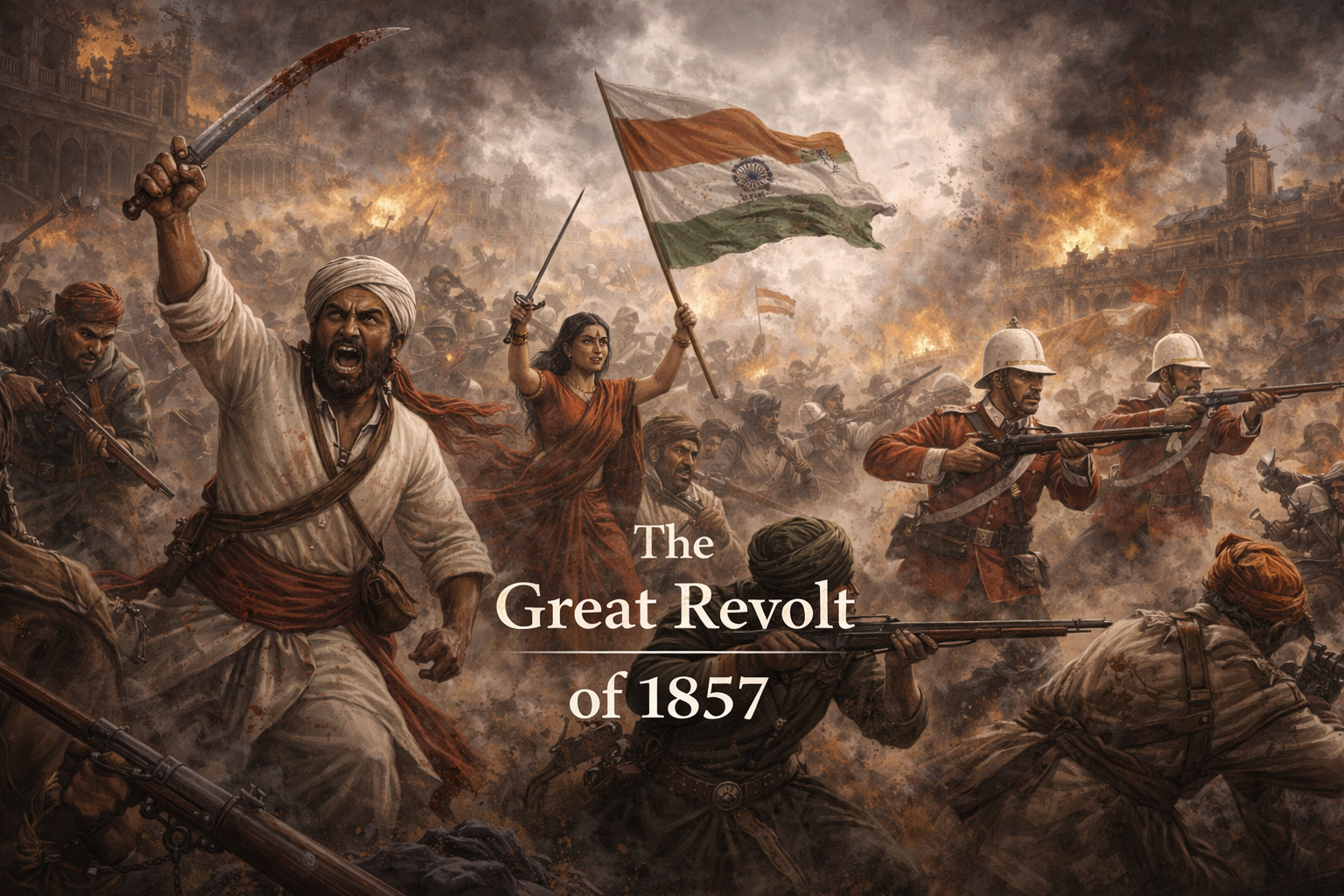
The Great Revolt of 1857
The Gathering Storm: Pre-1857 Context
By the mid-19th century, British expansionist policies, economic exploitation, and administrative innovations had adversely affected nearly every segment of Indian society. Rulers of Indian states found their sovereignty undermined, sepoys faced discrimination and cultural insensitivity, zamindars lost traditional privileges, peasants groaned under heavy taxation, and traders saw their livelihoods destroyed by colonial economic policies. Only the Western-educated urban class, whose position depended on Company patronage, remained relatively unaffected by these sweeping changes.
The Lucknow Proclamation of 1857 crystallised these grievances, identifying four fundamental aspects threatened by British rule: religion, honour, life, and property. These concerns resonated deeply with both Hindus and Muslims, transcending communal divisions and creating a shared sense of existential threat under colonial domination.
1806 - Vellore Mutiny
Early military resistance against British policies
1824 - Barrackpore Mutiny
Sepoys refused overseas service to Burma
1831-32 - Kol Insurrection
Tribal uprising against colonial encroachment
1855-56 - Santhal Rising
Major tribal rebellion preceding the Great Revolt
Economic Devastation: The Colonial Drain
The East India Company's colonial policies systematically destroyed traditional Indian trade and industry, transforming a prosperous economy into an impoverished agricultural hinterland. Karl Marx, writing in 1853, observed with stark clarity: "It was the British intruder who broke up the Indian hand loom and destroyed the spinning wheel. England began with depriving the Indian cottons from the European market; it then introduced twist into Hindustan and in the end inundated the very mother country of cotton with cottons."
Peasantry
Unpopular revenue settlements forced peasants into debt with moneylenders and traders, leading to widespread eviction from ancestral lands. The moneylender emerged as the new zamindar, fundamentally altering traditional agrarian relationships.
Artisans & Handicraftsmen
Loss of traditional patronage combined with British policies that discouraged Indian handicrafts whilst promoting British manufactured goods. The destruction of handicrafts occurred without compensatory industrial development.
Zamindars
The traditional landed aristocracy saw their rights forfeited through frequent use of quo warranto proceedings. In Awadh alone, 21,000 taluqdars had estates confiscated, plunging them into sudden poverty.
The ruination of industry increased pressure on agriculture and land, resulting in the systematic pauperisation of the country. These dispossessed groups awaited an opportunity to oppose British rule and reclaim what they had lost—an opportunity presented by the sepoy revolt of 1857.
Political Grievances: Annexation and Dispossession
The East India Company's political policies generated widespread suspicion and uneasiness amongst ruling princes throughout India. Through mechanisms such as 'Effective Control', Lord Wellesley's 'Subsidiary Alliance', and Lord Dalhousie's notorious 'Doctrine of Lapse', the Company systematically absorbed Indian states into its territorial empire. These policies, combined with the Company's reputation for breaking pledges and oaths, severely damaged British political credibility.
The distinction between 'dependent states' and 'protected allies' proved dangerously thin, with the East India Company holding unilateral authority over disputed interpretations. No independent Supreme Court existed to provide impartial verdicts on questions of right and wrong, leaving Indian rulers entirely at the mercy of Company decisions, with the Court of Directors' word being final.
Right of Conquest
Punjab, Pegu, and Sikkim annexed through military force
Doctrine of Lapse
Satara, Jaipur, Sambhalpur, Baghat, Udaipur, Jhansi, and Nagpur absorbed for lack of natural heirs
Administrative Pretexts
Oudh annexed on dubious grounds of "the good of the governed"
Humiliation of the Mughal House
The systematic degradation of the Mughal dynasty served as a powerful symbolic affront to Indian Muslims and to the broader Indian population who still regarded the Mughal emperor as a traditional sovereign. Bahadur Shah II, though advanced in age and politically weak, remained the titular emperor of Delhi. Lord Dalhousie had conditionally recognised the succession of Prince Faqir ul Din, imposing strict limitations on his authority.
"Were I Emperor of India for twelve years… no India prince should exist. The Nizam should no more be heard of.. Nepal would be ours…"
—Sir Charles Napier
Following Prince Faqiruddin's death in 1856, Lord Canning announced that the next successor would be required to renounce the regal title, vacate the ancestral Mughal palaces, and accept even more stringent conditions than those imposed on his predecessor. The regal titles of the Nawabs of Carnatic and Tanjore were abolished, whilst the pension of Peshwa Baji Rao's adopted son was stopped. These acts profoundly unnerved Indian Muslims and created widespread anxiety amongst ruling princes, who correctly perceived that the absorption of all Indian states was merely a matter of time.
The concept of 'absentee sovereigntyship' further alienated Indians from British rule. Unlike previous conquerors—Pathans and Mughals who had settled in India and become Indian—the British ruled from England, thousands of miles distant, draining the country's wealth whilst remaining fundamentally foreign. The policy of Pax Britannica had disbanded Pindaris, Thugs, and irregular soldiers, creating a nucleus of unemployed military men who would swell the ranks of rebels when disturbances erupted in 1857.
Administrative Injustices and Inefficiency
Systematic Discrimination
Indian aristocracy found itself deprived of power and position, with limited opportunities in the new administrative structure. All high posts, civil and military, were reserved exclusively for Europeans. In military service, the highest post attainable by an Indian was Subedar (earning Rs. 60-70 monthly), whilst in civil service, Sadr Amin represented the ceiling (Rs. 500 monthly). Promotion prospects remained virtually non-existent.
Institutional Racism
Sir Thomas Munro, pleading for Indian employment in 1817, wrote: "Foreign conquerors have treated the natives with violence, and often with cruelty, but none has treated them with so much scorn as we; none has stigmatised the whole people as unworthy of trust, as incapable of honesty and as fit to be employed only where we cannot do without them."
Revenue Administration Chaos
The administrative machinery proved both inefficient and insufficient. The land revenue police became deeply unpopular, with many districts in newly annexed states existing in permanent revolt, requiring military intervention to collect revenue. In Panipat district, for instance, 136 horsemen were maintained for revenue collection whilst only 22 performed police duties.
Sir Henry Lawrence remarked at the outbreak: "It was the Jackson, the John Lawrence, the Thomason, the Edmonstones who brought India to this." The new revenue settlements eliminated middlemen by establishing direct contact with peasants, dispossessing hereditary landlords. In Oudh, taluqdars suffered most severely.
The Inam Commission appointed in 1852 confiscated 20,000 estates in Bombay alone. Holders of rent-free tenures were dispossessed through quo warranto proceedings requiring production of title deeds. Large estates were sold at public auction to speculators who ruthlessly exploited tenants. These policies impoverished the aristocracy without benefiting peasants, who groaned under heavy assessments and excessive duties whilst harbouring sympathy for dispossessed landlords. Rampant corruption throughout the administration gave British rule a distinctly foreign and alien character in Indian eyes.
Socio-Religious Provocations
British racial attitudes and assumed superiority created deep resentment amongst Indians of all classes. The rulers pursued a deliberate policy of contempt, describing Hindus as barbarians lacking culture and civilisation, whilst Muslims were characterised as bigots, cruel and faithless. Indians were commonly addressed using the epithet "suar" (pig)—particularly offensive to Muslims—or referred to using racial slurs. European juries acquitted European criminals with minimal or no punishment, whilst Indians faced harsh sentences for similar offences. Such systematic discrimination rankled deeply in the Indian consciousness.
Christian Missionaries
Christianisation was openly declared as an ultimate aim of British rule in India. Major Edwards stated that "the Christianization of India was to be the ultimate end of our continued possession of it." Sepoys were promised promotions for converting to Christianity.
Cultural Assault
Missionary societies, such as the American Missionary Society at Agra, established extensive printing presses. Hindu idolatry was denounced, gods and goddesses ridiculed, and traditional practices dismissed as ignorance.
Social Reform
Well-intentioned reforms—abolition of sati, support for widow remarriage, women's education—were perceived as unwarranted interference in Indian social and religious domains.
Sir Syed Ahmed Khan noted that "it has been commonly believed that government appointed missionaries and maintained them at its own cost." The Religious Disabilities Act of 1856 modified Hindu customs, declaring that religious conversion did not debar a son from inheriting his father's property—a provision seen as encouraging apostasy. The government's decision to tax mosque and temple lands was viewed as direct religious persecution. Lord Shaftesbury voiced evangelical opinion by attributing the revolt to Britain's failure to Christianise India sufficiently.
Military Discontent: A Powder Keg
Since Lord Auckland's disastrous Afghan adventure, army discipline had deteriorated significantly. Lord Dalhousie himself wrote to home authorities that "the discipline of the army from top to bottom officers and men alike, is scandalous." The Bengal Army functioned as "a great brotherhood in which all the members felt and acted in union," with service being hereditary. Three-fifths of Bengal Army recruits came from Oudh and the North Western Provinces, predominantly from high-caste Brahmin and Rajput families who resented military discipline that treated them equally with low-caste recruits.
Three mutinies had occurred during Dalhousie's Governor-Generalship alone. Maulana Azad observed that the annexation of Oudh "marked the beginning of a rebellious mood in the army generally and in the Bengal army in particular." Sepoys suddenly realised that British power, acquired through their service and sacrifice, was being used to liquidate their own king.
Service Conditions
Extension of British dominion adversely affected sepoy service conditions. Soldiers were required to serve far from home without extra bhatta (allowance). Their emoluments were vastly inferior to British counterparts. They yearned for traditional rewards—jagirs and prizes—rather than witnessing their victories in Sindh and Punjab bring worse conditions.
Religious Conflicts
Service conditions conflicted with religious beliefs. Restrictions on wearing caste and sectarian marks, combined with proselytising rumours, created widespread anxiety. The General Service Enlistment Act of 1856 required future recruits to serve anywhere, including overseas—considered caste-defiling for Hindus. Afghan War veterans (1839-42) had not been readmitted to their castes.
Structural Weaknesses
The Post Office Act of 1854 withdrew free postage privileges. The army's composition—238,000 native versus 45,322 British soldiers—created dangerous imbalance. Good officers were deployed in administrative posts in newly annexed territories. Crimean War disasters had lowered British military morale, making Indian soldiers believe they had reasonable chances of success.
The sepoy was fundamentally a 'peasant in uniform' whose consciousness remained connected to rural populations. Their grievances extended beyond military matters, reflecting general disenchantment with British rule. A long history of revolts existed: Bengal (1764), Vellore (1806), Barrackpore (1825), and during the Afghan Wars (1838-42).
The Greased Cartridges: Spark to the Powder Keg
In 1856, the government decided to replace the old-fashioned musket, 'Brown Bess', with the superior Enfield rifle. Training centres were established at Dum Dum, Ambala, and Sialkot. The Enfield rifle's loading process required bringing the cartridge to the mouth and biting off the top greased paper covering. In January 1857, a rumour spread through Bengal regiments that the cartridge grease contained cow and pig fat—substances religiously abhorrent to Hindus and Muslims respectively.
The greased cartridge did not create new discontent in the army, but supplied the occasion when underground discontent erupted into open rebellion. It was the match that ignited the inflammable material accumulated through a century of political, social, religious, and economic grievances.
Military authorities immediately issued denials without proper investigation, proving counterproductive. Assurances from superior officers and minor concessions proved ineffective. Sepoys became convinced that introducing greased cartridges represented a deliberate attempt to defile their religion. Reports about bone dust being mixed in atta (flour) enhanced growing disaffection. The administration did nothing to allay these fears, leaving sepoys convinced their religion faced grave danger.
External events further influenced the situation. Britain had suffered serious losses in the First Afghan War (1838-42), Punjab Wars (1845-49), Crimean Wars (1854-56), and Santhal rebellion (1855-57), creating psychological repercussions that emboldened potential rebels whilst demoralising British forces and administrators.
The Explosion: Meerut to Delhi
February 1857 - Berhampur
Infantry refused Enfield rifles, broke into mutiny. Regiment disbanded.
March 29, 1857 - Barrackpore
Mangal Pandey (34th Native Infantry) fired at the sergeant major. Executed April 6; regiment disbanded in May.
May 3, 1857 - Barrackpore
7th Awadh Regiment defied officers, met similar fate as earlier regiments.
May 9, 1857 - Meerut
Eighty-five soldiers of 3rd Native Cavalry sentenced to 10 years' imprisonment for refusing greased cartridges.
May 10, 1857 - Meerut
Indian soldiers released imprisoned comrades, killed officers, unfurled the banner of revolt.
May 11, 1857 - Delhi
Meerut sepoys marched to Red Fort, appealed to Bahadur Shah II for leadership, transforming mutiny into revolutionary war.
The proclamation of Bahadur Shah as Shahenshah-e-Hindustan gave positive political meaning to the revolt. The long Mughal dynasty had become the traditional symbol of India's political unity. With this single act, sepoys transformed a soldiers' mutiny into a revolutionary war. All Indian chiefs participating in the revolt hastened to proclaim loyalty to the Mughal emperor.
Though Bahadur Shah vacillated—uncertain of sepoys' intentions or his own ability to play an effective role—he was eventually persuaded, if not coerced. He wrote letters to all Indian chiefs and rulers urging them to organise a confederacy of Indian states to fight and replace the British regime. Sepoys captured Delhi, killing Simon Fraser (the Political Agent) and several other Englishmen. Public offices were occupied or destroyed. Within a month, rebellion spread to Lucknow, Allahabad, Kanpur, Bareilly, Banaras, parts of Bihar, Jhansi, and other locations throughout Northern and Central India.
Storm Centres and Leadership Across India
Delhi - Bahadur Shah II & General Bakht Khan
Delhi became the revolt's symbolic centre. Real military command fell to General Bakht Khan, who led Bareilly troops to Delhi. Bahadur Shah's weak personality, advanced age, and lack of leadership created political weakness at the nerve centre, causing incalculable damage to the revolt's prospects.
Kanpur - Nana Saheb
Nana Saheb, adopted son of the last Peshwa Baji Rao II, had been refused the family title and banished from Poona. He expelled the English from Kanpur, proclaimed himself Peshwa, acknowledged Bahadur Shah as emperor, and declared himself the emperor's governor. General Wheeler surrendered on June 27. Tantia Tope joined as his able lieutenant.
Lucknow - Begum Hazrat Mahal
Rebellion broke out on June 4, 1857, with overwhelming popular sympathy for the deposed Nawab. Begum Hazrat Mahal assumed leadership, proclaiming her son Birjis Qadir as Nawab. Henry Lawrence, the British Resident, took shelter in the Residency, which was besieged by rebels. Lawrence was killed during the siege.
Jhansi - Rani Laxmibai
Troops mutinied in early June 1857. Rani Lakshmi Bai, widow of Raja Gangadhar Rao, was proclaimed ruler. After Kanpur's loss, Tantia Tope joined her. Together they marched to Gwalior, where Indian soldiers hailed them. Nana Saheb was proclaimed Peshwa with plans for a southern campaign.
Other significant leaders included Khan Bahadur (descendant of Rohilkhand's former ruler) at Bareilly, Kunwar Singh (zamindar of Jagdishpur) in Bihar, and Maulvi Ahmadullah at Faizabad. The revolt's real strength lay in widespread participation by peasantry, artisans, shopkeepers, day labourers, zamindars, religious mendicants, priests, and civil servants—giving it the character of a popular revolt rather than merely a military mutiny.
Popular Participation: Beyond the Sepoys
The sepoy revolt was accompanied by widespread rebellion of the civil population, particularly in the North-Western Provinces and Awadh. Peasants and petty zamindars expressed grievances by attacking moneylenders and zamindars who had displaced them from land. They destroyed moneylenders' account books and debt records, attacked British-established law courts, revenue offices (tehsils), revenue records, and police stations. This rural participation gave the revolt its genuine popular character and transformed it from a military mutiny into a broader social uprising.
At Banaras, a rebellion was organised but mercilessly suppressed by Colonel Neill. Throughout affected regions, the uprising transcended military boundaries, drawing participants from diverse social strata united in opposition to British rule. Shopkeepers closed establishments, artisans refused to work for the British, and religious figures provided moral support and sometimes leadership to rebel forces.
Peasantry
Rural populations formed the backbone of civil resistance, attacking symbols of British authority
Artisans
Skilled workers whose livelihoods had been destroyed by colonial policies joined the uprising
Traders & Shopkeepers
Urban commercial classes disrupted British supply lines and administration
Dispossessed Zamindars
Traditional landowners sought to reclaim lost status and properties
Religious Leaders
Pundits, maulvis, and mendicants provided spiritual legitimacy to the revolt
British Suppression: Reclaiming Control
The British eventually suppressed the revolt through systematic military operations, brutal reprisals, and strategic manipulation of Indian divisions. Delhi's recapture held great psychological importance, and British efforts concentrated there. Troops rushed from Punjab and positioned themselves north of Delhi. In September 1857, Delhi was recaptured, though John Nicholson, the siege's hero, succumbed to injuries sustained during operations. The Emperor was arrested, and terrible vengeance was wreaked upon Delhi's inhabitants. Lieutenant Hodson personally shot two sons and a grandson of the Emperor in public.
Lucknow Campaign
Early attempts by Havelock and Outram to recover Lucknow failed. Relief came in November 1857 when Sir Colin Campbell, the new Commander-in-Chief sent from England, entered the city with Gorkha regiments and evacuated Europeans. The city was finally reduced in March 1858.
Kanpur Reconquest
Military operations for recapturing Kanpur were closely associated with Lucknow's recovery. Sir Campbell occupied Kanpur on December 6. Tantia Tope escaped and joined the Rani of Jhansi. Nana Saheb, defeated at Kanpur, escaped to Nepal in early 1859, never to be heard from again.
Jhansi and Gwalior
Sir Hugh Rose recaptured Jhansi by assault on April 3, 1858. Gwalior was recaptured in June 1858; the Rani of Jhansi died fighting. Tantia Tope escaped southward but was captured in April 1859 by one of Sindhia's feudatories and handed over to the British for execution.
Final Suppression
By 1859, Kunwar Singh, Bakht Khan, Khan Bahadur Khan of Bareilly, Rao Sahib (Nana Saheb's brother), and Maulvi Ahmadullah were all dead. The Begum of Awadh was compelled to hide in Nepal. By July 1858, rebellion had been almost completely suppressed.
Britain poured immense supplies of men, money, and arms into the country. Indians were forced to repay the entire cost of their own suppression—a bitter irony that would not be forgotten. The suppression's brutality left deep scars on the Indian psyche and fundamentally altered the relationship between rulers and ruled.
Why the Revolt Failed: Analysing Defeat
Limited Territorial Spread
The revolt was localised and restricted. Eastern, southern, and western India remained largely unaffected. Bombay and Madras armies remained loyal. India south of the Narmada experienced little disturbance. Sindh and Rajasthan remained quiet, whilst Nepal's assistance proved invaluable in suppression. Punjab was effectively controlled by John Lawrence. By one estimate, not more than one-fourth of total area and one-tenth of total population was affected.
Class Divisions
Certain classes worked against the revolt. Big zamindars acted as "breakwaters to storm"; Awadh taluqdars backed off once land restitution promises were made. Moneylenders and merchants, having suffered rebel wrath, saw their class interests better protected under British patronage. Modern educated Indians viewed the revolt as backward-looking, mistakenly hoping British rule would usher in modernisation. Most Indian rulers refused to join, often giving active British assistance.
Superior British Resources
British Empire resources far exceeded rebel capabilities. Fortunately for Britain, Crimean and Chinese wars had concluded by 1856, allowing 112,000 British troops to pour into India from worldwide. An additional 310,000 Indian soldiers were recruited. Indian soldiers fought with guns, muskets, swords, and spears, whilst European soldiers wielded latest weapons like the Enfield rifle. The electric telegraph kept the Commander-in-Chief informed about rebel movements and strategy.
Poor Organisation
Rebel leaders possessed bravery but lacked experience, organising ability, and capacity for concerted operations. Surprise attacks and guerrilla tactics could not win independence. Government commissions and boards appointed after suppression found no unified plan behind the rebellion. Bahadur Shah's trial proved the rebellion surprised him as much as the British. Principal rebel leaders—Nana Saheb, Tantia Tope, Kunwar Singh, Laxmibai—were no match for British generals in military skill.
Structural Weaknesses of the Revolt
The mutineers lacked clear understanding of colonial rule and possessed no forward-looking programme, coherent ideology, political perspective, or societal alternative. Rebels represented diverse elements with differing grievances and political concepts. They shared anti-foreign sentiments but no common ideal. Bahadur Shah II was declared Emperor at Delhi, whilst Nana Sahib was proclaimed Peshwa at Kanpur and Gwalior. Hindu-Muslim differences lay dormant against the common enemy but were not eliminated.
Peasants and inferior castes showed limited active sympathy; soldiers in Bombay and Madras armies, recruited from lower castes, remained loyal. The revolt was mainly feudal in character with some nationalistic elements. Feudal elements of Oudh, Rohilkhand, and Northern India led the rebellion, whilst other feudal princes like the Rajas of Patiala, Jhind, Gwalior, and Hyderabad helped suppress it.
Leadership Quality
The East India Company was fortunate in having exceptional leaders: the Lawrence brothers, Nicholson, Outram, Havelock, Edwards. They fought the toughest battles in initial stages and controlled the situation until reinforcements arrived from abroad. Rebel leaders, whilst brave, could not match their strategic acumen or organisational capabilities.
Rewarding Loyalty
European historians praised Sir Dinkar Rao (Minister of Gwalior) and Salar Jang (Wazir of Hyderabad) for their loyalty. Canning wisely gave solemn assurances to Indian princes, winning their support. After suppression, loyalist princes were amply rewarded: Berar districts were restored to the Nizam with debts remitted, Nepal received Oudh territory, and the Sindhia, Gaikwar, and Rajput princes received rewards or concessions.
Absence of National Consciousness
Modern nationalism was yet unknown in India. The revolt of 1857 played an important role in bringing Indians together and imparting consciousness of belonging to one country, but this unity was not present during the revolt itself. Different regions, communities, and classes pursued separate agendas without coordinated national vision.
A Remarkable Unity: Hindu-Muslim Cooperation
Throughout the entire revolt, complete cooperation between Hindus and Muslims existed at all levels—amongst the people, soldiers, and leaders. This remarkable unity stands as one of the revolt's most significant aspects and would inspire later nationalist movements. All rebels acknowledged Bahadur Shah Zafar, a Muslim, as emperor without religious prejudice. The choice reflected recognition of the Mughal throne's traditional symbolic importance rather than sectarian preference.
Rebels and sepoys, both Hindu and Muslim, respected each other's religious sentiments. Immediate banning of cow slaughter was ordered once the revolt succeeded in any particular area—a gesture recognising Hindu religious sensitivities that demonstrated the depth of communal cooperation.
Shared Leadership
Both Hindus and Muslims were well represented in leadership positions. Nana Saheb had Azimullah, a Muslim and expert in political propaganda, as a key aide. Rani Laxmibai commanded the solid support of Afghan soldiers, demonstrating that military loyalty transcended religious boundaries.
Common Enemy
The shared experience of British oppression created bonds stronger than religious differences. Economic exploitation, cultural humiliation, and political dispossession affected Hindus and Muslims equally, forging unity through common suffering and shared aspirations for freedom from foreign domination.
Popular Support
At the grassroots level, Hindu and Muslim populations supported each other's participation in the revolt. Temples and mosques sometimes served as meeting places for planning resistance. Religious leaders from both communities provided moral support to the uprising, framing it as a righteous struggle against injustice.
This Hindu-Muslim unity during 1857 would later be idealised by nationalist leaders as proof that communal harmony was India's natural state and that religious divisions were largely British colonial constructs designed to weaken Indian resistance. The memory of 1857's united struggle would inspire future generations seeking to build an inclusive, secular nationalist movement.
Historiographical Debates: Interpreting 1857
Historians have interpreted the events of 1857 through vastly different lenses, reflecting their ideological positions and temporal distance from the events. These interpretations reveal as much about the interpreters' contexts as about the revolt itself.
'The Mutiny' - British Imperial View
Western scholars like Kaye, Malleson, Trevelyan, Lawrence, and Holmes labelled it 'The Mutiny of 1857'—a military outbreak lacking popular support. Sir John Seeley dismissed it as "a wholly unpatriotic and selfish Sepoy Mutiny with no native leadership and no popular support." This interpretation emphasised its treasonous nature whilst downplaying broader participation.
Religious War Thesis
L.E.R. Rees characterised it as "a war of fanatic religionists against Christians." Sir James Outram and W. Tayler described it as resulting from Hindu-Muslim conspiracy. These interpretations sought to explain the revolt through religious motivation, ignoring complex political and economic causes.
Racial Conflict Interpretation
Some British historians, including T.R. Holmes, portrayed it as conflict between civilisation and barbarism, or struggle between White and Black. These racially charged interpretations served to justify continued British rule whilst delegitimising Indian grievances and resistance.
Nationalist Perspective
V.D. Savarkar, in his 1909 book "The Indian War of Independence," described it as "a planned war of national independence." Benjamin Disraeli, a contemporary conservative leader in England, called it 'a national rising,' contending that "the decline and fall of empires are not affairs of greased cartridges… such rebellions are occasioned by adequate causes and accumulation of adequate causes."
Nehru's Analysis
Jawaharlal Nehru wrote: "Essentially it was a feudal outburst headed by feudal chiefs and their followers and aided by widespread anti-foreign sentiment." He emphasised the revolt's rural base whilst noting that "even the feudal chiefs were unorganised and had no constructive ideal or community of interests."
Modern Scholarly Assessments
R.C. Majumdar's Critique
Dr. R.C. Majumdar argued that whilst some segments of Indian society in many parts fought against the British, their motives appeared to be material interest and religious considerations. In very few cases were rulers moved by disinterested, patriotic motives of freeing the country from British rule. He controversially concluded: "It is difficult to avoid the conclusion that the so-called First National War of Independence of 1857 is neither First, nor National, nor War of Independence."
Majumdar and Dr. S.N. Sen agreed the uprising was not carefully planned nor masterminded. The circulation of chapatis or lotus flowers did not prove conspiracy. Bahadur Shah's trial made clear the uprising surprised him as much as the British. They noted that Indian nationalism was embryonic in mid-19th century—"India in the first half of the nineteenth century was a geographical expression."
S.N. Sen's Synthesis
"The Mutiny was inevitable. No dependent nation can forever reconcile itself to foreign domination." He believed "the revolt began as a fight for religion but ended as a war of independence," noting that when rebellion claims sympathies of substantial majority, it can claim national character.
S.B. Chaudhuri's Analysis
In "Civil Rebellions in the Indian Mutinies, 1857-59," Chaudhuri bifurcated the revolt into mutiny and rebellion—two series of disturbances provoked by independent grievances. He maintained: "It was certainly the First War of Independence as in recorded Indian history it would be difficult to find a parallel to this gigantic anti-foreign combine of all classes and many provinces."
Eric Stokes on Rural Participation
Stokes, based on regional studies, concluded violence was often fiercest where land transfers were low and moneylender hold weakest. He believed the revolt was essentially elitist in character, with major agrarian violence coming from traditionally superior class communities who had lost political influence under British rule.
Consequences: Transforming British India
The Revolt of 1857, though completely suppressed, shook British rule from its very foundations. The techniques of controlling India, though well established by 1857, were confirmed and uniformly implemented thereafter. Reactionary and vested interests were protected and encouraged, becoming pillars of British rule. The policy of divide and rule was deliberately pursued, whilst tight European control over key civil and military positions was maintained.
Transfer to Crown Rule
The Government of India Act 1858 abolished Company rule, transferring direct responsibility to the British Crown. Lord Canning announced the assumption in the 'Queen's Proclamation' at an Allahabad durbar. In Britain, the Act provided for a Secretary of State for India assisted by an Advisory Council of fifteen members.
Policy Towards Princes
Territorial expansion ended. The Queen's announcement declared against "extension of territorial possessions" and promised "to respect the rights, dignity and honour of native princes." Indian states became "breakwaters to the storm" and preserving them as Empire bulwark became cardinal policy. Taluqdars of Oudh were reinstated, becoming 'Barons of Oudh' and pillars of British rule.
Administrative Reforms
The Proclamation of 1858 assured that subjects "of whatever race or creed, be freely and impartially admitted to office." The Indian Civil Service Act of 1861 provided for annual competitive examination in London. Unfortunately, detailed rules effectively kept higher services a European preserve.
Army Reorganisation
The Army Amalgamation Scheme of 1861 transferred Company's European troops to Crown service. European troop strength increased from 45,000 to 65,000, whilst Indian troops were reduced from 238,000 to 140,000. All Indian artillery units were disbanded. The policy of 'division and counterpoise' was implemented—pitting "natives against natives."
Representative Institutions
Lack of contact between ruler and ruled was recognised as a basic cause. The Indian Councils Act of 1861 made a humble beginning towards developing representative institutions, believing Indian association in legislation would acquaint rulers with Indian sentiments.
Legacy: Seeds of Future Nationalism
Racial hatred and suspicion between Indians and English was aggravated. Indians were considered subhuman creatures controllable only by superior force. Imperialism's agents subjected Indians to insults, humiliation, and contemptuous treatment. The entire governmental structure was remodelled based on the idea of a master race. This neo-imperialism was justified by the philosophy of the White man's burden and England's civilising role in India. The gulf between rulers and ruled widened, erupting occasionally in political controversies, demonstrations, and violence.
The Revolt of 1857 ended an era and sowed seeds of a new one. Territorial aggrandisement gave way to economic exploitation. For the British, the danger from feudal India ended forever; the new challenge came from progressive India fed on the philosophy of John Stuart Mill and British 19th-century liberals.
"Julius Caesar dead was more powerful than when he was alive. The same thing may be said about the Mutiny of 1857. Whatever might have been its original character, it soon became a symbol of challenge to the mighty British power in India. It remained a shining example before nascent nationalism in India in its struggle for freedom from the British yoke, and was invested with the full glory of the first national war of independence against the British."
—R.C. Majumdar
Turning Point
The revolt became a watershed moment, fundamentally altering the relationship between Britain and India
Inspiration
Future generations of freedom fighters drew inspiration from the heroic resistance of 1857's rebels
Unity Symbol
Hindu-Muslim cooperation during the revolt became an ideal for later nationalist movements
National Consciousness
The revolt played a crucial role in developing consciousness of belonging to one nation
Historical Memory
Leaders like Savarkar, Nehru, and Azad reinterpreted 1857 to build modern nationalist ideology
Path Forward
Local traditions of resistance established in 1857 paved the way for the modern national movement
Professor Stanley Wolpert aptly summarised: "It was far more than a mutiny… yet much less than a first war of independence." Whatever its nature, the Revolt of 1857 established that Indians would not passively accept foreign domination. It demonstrated that despite overwhelming military superiority, colonial rule remained fundamentally vulnerable to popular resistance. The revolt's suppression came at enormous cost—both financial and moral—forcing Britain to fundamentally reconsider its approach to governing India. Most significantly, it planted seeds of national consciousness that would eventually flower into the great independence movement of the 20th century, fulfilling the dreams of those who fought and died in 1857.
