
Peasant Movements
The second half of the 19th century witnessed a remarkable transformation in peasant resistance across colonial India. These movements represented more than spontaneous uprisings—they marked the emergence of organized, strategic protests that combined traditional grievances with modern legal awareness. From the indigo fields of Bengal to the cotton districts of the Deccan and the forests of Chotanagpur, peasants began challenging the oppressive structures of colonial rule with unprecedented sophistication.
What distinguished these movements from earlier rebellions was the growing involvement of the educated middle class, the strategic use of legal institutions, and an increasing awareness of colonial policies and laws. The peasantry was no longer fighting blindly—they were learning to navigate the colonial legal system, form associations, and articulate their demands through channels that the British themselves had established. This period laid crucial groundwork for the nationalist movements that would follow in the 20th century.
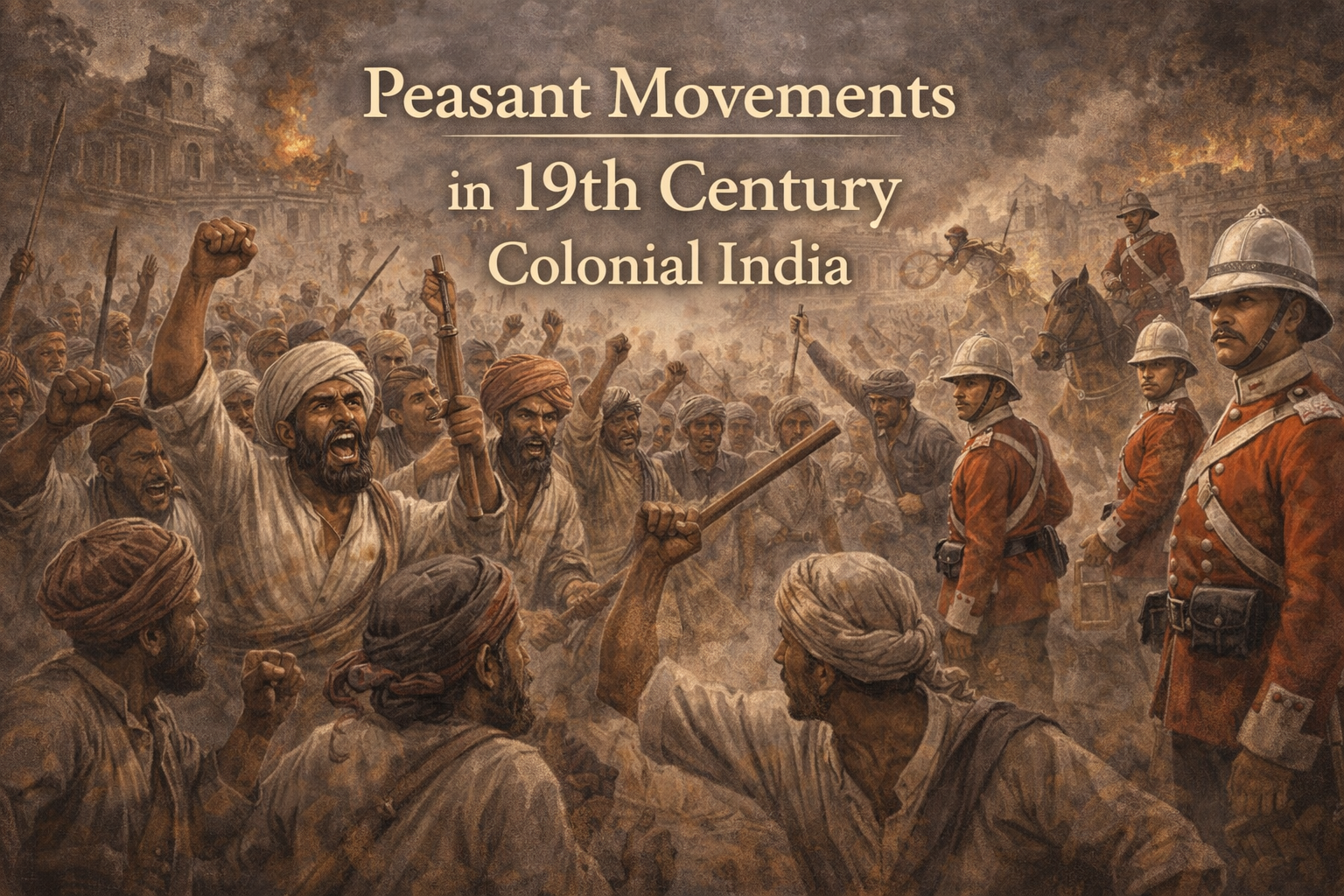
Peasant Movements in 19th Century Colonial India
The Changing Nature of Post-1857 Peasant Resistance
Traditional Elements
Continued tribal and peasant uprisings
Resistance to oppressive revenue systems
Spontaneous local protests
Traditional leadership structures
New Features
Greater awareness of colonial laws and institutions
Strategic use of court systems
Formation of organized agrarian leagues
Support from educated middle-class intelligentsia
After the Revolt of 1857, peasant movements in India acquired distinctive characteristics that set them apart from earlier forms of resistance. Whilst the fundamental grievances remained rooted in economic exploitation and social oppression, the methods of protest became more sophisticated. Peasants began to embrace colonial institutions—particularly the legal system—as legitimate spaces for seeking redress. This marked a significant shift from purely confrontational approaches to more strategic engagement with the colonial apparatus.
The involvement of the educated middle class added new dimensions to these movements. These urban intellectuals served as intermediaries between rural society and the administration, helping peasants articulate their grievances in language the colonial state understood. However, scholars remain divided on the true nature of this middle-class intervention. Whilst Ravinder Kumar saw them as effective channels of communication, Ranajit Guha criticised their inherent paternalism and collaborative mindset, arguing that their liberalism ultimately proved futile as a deterrent to tyranny.
The Indigo Revolt: Bengal's Blue Rebellion (1859-60)
The Indigo Revolt of 1859-60 stands as one of the most significant peasant uprisings in colonial India, combining both traditional and modern elements of resistance. This movement erupted in Bengal when peasants decisively rejected the oppressive indigo plantation system that had made their lives unbearable. British planters had forced cultivators to accept advances and sign fraudulent contracts, compelling them to grow indigo under terms that were profoundly unprofitable. The revolt was not a sudden explosion but rather the culmination of decades of systematic exploitation and mounting resentment.
What made this uprising particularly significant was its timing and context. The sympathetic Lieutenant Governor John Peter Grant had just taken office in May 1859, and some district officers began adopting pro-peasant positions, believing that the coercive methods of planters contradicted the principles of free enterprise. This official encouragement, combined with the peasants' own organisational capacity and the support of Bengal's educated elite, created conditions for a successful mass movement. The revolt's significance extended far beyond its immediate objectives—it became a template for future agrarian struggles and demonstrated the power of organised peasant resistance backed by public opinion.
Historical Context: The Rise of Indigo Cultivation
1777: Origins
Indigo planting begins in Bengal under East India Company patronage
1832: Early Resistance
Titu Mir's followers challenge planters in Barasat; Faraizi movement targets indigo system
1847: Economic Crisis
Union Bank failure increases pressure on planters to extract more from peasants
1859: Revolt Erupts
Peasants refuse advances and challenge the entire plantation system
Indigo had been identified as a major cash crop for the East India Company's investments in the 18th century, enjoying worldwide demand similar to cotton, opium and salt. By the time British power expanded in Bengal, indigo planting had become increasingly profitable due to European demand for blue dye. The crop was introduced across large parts of Burdwan, Bankura, Birbhum and Murshidabad, creating a plantation system that would eventually become synonymous with brutal exploitation.
European planters held a virtual monopoly over indigo farming, and they pursued profit with ruthless determination. The oppression intensified in the second half of the 19th century as indigo lost its economic importance as an export item. With the failure of the Union Bank in 1847—the chief financier for planters—the economic pressure on planters increased, which they in turn passed onto the peasants through even more coercive methods. The stage was set for inevitable confrontation.
The Mechanics of Exploitation
Fraudulent Contracts
Planters forced peasants to accept meagre advances and sign deceptive agreements
Debt Trap
High-interest loans (dadon) kept farmers perpetually indebted across generations
Land Appropriation
Forced cultivation on best lands, preventing more profitable crops like rice
Reign of Terror
Armed retainers (lathyals) enforced compliance through violence and intimidation
The indigo plantation system operated through a sophisticated mechanism of economic and physical coercion. Planters provided loans at exorbitant interest rates, ensuring that once a farmer accepted credit, he remained trapped in debt for his entire life—often passing this burden to his descendants. The peasant was compelled to grow indigo on his best land regardless of whether more profitable crops could be cultivated. At harvest time, he received prices far below market rates and was cheated even of these pittances through various deductions and bribes demanded by the planter's officials.
The system was enforced through systematic violence. Planters maintained bands of armed retainers who illegally assaulted, detained and terrorised farmers who resisted. If peasants refused to grow indigo and attempted to plant rice instead, they faced kidnapping, attacks on women and children, and destruction of their crops. The judicial system offered no relief—European judges invariably ruled in favour of European planters. Magistrates who attempted fairness were swiftly transferred, whilst many planters themselves served as Honorary Magistrates. An 1833 act had explicitly granted planters a free hand in oppression, making their tyranny legally sanctioned and practically unchallengeable.
The Revolt Unfolds
The indigo disturbances commenced in autumn 1859 when peasants across a wide region in the districts of Nadia, Murshidabad and Pabna refused to accept advances from planters. This was not a violent uprising initially, but rather a coordinated act of economic resistance. The Jessore peasants joined during the spring sowing season of 1860, by which time the entire delta region of Bengal had become affected. In April 1860, all cultivators in Barasat subdivision and the districts of Pabna and Nadia resorted to a complete strike, refusing to sow any indigo whatsoever.
When planters' agents attempted to coerce peasants into sowing indigo, they encountered determined resistance. In some areas, the planters' Indian agents faced organised social boycotts. The panic-stricken pro-planter lobby in Calcutta secured emergency legislation in March 1860 compelling peasants to fulfil their contractual obligations. Courts became inundated with cases as overzealous magistrates forced peasants to cultivate the despised crop. However, Lieutenant Governor Grant refused to extend this legislation beyond six months and prohibited magistrates from compelling peasants to accept advances. The movement subsequently transformed into a no-rent campaign, with peasants going to court to establish their rights as occupancy ryots under the Rent Act X of 1859.
Government Response and Commission of Inquiry
Why Restraint?
Recent memory of Santhal uprising
Trauma of 1857 Revolt still fresh
Recognition of changed peasant temper
Support from intelligentsia and missionaries
The colonial government's response to the Indigo Revolt was notably restrained compared to its harsh suppression of other rebellions. Having recently experienced the Santhal uprising and the devastating Revolt of 1857, the administration recognised the changed temper of the peasantry and the broad support the movement enjoyed from Bengal's educated classes and Christian missionaries.
The government established the Indigo Commission in 1860 to investigate the cultivation system. The evidence presented before this commission and its final report comprehensively exposed the coercion and corruption underlying the entire indigo plantation regime. In a damning observation, E.W.L. Tower noted that "not a chest of indigo reached England without being stained with human blood." The government subsequently issued notifications declaring that Indian farmers could not be compelled to grow indigo and that all disputes would be settled through legal means.
However, the planters themselves were already abandoning the system. Recognising that they could not maintain profitability without force and fraud, they began closing their factories. By the end of 1860, indigo cultivation had been virtually eliminated from Bengal. The peasants had achieved a remarkable victory—they had succeeded in dismantling an entire system of exploitation that had oppressed them for decades. This triumph stemmed from their tremendous initiative, cooperation, organisation and discipline, coupled with complete unity between Hindu and Muslim cultivators, leadership from substantial ryots, and crucial support from Bengal's intelligentsia.
Voices of Support: The Middle-Class Intervention
The Indigo Revolt marked a watershed moment in the relationship between India's educated middle class and peasant movements. Bengal's intelligentsia played a transformative role by organising a powerful support campaign that utilised the press as its primary weapon. This intervention had profound implications for the emerging nationalist consciousness. The educated elite carried out extensive newspaper campaigns, organised mass meetings, prepared detailed memoranda documenting peasant grievances, and provided crucial support in legal battles. They established a precedent with long-term implications for India's national movement.
The Bengali press, particularly the Hindoo Patriot under Harish Chandra Mukherjee, thoroughly documented the plight of indigo cultivators. The Hindoo Patriot, which had taken a hostile stance towards planters since its founding in 1853, became the voice of peasant suffering. Sisir Kumar Ghosh, who later founded the Amrita Bazar Patrika, served as an invaluable correspondent from Nadia and Jessore. His courageous reporting in an era without political organisations to support the people's cause proved instrumental in bringing the peasants' struggle to wider public attention. This journalistic activism, whilst appealing to liberal opinion within the imperial bureaucracy and reflecting unflagging faith in British justice, succeeded in bringing peasant issues into the institutional political arena and generated mounting pressure on planters to reform their behaviour.
Cultural Impact: Nil Darpan and Its Consequences
The Play
Dinabandhu Mitra's 1860 drama depicted planter atrocities in vivid detail
Translation and Trial
Rev. James Long translated it to English and faced prosecution for libel
Theatre Revolution
Influenced Girish Chandra Ghosh and the birth of Bengali commercial theatre
Dinabandhu Mitra's Bengali play Nil Darpan (literally "Blue Mirror"), published in September 1860, became one of the most powerful cultural artefacts of peasant resistance. The drama depicted the atrocities of indigo planters with unflinching boldness, showing how they forced ryots to cultivate without remuneration, confined and brutalised villagers, and corrupted their own servants. With such powerful expression, Nil Darpan became a symbol of the intelligentsia's awakening sympathy towards the peasantry and helped galvanise public opinion against the plantation system.
The play's translation into English by the renowned poet Michael Madhusudan Dutta brought it to the attention of liberal political circles in India and London. When Reverend James Long published this translation, he was tried for libel in Calcutta Supreme Court and sentenced to a fine of Rs. 1,000 and one month's imprisonment. This conviction enraged Calcutta's literary elite, with the Indian press—particularly the Hindoo Patriot and Somprakash—intensifying their support for indigo peasants. The British Indian Association also rallied to their cause. Beyond its immediate political impact, Nil Darpan proved essential to the development of Bengali theatre, influencing Girish Chandra Ghosh who established The National Theatre in Calcutta in 1872, where the first commercially staged play was Nil Darpan itself.
Legacy and Significance of the Indigo Revolt
Non-Violent Resistance
Primarily peaceful methods distinguished it from violent uprisings like the Sepoy Mutiny
Mass Mobilisation
Unified different strata of society in sustained, coordinated action
Legal Awareness
Demonstrated peasants' growing understanding of colonial legal institutions
Future Blueprint
Provided template for Gandhi's later passive resistance movements
The Indigo Revolt can justifiably be termed the first organised form of countryside resistance against British economic and social exploitation in India. Unlike the spontaneous eruption of the Sepoy Mutiny, this rural revolt evolved gradually and rallied diverse sections of society against colonial oppression—creating a thread of dissent that persisted for decades. Many historians consider it a forerunner of the non-violent passive resistance later successfully adopted by Mahatma Gandhi. The movement demonstrated that sustained, organised, largely peaceful resistance could achieve concrete victories against entrenched systems of exploitation.
The revolt also revealed important dynamics about peasant movements and class relations. As one historian observed, although distressed ryots and minor landholders initially looked to great zamindars for encouragement, the zamindars frequently lost control as initiative devolved to the lower classes. This was not a class struggle between zamindars and peasantry; rather, zamindars opposed European encroachment to protect their own interests whilst championing the peasants' cause. The movement's success stemmed from remarkable Hindu-Muslim unity, effective leadership from substantial ryots, and crucial support from the educated middle class—a combination that would become characteristic of later nationalist agitations.
The Deccan Uprising: Revenue, Debt and Desperation (1875)
As British rule expanded from Bengal across India, new revenue systems were imposed that transformed rural economies and social relations. The Ryotwari Settlement introduced in the Bombay Deccan contrasted sharply with Bengal's Permanent Settlement. Under this system, revenue was settled directly with individual cultivators (ryots) rather than through intermediaries. The government estimated average income from different soil types, assessed each ryot's revenue-paying capacity, and fixed a proportionate share as the state's claim. This seemingly rational system proved devastating in practice.
The first revenue settlement in the 1820s set demands so high that peasants in many areas deserted their villages and migrated to new regions. The situation deteriorated dramatically during the 1830s when agricultural prices collapsed after 1832 and remained depressed for over fifteen years, causing peasant incomes to plummet. The catastrophic famine of 1832-34 killed one-third of the Deccan's cattle and half its human population. Survivors had no agricultural stocks to weather the crisis. Inevitably, they borrowed. Revenue could rarely be paid without loans from moneylenders, but once indebted, ryots found repayment virtually impossible. As debt accumulated, peasant dependence on moneylenders intensified—they now required loans even for daily necessities and production expenses. By the 1840s, colonial officials documented alarming levels of indebtedness throughout the region.
The Cotton Boom and Subsequent Crash
American Dominance
Before 1860s, three-fourths of Britain's cotton came from America
Civil War Crisis
American Civil War (1861) created panic; imports fell to 3% of normal
Indian Boom
Cotton acreage doubled; 90% of British imports came from India by 1862
Post-War Collapse
American production revived in 1865; Indian exports declined sharply
The American Civil War of 1861 dramatically transformed the Deccan's economy. British cotton manufacturers, long worried about dependence on American supplies, panicked when the war reduced imports to less than three per cent of normal levels. Frantic messages went to India urging increased cotton exports. In Bombay, export merchants visited cotton districts to assess supplies and encourage cultivation. As cotton prices soared, these merchants provided advances to urban sahukars, who extended credit to rural moneylenders promising to secure produce. Deccan ryots suddenly found access to seemingly limitless credit. Cotton acreage doubled between 1860 and 1864, and by 1862, over 90 per cent of Britain's cotton imports originated in India.
This boom proved illusory and short-lived. When the Civil War ended in 1865, American cotton production revived and Indian exports steadily declined. Export merchants and sahukars in Maharashtra abruptly ceased extending long-term credit. Simultaneously, the revenue demand increased dramatically—the new settlement of the 1860s raised demands by 50 to 100 per cent compared to the 1820s-30s rates. Farmers again turned to moneylenders, but now faced refusal. Having lost confidence in the ryots' capacity to repay, moneylenders declined new loans. This combination of credit drought and revenue enhancement created conditions ripe for explosion.
Debates on Land Transfer and Its Role
Historian Ravinder Kumar argued that the Deccan Uprising stemmed from a fundamental "redistribution of social power in Maharashtra's villages." The introduction of ryotwari tenure created property rights in land and established courts to protect these rights, generating a land market and increased demand for land. Moneylenders began lending against land mortgages at high interest rates, and when peasants defaulted, took possession through court decrees. Caste prejudices prevented moneylenders from cultivating land themselves, so they leased it back to former owners, who thus became tenants on their ancestral holdings.
The extent and significance of land transfer during this period remains controversial amongst historians. Ian Catanach acknowledged land transfers occurred but disputed Kumar's contention that this was the primary cause of peasant discontent. Neil Charlesworth dismissed this factor entirely, arguing that only about five per cent of cultivable Deccan land had passed to Marwari or Gujarati moneylenders by the time of the riots. However, this small proportion represented the region's most fertile land, making its loss particularly resented. The psychological impact of losing ancestral holdings to "outsider" creditors likely exceeded the purely economic significance of the transfers.
Whatever the precise extent of land alienation, the broader transformation of rural social relations proved undeniable. Traditional patron-client relationships between Maratha Kunbi peasants and sahukars had historically involved lending without intensive control over village economies. The ryotwari system fundamentally altered these dynamics, creating conditions where moneylenders exercised unprecedented power over indebted cultivators. Combined with revenue enhancement, credit contraction, and the cotton boom's collapse, these structural changes created profound peasant grievances that would explode in 1875.
The Spark: Revenue Revision and Social Boycott
In 1867, the colonial government announced revenue rate increases justified by expanded cultivation and rising agricultural prices. In Indapur taluka, increases averaged 50 per cent, though some villages faced demands raised by 200 per cent. Whilst historian Neil Charlesworth questioned whether new taxes directly caused the riots—noting that villages most affected in Ahmadnagar district experienced no tax revision, whilst some revised talukas remained passive—the timing proved catastrophic. These enhanced rates came just as the cotton boom collapsed, peasants faced impoverishment, and mounting indebtedness made revenue payment increasingly impossible. The increase sparked panic rather than mere resentment.
Kunbi peasants appealed for rate revision, but their traditional leadership lacked familiarity with new colonial institutions and the rational, legalistic communication they demanded. The Poona Sarvajanik Sabha—an association of middle-class intellectuals—intervened in 1873, presenting a detailed case for revenue revision. They sent volunteers to villages to mobilise Kunbi peasants against the new rates. Under this pressure, the Bombay government granted a significant concession: when peasants failed to pay revenue, movable properties would be attached first; land would be auctioned only if movables proved insufficient. This concession inadvertently became a source of conflict, as moneylenders in 1874 refused credit to peasants for revenue payment, believing they now lacked sufficient security for loans.
A spontaneous protest movement began in December 1874 in Kardab village in Sirur taluka. When peasants failed to convince the local moneylender Kalooram not to act on a court decree to demolish a peasant's house, they organised a complete social boycott of "outsider" moneylenders. They refused to purchase from their shops, cultivate their fields, or provide any services. Village servants—barbers, washermen, carpenters, ironsmiths, shoemakers—declined to serve them. No domestic servants would work in their houses. The peasants also imposed social sanctions against any who refused to join the boycott. This non-violent resistance spread rapidly to villages across Poona, Ahmednagar, Sholapur and Satara districts, though it soon transformed into more direct action when boycotts proved insufficiently effective.
The Uprising Explodes
12 May 1875
Riots erupt in Supe village, Bhimthadi taluka, Poona district
Rapid Spread
Violence extends to Ahmednagar and surrounding districts
Two-Month Duration
Movement affects over 30 villages across 6,500 square kilometres
Targeted Action
Systematic attacks on moneylenders' houses and shops to destroy debt records
The uprising commenced on 12 May 1875 at Supe, a market centre in Bhimthadi taluka where numerous shopkeepers and moneylenders resided. Ryots from surrounding rural areas gathered and attacked these traders, demanding account books and debt bonds. They burnt financial records, looted grain shops, and in some cases set fire to sahukars' houses—individuals who served as both moneylenders and traders. From Poona, the revolt spread rapidly to Ahmednagar, eventually affecting more than 30 villages across an area of 6,500 square kilometres over the following two months.
The rioters' specific objective was obtaining and destroying debt bonds, deeds (signed under pressure, in ignorance, or through fraud), court decrees, and other documentation of their debts held by moneylenders. Violence occurred only when moneylenders refused to surrender these documents. Traditional headmen (Patels) provided leadership, and the movement embraced social boycotts both of moneylenders and of any villagers who refused to participate. Later, the movement received support from the Poona Sarvajanik Sabha led by Justice Ranade. As violence spread, authorities established police posts in villages to intimidate rebellious peasants. Troops were deployed and many convicted, though restoring countryside control required several months. Had British authorities not acted promptly, the rioting spirit would likely have engulfed all Maharashtra.
Character and Outcomes of the Deccan Uprising
Distinctive Features
Targeted violence against Gujarati and Marwari moneylenders
Minimal personal violence; focus on destroying debt records
Distinguished from typical poverty-driven "grain riots"
Demonstrated awareness of institutional power structures
Hindu-Muslim unity despite religious differences
Government Response
Initially dismissive but pressured by memories of 1857
Deccan Riots Commission established to investigate
Report presented to British Parliament in 1878
Deccan Agriculturists' Relief Act passed in 1879
Peasants protected from arrest for debt non-payment
The uprising's character revealed sophisticated peasant understanding of their predicament. Gujarati and Marwari moneylenders faced particular targeting not merely as "outsiders" but because peasants perceived them as more avaricious. Village residence made them more exposed to attacks than Brahman moneylenders who typically lived in better-protected cities. Remarkably, there was minimal violence against sahukars personally—debt bonds were the primary target. Violence occurred only when resistance prevented document surrender. This specificity distinguished these events from ordinary grain riots by impoverished peasants and demonstrated clear awareness of the institutional framework within which power relations operated.
The Bombay government initially treated the uprising as insignificant, but the Government of India—haunted by 1857's memory—pressured Bombay to establish an inquiry commission. The Deccan Riots Commission's report, presented to Parliament in 1878, led to the Deccan Agriculturists' Relief Act of 1879. This legislation prevented peasant arrest and imprisonment for debt non-payment—a significant protection. The colonial regime could accommodate this movement because its aims remained limited to immediate grievance redressal and enforcement of existing legal rights. The uprising never targeted the zamindari system itself nor acquired anti-colonial political character, though it did demonstrate the remarkable Hindu-Muslim solidarity characteristic of peasant movements in this era.
The Munda Rebellion: Ulgulan in Chotanagpur (1899-1900)
The Munda Rebellion, known locally as the "Ulgulan" or "Great Tumult," represented one of the 19th century's most significant tribal uprisings. Led by the charismatic Birsa Munda in the Chotanagpur region near Ranchi, this movement aimed at establishing Munda Raj by driving out British colonial authority. The uprising concentrated in the Munda belt encompassing Khunti, Tamar, Sarwada and Bandgaon, areas where forests formed the lifeblood of tribal existence. These communities had practiced traditional systems of joint land holding (khuntkatti) for generations, living in harmony with forest resources that provided sustenance, shelter and spiritual connection.
The British arrival shattered this world. Colonial forest, land and revenue laws systematically stripped tribals of their natural rights. The administration introduced moneylenders, landlords, traders, mahajans and contractors—collectively termed "dikus" (outsiders)—who made tribal peoples dependent and exploited. British authorities usurped tribal lands and reduced communities to conditions resembling slavery. Rich farmers, merchants and thekedars from northern India attempted to replace the khuntkatti system with typical zamindari-tenancy arrangements, causing widespread indebtedness and beth-begari (forced labour) amongst tribals. Against this multifaceted oppression, Munda tribes fought continuously for over three decades before Birsa Munda transformed their struggle, giving it new direction and meaning.
Birsa Munda: From Healer to Revolutionary Leader
1875: Birth
Born to a poor Munda family, experienced tribal oppression firsthand
1893-94: Early Activism
Participated in movement preventing Forest Department takeover of village wastelands
1894: Spiritual Leader
Gained popularity through medicinal and healing powers; declared himself a god
Political Awakening
Combined religion and politics; built politico-military organisation village by village
Imprisonment
Arrested and imprisoned for two years; emerged more determined
1899-1900: Ulgulan
Led armed uprising to establish Munda Raj and end British colonial rule
Birsa Munda, born in 1875 and often referred to as "Birsa Bhagwan" by Jharkhand's tribal residents, emerged as a transformative leader who fundamentally redirected Munda resistance. His initial reputation rested on medicinal and healing abilities through which he claimed to render followers invulnerable. In 1894, Birsa declared himself divine and began awakening masses, arousing them against the landlord-British combine. Skilfully combining religious authority with political mobilisation, he travelled village to village delivering discourses and constructing a sophisticated politico-military organisation. He declared an end to Victorian rule and proclaimed the establishment of Munda Rule, organising people to cease paying debts and interest to moneylenders and taxes to the British. Breaking all missionary connections, he embraced the path of ulgulan—revolt.
British authorities retaliated swiftly, deploying armed police who arrested Birsa during his sleep. He spent two years imprisoned. Upon release in November 1897, he immediately resumed organising tribals, now operating underground whilst sowing seeds of revolt against landlords and colonial power. He raised tribal self-confidence, inspiring increased attacks on landlords. He formed two distinct organisational units: one focused on military training and armed struggle, the other dedicated to propaganda and mobilisation. Rumours circulated about his occult powers, healing abilities and miracle-working capacity. In tribal imagination, he appeared as a messiah capable of transforming British bullets into water—a powerful metaphor for the protective faith he inspired amongst his followers.
The Ulgulan Erupts and the Final Struggle
Birsa took tribals on pilgrimages to Munda holy sites, holding large public meetings that invoked a mythical golden age (satjug) contrasted with the dark present (kaljug). He spoke of a time when Munda land (disum) was ruled by Queen Mandodari, wife of demon king Ravana—likely a metaphor for colonial rule under Queen Victoria. These gatherings articulated tribal peasants' profound antipathy towards foreigners—the dikus including landlords, moneylenders and their patrons, the sahibs (Europeans comprising both officials and Christian missionaries). These carefully orchestrated assemblies prepared ground for the massive anti-colonial tribal uprising that erupted during Christmas 1899.
Birsa declared 24 December 1899 as the day for launching armed struggle. On Christmas Eve, attacks commenced targeting churches, temples, policemen and symbols of the colonial regime. The first phase saw police stations attacked at Khunti, Jamar, Basia, Ranchi and other locations. Eight policemen were killed whilst 32 fled; 89 landlord houses were burnt; churches and British property reduced to ashes. The struggle's flames spread across 550 square miles in Chotanagpur. Using poisoned arrows, rebels killed many police and Britishers and burnt traders' houses. The uprising's intensity forced Ranchi's deputy commissioner to summon the Army on just the fourth day. British forces responded with brutal massacres, deploying superior weaponry against tribal arrows. On 3 February 1900, Birsa was captured. Severe charges were filed against him and 482 others. On 9 June 1900, aged merely 25, Birsa Munda died in Ranchi's Central Jail. British authorities claimed cholera as the cause, though many suspected foul play.
Legacies: Comparing Three Peasant Movements
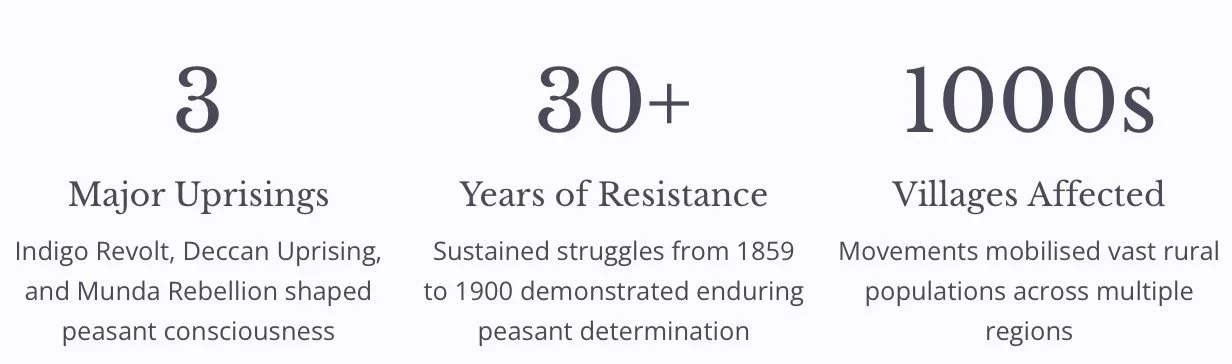
Indigo, Deccan and Munda Revolts
These three movements—whilst emerging from different regional contexts and targeting distinct forms of exploitation—collectively transformed the landscape of peasant resistance in colonial India. The Indigo Revolt achieved perhaps the most complete victory, forcing the virtual elimination of indigo cultivation from Bengal through non-violent organisation, Hindu-Muslim unity, and middle-class support. It established a template for future agrarian struggles and demonstrated that sustained, organised resistance could dismantle entrenched exploitation systems. The Deccan Uprising, though more violent, remained carefully targeted against debt documentation rather than persons, revealing sophisticated understanding of institutional power structures. The Deccan Agriculturists' Relief Act of 1879 provided important protections, showing that colonial authorities could be pressured into reform when peasant movements threatened stability.
The Munda Rebellion represented something qualitatively different—a tribal uprising that transcended localised grievances to articulate broader anti-colonial political consciousness. Birsa Munda's vision extended beyond driving out dikus; he aimed to destroy British rule entirely and establish alternative governance. This political awareness distinguished late 19th-century tribal movements from earlier localised resistance. Though brutally suppressed, the Ulgulan forced the colonial state to recognise khuntkatti rights and ban forced labour (beth begari) through the Chotanagpur Tenancy Act of 1908. More significantly, Birsa became legendary amongst Chotanagpur's tribals—a symbol of the anti-feudal, anti-colonial struggle whose memory inspired subsequent generations. These movements collectively demonstrated that India's rural masses—whether settled agriculturists or forest-dwelling tribals—were developing new forms of organisation, legal awareness, and political consciousness that would prove foundational for 20th-century nationalist mobilisation.
The Shift in the Character of Peasant Uprisings in the Post-1857 Period
The period following the 1857 Revolt marked a significant transformation in the nature of peasant resistance in colonial India. This document examines how peasant movements evolved from spontaneous rebellions into more organised struggles, characterised by greater awareness of colonial institutions, involvement of educated middle-class leaders, and specific economic grievances. These movements, whilst maintaining their agrarian focus, began to intersect with the broader nationalist movement, creating new dynamics in India's struggle against colonial exploitation.
Emerging Characteristics of Post-1857 Peasant Movements
The post-1857 period witnessed the continuation of earlier forms of protest against colonial oppression, particularly tribal and peasant movements. However, these movements now displayed distinct new features that set them apart from pre-1857 resistance. The peasantry, both tribal and non-tribal, demonstrated a heightened understanding of colonial policies, laws, and institutional mechanisms. This awareness fundamentally altered their approach to seeking redress for grievances.
Legal Consciousness
Peasants embraced colonial institutions, particularly law courts, as legitimate spaces for venting anger and seeking justice. They asserted their legal rights both within and outside judicial forums.
Counter-Legal Strategies
When deprived of legal rights through manipulation or extra-legal means, peasants responded with their own extra-legal measures, demonstrating tactical flexibility.
Faith in Authority
Many peasants believed the legally-constituted authority (sarkar) approved their actions or at least supported their claims and cause.
The Role of Middle-Class Intelligentsia
A crucial new dimension emerged with the growing involvement of the educated middle-class intelligentsia as spokespersons for the aggrieved peasantry. This intervention added new layers to peasant protests and connected their movements to wider agitation against undesirable aspects of colonial rule. The nature of this outside mediation became a subject of intense scholarly debate, with historians offering contrasting interpretations of the middle class's role and motivations.
Ravinder Kumar argued that these middle-class leaders performed an important and effective function as "a channel of communication between rural society and the administration" at a time when traditional channels had become ineffective. Their educated status and familiarity with colonial institutions enabled them to articulate peasant grievances in ways that could be heard by colonial authorities.
Scholarly Perspectives
Ravinder Kumar: Middle-class leaders served as effective communication channels between rural society and administration.
Ranajit Guha: Described nineteenth-century middle-class attitude as "a curious concoction of an inherited, Indian-style paternalism and an acquired, western-style humanism."
Conversely, Ranajit Guha offered a more critical assessment, describing the nineteenth-century middle-class attitude towards peasants as "a curious concoction of an inherited, Indian-style paternalism and an acquired, western-style humanism." Guha argued that their actions at every stage betrayed an innate collaborative mindset and revealed "the futility of liberalism as a deterrent to tyranny." Despite these divergent interpretations, the middle-class mediation remained a defining feature of nearly all peasant movements in the second half of the nineteenth century.
Structural Changes in Peasant Mobilisation
With princes, chiefs, and landlords having been crushed or co-opted by colonial authorities, peasants emerged as the main force in agrarian movements. This shift represented a fundamental change in the social composition and leadership of rural resistance. Peasants now fought directly for their own demands, which centred almost wholly on economic issues, and against their immediate enemies: foreign planters, indigenous zamindars, and moneylenders.
Direct Economic Focus
Struggles centred on specific economic grievances rather than broader political objectives
Immediate Enemy Identification
Clear targeting of foreign planters, zamindars, and moneylenders as oppressors
Limited Territorial Reach
Movements remained confined to particular localities with minimal inter-regional communication
Temporary Organisation
Organisational structures dissolved once specific objectives were achieved
These struggles were directed towards specific and limited objectives and redressal of particular grievances. Significantly, colonialism itself was not their target, nor was their objective the ending of the system of their subordination and exploitation. They did not aim at turning the world upside down. The territorial reach remained limited, confined to particular localities with no mutual communication or linkages between different movements.
Patterns of Resistance and Their Limitations
The movements lacked continuity of struggle or long-term organisation. Once specific objectives were achieved, organisational structures, along with the peasant solidarity built around them, dissolved and disappeared. The Indigo Strike, Pabna Agrarian Leagues, and the social-boycott movement of the Deccan ryots left behind no successors. Consequently, these movements never threatened British supremacy or even undermined it significantly.
These movements represented an instinctive and spontaneous response of the peasantry to their social condition. Peasants often rebelled only when they felt it was impossible to carry on in the existing manner. Their resistance was also moved by strong notions of legitimacy—clear ideas about what was justifiable and what was not.
This sense of legitimacy explains why peasants did not fight for land ownership or against landlordism per se, but against eviction and undue enhancement of rent. They did not object to paying interest on borrowed sums but hit back against fraud and chicanery by moneylenders, particularly when the latter went against tradition in depriving them of their land. They did not deny the state's right to collect land tax but objected when taxation levels overstepped all traditional bounds. They did not object to foreign planters becoming zamindars but resisted when planters took away their freedom to decide what crops to grow and refused to pay proper prices.
Strengths and Achievements of Peasant Movements
Peasant Movements
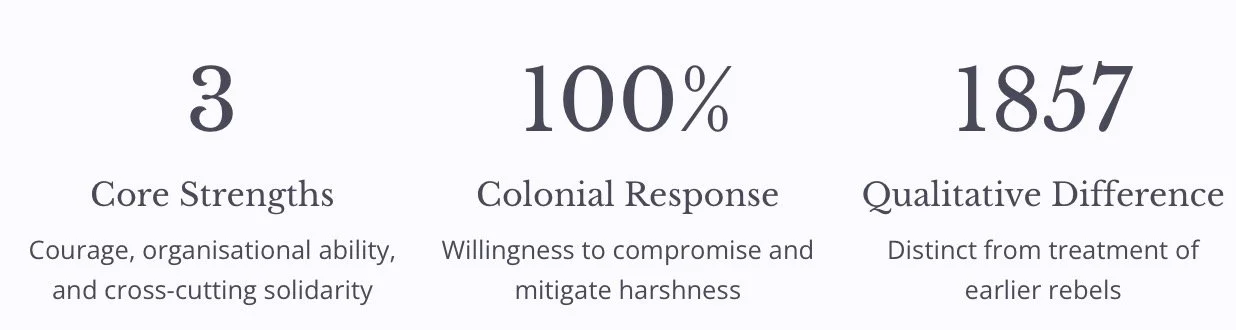
In these movements, Indian peasants showed great courage and a spirit of sacrifice, remarkable organisational abilities, and a solidarity that cut across religious and caste lines. They were able to wring considerable concessions from the colonial state. The colonial regime, not being directly challenged, was willing to compromise and mitigate the harshness of the agrarian system, though within the broad limits of the colonial economic and political structure.
The colonial regime's treatment of post-1857 peasant rebels was qualitatively different from its treatment of participants in civil rebellions, the Revolt of 1857, and tribal uprisings which directly challenged colonial political power. This differential response reflected the regime's pragmatic approach to managing agrarian unrest whilst maintaining overall control.
Fundamental Weaknesses of the Movements
Despite their achievements, these movements suffered from significant weaknesses. The most critical was the lack of an adequate understanding of colonialism and of the social framework of the movements themselves. Peasants did not possess a new ideology or a new social, economic, and political programme based on an analysis of the newly constituted colonial society.
Limited Ideological Framework
Struggles occurred within the framework of the old societal order
Absence of Alternative Vision
Lacked a positive conception of an alternative society
Incomplete Analysis
Unable to grasp the complex phenomenon of colonialism independently
Their struggles, however militant, occurred within the framework of the old societal order. They lacked a positive conception of an alternative society. This weakness was not a blemish on the character of the peasantry, which was perhaps incapable of grasping on its own the new and complex phenomenon of colonialism. That needed the efforts of a modern intelligentsia which was itself just coming into existence.
Most of these weaknesses were overcome in the twentieth century when peasant discontent was merged with the general anti-imperialist discontent and their political activity became part of the wider anti-imperialist movement. This integration would transform the nature and impact of peasant resistance in fundamental ways.
The Indigo Revolt (1859-60): Nilbidroha
Indigo planting in Bengal dated back to 1777, establishing a long history of exploitation. The indigo planters, nearly all Europeans, systematically exploited local peasants by forcing them to grow indigo on their lands instead of more profitable crops like rice. The planters forced peasants to take advance sums and enter into fraudulent contracts which were then used against them. This system created a debt trap from which peasants found it nearly impossible to escape.
Methods of Exploitation
Forced cultivation contracts through fraudulent agreements
Intimidation through kidnappings and illegal confinements
Flogging and attacks on women and children
Seizure of cattle and destruction of property
Burning and demolition of houses
Destruction of food crops
Forms of Resistance
Collective decision not to grow indigo
Physical resistance to planters and lathiyals
Organised counter-force formation
Rent strikes against enhanced rents
Legal action supported by fund collection
Physical resistance to eviction attempts
The anger of the peasants exploded in 1859 when, led by Digambar Biswas and Bishnu Biswas of Nadia district, they decided not to grow indigo and resisted the physical pressure of the planters and their lathiyals (retainers), backed by police and the courts. They also organised a counter-force against the planters' attacks. When planters tried methods like evictions and enhanced rents, the ryots replied by going on a rent strike, refusing to pay enhanced rents and physically resisting attempts to evict them.
Cultural Impact and Government Response to Indigo Revolt
Journalistic Support
Harish Chandra Mukhopadhyay thoroughly described the plight of poor peasants in The Hindu Patriot
Literary Representation
Dinabandhu Mitra's 1859 play Nil Darpan depicted the revolution, translated by Michael Madhusudan Dutta
International Attention
Published by Rev. James Long, the play stunned England with revelations of colonial brutality
The Bengali intelligentsia played a significant role by supporting the peasants' cause through newspaper campaigns, organisation of mass meetings, preparing memoranda on peasants' grievances, and supporting them in legal battles. This intellectual support proved crucial in amplifying the movement's message and legitimising peasant demands.
The revolt is considered a non-violent revolution, and that is why the Indigo Revolt was a success compared to the Sepoy Revolt. Many call it a forerunner of the non-violent passive resistance later successfully adopted by Gandhi. The revolt had a strong effect on the government. An Indigo Commission was appointed to inquire into the problem of indigo cultivation. Based on its recommendations, the Government issued a notification in November 1860 stating that ryots could not be compelled to grow indigo and that it would ensure all disputes were settled by legal means. However, planters were already closing down factories, and indigo cultivation was virtually wiped out from Bengal by the end of 1860.
Pabna Agrarian Leagues: Resistance Against Zamindari Oppression
During the 1870s and 1880s, large parts of Eastern Bengal witnessed agrarian unrest caused by oppressive practices of the zamindars. The zamindars resorted to enhanced rents beyond legal limits and prevented tenants from acquiring occupancy rights under Act X of 1859. To achieve their ends, zamindars resorted to forcible evictions, seizure of cattle and crops, and prolonged, costly litigation in courts where the poor peasant found himself at a disadvantage.
League Formation
Peasants of Yusufshahi Pargana in Pabna district formed agrarian leagues to resist zamindari demands
Rent Strike
Ryots refused to pay enhanced rents, challenging zamindars in courts with collective fund support
Movement Spread
Struggles spread throughout Pabna and to other districts of East Bengal
Resolution
Most cases solved by 1885 through official persuasion and zamindari fears
Having had enough of the oppressive regime, peasants formed an agrarian league or combination to resist zamindari demands. The league organised a rent strike—the ryots refused to pay enhanced rents, challenging the zamindars in the courts. Funds were raised by ryots to fight court cases. The main form of struggle was that of legal resistance; there was very little violence.
Though peasant discontent continued to linger on till 1885, most cases had been solved, partially through official persuasion and partially because of zamindars' fears. Many peasants were able to acquire occupancy rights and resist enhanced rents. The Government also promised to undertake legislation to protect tenants from the worst aspects of zamindari oppression. In 1885, the Bengal Tenancy Act was passed. Notably, those intelligentsia who had supported peasants in the Indigo Rebellion did not support Pabna rebellion as it was against Indian zamindars and not against European planters. Still, a number of young Indian intellectuals supported the peasants' cause, including Bankim Chandra Chatterjee, R.C. Dutt, and the Indian Association under Surendranath Banerjee.
Deccan Riots: Moneylender-Peasant Conflict
The ryots of Deccan region of western India suffered heavy taxation under the Ryotwari system. Here again the peasants found themselves trapped in a vicious network with the moneylender as the exploiter and the main beneficiary. These moneylenders were mostly outsiders—Marwaris or Gujaratis. The conditions had worsened due to several factors creating a perfect storm of peasant distress.
Cotton Price Crash
End of American Civil War in 1864 led to collapse of cotton prices, devastating peasant incomes
Revenue Enhancement
Government's decision to raise land revenue by 50% in 1867 added financial burden
Agricultural Crisis
Succession of bad harvests further undermined peasant economic stability
In 1874, the growing tension between moneylenders and peasants resulted in a social boycott movement organised by the ryots against the "outsider" moneylenders. The ryots refused to buy from their shops. No peasant would cultivate their fields. The barbers, washermen, and shoemakers would not serve them. This social boycott spread rapidly to the villages of Poona, Ahmednagar, Sholapur, and Satara.
Soon the social boycott was transformed into agrarian riots with systematic attacks on the moneylenders' houses and shops. The debt bonds and deeds were seized and publicly burnt. The Government succeeded in repressing the movement. As a conciliatory measure, the Deccan Agriculturists Relief Act was passed in 1879. This time also, some of the modern nationalist intelligentsia of Maharashtra supported the peasants' cause.
Twentieth Century Transition: New Dimensions
The peasant movements of the twentieth century were deeply influenced by and had a marked impact on the national freedom struggle. This period witnessed a fundamental transformation in the character, organisation, and political consciousness of peasant movements. The movements became increasingly integrated with the broader anti-imperialist struggle, whilst maintaining their focus on agrarian issues.
Kisan Sabha Movement
Organised peasant associations with formal structures and clear demands
Eka Movement
Unity movement emphasising collective resistance and mutual support
Mappila Revolt
Peasant-tenant uprising intersecting with religious-political identities
Bardoli Satyagraha
Non-violent resistance against unjust revenue enhancement
These movements marked a new phase in peasant mobilisation, characterised by greater organisational sophistication, clearer articulation of demands, and stronger connections with the nationalist movement. The involvement of Congress leaders and socialist activists brought new ideological dimensions to peasant struggles, whilst peasants themselves demonstrated increasing political consciousness and ability to sustain long-term organisational structures.
The Kisan Sabha Movement in United Provinces
Following the annexation of Avadh in 1856 and after the 1857 revolt, the Awadh Talukdars had regained their lands. The second half of the nineteenth century witnessed the strengthening of the hold of the taluqdars or big landlords over the agrarian society of the province. The majority of cultivators were subjected to high rents, summary evictions (bedakhali), illegal levies, and renewal fees or nazrana. The high price of food and other necessities that accompanied and followed World War I made the oppression all the more difficult to bear, and the tenants of Avadh were ripe for a message of resistance.
Organisational Development
Mainly due to the efforts of Home Rule activists, kisan sabhas were organised in UP. The UP Kisan Sabha was set up in February 1918 by Gauri Shankar Mishra and Indra Narayan Dwivedi, with support from Madan Mohan Malaviya. Towards the end of 1919, first signs of grassroots peasant activity were evident in reports of nai-dhobi band (social boycott) on an estate in Pratapgarh district.
Led by Baba Ramchandra—a sanyasi who had earlier been to Fiji as an indentured labourer—peasants started nai-dhobi bands in various places. These bands were organised by panchayats to deprive landlords of the services of even barbers and washermen. By June 1919, the UP Kisan Sabha had 450 branches.
Leadership and Expansion
Other prominent leaders included Jhinguri Singh, Durgapal Singh, and Baba Ramchandra. In June 1920, Baba Ramchandra urged Nehru to visit these villages. During these visits, Nehru developed close contacts with the villagers. The kisans found sympathy in Mehta, the Deputy Commissioner of Pratapgarh, who promised to investigate complaints forwarded to him.
The Kisan Sabha at village Roor in Pratapgarh district became the centre of activity, and about one lakh tenants reportedly registered their complaints with this Sabha on payment of one anna each. This easy victory gave new confidence to the movement and it burgeoned forth.
Awadh Kisan Sabha and Movement Radicalisation
Formation (October 1920)
Awadh Kisan Sabha came into existence in Pratapgarh due to differences in nationalist ranks
Integration
Successfully integrated all grassroot kisan sabhas that had emerged in Avadh under its banner
Programme Implementation
Asked kisans to refuse bedakhali land, not offer unpaid labour, and solve disputes through panchayats
Radicalisation (January 1921)
Activity changed to looting bazaars, houses, granaries and clashes with police
In October 1920, the Awadh Kisan Sabha came into existence in Pratapgarh because of differences in nationalist ranks. Congress at Calcutta had chosen the path of non-cooperation, and many nationalists of UP had committed themselves to it. But there were others like Malaviya who preferred constitutional agitation. These differences were reflected in UP Kisan Sabha as well, and soon non-cooperators formed the Awadh Kisan Sabha.
From the earlier forms of mass meetings and mobilisation, the patterns of activity changed rapidly in January 1921 to the looting of bazaars, houses, granaries, and clashes with the police. The centres of activity were primarily the districts of Rai Bareilly, Faizabad, and Sultanpur. In Awadh in the early months of 1921, when peasant activity was at its peak, it was difficult to distinguish between a Non-cooperation meeting and a peasant rally.
The movement declined soon, partly due to government repression and partly because of the passing of the Awadh Rent (Amendment) Act. The legislation, whilst not fully meeting peasant demands, provided sufficient concessions to diffuse the immediate agitation.
Eka Movement and Mappila Revolt
Eka (Unity) Movement
Towards the end of 1921, peasant discontent resurfaced in northern districts of United Provinces—Hardoi, Bahraich, Sitapur. The issues involved high rents (50% higher than recorded rates), oppression of thikedars in charge of revenue collection, and the practice of share-rents.
Pay only the recorded rent but pay it on time
Not leave when evicted
Refuse to do forced labour
Give no help to criminals
Abide by panchayat decisions
The grassroot leadership came from Madari Pasi and other low-caste leaders, and many small zamindars. By March 1922, severe repression brought the movement to an end.
Mappila Revolt (August 1921)
In Malabar district of Kerala, Mappila (Muslim) tenants rebelled against lack of security of tenure, renewal fees, high rents, and oppressive landlord exactions. The impetus came from the Malabar District Congress Conference at Manjeri in April 1920, which supported the tenants' cause.
The Khilafat Movement was inextricably merged with tenant struggles. After the arrest of national leaders like Gandhi, Shaukat Ali, and Maulana Azad, leadership passed to local Mappila leaders. In August 1921, the arrest of Ali Musaliar sparked large-scale riots. Initially targeting British authority and unpopular landlords, the rebellion acquired communal overtones after martial law was declared. By December 1921, all resistance had stopped.
The Great Depression and Peasant Movements of the 1930s
During the 1930s, peasant awakening was profoundly influenced by the Great Depression in industrialised countries and the Civil Disobedience Movement, which took the form of no-rent, no-revenue movements in many areas. The economic crisis created conditions of extreme distress for peasants, whilst the political atmosphere generated by the Civil Disobedience Movement provided opportunities for organised resistance.
No Revenue Campaigns
In UP, the no-revenue campaign soon converted into no-rent movements. In Punjab, campaigns focused on reduction of taxes and moratorium on debts.
Chowkidari Tax Resistance
In Bihar and Bengal, movements challenged the Chowkidari Tax which forced villagers to pay for the upkeep of their own oppressors.
Forest Satyagraha
In Maharashtra, Bihar, and Central Provinces, peasants defied forest laws that restricted their traditional rights.
Anti-Zamindari Struggle
In Andhra, organised struggle against the zamindari system gained momentum with peasant mobilisation.
After the decline of the active phase movement in 1932, many new entrants to active politics started looking for suitable outlets for release of their energies and took to organisation of peasants. The Civil Disobedience Movement brought leftists like Jawaharlal Nehru and Subhash Chandra Bose to prominence. In 1934, the Congress Socialist Party was formed. With the formation of the Congress Socialist Party, the process of consolidation of the Left forces received a significant push forward. The Communists, too, got the opportunity to work in an open and legal fashion by becoming members of the CSP.
Formation and Growth of All-India Kisan Sabha
The Kisan Sabha movement started in Bihar under the leadership of Sahajanand Saraswati, who had formed in 1929 the Bihar Provincial Kisan Sabha (BPKS) to mobilise peasant grievances against zamindari attacks on their occupancy rights. Gradually the peasant movement intensified and spread across the rest of India. The formation of the Congress Socialist Party in 1934 helped Communists to work together with the Indian National Congress, however temporarily.
April 1935
N.G. Ranga and E.M.S. Namboodiripad suggested formation of an all-India farmers body
April 11, 1936
All India Kisan Sabha formed at Lucknow Congress session with Swami Sahjanand Saraswati as president
August 1936
Kisan Manifesto released demanding abolition of zamindari system and cancellation of rural debts
Faizpur 1936
Second session held alongside Congress session; Kisan Manifesto influenced Congress agrarian programme
In April 1936, these radical developments culminated in the formation of the All India Kisan Sabha (AIKS) at the Lucknow session of the Indian National Congress with Swami Sahjanand Saraswati as president and N.G. Ranga as general secretary. It involved people such as Ranga, Namboodiripad, Karyanand Sharma, Yamuna Karjee, Yadunandan Sharma, Rahul Sankrityayan, P. Sundarayya, Ram Manohar Lohia, Jayaprakash Narayan, Acharya Narendra Dev, and Bankim Mukerji.
A Kisan Manifesto was finalised at the All-India Kisan Committee session in Bombay and formally presented to the Congress Working Committee to be incorporated into its forthcoming manifesto for the 1937 elections. The Manifesto demanded abolition of the zamindari system, cancellation of rural debts, fifty per cent reduction in land revenue and rent, a moratorium on debts, the abolition of feudal levies, security of tenure for tenants, a living wage for agricultural labourers, and recognition of peasant unions.
Provincial Peasant Movements: Regional Variations
Kerala (Malabar)
Peasants were mobilised mainly by Congress Socialist Party activists. Many "Karshak Sanghams" (peasants' organisations) came into existence. Main demands focused on abolition of feudal levies (akramapirivukal), renewal fees (policceluthu), advance rent, and stopping eviction of tenants.
The main form of mobilisation was the marching of jathas (large groups of peasants) to houses of big jenmies (landlords), placing demands before them and securing immediate redress. A significant campaign in 1938 pressed for amendment of the Malabar Tenancy Act, 1929.
Andhra
This region witnessed a decline in the prestige of zamindars after their defeat by Congressmen in 1937 elections. N.G. Ranga had set up, in 1933, the India Peasants' Institute in his home village in Guntur district. In 1938, over 2,000 kisans marched 1,500 miles, covering nine districts and walking for 130 days.
They held hundreds of meetings attended by lakhs of peasants and collected over 1,100 petitions, which were presented to the provincial legislature in Madras on 27 March 1938. Their main demands included debt relief, which was incorporated in legislation passed by the Congress Ministry.
Bihar
Bihar Provincial Kisan Sabha used meetings, conferences, rallies, and mass demonstrations, including a demonstration of one lakh peasants at Patna in 1938. In 1935, adopted the zamindari abolition slogan. The movement died out by August 1939 due to a combination of concessions, legislation, and arrest of about 600 activists.
Punjab
Earlier peasant mobilisation was organised by the Punjab Naujawan Bharat Sabha, Kirti Kisan Party, Congress, and Akalis. Pattern of mobilisation involved kisan workers touring villages, enrolling members, organising meetings. Main demands related to reduction of taxes and moratorium on debts. Main targets were landlords of western Punjab who dominated the Unionist ministry.
Wartime and Post-War Peasant Struggles
The rising tide of peasant awakening was checked by the outbreak of World War II, which brought about the resignation of Congress Ministries and the launching of severe repression against left-wing and Kisan Sabha leaders because of their strong anti-war stance. Following Hitler's attack on the Soviet Union, dissensions emerged between Communist and non-Communist members of the Kisan Sabha.
Tebhaga Movement (Bengal, 1946-47)
Campaign initiated by Kisan Sabha demanding reduction of landlords' share from one-half to one-third. In September 1946, Bengal Provincial Kisan Sabha gave a call to implement Floud Commission recommendations through mass struggle. The central slogan was "nij khamare dhan tolo"—sharecroppers taking paddy to their own threshing floor, not to the jotedar's house. The storm centre was north Bengal, principally among Rajbanshis, with significant Muslim participation.
Telangana Movement (1946-51)
The biggest peasant guerrilla war of modern Indian history. The princely state of Hyderabad was marked by religious-linguistic domination, total lack of political and civil liberties, and grossest forms of forced exploitation. The uprising began in July 1946 when a deshmukh's thug murdered a village militant in Jangaon taluq of Nalgonda. Peasants organised into village sanghams, attacking using lathis, stone slings, and chilli powder. The movement was at its greatest intensity between August 1947 and September 1948.
These dissensions came to a head with the Quit India Movement, in which Congress Socialist members played a leading role. The CPI, because of its pro-War People's War line, asked its cadres to stay away, and though local-level workers did join the Quit India Movement, the party line sealed the rift in Kisan Sabha ranks, resulting in a split in 1943. Three major leaders—N.G. Ranga, Swami Sahajanand Saraswati, and Indulal Yagnik—left the organisation.
Assessment and Legacy of Peasant Movements
Structural Impact
Erosion of landed class power prepared ground for agrarian transformation
Post-Independence Reforms
Created climate necessitating zamindari abolition and agrarian reforms
Nationalist Integration
Maintained vital and integral relationship with national freedom movement
The struggles were not clearly aimed at the overthrow of the existing agrarian structure but towards alleviating its most oppressive aspects. Nevertheless, they eroded the power of landed classes in many ways and prepared for transformation of its structure. Even when peasant movements did not register immediate successes, they created the climate which necessitated the post-Independence agrarian reforms. Zamindari abolition, for example, did not come about as a direct culmination of any particular struggle, but the popularisation of the demand by the kisan sabha certainly contributed to its achievement.
Key Achievements
Similar forms of struggle and mobilisation adopted across diverse areas
Violent clashes were the exception rather than the rule
Maintained vital relationship with national movement
Based on ideology of nationalism whilst pursuing class interests
Created organisational frameworks that survived beyond immediate struggles
Limitations
Except in few pockets like Andhra and Gujarat, agricultural labourers' demands did not become part of the movement
Sometimes extreme positions by both left-wing activists and conservative Congressmen led to confrontations
The split of 1942 showed that diverging too far from the national movement led to loss of mass base
The growth and development of the peasant movement was thus indissolubly linked with the national struggle for freedom. Main demands included reduction in taxes, abolition of illegal cess or feudal levies and forced labour, ending zamindari oppression, reduction of debts, restoration of illegally seized lands, and security of tenure for tenants. These movements eroded the power of the landed class, thus adding to the transformation of the agrarian structure. Their nature was similar in diverse areas, based on the ideology of nationalism, and they prepared the ground for the agrarian reforms that would follow Independence.
