
Early Indian Nationalism
The emergence of Indian nationalism during the British colonial period represents one of the most significant transformations in South Asian history. This movement, born from the confluence of political awakening, economic exploitation, and cultural renaissance, would eventually unite a diverse subcontinent in its struggle for self-determination. Understanding the factors that led to the birth of Indian nationalism provides crucial insights into how colonial rule inadvertently created the very forces that would challenge its existence.
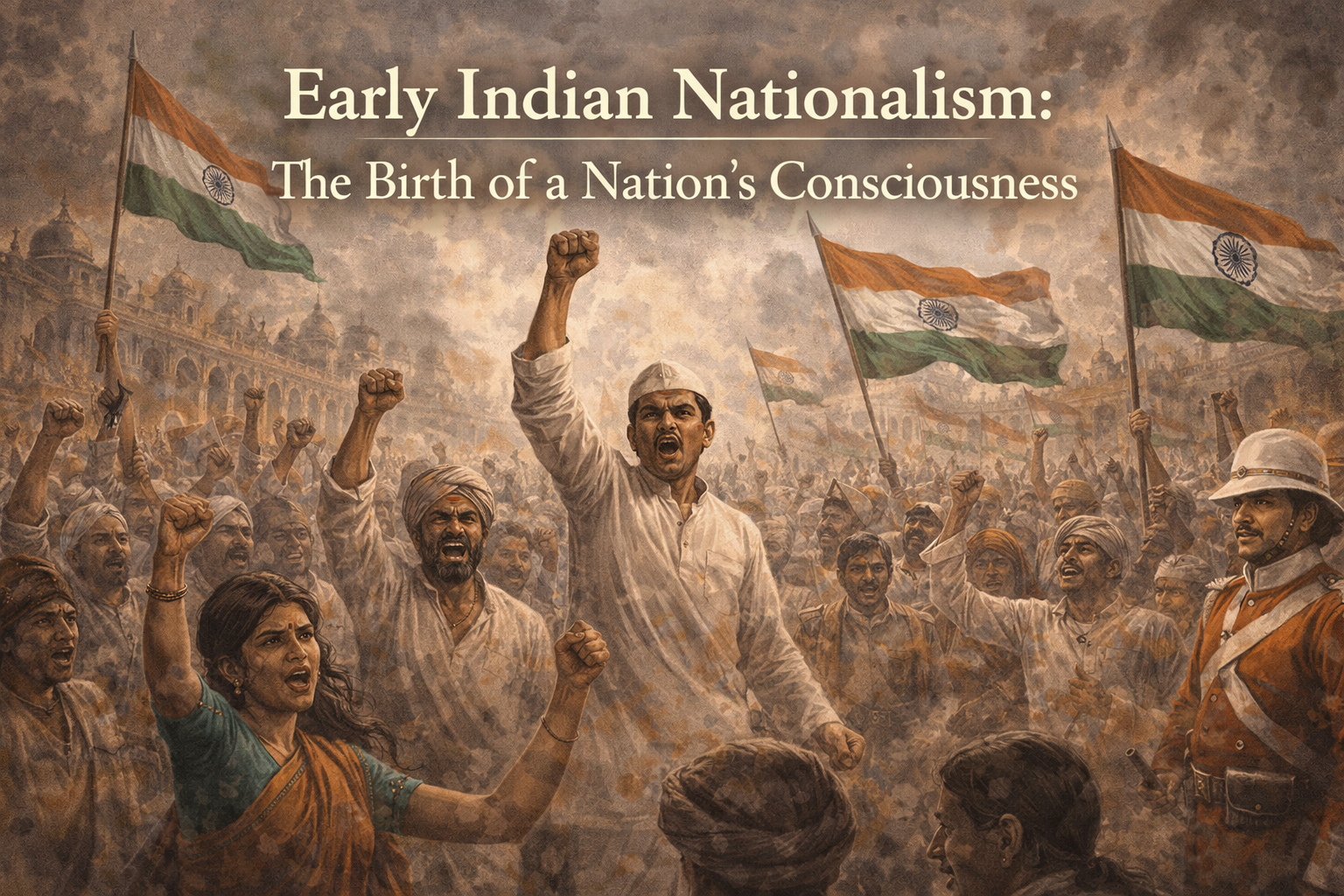
Early Indian Nationalism: The Birth of a Nation's Consciousness
The Seeds of Discontent: Understanding Popular Resentment
As the British Empire extended its control over India, a deep sense of resentment began to permeate through Indian society. This feeling was rooted in multiple perceptions: the belief that British rulers were directly responsible for the economic hardship faced by ordinary Indians, the humiliation of being looked down upon in their own country, and the threat to traditional ways of life. The lower strata of society expressed their discontent through sporadic uprisings, often directed against immediate exploiters like zamindars, sahukars, and tax collectors. However, these protests were fundamentally against the British colonial system itself.
The Great Revolt of 1857 emerged as the most significant manifestation of this accumulated discontent. Though it failed to achieve its immediate objectives, the revolt revealed two critical truths: first, that traditional methods of protest were inadequate against the organised might of colonial power, and second, that the old aristocratic classes could not serve as the saviours of Indian society. This realisation paved the way for a new leadership to emerge—the English-educated Indian middle class, who would become the architects of modern Indian nationalism.
The Rise of the Middle Class: A New Leadership Emerges
English-Educated Intelligentsia
Modern middle class emerged with Western education, combining knowledge of liberal European ideas with pride in India's glorious past.
Neo-Social Classes
Indian traders, business communities, landlords, money lenders, and educated Indians in lower administrative posts formed new economic groups.
Growing Consciousness
These groups gradually realised that foreign domination was inherently opposed to fulfilling legitimate Indian hopes and aspirations.
The English-educated Indian middle class initially adopted a positive approach towards colonial rule, believing that connection with the most advanced country in the world would benefit India immensely. They envisioned India transforming into a major industrial power, leveraging its immense natural and human resources. This class was familiar with European liberal ideas of the period—concepts of democracy, liberty, equality, and nationalism—whilst simultaneously maintaining a sense of pride in India's cultural heritage and historical achievements.
However, experience with colonial administration gradually transformed their perspective. Each group within these neo-social classes—though having different interests—realised that their interests could not be adequately protected under British rule. These groups took a leading role in developing a sense of patriotism amongst the people. Their consciousness found expression in the formation of numerous associations prior to the founding of the All India National Congress, which would eventually emerge as the primary platform for organising the national movement.
Political Unity and Administrative Consolidation
One of the most significant, albeit unintended, consequences of British conquest was the establishment of a centralised state structure across the Indian subcontinent. Pre-British India had been divided into numerous feudal states, frequently engaged in conflicts to extend their boundaries. The British authority established a centralised state with a uniform reign of law, enacted and codified laws applicable to every citizen, and enforced them through a hierarchically graded system of tribunals.
Pre-British India
Fragmented feudal states with constant boundary conflicts and diverse legal systems
British Conquest
Establishment of centralised authority and uniform administrative structure
Administrative Unity
Common laws, uniform currency, integrated public services across India
National Consciousness
Administrative unification inadvertently facilitated the rise of nationalism
The establishment of uniform currency systems, common administration, unified laws, and integrated judicial structures contributed significantly to India's unification. Public services brought about administrative consolidation that, whilst serving British imperial interests, ultimately helped forge a sense of national identity. Indians from different regions, who had previously identified primarily with their local kingdoms or communities, began to see themselves as part of a larger political entity. This administrative unity provided the structural foundation upon which the nationalist movement would build its case for self-governance.
Education and Language: Tools of Transformation
The introduction of Western education and the English language proved to be double-edged swords for British rule in India. Three main agencies were responsible for spreading modern education: foreign Christian missionaries, the British Government, and progressive Indians. The British Government, as the principal agent of disseminating modern liberal and technical education, established a network of schools and colleges throughout India. This initiative was primarily motivated by Britain's political, administrative, and economic needs—to fill subordinate administrative posts with educated Indians whilst reserving key positions for Europeans.
The Power of English Education
English education exposed Indians to the treasures of scientific and democratic thought from the West, contrasting sharply with the old education system that perpetuated superstition and orthodoxy. Leaders like Raja Ram Mohan Roy, Swami Vivekananda, Gopal Krishna Gokhale, Dadabhai Naoroji, Pherozeshah Mehta, and Surendranath Banerjee—all English-educated—led the social, religious, and political movements in India.
English became the medium of communication amongst educated Indians, enabling them to develop close contacts with one another across vast geographical distances. Through English, they accessed Western ideas, culture, and institutions, helping to build a democratic and rationalist outlook. Ideas of nationalism, democracy, liberty, equality, and socialism infiltrated Indian intellectual discourse.
Philosophical Influences
John Milton's advocacy for freedom of expression
John Stuart Mill's writings on liberty and representative government
Thomas Paine's revolutionary democratic ideas
John Locke's theories of natural rights
Jean-Jacques Rousseau's social contract theory
Giuseppe Mazzini and Giuseppe Garibaldi's nationalist movements
Exchange of views on social, political, and economic subjects became possible on a national scale, with educated Indians instrumental in the political awakening and organisation of political movements throughout the country.
Connecting a Nation: Transport and Communication Revolution
Railway Networks
Railways connected distant regions, enabling people from different towns, villages, districts, and provinces to meet, exchange views, and coordinate nationalist activities. Without railways, holding national conferences would have been impossible.
Roads and Canals
Construction of roads and canals facilitated movement of people and goods, breaking down regional isolation and fostering economic integration alongside cultural exchange.
Postal and Telegraph Services
Organisation of postal, telegraph, and wireless services across India enabled rapid communication, allowing political organisations to coordinate actions and disseminate information efficiently.
Modern means of transport and communication played a crucial role in consolidating people into a modern nation. Whilst these facilities were initially developed to serve British industrial interests and for political, administrative, and military purposes, they inadvertently promoted the growth of political and cultural life on a national scale. The infrastructure enabled the organisation and functioning of numerous political organisations, including the Indian National Congress, All India Kisan Sabha, Youth League, and All India Trade Union Congress. These modern communication networks made it possible for nationalist leaders to reach mass audiences, coordinate simultaneous protests across different regions, and maintain a sustained political movement that could challenge colonial authority effectively.
The Fourth Estate: Rise of the Nationalist Press
The emergence of modern press as a powerful social institution fundamentally transformed Indian politics by facilitating the exchange of ideas on a mass scale within a short time. The introduction of the printing press in India was an event of revolutionary significance, with Raja Ram Mohan Roy founding nationalist press in India through his 'Sambad Kaumudi' in Bengali (1821) and 'Mirat-ul-Akbar' in Persian (1822)—the first publications with a distinct nationalist and democratic progressive orientation.
Bengali Publications
Amrit Bazaar Patrika, Hindu Patriot, Som Prakash from Calcutta; The Bengali, Hindustan, Bharat Mitra, Jagat Mitra in Hindi and other languages
Bombay Press
Indu Prakash, Native Opinion, The Bombay Chronicle, The Maratha, The Keshari exposed colonial failures and promoted nationalist consciousness
Madras Newspapers
The Hindu, The Madras Mail and other publications brought national and international news to Southern India
Other Regional Papers
The Tribune, The Indian Mirror, The Pioneer and publications in Urdu and other languages spread across North India
Newspapers and journals blamed British policies for deteriorating economic conditions and emphasised the need to use Swadeshi goods. These ideas found expression even in dramatic performances, such as Dinabandhu Mitra's Nildarpan(around 1860) in Bengali, which highlighted the plight of indigo peasants and atrocities committed by planters. Bankim Chandra Chatterjee wrote historical novels highlighting colonial tyranny, with his novel Anandamath (1882) containing the immortal song Bande Mataram (composed in 1875) that would become a rallying cry for nationalists.
Similar patriotic feelings emerged in other languages. Bharatendu Harishchandra, regarded as the father of modern Hindi, used plays, poems, and journalism to advocate for using Swadeshi goods. Marathi literature saw tremendous growth in journalistic publications, increasing from just 3 (1818-1827) to 3,284 (1885-1896). The nationalist press played a creditable role in building public opinion favouring Indian national interests against colonial administration inequalities. The Free Press News Service distributed news from a nationalist standpoint, whilst Indian nationalists eagerly protected press independence. Raja Ram Mohan Roy, along with enlightened Indians like Dwarkanath Tagore, Harachandra Ghose, and members of the Tagore family, filed petitions in the Supreme Court of Calcutta for this purpose. The struggle for press freedom became an integral part of India's national movement.
Economic Exploitation: The Foundation of Discontent
The most devastating feature of British rule in India was the systematic economic exploitation of all classes. The British came as traders with a primary motive of financial gain, and the Industrial Revolution in Britain necessitated importing raw materials from foreign countries whilst searching for extensive markets for British manufactured goods. India provided both in abundance.
The British government maintained its civil service and military forces at India's expense. Deliberate attempts were made to destroy indigenous Indian industries to expand demand for British industrial goods. Heavy import duties restricted Indian goods' entry into British markets, whilst a free trade policy existed for raw materials and British goods in India.
Raw Material Extraction
India forced to export raw materials at low prices to feed British industries
Market Domination
Indian markets flooded with British manufactured goods, destroying local industries
Capital Drain
Wealth systematically transferred from India to Britain through various mechanisms
Economic Impoverishment
Indian economy reduced to colonial dependency, fuelling nationalist resentment
Leaders like Dadabhai Naoroji, Mahadev Govind Ranade, and Gopal Krishna Gokhale analysed the economic impact of colonial rule in India, developing the "drain of wealth" theory that demonstrated how India was being systematically impoverished. Economic exploitation to such an extent had tremendous repercussions on the growth of Indian nationalism, with people increasingly agitating against the foreign government. The understanding that British rule was fundamentally exploitative, rather than beneficial, transformed the middle class's initial optimism into determined opposition, providing economic justification for the political demand for self-rule.
Cultural Renaissance: Rediscovering India's Heritage
When Indians were developing an inferiority complex under exploitative colonial rule, the rediscovery of India's glorious heritage provided a powerful antidote. Western scholars like Max Müller, William Jones, and Charles Wilkins translated Sanskrit texts into English, demonstrating the supremacy of ancient Indian culture, heritage, and philosophy. Indian scholars like R.G. Bhandarkar and H.P. Shastri also contributed to reviving India's past glory, helping regenerate a sense of self-confidence and patriotism amongst the people.
Brahmo Samaj
Reformed Hinduism emphasising monotheism and social reform
Arya Samaj
Promoted Vedic values and fought against social evils
Ramakrishna Mission
Synthesised spiritual and social service ideals
Theosophical Society
Encouraged study of ancient wisdom and Indian philosophy
Various social and religious reform movements during British rule expressed the rising national consciousness. The new educated class, having imbibed liberal Western culture, recognised the need for reforming social institutions and religious outlooks, viewing these as obstacles to national advancement. Organisations like Arya Samaj, Brahmo Samaj, Ramakrishna Mission, and the Theosophical Society brought movements of reformation and renaissance to India.
These movements aimed to eliminate privilege from social and religious fields, democratise institutions, and promote individual liberty and social equality. They sought to establish equal rights for all individuals irrespective of caste or gender. National democratic awakening found expression in all fields of national life—in politics, it gave birth to movements for administrative reform, self-government, Home Rule, and ultimately independence. The cultural renaissance provided nationalists with a historical legitimacy and civilisational pride that countered colonial narratives of Indian backwardness.
Catalysts of Unity: International Inspiration and British Repression
1776: American Independence
The Declaration of Independence demonstrated that colonial powers could be successfully challenged
1789: French Revolution
Revolutionary ideals of liberty, equality, and fraternity inspired Indian intellectuals
1870: Italian and German Unification
Successful nationalist movements showed the power of united people
1904: Russo-Japanese War
Japan's defeat of Russia proved that Asian powers could defeat European empires
International events significantly inspired Indians, giving them confidence that fighting against the mighty British authority for self-determination was possible. These world events motivated Indians and promoted the rise of nationalism by demonstrating that colonial rule was not inevitable.
Lord Lytton's Oppressive Regime
Delhi Durbar (1877): Lavish ceremony when India was famine-stricken, as Queen Victoria assumed the title Kaiser-e-Hind
Arms Act (1878): Prohibited Indians from keeping arms without licence whilst exempting Europeans
Vernacular Press Act (1878): Curbed liberty of Indian press, infuriating educated Indians
Civil Service Discrimination (1879): Reduced upper age limit from 21 to 19, introducing statutory civil services favouring princely families and landed aristocracy
Economic Policies: Abolished import tax on foreign cotton cloth, harming Indian textile industry
The Ilbert Bill Controversy (1883)
During Lord Ripon's viceroyalty, the Ilbert Bill was passed to empower Indian judges to try Europeans. This created tremendous opposition from Europeans, whose pressure led to the bill's amendment, inserting a clause that an Indian could try a European only in the presence of European witnesses. This exposed the British authority's racial antagonism and malafide intentions.
Lord Curzon's Provocations
Lord Curzon adopted unpleasant measures hurting Indian self-respect, culminating in the partition of Bengal to suppress rising Indian nationalism. This order created widespread resentment, with the use of Swadeshi goods and boycott of foreign goods adopted as effective protest techniques.
The racial arrogance and rude behaviour of the British towards Indians played a significant role in making them conscious of their subjugated condition. The British Government denied educated Indians opportunities to serve in higher administrative posts. The resentment against repressive policies and racial arrogance helped strengthen Indian nationalism, demonstrating that colonial rule was fundamentally based on inequality and discrimination rather than benevolent governance.
Organising for Change: Early Political Associations
Signs of political awakening and feelings of oneness grew steadily, with organised political activities beginning in India dating back to the Landholders' Society in 1837—an association of landholders from Bengal, Orissa, and Bihar, principally aimed at guarding class interests. In 1843, the Bengal British India Society was formed with wider objectives of protecting general public interests. The Landholders' Society represented the aristocracy of wealth, whilst the Bengal British India Society represented the aristocracy of intelligence.
Early Associations (1837-1852)
Landholders' Society, Bengal British India Society, Bombay Association, and Madras Association formed to represent regional interests
Petitions to Parliament
Presidency associations sent political suggestions for changes in East India Company Charter, demanding Indian representation in legislative bodies
Provincial Organisations (1860s-70s)
Poona Sarvajanik Sabha (1870), East India Association (1866), and regional bodies established to propagate reforms
National Platform Emerges
Indian Association (1876) in Calcutta aimed at developing public opinion, promoting Hindu-Muslim friendship, and establishing mass contacts
Congress Foundation (1885)
These regional bodies became arms of the Indian National Congress, creating a unified national platform
During the 1860s and 70s, ideas of nationalism and patriotism filled the air, and numerous political associations were established in different parts of the country to propagate administrative reforms and promote political consciousness amongst various sections of Indian people. The Poona Sarvajanik Sabha, established by M.G. Ranade, G.V. Joshi, and S.H. Chiplunkar in 1870, brought out a journal from 1878 that aroused political consciousness and conducted political propaganda in England.
Indian students like Pherozeshah Mehta, Dadabhai Naoroji, and Badruddin Tyabji founded the East India Association in December 1866. The second half of the 19th century saw the emergence of national bodies, with the need for a national platform keenly felt across the country. In 1876, the Indian Association was formed in Calcutta with aims including developing strong public opinion, promoting Hindu-Muslim friendship, establishing contacts with masses, and generating wider awareness amongst Indian people. These were ingredients for a broad-based nationalist movement based on a conception of united India. Many political societies were founded elsewhere—Madras Mahajan Sabha, Bombay Presidency Association, Allahabad People's Association, and Indian Association of Lahore—with many having branches in mofussil towns. After 1885, these became regional arms of the Congress, transforming scattered provincial movements into a coordinated national struggle.
Interpreting Indian Nationalism: Contested Narratives
Indian nationalism that confronted British imperialism in the nineteenth century has been interpreted through various theoretical lenses, each offering different perspectives on its origins, nature, and development. As the self-professed mission of colonisers was to elevate the colonised from their present state of decadence to a desired state of progress towards modernity, it became imperative for the latter to contest that stamp of backwardness and assert their capability for self-rule within the framework of a modern state. The challenge of nationalism in colonial India was twofold: to forge national unity and to claim the right to self-determination.
Derivative Discourse View
Partha Chatterjee argued that nationalism in India was a "different" but "derivative discourse" from the West, shaped by Western-educated political leadership. Ashis Nandy similarly thinks Indian nationalism as a response to Western imperialism was shaped by what it was responding to.
Traditional Patriotism Foundation
C.A. Bayly argues that Indian nationalism built on pre-existing senses of territoriality and traditional patriotism, suggesting indigenous roots rather than purely colonial creation.
Early Nationalist School
Focused on supremacy of nationalist ideology and consciousness to which all other forms were subordinated. Based on shared antipathy towards colonial rule, patriotism, and pride in India's ancient traditions. However, this school ignored inner conflicts within Indian society.
Neo-Traditionalist School
Argued that politicisation developed along traditional social formations (linguistic regions, castes, religious communities) rather than modern categories. Institutional innovations like Western education and political representation intersected with traditional divisions, creating new status groups from existing privileged collectives.
Cambridge School
Questioned the ontology of a unified nationalist movement, tracing only localised movements. Viewed national leaders as self-serving individuals pursuing narrow interests, bargaining with the British for power and patronage. Critics argue this derecognised nationalist ideology and reduced the movement to "Animal Politics".
Orthodox Marxist School
Analysed the class character of the nationalist movement, explaining it through economic developments—rise of industrial capitalism and market society. Identified bourgeois leadership directing the movement to suit class interests whilst neglecting or betraying masses.
Later Marxist Writings
S.N. Mukherjee pointed out complexities and multiple layers of nationalism. Sumit Sarkar recognised legitimacy of nationalism whilst not ignoring "internal tensions", identifying elite and populist levels of anti-imperialist struggles. Bipin Chandra argued the nationalist movement was a popular movement of various classes, not exclusively controlled by the bourgeoisie, with primary contradiction between Indian people and British rule.
Subaltern Studies View
Ranajit Guha argued that historiography has been dominated by elitism, neglecting people's contributions made independently of elites. Distinguished between hollow nationalism of elites and real nationalism of masses (the 'subaltern'). Later shift incorporated elite politics as well, with Dipesh Chakrabarty noting that "elite and dominant groups can also have a subaltern past".
Indian nationalism remains an intensely contested discursive terrain from where it is difficult to arrive at a dialectical middle ground. If British rule sought to colonise Indian minds, Indians also selectively appropriated, internalised, and manipulated colonial knowledge to mount their resistance to colonial hegemony. India was a plural society, and therefore Indian nationalism was bound to have many voices, as different classes, groups, communities, and regions interpreted their 'nation' in various, sometimes contradictory, ways. Understanding these multiple perspectives enriches our comprehension of how a diverse subcontinent forged a nationalist movement that would eventually achieve independence, whilst recognising the complexities, contradictions, and compromises inherent in that historic struggle.
