
Formation of Indian National Congress
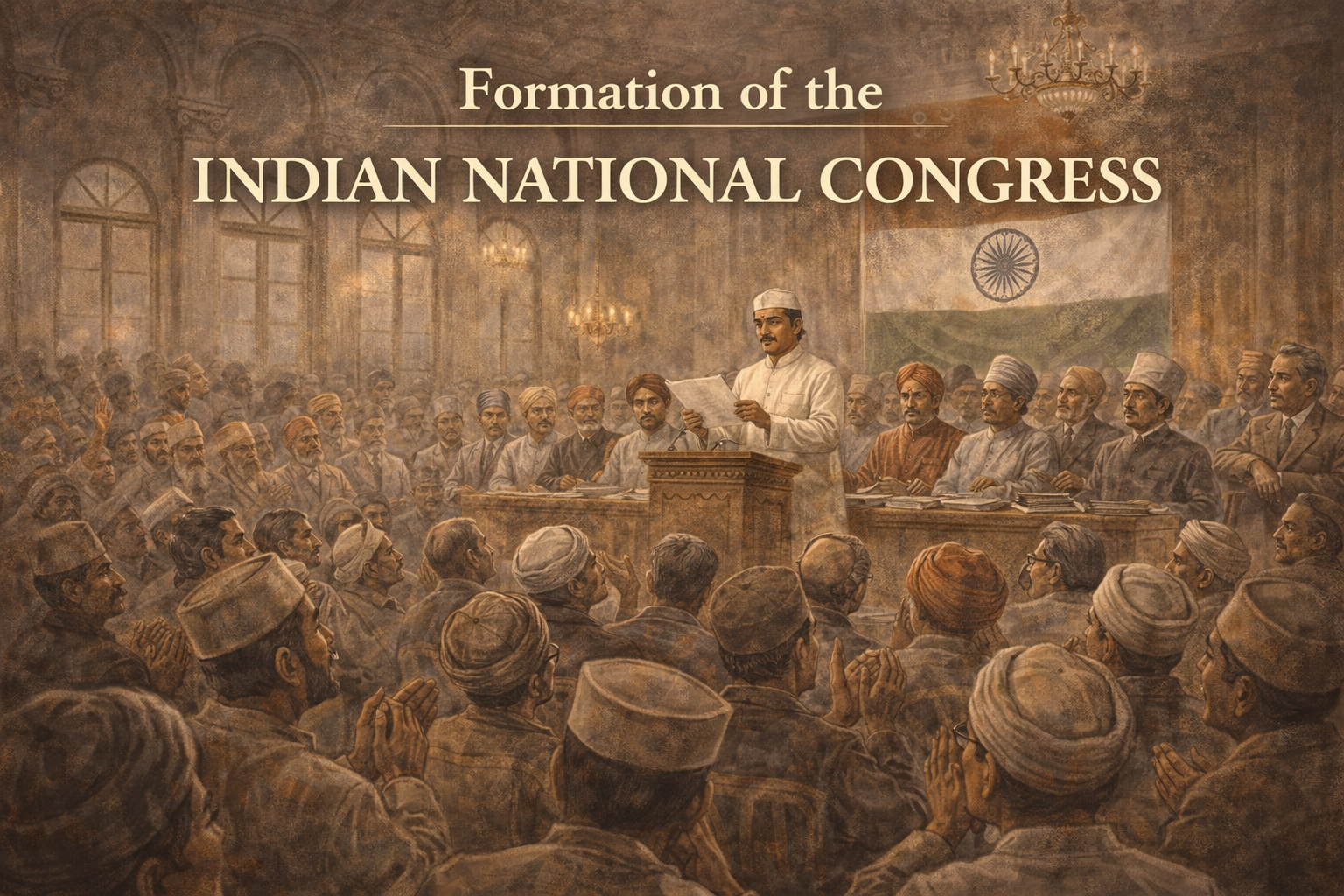
The formation of the Indian National Congress in 1885 marked a watershed moment in India's struggle for freedom. However, this momentous event was not a sudden occurrence but rather the culmination of decades of political awakening and organisational efforts. The story of India's political consciousness begins much earlier, in the first half of the nineteenth century, when the seeds of modern political thought were being sown across the subcontinent.
Formation of Indian National Congress
Early Political Associations: The Aristocratic Phase
The political associations that emerged in the early half of the nineteenth century bore distinct characteristics that reflected the social structure of colonial India. These organisations were predominantly controlled by wealthy and aristocratic elements, drawing their membership from zamindars, wealthy merchants, and the traditional elite. Their character remained largely local or regional, lacking the pan-Indian vision that would later define the nationalist movement.
These early associations relied primarily on the method of petitioning—submitting long, meticulously drafted petitions to the British Parliament in London. Through these formal appeals, they sought administrative reforms, greater association of Indians with the administration, and the expansion of educational opportunities. The tone remained respectful, even deferential, reflecting the prevailing belief amongst the elite that British rule, if reformed, could serve India's interests.
Key Characteristics
Dominated by wealthy aristocrats
Local or regional in scope
Relied on petitions to British Parliament
Sought gradual administrative reforms
Limited political consciousness
The Awakening: Mid-Nineteenth Century Transformation
The second half of the nineteenth century witnessed a profound transformation in India's political landscape. A new consciousness began to emerge, characterised by a more sophisticated understanding of colonial rule and its implications for Indian society. This period saw the foundation and growth of an organised national movement, marking a decisive break from the limited, aristocratic politics of earlier decades.
The modern Indian intelligentsia—comprising lawyers, journalists, teachers, doctors, and other professionals educated in Western thought—began creating political associations with a fundamentally different character. These organisations aimed to spread political education amongst the broader populace and initiate political work based on entirely new foundations: modern political ideas, fresh intellectual perceptions of reality, and innovative techniques of political organisation. The objectives, forces of struggle, and methods of resistance represented a radical departure from traditional forms of political expression.
However, the task proved immensely challenging. Indians remained largely unfamiliar with modern political work, and the very concept of organising politically in opposition to one's rulers was revolutionary. The political workers of this era understood that they were breaking new ground, and consequently, their work proceeded slowly and cautiously. It would require more than half a century of sustained effort to bring common people within the fold of modern politics. Yet the foundation was being laid for a movement that would eventually shake the British Empire to its core.
The New Leadership: Rise of the Educated Middle Class
The political associations of the second half of the nineteenth century came to be increasingly dominated by this educated middle class. Unlike their aristocratic predecessors, these new leaders possessed a wider perspective and a more ambitious agenda. They understood that India's problems required systematic analysis and coordinated action across regional boundaries. Their Western education, whilst introducing them to liberal political thought, also enabled them to articulate a critique of colonialism using the very vocabulary and concepts that the British claimed to champion—justice, representation, and progress.
Legal Professionals
Lawyers formed the backbone of the new political class, using their understanding of constitutional law and administrative procedure to articulate Indian grievances effectively.
Journalists and Writers
The emerging Indian press played a crucial role in spreading political awareness, with journalists becoming influential voices in the nationalist discourse.
Educators and Intellectuals
Teachers and scholars brought analytical rigour to political discussions, helping to develop a sophisticated critique of colonial policies.
Medical Practitioners
Doctors and other medical professionals contributed both their expertise and social standing to the nascent political movement.
The Lessons of 1857: A Turning Point
The failure of the 1857 revolt—variously termed the Sepoy Mutiny, the First War of Independence, or the Great Rebellion—delivered a harsh but instructive lesson to those seeking to challenge British rule. It became unmistakably clear that traditional methods of political resistance under the leadership of the landed upper classes, feudal chiefs, and traditional rulers could no longer succeed against the modern colonial state.
The brutal suppression of the revolt and its aftermath demonstrated the overwhelming military superiority of the British and their determination to maintain control. However, the failure also illuminated a crucial truth: resistance to colonial rule must flow through different channels, employ new strategies, and draw upon different sources of strength. The educated middle class began to understand that constitutional agitation, political organisation, and mass education offered a more viable path forward than armed rebellion.
Simultaneously, the character of British rule itself underwent a significant transformation after 1858. With the abolition of the East India Company and the assumption of direct Crown rule, British policies became markedly more reactionary. The liberal impulses that had occasionally influenced Company policies gave way to a more rigid, authoritarian approach. This hardening of imperial attitudes would have profound consequences for the development of Indian nationalism.
Growing Critique: Understanding Colonial Exploitation
As Indian intellectuals engaged more deeply with political economy and the workings of colonial administration, they gradually developed a more critical and sophisticated understanding of British rule. What had initially appeared to some as a benevolent if imperfect system began to reveal itself as fundamentally exploitative in nature. This intellectual awakening represented a crucial stage in the development of Indian nationalism.
Economic Analysis
Study of drain of wealth, deindustrialisation, and agricultural distress
Political Critique
Recognition of lack of representation and authoritarian governance
Ideological Development
Formation of nationalist consciousness and anti-imperialist thought
This understanding took considerable time to develop and mature. The process was gradual, marked by careful observation, analysis, and debate. However, once begun, and crucially, based as it was on modern intellectual tools and rational inquiry, the process probed ever deeper into the real nature of imperialism. Indian thinkers began to comprehend the systematic mechanisms through which wealth was extracted from India, how British policies systematically favoured British economic interests at India's expense, and how political subordination served economic exploitation. This evolving critique would ultimately be transformed into modern political activity and sustained resistance to colonial rule.
Raja Ram Mohan Roy: The Pioneer
Raja Ram Mohan Roy stands as one of the earliest Indian leaders to initiate an organised agitation for political reforms, earning him recognition as a pioneering figure in India's political awakening. His multifaceted activism addressed both social and political dimensions of colonial rule, demonstrating a remarkably progressive vision for his time.
Roy's political demands encompassed a wide range of issues that would later become central to the nationalist agenda. He fought vigorously for freedom of the press, recognising it as essential for public discourse and accountability. He advocated for trial by jury, seeing it as a fundamental right of citizens. The separation of executive and judiciary represented another key demand, reflecting his understanding of the importance of institutional checks and balances.
Administrative Reforms
Advocated for appointment of Indians to higher offices and institutional reforms
Social Justice
Championed protection of ryots from zamindari oppression
Economic Development
Promoted development of Indian trade and industry
Global Vision
Supported causes of liberty, democracy, and nationalism internationally
Following Roy's pioneering efforts, the Bangabhasha Prakasika Sabha was formed in 1836 by his associates, carrying forward his legacy of combining social reform with political activism. This organisation represented an important early attempt to create institutional structures for sustained political work, even as it remained limited in scope and influence.
The British Indian Association: Consolidation and Limitations
The formation of the British Indian Association in 1851 marked a significant milestone in the evolution of political organisation in India. This body emerged from the merger of two important predecessor organisations—the Zamindari Association (also known as the Bengal Landholders' Society) founded in 1836, and the British India Society established in 1843 in England.
The Landholders' Society (1836)
Founded by prominent figures including Dwarkanath Tagore, Prasanna Kumar Tagore, and Radhakanta Deb, the Zamindari Association primarily aimed to safeguard the interests of landlords. Whilst its objectives remained limited to protecting the landed aristocracy, the organisation marked the beginning of organised political activity in Bengal. More significantly, it pioneered the use of constitutional agitation for the redressal of grievances—a method that would become central to Indian political work.
The British India Society (1843)
Established in England largely through the efforts of William Adam, who had befriended Ram Mohan Roy in India, this society represented a broader vision. Its stated objective was "the collection and dissemination of information relating to the actual condition of the people of British India" and to employ peaceful and lawful means to "secure the welfare, extend the just rights and advance the interests of all classes." The society sought to influence British public opinion and parliamentary action on Indian affairs.
Activities and Achievements of the British Indian Association
1851: Formation
Merger of Landholders' Society and British India Society creates unified platform
1853: Charter Act Petition
Successful petition leads to addition of six legislative members to Governor-General's council
1857: Supporting the Raj
Association backs British during Sepoy Mutiny, calling for stern punishment of rebels
Post-1857: Growing Conservatism
Increasingly identified with zamindari interests, losing broader nationalist appeal
The British Indian Association sent a comprehensive petition to the British Parliament demanding the inclusion of several progressive suggestions in the renewed Charter of the Company. These demands included the establishment of a separate legislature of a popular character, separation of executive from judicial functions, reduction in salaries of higher officers, and abolition of various burdensome taxes including salt duty, abkari, and stamp duties. The partial acceptance of these demands, reflected in the Charter Act of 1853's provision for adding six members to the Governor-General's council for legislative purposes, represented a modest but real achievement.
However, the Association's activities revealed significant limitations. Its work consisted mainly of submitting petitions to the Government and British Parliament, reflecting an inherent trust in the good intentions of the rulers. Whilst it sought to address issues affecting all sections of society, it occasionally made conscious efforts to protect specifically the rights of the landed aristocracy. The Association lacked any constructive policy framework and seldom laid down any programme of systematic action for political advancement. Perhaps most critically, it failed to cover the country with a network of branches, remaining essentially an elite Calcutta-based organisation. Its support for the British during the 1857 revolt further alienated it from emerging nationalist sentiment.
Dadabhai Naoroji and the East India Association
The Grand Old Man of India
Dadabhai Naoroji, later honoured as the "Grand Old Man of India," founded the East India Association in London in 1867, marking a new chapter in Indian political organisation. Naoroji understood that influencing British public opinion and parliamentary action required a permanent presence and sustained advocacy in the imperial metropolis itself. His organisation aimed to discuss the Indian question, influence public men in England, and promote Indian welfare through systematic education and lobbying.
The East India Association represented one of the key predecessor organisations of the Indian National Congress, establishing important precedents for nationalist work. Its founding principle was to present correct information about India to the British public and give voice to Indian grievances in the heart of the empire. This strategy reflected a sophisticated understanding of how colonial policy was made and where pressure could be most effectively applied.
Countering Racism
The Association played a crucial role in challenging racist ideology, particularly countering the propaganda of the Ethnological Society of London, which in its 1866 session had attempted to "prove" the inferiority of Asians to Europeans. This intellectual battle against pseudo-scientific racism formed an important dimension of early nationalist work.
Winning British Support
Through patient advocacy and reasoned argument, the Association succeeded in winning support from eminent Englishmen and exercised considerable influence in the British Parliament. This demonstrated that sympathetic elements existed within British society who could be mobilised in support of Indian aspirations.
Expansion to India
In 1869, the organisation opened branches in Bombay, Calcutta, and Madras, creating an institutional link between advocacy work in London and political activity in India. However, the Association became defunct in the 1880s as more comprehensive organisational forms emerged.
The Indian Association of Calcutta: A New Generation Emerges
The founding of the Indian League in 1875 by Sisir Kumar Ghosh marked the emergence of a more explicitly nationalist approach to political organisation. The League's stated objective—"stimulating the sense of nationalism amongst the people"—represented a significant advance in political consciousness. Sisir Kumar Ghosh himself exemplified the new type of political leader: a journalist and educator rather than an aristocrat, he founded the influential Amrita Bazar Patrika in 1868 and spent much of his life in Santiniketan, where he served as Professor of English.
However, the most important of all pre-Congress associations was the Indian Association of Calcutta, also known as the Indian National Association, founded in 1876. This organisation superseded the Indian League and represented a decisive break with the conservative, pro-landlord politics that had dominated earlier associations. The driving force behind its formation came from younger nationalists of Bengal, particularly Surendranath Banerjee and Ananda Mohan Bose, who had grown increasingly discontented with the limitations and class bias of organisations like the British Indian Association.
Civil Services Reform
The Association vigorously agitated for reform in Civil Services examinations, making this a national issue. Surendranath Banerjee was sent as a special delegate across the country to build support for this campaign, becoming the first Indian leader to gain all-India popularity through such sustained political touring and mobilisation.
Public Opinion Building
The organisation worked systematically to create strong public opinion on political questions, recognising that sustained political pressure required an informed and engaged citizenry. This emphasis on political education represented a significant advance in political methodology.
National Unity
A key objective was to unify the Indian people on a common political programme, transcending regional, religious, and caste divisions. This vision of a unified Indian nation would become central to the Congress movement.
Comprehensive Development
The Association committed to "promoting by every legitimate means the political, intellectual and material advancement of the people," recognising the interconnection between political rights and broader social and economic progress.
Expanding the Base: Innovation in Political Organisation
The Indian Association of Calcutta introduced several innovative approaches that distinguished it from earlier organisations. Crucially, branches of the association were opened not only in other towns and cities of Bengal but also beyond the province's boundaries, making it the first truly regional organisation with aspirations to national reach. This geographical expansion reflected a growing understanding that effective political work required coordination across provincial boundaries.
Perhaps most significantly, the membership fee was deliberately kept low to attract participation from poorer sections of society. This represented a conscious effort to broaden the social base of political activity beyond the elite circles that had dominated earlier associations. Whilst the leadership remained largely middle-class, this attempt to create a more inclusive organisation marked an important step towards mass politics.
The Indian National Association earned recognition as the first avowed nationalist organisation founded in British India. It attracted educated Indians and civic leaders from across the country, demonstrating the appeal of its more assertive nationalist programme. The Association's activities and organisational model would directly influence the formation of the Indian National Congress, and it eventually merged with the Congress, bringing its membership and organisational experience into the larger national movement.
Ananda Mohan Bose: Reformer and Organiser
Ananda Mohan Bose exemplified the interconnection between social and political reform in nineteenth-century Bengal. A member of Brahmo Dharma, he became involved in disputes within the Brahmo Samaj regarding matters including child marriage and organisational governance. On 15 May 1878, he joined Shibnath Shastri, Sib Chandra Deb, Umesh Chandra Dutta, and others in founding the Sadharan Brahmo Samaj, serving as its first president. His simultaneous engagement with religious reform and political organisation illustrated how the new Indian intelligentsia sought comprehensive transformation of society.
Political Awakening in Western India
The political awakening that transformed Bengal found parallel expression in other regions of British India, particularly in Bombay Presidency. The organisations that emerged in western India reflected both the common concerns of the educated middle class across regions and the specific social and political conditions of their localities.
1852: Bombay Native Association
Founded by Jagannath Shankar Seth, this organisation marked the beginning of organised political activity in Bombay. Like its Bengal counterparts, it focused primarily on petitioning for administrative reforms and greater Indian participation in governance.
1870: Poona Sarvajanik Sabha
Established by the eminent reformer Mahadeo Govind Ranade along with GV Joshi and others, this organisation explicitly aimed to serve as "a bridge between the government and the people." The Sabha carried out active political education for three decades, playing a crucial role in developing political consciousness in Maharashtra. Ranade's involvement brought intellectual depth and a reformist vision to political work.
1885: Bombay Presidency Association
Founded by three distinguished leaders—Badruddin Tyabji, Pherozshah Mehta, and K.T. Telang—this association emerged just as the Indian National Congress was being established. Its formation reflected the maturation of political consciousness in Bombay and the readiness of leaders there to participate in broader national platforms. The organisation brought together Parsi, Muslim, and Hindu leaders, demonstrating a spirit of communal harmony that would characterise early Congress politics.
These organisations in Bombay Presidency developed their own distinctive characteristics whilst sharing the fundamental goals of increased Indian participation in administration, protection of Indian economic interests, and promotion of education. The presence of prominent industrialists and merchants in Bombay's political associations also reflected the city's unique position as an emerging centre of Indian capitalism.
The South Awakens: Political Organisation in Madras
The Madras Presidency, with its own distinctive social structure and political traditions, witnessed a parallel development of political organisations. The founding of the Madras Native Association in 1852 established it amongst the earliest regional political bodies, demonstrating that political consciousness was emerging simultaneously across different parts of British India.
The most significant organisation in Madras was the Madras Mahajan Sabha, founded in 1884 by M. Viraraghavachari, B. Subramaniya Aiyer, and P. Anandacharlu. Coming into existence just a year before the Indian National Congress, the Sabha represented the culmination of decades of political development in South India. Its leadership included some of the most distinguished intellectuals and public figures of Madras, and it quickly established itself as an influential voice for Indian interests in the region.
The timing of the Madras Mahajan Sabha's founding proved fortuitous. When the call came in 1885 to participate in the first session of the Indian National Congress, Madras had a well-established organisation capable of mobilising delegates and contributing to the new all-India platform. The 607 delegates who attended the Congress's Madras session in 1887 testified to the strength of political organisation in the presidency.
It bears noting that Dadabhai Naoroji's East India Association had also established a branch in Madras in 1869, creating institutional links between London-based advocacy and local political work. This network of interconnected organisations across different regions and even spanning the Indian Ocean created the infrastructure upon which the national movement could build.
The Eve of the Congress: A Nation in Waiting
By the mid-1880s, the political landscape of British India had been transformed. Where once stood scattered, elite-dominated associations focused on narrow regional or class interests, there now existed a network of organisations across the major centres of British India. These bodies shared a common language of political discourse, similar methods of constitutional agitation, and increasingly convergent demands for reform.
New Leadership
Educated middle class replacing traditional elite
Interconnected Organisations
Branches and affiliations across regions
Political Methods
Constitutional agitation and public mobilisation
Common Demands
Civil service reform, representation, economic justice
National Consciousness
Vision transcending regional boundaries
Broadening Base
Efforts to include wider sections of society
The politically conscious amongst Indians had come to realise that existing political associations, valuable as they had been, were too narrowly conceived to meet the challenges of the changed circumstances. The British Indian Association, for instance, had increasingly identified itself with zamindari interests and consequently with the ruling power, limiting its effectiveness as a vehicle for broader nationalist aspirations. What was needed was an organisation that could transcend regional boundaries, speak for all of India, and present a unified platform of demands to the British government.
The reactionary measures introduced during Lord Lytton's viceroyalty from 1876 to 1880 had quickened the pace of Indian nationalistic activity, creating a sense of urgency amongst political leaders. The time had arrived for the various streams of political work across India to converge into a single national organisation. The stage was set for the Indian National Congress.
The Foundation of the Indian National Congress
The story of the Indian National Congress's foundation centres on Allan Octavian Hume, a retired English civil servant who had chosen to remain in India after his retirement. Hume was a complex figure—liberal in outlook, genuinely concerned about India's future, yet also motivated by a desire to channel Indian nationalism into "safe" constitutional paths. During 1883-1884, he travelled extensively across the subcontinent, meeting prominent political leaders in Bombay, Madras, and Calcutta, persuading them to convene a national conference.
Hume's involvement stemmed partly from his close relationship with Lord Ripon, the Viceroy of India, who shared his liberal views. Both men believed that the emergence of an educated Indian middle class represented a political reality that needed to be acknowledged. Hume argued that timely steps should be taken to provide appropriate channels for expressing this class's grievances and satisfying its legitimate ambitions. This pragmatic approach to political reform reflected a strain of liberal imperialism that recognised the need to adapt colonial governance to changing social conditions.
On 1 March 1883, Hume addressed students at Calcutta University, urging them to form an association for "the mental, moral, social, and political regeneration of the people of India." This appeal resonated with many young Indians who were already engaged in political work through various regional organisations. Hume strenuously consolidated his network of contacts, meeting with influential leaders across presidencies to discuss programmes of political action for educated Indians.
The "Safety Valve" Theory: Myth and Reality
The "safety valve" theory posits that the British colonial government intentionally facilitated the creation of the Indian National Congress. The idea was to provide a controlled forum for educated Indians to express their grievances and channel rising nationalist sentiments. This, in turn, would prevent a more radical or violent uprising against British rule by offering a seemingly legitimate outlet for discontent. It suggests the British aimed to defuse potential political instability before it escalated.
One of Hume's stated aims in facilitating the Congress's establishment was to offer an outlet—a "safety valve"—for rising popular dissatisfaction against British rule. As Hume himself put it: "A safety valve for the escape of great and growing forces generated by our own action was urgently needed and no more efficacious safety valve than our Congress Movement could possibly be devised." This conception has given rise to what historians call the "safety valve theory" of the Congress's origin.
"If the founders of the Congress had not been such capable and patriotic men of high character, why did they need Hume to act as the chief organiser? The answer lies in the political realities of colonial India—these leaders willingly accepted Hume's assistance to avoid arousing official hostility at such an early stage of political activity."
However, the "safety valve" theory represents, at best, only a small part of the truth, and many historians consider it fundamentally false. More than anything else, the National Congress represented the natural culmination of the political awakening that had been developing for decades—the urge of politically conscious Indians to establish a national organisation to advance their political and economic interests. The nationalist movement was growing as a result of powerful historical forces, not merely as a colonial stratagem.
Why Indians Accepted Hume's Help
The Indian leaders who cooperated with Hume were patriotic individuals of high character. They accepted his assistance for practical reasons: the tradition of open opposition to rulers was not yet firmly entrenched, and given the vast size of India, relatively few people were engaged in political activity in the early 1880s. Having a British sponsor provided some protection against immediate official hostility, allowing the organisation to take root before facing inevitable government opposition.
Hume as "Lightning Conductor"
Gopal Krishna Gokhale later wrote that any attempt by Indians alone to form an all-India organisation would have immediately attracted unfriendly official attention. He observed: "If the founder of the Congress had not been a great Englishman, the authorities would have at once found some way or the other to suppress the movement." Thus, whilst Hume hoped to use Congress as a "safety valve," Indian leaders hoped to use Hume as a "lightning conductor" to deflect initial British hostility.
The First Session: 28 December 1885
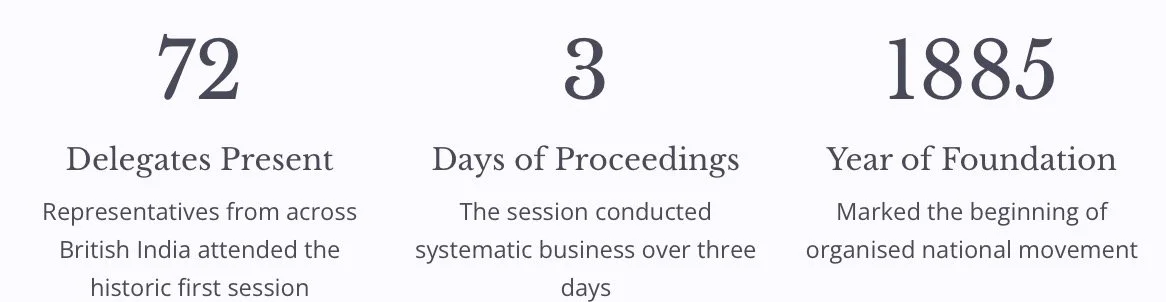
Hume's sustained efforts culminated in the organisation of the first session of the Indian National Congress at Bombay in the hall of Gokuldas Tejpal Sanskrit College on 28 December 1885 (a Monday). The session was presided over by Womesh Chandra Banerjee of Bengal, himself one of India's first barristers and a foremost legal luminary of his time. His election established a healthy precedent that would be maintained in subsequent years—the president should be chosen from a province other than the one hosting the Congress session, symbolising the organisation's all-India character.
The First Session: 28 December 1885
The foundation of the Congress represented the natural culmination of previous political work. By 1885, Indian political development had reached a stage where certain basic objectives needed to be articulated and struggled for systematically. Moreover, these objectives were interconnected and could only be pursued effectively through an all-India organisation. The men who gathered in Bombay on that December day understood this clearly—they hoped to initiate a process that would ultimately transform India's relationship with its colonial rulers.
Success or failure, and the future character of the Congress, would be determined not by the identity of its founders but by the extent to which its stated objectives could be achieved. The question of whether Hume or Indian leaders "founded" the Congress ultimately matters less than understanding the historical forces that made such an organisation necessary and the political programme it would pursue. With the Congress's establishment, the struggle for India's freedom from foreign rule was launched in a small but organised manner. The national movement would grow continuously from this point forward, and the country would know no rest until freedom was won.
Early Congress: Character and Growth
The early Congress was not a "full-fledged political party" in the modern sense. It lacked many characteristics of a permanent political organisation—no paying membership system, no central office, no permanent fund, and no permanent officials. Its organisational structure consisted merely of a general secretary and the annual session. This minimalist institutional framework reflected both the limited resources available and the uncertain political environment in which it operated.
Rapid Growth in Attendance
1885 Bombay: 72 delegates
1886 Calcutta: 436 delegates
1887 Madras: 607 delegates
1888 Allahabad: 1,248 delegates
1889 Bombay: 1,889 delegates
The Congress leaders took considerable pains to assure the British Raj that their organisation "wasn't a nursery for sedition and rebellion." As Jawaharlal Nehru would later admit, they remained preoccupied with concerns of landlords, capitalists, and the educated unemployed rather than the masses. Yet despite these limitations, the proceedings of early sessions indicate a genuine will to present an all-India front to the colonial regime and to raise issues of national importance.
The number of delegates representing India's four corners grew dramatically, from 72 at the first Bombay session to 1,889 by the 1889 Bombay session. This spectacular increase demonstrated the Congress's growing appeal and the spread of political consciousness across regions. Along with Hume and William Wedderburn, other "distinguished Europeans" joined various sessions, lending credibility to the organisation in British eyes whilst also reflecting genuine liberal sympathies amongst some Britons.
Popular enthusiasm manifested itself dramatically from the second session onwards. At the 1886 Calcutta session, the Town Hall venue was "stifled in a crowd of 2,000 to 3,000 lookers-on" on the very first day. By the 1889 Congress, such accompanying crowds had swelled to 6,000 people. This popular interest, whilst not translating into mass participation, indicated that the Congress was capturing public imagination beyond the educated elite who composed its membership.
Legacy and Significance of Pre-Congress Political Associations
The political associations that emerged in the decades before the Indian National Congress's foundation played an indispensable role in preparing the ground for India's national movement. Though limited in their social base, modest in their demands, and respectful in their methods, these organisations initiated crucial processes that would fundamentally reshape Indian politics.
Creating Political Infrastructure
The early associations established the basic infrastructure for political work—regular meetings, petition drafting, delegation to authorities, public education, and fundraising. These mundane but essential organisational skills would prove invaluable when nationalist politics intensified. They demonstrated that Indians could organise effectively, sustain institutions over time, and conduct political business in an orderly manner.
Developing Political Consciousness
Through their activities, these associations spread political awareness amongst the educated classes and even beyond. They trained a generation of political workers, familiarised Indians with concepts like representation and rights, and normalised the idea of organised opposition to government policies. The transition from viewing politics as the preserve of rulers to seeing it as a field for citizen action represented a revolutionary shift in political culture.
Articulating Common Interests
By identifying issues that affected Indians across regions and communities—civil service reform, economic exploitation, lack of representation—these associations began to define a common national interest. This represented a crucial step towards imagining India as a unified political community rather than a collection of disparate groups. The very act of framing demands in terms of "Indian" interests, as opposed to regional or communal interests, helped construct a national identity.
Establishing Constitutional Methods
The associations pioneered constitutional methods of agitation—petitioning, public meetings, press campaigns, and mobilising opinion—that would remain central to Indian nationalism. They demonstrated that these methods, whilst limited in immediate effectiveness, could build sustained pressure for reform. The commitment to peaceful, constitutional means, established by these early organisations, would become a defining characteristic of mainstream Indian nationalism.
The Indian National Congress did not emerge from a vacuum but represented the culmination of more than half a century of political experimentation and organisation. The associations founded by pioneers like Raja Ram Mohan Roy, the leaders of the British Indian Association, Dadabhai Naoroji, Surendranath Banerjee, and countless others created the foundations upon which the national movement would build. Their work, however modest it may appear in retrospect, transformed Indian politics from the preserve of rulers and traditional elites into an arena where educated Indians could assert their voice and claim their rights.
As India moved into the twentieth century, the limitations of the early associations—their elite character, moderate demands, and deferential methods—would become increasingly apparent. A new generation of leaders would push for more radical goals using more confrontational methods. Yet they would do so standing on the shoulders of those who had initiated organised political work in an unfamiliar and often hostile environment. The legacy of the pre-Congress political associations thus lies not in what they achieved immediately, but in how they made possible the mass nationalist movement that would eventually win India's independence.
