
Programme and Objectives of Early Congress
The Indian National Congress, founded in 1885, emerged as one of the most consequential political organizations in modern history. During its formative phase from 1885 to 1905 — commonly known as the Moderate Era — the Congress operated not as a radical movement, but as a careful, constitutionalist body seeking incremental reforms under British rule. This document traces the nature and character of the early INC, its foundational objectives, and the evolving British attitude toward its growing presence.
Far from being a full-fledged political party in any modern sense, the early Congress lacked paying members, a central office, a permanent fund, or permanent officials. Yet it represented something historically unprecedented: a platform where Indians from across regions, religions, castes, and professions could articulate shared political aspirations. Understanding this formative period is essential for grasping how a modest, elite-dominated annual gathering eventually grew into the engine of a mass independence movement.
Phase Covered
Moderate Era: 1885–1905
Founded
December 1885, Bombay
Character
Elitist, constitutionalist, petitionary
Key Figure
A.O. Hume, Dadabhai Naoroji, Gokhale
Nature & Character
What Kind of Organisation Was the Early INC?
The early Indian National Congress defies easy categorisation. It was neither a political party in the conventional sense nor a revolutionary movement. It had no paying members, no central office, no permanent fund, and no permanent officials — only a general secretary. Its leaders went to great lengths to assure the British Raj that the Congress was not, as W.C. Banerjee (president of the first Congress) put it, "a nest of conspirators and disloyalties." They were, he emphasised, "thoroughly loyal and consistent well-wishers of the British Government."
Jawaharlal Nehru himself admitted that the early Congress leaders remained preoccupied with the concerns of landlords, capitalists, and the educated unemployed — a class whose professional frustrations and administrative grievances shaped much of the early Congress agenda. Their methods were characteristically moderate: prayers, petitions, and memoranda addressed to colonial authorities. Surendranath Banerjee's phrase "un-British rule" encapsulated their worldview — they were not opposed to British connection per se, but to what they perceived as a departure from the liberal values Britain claimed to uphold.
Nevertheless, the Congress represented a genuinely new departure in Indian political tradition. It was, as Gokhale observed, conceived from the beginning as a movement, not a party. It required no particular ideological commitment beyond broad democratic and secular nationalism. It welcomed lawyers, merchants, bankers, landowners, medical men, journalists, educationists, and religious reformers alike. In doing so, it sought to forge — however tentatively — an overarching national unity across the vast, diverse subcontinent.
What It Was
An all-India political platform
A movement incorporating diverse classes
A forum for petitionary constitutionalism
A vehicle for national consciousness
What It Was NOT
A full-fledged political party
A radical or revolutionary organisation
A social reform platform
A mass-based popular movement (yet)
Growth & Representation
Rising Numbers: The Congress Gains Momentum
One of the most striking features of the early Congress was its rapid growth in delegate numbers and popular enthusiasm. From a modest gathering of 72 non-official Indian representatives at the first session in Bombay in 1885, attendance multiplied dramatically within just a few years. This growth was not merely numerical — it reflected a genuine expansion of the Congress's geographic and social reach, drawing participants from what the official report described as "most classes" of Indian society.
Popular enthusiasm was particularly visible from the second session at Calcutta, where the Town Hall venue was "stifled in a crowd of 2,000 to 3,000 lookers-on" on the very first day. By 1889, such accompanying crowds had grown to 6,000. This enthusiasm demonstrated that even in its early, elite-dominated phase, the Congress resonated beyond the narrow circle of its delegates and had begun to capture the imagination of urban India.
The geographic rotation of sessions — held alternately in Bombay, Calcutta, Madras, Allahabad, and other cities — was itself a deliberate strategy to transcend regional identities. The decision to choose the president from a region different from where the session was held further reinforced this all-India character. The presence of distinguished Europeans like A.O. Hume and William Wedderburn at early sessions also provided the Congress with a measure of legitimacy and protection it might otherwise have lacked in the eyes of the colonial administration.
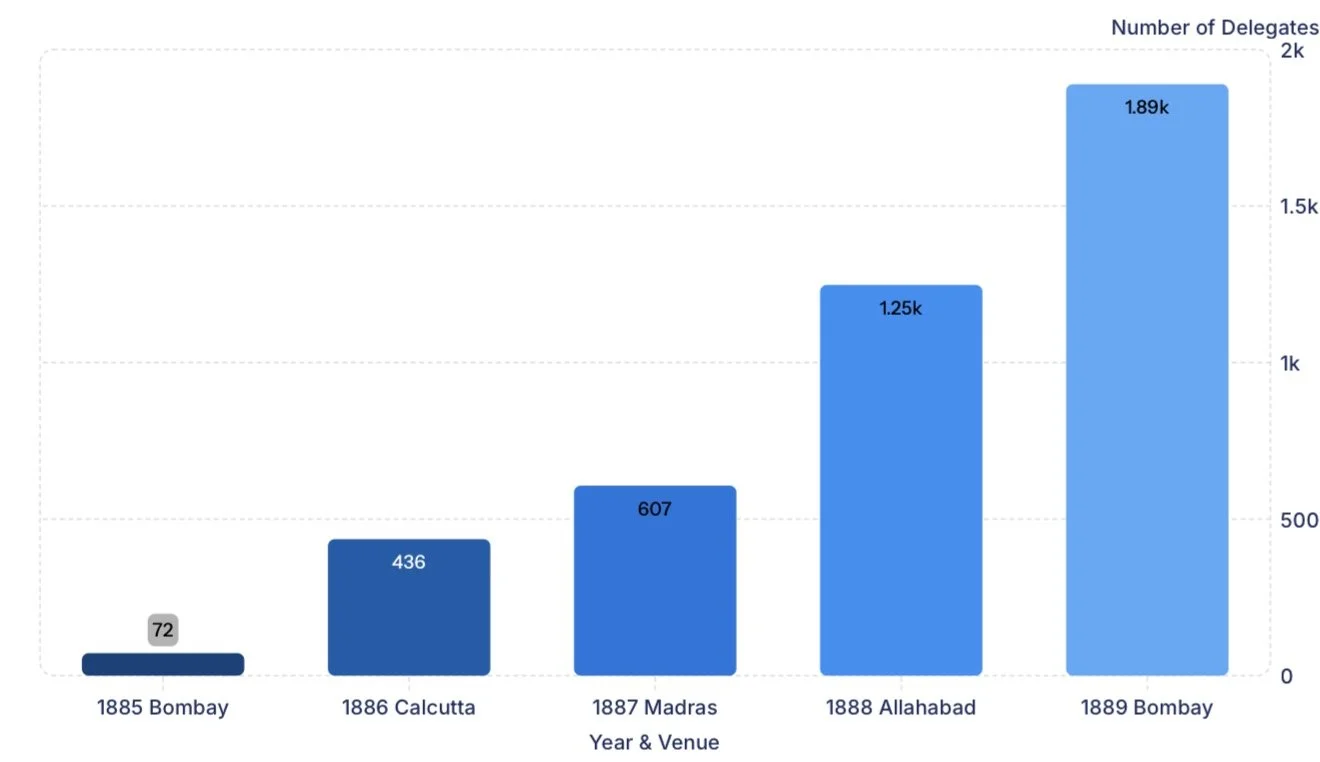
The rapid increase in delegate attendance — from 72 in 1885 to 1,889 by 1889 — illustrates the early Congress's expanding reach and growing national appeal, even within its moderate, constitutionalist framework.
Moderate Leadership
The Moderate Leaders: Methods, Ideology, and Limitations
The dominant ethos of the Congress between 1885 and 1905 was shaped entirely by moderate leaders. Their ideology was rooted in an absolute faith in the effectiveness of peaceful and constitutional agitation and in a belief — which Nehru and later historians would characterise as an illusion — that the British government was fundamentally just and that rational persuasion would yield meaningful reforms. Their aim, in short, was not to overthrow British rule but to reform it from within.
The moderates pleaded for policies that would transform India economically, socially, and politically through gradual change. They favoured self-rule for India but understood it as a distant, evolutionary goal — not an immediate demand. They worked within strict constitutional limits, observing parliamentary procedure in moving, discussing, and passing resolutions. The Congress proceedings were, by all accounts, organized in the most orderly and efficient manner. In the initial years, the Congress leaders explicitly did not want the organisation to function as a political party at all; they sought autonomy in internal affairs under British suzerainty while expressing what appeared to be immense faith in British sincerity.
Their social composition reinforced this moderate orientation. The early Congress was dominated by the educated middle class — lawyers, journalists, educationists, and professionals — who had benefited from colonial modernity and shared a broadly liberal outlook. As Gokhale observed in 1913, any attempt by Indians to form an all-India organisation would immediately attract unfriendly official attention; the early moderates were acutely conscious of this vulnerability and calibrated their actions accordingly.
Method of Agitation
Prayers, petitions, and memoranda addressed to the colonial government. Strict adherence to constitutional means and parliamentary procedure within Congress sessions.
Faith in British Justice
Moderates believed in the "essential sense of justice and kindness of the British nation." Their goal was to educate Indian public opinion and make it conscious of its rights — not to confront the Raj directly.
Limited Social Vision
Preoccupied with concerns of landlords, capitalists, and educated unemployed. Social reforms were deliberately excluded from the Congress agenda to maintain political unity.
Role of A.O. Hume
"If Hume and other English liberals hoped to use Congress as a safety-valve, the Congress leaders hoped to use Hume as a lightning conductor." — A mutual instrumentalisation of the British connection.
Foundational Objectives
Objectives of the Early Indian National Congress (1885)
The founding objectives of the Indian National Congress in 1885 were both ambitious and carefully bounded. They were ambitious in their vision of forging a unified Indian political identity from an extraordinarily diverse population; they were carefully bounded in their insistence on constitutional methods and loyalty to the Crown. The objectives addressed both the immediate need for political organisation and the longer-term project of building a national consciousness that could sustain such organisation.
A particularly significant institutional safeguard introduced in 1888 stated that no resolution would be passed if it was objected to by an overwhelming majority of Hindu or Muslim delegates — a provision designed to ensure that the Congress remained a genuinely all-community platform. A related majority clause appeared in a resolution adopted in 1889 demanding reform in the legislative councils. These provisions reveal the Congress's acute awareness of the communal tensions that could fracture its pan-Indian ambitions.
Crucially, social reforms were explicitly excluded from the Congress agenda. The Congress was conceived as a political body to represent the political aspirations of the Indian people as a whole — not a platform to discuss social reform. This decision was primarily driven by the goal of creating political unity across communities divided by caste, religion, and custom. The early Congress also broadly followed what has been described as a bourgeois path of socio-economic and political development — seeking space for Indian capital, educated professionals, and the indigenous middle class within the colonial framework rather than challenging that framework's foundations.
Promote National Unity
Develop and consolidate feelings of national unity irrespective of race, caste, religion, and province. Counter the imperialist claim that Indians were not a people or a nation.
Create an All-India Political Platform
Build a national political programme on which all Indians could agree and which could serve as the basis for all-India political activity.
Politicise Public Opinion
Train and organise public opinion; create public interest in political questions; build political awareness across the educated classes.
Build All-India Political Leadership
Develop a country-wide leadership and a common band of political workers or cadre to carry on political work — which did not exist in the 1880s.
Record and Represent Educated Opinion
Document the opinions of the educated classes on pressing problems and lay down lines for future course of action in the public interest.
Economic & Political Demands
Beyond Indianisation: The Economic and Political Demands of Early Congress
The substantive demands of the early Congress were considerably more wide-ranging than is sometimes assumed. Delegates did not merely advocate for greater Indian representation in government councils or the Indianisation of the civil services — though these were certainly prominent concerns. The Congress sessions saw articulate criticism of the broader direction of British economic and administrative policy in India, revealing a body that, for all its moderate methods, engaged seriously with the structural consequences of colonial rule.
Delegates spoke of India "sinking deeper and deeper into this abyss of destitution" — a formulation that foreshadowed the later, more systematic economic nationalist critique developed by Dadabhai Naoroji in his theory of economic drain. The Congress also criticised the annexation of Upper Burma, proposed the separation of the executive and judiciary (a significant demand for the rule of law), called for the re-imposition of import duties on finer classes of cotton goods to protect Indian textile industries, and urged active encouragement of indigenous manufactures.
Demands for the promotion of general and technical education — alongside a reduction of government control over education — further indicated that the early Congress understood development in comprehensive terms. These issues were framed explicitly as matters of common national concern, cutting across regional and community identities. The economic and political demands were, in this sense, deliberately structured to unify the Indian people on the basis of a shared political programme rather than a sectional interest.
Judicial Reform
Proposed separation of executive and judiciary to establish the rule of law and protect Indians from arbitrary administrative decisions.
Economic Protection
Re-imposition of import duties on finer cotton goods; encouragement of indigenous manufactures to counter deindustrialisation.
Education Policy
Promotion of general and technical education; reduction of government control over education to foster independent intellectual development.
Military Expenditure
Opposed increasing military expenditure of the Raj, which was seen as a burden on Indian revenues with little benefit to the Indian population.
Congress as Movement
Congress as a Movement, Not a Party: National Unity and Its Significance
One of the most analytically important characteristics of the early Indian National Congress was its self-conception as a movement rather than a party. This distinction was more than semantic. A political party typically demands ideological uniformity and organisational discipline from its members. A movement, by contrast, is defined by broad commitment to a shared goal — in this case, democratic and secular nationalism — while tolerating wide diversity of opinion, social background, and political temperament among its participants.
The Congress from its inception sought to incorporate different political trends, ideologies, and social classes, provided the commitment to overarching national unity was present. It made no attempt to limit its following to any particular social class or group. This deliberate inclusivity was both its greatest strength and, paradoxically, a source of its early limitations: the need to maintain unity across such a diverse coalition required the subordination of more radical demands to the lowest common denominator of moderate constitutionalism.
The decision to hold the annual session in different parts of the country, rotating the presidency across regions, and the emphasis on developing "those sentiments of national unity" irrespective of region, religion, and caste — all these were conscious strategies to build a genuinely pan-Indian identity at a time when such an identity was more aspiration than reality. The moderate Congress leaders were, as Nehru later acknowledged, building a nation in the making; their contribution lay in laying the institutional and psychological groundwork for a national political culture, even if their immediate demands fell far short of what was ultimately required.
"Despite its limitations, it sought to forge an overarching national unity and raised a very important political demand: the basis of the government should be widened and the people should have their proper and legitimate share in it. It was from here that the mainstream of Indian nationalist politics began to flow."
The early Congress's most enduring contribution, then, was not any particular legislative victory — of which there were few — but the very creation of an all-India political imagination: a shared sense that Indians, despite their extraordinary diversity, constituted a people with common interests and common political aspirations capable of being expressed through a common platform.
British Response
British Attitude Towards the Early Congress: From Neutrality to Hostility
The evolution of the British attitude toward the Indian National Congress between 1885 and 1905 traces a trajectory from cautious neutrality to active hostility — a shift that reveals much about the colonial government's understanding of the political threat the Congress represented, even in its moderate phase. In the early years, British officialdom maintained a posture of indifference, if not occasional goodwill. Lord Dufferin gave a garden party to delegates attending the second Congress session in Calcutta in 1886; the Governor of Madras provided facilities to organisers of the third session in 1887; and the 1888 Allahabad Session was presided over by George Yule, the first Englishman to do so.
This apparent cordiality did not last. By 1887, it had become apparent that the Congress would not confine itself to a limited, advisory role. The very third session at Madras saw the word "self-governance" mentioned publicly for the first time. Dufferin responded by attacking the Congress in a public speech, ridiculing it as representing "only a microscopic minority of the people" and dismissing its demands as "a big jump into the unknown." The tone was set for a decades-long pattern of official contempt for and fear of the Congress.
In 1890, government employees were forbidden from participating in or attending Congress meetings. George Hamilton, the Secretary of State for India, accused the Congress of possessing a "seditious and doubled-sided character," writing to Dadabhai Naoroji in 1900: "You announce yourself as a sincere supporter of the British rule, but you denounce the conditions and consequences which are inseparable from the maintenance of that rule." Lord Curzon was even more explicit, declaring that the Congress was "tottering to its fall" and that one of his greatest ambitions in India was "to assist it to a peaceful demise."
This trajectory illustrates that the British, despite the Congress's moderate methods and professions of loyalty, recognised it as a long-term threat to colonial authority. The very success of the Congress in building all-India solidarity — however partial — was precisely what made it dangerous in colonial eyes.
Divide and Rule
British Strategy: Divide and Rule Against the Congress
Realising that the growing unity of the Indian people posed a major threat to their rule, the British authorities responded not merely with repression but with a sophisticated strategy of fragmentation — deliberately exploiting existing social, religious, and regional divisions to undermine the Congress's pan-Indian ambitions. This policy of divide and ruleoperated on multiple levels simultaneously and had lasting consequences for Indian politics well beyond the moderate era.
The British encouraged Sir Syed Ahmed Khan and the Aligarh Movement, Raja Shiva Prasad of Benaras, and other pro-British individuals to start anti-Congress movements, particularly by cultivating the idea that the Congress represented exclusively Hindu interests. They exploited the controversy around Hindi and Urdu to promote communal feelings. The cow protection movement by orthodox Hindus was also instrumentalised for this purpose. Kimberley, the Secretary of State for India, wrote revealingly to the Viceroy Lansdowne in 1893: "The movement makes all combinations of Hindu and Muslim impossible and so cuts at the root of the Congress agitation for the formation of a united Indian people."
Efforts were made to turn the traditional feudal class against the new intelligentsia, province against province, caste against caste. The moderate sections of the Congress were selectively appeased: concessions like the Indian Councils Act of 1892 and increases in the maximum age limit for civil service recruitment were offered to reward constitutional moderation and drive a wedge between moderates and the emerging radical tendency. The Education Act of 1903, which imposed strict control on university education, reflected the British assessment that the spread of education was fuelling nationalism.
Repression-Conciliation
The Policy of Repression-Conciliation-Suppression
After the Swadeshi Movement that erupted in Bengal following the Partition of 1905, the British adopted a new and more sophisticated policy framework that has been characterised as "Repression-Conciliation-Suppression." This three-stage strategy represented a significant evolution in colonial counter-nationalist politics, one that exploited the internal divisions within the Congress between moderates and extremists with considerable effectiveness.
The sequence worked as follows: the British first used repression against the militant leadership of the extremist faction — leaders like Bal Gangadhar Tilak who advocated mass mobilisation, boycott, and swadeshi as weapons of political struggle. Having suppressed or weakened the extremists, they then turned to conciliation — making selective concessions to win over the moderate wing of the Congress, which had always been more amenable to negotiated settlement and constitutional advance. Finally, having isolated the militants and co-opted the moderates, they moved to suppress the militant leadership completely, leaving the moderates without their more radical counterparts and increasingly without popular credibility.
Both the moderates and the extremists, as historical analysis has noted, fell into this trap. The moderates were too easily appeased by symbolic concessions; the extremists were too easily portrayed as seditious, losing the shield of the moderates' constitutional respectability. Earlier, the British had believed that a moderate-led Congress would be easily finished because it lacked a popular base. The Bengal Partition and the Swadeshi Movement changed this calculation dramatically, demonstrating that even the Congress — and certainly the broader nationalist movement — had the capacity to mobilise mass sentiment. This realisation forced a fundamental shift in British counter-nationalist strategy.
Repression
Targeted suppression of militant extremist leadership — arrests, deportations, sedition laws applied against Tilak and others.
Conciliation
Selective concessions offered to moderate Congress leaders — Indian Councils Act 1892, civil service reforms — to drive a wedge between factions.
Suppression
Complete isolation and suppression of radical leadership; moderates left without popular base or radical allies, and ultimately marginalised.
Key Insight: The British success with this strategy demonstrated the structural vulnerability of a movement divided between those willing to work within colonial frameworks and those demanding a fundamental break. The failure of early Congress moderation to secure substantial concessions was ultimately what gave rise to the extremist tendency — and to the mass nationalism that would follow.
Historical Assessment
Historical Significance and Assessment of the Early Congress
The historical significance of the early Indian National Congress cannot be measured solely by the legislative concessions it won — which were, by any reckoning, modest. Its significance lies rather in what it created: a new and modern trend in Indian political tradition, a pan-Indian political imagination, and the institutional infrastructure upon which later, more radical nationalism would be built. As a vehicle for the articulation of shared Indian interests against colonial rule, it was without precedent.
The early Congress operated, to borrow a phrase, as a politics of "limited elitist politics for limited reforms." Its social base was narrow, its methods cautious, and its aspirations bounded by what its leaders believed was politically achievable within the colonial framework. Yet within these limitations, it accomplished something genuinely important: it demonstrated that Indians from across the country's vast geographic, linguistic, religious, and caste diversity could act together, speak together, and aspire together toward a common political goal. This was not a small achievement in the India of the 1880s.
The early moderates also left a crucial institutional legacy. The annual congress sessions trained a generation of political workers in the practices of public deliberation, resolution-drafting, and organised political advocacy. They built networks of communication and solidarity that cut across provincial and communal lines. And they established the principle — radical in the Indian context of the 1880s — that the legitimacy of government ultimately rested on the consent and participation of the governed. When Gokhale wrote in 1913 that Hume's role was indispensable to the survival of the early Congress, he was acknowledging not just a tactical reality but a structural truth about the constraints within which nationalist politics had to be conducted under colonial rule.
The early Congress's most enduring contribution was ultimately ideological: it established that Indian nationalism was not merely a reaction to colonial oppression but a positive, constructive aspiration for self-governance, democratic participation, and national dignity. The mainstream of Indian nationalist politics — through all its subsequent transformations — flowed from this source.
