
Khilafat Movement & Non-Cooperation Movement
Between 1919 and 1922, India witnessed two of its most transformative mass movements — the Khilafat Movement and the Non-Cooperation Movement. United under the banner of non-violent resistance and led by Mahatma Gandhi, these movements brought together Hindus, Muslims, peasants, students, and women in an unprecedented wave of nationalist sentiment. This document traces the origins, development, key events, withdrawal, and lasting legacy of these historic movements that fundamentally altered the course of India's struggle for independence.
Gandhi's Entry & the Philosophy of Satyagraha
The year 1919 marked a decisive turning point in Indian nationalism. Mohandas Karamchand Gandhi assumed leadership of the national movement, initiating the third and most significant phase of the independence struggle — one that would continue until 1947. Gandhi's political philosophy was radically different from those of his predecessors. Rather than relying on petitions, constitutional debates, or armed resistance, Gandhi introduced a moral and spiritual framework for political action.
Gandhi had refined his methods during his years in South Africa, where he developed the technique of Satyagraha — literally meaning "truth-force" or "soul-force" — as a means of fighting racial injustice without resorting to violence. Rooted in the principles of truth (Satya) and non-violence (Ahimsa), Satyagraha was not passive submission but an active, courageous resistance to injustice.
Satyagraha
Fighting injustice through truth and non-violence. Not passive resistance, but active moral courage against oppression.
Swadeshi Programme
Gandhi believed political freedom was inseparable from social and economic self-reliance. The Swadeshi programme promoted Indian handmade goods — especially Khadi — over foreign machine-made cloth, symbolising both economic self-sufficiency and defiance of colonial commerce.
When applied to India's vast and diverse society, Gandhian philosophy proved enormously effective. It created a framework that could bring millions of ordinary people — regardless of class, religion, or region — into the fold of the national movement. His moral authority and accessible methods transformed the Congress from an elite debating society into a genuine mass organisation.
Background: Post-War Discontent and the Roots of Unrest
The close of the First World War in 1918 left India in a state of deep disillusionment. Indians had contributed enormously to the British war effort — in men, money, and resources — and had hoped that their loyalty would be rewarded with greater political concessions and self-governance. Instead, the post-war years brought a cascade of grievances that united virtually every section of Indian society against colonial rule.
Economic Hardship
The post-war economy was in distress. Prices of essential commodities rose sharply, industrial production declined, and the burden of taxes and rents increased heavily on both the urban poor and rural peasantry.
Rowlatt Act (1919)
The Rowlatt Act allowed the colonial government to imprison political suspects without trial, trial without jury, and detention without judicial review — a blatant assault on civil liberties that outraged all Indians.
Jallianwala Bagh Massacre
On 13 April 1919, General Dyer ordered troops to fire on an unarmed, peaceful gathering in Amritsar, killing hundreds. The subsequent Hunter Commission report was widely seen as an eyewash, and the British House of Lords endorsed Dyer's actions — deepening Indian fury.
Montagu-Chelmsford Reforms
The Dyarchy scheme introduced by the Montagu-Chelmsford Reforms fell far short of Indian aspirations for genuine self-government, leaving nationalists thoroughly disappointed with constitutional methods.
These events collectively shattered Indian faith in the benevolence of British rule. The myth that colonial governance served Indian interests was rapidly dissolving, creating fertile ground for a mass movement of non-cooperation.
Hindu-Muslim Unity: The Ground Prepared
One of the most remarkable features of this period was the unprecedented coming together of Hindu and Muslim communities in political action. Several developments in the preceding years had laid the groundwork for this historic convergence, making the early 1920s a rare moment of communal solidarity in India's nationalist history.
Lucknow Pact (1916)
The Congress and Muslim League agreed on a joint scheme of constitutional reforms, stimulating cooperative political action between the two organisations for the first time.
Rowlatt Agitation (1919)
The protests against the Rowlatt Act brought together Hindus, Muslims, Sikhs, and other communities in a common struggle, dissolving communal barriers in the heat of shared grievance.
Rise of Radical Muslim Leaders
Figures such as Mohammad Ali, Abul Kalam Azad, Hakim Ajmal Khan and Hasan Imam replaced the conservative Aligarh school in influence. They championed militant nationalism and anti-imperialism, aligning Muslim political aspirations with the broader independence movement.
Khilafat Issue Emerges
The treatment of Turkey by Britain after World War I galvanised Indian Muslims, providing a powerful emotional and religious platform around which Hindu-Muslim political action could be organised.
Symbolic gestures reinforced this unity at the grassroots level. Swami Shradhanand of the Arya Samaj was invited to preach from the pulpit of Jama Masjid in Delhi, while Dr. Kitchlew, a Muslim, was handed the keys of the Golden Temple in Amritsar — powerful symbols of inter-faith solidarity that would have seemed unimaginable just years before.
The Khilafat Issue: Origins and Significance
The Khilafat Movement (1919–1924) was a pan-Islamic, political protest campaign launched by Muslims in British India to protect the Ottoman Empire and its Caliph — the symbolic head of the global Islamic community — from the punitive post-war policies of Britain and its allies.
For Muslims across the world, the Sultan of Turkey held the sacred position of Khalifa — the spiritual successor of the Prophet and the protector of Islam's holiest places. During the First World War, Turkey had allied with Germany and Austria against Britain. When the war ended, Britain took a severe stance against the defeated Ottoman Empire.
Key Treaties That Inflamed Muslims
Armistice of Mudros (October 1918): Military occupation of Istanbul began.
Treaty of Versailles (1919): Further humiliation of the Ottoman state.
Treaty of Sèvres (August 1920): Partitioned the Ottoman Empire; gave Greece a powerful position in Anatolia, stripping Turkey of vast territories and deeply distressing Muslims worldwide.
The Two Core Demands of Khilafat Leaders
The Caliph must retain sufficient territories to defend the Islamic Faith.
The Jazirat-ul-Arab — including Arabia, Syria, Iraq, and Palestine — must remain under Muslim sovereignty.
Neither demand was ever accepted by the British.
In India, the Ali Brothers — Mohammad Ali Jauhar and Shaukat Ali — along with leaders such as Maulana Abul Kalam Azad, Dr. Mukhtar Ahmed Ansari, Hasrat Mohani, and Dr. Hakim Ajmal Khan, established the All India Khilafat Committee at Lucknow in 1919, with Seth Chotani as its president. On 17 October 1919, Khilafat Day was observed across India, with Hindus joining Muslims in strikes — a vivid demonstration of communal solidarity.
Development of the Khilafat–Non-Cooperation Programme
What began as a campaign of meetings, petitions, and deputations in favour of the Khilafat cause gradually evolved into a far more militant programme of active non-cooperation with British rule. This transformation occurred over a series of crucial meetings and conferences between 1919 and 1920, as nationalist leaders recognised the unique opportunity to harness Muslim grievances within a broader anti-colonial framework.
All India Khilafat Conference, Delhi (November 1919)
A call was made for the boycott of British goods. A Khilafat Manifesto was published urging Britain to protect the Caliphate. Leaders warned that if peace terms were unfavourable to Turkey, all cooperation with the Government would cease.
Khilafat Day (19 March 1920)
A second Khilafat Day was observed nationwide, reinforcing mass mobilisation and building momentum for a more organised agitation.
All-Party Conference, Allahabad (June 1920)
An all-party conference finalised the agenda of Non-Cooperation: boycott of government-conferred titles; boycott of civil services, army, police, and government offices; and non-payment of taxes. Gandhi was chosen to lead the movement.
Formal Launch (31 August 1920)
The Khilafat Committee formally launched the campaign of non-cooperation. Significantly, Bal Gangadhar Tilak — who had been sceptical — had died just days earlier, removing a major voice of opposition within the nationalist leadership.
At the Delhi session of the All India Khilafat Committee in 1920, Gandhi — serving as president of the Committee — clearly saw the Khilafat issue as a platform from which a mass, united non-cooperation against British rule could be declared. He was determined to use this moment of Muslim political mobilisation to forge a truly national movement.
Congress Stand on the Khilafat Question
The support of the Indian National Congress was indispensable to the Khilafat Movement's success. However, Gandhi's proposal to launch Satyagraha and non-cooperation in solidarity with the Khilafat cause was far from universally welcomed within Congress ranks. The organisation was deeply divided over both the form and the wisdom of this new political strategy.
Opposition Within Congress
Bal Gangadhar Tilak opposed an alliance with Muslim leaders over a religious issue and was sceptical of Satyagraha as a political instrument.
Several leaders objected to specific provisions such as the boycott of councils.
Leaders like Mohammad Ali Jinnah, Annie Besant, G.S. Kharpade and B.C. Pal eventually left Congress, believing in constitutional and lawful struggle.
Surendranath Banerjee founded the Indian National Liberal Federation.
Why Congress Eventually Supported the Movement
It was seen as a golden opportunity to cement Hindu-Muslim unity and bring Muslim masses into the national movement.
The Congress was losing faith in constitutional struggle, especially after the Punjab incidents and the partisan Hunter Commission Report.
Congress leaders recognised that the masses were eager to express their discontent and needed leadership.
The Muslim League also resolved to give full support to Congress on political questions.
Gandhi made a concerted effort to win over sceptics, particularly Tilak, arguing the virtues of Satyagraha and the strategic importance of Hindu-Muslim solidarity. Eventually, Congress approved Gandhi's programme of political action. A joint Hindu-Muslim deputation was also sent to the Viceroy in early 1920 to seek redress on the Khilafat grievance, but it proved unsuccessful — making confrontational non-cooperation the only remaining path.
The Non-Cooperation Programme: Formal Adoption
The Non-Cooperation Movement was formally endorsed by the Congress at the Special Session held at Calcutta in September 1920, and then consolidated at the landmark Nagpur Session of December 1920. These sessions not only approved the programme of action but also introduced profound structural changes to the Congress organisation itself.
Boycott Measures
Government schools and colleges
Law courts (justice through Panchayats instead)
Legislative Councils
Foreign cloth (replaced by Khadi)
Government honours and titles
Second Phase (Civil Disobedience)
Mass resignation from government service
Non-payment of taxes
Broader civil disobedience campaign
Constructive Programme
Promote Hindu-Muslim unity
Prohibition of alcohol
Establish national education institutions
Collect Tilak Swaraj Fund (one crore rupees)
Remove untouchability
Remain non-violent at all times
The three overarching objectives of the Non-Cooperation Movement were:
(a) to restore the status of the ruler of Turkey;
(b) to avenge the Jallianwala Bagh massacre and the wrongs done in Punjab; and
(c) to secure Swaraj for India. Gandhi boldly promised Swaraj within one year if the programme was fully and faithfully implemented.
Nagpur Session (December 1920): Organisational Transformation
The Nagpur Session of the Indian National Congress in December 1920 was a landmark moment not only for the Non-Cooperation Movement but for the entire history of the Congress as an organisation. It marked a fundamental shift — from a body engaged in constitutional lobbying to a vehicle for mass political mobilisation and extra-constitutional struggle.
New Congress Creed
The goal of the Congress changed from "attainment of self-government through constitutional means" to "attainment of Swaraj through peaceful and legitimate means" — committing it explicitly to extra-constitutional mass struggle.
Congress Working Committee (CWC)
A Congress Working Committee of 15 members was set up as the principal executive body to lead the Congress between full sessions — a structure that remains relevant to this day.
Provincial Reorganisation
Provincial Congress Committees were reorganised on a linguistic basis, making the Congress more accessible and representative of India's diverse regional populations.
Entry Fee Reduced
The membership fee was reduced to four annas, making Congress membership affordable to the masses and transforming it from an elite organisation into a genuinely popular one.
The Nagpur Session also saw the endorsement of the non-cooperation programme with renewed energy. The adoption of a mass movement strategy by the Congress gave new vigour to the agitation that the Khilafat Committee had already initiated, setting the stage for an unprecedented upsurge across the country in 1921 and 1922.
Spread of the Movement: An Unprecedented Upsurge
The years 1921 and 1922 witnessed a popular upsurge of a scale previously unseen in Indian history. For the first time, the nationalist movement reached every corner of the subcontinent and touched every strata of society. Gandhi, accompanied by the Ali Brothers, undertook a nationwide tour, igniting public enthusiasm wherever they travelled.
Educational Boycott
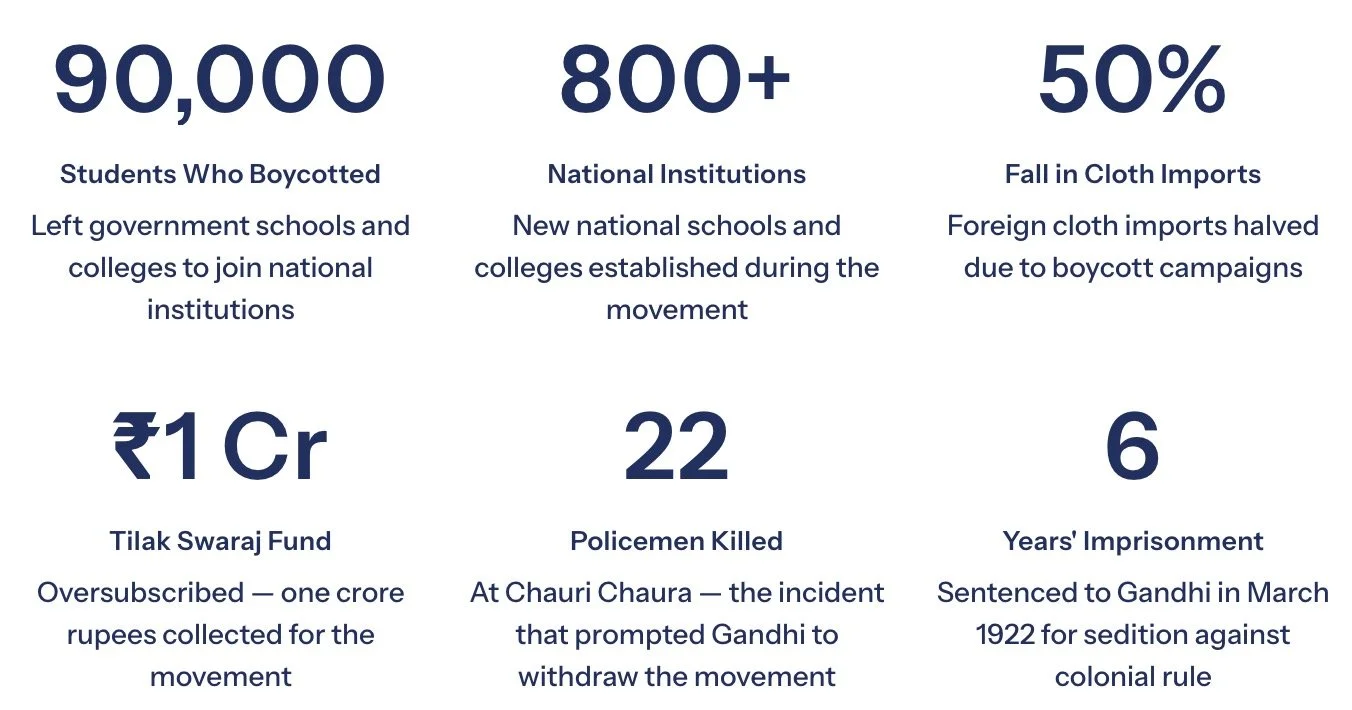
About 90,000 students left government schools and colleges. Around 800 national schools and colleges were established, including Jamia Millia (Aligarh), Kashi Vidyapeeth, Gujarat Vidyapeeth and Bihar Vidyapeeth, led by figures like Acharya Narendra Dev, Zakir Hussain, and Subhash Bose.
Legal Boycott
Distinguished lawyers abandoned their lucrative legal practices, including Motilal Nehru, Jawaharlal Nehru, C.R. Das, C. Rajagopalachari, Vallabhbhai Patel, Asaf Ali, Saifuddin Kitchlew, T. Prakasam and Rajendra Prasad.
Cloth Boycott
Heaps of foreign cloth were burnt publicly in symbolic acts of defiance. Imports of foreign cloth fell by half. Picketing of shops selling foreign liquor and toddy was undertaken widely. The Tilak Swaraj Fund was oversubscribed — one crore rupees collected.
Mass Participation
Congress volunteer corps functioned as parallel police forces. Artisans, peasants, students, urban poor, women, and traders all joined in. Local struggles erupted across the country, including the Awadh Kisan Movement, Eka Movement (UP), Moppila Revolt (Malabar), and Sikh agitation in Punjab.
In July 1921, the Ali Brothers called upon Muslims to resign from the British Indian Army, describing military service as incompatible with their faith. They were arrested in September for this. Gandhi echoed their call, asking local Congress committees to pass similar resolutions. The visit of the Prince of Wales in November 1921 was met with strikes and demonstrations across India, further demonstrating the depth of popular resentment.
Local Movements and Regional Struggles
The Non-Cooperation Movement was not a monolithic, centrally-directed campaign — it ignited a host of localised struggles across different regions of India, each rooted in specific local grievances but connected to the larger anti-colonial framework provided by Gandhi and Congress. These regional upsurges demonstrated the movement's extraordinary capacity to absorb and channel diverse forms of discontent.
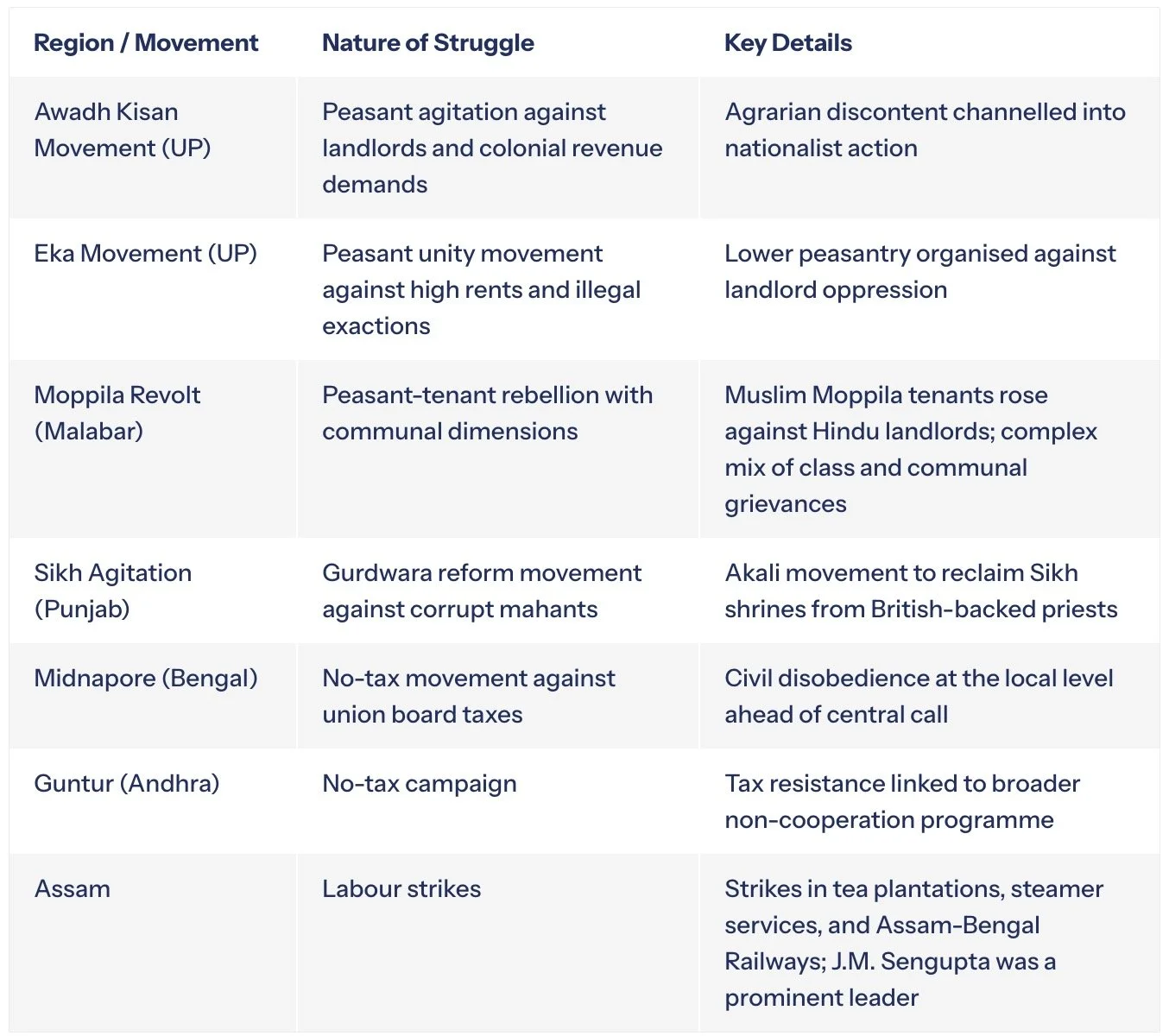
Local Movements and Regional Struggles
These diverse local movements demonstrated that the Non-Cooperation Movement had genuinely penetrated the social fabric of Indian society. While Gandhi and Congress provided the overarching ideology and organisational framework, ordinary Indians across every region were willing to take significant personal risks in the cause of national liberation.
Government Response: Repression and Breakdown of Talks
The British colonial government's response to the Non-Cooperation Movement evolved from cautious engagement to outright repression as the scale and intensity of the movement became clear. The government was caught between the need to appear moderate and the impulse to suppress what was rapidly becoming the most serious challenge to British authority since 1857.
Failed Negotiations
Talks between Gandhi and Viceroy Reading broke down in May 1921. The Government demanded that Gandhi urge the Ali Brothers to remove violent passages from their speeches. Gandhi recognised this as an attempt to drive a wedge between him and the Khilafat leaders and firmly refused to comply.
State Crackdown (December 1921)
The Government launched a severe crackdown:
Congress volunteer corps declared illegal
Public meetings banned across the country
The press was gagged and censored
Most major leaders — barring Gandhi himself — were arrested
Despite arrests of leaders like C.R. Das (who presided over the Ahmedabad session from jail), the movement continued, with Hakim Ajmal Khan serving as acting president of the Congress.
The government's strategy of arresting leaders while leaving Gandhi free was calculated — they feared that arresting Gandhi would only intensify the movement. However, by December 1921, with most of the leadership behind bars, Gandhi was under mounting pressure from the Congress rank and file to escalate to full civil disobedience. The Ahmedabad session appointed him the sole authority to decide on the timing of civil disobedience — a moment of extraordinary personal responsibility.
The Chauri Chaura Incident: Turning Point
On 1 February 1922, Gandhi issued an ultimatum to the Government from Bardoli in Gujarat: unless political prisoners were released and press controls lifted, he would launch civil disobedience. The movement seemed poised to enter its most decisive phase. But an incident in a small village in Uttar Pradesh would bring everything to an abrupt and controversial halt.
On 5 February 1922, in Chauri Chaura village in Gorakhpur district, a group of volunteers campaigning against liquor sales and high food prices was attacked by the local police. When a crowd gathered outside the police station to protest, the police opened fire. In retaliation, the enraged crowd set the police station on fire, killing twenty-two policemen.
Gandhi was deeply troubled not just by this isolated incident of violence but by what he perceived as a broader trend of increasingly violent conduct across the movement. He concluded that the people had not yet fully internalised the discipline of non-violence — and without that discipline, escalation to mass civil disobedience would be disastrous.
Gandhi immediately announced the withdrawal of the Non-Cooperation Movement. The Congress Working Committee met at Bardoli in February 1922 and resolved to stop all activities involving breach of law, redirecting energy towards constructive work: popularisation of Khadi, national schools, temperance, Hindu-Muslim unity, and campaigns against untouchability.
Why Gandhi Withdrew: A Strategic and Moral Assessment
Gandhi's decision to withdraw the Non-Cooperation Movement following Chauri Chaura remains one of the most debated decisions in Indian political history. To his followers and critics alike, it appeared baffling — a movement at its peak of popular enthusiasm was suddenly halted because of violence in one remote village. Yet Gandhi's reasoning was deeply considered and rooted in his fundamental philosophy.
Non-Violence Was Non-Negotiable
For Gandhi, Satyagraha without Ahimsa was not Satyagraha at all — it was merely a different form of coercion. He believed that a violent movement would not only be morally bankrupt but would also give the colonial government the justification it needed to deploy its full military and repressive apparatus against the people.
Signs of Fatigue
The movement was also showing signs of exhaustion. Sustaining a mass agitation at peak intensity for over a year is inherently difficult. The government had shown no willingness to negotiate seriously, making a prolonged standoff increasingly untenable.
Disciplinary Message
Gandhi believed that withdrawing the movement — even at enormous political cost — would teach the people and the organisation that Satyagraha required absolute internal discipline. Without that foundation, any future movement would risk becoming uncontrollable.
The reaction within Congress was one of widespread bewilderment and frustration. Leaders including C.R. Das, Motilal Nehru, Subhash Bose and Jawaharlal Nehru openly expressed their disagreement. Motilal Nehru and C.R. Das went on to form the Swaraj Party, rejecting Gandhi's leadership on this issue and choosing to contest elections to the legislative councils from within. In March 1922, Gandhi was arrested and sentenced to six years in prison, delivering his now-famous court statement expressing cheerful submission to the law.
Gandhi's Historic Courtroom Statement
"I am here, therefore, to invite and submit cheerfully to the highest penalty that can be inflicted upon me for what in law is deliberate crime, and what appears to me to be the highest duty of a citizen."
— Mahatma Gandhi, at his trial, March 1922
Gandhi's words in the courtroom transformed his imprisonment into a moral triumph. Rather than defending himself against the charge of sedition, he acknowledged it openly and framed his defiance of colonial law as a sacred duty. This statement was widely published and deeply moved Indians across the country, turning his trial into a platform for the legitimacy of the independence movement itself.
The Power of Moral Authority
Gandhi demonstrated that a political leader need not rely on armed force or institutional power — moral clarity, public transparency, and personal sacrifice could command greater respect and inspire greater loyalty than any conventional political strategy.
Setting a Precedent
Gandhi's willingness to go to jail — and his dignified conduct throughout — set a precedent that many future nationalist leaders would follow. Imprisonment became, in the nationalist tradition, a badge of honour rather than a mark of shame.
Collapse of the Khilafat Movement
Even as the Non-Cooperation Movement was being withdrawn in India, the Khilafat cause — which had provided its immediate impulse — was simultaneously losing its very reason for existence. A series of dramatic political developments in Turkey itself dissolved the Khilafat question entirely within a few years.
November 1922
Mustafa Kemal Pasha led a nationalist revolution in Turkey, deposing the Sultan of political power and beginning the transformation of Turkey into a modern, secular nation-state.
1923–1924
Turkey was declared a secular republic. A European-style legal system was introduced, extensive rights were granted to women, education was nationalised, and modern agriculture and industries were promoted.
1924: Abolition
The Caliphate itself was formally abolished in 1924 by the new Turkish government. The very institution in whose defence the Khilafat Movement had been launched no longer existed — the movement's central cause had been eliminated from within the Muslim world.
The withdrawal of the Non-Cooperation Movement and the suspension of Satyagraha by Gandhi also drove a wedge between him and the Khilafat leadership. The Ali Brothers criticised Gandhi's extreme commitment to non-violence and eventually severed their ties with him and Congress, joining the Muslim League. However, leaders such as Dr. Ansari, Maulana Azad and Hakim Ajmal Khan remained steadfast supporters of Gandhi and the Congress. The Khilafat leadership fragmented along different political lines — Syed Ata Ullah Shah Bukhari created the Majlis-e-Ahrar-e-Islam with the support of Chaudhry Afzal Haq.
What Did the Movements Achieve?
The Khilafat and Non-Cooperation Movements occupy a complex and contested place in the historiography of Indian nationalism. They were simultaneously a triumph of mass mobilisation and a moment of unrealised potential — movements that transformed Indian politics even as they ended inconclusively.
Achievements
First truly countrywide popular movement — reached every nook and corner of India
Politicised every strata of society: artisans, peasants, students, urban poor, women, traders
Destroyed the myth of colonial invincibility — masses lost their fear of British repression
Demonstrated that mass non-violent resistance could challenge a powerful empire
Brought urban Muslims into the national movement on an unprecedented scale
Created lasting nationalist institutions: national schools, volunteer corps, the CWC
Limitations and Criticisms
The movement communalised national politics to an extent — religious mobilisation had long-term consequences
National leaders failed to raise Muslim political consciousness from religious to secular grounds
Khilafat is regarded as a pan-Islamic, fundamentalist platform largely indifferent to Indian independence per se
Critics see the Congress–Khilafat alliance as a marriage of convenience
The abrupt withdrawal left many activists demoralised and the momentum lost
The movements also shattered two foundational myths of colonial rule. The first — that British rule served Indian interests — had already been demolished by the economic critiques of Moderate nationalists. The second — that colonial rule was invincible — was now directly challenged by Satyagraha and mass struggle. Millions of men and women who had once regarded British authority as unassailable now understood that it could be resisted, questioned, and eventually overcome.
The Scale of the Movement
The Scale of the Movement
